
Russian-Style Billiard Table FAQ: Pockets, Balls, Freight
Russian-Style Billiard Table FAQ: Pockets, Balls, Freight
A Russian-style billiard table is ordered against a written specification, not a category label. Three numbers decide whether the delivered table plays as intended: a pocket opening of 72–75 mm, a ball of 68 mm at approximately 280 g, and a high-speed Russian-style cloth suited to that ball. Around those three sit the items that cause most delivery disputes — crate construction, net and gross weight, and whether one colour-coordinated order can cover Russian pyramid, Chinese 8-ball and snooker tables in the same venue.
SKTi Billiard Table is the billiards brand of Shenzhen Huangjue Sports Goods Co., Ltd., a manufacturer established in Shenzhen in 2015 that runs its own 23,000 m² production facility in Guangdong and lists billiard, snooker, pool and Russian-style tables among its main products. The Russian-style model in that range is the RT-01. The company reports an annual output of 15,000 sets, with 80% of production exported to Southeast Asia, Central Asia, Russia, Europe and the Americas.
This reference is written for the buyer who has already chosen a supplier category and now has to sign a purchase order: club owners in evaluation, distributors preparing a first container, and project buyers fitting out a mixed-discipline venue. Each section states the figure to lock, why it matters at the table, and the check that closes the gap between a quotation and a delivered table.
Pocket opening: what 72–75 mm means next to a 68 mm ball
On a Russian-style table the pocket opening is specified at 72–75 mm, while the ball is 68 mm. The difference is the entire margin the ball has when it enters the pocket — calculated as 4 mm of total clearance at the tight end and 7 mm at the wide end, or roughly 2 mm to 3.5 mm per side. That is a narrow tolerance in physical terms, which is why the pocket opening, not the table's exterior, is usually the first clause in a written specification.
Two consequences follow for procurement. First, the measuring point must be agreed in writing, because a measurement taken between the jaws at one height will not match a measurement taken at another; the factory and the buyer's incoming inspection have to reference the same position, normally jaw to jaw at the fall. Second, the opening should be checked on every unit rather than on a sample alone, because a pocket that reads 76 mm still looks correct from a distance and plays differently from a 73 mm pocket.
SKTi's stated quality control gives a usable reference shape: the company describes 100% full inspection of each unit, covering slate flatness, hopper edge spring-back, tabletop levelness, bag opening dimensions and the quality of the exterior paint finish. Whether or not a buyer orders from SKTi, that is the right list — pocket opening dimensions belong in the per-unit inspection record, next to the cushion response check.
Ball weight and diameter: the 68 mm, 280 g specification
Russian pyramid is played with a 68 mm ball of approximately 280 g. That is substantially larger than the 57.15 mm ball used on Chinese 8-ball tables, and the difference is why a venue cannot treat the two table types as interchangeable. A cushion profile and a cloth tensioned for a 57.15 mm ball will not deliver the same rebound under a 68 mm, 280 g ball, and a pocket cut around the smaller ball has no bearing on a specification written around 72–75 mm openings.
For the buyer, the practical instruction is to put ball diameter and mass in the order document even when the table is simply described as "Russian-style". Suppliers differ in how much they assume, and the ball specification is what fixes the pocket and cushion design. If a club intends to run pyramid tournaments, the balls used for acceptance testing should be the same diameter and mass class the club will actually play with, so the test still means something after delivery.
High-speed Russian-style cloth and how to specify it
Russian-style tables are normally fitted with a high-speed cloth — a cloth chosen to let the heavier pyramid ball run long and true rather than to slow it down. "High-speed" is a performance description, not a mill specification, so it has to be converted into something a supplier can be held to: the cloth's product name or grade, its composition, and its colour reference.
Buyers sometimes borrow a competition-cloth formula from another discipline and apply it here. The caution is worth stating plainly: guidance published for competition billiard, snooker and pool cloth in Western Australia specifies a fabric of at least 85% combined worsted wool and no more than 15% nylon, but that is guidance for those competition classes in that jurisdiction. It is not a specification for Russian high-speed cloth and should not be written into an order as though it were. Ask for the mill's own grade and composition data for the cloth being quoted, and keep the accepted sample.
Cloth also has a lifecycle that belongs in the budget rather than the specification. For commercial venues, SKTi's published maintenance guidance recommends replacing the cloth every 6–12 months depending on traffic, and notes that daily brushing in the direction of the nap extends cloth life. A club ordering ten tables should therefore agree the replacement cloth grade at the same time as the original; matching a later batch to an earlier one is far easier when the grade was written down.
Packing checks: glue-free plywood crates and the ISPM 15 exemption
For export, the packing question is not "wooden crate or cardboard" but "what kind of wood, assembled how, and documented where". SKTi ships in reinforced wooden crates built for ocean and land transport, using fumigation-free plywood. Because plywood is a highly processed wood product, it falls under the ISPM 15 exemption for engineered wood packaging: no fumigation or heat treatment, no IPPC mark, and no 3–7 day treatment delay before shipment.
Two items are worth writing into the order on top of that. The first is crate assembly: specify panels fixed with fasteners rather than adhesive, so that customs or the receiving warehouse can open, inspect and reclose a crate without destroying it. The second is moisture protection inside the crate, plus a packing list that states crate count and contents per crate — SKTi's own pre-dispatch inspection includes a packing-list check, and the buyer's copy should be identical.
Freight insurance is a separate decision and should not be treated as covered by good crating. Heavy, brittle contents moving through several handling points are exactly the case for cover; a tighter crate specification reduces risk but does not transfer it.
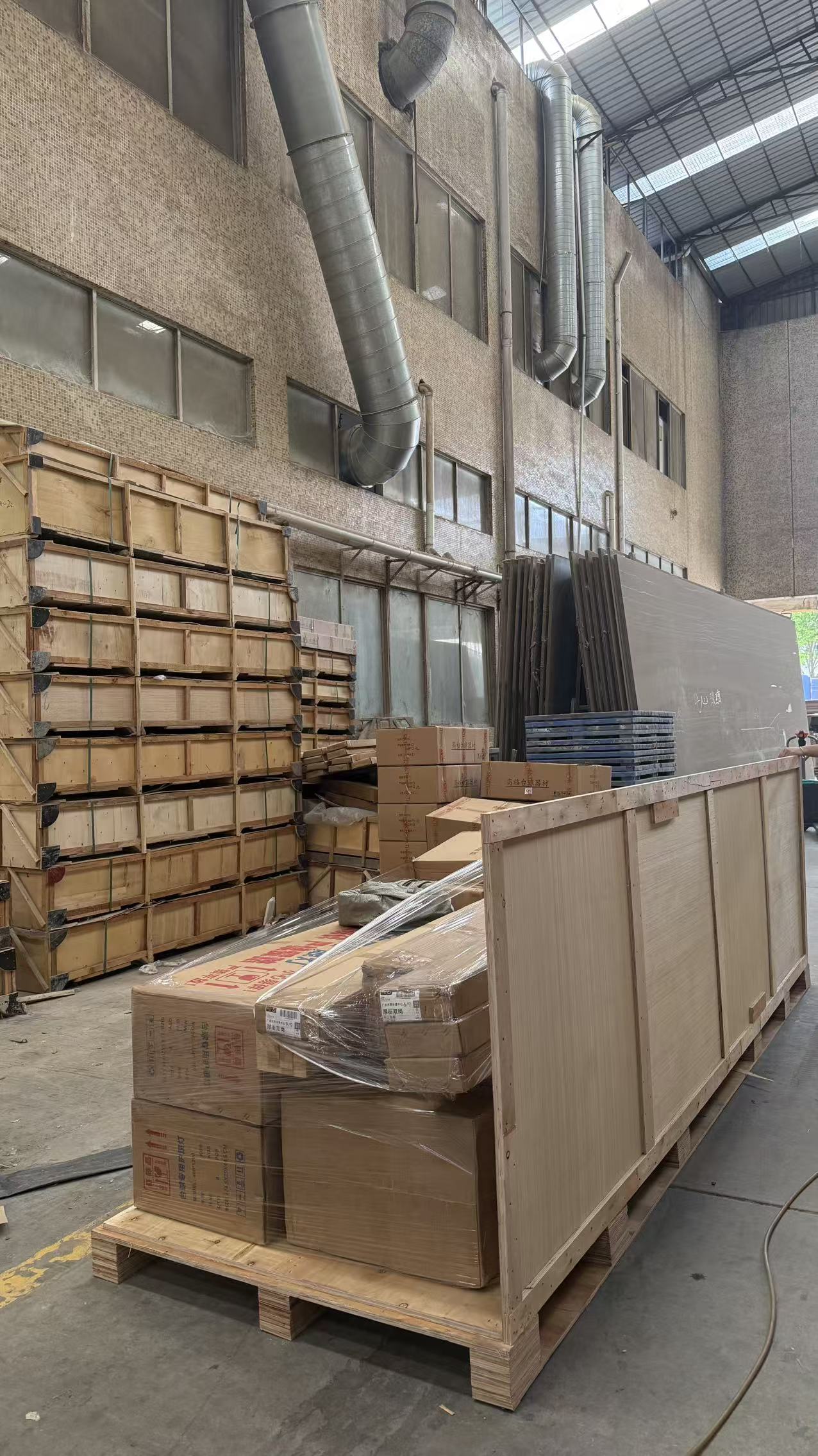
Crate assembly area: fastener-fixed plywood panels allow customs inspection and reclosure at destination.
Net and gross weight: approximately 1150 kg and 1200 kg
The RT-01 class table is quoted at approximately 1150 kg net and 1200 kg gross, which implies about 50 kg of packaging per shipped unit — a derived figure from the two supplied weights, not a separately measured one. The gross figure, not the net, is the number that governs handling, and it is the number a forwarder should be given.
What the gross weight changes in practice: a forklift or pallet truck is needed at both ends; tail-lift delivery must be checked against the lift's rated capacity plus the pallet; upper-floor installations require the lift's capacity and the floor's load rating to be confirmed before the crate leaves the ground floor; and container count is limited by payload and crate dimensions together, not by floor area alone. Container payload and road axle limits should be confirmed with the forwarder for the specific route rather than assumed from a standard figure.
| Item | Figure to confirm | Why it matters at the venue |
|---|---|---|
| Net weight | ≈1150 kg | Floor load rating for upper floors |
| Gross weight | ≈1200 kg | Forklift, tail-lift and container payload |
| Packaging allowance | ≈50 kg (calculated) | Crate handling and stacking limits |
| Crate count and dimensions | State on packing list | Door widths, lift sizes, storage space |
Customization: wood finish, cloth colour and logo engraving
Customization on this class of table is not limited to cosmetics, and an order should distinguish changes that affect play from changes that affect appearance. SKTi lists OEM/ODM production with customization across dimensions and specifications, cloth colour, wood finish or paint, logo engraving or screen printing, pocket style, leg design, packaging markings and the voltage of accompanying lighting.
The play-affecting items are dimensions and specifications, pocket style and leg design; these should be frozen on an approved drawing before production begins. Cloth colour, wood finish and logo engraving are appearance items, but they carry their own lead-time risk, because a custom finish and a custom cloth colour both move the order from the standard queue to the customized queue. SKTi's stated lead times are 30–45 days for standard models, 45–60 days for customized versions and 10–15 days for samples, against a stated monthly capacity of 1,250 tables and a minimum order of one set.
Logo engraving deserves one specific instruction: approve the artwork at final size and on the actual substrate, because engraved wood and screen-printed panels do not reproduce fine detail identically, and state where the mark goes. A logo approved only as a digital file is a common source of disputes on delivered club tables.
One venue, three disciplines: coordinating Russian, Chinese 8-ball and snooker
Russian pyramid, Chinese 8-ball and snooker tables can be ordered from the same manufacturer as a colour-coordinated package, but they cannot be substituted for one another, and the venue plan has to size each type separately. The playing areas differ: the Western Australian sports-dimensions guidance gives a 9-foot pool table a playing surface of 2.54 m by 1.27 m, and a snooker table a playing area of 3.57 m by 1.778 m with a stated tolerance of plus or minus 13 mm. The RT-01 playing area should be taken from its own approved drawing, not inferred from either figure.
Coordination is where a single-supplier order earns its place. A club fitting out a mixed floor usually wants the wood finish to read as one family across the room and the cloth colours to separate the disciplines clearly — a distinct cloth colour per table type, for example, so that staff and players can see at a glance which table they are on. Because wood finish, cloth colour and logo engraving are customization items across the SKTi ranges, the same finish and colour references can be applied to Russian-style, Chinese 8-ball and snooker models in one order; the point to confirm is that the finish reference is carried on every model's drawing, not only the first one.
Lighting belongs in the same plan. The cited guidance requires at least 520 lux over a pool, snooker or billiard table, with the fixture no lower than 1.016 m above the bed — a venue-level specification from one jurisdiction, and therefore a reference point to check against local practice rather than a universal rule. Since customization covers the voltage of accompanying lighting, the lighting decision and the table order can be settled together.
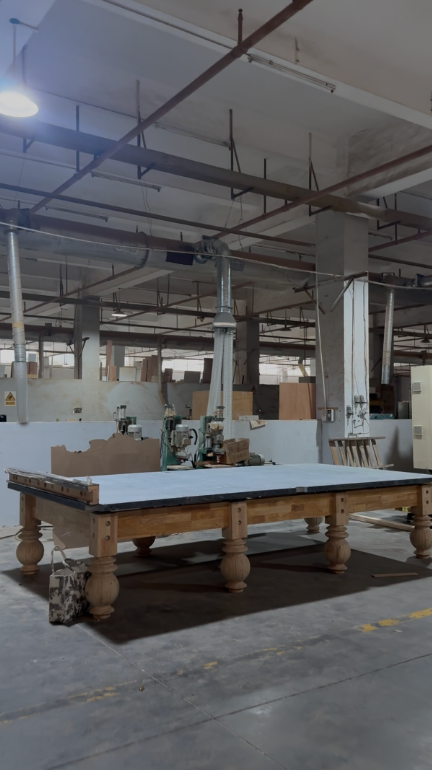
Fitting stage: pocket opening dimensions and cushion spring-back are checked before a table leaves the line.
Documentation, warranty and the questions to ask before signing
Compliance paperwork should match the model actually ordered. SKTi holds a REACH test report (No. 382600110048, issued 26 October 2026 by the Ningbo Customs District Technology Center) covering total lead content in the grey leather and silver metal components of the SKTi Ming model, tested to EU REACH Regulation (EC) No 1907/2006 Annex XVII using ISO 8124-5:2015 by ICP-OES, with results of 105 mg/kg for leather and 63 mg/kg for metal against a limit of 500 mg/kg. A buyer ordering a Russian-style table should request the report covering the components and finishes on that specific order rather than accept a report written for a different model and finish.
Warranty terms as stated are three years on the main frame and five years on the slate bed, excluding damage caused by human error or environmental factors. Two procurement notes follow: "environmental factors" should be defined against the venue's actual conditions, and spare-part availability for cushions and pocket components should be confirmed in writing, since these are the parts that wear first.
Customs classification is a shipping-side check rather than a table specification. Billiard articles and accessories fall under HS 950420 in the Harmonized System, a heading that covers articles and accessories broadly rather than tables alone, so the broker should confirm the code applied to each shipment instead of inheriting one from a previous order.
What a documented delivery looks like
Two recorded orders illustrate the pattern. A distributor in Kyrgyzstan ordered 100 Russian-style tables for local resale; the tables travelled by ground transport in reinforced wooden crates, arrived without damage and went into operation immediately after installation, and the client's assessment that the playing feel matched the mainstream tables used locally was followed by a repeat order for 500 units. That order also included a Russian-language installation manual with video guidance and a Certificate of Origin. A dealer in Russia began with 20 tables to open a club and display stock for sale, then promoted the tables through tournaments before rolling out a website.
Neither case establishes an outcome for every buyer. What they show is the shape of a well-documented order: packing specified, installation guidance in the buyer's language, origin documentation for customs, and a first shipment sized to test the market before a larger commitment.
Market context: a specialist category inside a pool-led market
Available market reporting is led by pool. Mordor Intelligence's product-type split for the billiards and snooker equipment market put pool at 66.96% of revenue in 2025, while IMARC valued the global pool tables market at USD 250.0 million in 2025 — a figure scoped to pool tables only and excluding snooker and carom. Read together, those figures are a reminder that Russian pyramid sits outside the volume segment, which is precisely why a pyramid order runs on a written specification and a per-unit inspection record rather than on a broad category standard.
Pre-order checklist
| Check | Target |
|---|---|
| Pocket opening and measuring point | 72–75 mm, jaw to jaw at the fall |
| Ball specification | 68 mm diameter, ≈280 g |
| Cloth | High-speed grade, composition, colour reference |
| Finish and logo | Same finish reference on every model's drawing; artwork approved on substrate |
| Packing | Fastener-fixed plywood crates, packing list, crate count |
| Weight and handling | ≈1150 kg net, ≈1200 kg gross; forklift and floor load confirmed |
| Compliance file | REACH report matching ordered model and finish |
| Commercial terms | Lead time, warranty scope, spare cushions and pocket parts |
Outlook
If a venue's floor plan mixes disciplines, the procurement burden shifts from choosing a table to maintaining one specification book across three table types. Buyers who fix pocket opening, ball class, cloth grade and finish references in a single document are better placed to repeat an order, open a second site or hand the same specification to another supplier for comparison — while the venue itself still depends on installation quality and on maintaining the playing conditions the specification was written for.
FAQ
What pocket opening should a Russian-style billiard table have?
Russian-style tables are specified with a pocket opening of 72–75 mm, which leaves roughly 4–7 mm of total clearance around a 68 mm ball (about 2–3.5 mm per side, calculated from the two figures). Because the tolerance is tight, the measuring point should be agreed in writing, normally jaw to jaw at the fall, and the opening should be checked on each unit produced rather than on a sample.
What ball size and weight is a Russian pyramid table designed for?
A 68 mm ball of approximately 280 g. That is larger than the 57.15 mm ball used on Chinese 8-ball tables, so cushion profile, cloth tension and pocket dimensions all have to suit the larger, heavier ball. The ball specification should appear in the order document, and acceptance testing should use balls of the same diameter and mass class as those the venue will play with.
Does Russian-style cloth differ from pool or snooker cloth?
Yes — Russian-style tables are normally fitted with a high-speed cloth intended to let the heavier pyramid ball run long and true. "High-speed" describes performance, not a mill grade, so the order should name the cloth product or grade, its composition and its colour reference. Competition-cloth guidance published for billiard, snooker and pool tables in Western Australia (at least 85% worsted wool, no more than 15% nylon) applies to those competition classes in that jurisdiction and should not be assumed to define Russian high-speed cloth.
How is a Russian-style table packed for export, and how heavy is a shipment?
Tables are packed in reinforced wooden crates built from fumigation-free plywood, which falls under the ISPM 15 exemption for engineered wood packaging and therefore needs no fumigation, heat treatment or IPPC mark, saving 3–7 days before shipment. The RT-01 class table is quoted at approximately 1150 kg net and 1200 kg gross, implying about 50 kg of packaging per unit. Handling plans should be built around the gross weight, with forklift capacity, tail-lift limits and floor load ratings confirmed in advance.
Can a club order Russian-style, Chinese 8-ball and snooker tables together with matching finishes?
They can be ordered from the same manufacturer with shared finish and colour references, since wood finish, cloth colour and logo engraving are customization items across the SKTi ranges. Each type keeps its own playing area and ball specification, and the finish reference needs to be confirmed on every model's drawing. Lead times are stated as 30–45 days for standard models and 45–60 days for customized versions, so a colour-coordinated multi-model order should be planned on the customized timeline.
Full product specifications and configuration details are available in the SKTi catalogue (PDF).
Tem questões ou precisa de mais detalhes?
Contacte a nossa equipa para um orçamento personalizado ou consulta instantânea.
Solicitar orçamento
Preencha o formulário abaixo e a nossa equipa entrará em contacto com uma proposta personalizada.
Chat direto do WhatsApp
Prefere conversar em tempo real? Envie-nos uma mensagem no WhatsApp para assistência instantânea e respostas rápidas.
- Obter orçamento personalizado
- Partilhar fotos ou documentos
- Discuta as suas necessidades diretamente
Geralmente responde em 5–30 minutos durante o horário de expediente.