
Russian and French Wall Sockets: H129, A129 and VC139
Flush-mount socket schedules that serve Russian-format and French-format markets rarely fail on electrical function. They fail at the wall — where two socket formats, two panel modules and one tiling sequence have to be reconciled before the first box is set. H129, A129 and VC139 are all 1-gang flush-mounted mechanical wall sockets, and none of them is a substitute for the other two in a drawing.
This shortlist compares the three models on the criteria that decide a project order: the socket format the client's appliances need, the panel module the wall and the tiling can accept, the stated rating, and the documentation a buyer must hold before release. H129 and A129 are Russian-format sockets separated by panel geometry alone — 86 × 86 mm against 81.6 × 81.6 mm. VC139 is the 1-gang French-format socket in an 86 × 86 mm panel, stated at 16 A / 220–250 V~. Because the plate is the component the client sees, the installer aligns and the tiler finishes around, the panel module carries more decision weight than its few millimetres suggest.
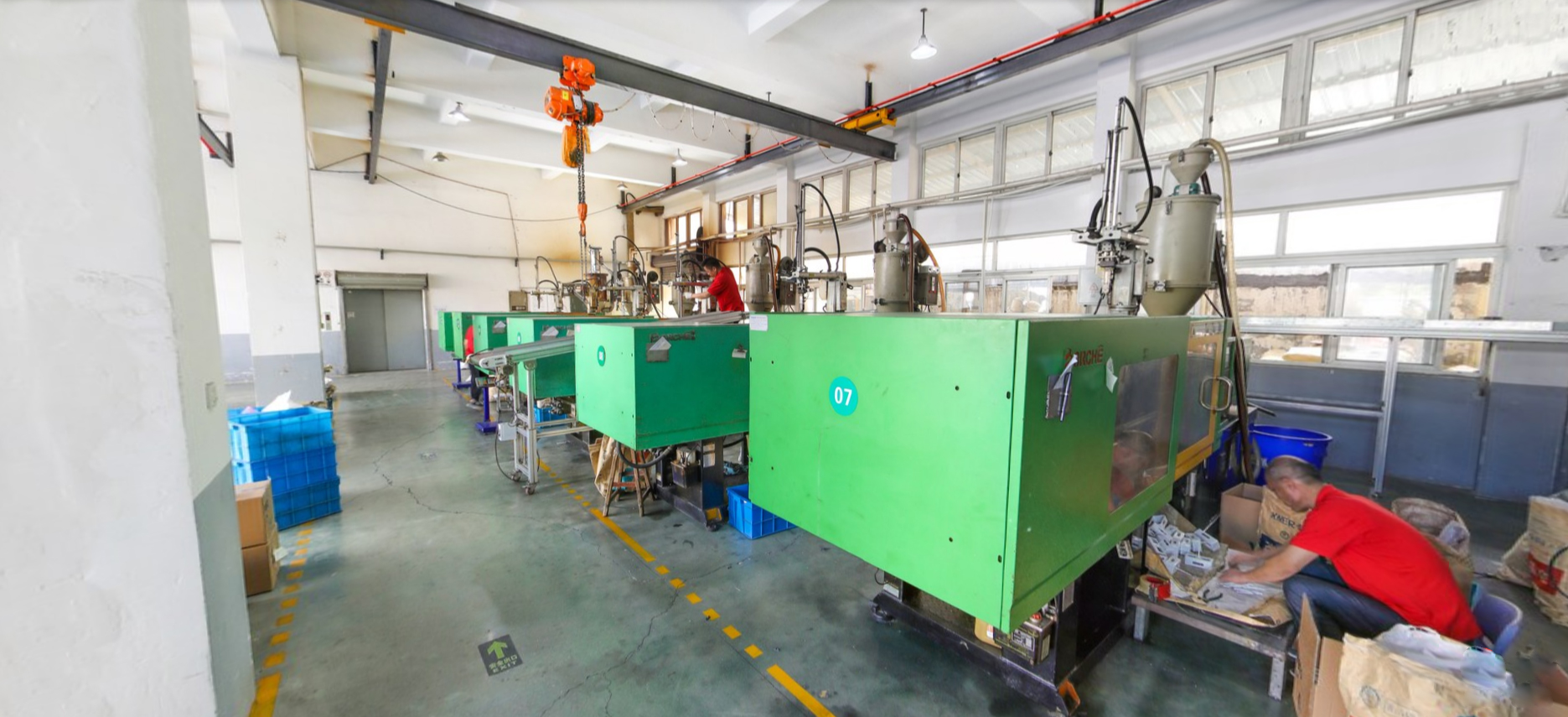
Injection moulding of socket plates and housings. Panel-module standardisation is decided at tooling level, long before a project schedule is written.
Why Two Socket Formats in One Schedule Become a Procurement Decision
Russian-format and French-format outlets increasingly coexist inside the same building rather than in separate ones. Apartments marketed to CIS buyers, hotels with mixed guest nationalities, serviced offices leased to French-speaking tenants, and cross-border residential developments all produce a schedule in which two plug standards sit on the same floor plate.
The electrical intent in both cases is identical: a single-gang wall socket, flush-mounted, mechanically switched at the contact level rather than electronically. What differs is the interface the plug sees and the plate the wall sees. Procurement teams that treat the two formats as one line item usually discover the distinction late — after cutouts are set and tiles are laid — at which point the only remaining options are adapters or rework.
A second, quieter pressure is inventory. Every additional plate module in a project means a separate spare-part line, a separate cutout dimension and a separate finishing instruction for the installer. Reducing the number of modules is often worth more to a contractor than reducing the number of models.
The Shortlist at a Glance
| Model | Socket format | Gangs | Panel size | Mounting | Stated rating |
|---|---|---|---|---|---|
| H129 | Russian format | 1 | 86 × 86 mm | Flush-mounted | 16 A / 220–250 V~ (confirm on current datasheet) |
| A129 | Russian format | 1 | 81.6 × 81.6 mm | Flush-mounted | 16 A / 220–250 V~ (confirm on current datasheet) |
| VC139 | French format | 1 | 86 × 86 mm | Flush-mounted | 16 A / 220–250 V~ |
All three models share a flush-mounted mechanical wall socket classification: the switching and contact functions are mechanical, with no integrated smart module, USB charging circuit or wireless control. Panel dimensions and the VC139 rating are stated in the product brief; buyers should confirm the rated current and the certification documents for the specific model and order before release.
Read as a set, the table answers one question immediately and leaves another open. It answers which model carries the French interface: only VC139. It leaves open which Russian-format model a project should standardise on, because H129 and A129 are electrically equivalent in format and differ only in the plate. That is a site and finishing question, not an electrical one — and it is where most of the evaluation effort should go.
H129 and A129: One Format, Two Panel Modules
H129 and A129 are the same product concept expressed at two plate dimensions. Both are 1-gang Russian-format flush-mounted sockets; both are specified where the socket interface, not the plate, is the functional requirement. The distinction is 4.4 mm per side: 86 mm against 81.6 mm.
On a single isolated socket, that difference is invisible in use and barely visible on a wall. It becomes consequential in three situations.
1. Runs and alignment
Where several plates sit side by side along a worktop, a headboard wall or a hotel desk, alignment is read as a horizontal line. Mixing an 86 mm plate with an 81.6 mm plate in the same run produces a step in that line. The step is small but deliberate-looking, and clients interpret it as an installation error rather than a specification choice. A run should therefore be standardised on one module.
2. Cutout tolerance
A flush-mounted plate must cover the opening in the finished wall with a margin on every side. The larger 86 mm plate leaves more tolerance around a given cutout; the 81.6 mm plate leaves less. On hand-cut plasterboard or on stone and tile where the opening is set by a fabricator, that tolerance margin is the difference between a clean cover and a visible gap. Where cutout precision cannot be guaranteed, the larger module is the lower-risk choice — provided the wall composition and the box depth support flush installation at all.
3. Retrofit direction
Replacement in an existing opening is not symmetrical. Moving from a smaller plate to a larger one is generally the workable direction, because the larger plate can still cover the original opening if the box and fixing centres allow. Moving from a larger plate to a smaller one is the harder direction, because the smaller plate must cover the same opening without leaving an exposed edge. Whether a specific A129 substitution works in a specific 86 mm opening depends on the actual cutout and plate edge, and that check belongs on the drawing — not on the assumption that both are Russian-format sockets.
The practical consequence for buyers is that A129 is a deliberate specification, not a default. It is chosen where the project has an established 81.6 mm plate grid, where a matching accessory family already uses that module, or where a design intent calls for the smaller plate. H129 is chosen where the schedule is new and plate tolerance is worth more than compactness.
VC139: The French Format Inside an 86 mm Module
VC139 is the 1-gang French-format wall socket in this shortlist, with an 86 × 86 mm panel and a stated rating of 16 A / 220–250 V~. Two facts about it matter more than any other in a mixed-format project.
The first is function: VC139 is the only model here that provides the French socket interface, so any room requiring French-format outlets takes this model regardless of plate considerations.
The second is geometry: VC139 shares the 86 mm module with H129. That is not a cosmetic detail. It means a wall carrying both Russian-format and French-format outlets can be planned on a single plate grid without a visible size step between the two formats. In a hotel corridor where one room takes a Russian-format socket and the next takes a French-format socket, that consistency is what the client actually perceives. A schedule that pairs VC139 with A129 loses that advantage and reintroduces the step the module choice was meant to remove.
Buyers should still verify plug compatibility against the plug standard actually used on site rather than relying on the format name alone, and should confirm that the 16 A / 220–250 V~ rating matches the circuit protection and cable sizing in the electrical design.
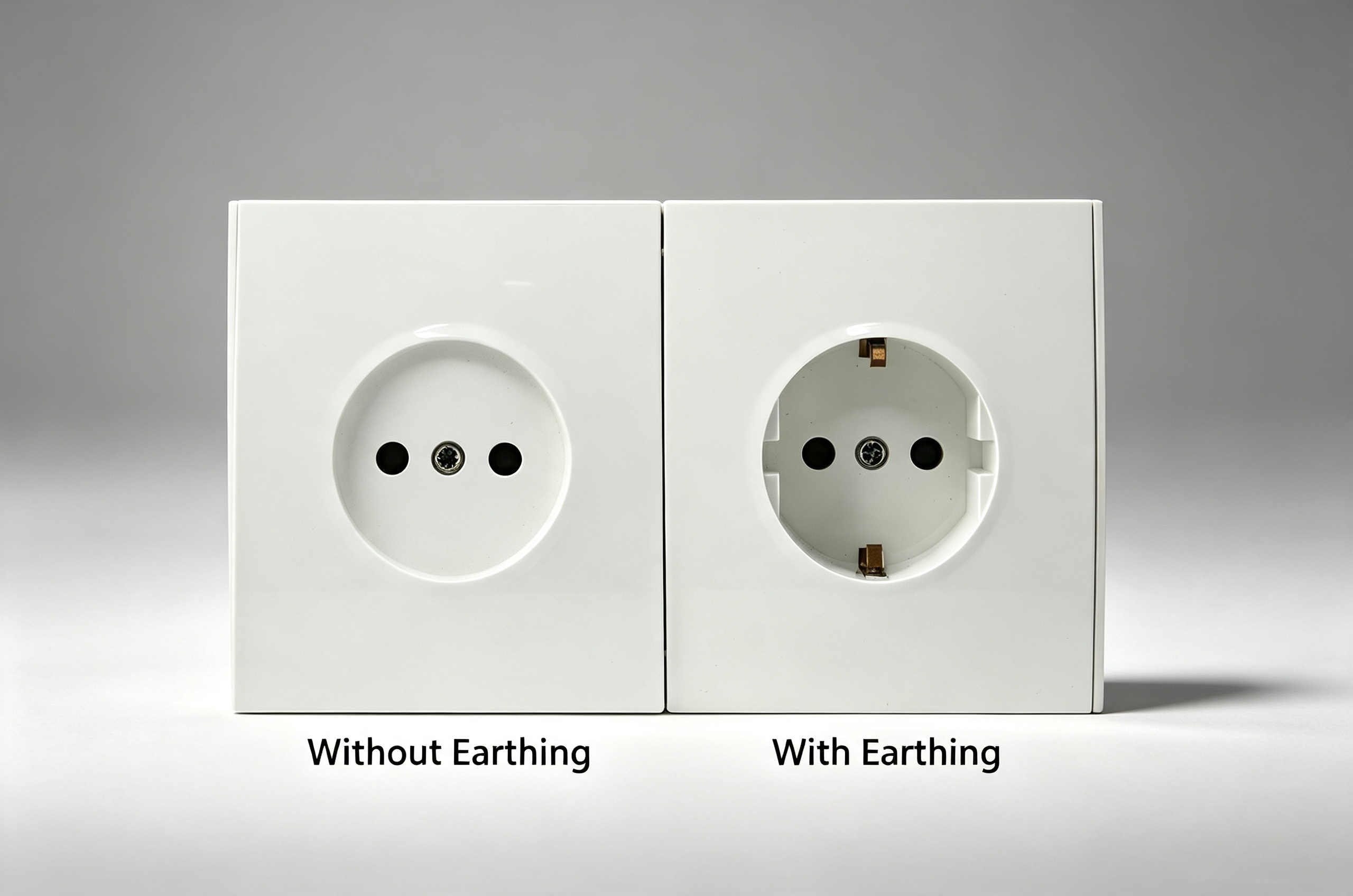
Wiring methods compared: a grounded socket-outlet provides live, neutral and protective earth, while a basic ungrounded socket provides live and neutral only. Earthing provision governs which appliances a socket can safely serve.
Rating, Earthing and the 16 A Question
The 16 A / 220–250 V~ figure recorded for VC139 is the rating band this shortlist is built around, and it aligns with the general requirement level of IEC 60884-1:2022, which covers plugs and socket-outlets for household and similar purposes and is limited to 16 A for screwless terminals. That alignment matters at tender stage: a 16 A socket is the ordinary specification for general-purpose circuits, not a heavy-duty claim.
Earthing is the variable that changes the safety case. A grounded socket-outlet provides three electrical connections — live, neutral and protective earth — and offers grounding protection for Class I appliances. A basic ungrounded socket typically provides only two connections, live and neutral. The difference is not a marketing distinction: it determines whether Class I equipment can be connected at all without an alternative protective measure, and it drives the installation and inspection requirements for the whole circuit.
Wall socket risk in real installations concentrates in a short list of failure modes: electrical overload, loose wiring, poor contact between plug and socket, grounding failure, and prolonged high-power use. Each of these can produce overheating, electrical arcing, electric shock or damage to the socket itself. Control is engineered rather than asserted — through socket contact design, terminal and grounding design, copper components sized for the rated current, and flame-retardant materials, verified by temperature-rise, insertion-life, grounding-continuity, dielectric-strength, insulation and electrical-load testing. Buyers evaluating any shortlist should ask which of these tests are performed per production batch and which are type tests held on file.
Where Each Model Fits
- H129 — Russian-format residential and hospitality rooms on a new schedule. The 86 mm plate gives the widest tolerance margin around hand-cut or fabricated openings, and it keeps the wall line consistent when combined with 86 mm French-format outlets.
- A129 — Russian-format projects with an established 81.6 mm plate grid. Best used where a matching accessory module already governs the design, or where the schedule is fully controlled and cutout precision is assured.
- VC139 — French-format rooms anywhere in the building. Required wherever the French socket interface is specified; its 86 mm panel makes it the natural partner to H129 on shared walls.
In mixed developments the most common configuration is not a choice between the three models but a pairing: H129 plus VC139 on a common 86 mm grid, with A129 held as a targeted exception for areas that already use the smaller module. That pairing reduces the number of cutout dimensions on site to one while still serving both plug standards.
Market Context: Modularity Rewards Plate-Level Decisions
The direction of the category supports this way of specifying. Modular sockets accounted for 43% of total wall socket sales in 2024, according to Fortune Business Insights, a share attributed to space-saving and customisation trends. When nearly half the market is modular, the plate module stops being an accessory detail and becomes a primary specification field.
Scale reinforces the point. Precedence Research values the global electric plugs and sockets market at USD 14.13 billion in 2025, while market reporting linked to Grand View Research records global wall socket production above 3.1 billion units in 2024, with China as the leading producer. Scope definitions differ between these estimates — industrial-only versus combined residential and industrial — so the figures are best read as an indication of scale rather than as a single consistent market size. For a buyer, the useful signal is not the number itself but what it implies: with production at that volume, format and module variants are abundant, and the risk shifts from availability to selection error.
Standardisation pressure runs in the same direction. IEC 60884-1:2022 provides the current general requirements for plugs and socket-outlets for household and similar purposes, and 16 A-rated socket-outlets such as these sit squarely inside its scope. Where a project spans several markets, referencing one general standard alongside the national plug-format requirement keeps the technical file coherent.
Comparison with Traditional Alternatives — and Where This Shortlist Stops
Three common alternatives are worth measuring against the shortlist, because each solves a problem the shortlist does not.
Basic ungrounded sockets have a simpler structure and lower cost, and generally lower material and structural costs follow from the absence of grounding components and the associated safety requirements. For double-insulated, low-power devices in applications permitted by local standards, they remain a legitimate choice. They are not a substitute where Class I appliances require protective earthing, and they should never be used to reduce cost inside a circuit designed around earthed outlets.
Surface-mounted sockets avoid the back-box and finished-wall dependency that flush mounting creates. In a retrofit where the wall is already finished and cannot be opened, surface mounting is often the only rational option. The trade-off is projection and appearance: surface accessories change the wall line and are rarely accepted in finished hotel, residential or retail interiors.
Format adapters and converted plates allow a plug standard to be served without changing the installed socket. They introduce an additional interface and an additional mechanical connection, and they are normally treated as a temporary measure rather than a specification.
The limits of this shortlist itself should be stated plainly, because they decide whether it is the right shortlist at all.
- Mechanical only. None of the three models includes USB charging, Wi-Fi, Zigbee, Bluetooth mesh or app-based timing. A project that needs integrated charging or remote control must add a separate device or select a different range; specifying H129, A129 or VC139 does not deliver those functions.
- Single-gang only. All three are 1-gang products. Multi-gang positions are achieved through multiple boxes and plates, not through a wider variant in this shortlist.
- Flush mounting is a construction dependency. These models assume a recessed box and a finished wall that accepts a flush plate. They are not a solution for surface wiring, shallow chases or walls that cannot be opened.
- Module mixing has a visible cost. Pairing an 86 mm plate with an 81.6 mm plate on one run produces a step. If uniformity is the design intent, the schedule must commit to one module rather than optimising each position individually.
- Panel size is not a compliance argument. Plate dimensions say nothing about certification for a specific order, and the technical file must be verified separately for each model and each destination market.
A Decision Framework for Buyers
| Decision point | Question to settle | Why it decides the model |
|---|---|---|
| Plug standard | Which plug standard do the room's appliances and guests actually use? | Determines Russian format (H129 or A129) versus French format (VC139). |
| Plate module | Is an 86 mm or an 81.6 mm grid already established on the project? | Decides between H129 and A129 and prevents a mixed-module wall line. |
| Cutout precision | Who cuts the opening, and to what tolerance? | Smaller plates leave less margin; hand-cut openings favour the larger module. |
| Circuit design | What current and voltage does the design assume, and is earthing required? | Aligns the socket rating and earthing provision with the protective device and cable sizing. |
| Wall construction | Is a recessed box possible, and what finished wall thickness applies? | Flush mounting is only viable where the construction allows it. |
| Spares and continuity | How many modules and models must be held for maintenance? | Fewer modules means simpler long-term stock and consistent replacement. |
| Documentation | Which certificates, test records and drawings are required at handover? | Determines what must be requested with the purchase order, not after delivery. |
Supply and Verification Behind the Shortlist
Wenzhou Huafeng Electric Co., Ltd. (HYFF) is a Wenzhou-based manufacturer of wall switches and wall sockets, founded in 2011, operating a 7,000 m² factory with 118 employees, an engineering team of 10 and annual output of 35,000,000 units. The company exports its full output, serving markets across Europe, the Americas, Oceania, Asia and Africa. H129, A129 and VC139 sit within that wall socket range.
For a decision-stage buyer, the relevant question is not whether a manufacturer can produce a socket but how the batch is controlled. HYFF's stated control measures address overload, loose wiring, poor contact between plug and socket, grounding failure and prolonged high-power use through socket contact design, terminal and grounding design, copper components sized for the rated current, flame-retardant materials, and testing that includes temperature-rise, insertion-life, grounding-continuity, dielectric-strength, insulation and electrical-load verification. Incoming material inspection, assembly inspection and finished-product sampling run through production, and samples are verified with compatible plugs and functionally tested before mass production. The company holds CE and CB certification issued by BV and Intertek for its wall switches and sockets — certification that should still be checked against the specific model and market on any purchase order.
Future Outlook
Flush-mounted mechanical sockets are a slow-changing product category, and that stability is part of their value in project work. The change that is underway sits at the edges: modular plate systems continue to absorb share because they let a project solve appearance and format separately, and charging interfaces continue to migrate into the wall as USB-C becomes the default connector for portable electronics in the EU. Neither trend removes the need for a correctly specified 1-gang socket — but both push the plate module and the accessory grid earlier into the design conversation.
For projects combining Russian-format and French-format requirements, the practical outlook is consolidation rather than proliferation: one plate module, two socket interfaces, and a schedule that resolves the difference before the wall is closed.
FAQ
What is the difference between H129 and A129?
H129 and A129 are both 1-gang Russian-format flush-mounted wall sockets. The difference is the panel: H129 uses an 86 × 86 mm plate and A129 uses an 81.6 × 81.6 mm plate, a difference of 4.4 mm per side. Because the plate is what the wall and the tiling must accommodate, the two models are chosen by plate module rather than by electrical function.
Can A129 be used in an existing 86 mm opening?
Replacement in that direction is the harder one, because a smaller plate must still cover the original opening without leaving an exposed edge. Whether a specific A129 substitution works depends on the actual cutout and plate edge in that wall, and it should be checked on the drawing or on site rather than assumed. Moving from a smaller plate to a larger one is generally the more workable direction.
What rating does VC139 carry?
VC139 is a 1-gang French-format wall socket with an 86 × 86 mm panel, stated at 16 A / 220–250 V~. That rating sits within the scope of IEC 60884-1:2022, the general requirement standard for plugs and socket-outlets for household and similar purposes, which is limited to 16 A for screwless terminals. Plug compatibility should be confirmed against the plug standard used on site.
Can the three models be mixed within one project?
They can, and mixed-format buildings commonly require it, because VC139 is the only French-format model in the set. The constraint is visual and dimensional: pairing an 86 mm plate with an 81.6 mm plate on the same run produces a visible step. Pairing H129 with VC139 keeps a single 86 mm grid and avoids that step, while A129 is better reserved for areas that already use the smaller module.
What should be verified before placing a flush-mount order?
Four items decide whether the order performs: the plug standard each room actually uses, the plate module already established or intended on the project, the wall construction and cutout tolerance that flush mounting depends on, and the technical documentation — certification, test records and drawings — required at handover. Panel dimensions and stated ratings are inputs to that check, not a substitute for it.
Tem questões ou precisa de mais detalhes?
Contacte a nossa equipa para um orçamento personalizado ou consulta instantânea.
Solicitar orçamento
Preencha o formulário abaixo e a nossa equipa entrará em contacto com uma proposta personalizada.
Chat direto do WhatsApp
Prefere conversar em tempo real? Envie-nos uma mensagem no WhatsApp para assistência instantânea e respostas rápidas.
- Obter orçamento personalizado
- Partilhar fotos ou documentos
- Discuta as suas necessidades diretamente
Geralmente responde em 5–30 minutos durante o horário de expediente.