
Russian vs American vs Chinese 8-Ball vs Snooker: A Buyer's Table Comparison
Russian vs American vs Chinese 8-Ball vs Snooker: A Buyer's Table Comparison
Four table formats dominate commercial billiard floors — Chinese 8-ball, American 9-ball, snooker and Russian pyramid — and for a buyer the decisive differences are not prestige but operating arithmetic: how much floor each table consumes, how many minutes each game occupies it, how often cloth and cushions need attention, and which customers will actually pay to play on it.
This comparison sets the four formats against one another on the dimensions that determine payback in a club, a mall outlet, a hotel entertainment area or a private villa. It draws on SKTi Billiard Table's published format comparisons and product documentation, together with the company's manufacturing and compliance record. The performance and cost ranges quoted here are supplier-reported comparisons of SKTi's own configurations rather than independent laboratory benchmarks; they are most useful as planning inputs to be verified against a specific floor plan, lease and customer mix.
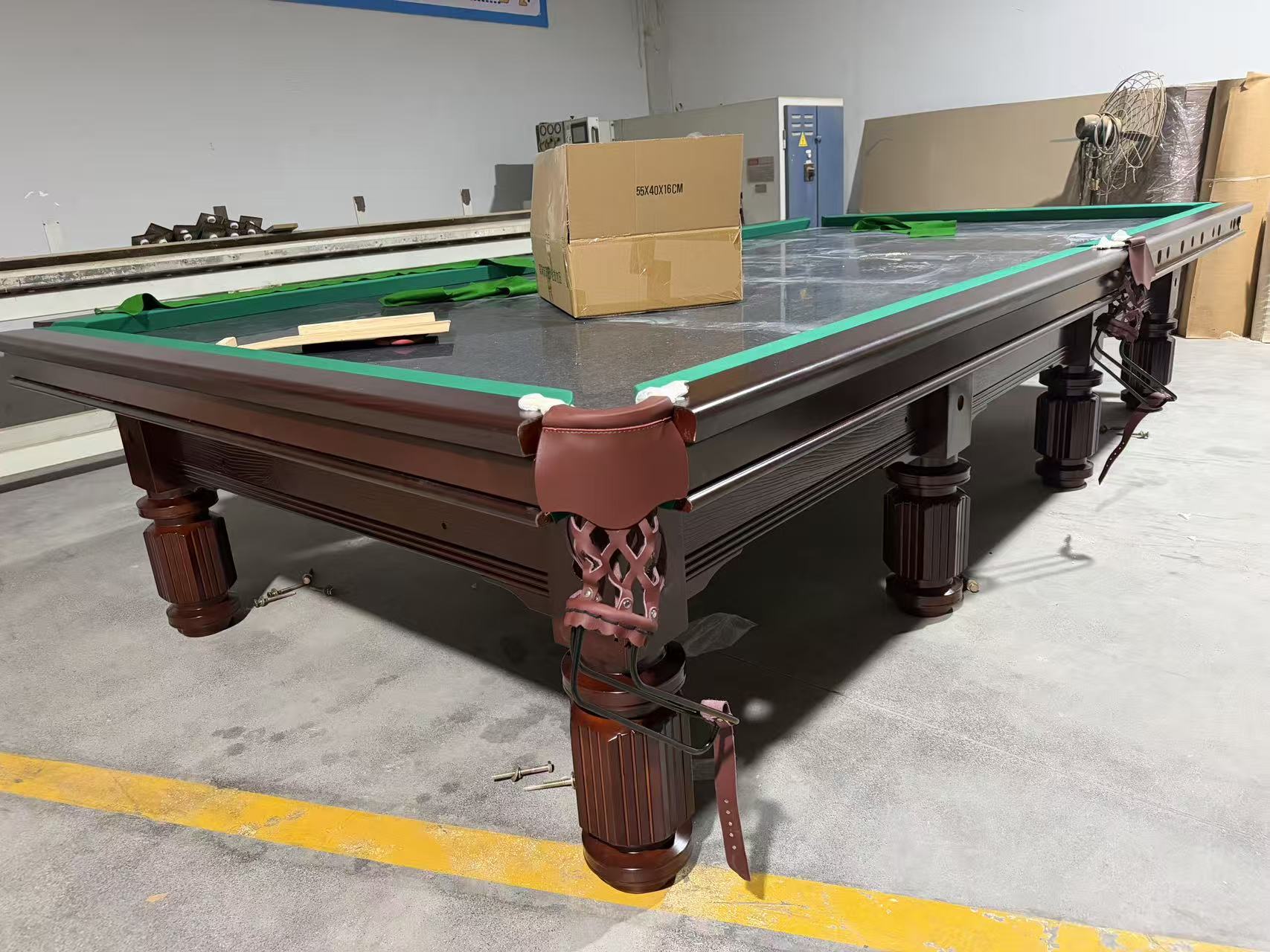
Trial assembly area: commercial table frames are checked for alignment before crating and shipment.
How the four formats actually differ
Chinese 8-ball is played on a table with a playing surface of approximately 2.54 m × 1.27 m — the 9ft format — using 57.15 mm balls, tighter pockets and steel-backed cushions. It is the most prevalent club table type in China, and its playing experience sits between American pool and snooker: more demanding than a loose-pocket pool table, more accessible than a 12ft snooker table.
American 9-ball uses a 9ft footprint but a different specification. Pocket openings are typically 110–120 mm against 85–95 mm on the Chinese-style table, and the cloth runs faster. The result is a more forgiving table that demands less precision from the player, and one better suited to bars and venues that specialise in nine-ball.
Snooker moves to a 12ft table with slower nap cloth. A single frame can last 30–60 minutes, which makes the format a professional-competition product rather than a volume product. Russian pyramid also uses a 12ft table, but with 68 mm heavy balls and extremely tight 72–75 mm pockets; it is a niche format reserved for professional-level competition and a specialist player base.
One construction term recurs throughout any comparison and deserves a plain definition. A steel-cushion table uses a rail framework built from automotive-grade spring steel, which holds its shape and rebound under repeated load. A wooden-cushion table uses a timber framework: cheaper, but liable to absorb moisture and develop inconsistent or dead sections along the rail over time.
Side-by-side comparison
| Format | Playing surface | Ball and pocket | Space footprint | Typical best fit |
|---|---|---|---|---|
| Chinese 8-ball | 9ft, approx. 2.54 m × 1.27 m | 57.15 mm ball; 85–95 mm pockets | Baseline for this comparison | Public clubs, mall venues, franchise chains, neighbourhood shops |
| American 9-ball | 9ft | Larger 110–120 mm pockets; faster cloth | Same 9ft footprint | Bars, nine-ball specialist venues, casual play |
| Snooker | 12ft | Slower nap cloth; 30–60 minute frames | Approx. 29% more than the 9ft layout | Professional halls and tournament venues |
| Russian pyramid | 12ft | 68 mm heavy ball; 72–75 mm pockets | Approx. 47% more than the 9ft layout | Niche professional competition |
Pace of play and the revenue per table-hour question
Format choice changes how often a table can be sold. In SKTi's comparison of its 9ft Chinese 8-ball table against a 12ft snooker table, a game of Chinese 8-ball runs 15–25 minutes against 30–60 minutes for a snooker frame, producing a one- to two-times faster table turnover. On that basis the supplier reports a 30%–40% increase in the average number of games played daily per unit of floor area.
The gap is wider against Russian pyramid. Because the 12ft table consumes roughly 47% more floor for the same unit, the 9ft layout allows close to twice as many tables in the same venue, and SKTi reports a 25%–35% increase in average daily effective usage time per table. It also widens the addressable customer base: a 68 mm ball and 72–75 mm pocket is a professional proposition, whereas a 57.15 mm ball on an 85–95 mm pocket is playable by a first-time customer.
Against the American 9-ball format, the trade-off is different in kind. Both occupy a 9ft footprint, so the floor plan is neutral. What changes is the shot tolerance: the tighter Chinese-style pocket reportedly improves precision by 20%–30% relative to the 110–120 mm American pocket, while the American table is the friendlier option for casual players and nine-ball regulars. A buyer choosing between the two is choosing a customer profile, not a footprint.
Slate, cushions and the parts that decide consistency
The visible difference between a premium table and a budget table is small; the difference that shows up in year three sits under the cloth. SKTi's like-for-like comparison at a single price point sets its 4.5 cm premium bluestone bed and automotive-grade spring steel cushions against the 3.0–4.0 cm stone beds and wooden or thin steel cushions typical of standard tables. The reported slab thickness advantage is 15%–50%, with a 5.0 cm extra-thick option available.
Thickness matters because a thinner slab flexes under its own weight and the support of the frame, which is one route to a ball drifting off line. A 4.5 cm bluestone slab combined with a multi-point levelling system is documented as holding surface flatness deviation within 0.1 mm. Cushion construction affects the other half of the equation: spring steel recovers its shape after impact and is less sensitive to temperature and humidity, while a timber rail that has absorbed moisture deforms irreversibly and produces dead sections.
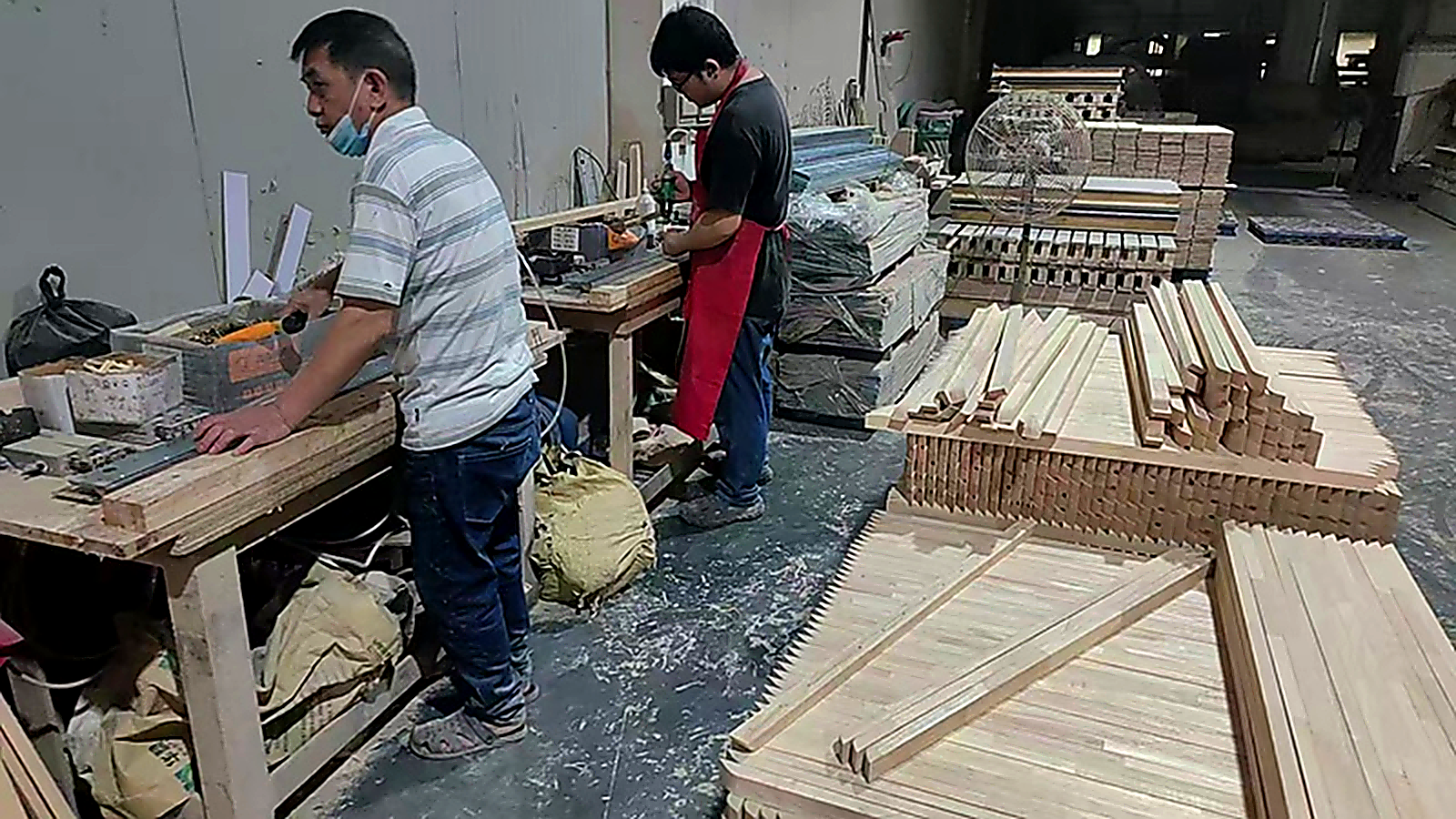
Cushion rail components in production: the steel framework governs rebound consistency across the length of the table.
The measurable claims attached to that specification are rebound consistency deviation of 5% or less, against plus or minus 10%–15% for standard tables, and a three-year failure rate below 2%, against 5%–8%. Those are supplier figures for its own specification tiers and should be read as such; what they establish is the direction of the difference, not an audited field result across all venues.
Installation discipline is part of the same story. SKTi documents a six-step process — component check and floor levelling, frame assembly and rough levelling, laying and seaming the three slate sections, cloth fitting, rail and pocket assembly, then fine levelling and a test play. Two people can complete it in roughly three to four hours, with illustrated guides and video tutorials supplied; moving the slate itself requires at least four people and gloves.
Cost and maintenance: where the ranges come from
Against the 12ft snooker format, SKTi reports procurement savings of 40%–80% for the 9ft Chinese 8-ball configuration, with further savings on rent because less floor is required. Against Russian pyramid, the reported saving is 30%–50% on procurement plus reduced shipping and facility rent. Against the American format, the ex-factory price for an equivalent configuration is reported 10%–15% lower, and the comparison notes that imported American-style tables can cost two to three times as much to procure, which shortens the payback period on the domestic-style option.
At the same price point against standard Chinese 8-ball tables, SKTi reports factory-direct pricing 10%–20% lower, meaning a higher specification for the same budget rather than a cheaper table. None of these figures is a quotation: pricing depends on slate thickness, rail construction and cloth grade, and the company's stated process is to work from a buyer's budget to two or three tailored configuration options, with orders accepted from a single table.
Maintenance follows the same pattern. Steel cushions require no calibration, and parts are interchangeable, which keeps restocking fast. Rubber strips on steel-cushion rails are documented as needing replacement every three to five years; cloth replacement in commercial venues is recommended every 6–12 months, and a daily soft-brush routine along the nap plus weekly deep cleaning with a cloth brush and low-power vacuum is credited with extending cloth life by more than 30%. SKTi reports annual maintenance costs around 30% lower than standard tables, cloth replacement costs 50%–70% lower than the snooker format and 40%–60% lower than the Russian format, and a 48-hour response time. Service life is given as 8–10 years, against 6–8 years for American-made versions and 5–6 years for standard Chinese tables.
Which format fits which venue
The commercial operating envelope assumed in SKTi's club scenario is indoor use at 10–16 hours a day, more than 350 days a year, at 10–35°C and 40%–70% relative humidity, with daily surface cleaning. Within that envelope, the 9ft Chinese 8-ball table covers the volume business: mass-market clubs, mall-based outlets, hotel entertainment areas and community locations, where the customer base runs from beginners to league players and the table has to turn over quickly.
Snooker and Russian pyramid remain legitimate parts of a floor plan, but as anchors rather than volume units. SKTi notes that professional billiard halls and tournament venues can incorporate snooker tables alongside 9ft tables, and the company offers a snooker version for that purpose. Russian pyramid, by contrast, is a specialist product for venues serving a competitive player base; its 68 mm ball and tight pocket make it unsuitable as the default table in a mass-market room.
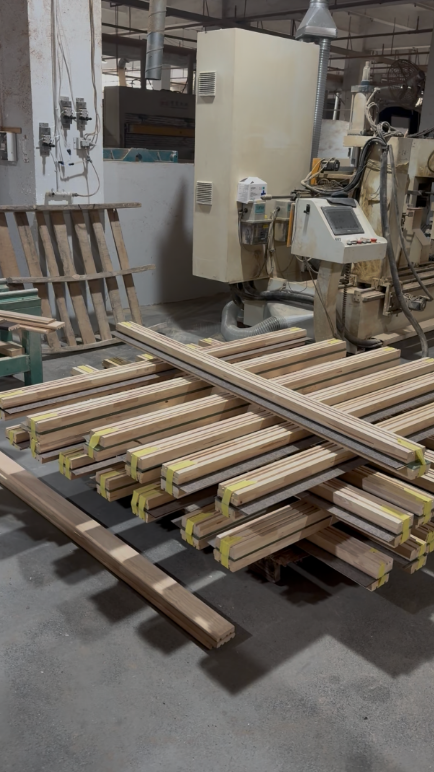
Display area: format mix, not a single table type, is what most commercial floors are now planned around.
Space planning is the constraint that usually settles the argument. A 9ft table measures roughly 2.83 m × 1.53 m overall, and with 1.5 m of cue clearance on all sides a single table needs about 5.8 m × 4.5 m. Two tables side by side can reduce the gap between them to 1.2 m. For a home or villa installation, where play frequency is lower and appearance matters more, a mid-sized 8ft Chinese 8-ball or American-style table with custom wood finish and cloth colour is the practical recommendation, with a 7ft or custom shorter model where space is tight.
What the supplier side adds to a multi-format purchase
SKTi Billiard Table is the billiards brand of ShenZhen Huangjue Sports Goods Co., Ltd., established in Shenzhen in 2015 and operating its own manufacturing facility. The plant covers more than 23,000 m² with a workforce of 50–100, an engineering team of 20, and annual output of 15,000 sets; the production line was upgraded with automated equipment in 2022. Roughly 80% of output is exported, with main markets in Southeast Asia, Central Asia, Russia, Europe and the Americas. The company states it has served more than 8,000 partner clubs.
For a buyer comparing formats, the relevant point is that the range spans all four: Chinese 8-ball models including Diamond Leg, Diamond-Shaped Leg, SKTI-Tang, SKTI-Song, SKTi-Ming, SKTI-Rose Gold and SKTI-Galloping Wind; a Snooker Table with nano-electroplated legs; American Pool Tables including the crystal glass model and the Generation 4, 5 and 6 series; and the Russian-style RT-01. Full details are published at SKTi Billiard Table. That breadth matters because it allows one supplier and one installation standard across a mixed floor, rather than separate procurement tracks for the volume tables and the specialist ones.
Compliance and delivery terms are part of the comparison. The company reports standard lead times of 30–45 days, 45–60 days for custom models and 10–15 days for samples, with FOB, CIF and DDP terms and export coverage including the EU, Southeast Asia, the Middle East, Australia and New Zealand, India, the United States, Turkey and Russia. Products have been tested for total lead content under REACH Annex XVII (Report No. 3 82600011048), with results of 105 mg/kg for leather components and 63 mg/kg for metal components, both within compliant limits. The main frame carries a 3-year warranty and the slate bed a 5-year warranty, excluding damage caused by human error or environmental factors. Packaging uses reinforced wooden crates suitable for ocean transport, with English installation instructions included.
Fit boundaries a buyer should check before committing
The first boundary is format substitution. A 9ft Chinese 8-ball table does not reproduce snooker, and it does not reproduce Russian pyramid; different ball diameters, pocket openings and cloth speeds produce different games. Where a venue's paying customers are snooker or pyramid players, the smaller table is a complement, not a replacement, and a floor plan built entirely on 9ft tables will exclude that segment.
The second is the status of the numbers. The percentage savings, turnover gains and failure rates above come from SKTi's comparisons of its own formats and specification tiers. They are internally consistent and specific, but they are not independent third-party benchmarks, and they assume comparable configurations and operating conditions. Space and rent savings depend on local lease terms and the actual floor plan; maintenance savings depend on usage intensity; and a low-traffic home installation may not justify the top slate and cushion specification at all.
The third is the American-format trade-off. A tighter pocket is a precision feature for the operator and a difficulty feature for the player. Venues whose revenue depends on casual, social and nine-ball play may find the 110–120 mm pocket and faster cloth of the American format the better commercial fit, even though the Chinese-style table reports higher precision and a longer service life.
Where the format decision is heading
The setting around the table is changing as much as the table itself. SKTi describes a shift from street-side pool halls into commercial complexes, and from a single-purpose gaming room into a hub for socialising, tournaments, training and content creation. That is the supplier's reading of its own market rather than a measured forecast, but its practical implication for a buyer is concrete: a floor planned around one format and one revenue stream carries more risk than a floor planned as a mix.
Under that reading, the 9ft Chinese 8-ball table does the volume work, snooker carries the competitive and tournament identity, and the American and Russian formats serve defined customer groups. The decision worth making carefully is not which format is superior, but how much floor, capital and maintenance budget each format deserves in a specific venue.
FAQ
Is a 9ft Chinese 8-ball table or a 12ft snooker table the better commercial choice?
For a venue whose revenue depends on table turnover, the 9ft format is the more efficient unit: SKTi's comparison reports a game length of 15–25 minutes against 30–60 minutes for a snooker frame, roughly 29% less floor per table, 40%–80% lower procurement cost and 50%–70% lower cloth replacement cost. A 12ft snooker table remains appropriate where the customer base is competitive and tournament play is part of the venue's identity; the two formats can sit on the same floor.
How much floor space should be planned for each table?
A 9ft table measures approximately 2.83 m × 1.53 m overall. Allowing 1.5 m of cue clearance on all sides, a single table needs about 5.8 m × 4.5 m; where two tables stand side by side, the gap between them can be reduced to 1.2 m. A 12ft table requires roughly 29% more space than a 9ft layout, and a 12ft Russian pyramid table roughly 47% more.
What slate thickness and cushion type should a buyer specify?
For high-traffic commercial use, a 4.5 cm bluestone slate is the recommended specification, with a 5.0 cm extra-thick version also available; standard tables typically use 3.0–4.0 cm beds. Combined with a multi-point levelling system, the thicker slab is documented as holding surface flatness deviation within 0.1 mm. Steel cushions built on automotive-grade spring steel are recommended for commercial rooms because they require no calibration and resist the moisture-related deformation that produces dead sections in wooden rails.
How do maintenance routines differ across the formats?
Steel-cushion tables need no cushion calibration, and their rubber strips are documented as requiring replacement every three to five years. Cloth should be brushed daily along the nap, deep-cleaned weekly with a cloth brush and a low-power vacuum, and replaced every 6–12 months in commercial venues; that routine is credited with extending cloth life by more than 30%. Snooker and Russian pyramid tables use slower or heavier cloth specifications with correspondingly higher replacement cost, reported at 40%–70% above the 9ft Chinese 8-ball configuration.
What lead times, compliance evidence and warranty apply to SKTi tables?
Lead times are 30–45 days for standard models, 45–60 days for custom models and 10–15 days for samples, with FOB, CIF and DDP terms available and orders accepted from one table. Products have been tested for total lead content under REACH Annex XVII, Report No. 3 82600011048, with 105 mg/kg for leather components and 63 mg/kg for metal components, both within compliant limits. The main frame carries a 3-year warranty and the slate bed a 5-year warranty, excluding damage caused by human error or environmental factors.
The full SKTi catalogue, covering formats, models and configuration options, is available for download: SKTi Billiard Table catalogue (PDF).
Tem questões ou precisa de mais detalhes?
Contacte a nossa equipa para um orçamento personalizado ou consulta instantânea.
Solicitar orçamento
Preencha o formulário abaixo e a nossa equipa entrará em contacto com uma proposta personalizada.
Chat direto do WhatsApp
Prefere conversar em tempo real? Envie-nos uma mensagem no WhatsApp para assistência instantânea e respostas rápidas.
- Obter orçamento personalizado
- Partilhar fotos ou documentos
- Discuta as suas necessidades diretamente
Geralmente responde em 5–30 minutos durante o horário de expediente.