
S300E vs. L600: AMR Fit for 75/80 cm Passage and 300/600 kg Loads
S300E vs. L600: AMR Fit for 75/80 cm Passage and 300/600 kg Loads
Why Passage Width and Payload Define the Feasibility Question
In smart manufacturing, the shortlist between two autonomous mobile robots rarely hinges on headline capacity alone. The more consequential question is whether a platform fits the physical and operational constraints of the facility that will host it. Aoman Future's S300E latent jacking AMR and L600 heavy-load AMR make this tension explicit: the S300E is specified around a 300 kg rated load and a 75 cm minimum passage, while the L600 is specified around a 600 kg rated load and an 80 cm minimum passage. Both share a 310 mm body height, a 1.2 m/s maximum speed, and ±5 mm positioning accuracy. Those shared values reduce the comparison to a narrower set of variables, but the payload gap and the five-centimetre passage difference produce materially different deployment profiles across electronics assembly, automotive parts, pharmaceutical warehousing, 3PL picking, and workshop material flow.
The passage specification deserves particular attention because it is often checked late in a project, after the payload and throughput calculations are complete. In a new-build facility, a five-centimetre difference in minimum passage can be absorbed at the layout stage. In brownfield sites, where racking, door frames, and safety fencing are already fixed, that same difference can determine whether a route is feasible without civil works. Buyers evaluating the S300E and L600 should therefore treat passage width and payload as joint constraints rather than sequential checks.
The International Federation of Robotics has framed the convergence of operational technology and information technology as central to smart manufacturing software, describing it as an opportunity for robot suppliers. For procurement teams, that convergence has a practical translation: mobile robots are increasingly assessed not only as vehicles but as nodes in a scheduling and data layer. The S300E and L600 comparison should be read in that context, with the understanding that the robot that fits the route and the load is also the robot that can be integrated into a wider material-flow system.
S300E and L600: Verified Specifications Side by Side
The table below summarises the verified specification points supplied for this comparison. It is deliberately limited to those attributes. Where a value is not stated in the verified specification set, it is marked as not stated rather than estimated.
| Parameter | S300E (latent jacking AMR) | L600 (heavy-load AMR) |
|---|---|---|
| Rated load | 300 kg | 600 kg |
| Body height | 310 mm | 310 mm |
| Minimum passage | 75 cm | 80 cm |
| Maximum speed | 1.2 m/s | 1.2 m/s |
| Positioning accuracy | ±5 mm | ±5 mm |
| Runtime | 9 h (verified) | Not stated in the verified specification set |
| Protection rating | IP43 | IP66 |
Three observations follow directly from the table. First, the 310 mm body height is common to both platforms, which matters for applications that require the robot to pass under raised conveyor sections, shelf beams, or low-clearance transfer points. Second, the 1.2 m/s speed and ±5 mm positioning accuracy are shared, so neither platform gains a head-to-head advantage on those dimensions. Third, the meaningful separations are load, passage, runtime, and ingress protection, and those are the variables that should drive the facility-fit decision.
The IP43 and IP66 ratings are often treated as a simple hierarchy, with the higher number assumed to be better. For deployment decisions, that reading is too coarse. IP43 describes protection against solid objects above 1 mm and against splashing water. IP66 describes protection against dust ingress and against powerful water jets. The correct rating depends on the operating environment, not on a general preference for a higher number.
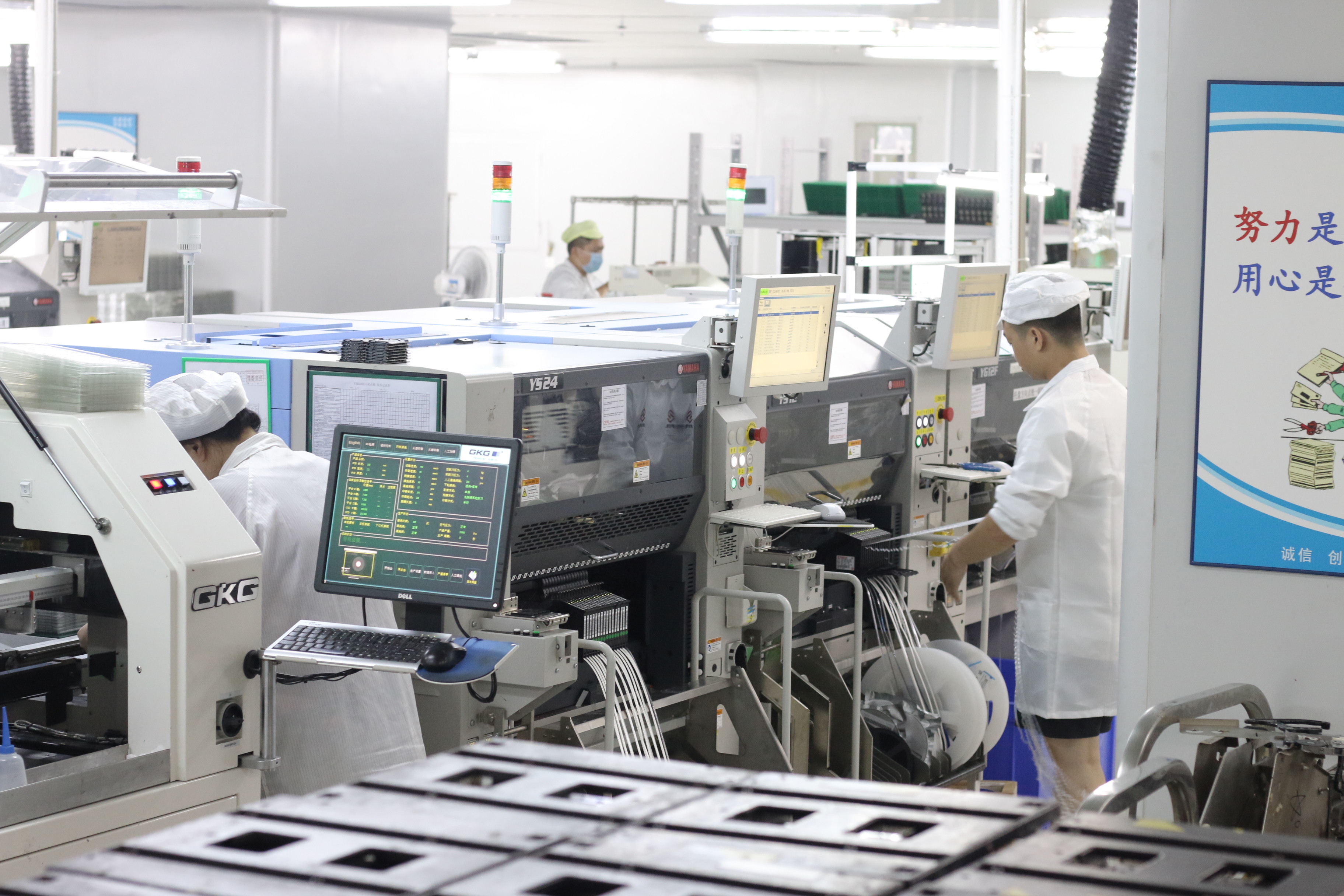
Aoman Future's manufacturing base in Shenzhen, where service and industrial robot lines are produced for export markets.
Electronics Assembly and Pharmaceutical Warehousing: Where 75 cm Matters
Electronics assembly environments are typically dense. Production cells, component racks, and conveyor interfaces are packed into constrained floor space, and the narrowest aisle in the route often becomes the limiting factor for any mobile platform. The S300E's 75 cm minimum passage is designed for that constraint. A 300 kg rated load is sufficient for the trays, component bins, and sub-assembly carriers that move between SMT lines, test stations, and packing areas. The 310 mm body height also allows the robot to pass beneath low-clearance interfaces that would block a taller platform.
Environmental exposure in electronics assembly is usually moderate. Temperature and humidity are controlled, and there is limited contact with dust or liquid. The S300E's IP43 rating is therefore aligned with the typical operating condition: protection against solid objects above 1 mm and against splashing water is generally adequate where the main risk is incidental contact rather than washdown or heavy dust. The verified 9 h runtime supports a single shift without intermediate charging and gives a reasonable margin for a second shift with opportunity charging.
Pharmaceutical warehousing presents a different but related profile. Clean-zone requirements tend to restrict the use of platforms that generate particles or are difficult to clean, and routes are often defined by racking geometry rather than by open floor space. The S300E's 75 cm passage and 300 kg load allow it to serve standard pharmaceutical cartons, tote bins, and small medical-device containers within existing aisle dimensions. The 310 mm body height is useful where the robot needs to access lower shelf levels or pass beneath conveyors. The 9 h runtime is compatible with predictable, schedule-driven material movement, provided the charging strategy is aligned with the facility's cleaning and changeover windows.
In both environments, the L600's additional 5 cm passage requirement is the first constraint to test. Where the narrowest route is close to 80 cm, the L600 may still be feasible, but the margin for pedestrian clearance, pallet overhang, and temporary obstructions is reduced. Buyers should measure the actual route rather than rely on nominal aisle drawings, because racking tolerances and safety-fencing positions often erode a few centimetres in practice.
Automotive Parts and Workshop Material Flow: Where 600 kg and IP66 Earn Their Keep
Automotive parts operations and general workshop material flow shift the decision toward the L600. Heavy castings, machined components, assembly fixtures, and packed totes can exceed the 300 kg rated load of the S300E, making the L600's 600 kg capacity the relevant threshold. The same environments frequently expose mobile equipment to metal dust, coolant mist, and intermittent water spray during cleaning. The L600's IP66 rating provides protection against dust ingress and powerful water jets, which is a closer match to those conditions than IP43.
The 80 cm minimum passage is less constraining in automotive and workshop settings than it would be in electronics assembly, because main material-flow routes in those environments are usually wider. The practical question is not whether the L600 can pass through a main aisle, but whether it can reach the specific pick-up and drop-off points along that aisle. Transfer stations, lift interfaces, and buffer zones may be tighter than the route itself, so the passage check should be applied to the complete route, including the final approach to each stop.
The shared 1.2 m/s speed and ±5 mm positioning accuracy become relevant in this context for a different reason. Heavy-load transfers place greater demands on stopping accuracy and docking repeatability, because a misaligned pallet or fixture can damage the load or the receiving station. The L600's ±5 mm positioning specification should be verified against the tolerance of the specific transfer equipment in the facility, particularly where powered rollers or automated lift interfaces are involved.
Buyers should also distinguish between rated load and dynamic load during travel. The 600 kg rating is a verified specification point, but the actual load distribution, centre of gravity, and acceleration profile affect how that capacity is used in practice. A procurement check that tests only a static load will not reveal whether the platform remains stable during turning, braking, and docking under a representative load.
3PL Picking: Mixed-Fleet Logic and Throughput Trade-offs
Third-party logistics picking operations rarely present a single, uniform material-flow profile. A 3PL site may combine narrow-aisle picking zones, wide-aisle replenishment routes, and heavy-load inbound and outbound staging areas within the same building. In that setting, the S300E and L600 are less likely to be alternatives than complements. The S300E can serve the narrow-aisle picking and put-away tasks where a 75 cm passage and 300 kg load are sufficient, while the L600 can handle replenishment and heavy tote movement on wider routes.
A mixed fleet introduces a scheduling requirement that a single-model deployment does not. The traffic-management and dispatch layer must be able to assign tasks by route width, load weight, and priority, and it must prevent the two platforms from blocking each other at intersections or charging stations. Buyers evaluating a mixed-fleet approach should ask whether the supplier's scheduling system supports heterogeneous fleets, and should test that capability during a pilot rather than assume it from a single-robot demonstration.
Throughput calculations in 3PL environments should also account for the runtime difference. The S300E's verified 9 h runtime supports extended picking shifts, but the L600's runtime is not stated in the verified specification set for this comparison. That gap is not a reason to exclude the L600; it is a reason to request the missing value from the supplier before finalising the fleet mix. A throughput model that assumes an unverified runtime for either platform would be based on an estimate rather than a specification.
Protection, Battery, and Operating Conditions
Ingress protection and battery management are often treated as secondary procurement items, but they determine whether a platform can operate reliably in the target environment over a multi-year service life. The S300E's IP43 rating and the L600's IP66 rating are verified specification points, and they should be matched to the actual exposure profile rather than selected by default.
Battery strategy is the second operating-condition variable. The S300E's verified 9 h runtime gives a clear basis for shift planning, provided the charging method is specified. Opportunity charging during breaks, overnight charging, and battery-swap approaches each impose different infrastructure requirements and different downtime assumptions. Buyers should ask for the charging profile, the recommended charging window, and the expected battery service life for the selected model. These are model-specific facts that should be confirmed in writing rather than inferred from the runtime figure alone.
Safety provisions also belong in this section of the evaluation. Emergency-stop functionality, low-battery protection, and obstacle-detection behaviour are standard procurement checks for any mobile robot, and they should be demonstrated during a site trial rather than accepted from a datasheet. Where the robot will interact with elevators, automatic doors, or fire-safety systems, the integration responsibilities should be assigned explicitly, because those interfaces typically involve third-party equipment and coordination outside the robot supplier's direct control.
Buyer check: Confirm the selected model's ingress protection rating against the actual cleaning and exposure regime, request the charging profile and battery service-life data in writing, and test emergency-stop and obstacle-detection behaviour under a representative load before signing off on a fleet order.
Aoman Future's Manufacturing Context and Supply Continuity
Aoman Future Robotics Technology (Shenzhen) Co., Ltd. was founded in 2018 and operates a manufacturing footprint of approximately 25,000 m² with six dedicated production lines, according to the company's published profile. The company reports more than 420 employees and an annual output of 1,500 units or more, with a research and development team of about 130 people covering robot motion control, SLAM navigation, AI scheduling systems, and industrial vision. Its products are exported to Europe, the United States, Canada, Australia, New Zealand, Japan, South Korea, Singapore, and the Middle East, with an export ratio of about 70%.
For a decision-stage buyer, this context matters less as a brand claim than as a supply-continuity signal. Six dedicated production lines and a stated annual output provide a basis for asking about lead times, spare-part availability, and the capacity available for a fleet order. The export footprint provides a basis for asking about regional service coverage and documentation for the destination market. Neither of those questions is answered by the manufacturing profile alone, but the profile indicates that the questions are reasonable to ask and that the supplier has an operating base from which to answer them.
The S300E and L600 should be evaluated within that operating context. Buyers comparing the two platforms are not only comparing specifications; they are also assessing whether the supplier can support the selected model through installation, commissioning, spare-parts supply, and software updates. A site visit or a reference call with an existing operator in a comparable environment is a more reliable input for that assessment than a specification sheet.

Aoman Future's corporate identity, associated with its service and industrial robot portfolio.
Traditional Material Handling vs. AMR: Where the Boundary Sits
The case for mobile robots over traditional material-handling equipment rests on flexibility and infrastructure avoidance. Conventional automated guided vehicles typically depend on fixed guidance infrastructure such as magnetic tape, floor markers, or rails, which constrains route changes and increases the cost of layout modifications. The S300E and L600, as AMRs, use onboard navigation rather than fixed guidance, which allows routes to be redefined in software. That flexibility is a genuine advantage in facilities where production layouts change or where multiple material-flow patterns share the same floor.
The boundary conditions matter as much as the advantage. AMRs are not a universal replacement for every material-handling task. Loads beyond the platform's rated capacity, floor surfaces that are uneven or obstructed, and environments with explosive atmospheres or extreme temperatures fall outside the typical operating envelope. The S300E and L600 should be matched to tasks within their verified payload and passage specifications, not stretched to cover tasks that require a different class of equipment.
There is also an integration boundary. An AMR fleet requires a scheduling layer, charging infrastructure, and a defined interface with the facility's existing material-flow systems. Buyers who compare the S300E and L600 solely on robot specifications may underestimate the effort required to integrate either platform into a live operation. The comparison is therefore most useful when it is paired with an integration assessment that covers the facility's WMS or WCS interface, the charging-station locations, and the traffic-management rules that will govern the fleet.
Five Decision Criteria Before Committing
The following criteria translate the specification comparison into a practical decision sequence. They are presented in the order in which they tend to eliminate options, so that the buyer does not invest time in a platform that cannot serve the route or the load.
- Measure the narrowest route, not the nominal aisle. The S300E requires 75 cm and the L600 requires 80 cm. The measurement should include door frames, safety fencing, racking tolerances, charging-station access, and any zone where temporary obstructions reduce the effective width.
- Confirm the peak load, not the average load. The S300E is rated for 300 kg and the L600 for 600 kg. The load calculation should use the heaviest representative load, including the carrier or tote, and should account for load distribution during turning and braking.
- Match ingress protection to the actual exposure. IP43 is appropriate for moderate environments with incidental splash risk; IP66 is appropriate where dust and powerful water jets are present. The cleaning method and cleaning agents should be confirmed with the supplier.
- Model the runtime against the shift pattern. The S300E's 9 h runtime supports extended shifts, but the charging method and battery service life should be confirmed. The L600's runtime should be requested from the supplier before it is used in a throughput model.
- Assess the fleet and integration layer. A single-model deployment and a mixed S300E/L600 fleet impose different scheduling, charging, and traffic-management requirements. The supplier's ability to support the chosen configuration should be tested during a pilot.
These criteria do not produce a universal answer. A facility with narrow aisles, moderate loads, and controlled environmental exposure will generally find the S300E the better fit. A facility with wide routes, heavy loads, and dust or water exposure will generally find the L600 the better fit. Facilities that combine both profiles may need a mixed fleet, and the decision then shifts from model selection to fleet design.
What the S300E/L600 Split Suggests for Smart Manufacturing
The existence of two platforms with different payload and passage specifications reflects a broader pattern in smart manufacturing: material-flow automation is being segmented by route and load profile rather than served by a single general-purpose platform. That segmentation is useful for buyers, because it allows the robot specification to be matched to the facility constraint rather than compromised across it. It also raises the bar for procurement, because the buyer must now evaluate a portfolio rather than a single product.
The market context supports the direction without settling the model choice. Grand View Research estimated the global smart robots market at USD 33.8 billion in 2024, which indicates the scale of adoption but does not predict which payload class will grow fastest in any given facility. The IFR's framing of OT/IT convergence points to the integration layer as a source of value, which reinforces the importance of scheduling and traffic-management capability in the S300E/L600 decision. Neither source substitutes for a site-specific feasibility assessment.
For decision-stage buyers, the practical implication is to treat the S300E and L600 as two points on a facility-fit spectrum rather than as competing products with a single winner. The right choice depends on the route, the load, the environment, and the integration scope. A buyer who measures those variables before requesting a quotation will be in a better position to evaluate the supplier's proposal, and a buyer who tests the selected platform under representative conditions will be in a better position to commit to a fleet order.
Frequently Asked Questions
What is the main difference between the S300E and the L600?
The S300E is a latent jacking AMR rated for 300 kg with a 75 cm minimum passage, while the L600 is a heavy-load AMR rated for 600 kg with an 80 cm minimum passage. Both share a 310 mm body height, a 1.2 m/s maximum speed, and ±5 mm positioning accuracy. The S300E has a verified 9 h runtime; the L600 runtime is not stated in the verified specification set for this comparison.
Which AMR fits a 75 cm passage?
The S300E, with its 75 cm minimum passage specification, is the platform designed for that constraint. The L600 requires at least 80 cm. Buyers should measure the narrowest point along the actual route, including door frames, safety clearances, and temporary obstructions, before confirming fit.
Does the L600's IP66 rating make it suitable for washdown environments?
IP66 indicates protection against dust ingress and powerful water jets, but it is not identical to a washdown rating. Buyers should confirm with the supplier whether the L600 is intended for direct high-pressure cleaning and which cleaning agents are compatible. The S300E's IP43 rating covers solid objects above 1 mm and splashing water, which suits moderate environments rather than washdown.
Can the S300E and L600 operate in the same facility?
Yes, where the facility contains both narrow-passage zones suited to the S300E and wider, heavy-load routes suited to the L600. Mixed-fleet operation requires a common scheduling and traffic-management layer, which buyers should test during a pilot before committing to full deployment.
How should a buyer verify passage width before deployment?
Measure the narrowest physical clearance along the intended route, subtract the safety margin the supplier specifies, and check that the result meets or exceeds the AMR's minimum passage rating. The check should cover doorways, aisle intersections, charging-station access, and any zone where pallets or equipment may narrow the path.
About Aoman Future: Aoman Future Robotics Technology (Shenzhen) Co., Ltd. is a Shenzhen-based developer and manufacturer of service and industrial robots, including delivery robots, cleaning robots, hotel service robots, customer service robots, humanoid robots, and industrial AMRs and AGVs. The company was founded in 2018, operates a manufacturing footprint of approximately 25,000 m² with six dedicated production lines, and exports to Europe, the United States, Canada, Australia, New Zealand, Japan, South Korea, Singapore, and the Middle East. Further information is available at www.aomanfuture.com.
Tem questões ou precisa de mais detalhes?
Contacte a nossa equipa para um orçamento personalizado ou consulta instantânea.
Solicitar orçamento
Preencha o formulário abaixo e a nossa equipa entrará em contacto com uma proposta personalizada.
Chat direto do WhatsApp
Prefere conversar em tempo real? Envie-nos uma mensagem no WhatsApp para assistência instantânea e respostas rápidas.
- Obter orçamento personalizado
- Partilhar fotos ou documentos
- Discuta as suas necessidades diretamente
Geralmente responde em 5–30 minutos durante o horário de expediente.