
SA-50 vs. European Fiber Grade Titanium Dioxide: A Cost-Benefit Analysis for Polyester Spinning
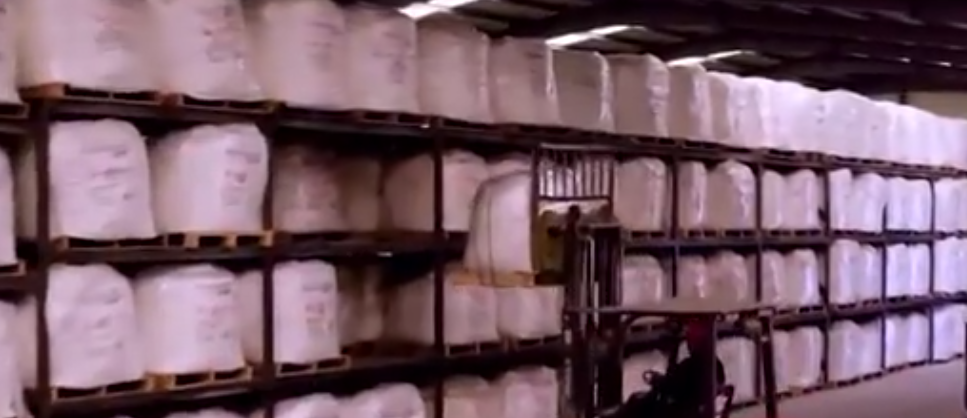
Polyester fiber producers evaluating fiber grade titanium dioxide face a critical decision between established European brands and emerging alternatives that promise comparable performance at significantly lower cost. The global fiber grade titanium dioxide market, valued at USD 1.46 billion in 2024 and projected to reach USD 1.94 billion by 2032, is dominated by the polyester segment, which accounts for over 60% of all applications. Against this backdrop, Orient International Holding Shanghai Foreign Trade Co., Ltd — a state-owned enterprise founded in 1988 with a registered capital exceeding RMB 548 million — offers SA-50, a spinning-grade titanium dioxide engineered specifically for polyester production.
The Challenge: Balancing Cost, Quality and Supply Chain Reliability
Polyester staple fiber, filament, and recycled PET producers rely on titanium dioxide for delustering, whitening, and matting effects. Traditional European products such as Kronos 1071 and Venator LW-S100 have set the benchmark for performance, but their high unit cost (21,000–23,500 RMB/MT CIF Asia) and extended lead times (35–60 days) pressure margins in a globally competitive market. Producers also face hidden costs: maintenance from abrasive particles, energy consumed during pre-heating, and filter replacement downtime. A need exists for a fiber-grade TiO₂ that maintains spinning stability while reducing total cost of ownership.
SA-50: A Purpose-Built Polyester Solution
SA-50 is a low-impurity, anatase fiber-grade titanium dioxide developed by Orient International for polyester spinning. Its core technology is an exclusive polyester-specific special organic coating produced via Japanese refined dry modification technology. This coating differs fundamentally from the traditional silicon-aluminum inorganic double coating used by Kronos and Venator. The organic coating achieves dual compatibility with ethylene glycol and polyester resin, enabling rapid dispersion without pre-infiltration. With TiO₂ content ≥99.4%, low iron, and low conductivity, SA-50 maintains stable PET viscosity during polymerization without black spots or crystal points. Its cool blue-white shade (b-value ≤ -0.4) is preferred for high-grade light-color and pure-white polyester fabrics, compared to the warm yellow tone (b-value +0.8~+1.7) of European grades.
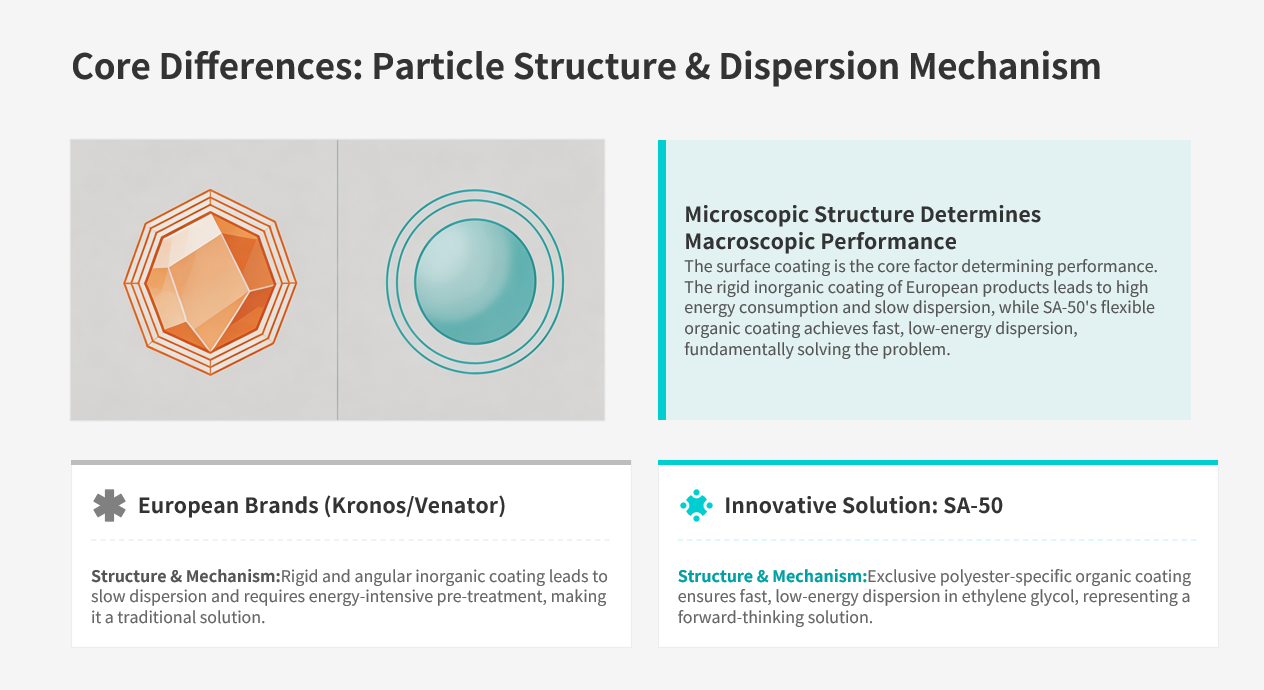
Coating architecture comparison: SA-50's organic layer vs. traditional inorganic double coating.
Application Scenarios: Where SA-50 Excels
SA-50 is designed for PET in-reactor polymerization matting, particularly suited for high-speed continuous spinning lines (POY, FDY, DTY). Its special organic coating ensures a smoother particle surface that reduces spinneret abrasion by 3%–8%, lowering filter blockage frequency and enabling 7×24-hour mass production. The product is also ideal for cost-sensitive global polyester factories in China, Southeast Asia, India, Korea, and the Middle East, where fast delivery and flexible trial orders (MOQ from 1 MT) are critical. Additionally, for high-grade light-color and pure-white fabrics, SA-50 delivers a cleaner, brighter appearance without the yellowish cast of European products.
Market Trend Analysis: The Shift Toward Cost-Competitive Alternatives
China's titanium dioxide exports reached a record 1.9017 million tons in 2024, a 15.84% increase year-on-year, signaling growing global acceptance of Chinese-manufactured TiO₂. As polyester fiber production — the largest application segment — continues to expand, producers are increasingly scrutinizing total cost of ownership beyond the unit price. The anatase crystalline form, preferred for fiber grades due to its lower Mohs hardness (5.5–6.0 vs. rutile 6.0–7.0), already dominates fiber applications. Within this context, SA-50 addresses the industry push for supply chain diversification and cost reduction without compromising spinning performance.
Comparison with Traditional European Solutions
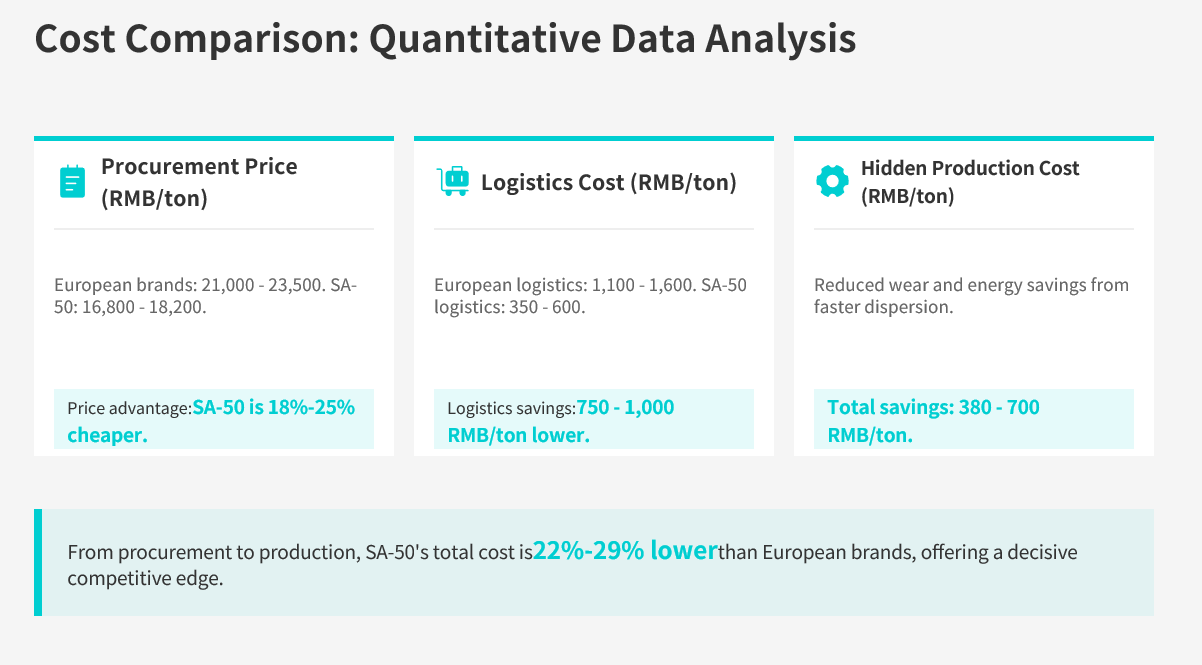
Performance and cost comparison summary across key metrics.
Compared to Kronos 1071 and Venator LW-S100, SA-50 offers a total comprehensive cost gap of 22%–29% lower. This includes a unit price reduction of 4,200–5,300 RMB/MT, logistics savings of 750–1,000 RMB/MT (with delivery time reduced by over 50%), and hidden production savings of 380–700 RMB/MT from reduced spinneret wear and faster dispersion. Maintenance requirements drop significantly: spinneret replacement frequency is 40% lower, filter consumption 25% lower, and pipeline cleaning interval extends from monthly to every 2 months, reducing overall maintenance workload by over 50%. Energy efficiency in glycol batching improves by 55%–62% because no heating pretreatment is needed; extrusion energy drops 9%–14%, and 30% less downtime adds another 4%–7% energy reduction. Spinneret lifespan is 12%–18% longer due to reduced abrasion from smoother particles.
Honest Limitation: SA-50 currently lacks the OEKO-TEX ECO PASSPORT certification that Venator's HOMBITAN® LW-S 100 holds, which may be a requirement for producers targeting certain high-spec textile markets demanding third-party validated non-toxic inputs.
Future Outlook
As polyester fiber production continues to scale, driven by recycled PET and high-performance textile demand, the need for cost-effective, reliable fiber-grade TiO₂ will intensify. Orient International's combination of state-owned stability, 73 overseas branches, and a dedicated R&D team of 25 engineers positions SA-50 as a long-term alternative in the global supply chain. If certification pathways such as ECO PASSPORT are pursued, SA-50 could further close the gap with European incumbents. For now, its performance parity in spinning stability and color quality, coupled with a 22%–29% total cost advantage, makes it a strong candidate for bulk polyester production.
FAQ
- What is the main technical difference between SA-50 and European fiber grade titanium dioxide?
- SA-50 uses an exclusive polyester-specific special organic coating with Japanese refined dry modification technology, whereas Kronos 1071 and Venator LW-S100 use traditional silicon-aluminum inorganic double coating. This organic coating provides dual compatibility with ethylene glycol and polyester resin and enables rapid dispersion without pre-infiltration.
- How does the color of SA-50 compare to Kronos 1071 and Venator LW-S100?
- SA-50 delivers a cool blue-white shade (b-value ≤ -0.4), while European products produce a warm yellow tone (b-value +0.8~+1.7). This makes SA-50 more suitable for high-grade light-color and pure-white polyester fabrics.
- What is the actual cost difference on a per-ton basis?
- SA-50's unit price is 4,200–5,300 RMB/MT lower than European competitive products. Logistics cost is lower by 750–1,000 RMB/MT. Hidden production savings from reduced spinneret wear and faster dispersion add 380–700 RMB/MT, resulting in a total comprehensive cost advantage of 22%–29%.
- Does using SA-50 require changes to existing spinning equipment?
- No. SA-50 is designed as a drop-in replacement for standard PET polymerization and spinning processes. It disperses at room temperature without heating pretreatment, and its smooth particle surface reduces wear on spinnerets and filters, potentially improving equipment uptime.
- What maintenance benefits can a polyester fiber plant expect when switching to SA-50?
- Spinneret replacement frequency is 40% lower, filter consumption 25% lower, and pipeline cleaning intervals extend from monthly to every 2 months, reducing overall maintenance workload by over 50%. Spinneret lifespan is 12%–18% longer compared to using European inorganic coated TiO₂.
- Does SA-50 have any environmental or safety certifications comparable to European brands?
- Currently, SA-50 does not hold the OEKO-TEX ECO PASSPORT certification that Venator's LW-S 100 has obtained. Producers requiring such certification for downstream textile markets may need to evaluate this limitation.
Further Reading
For detailed product specifications and company capabilities, download the official company brochure: Orient International Company Profile (PDF).