
SB-Y1 Hydraulic Cylinders: Mining Fit and Design Limits
Mining machinery rarely fails a hydraulic cylinder because the cylinder was inexpensive. It fails because the cylinder was specified for a duty cycle the machine never actually runs: a smooth, guided, axially loaded stroke instead of a shock-loaded, dusty, articulating one.
This reference examines the SB-Y1 Series heavy-duty industrial hydraulic cylinder from Wuxi Shibang Machinery Manufacturer Co., Ltd. (brand: shellppon) as an intended fit for mining machinery. It separates what the documented specification supports from what it does not, and identifies the decisions that belong to the machine builder rather than the cylinder supplier.
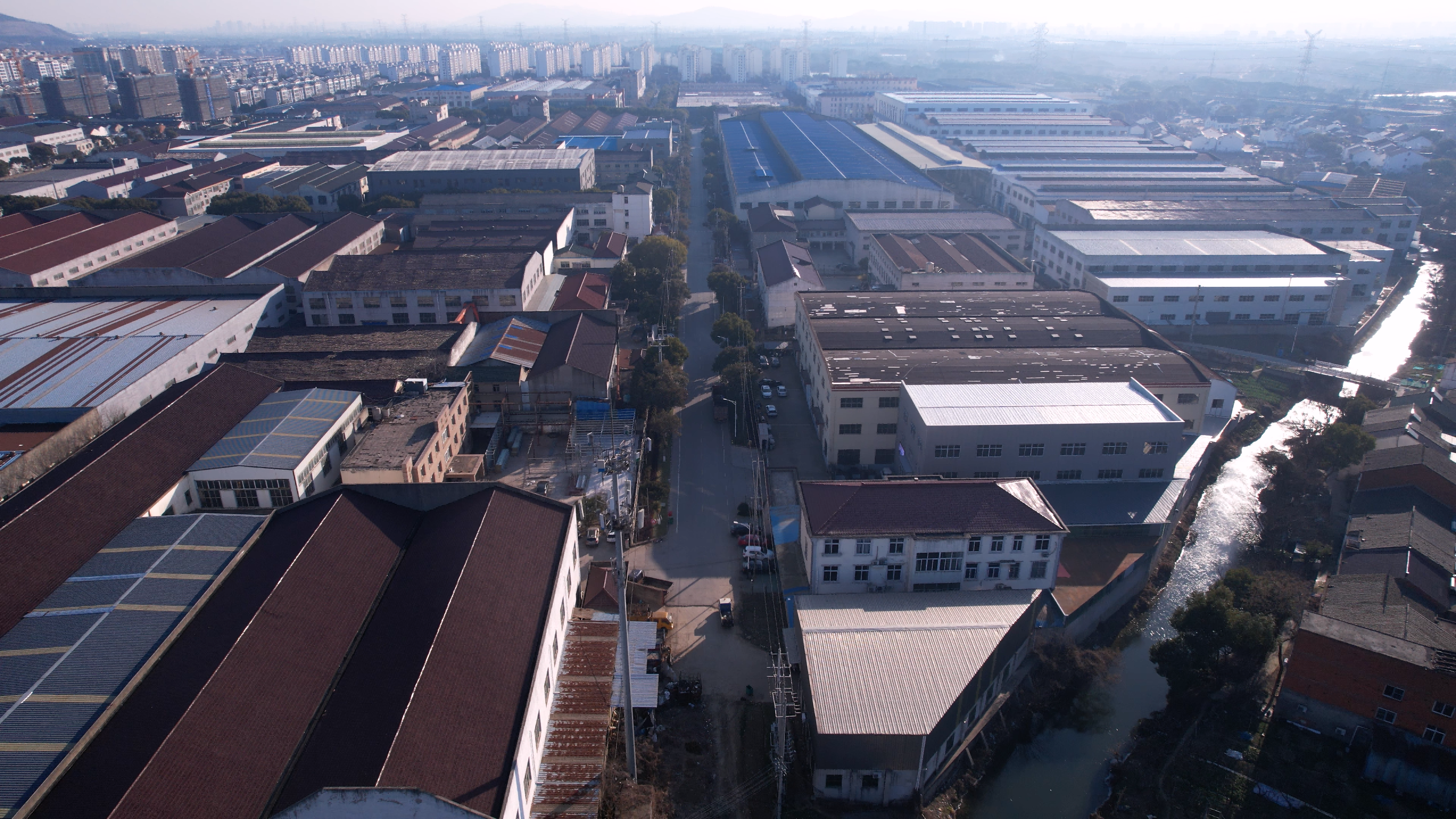
Wuxi Shibang Machinery Manufacturer Co., Ltd. is a Chinese hydraulic cylinder and hydraulic system manufacturer based at No. 7 Hengtong Road, Yangshan Industrial Park, Huishan District, Wuxi. The company was restructured into a private joint-stock company in 2003 and operates a 7,000 m² site with 4,000 m² of standard factory buildings and 120+ employees, including 8 technical staff. It manufactures custom hydraulic cylinders and hydraulic cylinder spare parts, exports 30–40% of output, and lists Europe, the Americas and Southeast Asia among its markets, with site-listed exports to Russia, Romania, Morocco, Thailand and Germany.
Mining machinery as a stated application
The SB-Y1 platform's relevance to mining starts with an explicit statement rather than an inference. The company profile names mining alongside metallurgy, lifting, transportation, shipping, forging, casting, machine tools, coal and petroleum, and chemical research as industries where its cylinders are used. That is a statement of intended application. It is not a published mining field-performance record, and no such record appears in the available documentation.
For a buyer, the useful question is therefore not whether a supplier lists mining, but which properties of a mining duty the cylinder design has to answer. Four dominate:
- Load character. Shock and reversing loads arrive through an articulating linkage, not through a guided axial push inside a frame.
- Pressure class. The cylinder's rated class must cover the system working pressure with a safety factor set by the load case.
- Geometry. Long strokes turn rod buckling into a design constraint rather than a detail.
- Environment. Dust, moisture and abrasive carry-over attack the piston rod surface and the wiper seal first.
Each of these maps onto a documented feature of the SB-Y1 platform, which is why the platform is a reasonable candidate for evaluation in mining equipment. None of them can be resolved without the machine's own rated pressure, stroke, mounting geometry and load data.
What the SB-Y1 heavy-duty cylinder is
The SB-Y1 Series is a heavy-duty industrial hydraulic cylinder supplied as a single-rod, double-acting metallurgical cylinder. In its documented configuration the structural arrangement is a square flange at the head with front flange mounting at the head, and the front flange mounting is specified as designed to reduce side-load risk. The cylinder is stated as compliant with GB/T 2348-1993 and JB/T 10205-2010.
The wider product range gives the platform context: CD/CG250 and 350 heavy-duty cylinders, JB/ZQ4395-86 heavy-duty metallurgical cylinders, DG vehicle cylinders, HSG engineering cylinders, wood press plunger cylinders and light pull rod cylinders, together with high-precision cylinder steel pipes and piston rods. Basic performance parameters follow ISO and GB standards, and installation dimensions follow the REXROTH 'CD250, CG250' convention; the company describes the series as broadly matching the Italian FOOSA 'DIN Type 200/250' and British ELRAM '250K' series.
That range matters for one practical reason. A press cylinder and a mining linkage cylinder can share a heavy-duty build logic without sharing a specification. A press applies a guided axial load inside a frame. A mining linkage applies a reversing load through pins, with the cylinder free to articulate and with side loads that the mounting must absorb or avoid. The commonality is manufacturing discipline; the difference is the load path — which is why press experience cannot simply be read across to a boom or an outrigger.
16 MPa or 25 MPa: choosing the pressure class
The SB-Y1 platform is offered in a 16 MPa standard version and a 25 MPa reinforced version. The choice between them is a system decision, not a preference for a heavier cylinder.
Both classes rest on the same documented structural basis: 27SiMn seamless tube for 16–25 MPa high-pressure cylinders, forged 45# steel for the cylinder bottom, piston and guide sleeve, heat treatment and post-weld stress relief, and a hydrostatic test at 1.5 times rated pressure. The rated class drives wall thickness and safety-factor selection against the rated pressure and load condition.
| Decision point | 16 MPa standard version | 25 MPa reinforced version |
|---|---|---|
| Rated pressure class | 16 MPa | 25 MPa |
| Structural basis | 27SiMn seamless tube; forged 45# steel ends, piston and guide sleeve | 27SiMn seamless tube; forged 45# steel ends, piston and guide sleeve |
| Hydrostatic test | 1.5× rated pressure | 1.5× rated pressure |
| When it is specified | The machine's rated working pressure and calculated load case fall within the standard class | The machine's rated working pressure and calculated load case require the reinforced class |
Two boundaries deserve stating plainly. First, fitting a 25 MPa cylinder to a machine whose pump, valve block, hose rating and relief setting are built around 16 MPa does not raise the machine's capability; the pressure boundary is the whole circuit. Second, a higher rated class is not a substitute for a buckling check. Stroke length and rod diameter determine whether the rod is stable at working pressure, and that is a separate calculation.
Bore, rod and stroke envelope
Bore, rod diameter and stroke are customisable on the SB-Y1 platform. Custom bore and stroke dimensions are supported, custom mounting dimensions and pressure classes are supported, and position measuring and proximity switches can be integrated into the design. For evaluation purposes, the documented supply record provides a practical envelope rather than a catalogue ceiling.
| Parameter | Documented values | Note |
|---|---|---|
| Bore | 40–320 mm | Custom bore dimensions supported |
| Rod diameter | 28–220 mm in documented combinations | Custom rod diameter supported |
| Stroke | 400–4,630 mm across documented supply | Long-stroke push-pull units at 100/70/4630 mm |
| Documented combinations | 40/28/400 mm up to 320/220/2900 mm | From the 2008 heavy-metallurgy supply |
The documented combinations come from a 2008 steel-mill order: 34 cylinders for Jinan Iron and Steel's 4300 mm roughing mill (20 units) and Shandong Fulun Iron and Steel's 1000 mm hot-strip mill (14 units), covering bore/rod/stroke combinations from 40/28/400 mm to 320/220/2900 mm, plus 100/70/4630 mm long-stroke push-pull cylinders. These are metallurgical duties, not mining duties, but they establish that the platform has been built at the large-bore end of that envelope and at long stroke lengths.
For mining, the long-stroke end is where engineering attention belongs. ISO/TS 13725:2021 sets out a method for evaluating the buckling load of a hydraulic cylinder based on elastic buckling theory, applicable to single and double acting cylinders conforming to ISO 6020, ISO 6022 and ISO 10762. A bore-and-stroke request outside the documented envelope is not excluded — it is a request that needs a design review before a quotation means anything.
Mounting interface and side-load control
Mounting choice determines how much side load reaches the piston rod. The documented mounting options and their stated uses are:
- Clevis mounting at base. A U-clevis with pin, described for medium and heavy pivoting mechanism drive.
- Trunnion mounting at head or at base. Pivoting about a trunnion axis.
- Square flange at head and front flange at head. The front flange mounting is specified as designed to reduce side-load risk.
- Round flange at head, rectangular flange at head, rectangular flange at base. Flange families for locations where the load is intended to remain axial.
A mining linkage usually requires the cylinder to pivot, which points toward clevis or trunnion arrangements; a flanged arrangement suits a mounting location where the load is designed to stay axial. Either choice is only as good as the alignment behind it. The documented mitigation for mounting and alignment stress is procedural: review the mounting arrangement, bore, rod diameter, stroke, concentricity and connection tolerances against the equipment design; inspect concentricity of the tube, piston rod and guide sleeve; use dedicated assembly fixtures; and support installation, commissioning and technical follow-up.
Sealing, rod surface and contamination
In dusty operation the piston rod and the wiper are the first components to be tested. The documented build specifies:
- Bore honed to IT7 with Ra ≤ 0.2 μm.
- Stefa seals, Glyd rings, wiper seals and O-rings.
- Ultrasonic cleaning and drying of components, followed by pressure-holding and internal-leakage tests.
- Piston rod in 40Cr or 45# steel, induction hardened to HRC 50–55, with 0.03–0.05 mm hard chrome.
- Inspection of straightness, roundness and surface quality, and anti-rust grease before shipment.
Seal selection is condition-dependent rather than universal. The published purchasing guidance is to confirm bore size, rod diameter, working pressure, stroke length, mounting type, sealing material, medium, operating temperature, cylinder material and surface treatment before production begins. In a mining environment the hydraulic fluid, the ambient temperature range and the dust load belong inside that confirmation, because they drive seal compound and rod protection rather than bore size.
Documented delivery evidence — and the mining evidence gap
Three deliveries are documented in the available records, and each tests a different part of the heavy-duty claim.
Steel rolling. The 2008 heavy-metallurgy order supplied 34 custom cylinders for lifting, balancing, turning and long-stroke push-pull duty in two rolling mills. Delivery completion is documented; operating results are not quantified in the source file.
Port machinery. Hydraulic systems for an RTG crane covered the chassis, wheels, boom and container spreader, serving wheel steering, crane jacking, boom luffing and spreader telescoping for 20-foot and 40-foot containers, over a documented 5-year duration. The design target was a high-salt, humid, high-impact environment, with high-strength steel tubes, smooth inner walls to reduce friction, rust-resistant piston-rod coatings, and durability and leak-resistance testing of hydraulic components. Reported functions include straight driving, 90-degree lateral steering and diagonal movement, with reduced tire dragging during jacking.
Heavy lifting. A 43-metre horizontal steel storage tank weighing approximately 1,800 tons was lifted at four symmetrical points with ±1 mm synchronization accuracy on a heavy-duty 35 MPa hydraulic system, exported from Wuxi to Dammam, Saudi Arabia, over a documented 5-year duration.
The gap should be stated with equal clarity. Mining is listed as an intended industry in the company profile, but the available records contain no mining-specific field dataset: no machine-hour logs, no wear intervals, no tonnage figures and no failure statistics. A buyer evaluating the SB-Y1 for a mining machine should therefore treat the documented build specification and the adjacent heavy-duty deliveries as the evidence base, and plan its own validation — a sample cylinder, a bench test against the agreed drawing, and a monitored first installation — rather than assume that steel-mill or port results transfer directly.
The compliance file a mining buyer can verify
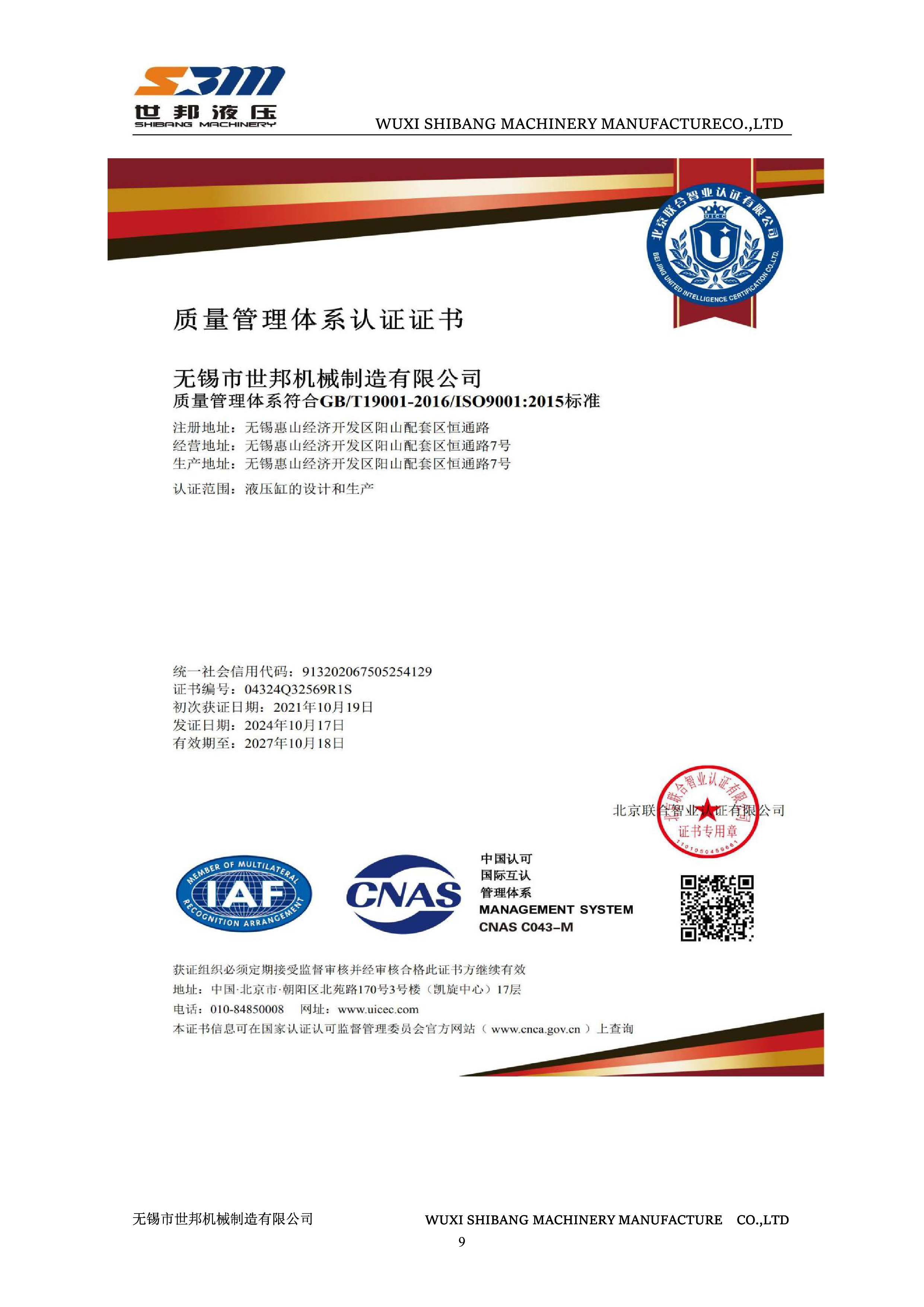
Quality management is certified to ISO 9001 under certificate 04324Q32569R1S, issued by Beijing United Intelligence Certification Co., Ltd. (UICC) on 17 October 2024 and valid to 18 October 2027, with the scope covering design and production of hydraulic cylinders. Occupational health and safety management (ISO 45001, certificate 04324S41946R0S) and environmental management (ISO 14001, certificate 04324E32063R0S) are held on the same issuing basis.
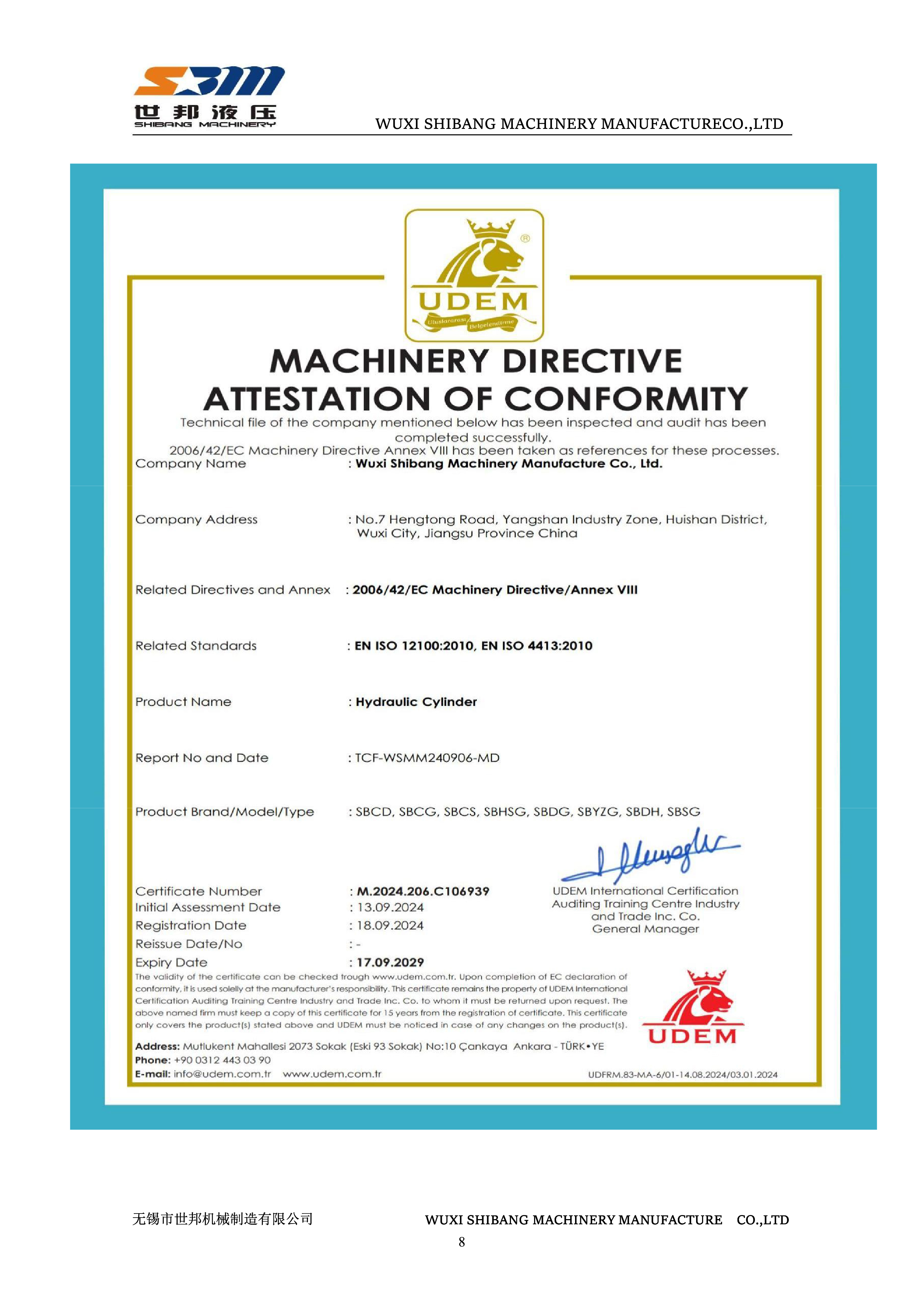
For European market access, a CE Machinery Directive attestation of conformity, certificate M.2024.206.C106939, was issued by UDEM on 18 September 2024 and is valid to 17 September 2029, citing 2006/42/EC Annex VIII, EN ISO 12100:2010 and EN ISO 4413:2010 with hydraulic cylinder as the scope. Two CE Pressure Equipment certificates to Directive 2014/68/EU Module G are also held — Z-AS-CN-SHA-25-09-3465291-18130549 and Z-AS-CN-SHA-25-09-3465291-25202735, issued by TÜV SÜD Industrie Service GmbH on 27 September 2025 — and their stated scope is piston accumulator, so they should not be read as cylinder pressure-equipment certification.
Acceptance is defined rather than implied: inspection and acceptance against the agreed drawing and technical standard, with dimensional, surface-hardness, dynamic-balance, NDT, hydraulic and pneumatic tests applied as applicable, and third-party inspection subject to agreement. The factory operates 50+ production machines, 3 inspection devices and 3 test rigs — 2 hydraulic and 1 pneumatic — and each cylinder is acceptance-tested.
How this compares with common specification approaches
Three routes are typically open to a mining equipment builder, and they differ less in ambition than in what they can prove on paper.
| Approach | What it provides | Where it stops |
|---|---|---|
| Catalogue standard cylinder | Fast availability and published mounting dimensions | Bore, stroke, mounting or pressure class may not match the machine; heavy-duty features may be absent |
| Drawing-built cylinder from a general fabricator | Dimensional freedom | Welding, heat treatment, honing and test discipline vary and must be verified — for welded joints against a specification such as AWS D14.9/D14.9M:2022 |
| SB-Y1 heavy-duty platform with custom dimensions | Documented material and test basis, custom bore/rod/stroke/mounting/pressure class, integration of position measuring and proximity switches | Requires a specification from the machine builder, and a design review outside the documented envelope |
The honest limitation of the third route is that it is only as good as the buyer's input. Custom bore and stroke are supported, but the supplier cannot choose the machine's rated pressure, the linkage geometry or the duty cycle. Where those inputs are vague, a custom cylinder becomes a precise answer to an imprecise question.
Standards and trade context shaping cylinder sourcing
Hydraulic cylinder specification is increasingly written against published standards rather than drawing conventions alone. ISO standards cover design, mounting dimensions, acceptance and function tests, and buckling-load evaluation — including ISO 10100:2020 for acceptance and function tests and ISO/TS 13725:2021 for buckling, alongside ISO 6020-1/2/3 and ISO 6022 for mounting dimensions. In the United States, AWS D14.9/D14.9M:2022 addresses the welding of hydraulic cylinders, including pressure-containing and structural welded joints used in cylinder manufacture.
Trade policy belongs in the sourcing picture as well. The U.S. Department of Commerce announced antidumping and countervailing duty investigations of certain linear hydraulic cylinders and parts thereof in 2024. For a mining project with cross-border procurement, origin documentation and duty exposure sit alongside the technical file rather than after it. On the supply side, the market includes broad portfolios — Parker, for example, describes standard and special tie rod, roundline and mill type cylinders for industrial applications in China — which makes documented specification, rather than range breadth alone, the more useful differentiator.
RFQ checklist before a mining cylinder quotation
A mining cylinder request that can be quoted without guesswork contains the following:
- Bore size and rod diameter.
- Working pressure and required pressure class (16 MPa standard or 25 MPa reinforced).
- Stroke length and mounting type, with an interface drawing showing concentricity and connection tolerances.
- Sealing material, hydraulic medium and operating temperature range.
- Cylinder material and surface treatment, including piston-rod coating requirements.
- Required integration: position measuring, proximity switches, cushioning, control system and added functions.
- Acceptance criteria and whether third-party inspection is required.
Two commercial items are quotation-stage rather than published values: lead time is confirmed by quotation and project specification, and minimum order quantity is not publicly disclosed. Neither should be assumed when building a project schedule. OEM production services are available for hydraulic cylinders and ODM design and production services for hydraulic cylinders and hydraulic systems, under an ISO 9001 quality system.
Frequently asked questions
Can the SB-Y1 be used in mining machinery?
Mining is listed among the industries served in the manufacturer's company profile, and the SB-Y1 is a heavy-duty industrial hydraulic cylinder built as a single-rod, double-acting metallurgical cylinder. Whether a specific machine is a fit depends on its rated working pressure, bore, stroke, mounting geometry and operating environment. No mining-specific field performance data is published in the available records, so a first installation should be validated against the agreed drawing and test criteria.
Should I choose the 16 MPa standard or the 25 MPa reinforced version?
The class is set by the machine's rated working pressure and load case, with wall thickness and safety factor selected accordingly. Both versions use 27SiMn seamless tube for 16–25 MPa service, forged 45# steel for the cylinder bottom, piston and guide sleeve, and a hydrostatic test at 1.5 times rated pressure. A higher cylinder class does not raise the rating of the rest of the hydraulic circuit, and it does not replace a rod buckling check.
What bore, rod and stroke sizes can be ordered?
Custom bore, rod diameter and stroke dimensions are supported. The documented supply record covers bore sizes from 40 to 320 mm, with bore/rod/stroke combinations from 40/28/400 mm to 320/220/2900 mm, plus 100/70/4630 mm long-stroke push-pull cylinders. Requests outside that documented envelope are handled as engineering reviews rather than as catalogue selections.
Which mounting type suits a pivoting mining linkage?
Clevis mounting at base uses a U-clevis with pin and is described for medium and heavy pivoting mechanism drive; trunnion mounting at head or base also permits pivoting. Flange mountings, including square flange at head and front flange at head, suit locations where the load is intended to remain axial, and the front flange mounting is specified as designed to reduce side-load risk. Concentricity and connection tolerances should be reviewed against the equipment design before ordering.
How is a cylinder verified before shipment?
Inspection and acceptance follow the agreed drawing and technical standard, with dimensional, surface-hardness, dynamic-balance, NDT, hydraulic and pneumatic tests applied as applicable; third-party inspection is available by agreement. The factory runs 2 hydraulic test rigs and 1 pneumatic test rig, and each cylinder is acceptance-tested. Internal build controls include boring to IT7 with Ra ≤ 0.2 μm, ultrasonic cleaning of components, and pressure-holding and internal-leakage testing.
Can position feedback be integrated into the cylinder?
Yes. Position measuring and proximity switches can be integrated into hydraulic cylinder designs, and customization covers bore, rod diameter, stroke, mounting, pressure class, fluid and seals, piston-rod coating, cushioning, control systems and added functions. Integration requirements should be stated in the RFQ together with the machine's control interface.
What are the limits of the available evidence?
Documented delivery evidence covers a 34-cylinder steel-rolling order, hydraulic systems for an RTG crane, and a four-point synchronized lift of a 43-metre, approximately 1,800-ton tank at ±1 mm using a 35 MPa system. Mining appears as an intended industry in the company profile, not as a published field programme. Minimum order quantity is not publicly disclosed, lead time is confirmed per quotation, and performance in a specific mining duty remains to be validated by the buyer.
Outlook
Heavy-duty cylinder procurement is moving toward documented specification: material grade stated, test pressure stated, standard cited, certificate scoped to the actual product. Mining buyers are also asking for sensing at the cylinder rather than downstream, which the platform can already accommodate through integrated position measuring and proximity switches. What is unlikely to change is the division of responsibility — the machine builder owns the load case, the cylinder supplier owns the pressure boundary, and the strength of the resulting cylinder depends on how precisely the first is handed to the second.
The manufacturer's English catalogue, covering the cylinder range and specification data, can be downloaded here: Wuxi Shibang English product catalogue (PDF).
Tem questões ou precisa de mais detalhes?
Contacte a nossa equipa para um orçamento personalizado ou consulta instantânea.
Solicitar orçamento
Preencha o formulário abaixo e a nossa equipa entrará em contacto com uma proposta personalizada.
Chat direto do WhatsApp
Prefere conversar em tempo real? Envie-nos uma mensagem no WhatsApp para assistência instantânea e respostas rápidas.
- Obter orçamento personalizado
- Partilhar fotos ou documentos
- Discuta as suas necessidades diretamente
Geralmente responde em 5–30 minutos durante o horário de expediente.