
SB-Y1 in Mining Machinery: Scenario Fit and Limits
SB-Y1 Hydraulic Cylinders in Mining Machinery: Scenario Fit and Limits
Mining machinery is one of the hardest environments a hydraulic cylinder can be placed in. A cylinder on a drilling rig, a face loader, a crusher feed arrangement or a haul-truck tipping mechanism converts hydraulic pressure into linear force while the machine is under continuous vibration, abrasive dust and variable thermal load. Whether a given cylinder is a fit is therefore decided less by a product listing than by four verifiable questions: what pressure class it is rated for, what bore and stroke range it can be produced in, how it mounts to the machine structure, and what structural design stands behind the load path.
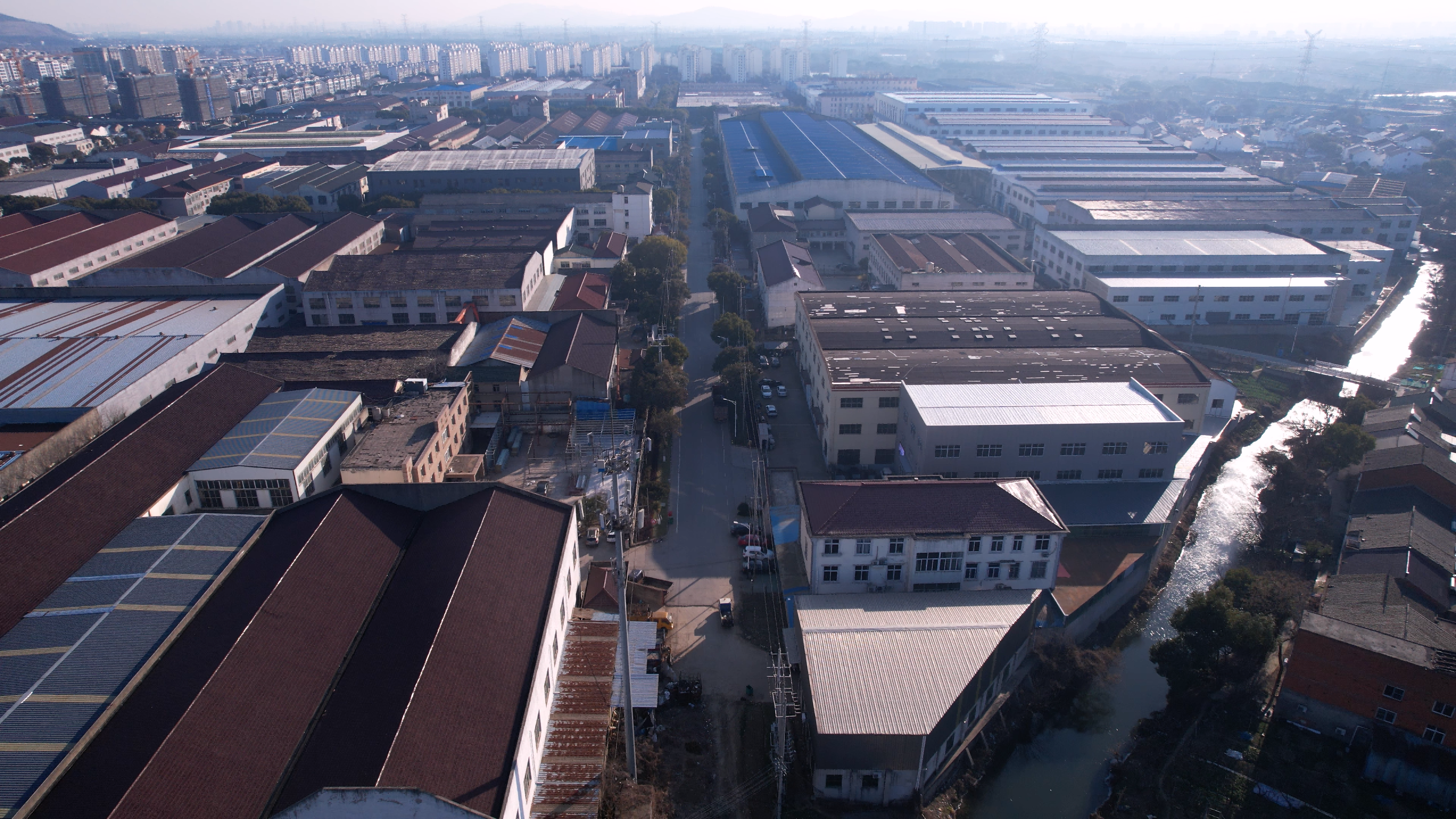
The SB-Y1 Series is a heavy-duty industrial hydraulic cylinder produced by Wuxi Shibang Machinery Manufacturer Co., Ltd., an industrial cylinder manufacturer located in Yangshan Industrial Park, Huishan District, Wuxi, China, and operating under the brand shellppon. Company records list mining among the intended application industries for its hydraulic and pneumatic cylinder output, alongside metallurgy, lifting, transportation, shipping, forging, casting, machine tools, coal and petroleum, and chemical research.
That statement is a positioning claim, not a mining case history. This reference separates the two: it sets out what is documented about the SB-Y1 Series for mining machinery scenarios, what a buyer can reasonably infer from those specifications, and which parts of a mining duty cycle remain subject to project-specific engineering confirmation.
Why mining machinery is a different cylinder problem
Hydraulic cylinders in general industrial duty are usually specified around a steady load and a known cycle count. Mining equipment changes that baseline in three ways that matter for procurement.
Load is dynamic and often reversed. A loader bucket cylinder alternates between breakout force, lift and return within seconds, and a drill feed cylinder absorbs impact energy that never appears on the machine's nominal load chart. A cylinder rated for a static pressure can still be structurally marginal if the buckling and fatigue envelope is not reviewed against the real load path.
Stroke is long and the mounting is a structural interface, not an accessory. Long-stroke cylinders are buckling-sensitive. ISO/TS 13725:2021, the published method for evaluating hydraulic cylinder buckling load, applies specifically to single and double acting cylinders that conform to ISO 6020 (all parts), ISO 6022 and ISO 10762. That standard exists because the failure mode at long stroke is not the bore — it is the rod and guide geometry under compression.
Contamination and surface wear drive service life. In a mine, the piston rod sees grit, moisture and impact. Rod surface hardness and coating quality are therefore a specification item on the same level as working pressure, not a finishing detail.
This is the opportunity side of the problem as well. A supplier that can hold a documented pressure class, a broad bore range, multiple mounting styles and a controlled rod treatment in one production system is in a better position to serve mining OEMs than a supplier that offers only one configuration. The question for a buyer is whether those capabilities are documented at the level their application needs.
Where the SB-Y1 Series sits as a supplied capability
Wuxi Shibang Machinery Manufacturer Co., Ltd. was established in 2003 from a restructured collective enterprise. Publicly listed company facts include a 7,000+ m² factory, 120+ employees, and a technical team of 8 staff including 2 senior engineers and 5 engineers. The company produces custom hydraulic cylinders and hydraulic cylinder spare parts, exports to Europe, the Americas and Southeast Asia, and lists site-recorded export destinations including Russia, Romania, Morocco, Thailand and Germany.
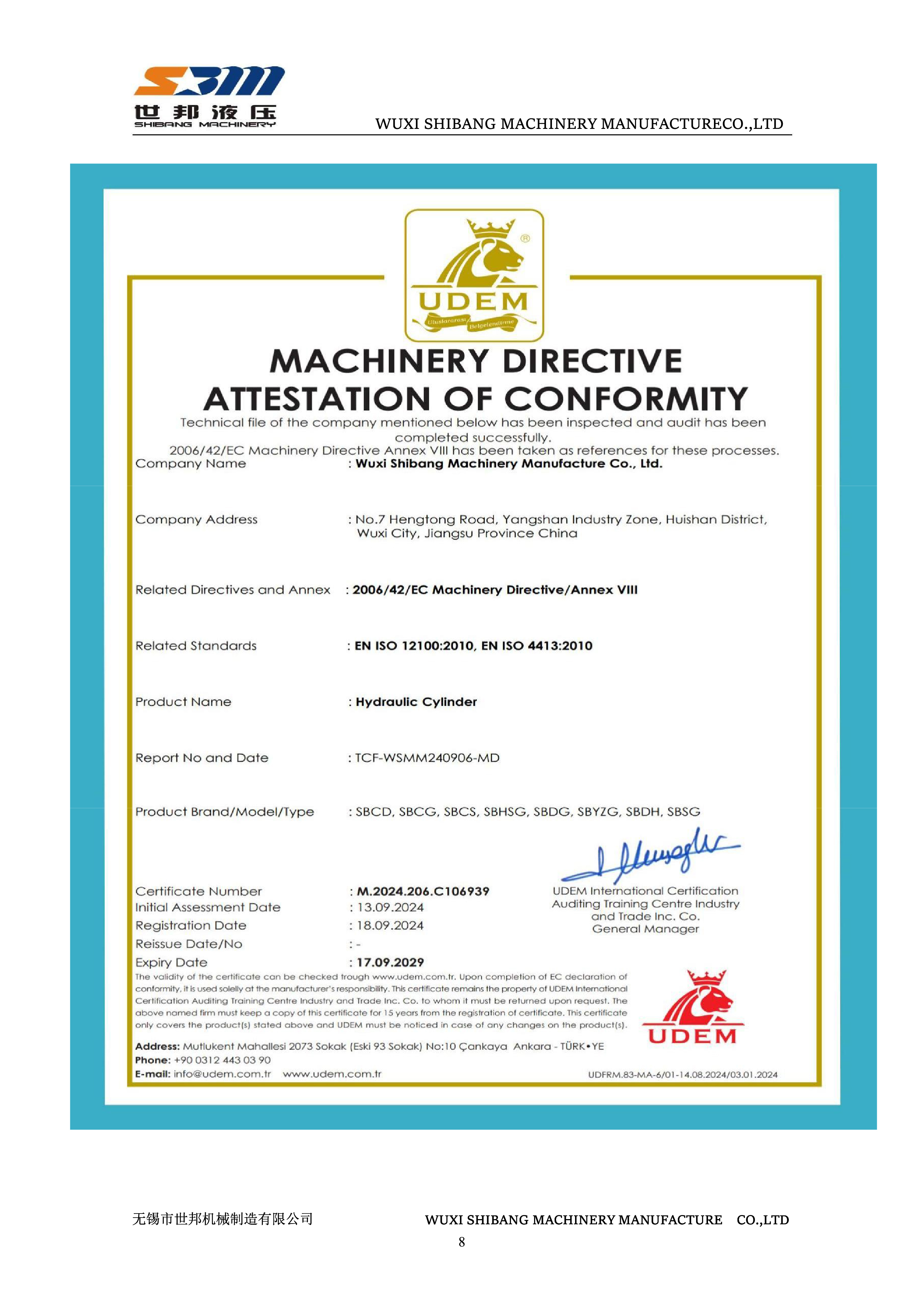
For mining machinery buyers, the relevant capability layer is configuration control. The SB-Y1 Series is documented with bore sizes from 40 mm to 320 mm, a 16 MPa standard pressure version and a 25 MPa reinforced pressure version. Production is organised around OEM and ODM services for hydraulic cylinders and hydraulic systems, with in-house design and manufacturing. Qualification records include an ISO 9001 quality management system certificate covering the design and production of hydraulic cylinders, alongside ISO 45001 and ISO 14001 management system certificates and a CE Machinery Directive attestation of conformity covering hydraulic cylinders under 2006/42/EC, EN ISO 12100:2010 and EN ISO 4413:2010.
The practical meaning of that combination is narrower than a general capability statement and more useful. A mining OEM does not usually need a supplier who can build any cylinder; it needs a supplier who can hold one configuration stable across a production run, document the pressure class it ships, and reproduce the same bore, rod and mounting interface on a repeat order.
Technical explanation: what the 16 MPa / 25 MPa split actually changes
The SB-Y1 Series is documented as a single rod, double-acting metallurgical cylinder with a square flange at head structural configuration and a front flange mounting at head. The front flange arrangement is designed to reduce side-load risk, which matters in mining machinery where cylinders are frequently mounted in structures that deflect under load.
The two pressure versions are not simply the same cylinder tested at two pressures. They define which projects the series is quoted into. A 16 MPa standard version covers applications where system pressure stays inside that class across the full duty cycle. A 25 MPa reinforced version is the configuration for machines whose working pressure regularly approaches the upper part of the range. Selecting the reinforced version is a design decision, not an upgrade — it should be made against the machine's actual pressure setting, not against a rounded-up assumption.
| Documented element | SB-Y1 Series detail |
|---|---|
| Cylinder type | Single rod, double-acting metallurgical cylinder |
| Pressure versions | 16 MPa standard; 25 MPa reinforced |
| Bore range | 40 mm to 320 mm |
| Structural configuration | Square flange at head |
| Mounting | Front flange at head, designed to reduce side-load risk |
| Barrel material | 27SiMn seamless tube for 16–25 MPa high-pressure cylinders |
| End cap, piston, guide sleeve | Forged 45# steel |
| Piston rod | 40Cr or 45# steel, induction hardened to HRC 50–55, hard chrome 0.03–0.05 mm |
| Bore finishing | Honed to IT7, Ra ≤ 0.2 μm |
| Pressure testing | Hydrostatic test at 1.5 times rated pressure |
| Sealing system | Stefa seals, Glyd rings, wiper seals, O-rings |
| Standards referenced | GB/T 2348-1993; JB/T 10205-2010 |
Two details in that table carry more weight than the headline numbers. First, the honed bore tolerance of IT7 with Ra ≤ 0.2 μm is a seal-life specification; seal leakage in a dusty environment usually traces back to bore accuracy, roundness and component cleanliness rather than to the seal itself. Second, the 1.5× hydrostatic test is a pressure-holding check on the finished assembly, which is the point at which a weld or a seal failure would show up before shipment rather than in the field.
Application and use cases in mining machinery
Mining machinery is a broad category, and not every mining cylinder has the same requirement. The SB-Y1 capability set maps onto several distinct sub-scenarios, each with a different dominant constraint.
Excavator and loader boom, arm and bucket functions
Mining-class excavators and wheel loaders use large-bore, high-force cylinders in the boom, arm and bucket positions. These are the positions where side load and mounting alignment are most likely to appear, because the cylinder is part of a pin-jointed linkage that flexes under breakout force. The front flange at head configuration of the SB-Y1 Series is documented as designed to reduce side-load risk, which is directly relevant to this arrangement. Bore sizes at the upper end of the 40–320 mm range are the relevant specification band for these functions, and the buyer should specify the pressure version against the machine's actual relief setting.
Drilling rigs and feed systems
Feed and positioning cylinders on drilling rigs combine long stroke with high cycle counts. This is where the buckling question becomes engineering rather than commercial. ISO/TS 13725:2021 provides a published evaluation method for exactly this case, and a buyer specifying a long-stroke SB-Y1 configuration should require the buckling check against rod diameter and stroke rather than accept a pressure rating alone.
Crusher, feeder and conveyor tensioning
Fixed plant in a mine — crushers, apron feeders, belt tensioners — uses cylinders in positions that are less dynamic but more continuously loaded. Here the relevant property is structural consistency over long running hours, which is where the forged 45# steel end cap, piston and guide sleeve specification and the post-weld stress relief step in the production process carry practical weight.
Haul truck and tipping mechanisms
Tipping and tailgate cylinders on mining haul trucks operate in a high-dust, high-vibration environment with repeated full-stroke movement. The rod treatment specification — induction hardening to HRC 50–55 with 0.03–0.05 mm hard chrome — is the element that most directly addresses the wear path in this scenario, together with the wiper seal arrangement.
Market trend signals a mining cylinder buyer should track
Three verifiable developments shape how heavy-duty cylinder sourcing is being assessed in industrial equipment categories.
Standardisation is becoming a procurement document. Hydraulic cylinders are covered by internationally published standards for design, mounting dimensions, acceptance tests and buckling-load evaluation, including ISO 10100:2020, ISO/TS 13725:2021, ISO 6020-1/2/3 and ISO 6022. The practical consequence for a mining buyer is that a supplier's ability to reference a buckling evaluation method and an acceptance test standard is now a checkable item, not a marketing claim.
Welding quality has a published reference point. AWS D14.9/D14.9M:2022, the Specification for the Welding of Hydraulic Cylinders, sets standards for pressure-containing welded joints and structural welded joints used in hydraulic cylinder manufacture. For mining equipment, where a structural weld failure is a safety event rather than a maintenance event, that specification gives a buyer a concrete basis for asking how pressure-containing welds are qualified.
Trade policy is affecting sourcing routes. The U.S. Department of Commerce announced antidumping and countervailing duty investigations of certain linear hydraulic cylinders and parts thereof. Buyers with North American channels should treat trade remedy status as a live variable in supplier selection, separate from product capability.
None of these trends changes what a cylinder can do. They change what a buyer can ask for in writing.
Comparison with traditional sourcing approaches — and the limits of this configuration
The conventional approach to sourcing mining machinery cylinders is either to buy a general-purpose industrial cylinder and adapt the mounting, or to specify a fully bespoke cylinder from a specialist fabricator. The SB-Y1 Series sits between those two positions, and the trade-offs are real in both directions.
| Approach | What it offers | Where it constrains the buyer |
|---|---|---|
| General-purpose industrial cylinder, adapted on site | Fast availability and a wide catalogue of standard mounting styles | Pressure class, rod treatment and buckling margin may not match the mining duty cycle; on-site adaptation adds an alignment risk that the cylinder design does not control |
| SB-Y1 Series heavy-duty configuration | Documented 16 MPa and 25 MPa versions, 40–320 mm bore range, front flange mounting designed to reduce side-load risk, forged 45# steel structural parts, hardened and chrome-plated rod, 1.5× hydrostatic testing | Documented as an intended industrial application, not a published mining field record; each mining duty still requires a project-specific buckling and load review |
| Fully bespoke specialist cylinder | Design built entirely around one machine's load path | Longer engineering cycle, higher unit cost, and a repeat-order dependency on the same engineering file |
The limits deserve to be stated plainly. The SB-Y1 Series is documented with mining machinery among its intended application industries, but no mining-specific field performance data is published for the series. The heavy-duty reference case in the company record is rolling-mill duty in steel production, not mining equipment. Buyers evaluating the series for a mining machine should therefore treat the following as open items to resolve at the drawing stage rather than settled by the product specification:
- Pressure ceiling. The documented pressure range for the series is 16–25 MPa. A mining machine whose working pressure exceeds that range is outside the standard configuration and would need a custom pressure class confirmed by the manufacturer.
- Buckling and fatigue margin. Long-stroke mining applications require a buckling evaluation against the real rod diameter and stroke, and a fatigue assessment against the actual load spectrum. Neither is implied by the pressure rating.
- Mounting geometry. The front flange at head design reduces side-load risk, but the surrounding structure still has to be aligned to the cylinder. Concentricity of the tube, piston rod and guide sleeve is controlled in production; the machine-side interface is not.
- Environment. Induction-hardened, hard-chrome-plated rods with wiper seals address the wear path, but no corrosion or abrasion life figure is published for mining atmospheres.
- Verification path. Acceptance testing is agreed against the drawing and technical standard, with dimensional, surface-hardness, dynamic-balance, NDT, hydraulic and pneumatic tests applied as applicable, and third-party inspection available by agreement. The scope of that testing should be written into the order, not assumed.
Future outlook
The direction of travel in heavy industrial cylinder procurement is toward documented configuration rather than catalogue selection. Standards for acceptance testing, mounting dimensions and buckling evaluation already exist and are being treated as procurement checkpoints. Mining machinery buyers are increasingly asking for the load case behind a pressure rating, not just the rating.
For a manufacturer, that shifts competitive weight toward engineering documentation: whether a custom bore, rod diameter, stroke, mounting, pressure class, fluid and seal set, rod coating, cushioning, position measuring, proximity switches and control integration can be fixed in a drawing and reproduced. Wuxi Shibang's stated customisation scope covers those parameters, and its production base includes 50+ production machines, 3 inspection devices and 3 test rigs — 2 hydraulic and 1 pneumatic — with each cylinder acceptance-tested.
The reasonable expectation for the SB-Y1 Series in mining machinery is therefore not a claim of proven mining performance. It is a configuration-ready heavy-duty cylinder whose suitability is established project by project, against a documented pressure class, a defined bore range, a specified mounting and a verified test regime.
Frequently asked questions
What specifications should a buyer confirm before selecting a hydraulic cylinder for mining machinery?
The purchasing parameters that must be fixed before production are bore size, rod diameter, working pressure, stroke length, mounting type, sealing material, medium, operating temperature, cylinder material and surface treatment. For mining machinery specifically, the working pressure should be taken from the machine's actual relief setting rather than a nominal figure, and the stroke should be checked against a buckling evaluation because long-stroke cylinders are compression-sensitive.
Is the 16 MPa version or the 25 MPa version of the SB-Y1 Series appropriate for a mining application?
The choice follows the machine's working pressure, not the severity of the environment. The SB-Y1 Series is documented in a 16 MPa standard version and a 25 MPa reinforced version, and both use 27SiMn seamless tube for the 16–25 MPa high-pressure range with forged 45# steel for the cylinder bottom, piston and guide sleeve. If the machine's working pressure sits comfortably within 16 MPa across the full duty cycle, the standard version matches the requirement. If it regularly approaches the upper part of the range, the reinforced version is the applicable configuration.
How does the SB-Y1 mounting arrangement handle side load in mining equipment linkages?
The SB-Y1 Series is documented as a single rod, double-acting metallurgical cylinder with a square flange at head structural configuration and a front flange mounting at head. The front flange mounting is designed to reduce side-load risk. This addresses the cylinder side of the interface; the machine-side structure still has to be aligned to the cylinder, because mounting or alignment stress arises when mounting interfaces do not match, concentricity is insufficient, or connection tolerances are improper.
Can the SB-Y1 Series be customised for a specific mining machine, and what can be changed?
Custom bore and stroke dimensions are supported for hydraulic cylinder production, and custom mounting dimensions and pressure classes are supported. Customisation options extend to rod diameter, fluid and seals, piston-rod coating, cushioning, position measuring, proximity switches, control systems and added functions. Production services cover custom hydraulic-cylinder and hydraulic-system design, manufacturing, installation, debugging and service, with OEM and ODM services available for hydraulic cylinders and hydraulic systems.
How is a mining cylinder order verified before shipment?
Inspection and acceptance are performed against the agreed drawing and technical standard. Depending on the specification, dimensional checks, surface-hardness testing, dynamic-balance testing, NDT, and hydraulic and pneumatic tests apply, and third-party inspection is available subject to agreement. Production uses 27SiMn seamless tubes for 16–25 MPa cylinders with forged 45# steel for the cylinder bottom, piston and guide sleeve, with heat treatment, post-weld stress relief and hydrostatic testing at 1.5 times rated pressure. Piston rods are 40Cr or 45# steel, induction hardened to HRC 50–55, with 0.03–0.05 mm hard chrome and a straightness, roundness and surface-quality check before anti-rust greasing and shipment.
Reference note. This article describes documented capability for the SB-Y1 Series as an intended industrial application. Mining machinery suitability should be confirmed against a project-specific load, pressure and buckling review rather than inferred from the series specification alone.
Full technical and configuration details are available in the Wuxi Shibang hydraulic cylinder product brochure (PDF).
Tem questões ou precisa de mais detalhes?
Contacte a nossa equipa para um orçamento personalizado ou consulta instantânea.
Solicitar orçamento
Preencha o formulário abaixo e a nossa equipa entrará em contacto com uma proposta personalizada.
Chat direto do WhatsApp
Prefere conversar em tempo real? Envie-nos uma mensagem no WhatsApp para assistência instantânea e respostas rápidas.
- Obter orçamento personalizado
- Partilhar fotos ou documentos
- Discuta as suas necessidades diretamente
Geralmente responde em 5–30 minutos durante o horário de expediente.