
SC-A1025 vs SC-A1010: Anatomy Models by Teaching Level
A three-part natural adult skull and a natural-size knee joint model answer two different teaching questions. In a university anatomy lab, the choice between them is a curriculum decision, not a catalogue decision.
Anatomy teaching budgets are rarely settled at the level of “do we need models.” They are settled at the level of which structures a cohort must identify by the end of a module, and which movements a student must be able to describe and demonstrate. That is why a multi-part skull and a specialized joint model, both made of PVC and both listed for medical education, are not interchangeable purchases even when they sit in the same catalogue range.
Within the anatomical model range of Chongqing Scope Instrument Co., Ltd. — a Chongqing-based supplier of laboratory and medical training instruments, established in 2017, whose medical manikin portfolio covers CPR, clinical, nursing and anatomical models — two models sit on either side of that decision. The SC-A1010 is a natural adult skull divided into three parts, with an active chin, a cut cranium and a suture, intended for medical education and clinical training. The SC-A1025 is a natural-size knee joint model that shows flexion, extension and inward/outward rotation, placed on a plastic seat and measuring 12×12×33 cm. One is structure-led; the other is function-led.
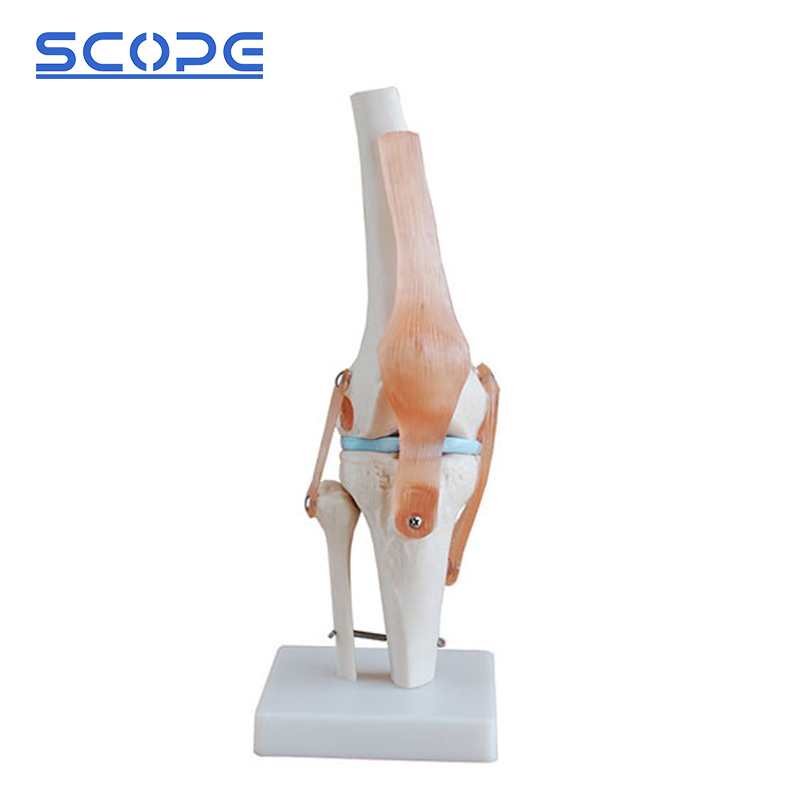
SC-A1025 Joint Model: a natural-size knee unit on a plastic seat, used where joint motion rather than bone identification is the learning outcome.
Why anatomical models have become a curriculum purchase
Anatomical models accounted for approximately 41.4% of the medical simulation product segment in 2025 — the largest single product share in that market (Grand View Research, Medical Simulation Market Size & Share Report, 2026–2033). The wider medical simulation market was valued at USD 2.17 billion in 2024 and is projected to reach USD 4.48 billion by 2030 (MarketsandMarkets, Medical Training Simulation Market Report 2025–2030). A narrower estimate covering only physical training manikins places that segment at USD 600 million in 2024 and USD 1.2 billion by 2035 (WiseGuyReports, 2026). These three figures measure different scopes and should not be combined; what they share is direction.
The practical consequence for an anatomy department is not market growth but justification pressure. Because anatomical models carry the largest product share, they are also the category most exposed to curriculum review: a model specified for a discontinued module becomes a storage problem, while a model specified too narrowly forces a repeat purchase a year later. Price bands across the manikin category as a whole run from around USD 500 for basic low-fidelity CPR models to above USD 85,000 for high-fidelity patient simulators (Grand View Research, 2026) — a spread wide enough that “we bought a model” says very little about what was actually specified.
The useful question is therefore narrower: does this purchase need to support identification of structures, or demonstration of movement? The SC-A1010 and the SC-A1025 answer those two questions respectively.
SC-A1010: the three-part natural adult skull
The SC-A1010 is a natural adult skull model made of PVC and divided into three parts. Its documented structural configuration includes an active chin, a cut cranium and a suture. It is described as suitable for anatomy and physiology education and is listed for medical education and clinical training scenarios.
What that configuration implies for teaching is identification work. A skull that separates into parts lets an instructor expose internal surfaces and cranial relationships during a demonstration rather than describing them against a sealed cast. The active chin allows the mandible to be moved, which supports explanation of jaw articulation in a live class setting. The suture gives a visible reference for cranial bone junctions. None of this requires consumables, power, or a simulated patient — the model works as a pass-around object in a lecture theatre and as a station object in a practical exam.
A point worth confirming before ordering: the published specification states that the model is divided into three parts and that the cranium is cut, but it does not itemise which three parts. Programmes that build station protocols around a specific disassembly sequence — calvarium off, mandible off, base exposed, for example — should ask the supplier to confirm the exact breakdown against their own teaching protocol rather than assume it.
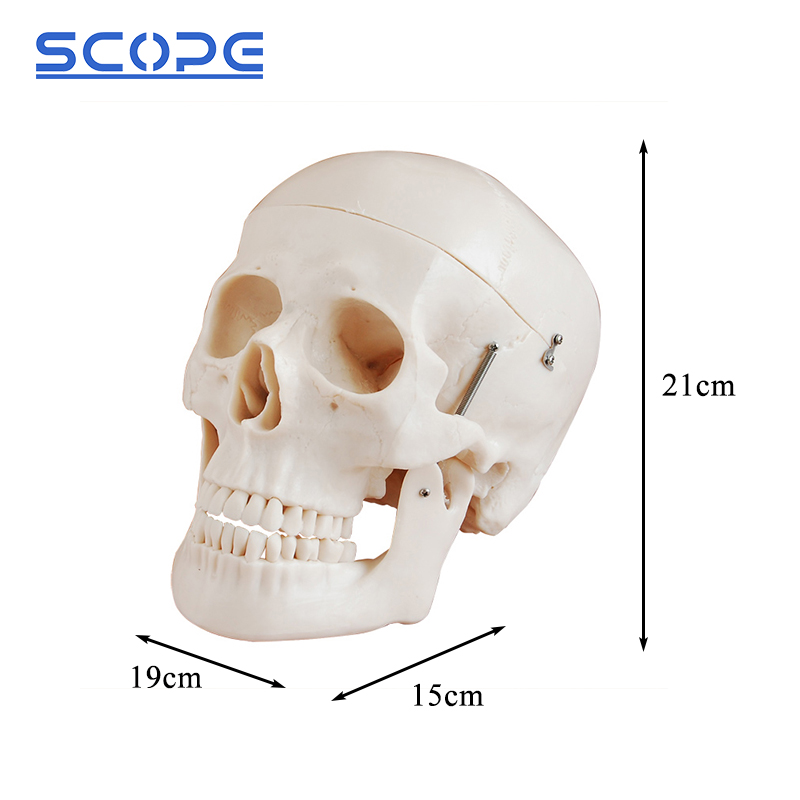
SC-A1010: natural-size adult skull with an active chin, cut cranium and suture, divided into three parts for classroom demonstration.
SC-A1025: the natural-size knee joint model
The SC-A1025 is classified as an anatomy model and as a joint model, made of PVC, showing knee flexion, extension and inward/outward rotation. It is natural size, placed on a plastic seat, and measures 12×12×33 cm. Its stated application is medical education.
The teaching logic here is different in kind. A joint model exists to show that a joint moves — and to let a student see the relationship between the movement being described and the bony surfaces producing it. Flexion and extension cover the primary plane; inward and outward rotation adds the rotational component that students frequently struggle to visualise from two-dimensional diagrams. Because the unit is compact and seated, it can be placed on a bench between two or three students, moved between seminar rooms, or set out in multiples for a rotation station without consuming the floor space a full torso model requires.
One boundary is visible in the specification itself. The documented functions are three motions; the specification does not quantify the mechanical range of each motion, and it does not list internal soft-tissue structures. Programmes that teach goniometric measurement, or that need students to inspect ligaments and menisci, should treat the SC-A1025 as a motion-demonstration aid and confirm range limits and internal detail with the supplier before building an assessment station around it.
Technical comparison: structure-led versus function-led design
Both models are PVC, both are described as natural size, and both are listed for medical education. Beyond that, the design logic diverges.
The SC-A1010 is a disassembly object. Its value comes from parts, a cut cranium, a suture and a movable chin — features that support identification, orientation and terminology. It does not articulate beyond the chin, and it carries no soft tissue. The SC-A1025 is an articulation object. Its value comes from three documented motions on a fixed base, which supports description of joint mechanics rather than identification of named bony landmarks.
Material matters in both cases for the same reason: PVC is rigid, dimensionally stable and cleanable, which is why it is used across the company's anatomical and manikin ranges. The trade-off is that rigid PVC communicates shape, not tissue feel. Neither model is intended to reproduce the compliance of cartilage, ligament or muscle, and neither should be evaluated against that standard.
Side-by-side comparison
| Comparison point | SC-A1010 | SC-A1025 |
|---|---|---|
| Product category | Anatomy model / teaching manikin | Joint model / anatomy model |
| Anatomical focus | Adult skull — head and neck osteology | Knee joint — regional joint anatomy |
| Structure | Divided into three parts; active chin; cut cranium; suture | Single articulated joint unit on a plastic seat |
| Documented movement | Movable chin | Flexion, extension, inward/outward rotation |
| Size | Natural size | Natural size; 12×12×33 cm |
| Material | PVC | PVC |
| Stated application | Medical education; clinical training; anatomy and physiology education | Medical education |
| Typical teaching level | Foundation and pre-clinical anatomy; identification and terminology | Regional and functional anatomy; kinesiology and joint mechanics |
| Documented limit | No soft tissue; no procedure training; part breakdown not itemised in the published specification | Three motions only; motion range not quantified; no internal soft-tissue structures listed |
Which teaching level does each model fit?
Foundation-year anatomy is dominated by identification: naming bones, locating landmarks, recognising sutures, understanding how the mandible relates to the cranium. This is where the SC-A1010 does its work. A three-part skull supports the sequence most departments already teach — whole specimen first, then components, then relationships — and its movable chin lets an instructor demonstrate articulation without a second model. In practical examinations, a disassemblable skull also allows stations to be reset quickly between candidates.
Regional and functional modules shift the requirement toward movement. Once students are asked to describe what a joint does, in which plane, and with what rotational component, a static illustration stops carrying the explanation. The SC-A1025 covers flexion, extension and inward/outward rotation in one object, which makes it useful in kinesiology tutorials, introductory orthopaedics seminars and biomechanics primers. Its footprint — 12×12×33 cm on a plastic seat — also makes it practical for small-group rotation, where several units can be placed on a single bench.
A department running both foundation and functional modules does not face a genuine either/or. The more accurate framing is sequencing: which model does the cohort meet first, and which one does the assessment depend on. Where a single purchase must carry a whole programme, a systemic model such as the SC-A1041 torso — 85 cm tall, 23 parts, interchangeable male and female reproductive organs — covers broader regional anatomy, but it does not replace either the detailed skull or the articulating knee for the specific outcomes those two models serve.
Where these models stop: limits and boundaries
Neither model is a procedural task trainer. The SC-A1010 documents no soft tissue and no injectable or puncturable structure; the SC-A1025 documents joint motion, not joint access. A programme that needs students to practise knee arthrocentesis is looking at a different product — within the same range, the SC-CK20135 knee training model is specified for knee arthrocentesis, reproducing an adult leg with structures including the patellar ligament, menisci, cruciate and collateral ligaments, fat pad and synovial sac. Buying a joint model to teach injection would be a specification error, not a supplier error.
A second boundary is representational. A PVC model reproduces one idealised specimen. It does not show anatomical variation between individuals, age-related change, or pathology, and it does not reproduce tissue texture. Where those are the learning outcomes, cadaveric prosections and imaging remain necessary, and models function as preparation and reinforcement rather than substitution.
A third boundary concerns evidence. Publicly available product documentation for these models describes structure, dimensions and documented motions, but it does not include independent anatomical-fidelity testing or published durability data such as articulation cycle life. Buyers comparing suppliers should therefore ask for documentation rather than infer performance from a specification sheet, and should treat claims of realism as qualitative until a sample has been handled.
Supplier context and market trend
The supplier side of this category is geographically diverse. Laerdal Medical (Norway) is historically associated with CPR training manikins; Ambu A/S (Denmark) is a medical device company whose portfolio includes training manikins; Gaumard Scientific (United States) develops patient simulators and training manikins; Kyoto Kagaku (Japan) manufactures medical simulation and anatomical models; 3B Scientific (Germany) manufactures anatomical models and medical training manikins. These are company-level descriptions, not performance comparisons — public documentation does not support ranking one manufacturer's anatomy model against another's on fidelity.
Two trends are visible in how buyers approach this category. The first is modular, curriculum-aligned purchasing: instead of one large systemic model per department, programmes buy a small number of focused models that map directly onto named learning outcomes. The second is documentation-led qualification. Chongqing Scope lists ISO 9001, ISO 14001, ISO 45001, ISO 13485, CE and RoHS documentation for export, alongside neutral export packaging and clearance documents such as CO, Form E and Form F. For an anatomy model purchase those certificates are not the decision, but they shorten the supplier-qualification step, particularly for institutions that must register a supplier before a purchase order can be raised.
Regional demand patterns are consistent with that picture. The company's application documentation for this product family cites medical school teaching projects, with typical markets including India, Indonesia and Malaysia among others. The company reports serving more than 500 clients worldwide, with export accounting for 50% of total sales and major markets in Europe, Southeast Asia, the Middle East, South America and Africa — context that matters to buyers assessing whether a supplier can support repeat orders and spare-part requests over a multi-year curriculum cycle.
Procurement checklist for anatomy model buyers
- Start from outcomes, not models. List the structures students must identify and the movements they must describe; only then match SC-A1010, SC-A1025, or both to those lists.
- Confirm the part breakdown. For the SC-A1010, ask which three parts separate and how the cranium is cut, so the model fits your station protocol.
- Request motion range data. For the SC-A1025, ask for the actual travel limits of flexion, extension and rotation if assessment depends on measurement.
- Check the footprint against the room. The SC-A1025 measures 12×12×33 cm on a plastic seat; multiply by station count before specifying quantities.
- Verify material and finish expectations. Both models are PVC; confirm cleaning instructions and colour-fastness requirements with the supplier.
- Ask about replacement components. Disassemblable models are handled heavily; clarify whether individual parts can be reordered.
- Collect certification and export documents early. ISO 13485 and CE documentation, plus CO, Form E or Form F where applicable, are usually requested by institutional procurement before order release.
- Evaluate a sample before committing to a programme-wide order. Handling a model is the only reliable way to judge whether its level of detail matches the cohort.
Future outlook
Anatomy teaching is converging on blended delivery: digital resources for orientation and repeat viewing, physical models for demonstration, handling and assessment. That division of labour favours focused physical models over general-purpose ones, because a model earns its place by doing something a screen cannot — being passed around, disassembled, articulated, and inspected from an angle the student chooses.
The likely direction for buyers is narrower specifications with clearer documentation. Expect more requests for part-level detail, quantified articulation ranges and material declarations, and less reliance on catalogue photography. Suppliers who can answer specification questions precisely — part counts, dimensions, document numbers — will qualify faster than those who answer with adjectives. For a department choosing between a three-part skull and an articulating knee, that is the practical test: which supplier can tell you exactly what the model does, and exactly what it does not.
FAQ
What is the difference between the SC-A1025 and the SC-A1010?
The SC-A1010 is a natural adult skull model divided into three parts, with an active chin, a cut cranium and a suture, intended for anatomy and physiology education. The SC-A1025 is a natural-size knee joint model on a plastic seat that shows flexion, extension and inward/outward rotation. One supports identification of skull structures; the other supports demonstration of joint motion.
Which model fits a first-year anatomy course?
A first-year course built around identification and terminology is served by the SC-A1010, because a three-part skull with a movable chin and visible suture supports bone naming, landmark location and demonstration of jaw articulation. A first-year course that already includes joint mechanics may also use the SC-A1025, but its primary fit is regional and functional teaching rather than introductory osteology.
Are both models natural size and made of PVC?
Yes. The SC-A1010 is described as a natural-size adult skull made of PVC. The SC-A1025 is described as natural size, made of PVC, measuring 12×12×33 cm and placed on a plastic seat.
Can the SC-A1010 be taken apart for classroom demonstration?
The model is specified as divided into three parts, with a cut cranium, an active chin and a suture. The published specification does not itemise which three parts separate, so departments that need a specific disassembly sequence should confirm the breakdown with the supplier before ordering.
Can the SC-A1025 be used for knee injection or arthrocentesis training?
No. The SC-A1025 is documented for demonstrating knee flexion, extension and inward/outward rotation, and it has no puncturable structure. Knee arthrocentesis training requires a dedicated task trainer; the SC-CK20135 knee training model in the same range is specified for that purpose, reproducing an adult leg with structures including the patellar ligament, menisci, cruciate and collateral ligaments, fat pad and synovial sac.
What documentation should a buyer request before ordering anatomy models?
Request the part breakdown and dimensions, the documented motion range where relevant, material and cleaning instructions, availability of replacement components, and certification documents. Chongqing Scope lists ISO 9001, ISO 14001, ISO 45001, ISO 13485, CE and RoHS documentation for export, and can provide clearance documents such as CO, Form E and Form F. Independent anatomical-fidelity or durability test data is not included in the public product documentation, so a sample evaluation is the practical way to judge detail level.
A downloadable brochure covering the medical training and anatomical model range is available here: Chongqing Scope product brochure (PDF).
Tem questões ou precisa de mais detalhes?
Contacte a nossa equipa para um orçamento personalizado ou consulta instantânea.
Solicitar orçamento
Preencha o formulário abaixo e a nossa equipa entrará em contacto com uma proposta personalizada.
Chat direto do WhatsApp
Prefere conversar em tempo real? Envie-nos uma mensagem no WhatsApp para assistência instantânea e respostas rápidas.
- Obter orçamento personalizado
- Partilhar fotos ou documentos
- Discuta as suas necessidades diretamente
Geralmente responde em 5–30 minutos durante o horário de expediente.