
SGS RoHS Report for PVC Flooring: Scope, Standard, Model Coverage
SGS RoHS Report for PVC Flooring: Scope, Standard, Model Coverage
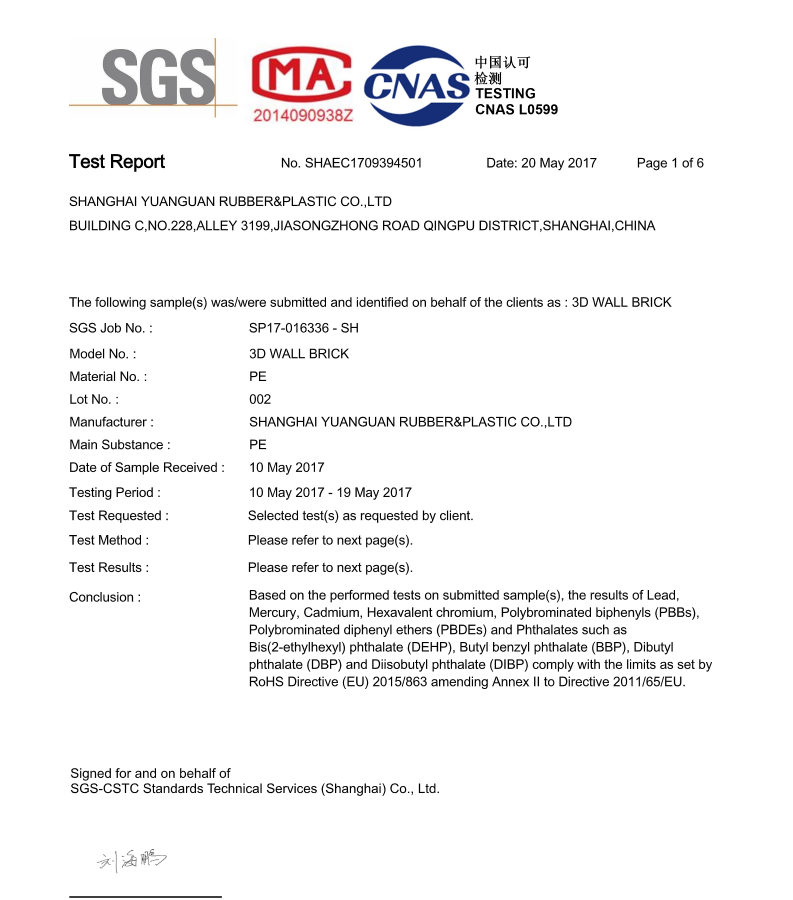
An SGS RoHS Test Report is a laboratory test document, not a general product certificate. Whether it supports a PVC flooring order depends on three readable fields: who issued it, which standard it cites, and which products and models it actually names. The report examined here carries the number SHAEC1709394501, was issued by SGS-CSTC, cites RoHS Directive (EU) 2015/863, and is recorded as applicable to the EU market. It is held by Shanghai Yuanguan Rubber & Plastic Co., Ltd., the manufacturer behind the SXP Wall Panel decorative range.
Most certificate problems in flooring procurement are not forgery. They are mismatches. A buyer requests compliance evidence for a floor tile and receives a document whose scope description refers to a different product format. Or the model code matches but the product description does not. Or the standard cited is correct for one destination market and questioned by the compliance team for another. Each of those situations is resolvable in a short exchange — provided the buyer reads the document in the right order: issuer and number first, standard second, scope and model coverage third.
Why “is your PVC flooring RoHS certified?” rarely produces a usable answer
A yes/no answer collapses three different things into one word. A supplier may answer yes because one model in a wide decorative range has been tested; because a wall product and a floor product share the same model code; or because a report exists but names a sample description that does not match the buyer's specification. None of these is dishonest, and all three produce the same problem at the quality-assurance or customs stage: the document in the file cannot be tied to the goods on the order.
For PVC flooring the mismatch risk is higher than for a single-product supplier, because flooring, wall panels, wall stickers and foam slats are frequently offered by the same manufacturer and sold through the same channel. A report covering several of those categories is efficient for the supplier and risky for a buyer who reads only the report number. The sections below set out what each field establishes, and how to reconcile it with a purchase order.
Field one: the document identity
The identity block is what a buyer quotes in the purchase order, the technical file and any quality agreement. It is also what a compliance team uses when requesting verification from the issuing organisation, rather than relying on an emailed PDF.
| Field | Recorded value | Why the buyer reads it |
|---|---|---|
| Document type | SGS RoHS Test Report (RoHS) | Separates a restricted-substance test from performance testing or system certification. |
| Report number | SHAEC1709394501 | The identifier to quote in RFQs, purchase orders and quality agreements. |
| Issuing authority | SGS-CSTC | The testing organisation named on the report; the party to verify the number with. |
| Standard cited | RoHS Directive (EU) 2015/863 | Defines which restriction framework the results belong to. |
| Market applicability | EU | Shows the destination market the document was prepared for. |
| Scope description | 3D WALL BRICK (PE material), manufactured by Shanghai Yuanguan Rubber & Plastic Co., Ltd. | Describes the tested product on the record; must be read together with the model list, never instead of it. |
One practical point about dates. The report is dated 20 May 2017, and the record carries an expiry of 1 January 2099. A far-future expiry date should not be read as a statement that a 2017 test describes goods manufactured in 2026. Where a compliance file requires a report reflecting the current formulation, the right request is for the current report version plus the sample-description pages for the ordered model — not an argument about the expiry field.
Field two: the standard cited, and the limit of what it proves
The report cites RoHS Directive (EU) 2015/863. That reference tells the reader which restricted-substance framework the results belong to; it does not describe behaviour in service. Three limits follow, and they are the source of most over-reading of RoHS documents.
It is substance evidence, not market authorisation. A test report records results for the samples submitted. Placing decorative materials on the EU market depends on the legal framework applicable to that product category and on the importer's own obligations. Whether a specific report satisfies those obligations is a question for the buyer's compliance function or a qualified adviser; the report does not settle it, and neither does a supplier's statement about the report.
It says nothing about fire, slip, wear or emissions. Those are separate evidence categories, addressed further below.
Version matters more than the standard's name. A report citing 2015/863 is a document of its period. Buyers whose compliance team tracks a later revision should ask directly which version the supplier's current file references, and treat an older citation as a prompt for a question rather than as a defect.
Field three: scope, and the model list that sits beside it
Scope is where most procurement time is lost, and where the difference between a usable report and an unusable one is decided.
The certificate record for SHAEC1709394501 carries a product scope description naming “3D WALL BRICK (PE material), manufactured by Shanghai Yuanguan Rubber & Plastic Co., Ltd.” Alongside that scope description, the record lists the product models for which coverage under the same SGS RoHS Test Report is stated. Both fields have to be read, and neither replaces the other: the scope description identifies the tested product the record describes, while the model list identifies the product lines the supplier states as covered. A buyer whose order is absent from the model list has no basis for assuming coverage; a buyer whose model is on the list should still confirm that the sample description page in the full report corresponds to the goods being shipped.
Where a scope description and a model list do not obviously align on first reading, the correct next step is a documentation request: ask for the report pages showing the sample description, and ask the supplier to state in writing which page corresponds to the ordered model. That is a routine exchange in EU-bound decorative material purchasing, not an accusation — and a supplier who produces those pages quickly is demonstrating exactly the document control a buyer wants to see.
Model coverage as recorded
| Product description on the record | Model | Coverage statement | Buyer check |
|---|---|---|---|
| PVC floor tile | WB-PVC | Covered by SGS RoHS Test Report; EU market | Match the ordered flooring SKU to “PVC floor tile”, not to the code alone. |
| PVC wall sticker panel | WB-PVC | Covered; EU market | Same code, different product — keep wall and floor lines separate on the PO. |
| PVC parquet wall sticker | WB-PVC | Covered; EU market | Parquet-pattern wall sticker is a wall product, not flooring. |
| PET marble wall sticker | WB-PET | Covered; EU market | PET surface family, distinct from PVC products. |
| 3D Self-Adhesive Foam Slat Wall Sticker | WB-KC | Covered; EU market | Foam slat format; confirm thickness and packaging variant. |
| WPC wall panel | WB-WPC | Covered; EU market | Wood-plastic composite, different substrate from PVC tile. |
| Leather wall sticker | WB-PG | Covered; EU market | Leather-look wall line; not interchangeable with floor stock. |
| 3D WALL BRICK (PE material) | — | Scope description carried on the record | Request the report page where this sample description appears. |
Note the pattern. WB-PVC appears three times, attached to three different product descriptions: a floor tile, a wall sticker panel and a parquet wall sticker. That is a real and easily missed reading hazard. A model code alone does not identify a product here; the code plus the product description does. Any purchase order, quality agreement or inspection instruction referencing “WB-PVC” without the product description is ambiguous, and ambiguity is what turns a straightforward compliance check into a claim dispute.
What the report does not establish, and what to request instead
Several attributes buyers ask about most often for PVC flooring fall outside a RoHS test entirely. Grouping them makes the gap visible.
Reaction to fire. PVC flooring is commonly classified under national and regional fire schemes — B1 under China's GB 8624-97 and Cfl-s1 under EN 13501-1 are frequently cited classifications — and those classifications come from fire testing, not from a restricted-substance report. A buyer specifying fire-resistant PVC flooring for a corridor, stair or commercial kitchen needs the fire classification document as a separate item in the file.
Indoor air quality and emissions. FloorScore certification, for example, verifies that hard-surface flooring complies with the volatile organic compound emissions criteria of California Section 01350. That is a different test regime with a different purpose, and it is the document required when a specification mentions low emissions.
Mechanical and surface performance. Wear-resistant, anti-slip, anti-static, waterproof, click-locking and matte-surface descriptions all refer to construction or surface attributes. They are supported by the product specification and the relevant performance tests, not by a RoHS report. For the WB-PVC floor tile the recorded specification is a PVC floor tile in 40/60/120 × 300 cm sizes at 1.5 mm thickness: useful for tying the ordered SKU to the report entry, and silent on wear or slip.
Phthalate positioning. Phthalates sit inside the RoHS restricted-substance discussion, which is why “phthalate-free” so often appears next to RoHS in supplier marketing. The two are not the same statement. A restricted-substance test result is not a full formulation declaration; where phthalate-free sourcing is a requirement, ask for the substance declaration or the specific test behind the claim. For context on how the industry has moved, Tarkett has stated that by 2018 all of its vinyl production sites in Europe, North America, Serbia and China used phthalate-free technology with alternative plasticizers such as DOTP — a company statement about one manufacturer's production, not a market-wide rule and not a statement about any other supplier's formulations.
Installation and substrate suitability. The self-adhesive format is installed dry, without cement or glue, on smooth solid bases: cement floors, tiled surfaces, latex-painted walls, plasterboard or plywood, flat, dry and free of dust and grease, with no hollow spots on floors. Powdery, sandy or loose surfaces are excluded. None of this is covered by a substance test, and none of it should be assumed from one.
ISO9001: supporting context, not a substitute
Shanghai Yuanguan Rubber & Plastic Co., Ltd. states that it holds ISO9001 quality management system certification. That belongs in a different part of the evaluation. ISO9001 describes how a production organisation manages process, documentation and corrective action; it does not test a product and does not report substance content. The two documents answer different questions. ISO9001 answers whether a system controls how goods are made and inspected; the SGS RoHS report answers what a laboratory found in the samples it tested. A supplier holding both is easier to audit than one holding either, but neither document substitutes for the other, and a buyer who accepts ISO9001 as product compliance evidence will eventually find a gap in the file.
Internal inspection sits on a third level again. The manufacturer states 100% testing as its quality-control approach — an in-house routine valuable for batch consistency, and distinct from both third-party testing and system certification.
Application fit: where WB-PVC flooring is specified
WB-PVC floor tile is recorded for interior decoration, home and garden, and building materials applications, with documented working conditions of indoor use at normal room temperature, including typical humid environments such as bathrooms and dry kitchen areas, while avoiding prolonged strong sunlight. Documented project types include apartment renovation, hotel and B&B refurbishment, chain retail fit-out, office fitting, temporary exhibition booths and short-cycle rental refurbishment.
For a buyer, the compliance decision and the application decision are separate steps that work best in sequence. A retail fit-out with a short lease and a fast turnaround is a reasonable match for a self-adhesive tile installed dry over a sound existing floor. A specification labelled hospital-grade, or one written for a kindergarten, will normally carry requirements — cleaning regime, emissions, fire behaviour, slip resistance — that no single restricted-substance report can satisfy, and those requirements need to be defined in writing before samples are requested. Treating “hospital-grade” and “kindergarten” as descriptors to be confirmed against a written criteria list, rather than as categories with a settled meaning, prevents a late-stage specification argument.
Market context: why documentation now differentiates offers
Scale explains part of the pressure. Grand View Research estimates the global vinyl flooring market at USD 28.0 billion in 2026 — a figure covering LVT, VCT and sheet products, and therefore wider than a narrow PVC flooring definition, so buyers comparing published numbers should check the product scope behind them. On the trade side, OEC records China as the leading exporter of floor, wall and ceiling coverings under HS 391810 in 2024, at USD 4.97 billion.
The procurement consequence is straightforward. When a large share of offers originates from the same exporting base, product photographs and general compliance claims stop being differentiators. What separates suppliers is the granularity of the evidence file: whether the report number, the standard, the model code and the product description line up with the purchase order — and whether the supplier can produce the matching report pages on request, rather than forwarding the same PDF to every inquiry.
Keeping the file current
The practical direction for buyers over the next few procurement cycles is a per-SKU evidence file rather than a per-supplier folder: one record per ordered model holding the report number, the standard cited, the market applicability, the model code, the product description exactly as written on the report, and the date on which the supplier last confirmed that the report describes the current formulation.
Two conditions make that file worth maintaining. First, decorative ranges change: when the material structure, thickness or surface construction of a model changes, the buyer should ask the supplier whether the existing report still describes the goods, and record the answer. Second, reports age even when they do not expire in the administrative sense, so a report issued years before a formulation change describes historical samples. Neither point implies that any particular report is inadequate; both mean the question “which report, for which model, as of when” is the one that keeps a compliance file accurate.
A ten-minute check before the order
- Write the report number into the purchase order and quality agreement, together with the model code and the product description exactly as they appear on the report.
- Confirm the standard cited matches what your compliance team asked for, and log any revision gap as an open question rather than an automatic rejection.
- Match three ways — order line, model code, product description. Never accept a code-only match where one code covers several product types.
- Request the report pages showing the sample description for the ordered model, and ask for written confirmation of the page reference.
- List every attribute your specification raises beyond restricted substances — fire, emissions, wear, slip, anti-static — and request separate evidence for each.
- Record the supplier's answer in writing, with a date, and keep it with the order file.
Shanghai Yuanguan Rubber & Plastic Co., Ltd. manufactures the WB-PVC flooring and related decorative lines discussed here; company and product documentation is published on the Shanghai Yuanguan Rubber & Plastic Co., Ltd. website. A consolidated product brochure (PDF) is also available for specification review.
FAQ: reading an SGS RoHS report for decorative materials
Does SGS RoHS Test Report SHAEC1709394501 cover PVC floor tile WB-PVC?
Yes, as recorded. The PVC floor tile in model WB-PVC is stated as covered by the SGS RoHS Test Report, applicable to the EU market, issued by SGS-CSTC under RoHS Directive (EU) 2015/863. Because the same model code is also used for wall products, buyers should match their order line to the product description “PVC floor tile”, not to the code alone.
Which authority issued the report, and which standard does it cite?
The issuing authority named on the record is SGS-CSTC, and the certification number is SHAEC1709394501. The applicable standard is RoHS Directive (EU) 2015/863, and the recorded market applicability is the EU.
The report also lists wall panels and wall stickers. Are those separate entries?
Yes. The record lists distinct entries for the PVC wall sticker panel (WB-PVC), the PVC parquet wall sticker (WB-PVC), the PET marble wall sticker (WB-PET), the 3D Self-Adhesive Foam Slat Wall Sticker (WB-KC), the WPC wall panel (WB-WPC) and the leather wall sticker (WB-PG). These are separate product descriptions sharing a report, so the description matters as much as the model code.
Does a RoHS report prove fire resistance, slip resistance or low VOC emissions?
No. Those attributes are evidenced by other documents. Fire behaviour is classified under schemes such as GB 8624-97 (B1) and EN 13501-1 (Cfl-s1); indoor air quality is addressed by programmes such as FloorScore, which verifies compliance with the volatile organic compound emissions criteria of California Section 01350. Mechanical, slip and anti-static performance come from product specifications and their own test regimes.
Where does ISO9001 fit if a buyer is assembling a compliance file?
ISO9001 is quality management system certification held by the manufacturer, covering process and documentation control. It is not part of the SGS RoHS Test Report and does not report substance content. It supports supplier evaluation, while the RoHS report provides product-level test evidence; the two complement each other rather than replace each other.
Tem questões ou precisa de mais detalhes?
Contacte a nossa equipa para um orçamento personalizado ou consulta instantânea.
Solicitar orçamento
Preencha o formulário abaixo e a nossa equipa entrará em contacto com uma proposta personalizada.
Chat direto do WhatsApp
Prefere conversar em tempo real? Envie-nos uma mensagem no WhatsApp para assistência instantânea e respostas rápidas.
- Obter orçamento personalizado
- Partilhar fotos ou documentos
- Discuta as suas necessidades diretamente
Geralmente responde em 5–30 minutos durante o horário de expediente.