
SHACMAN vs SINOTRUK: An Independent 6x4 Truck Comparison
SHACMAN vs SINOTRUK Heavy Duty Trucks: An Independent 6x4 Buyer Comparison
The global heavy-duty truck market was estimated at USD 308.3 billion in 2025 and is projected to reach USD 475.5 billion by 2035, according to Global Market Insights. On the supply side, China exported 295,000 heavy-duty trucks in 2024, following 276,000 units in 2023, according to China Association of Automobile Manufacturers figures cited in Shacman industry reporting. For fleet buyers in Africa, Southeast Asia and the Middle East, that volume has converted a simple brand question into a specification question: which 6x4 platform, with which engine, frame and emission class, actually fits the routes, loads and regulations the fleet operates under.
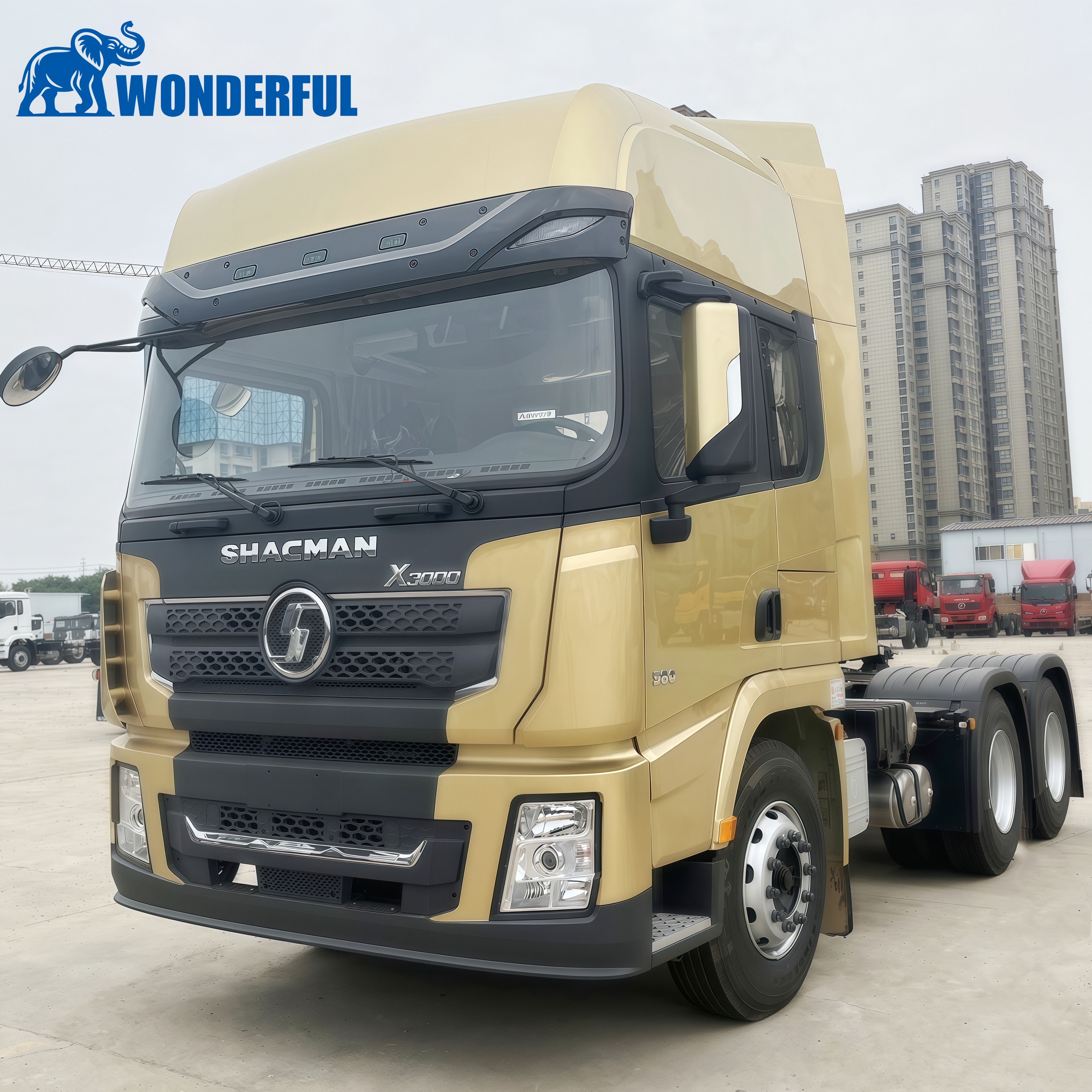
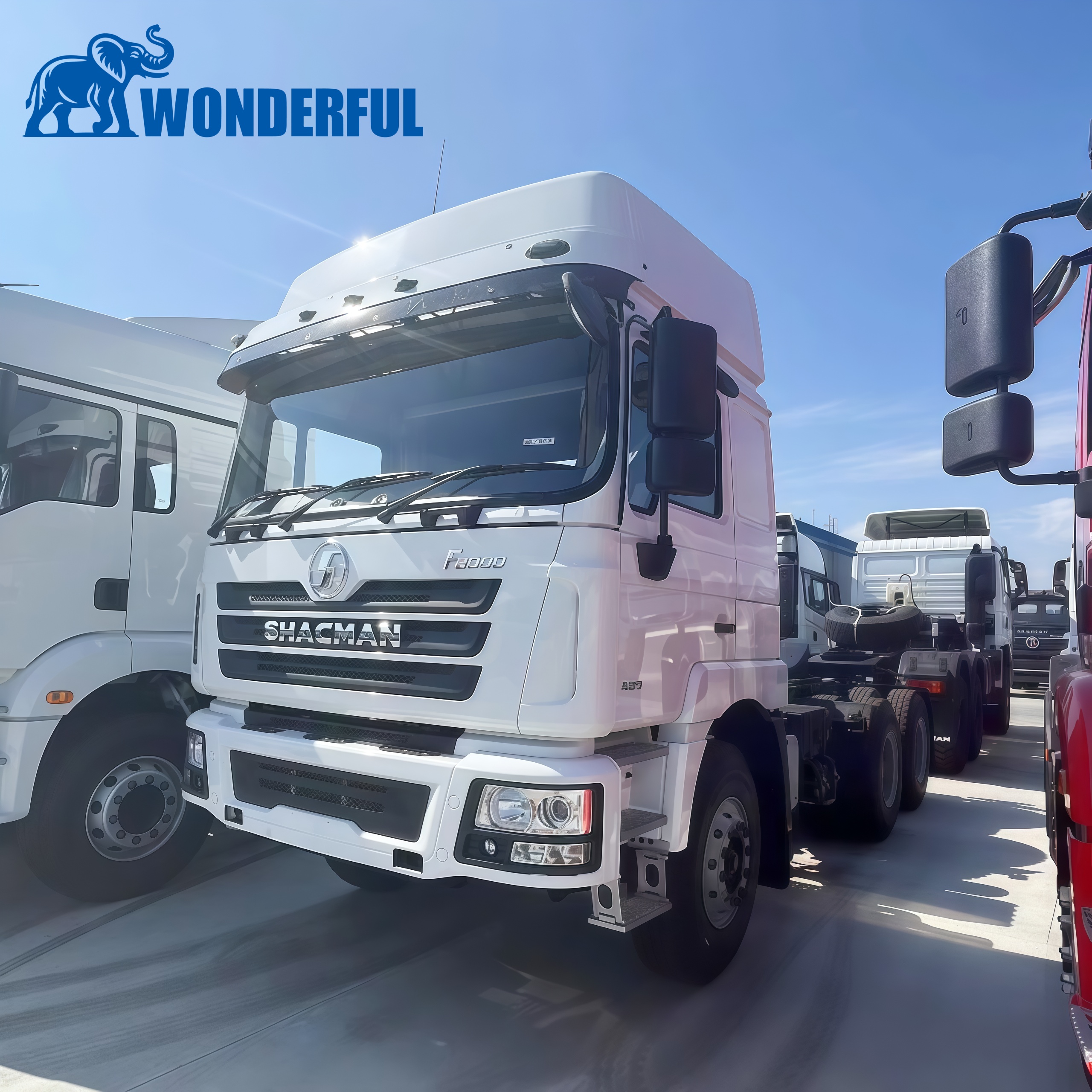
This article compares three configurations that are frequently shortlisted against each other in that decision: the SHACMAN F3000 6x4 tractor, the SHACMAN X3000 6x4 dump truck (model SX3258W384C), and the SINOTRUK 6x4 dump truck ZZ3257N384GB1R. The comparison is deliberately restricted to specifications that appear in product data, certification records and case records held by the supplier, SHANDONG WONDERFUL AUTO COMPANY LIMITED. Where a value is not published for a given model, it is marked as not specified in the cited data rather than estimated. That constraint is itself useful information, because it tells a buyer exactly which questions still need to be answered before a purchase order is signed.
Who supplies these trucks, and why that matters to the comparison
SHANDONG WONDERFUL AUTO COMPANY LIMITED is a Qingdao-based manufacturer and exporter of heavy duty trucks and semi-trailers, serving mining, engineering, agriculture and logistics applications. Company records list 500 employees, a 20-engineer R&D team, an annual output of 6,000 units, and an export ratio of 100%, with Africa as the principal market and additional activity in Southeast Asia. The product range covers heavy duty trucks alongside flatbed, lowbed, cement tanker, dump, fence and sidewall semi-trailers.
That matters for two reasons. First, the F3000, X3000 and SINOTRUK units discussed here are offered through the same supplier, so a buyer negotiating a mixed fleet is not comparing three unrelated sales channels. Second, the supplier publishes certification records for the truck and special-vehicle scope, which gives buyers a documented starting point for compliance screening rather than a verbal assurance.
The specification baseline: three 6x4 configurations side by side
All three models share the same fundamental architecture: 6x4 drive, a reinforced chassis, and a specification set aimed at heavy-load work rather than light distribution. The differences sit in engine technology, emission class, frame construction, gearing and body volume. The table below reproduces the published data without adjustment.
| Parameter | SHACMAN F3000 (6x4 tractor) | SHACMAN X3000 SX3258W384C (6x4 dump) | SINOTRUK ZZ3257N384GB1R (6x4 dump) |
|---|---|---|---|
| Body type / drive | Tractor truck, 6x4 | Dump truck, 6x4, left-hand drive | Dump truck, 6x4 |
| Engine | WP10.340E22, 340 HP | CUMMINS ISM11E5 440 (JACOB), 324 kW / 440 HP, 10.8 L | WD615.47, 371 hp |
| Emission standard | Euro II | EURO 5 | Not specified in the cited data |
| Transmission | 10JSD180 iron shell gearbox with QH50 | 12JSD200T-B with QH50 and FHB400 hydraulic retarder | HW19710 with HW50 direct-connection power take-off |
| Cab | Medium-length flat roof cab, no top guide cover | X3000 long flat roof cab, no guide cover, 4-point hydraulic suspension | Not specified in the cited data |
| Cargo body | Not applicable (tractor unit) | 5600 x 2300 x 1400 mm; floor 8 mm, side panel 6 mm; 180 front lift cylinder | 5600 x 2300 x 1500 mm; bottom 8 mm, side 6 mm; Q355 manganese plate, square grid large box |
| Frame | Not specified in the cited data | 850 x 300 (8+7) mm, multi-plate beam with four main pieces, Q345B high-strength alloy steel | Double-layer frame, 8+8 / 300 mm |
| Axles | Not specified in the cited data | HANDE MAN 9.5 T front; HANDE 16 T MAN double-stage widened rear, final drive ratio 5.262 | VGD95 front with drum brake; MCP16ZG dual rear axles, gear ratio 5.45 |
| Tyres | Not specified in the cited data | 12.00R20 mixed on-off road tread | 12.00R20 mixed tread pattern, 18PR |
| Fuel tank | Not specified in the cited data | 400 L aluminium alloy | 400 L |
| Brake system | Not specified in the cited data | Dual-circuit compressed air service brake; spring air discharge parking brake; engine exhaust (Jacob) brake; ABS not fitted | Front drum brake; rear detail not stated in the cited data |
| Max speed | Not specified in the cited data | 82 km/h | Not specified in the cited data |
| Declared material | Steel | High-strength Q345B alloy steel | Carbon steel / SS304 |
| China Compulsory Certificate (CCC) | Covered as a related product under the Special Vehicles certification scope | Covered as a related product | Covered as a related product |
Reading the table as a buyer rather than as a spec sheet, three asymmetries stand out immediately: the emission-class gap between the F3000 and the X3000, the different frame-construction philosophies behind the X3000 and SINOTRUK dump bodies, and the fact that several fields are simply not published for the F3000 and for the SINOTRUK cab. Each of those asymmetries has a procurement consequence.
Powertrain: rated horsepower is not the same as usable power
The SHACMAN X3000 dump truck carries the most powerful engine of the three. Its CUMMINS ISM11E5 440 unit is rated at 324 kW / 440 HP from 10.8 litres of displacement and meets EURO 5. It is paired with a 12JSD200T-B transmission, a QH50 power take-off and an FHB400 hydraulic retarder. The SINOTRUK 6x4 dump truck uses a WD615.47 engine rated at 371 hp with an HW19710 gearbox and an HW50 direct-connection power take-off unit. The SHACMAN F3000 tractor uses a WP10.340E22 engine rated at 340 HP and meeting Euro II, matched to a 10JSD180 iron shell gearbox with a QH50 power take-off.
Horsepower alone rarely decides a fleet purchase. Two other elements in these specifications matter more in daily operation.
The first is the retarder. The X3000 configuration includes an FHB400 hydraulic retarder in addition to an engine exhaust (Jacob) brake. On extended descents with a loaded body, a hydraulic retarder reduces reliance on the service brake, which in turn affects brake wear, brake fade risk and maintenance intervals. For a mining or quarry operation with a loaded downhill leg, this is a functional difference rather than a comfort feature.
The second is the power take-off arrangement. Both the X3000 (QH50) and the SINOTRUK unit (HW50 direct-connection) are specified with a power take-off, which is the interface that drives the dump hydraulic pump. A direct-connection PTO is intended to transmit pump drive without an intermediate driveline, and its presence or absence changes how the tipping system is integrated and how it is serviced locally. Buyers comparing quotations should confirm the PTO arrangement explicitly, because it is frequently omitted from headline specifications even when it determines whether the body can be operated as delivered.
Frame, body and durability: two different reinforcement philosophies
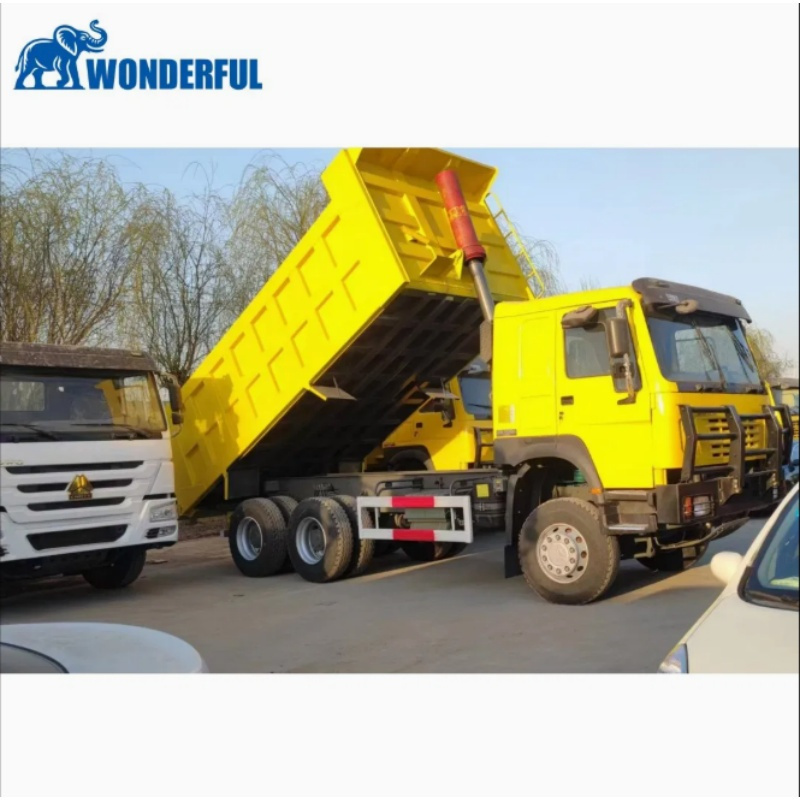
The SHACMAN X3000 dump truck uses a frame described as 850 x 300 (8+7) mm, built as an ultra-thick multi-plate beam with four main pieces and made from high-strength Q345B alloy steel. The SINOTRUK 6x4 dump truck uses a double-layer frame with dimensions given as 8+8 / 300 mm. In practical terms, both are heavy reinforced ladder frames with a 300 mm section depth; the difference lies in how the material is distributed, with the X3000 specification emphasising a four-piece multi-plate main beam and the SINOTRUK specification describing a two-layer 8 mm plus 8 mm construction. Neither approach is universally superior. What a buyer should verify is the delivered frame drawing, the welding and riveting standard applied, and whether the reinforcement matches the actual payload and road profile rather than the most demanding profile in the catalogue.
Axle specification also diverges. The X3000 lists a HANDE MAN 9.5 T front axle and a HANDE 16 T MAN double-stage widened rear axle with a final drive ratio of 5.262. The SINOTRUK unit lists a VGD95 front axle with drum brake and MCP16ZG dual rear axles with a ratio of 5.45. The ratio difference is small but directionally meaningful: the numerically higher 5.45 ratio on the SINOTRUK unit provides slightly more torque multiplication at the wheel for a given engine output, which favours heavy starting loads and steep grades, while the 5.262 ratio on the X3000 is marginally more oriented toward road speed at a given engine speed. Tyre fitment is comparable in size across the two dump trucks, at 12.00R20, with the SINOTRUK unit additionally specifying an 18PR load rating and a mixed tread pattern.
Body volume is where the two dump trucks separate most clearly for hauling economics. The X3000 body measures 5600 x 2300 x 1400 mm with an 8 mm floor and 6 mm sides. The SINOTRUK body measures 5600 x 2300 x 1500 mm, also with an 8 mm bottom and 6 mm sides, but constructed from Q355 manganese plate in a square grid large box. The 100 mm side-height difference changes nominal volume, and the manganese-plate specification is a wear-oriented material choice for abrasive loads such as aggregate and ore. Buyers hauling dense, abrasive material should treat the body material specification as a cost-of-ownership item, not a cosmetic one.
Fuel efficiency: what can be verified, and what cannot
Fuel is usually the largest single operating cost in a heavy truck fleet, which makes it the area most vulnerable to unverifiable claims. In the data reviewed for this comparison, no standardised fuel consumption value is published for the F3000, the X3000 dump or the SINOTRUK 6x4 dump. Any specific litres-per-100-kilometre figure quoted for these platforms should therefore be treated as route-specific and validated by the buyer, not accepted as a general property of the model.
What the verified record does support is narrower but more useful. A documented fleet delivery of 18 units to a heavy-duty commercial vehicle OEM in Ghana, applied to transportation work, records optimised fuel efficiency as a contributing factor in reducing fleet operating costs, alongside reliable and stable operation. That is a customer-reported outcome for a specific deployment, not a benchmark that can be transferred to another route, load factor or driver population.
Three specification facts do have a defensible bearing on fuel consumption and are worth weighing during evaluation. First, both the X3000 dump and the SINOTRUK dump carry 400 L fuel tanks, with the X3000 specifying an aluminium alloy tank; tank capacity sets the practical range between refuelling stops, which matters in remote mining and construction logistics. Second, gearing affects how efficiently engine output is converted into motion: the 5.262 final drive on the X3000 and the 5.45 on the SINOTRUK unit will produce different engine speeds at the same road speed, which in turn affects consumption on flat highway legs versus loaded grades. Third, aerodynamics matter for tractor work in particular, and neither the F3000 nor the X3000 cab specification cited here includes a top guide cover, which is the roof fairing used to reduce drag on long-haul tractor units. Fleets planning sustained high-speed highway operation should factor that into their expectations rather than assume tractor-level highway economy from an unfaired cab.
Certification and market access: the constraint layer that decides the shortlist
For a research-to-evaluation purchase, compliance is often the factor that removes a model from consideration before price is discussed. The heavy duty truck and semi-trailer scope offered by SHANDONG WONDERFUL AUTO COMPANY LIMITED holds China Compulsory Certificate (CCC) certification issued by China Automotive Certification Center Co., Ltd. The certificate number is 2020091101023320, the applicable standard is CNCA-C11-01:2020 (Rules for Compulsory Product Certification - Automobiles), the certification scope is Special Vehicles, and it is valid for the Mainland China market from 2025-12-10 to 2030-12-09. The F3000, the X3000 dump and the SINOTRUK 6x4 dump are all listed as related products under that certification.
Two conclusions follow, and both are constraints rather than selling points. First, the CCC certificate is scoped to Mainland China. It does not by itself authorise registration in an export market; buyers in Africa, Southeast Asia or the Middle East must complete destination-market homologation and registration separately, and should confirm which documents the supplier will provide for that process. Second, emission class drives the addressable market. The X3000 dump is EURO 5, while the F3000 tractor is Euro II. Those two vehicles cannot be sold into the same set of national markets, and the gap will widen as more jurisdictions tighten limits. For reference, the US Environmental Protection Agency finalised its Phase 3 greenhouse gas standards for heavy-duty vehicles beginning in model year 2027, requiring roughly an 80% reduction in NOx, which illustrates the direction of regulation in major markets even where those rules do not apply directly.
One further constraint is worth flagging because it appears in the cited specification rather than in marketing material: the X3000 dump configuration as listed is not fitted with ABS. Buyers operating in markets with braking-system requirements, or on steep and frequently wet routes, should confirm whether ABS or an equivalent braking-assistance specification is available for their order, and whether it is required for registration in the destination country.
Application fit: matching each configuration to a working condition
The published application profile for these products covers manufacturing, engineering, mining, agriculture and logistics industries, with working conditions described as heavy load, highway, unpaved road and steep slope. Typical project types include mining projects, road construction, infrastructure development, port logistics, bulk cargo transportation and agricultural product transport, with matched equipment spanning cargo, flatbed, lowbed, rear dump, side dump, cement tanker and fuel tanker semi-trailers, and operation described as 24/7 in the most demanding deployments. Stated requirements include high wear resistance, rust resistance, adaptability to poor road conditions, easy maintenance and long service life.
Against that profile, the three configurations land in different places.
The X3000 6x4 dump truck is the strongest fit where loaded descents and mixed on-off road surfaces dominate. Its CUMMINS 440 HP EURO 5 engine, hydraulic retarder, 16 T rear axle with widened double-stage construction and 12.00R20 mixed on-off road tyres are all consistent with quarry, mining and heavy infrastructure hauling, and its 82 km/h maximum speed indicates a platform designed around haul-cycle productivity rather than long-distance highway travel.
The SINOTRUK 6x4 dump truck fits aggregate, ore and construction-material hauling where body wear and material robustness are the deciding factors. Its 1500 mm side height, Q355 manganese square-grid body, double-layer 8+8 / 300 mm frame and reinforced multi-leaf spring suspension are oriented toward abrasive, high-density loads, and the 371 hp engine with direct-connection PTO supports tipper operation in continuous duty cycles.
The F3000 6x4 tractor serves a different role altogether. As a tractor unit it is intended to pull semi-trailers rather than carry a body, and its Euro II emission class narrows its market to jurisdictions that still permit that standard. Within those markets it is a straightforward, mechanically conventional option for general freight and bulk transport where the trailer fleet, not the tractor, carries most of the payload variability.
Supplier-side constraints: lead time, volume and customisation
Specification comparison is only half of a procurement decision. The other half is whether the supplier can deliver the specified configuration on the buyer's schedule. Published capability data for SHANDONG WONDERFUL AUTO COMPANY LIMITED lists a monthly capacity of 500 units, a lead time of 30 to 45 days, a minimum order quantity of 1 unit, 100% testing as the quality-control standard, OEM, ODM, CKD and SKD production modes, customisation of logo, colour, material and shape, and a one-year warranty. Export markets are listed as Africa and Southeast Asia.
For fleet buyers, those figures translate into specific planning rules. A minimum order quantity of one unit means a pilot or single-unit validation is commercially possible before committing to a fleet order, which is the lowest-risk way to test any claim that cannot be verified from a specification sheet, particularly fuel consumption and body wear. A 30 to 45 day lead time needs to be positioned against the project mobilisation date rather than the order date, because shipping, customs clearance and inland transport are additional to that window. CKD and SKD modes give buyers in markets with local assembly capacity or import-duty structures an alternative to complete-vehicle importation, while logo, colour and material customisation allows the same base platform to be aligned with a fleet's branding and with specific wear requirements.
The documented Ghana delivery of 18 units to a heavy-duty commercial vehicle OEM, used in transportation, provides a reference for fleet-scale supply rather than single-unit sale. Buyers evaluating a supplier should ask for references in their own region and operating profile, because the same truck specification produces different reliability outcomes on paved highway and on unpaved haul roads.
Where each platform falls short: boundaries buyers should not ignore
An honest comparison has to state limits, and this comparison has several.
- Emission-class restriction. The F3000 is Euro II. That confines it to markets that still permit Euro II registration and makes it unsuitable for any jurisdiction already enforcing Euro V or equivalent limits.
- ABS not fitted on the cited X3000 configuration. The published specification states ABS is not included. Buyers should verify whether this is acceptable for their destination market and, if not, whether an alternative braking specification can be ordered.
- No top guide cover on either SHACMAN cab specification. Both the F3000 medium-length flat roof cab and the X3000 long flat roof cab are listed without a guide cover. Long-haul buyers expecting aerodynamic highway economy should confirm whether a fairing option exists.
- CCC is a Mainland China certificate. It does not substitute for destination-market homologation, and buyers outside China must plan for their own compliance process.
- 400 L tanks on both dump trucks. That capacity is adequate for regional hauling but constrains range in remote operations with long refuelling intervals.
- Incomplete published data. Frame, axle, tyre and brake specifications are not published for the F3000; cab and rear-brake detail are not published for the SINOTRUK unit. Those gaps must be closed in writing before a purchase order, not assumed from platform family.
- Fuel consumption is not published as a standardised figure. Consumption differences between these three models should be treated as unverified until measured on the buyer's own routes.
Market context: what the numbers say about this comparison
Two structural facts shape the SHACMAN-versus-SINOTRUK decision. First, Chinese supply is now a mainstream source rather than a marginal one: in the first half of 2024, China's total truck exports reached 351,000 units, with one out of every three heavy trucks seen overseas originating from China, according to CAAM data. Second, the supplier landscape is concentrated but not dominated by a single player: Daimler Truck led the global market with a share of over 12% in 2025, while the top five players, Daimler, PACCAR, Sinotruk, TRATON and Volvo, held 32% collectively, according to Global Market Insights. Both SHACMAN and SINOTRUK therefore operate in a market where brand prestige is a weak differentiator and specification fit, parts availability and total cost of ownership are the practical levers.
A second shift is also visible in the same data set. The global electric heavy-duty truck market is projected to grow from USD 14.84 billion in 2026 to USD 101.02 billion by 2034, according to Fortune Business Insights, and S&P Global Ratings forecasts that heavy-duty electric truck penetration in China will exceed 20% in 2026, driven by subsidy-led replacement and charging infrastructure growth. For diesel platforms such as the three compared here, that does not eliminate demand; it concentrates it. Segments where diesel remains the rational choice, including remote mining, long-haul freight and markets without charging infrastructure, will keep absorbing mechanical, easily serviced platforms, while urban and short-cycle operations migrate first.
Future outlook
Over the next several years the deciding variable for these platforms is likely to be compliance rather than hardware. Emission thresholds are tightening in major markets, and the practical consequence for buyers is that the usable life of a Euro II platform depends on the regulatory timetable of the country it is registered in, not on the condition of the truck. That argues for matching emission class to the intended operating market and expected service life at the point of purchase, and for treating a mixed diesel fleet as a portfolio decision rather than a per-unit one.
The second trend is the gradual standardisation of the specification information buyers will expect. As more fleet purchases are evaluated against written specification records rather than verbal assurances, suppliers that publish complete data, including the fields currently marked as not specified in this comparison, will be easier to shortlist. That is a benefit to buyers: it reduces the cost of comparing offers and makes it harder for unverifiable performance claims to survive the evaluation stage.
FAQ
What are the main specification differences between the SHACMAN X3000 6x4 dump truck and the SINOTRUK 6x4 dump truck?
The SHACMAN X3000 dump truck (model SX3258W384C) uses a CUMMINS ISM11E5 440 engine rated at 324 kW / 440 HP meeting EURO 5, a 12JSD200T-B transmission with QH50 and an FHB400 hydraulic retarder, an 850 x 300 (8+7) mm Q345B frame, a HANDE MAN 9.5 T front axle and a 16 T rear axle with a 5.262 ratio, and a cargo body of 5600 x 2300 x 1400 mm. The SINOTRUK ZZ3257N384GB1R uses a WD615.47 engine rated at 371 hp, an HW19710 gearbox with HW50 direct-connection power take-off, a double-layer 8+8 / 300 mm frame, a VGD95 front axle and MCP16ZG dual rear axles with a 5.45 ratio, and a 5600 x 2300 x 1500 mm body in Q355 manganese plate.
Which emission standards do these trucks meet, and what does that mean for market access?
The SHACMAN X3000 6x4 dump truck meets EURO 5. The SHACMAN F3000 tractor is specified with a WP10.340E22 engine meeting Euro II. The emission standard is not stated in the cited specification for the SINOTRUK ZZ3257N384GB1R. Emission class determines which national markets can register the vehicle: a Euro II tractor cannot be registered where Euro V or equivalent limits apply, so the F3000 and the X3000 do not have the same addressable market.
Is SHACMAN X3000 dump truck certified for the Chinese market?
Yes. The heavy duty truck and semi-trailer scope holds China Compulsory Certificate (CCC) number 2020091101023320, issued by China Automotive Certification Center Co., Ltd. under standard CNCA-C11-01:2020, with Special Vehicles as the certification scope and validity from 2025-12-10 to 2030-12-09 for the Mainland China market. The SHACMAN X3000 dump truck is listed as a related product under that certification.
What are the main limitations of these three heavy duty truck configurations?
Several limits are documented. The SHACMAN F3000 tractor is Euro II, which restricts its market. The cited SHACMAN X3000 configuration is not fitted with ABS. Neither the F3000 medium-length flat roof cab nor the X3000 long flat roof cab specification includes a top guide cover, which affects long-haul aerodynamics. The CCC certificate applies to Mainland China only and does not replace destination-market homologation. Both dump trucks carry 400 L fuel tanks, which constrains range in remote operations. Frame, axle and brake specifications are not published for the F3000, and cab and rear-brake detail are not published for the SINOTRUK unit.
How should a fleet buyer validate power, durability and fuel efficiency before ordering?
Because a minimum order quantity of one unit applies, a single-unit pilot deployment is the most reliable validation route. Powertrain and durability can be checked against the written specification, including engine model, rated power, transmission model, frame dimensions and rear-axle ratio, and confirmed against the delivered vehicle. Fuel efficiency is not published as a standardised value for these models, so it should be measured on the buyer's own routes with a defined payload and average speed, and compared against the same baseline for each candidate model rather than against a supplier-quoted figure.
Product specification sheets, the CCC certification record and the current company brochure for SHANDONG WONDERFUL AUTO COMPANY LIMITED are available for review and download, providing the underlying data behind this comparison.
Tem questões ou precisa de mais detalhes?
Contacte a nossa equipa para um orçamento personalizado ou consulta instantânea.
Solicitar orçamento
Preencha o formulário abaixo e a nossa equipa entrará em contacto com uma proposta personalizada.
Chat direto do WhatsApp
Prefere conversar em tempo real? Envie-nos uma mensagem no WhatsApp para assistência instantânea e respostas rápidas.
- Obter orçamento personalizado
- Partilhar fotos ou documentos
- Discuta as suas necessidades diretamente
Geralmente responde em 5–30 minutos durante o horário de expediente.