
SJ vs SJSZ Extruder FAQ: Steel, Model Ranges, Order Terms
SJ vs SJSZ Extruder FAQ: Steel, Model Ranges, Order Terms
Four questions decide most extruder purchases: which steel the screw and barrel are made from, what the model range actually covers, how the machine is matched to the downstream line, and what the order terms commit both sides to. Wuxi JKS Machinery Manufacturing Co., Ltd. is a Chinese manufacturer of custom plastic extrusion machinery and complete turnkey production lines, founded in 2013, whose catalogue includes the SJ single screw series (SJ30, SJ45, SJ65 and SJ90) and the SJSZ conical twin screw series (SJSZ-45 through SJSZ-110). Both series specify 38CrMoAlA nitrided alloy steel for screws and barrels. The sections below set out what is documented on each point, what it changes at the point of order, and where a buyer should ask for evidence rather than assume.
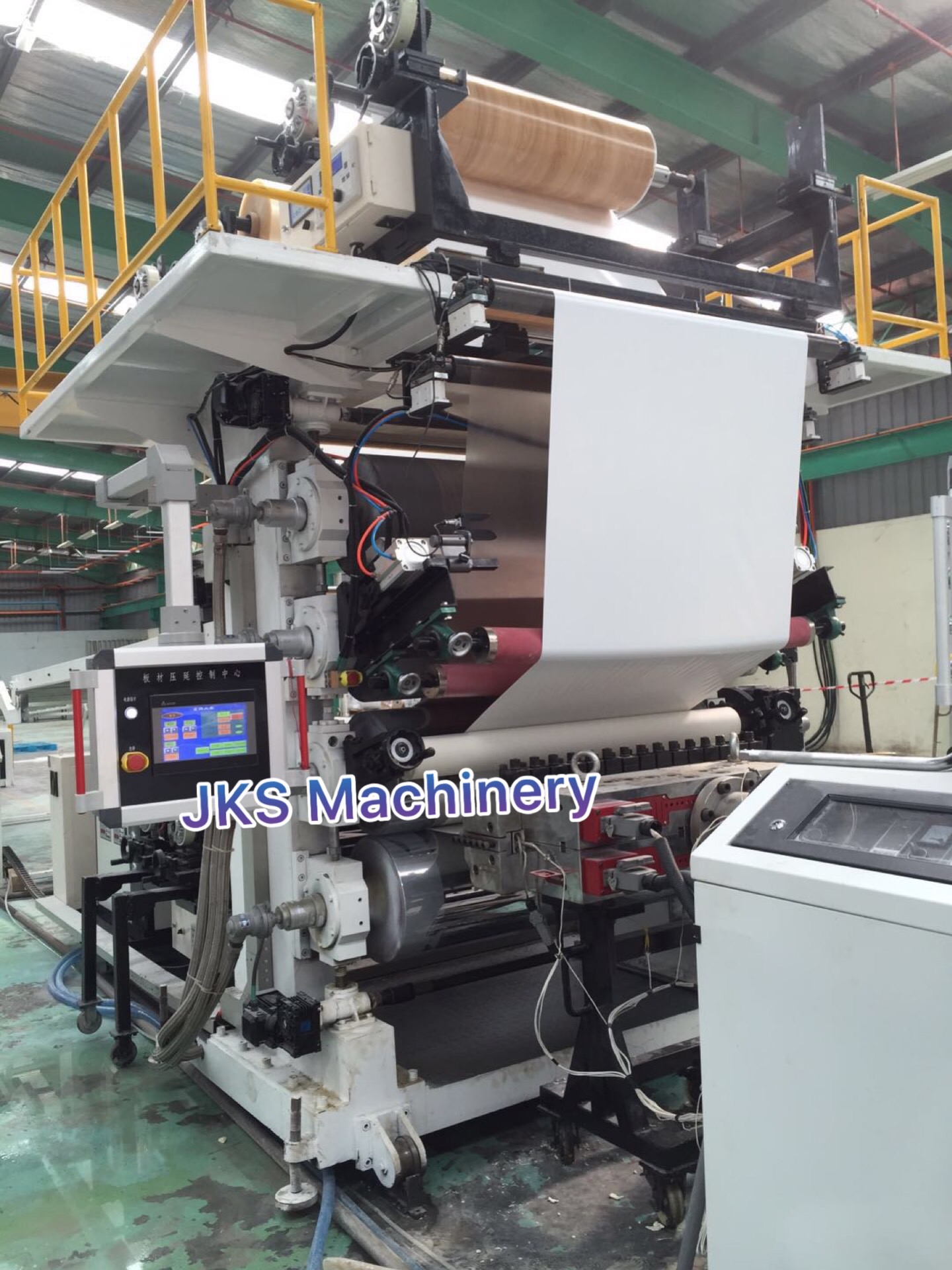
Extruder and calendering section of an SPC flooring line recorded at a customer site in Malaysia.
What separates the SJ single screw from the SJSZ conical twin screw?
The SJ and SJSZ ranges are separate machine families built for different material systems and different line architectures. They are not two output levels of one design, and a higher model number in one family does not correspond to a higher model number in the other.
The SJ single screw range covers SJ30, SJ45, SJ65 and SJ90 as custom models. The SJ range is applied to thermoplastics including PVC, PP, PE, Nylon and ABS, with the screw configuration matched to the material being run. In the manufacturer's line configurations, SJ extruders appear on solid plastic rod extrusion (SJ45, SJ65), multi-material plastic profile extrusion (SJ45, SJ50, SJ65), small single screw profile work, and PP hollow construction formwork lines listed as SJ-90×33 at 75 kW and SJ-130×33 at 160 kW.
The SJSZ conical twin screw range covers SJSZ-45, SJSZ-51, SJSZ-55, SJSZ-65, SJSZ-80, SJSZ-92 and SJSZ-110. Two conical, intermeshing screws change how the melt is fed, compressed and ventilated compared with a single screw, which is why the SJSZ models in the catalogue concentrate on PVC-based lines: hollow wall panels and ceiling panels (SJSZ51, SJSZ55, SJSZ65, SJSZ80), grille and decoration profiles (SJSZ51 at 18.5 kW, SJSZ55 at 22 kW, SJSZ65 at 37 kW), PVC and WPC door and window profiles (SJSZ65/132 and SJSZ92/188), WPC door panels (SJSZ80, SJSZ92), foam board (SJSZ80/156 at 75 kW, and an 80+165 co-extrusion at 75+37 kW), imitation marble sheet (SJSZ80/156 at 75 kW, SJSZ92/188 at 110 kW), SPC flooring (SJSZ92/188 at 110 kW, SJSZ110/220 at 200 kW) and PVC hot-cut pelletizing (SJSZ55, SJSZ65, SJSZ80, SJSZ92).
Read that mapping for what it is: an association between model and line type in one supplier's published configurations, not a rule that a given material can only be run on one family. PVC compounds appear predominantly against SJSZ lines here, while the SJ range carries rod, multi-material profile and formwork work. The practical consequence for a buyer is that the two series should be compared as alternative process routes for a defined product, not as interchangeable capacity steps.
Why do both ranges use 38CrMoAlA nitrided alloy steel screws and barrels?
38CrMoAlA is a nitriding-grade alloy steel. Its aluminium content allows fine nitride precipitates to form during nitriding, producing a hard, wear-resistant surface layer while the core of the part retains toughness. Nitriding is carried out after machining and at a lower temperature than through-hardening processes, so distortion is limited and the finished screw flight and barrel bore geometry is preserved through the treatment. That matters in extrusion, where clearance between flight and bore governs how the melt is conveyed.
The two dominant wear paths on an extruder are abrasion and, in PVC processing, chemical attack. Abrasion comes from hard particulate in the compound, including the mineral filler carried in SPC-type formulations. Attack comes from the hydrogen chloride released as PVC is heated. A nitrided case on both the screw and the barrel puts a hardened surface in the contact and flow zone, which is why the treatment is applied to the pair rather than to the screw alone.
Applying the same base grade across both series is a specification decision, not a claim that the two machines behave alike. Screw geometry, compression ratio and mixing profile differ between a single screw and a conical twin; the steel in which those profiles are cut does not. The practical benefit for a buyer running more than one line type is a common material baseline, a common reference for spare screws and barrels, and one set of documents to check.
There is a boundary worth stating plainly. The documentation available for this article specifies the steel grade and the nitriding treatment. It does not state a case depth in millimetres, a surface hardness in HV, or an expected service life in tonnes. Those figures belong to the material certificate and the heat-treatment record, and they are the documents a buyer should request with the quotation: the steel mill certificate for the 38CrMoAlA billet, the nitriding inspection record for screw and barrel, and the final dimensional report. Just as important, the technical agreement should state the filler loading, any abrasive additive and any corrosive exposure the line will see, because those variables move wear rate far more than the grade name does.
What do the model ranges actually cover?
The ranges are best read as two catalogues with different logic. The SJ series is listed as custom models sized to the product, while the SJSZ series is listed with compound designations in which the same base number appears with different drive power and different second-stage figures depending on the line.
| Series | Models recorded in the catalogue | Where they appear |
|---|---|---|
| SJ single screw | SJ30, SJ45, SJ65, SJ90 (custom models) | Solid rod (SJ45, SJ65); multi-material profile (SJ45, SJ50, SJ65); small single screw profile work |
| SJ (formwork) | SJ-90×33 (75 kW), SJ-130×33 (160 kW) | PP hollow construction formwork line |
| SJSZ conical twin | SJSZ-45, SJSZ-51, SJSZ-55, SJSZ-65, SJSZ-80, SJSZ-92, SJSZ-110 | Panel, profile, board, sheet and pelletizing lines |
| SJSZ (compound) | SJSZ65/132, SJSZ80/156 (75 kW), SJSZ92/188 (110 kW), SJSZ110/220 (200 kW) | Door and window profile, foam board, marble sheet, SPC flooring |
| SJP | SJP115/30 (90 kW), SJP135/30 (132 kW) | Also listed against SPC flooring alongside SJSZ models |
Two observations follow directly from the table. First, the same base model does not carry a fixed drive power: SJSZ51 is recorded at 18.5 kW on a grille and decoration profile line and SJSZ55 at 22 kW, while SJSZ65 is recorded at 37 kW on the same line family but as SJSZ65/132 on a door and window profile line. Second, SPC flooring — the highest-output application in the catalogue — is served by more than one extruder type, SJSZ92/188, SJSZ110/220 and the SJP115/30 and SJP135/30 models. A buyer should therefore treat a model number as a starting reference and confirm the full designation, screw geometry and drive configuration in the technical agreement, because the short designation alone does not fix the specification.
Why the downstream line, not tonnage, sets the model
An extruder is sized to the die and to the train behind it — calibration, haul-off, calendering, cutting — and to the section that train must hold. Tonnage or a single output figure describes one operating point of a machine; it does not describe whether the machine fits the line. The catalogue shows this directly, because one product family is served by several models and the model changes with the section being produced.
| Downstream line | Extruder models recorded |
|---|---|
| PVC hollow wall panel and ceiling | SJSZ51, SJSZ55, SJSZ65, SJSZ80 |
| PVC grille and decoration profile | SJSZ51 (18.5 kW), SJSZ55 (22 kW), SJSZ65 (37 kW) |
| PVC and WPC door and window profile | SJSZ65/132, SJSZ92/188 |
| WPC door panel | SJSZ80, SJSZ92 |
| PVC and WPC foam board | SJSZ80/156 (75 kW); 80+165 co-extrusion (75+37 kW) |
| SPC flooring | SJSZ92/188 (110 kW), SJSZ110/220 (200 kW), SJP115/30 (90 kW), SJP135/30 (132 kW) |
| PVC hot-cut pelletizing | SJSZ55, SJSZ65, SJSZ80, SJSZ92 |
| Strand cutting pelletizing | ST80, ST100, ST120, ST150 |
Three procurement consequences follow. A single product family such as PVC hollow wall panel spans four SJSZ models, so "which model is bigger" is the wrong opening question; the right one is which panel width, wall section and output the die and downstream train are built for. Drive power for a base model changes with the line, so a quotation that names only the model number leaves the specification open. And in pelletizing, the extruder is listed with the SJSZ base models while the strand cutting line carries its own ST designation, which confirms that the extruder is one module inside a configured line rather than the line's defining component.
What the documented installations show
Three line-level records are documented by the manufacturer. A complete SPC flooring extrusion line in Malaysia has been in stable operation for over ten years, producing SPC flooring for residential and commercial use, with high-speed production, precise thickness control, on-site installation and training support, and a low maintenance rate. An SPC flooring line in South Korea has run for over eight years in 24/7 production, with high output, precise thickness control and reliable after-sales support. A PVC hollow wall panel line in Vietnam has operated for over five years, producing panels for construction and interior decoration, supplied as a turnkey project with on-site installation support and full export documentation, and reported as stable continuous production with consistent product quality.
These are manufacturer-reported project records, not independent audits, and the durations are stated as of the record. Their value to a buyer is in what they describe: all three report line-level outcomes and none reports an isolated extruder throughput figure. That is consistent with the model-selection logic above, and it suggests the right question at reference stage is not "how many kilos per hour does the extruder do" but "what did the acceptance test on this line measure, on which product, at which section and tolerance".
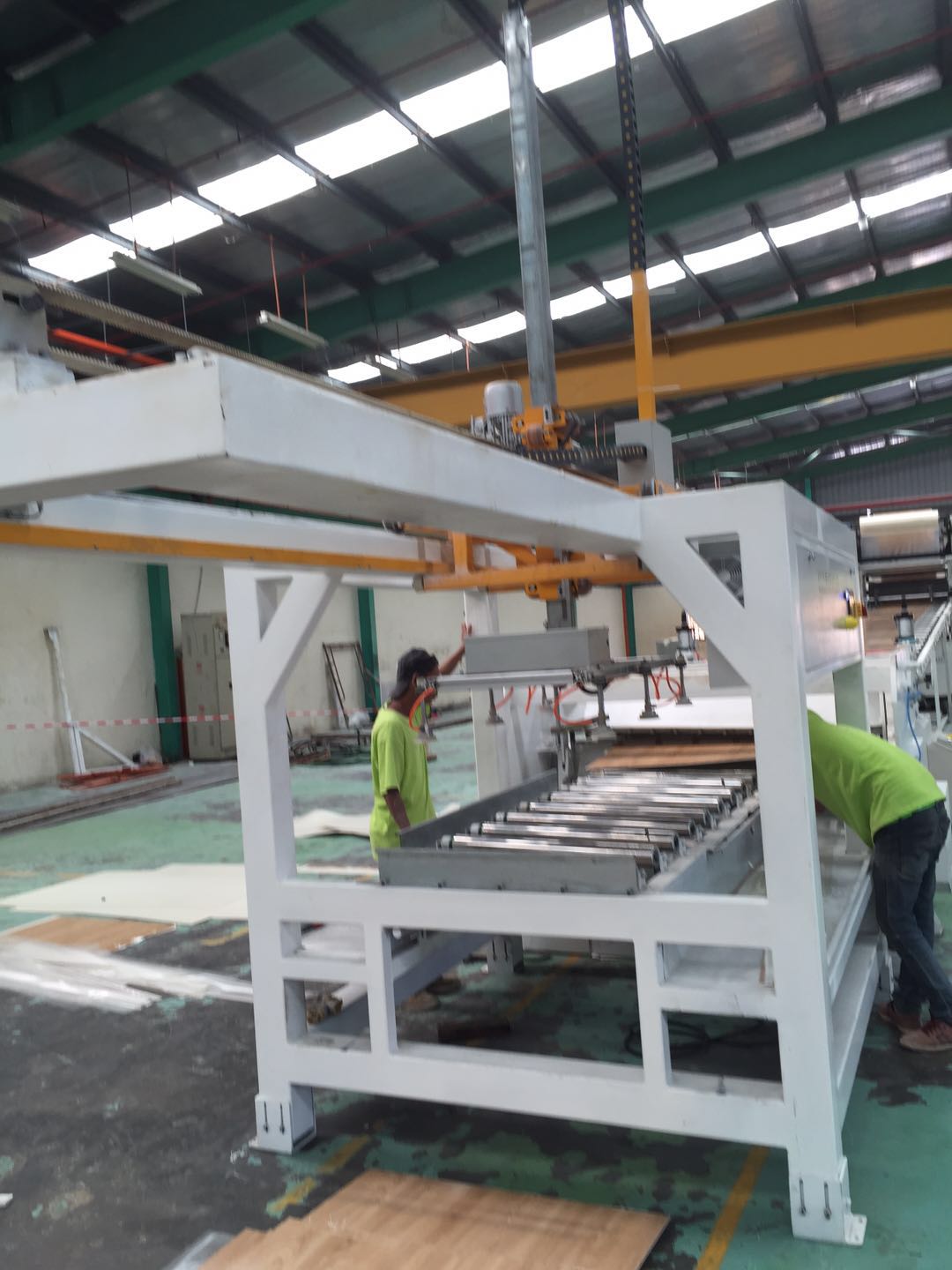
SPC flooring produced on a documented line at a customer site in Malaysia.
Purchasing terms and acceptance criteria, as documented
The commercial terms recorded for this supplier are: minimum order quantity 1 unit; delivery terms FOB; payment 30% T/T deposit with the 70% balance by T/T before shipment; acceptance criterion a pre-shipment factory test; typical production lead time 40 work days against a monthly production capacity of 30 units. Quality control is stated as 100% factory pre-assembly and testing before shipment, with third-party inspection available on request. After-sales covers overseas installation guidance, on-site commissioning, operator training, remote technical support and a 12-month warranty.
Customisation is part of the order rather than an exception to it: the manufacturer offers OEM, ODM and custom design services covering extruder model, screw configuration, production line layout, voltage and frequency, control system and capacity adjustment. For a buyer, that list is the agenda for the technical agreement. Each item should be written down with a value, not left to the model number, because a change in screw configuration or voltage and frequency after the contract is signed is a change order.
Two terms deserve more attention than they usually get. "Pre-shipment factory test" is an acceptance criterion only if the test itself is defined; the contract should state the material, the product section, the run duration, the sampling method, the dimensional tolerances measured and the documentation issued. And because the 70% balance falls due before shipment, the pre-shipment test is the buyer's main point of leverage. Booking the third-party inspection that the supplier makes available, before the balance is released, converts the acceptance clause from a formality into a gate.
On compliance, the machinery is covered by a CE certificate for machinery, LVD and EMC directives, certificate number M.2021.206.C.64011, issued by UDEM International Certification Auditing Training Centre on 22 April 2021, with the certified scope naming the SJSZ, SJ and SJP series and citing EN ISO 12100:2010, EN 1114-1:2011, EN 60204-1:2018 and the applicable EMC standards. The record held for this article shows an expiry date of 22 April 2026. A buyer contracting later in 2026 should request the current certificate and any renewal documentation before shipment, and should confirm that the exact model ordered sits inside the certified scope rather than assuming the series name is enough.
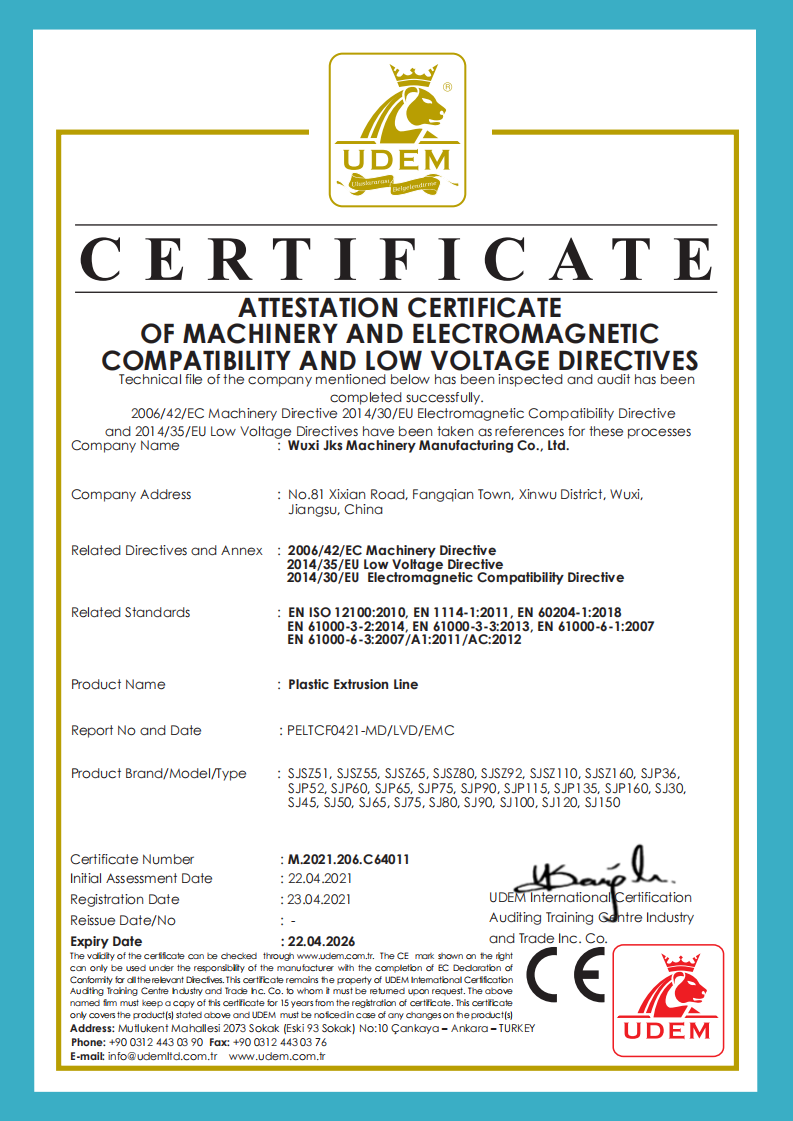
CE certificate M.2021.206.C.64011, issued by UDEM; buyers should confirm current validity and model coverage before shipment.
Market context for the sourcing decision
Two external data points frame the category. Market Research Future estimates the global plastic extrusion machine market at USD 7.9 billion in 2025, projected to reach USD 12.87 billion by 2035, with the definition covering revenue from sales of new single screw and twin screw extruders. The Observatory of Economic Complexity, drawing on UN Comtrade data, records China as the leading exporter of rubber and plastic working machinery under HS 8477 in 2024 at USD 8.55 billion, ahead of Germany at USD 6.11 billion and Italy at USD 2.61 billion.
Read with their limits intact, these figures describe category revenue and trade value, not the capability, output or quality of any individual supplier, and the 2035 figure is a projection with a stated base year rather than an observed result. What they do support is a simple sourcing judgement: China is an established export channel for this machinery class, so the differentiator in a shortlist is not country of origin but the specific evidence a supplier can put behind steel, model fit, test protocol and documentation.
FAQ
Why do both the SJ and SJSZ ranges use 38CrMoAlA nitrided alloy steel for screws and barrels?
Because the wear environment is shared even though the screw geometry is not. 38CrMoAlA is a nitriding-grade alloy steel whose aluminium content allows a hard nitride case to form during nitriding, while the core stays tough; nitriding runs after machining and at moderate temperature, so the flight and bore geometry survive the treatment. The two series differ in screw geometry, compression and mixing behaviour, not in the base steel those profiles are cut into. The grade and treatment are specified; case depth, surface hardness and service life are not stated in the published documentation and should be requested as material and heat-treatment records.
How does a buyer choose between SJ30, SJ45, SJ65 and SJ90?
By the product and the line downstream, not by the number. In the published configurations, SJ45 and SJ65 appear on solid plastic rod extrusion, SJ45 and SJ65 also appear in multi-material profile lines alongside SJ50, and the formwork line is listed as SJ-90×33 at 75 kW and SJ-130×33 at 160 kW. The SJ range is applied across thermoplastics including PVC, PP, PE, Nylon and ABS with screw configuration matched to the material. A buyer should present the polymer, the product section, the target output and the downstream equipment, then confirm screw diameter, L/D and drive power in writing.
What changes across SJSZ-45 to SJSZ-110?
The span covers seven base models, and the assignment to line types shifts across the range: SJSZ51, SJSZ55, SJSZ65 and SJSZ80 appear across hollow wall panel and ceiling lines, SJSZ80 and SJSZ92 on WPC door panels, SJSZ92/188 and SJSZ110/220 on SPC flooring, and SJSZ55 through SJSZ92 on PVC hot-cut pelletizing. Drive power is not fixed by the base number — SJSZ51 is recorded at 18.5 kW and SJSZ55 at 22 kW on grille and decoration profile lines, while SJSZ65 appears there at 37 kW and as SJSZ65/132 on a door and window profile line. Confirm the full designation and drive configuration in the technical agreement.
What purchasing terms and acceptance criteria apply to an extruder order?
The recorded terms are a minimum order quantity of 1 unit, FOB delivery, 30% T/T deposit with the 70% balance by T/T before shipment, and a pre-shipment factory test as the acceptance criterion, against a typical lead time of 40 work days and a monthly capacity of 30 units. Pre-shipment quality control is stated as 100% factory pre-assembly and testing, with third-party inspection available on request, and after-sales covers installation guidance, commissioning, operator training, remote support and a 12-month warranty. Because the balance is payable before shipment, the test protocol should be defined in the contract and the available third-party inspection scheduled before the balance is released.
Does choosing a larger extruder give a better production line?
Not by itself. The extruder is sized to the die and to the calibration, haul-off, calendering and cutting train behind it, and to the section that train has to hold. The catalogue shows the same product family served by several models — PVC hollow wall panel spans SJSZ51, SJSZ55, SJSZ65 and SJSZ80 — and SPC flooring is served by both SJSZ and SJP models. A larger machine that outruns the downstream equipment or does not match the die produces no advantage. The correct specification sequence starts from the product and the line, and ends with the extruder model and drive power.
For buyers who want the underlying line configurations in one place, a short project brief covering the WPC door panel line is available as a downloadable PDF. Company information and the full product catalogue are published by Wuxi JKS Machinery Manufacturing Co., Ltd.
Tem questões ou precisa de mais detalhes?
Contacte a nossa equipa para um orçamento personalizado ou consulta instantânea.
Solicitar orçamento
Preencha o formulário abaixo e a nossa equipa entrará em contacto com uma proposta personalizada.
Chat direto do WhatsApp
Prefere conversar em tempo real? Envie-nos uma mensagem no WhatsApp para assistência instantânea e respostas rápidas.
- Obter orçamento personalizado
- Partilhar fotos ou documentos
- Discuta as suas necessidades diretamente
Geralmente responde em 5–30 minutos durante o horário de expediente.