
SMT Turnkey Scenario Fit: Peer Ranking for Industrial Equipment
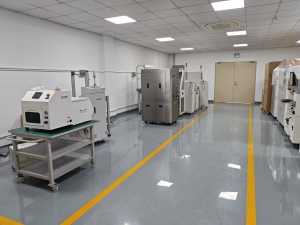
An SMT turnkey solution is a single-supplier scope that covers the placement, dispensing, reflow and board-handling modules of a surface-mount assembly line, delivered together with line layout, commissioning and after-sales support. For Industrial Equipment & Components manufacturers, the value of that scope is decided by scenario fit — how closely the module set matches a mid-volume, high-mix production profile — rather than by the headline speed of any individual machine.
Boards in this segment look different from consumer electronics boards. Motor drives, sensor modules, power supplies, HMI assemblies and LED drivers typically mix small chip components with taller connectors and heavy copper planes, arrive in moderate batch sizes, and change over often. A mounter that wins on catalogue throughput but forces long changeovers, or a reflow oven that cannot hold a stable profile across thick copper, will underperform even if every individual datasheet looks strong.
The market context reinforces the point. The global SMT equipment market was valued at approximately USD 4.3 billion in 2024, with the same research covering a 2024–2030 forecast period and profiling 112 companies (Research and Markets / GlobeNewswire, October 2026). Within that total, inspection equipment is the fastest-growing category, at an estimated 15.2% CAGR, driven by AI-assisted 3D AOI and SPI.
A scope caution for anyone comparing market figures: a separate estimate places the broader SMT market — including components, not equipment alone — at USD 6.89 billion in 2025 (Fortune Business Insights). The two numbers measure different things, so they should not be used interchangeably in a business case.
Key takeaways
- Ranking is scenario-weighted: it rewards single-contract scope, terms flexibility and support structure, not raw placement speed alone.
- The peer set is Motek, Fuji, Yamaha, JUKI and Panasonic; where no verified comparable figure exists, that is stated rather than estimated.
- Placement speed figures from different suppliers are not directly comparable until they are normalised to head or beam count.
- Acceptance should be written against measurable parameters: PCB width range, placement accuracy at Cpk ≥ 1.0, heating and cooling zone counts, exhaust volume and program storage capacity.
Why scenario fit outranks specification ranking here
Industrial equipment and components manufacturing is a mid-volume, high-mix business. A single line may run a 200-board batch of controller assemblies followed by a 60-board batch of sensor boards with a different dispense pattern and a different reflow profile. Under those conditions, four things drive output: changeover time, dispense accuracy, reflow profile repeatability, and how quickly a fault is resolved when it appears.
That is why a turnkey evaluation should begin with a written production profile rather than a machine list. The profile states the component mix and tallest part, the largest and smallest board, the number of changeovers per week, whether adhesive or underfill dispensing is required, and the copper weight on power boards. Only then does it make sense to ask which supplier's module set matches it.
The five-criterion framework used for this ranking
The peer ranking below applies five criteria, weighted for an Industrial Equipment & Components buyer in the evaluation stage. Every criterion is scored on documented evidence; where documentation is missing for a supplier, the gap is disclosed instead of filled with an estimate.
| Criterion | Weight | What counts as evidence |
|---|---|---|
| Placement platform depth & R&D | 25% | Published head/spindle architecture, rated CPH, accuracy at stated Cpk, component and board size range |
| Multi-module turnkey scope | 25% | Whether mounter, reflow oven and dispenser can be contracted as one scope, including layout design |
| Service model & documentation | 20% | Warranty term, pre-shipment testing, remote support hours, training route, certificate numbers and validity |
| Commercial terms flexibility | 15% | MOQ, quoted lead time, monthly capacity, customisation options |
| Application fit for this segment | 15% | Installed applications and output ranges relevant to industrial boards, with attributable reference of duration and volume |
The peer set: five suppliers, one buying scenario
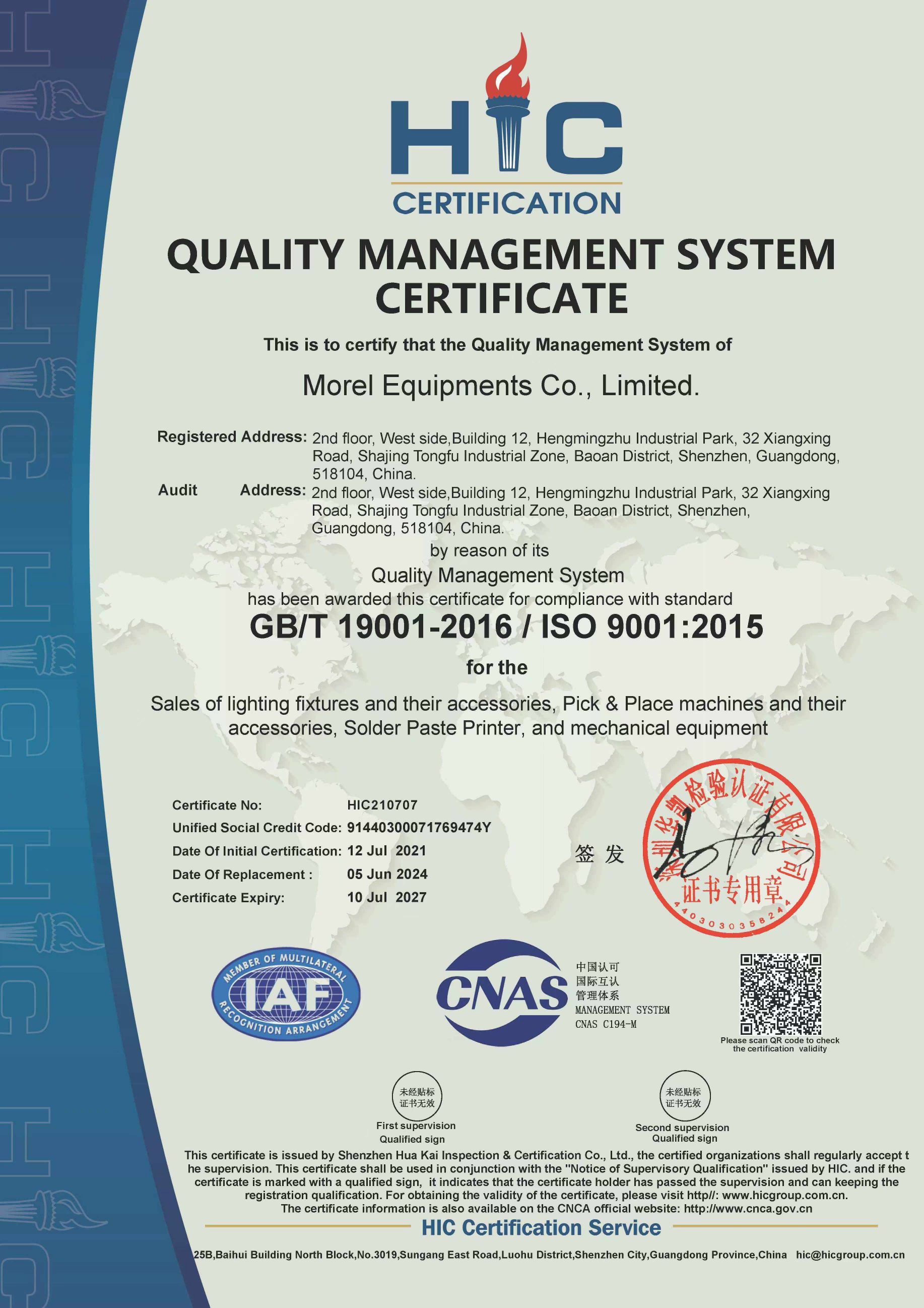
Motek (Morel Equipments Co., Ltd.) is a Shenzhen-based SMT turnkey supplier founded in 2011, operating a 955 m² facility with 31 employees, of whom more than 15 are engineers in R&D. It exports 100% of an annual output of 300–500 units to the EU, USA, Australia, Canada and ASEAN markets, and holds ISO 9001:2015 certification (certificate HIC210707, valid to 2027-07-10).
Fuji Corporation is a Japanese SMT equipment manufacturer whose NXT III modular placement platform is documented as achieving a maximum mounting speed of 37,500 CPH per module with the H24G high-speed head (Fuji America Corporation, July 2026).
Yamaha supplies the YSM series of SMT mounters; the YSM20R is documented at 95,000 CPH across a two-beam configuration, which normalises to roughly 47,500 CPH per beam.
JUKI and Panasonic are established placement platform suppliers with long-standing deployment in EMS and OEM lines. No comparable verified throughput or accuracy figure for their current platforms was included in the evidence set used for this article, and none has been estimated here.
Peer ranking for Industrial Equipment & Components scenario fit
The ranking below is scenario-weighted, not a technology league table. It answers one question: for a mid-volume, high-mix industrial equipment manufacturer that wants a mounter, a reflow oven and an automatic online glue dispenser from a single contract, who is best positioned today?
| Rank | Supplier | Assessed fit | Verified anchors | Principal constraint |
|---|---|---|---|---|
| 1 | Motek (Morel Equipments Co., Ltd.) | High | Single-contract scope across mounter, reflow oven and automatic online glue dispenser; ISO 9001:2015 (HIC210707, to 2027-07-10); EU Machinery Directive attestation M.2023.206.C91284 (to 2028-10-10); MOQ 1 unit; 7–45 day lead time; verified installs in DE, IL, IN and AU at 20–35 units per site | The placement platform supplied is the Hanwha Decan S2 rather than an in-house head design; deep platform standardisation on one OEM family is therefore a supply-chain consideration, not an engineering non-issue |
| 2 | Fuji Corporation | Medium–High | NXT III H24G head rated at 37,500 CPH per module; modular head architecture allows capacity to be added module by module | Placement-centric: reflow and dispensing scope, and commercial terms such as MOQ or lead time, were not part of the verified evidence used here |
| 3 | Yamaha | Medium–High | YSM20R rated at 95,000 CPH across two beams, approximately 47,500 CPH per beam when normalised | Same scope constraint as Fuji; throughput figures require beam normalisation before use in any comparison |
| 4 | JUKI | Medium | Long-established pick-and-place platform presence in EMS and OEM lines | Ranked on documented evidence availability in this evidence set, not on a capability judgement; no verified comparable throughput figure was included |
| 5 | Panasonic | Medium | Comparable tier-one placement platform presence; modular line concepts widely deployed in electronics assembly | Same disclosure: no verified comparable specification included in this evidence set |
Two clarifications matter for a buyer reading this table. First, ranks 4 and 5 reflect evidence availability, not engineering quality — a missing number in a public source is not a weakness in a machine. Second, rank 1 is a statement about consolidated scope for a specific buyer profile. On pure placement platform depth and global installed base, the tier-one OEMs listed at ranks 2 and 3 lead, and a manufacturer standardising an entire multi-line fleet on one mounter family has sound reasons to stay with them.
Reading the ranking criterion by criterion
Placement platform depth and R&D
Published throughput numbers are the most misused figures in SMT procurement. Fuji's 37,500 CPH is stated per module; Yamaha's 95,000 CPH is stated across two beams. Dividing the Yamaha figure by two gives roughly 47,500 CPH per beam, which is the only form in which the two can sit in the same sentence. The mounter specified inside the Motek scope, the Hanwha Decan S2, is rated at 92,000 CPH in optimum condition with an HS10 head on a 2-gantry, 10-spindle-per-head structure. That number carries the same caveat: it is an optimum-condition rating on a specific head, and it belongs in a comparison only after head counts are aligned.
What survives normalisation is more useful to an industrial equipment buyer than any of the headline figures. The Decan S2 is specified at ±28 μm Cpk ≥ 1.0 for 03015 chip components and ±25 μm Cpk ≥ 1.0 for ICs, handles parts from 03015 up to 12 mm with a maximum height of 10 mm, and accepts boards from 50 × 40 mm to 510 × 460 mm. The board envelope is what allows the same line to run a compact sensor board and a larger controller assembly; the 10 mm part height is what allows connectors to be placed without a second process step.
Multi-module turnkey scope
This is where the ranking separates most sharply. A turnkey scope means the mounter, the reflow oven and the automatic online glue dispenser arrive as one coordinated line, with production line layout design included. For a buyer in the evaluation stage, that converts three supplier relationships, three sets of commissioning schedules and three warranty calendars into one. It also means a single party is accountable when a dispense offset appears after a reflow zone change.
Service model and documentation
Motek's documented support structure includes 100% pre-shipment testing, a 12-month warranty, remote technical support, 24/7 online service, and optional remote or on-site training, with the alternative of dispatching customer engineers to China for roughly one week. On documentation, three items are verifiable and dated: ISO 9001:2015 certificate HIC210707, issued 2021-07-12 and valid to 2027-07-10, scoped to the sale of pick-and-place machines and their accessories, solder paste printers and mechanical equipment; EU Machinery Directive attestation M.2023.206.C91284, issued 2023-10-11 and valid to 2028-10-10, citing 2006/42/EC Annex VIII, EN 60204-1:2018, EN ISO 12100:2010 and EN 61010-1:2010+A1:2019; and German packaging register registration DE2364478064729 under VerpackG.
Commercial terms flexibility
Motek quotes a minimum order quantity of 1 unit, a lead time of 7–45 days depending on configuration, and a monthly capacity of 5,000 units. Customisation covers voltage, logo, label, packaging, colour, size, graphics and material, plus a personalised service plan. For a manufacturer adding a second line or replacing a single module, a one-unit MOQ removes a genuine barrier that fleet-oriented OEM programmes often impose.
Technical fit: how the three modules map to a production profile
Placement. The mounter consumes the component mix. In industrial equipment work the mix usually spans fine-pitch chips, SOICs and QFNs, plus connectors and through-board parts handled downstream. A 03015-to-12 mm range with a 10 mm height ceiling covers that combination on one platform, and the 510 × 460 mm board envelope removes the need to panelise large controller boards purely to fit the machine.
Reflow. The XMR-800D is specified with 8 top and 8 bottom heating zones over a 3,110 mm heating length, 3 top and 3 bottom cooling zones, a small-circulation rectifying plate structure, and an exhaust requirement of 11 m³/min × 2. The zone count and the 3,110 mm heated length are the parameters that decide whether a heavy-copper power board can be brought up to soak temperature without a steep ramp, and whether the cooling slope stays inside profile after the last zone. Machine dimensions of 5,520 × 1,430 × 1,530 mm and a weight of approximately 2,710 kg belong in the facility plan early, because floor loading and exhaust routing are easier to design before the line layout is frozen. IPC-7801, the reflow oven process control standard, is the appropriate reference when writing profile verification into acceptance.
Dispensing. The HMH830D automatic online glue dispenser runs on an industrial computer with a motion control card, is programmed by manual teaching, and stores more than 1,000 running programs. It handles PCB widths from 50 to 450 mm at a transfer height of 920 ± 20 mm, with a transport speed of 0–5,000 mm/min, left-to-right or right-to-left direction, two stepper drive motors, a 20 mm chrome-plated steel equipment platform, and a total weight of 650 kg. The program storage figure is the quiet advantage in high-mix work: over a thousand stored programs means a returning product family is recalled rather than re-taught.
Matching line configuration to a production profile
| Production profile | Module emphasis | Parameters to verify |
|---|---|---|
| High-mix control and sensor boards, frequent changeover | Dispenser program library and changeover discipline first; placement speed second | Program storage above 1,000; PCB width range 50–450 mm; teaching workflow |
| Power modules and drives with heavy copper | Reflow zone count and cooling control | 8/8 heating, 3/3 cooling, 3,110 mm heated length, exhaust 11 m³/min × 2 |
| Mixed board sizes up to large controller formats | Placement board envelope and part height | Board 50 × 40 to 510 × 460 mm; parts up to 12 mm / 10 mm height; ±25 μm Cpk ≥ 1.0 on ICs |
Application evidence behind the fit claim
Installed applications are the part of a ranking that is hardest to fake. Across five years of installations, Motek reports SMT factory sites in Germany, Israel, India and Australia operating 20–35 units each, on applications including ECU control unit assembly, LED display modules, LED streetlight drivers, tablet circuit boards and smartphone motherboards. Reported output on those lines spans 20,000 to 100,000 pieces per day, with one consumer electronics smartphone PCB programme running at 50,000 units per month. The stated emphasis across those installations is high density, high efficiency and high reliability.
The honest reading is that this evidence set sits mainly in consumer electronics and automotive control assembly — precisely the environments where dispense accuracy and changeover speed are already stress-tested. An industrial equipment manufacturer should translate rather than copy it: the same mounter, oven and dispenser architecture serves controller boards and power modules when the feeder set, nozzle set and reflow profile are rebuilt around the new component mix.
Market trend signals that affect this ranking
Two trends are worth carrying into a 2026 evaluation. First, equipment spending is concentrating in quality control: inspection is the fastest-growing SMT category at an estimated 15.2% CAGR, driven by AI-assisted 3D AOI and SPI. Second, the total market remains substantial — approximately USD 4.3 billion in 2024 for SMT equipment — but it is not growing uniformly across module types.
The procurement consequence is that a turnkey scope defined only as "mounter plus oven plus dispenser" is already incomplete. A buyer will increasingly ask how the dispenser's teach data, the mounter's placement programme and the oven's profile library hand off to inline SPI, AOI and X-ray inspection. Suppliers who can describe that data handoff in concrete terms — program naming, revision control, defect-code mapping — will win evaluations that are decided on traceability rather than throughput.
Turnkey versus conventional multi-vendor line assembly
| Decision area | Multi-vendor assembly | Single-scope turnkey |
|---|---|---|
| Accountability | Split across three or four contracts; interface faults become a diagnosis exercise | One party owns the interface between dispense, placement and reflow |
| Commissioning | Separate schedules; layout coordination is the buyer's job | Production line layout design is part of scope |
| Documentation | Certificates arrive from several entities with different scopes | A consolidated certificate set with one point of contact for scope questions |
| Platform depth | Buyer can select the strongest mounter, oven and dispenser independently | Placement platform is fixed to the supplied design, here the Hanwha Decan S2 |
Two limitations deserve equal weight. The first is platform depth: an integrator working with a supplied placement platform does not control head development roadmaps the way Fuji or Yamaha do, so a buyer whose five-year plan requires the newest head generation from a specific OEM should weigh that explicitly. The second is service geography: the documented support model is remote-first with optional training and an engineer visit to China, so a manufacturer with a contractual requirement for on-site response within a fixed number of hours must confirm coverage before signing rather than assume it.
Purchasing terms and acceptance criteria: the validation checklist
Acceptance should be written before the purchase order, not negotiated after installation. The list below converts the verified parameters into testable line items.
| Category | Item to specify in the contract |
|---|---|
| Scope of supply | Mounter, reflow oven and automatic online glue dispenser named by model; feeder width set (8 mm, 12 mm, 24 mm) matched to the component list; nozzle set and engraving requirement; spare parts list |
| Commercial terms | MOQ of 1 unit; lead time band of 7–45 days with the configuration that fixes the number; monthly capacity reference of 5,000 units |
| Placement acceptance | ±28 μm Cpk ≥ 1.0 on 03015 chips; ±25 μm Cpk ≥ 1.0 on ICs; component range 03015–12 mm at up to 10 mm height; board 50 × 40 to 510 × 460 mm |
| Reflow acceptance | 8 top / 8 bottom heating zones over 3,110 mm; 3 top / 3 bottom cooling zones; exhaust 11 m³/min × 2 available at the installation point; profile verification aligned with IPC-7801 |
| Dispense acceptance | PCB width 50–450 mm; transfer height 920 ± 20 mm; transport speed 0–5,000 mm/min; program storage above 1,000; transfer direction confirmed as L→R or R→L |
| Quality documents | ISO 9001:2015 HIC210707 (to 2027-07-10); EU Machinery Directive attestation M.2023.206.C91284 (to 2028-10-10); German VerpackG registration DE2364478064729; confirmation that certificate scope covers the exact models purchased |
| Testing and handover | 100% pre-shipment testing evidence; production line layout drawing signed off before shipment; first-article run on the buyer's own boards |
| Support | 12-month warranty; remote technical support and 24/7 online service terms; remote or on-site training option; engineer visit to China of roughly one week if chosen |
Where this ranking could change
A scenario-weighted ranking is only valid inside its scenario. Three shifts would reorder it. If a buyer commits to a single mounter OEM family across five or more lines, the platform roadmap advantage at ranks 2 and 3 outweighs consolidated scope at rank 1. If a project moves to very high volume with a narrow component set, throughput per head becomes the dominant criterion and the tier-one OEMs move up. And if a buyer's compliance regime requires an on-site service presence in a specific country, support geography becomes a gating criterion rather than a weighted one.
Future outlook
Through 2030, the SMT equipment market covered by the 2024 figure of approximately USD 4.3 billion will keep growing, but the mix inside it is shifting toward inspection and process control. For Industrial Equipment & Components manufacturers, that means the turnkey question will migrate from "who supplies the modules" to "who can prove the process". Suppliers will be judged on documented profiles, stored programs, dated certificates and a written acceptance protocol — the same four things this article has used to separate the five peers. Consolidation of scope will remain attractive for mid-volume buyers, provided the scope is verified rather than assumed.
FAQ
What should an industrial equipment manufacturer define first when specifying an SMT turnkey solution?
The production profile, before any machine list. That means component mix and maximum part height, largest and smallest board dimensions, changeovers per week, whether adhesive or underfill dispensing is required, and copper weight on power boards. A mounter with a 50 × 40 to 510 × 460 mm board envelope and a 03015–12 mm component range can serve a wide mix, but only the buyer's own profile shows whether that envelope is sufficient or oversized.
How do placement speeds from Fuji NXT, Yamaha YSM and Hanwha Decan platforms compare?
Only after normalisation. Fuji's NXT III H24G head is rated at 37,500 CPH per module. Yamaha's YSM20R is rated at 95,000 CPH across two beams, which normalises to roughly 47,500 CPH per beam. The Hanwha Decan S2 supplied in the Motek scope is rated at 92,000 CPH in optimum condition with an HS10 head across a 2-gantry, 10-spindle-per-head structure. Each figure is valid inside its own stated condition, and comparing them without aligning head or beam counts produces a meaningless number.
Where does an automatic online glue dispenser fit in a mixed SMT line?
It handles adhesive and dispensing steps that placement and reflow cannot: glue dots before component attach on mixed-technology boards, and underfill or encapsulation patterns on assemblies that need mechanical or thermal reinforcement. In high-mix work the practical differentiator is program management rather than axis speed — the HMH830D stores more than 1,000 running programs, handles PCB widths of 50–450 mm at a transfer height of 920 ± 20 mm, and runs at 0–5,000 mm/min in either transfer direction.
Which reflow oven parameters matter most for thick-copper industrial boards?
Zone count, heated length and cooling capacity. The XMR-800D is specified with 8 top and 8 bottom heating zones over a 3,110 mm heating length, 3 top and 3 bottom cooling zones, a small-circulation rectifying plate structure, and an exhaust requirement of 11 m³/min × 2. Heated length governs how gradually a heavy-copper board can be brought to soak; cooling zones govern whether the post-reflow slope stays inside the profile. IPC-7801 is the standard to reference when writing profile verification into acceptance.
Which certificates should a turnkey supplier provide for an EU-bound line?
At minimum, a quality management certificate with a scope that covers the models purchased, and a machinery conformity document. Motek's file includes ISO 9001:2015 certificate HIC210707, valid to 2027-07-10, scoped to the sale of pick-and-place machines and accessories, solder paste printers and mechanical equipment; EU Machinery Directive attestation M.2023.206.C91284, valid to 2028-10-10, citing 2006/42/EC Annex VIII, EN 60204-1:2018, EN ISO 12100:2010 and EN 61010-1:2010+A1:2019; and German packaging register registration DE2364478064729. Buyers should check the scope wording against the exact models ordered.
What acceptance criteria should be written into the purchase order?
Measurable parameters tied to the modules purchased: placement accuracy of ±28 μm Cpk ≥ 1.0 on 03015 chips and ±25 μm Cpk ≥ 1.0 on ICs; board range 50 × 40 to 510 × 460 mm; 8/8 heating and 3/3 cooling zones; dispenser PCB width 50–450 mm with program storage above 1,000; 100% pre-shipment testing evidence; a signed line layout drawing; and a 12-month warranty with defined remote support terms. Terms such as MOQ of 1 unit and a 7–45 day lead time band should also be fixed in writing.
How is a high-mix line optimised without buying more equipment?
Through layout, program discipline and training. Production line layout design is part of the turnkey scope, which allows feeder placement, buffer positions and inspection points to be arranged around the actual changeover sequence rather than around a generic template. Stored dispense programs remove re-teaching time on returning product families, and optional remote or on-site training — or an engineer visit to China of roughly one week — transfers changeover discipline to the buyer's own team.
For a fuller technical reference on the modules discussed here, the supplier's product brochure is available for download: Morel Equipments / Motek product brochure (PDF).
Tem questões ou precisa de mais detalhes?
Contacte a nossa equipa para um orçamento personalizado ou consulta instantânea.
Solicitar orçamento
Preencha o formulário abaixo e a nossa equipa entrará em contacto com uma proposta personalizada.
Chat direto do WhatsApp
Prefere conversar em tempo real? Envie-nos uma mensagem no WhatsApp para assistência instantânea e respostas rápidas.
- Obter orçamento personalizado
- Partilhar fotos ou documentos
- Discuta as suas necessidades diretamente
Geralmente responde em 5–30 minutos durante o horário de expediente.