
SMT Turnkey for High-Mix Prototype Runs: Where Dispensing Fits
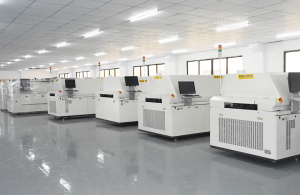
SMT production floor. In high-mix work the binding constraint is usually changeover, not peak placement speed.
For an electronics manufacturer running high-mix, low-volume and prototype production, the useful question is not whether a glue dispenser can sit next to a pick-and-place machine and a reflow oven. It is whether dispensing belongs inside the SMT turnkey scope at all. Integrated programmable dispensing turns the adhesive pattern into a stored program that travels with the board design, so a change of panel layout becomes a software change instead of a mechanical rebuild. The boundary is just as concrete: dispensing does not replace solder paste printing, and every new pattern still needs validation before the first article is accepted.
High-mix production is a growth segment, not a niche detour
The economics behind this decision are visible in the equipment market itself. The global Surface Mount Technology (SMT) equipment market was valued at approximately USD 6.6 billion in 2025 and is projected to reach USD 14.6 billion by 2036, according to Transparency Market Research. Asia-Pacific held a 54% revenue share in 2025, ahead of North America and Europe.
Placement equipment — pick-and-place machines — accounts for roughly 38% to 48% of total SMT equipment market value, which is why mounter selection tends to dominate purchasing conversations. The segment that matters for prototype and high-mix work is narrower and faster-moving: Mordor Intelligence projects the High-Mix/Low-Volume assembly line segment to grow at a CAGR of 8.31% through 2031, driven by demand for customized industrial and medical electronics.
Inspection is expanding faster still. 3D Automated Optical Inspection (AOI) and Solder Paste Inspection (SPI) are identified as the fastest-growing equipment sub-sectors, at a 15.2% CAGR, a trend attributed to automotive zero-defect requirements. Taken together, these figures describe a market where mix and verification, not raw throughput, increasingly set the line specification.
Why changeover, not placement speed, decides prototype fit
A high-mix line is measured by how much of it has to change when the next board design arrives. Placement speed is the most visible specification on a datasheet, but in low-volume, high-variety production it is rarely the binding constraint. The real constraint is the list of items that must be touched between runs.
- Solder paste and stencil: a new board design usually means a new stencil and a re-defined print program.
- Feeder setup: tape widths such as 8 mm, 12 mm and 24 mm have to be positioned, loaded and verified against the placement program.
- Nozzle set: component mix determines which nozzles are installed, and nozzle replacement on Fuji, Yamaha or JUKI platforms is a physical changeover step.
- Conveyor width and board transfer: panel and board dimensions determine rail settings, loader and unloader behavior and any buffer conveyor logic.
- Process programs: placement, dispensing, reflow profile, SPI and AOI recipes all have to match the new design.
- Downstream steps: depaneling programs and PCBA cleaning cycles may change with the panel or the residue profile.
Each item on that list is a potential stop. A turnkey evaluation that looks only at placement capability misses where the hours actually go, which is why decision-stage buyers increasingly ask what a line does between jobs rather than inside one.
What a dispenser actually does inside an SMT turnkey line
Glue dispensing in SMT is an adhesive placement process, not a soldering process. The dispenser deposits small, defined volumes of adhesive at points defined by the board design. Those deposits hold components in position during subsequent handling, processing or reinforcement steps, complementing rather than replacing the solder joints formed from printed paste.
Programmable dispensing changes the setup logic. The dot pattern is defined in software, referenced to board fiducials, and recalled together with the board program. When a new design arrives, the change is a pattern and position change in the program rather than a mechanical re-setup of a dispense head. That is the mechanism by which dispensing supports quick changeovers — it moves variation out of hardware and into data.
Integration points that determine whether it works in practice
- Board transfer: the dispenser has to share conveyor height, rail width range and transport logic with the pick-and-place machine and reflow oven, including PCB loader and unloader stations and any SMT buffer conveyor used to decouple process steps.
- Vision and fiducials: pattern placement depends on the same fiducial recognition strategy used by the mounter, so the fiducial scheme has to be defined for the whole mix, not per machine.
- Program and recipe handling: if the dispense pattern, the placement program and the reflow profile are released as one job package, changeover becomes a recall; if they are managed separately, the operator rebuilds the setup three times.
- Thermal compatibility: adhesive chemistry, cure behavior and the reflow profile have to be validated together, because the profile is driven by the paste system as well.
- Verification: SPI confirms paste deposition, AOI confirms placement and joint appearance after reflow, and X-ray BGA inspection covers joints that optical methods cannot see. Adhesive placement needs its own verification decision.
Acceptance criteria should also be written down rather than assumed. IPC-A-610J, released in March 2024, remains the current global standard for the acceptability of electronic assemblies and defines Class 1, Class 2 and Class 3 quality levels. Naming the applicable class in purchase documentation removes ambiguity when a prototype build is inspected.
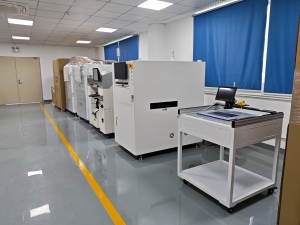
Prototype runs are judged against written acceptance criteria — the applicable IPC-A-610J class is a procurement decision, not a factory-floor assumption.
Scenario fit: four high-mix cases where in-line dispensing earns its place
The configuration is not universal. It fits a defined set of production scenarios, and each one carries its own confirmation requirements.
| Scenario | What the dispenser contributes | What must be confirmed before ordering |
|---|---|---|
| Mixed-technology boards combining SMD and through-hole parts | Adhesive deposits hold components through handling and subsequent thermal steps, so positioning does not rely on component weight alone | Adhesive compatibility with the paste system and the reflow profile; dispense position relative to placement and reflow in the line sequence |
| NPI and prototype runs with frequent design revisions | The pattern is stored per board design and recalled with the placement program, so a revision changes data rather than hardware | Which pattern parameters can be edited at the machine and which require a full program release and re-validation |
| Panelized boards whose panel layout changes between orders | Pattern and position data follow the panel drawing instead of a fixed mechanical arrangement | Fiducial strategy and conveyor width range across all panel sizes in the mix |
| Large or heavy components requiring reinforcement | Programmed dispensing applies material at defined points repeatably across units | Volume repeatability requirement and the inspection method used to verify it |
In all four cases, the value is consistency across a mixed order book. The dispenser is not making the line faster on any single board; it is making the transition between boards predictable, which is the metric that determines whether a prototype quotation is profitable.
Decision comparison: in-line programmable dispensing versus the alternatives
Buyers comparing options typically face three routes: integrate dispensing into the SMT turnkey line, keep a standalone dispensing station beside the line, or outsource dispensing with the rest of assembly. Each has a different changeover profile and a different volume band where it makes sense.
| Decision criterion | In-line programmable dispensing | Standalone dispensing station | Outsourced dispensing |
|---|---|---|---|
| Changeover mechanism | Program recall tied to the board design | Manual repositioning or separate pattern setup per batch | Handled by the supplier, outside the buyer's control |
| Per-design work before first article | Pattern validation and program release | Pattern setup plus physical re-fixturing between batches | Documentation and specification exchange |
| Line balance and utilization | Dispensing shares conveyor and control infrastructure with placement and reflow | Additional handling step and possible queue between processes | No internal capacity consumed |
| Traceability | Pattern data lives with the job record | Depends on local documentation discipline | Depends on supplier reporting |
| Where it typically fits | Recurring high-mix production with repeated design revisions | Occasional dispensing with stable, low-variety demand | Very low internal volume or capability gaps |
| Main boundary | Requires program ownership and validation discipline | Adds manual steps that scale poorly with mix | Reduces control over changeover time and process data |
The comparison is not a ranking. It is a fit test: in-line integration pays back when the design mix is high enough that program recall replaces repeated physical setup, and it is the wrong answer when dispensing happens once a quarter on a stable product.
Component-level decisions that determine how fast a design change is absorbed
Dispensing flexibility is only half of the changeover equation. The rest depends on how the placement, printing and inspection equipment handle variety.
On the mounter side, modular platforms dominate high-mix work. Fuji Corporation's NXT platform and Yamaha's YSM series, such as the YSM20R, are industry-standard modular mounters for high-speed and high-precision placement, according to the manufacturers' product catalogs. Key global SMT vendors also include ASMPT Limited, Panasonic, Juki Corporation and Hanwha Precision Machinery. Modularity matters because it allows a line to be re-balanced across configurations rather than replaced when the mix shifts.
Around the mounter, the flexibility of the line is determined by a series of supporting choices:
- Feeder infrastructure: mixed 8 mm, 12 mm and 24 mm tape formats and feeder count directly determine how much of a new bill of materials can be loaded without stopping.
- Nozzle management: nozzle replacement for Fuji, Yamaha and JUKI platforms is routine maintenance; whether nozzles are grouped by product family determines how often that maintenance interrupts a prototype run.
- Printing: the solder paste printer and its stencil handling set the pace of the first process step and are frequently the bottleneck in a changeover.
- Inspection coverage: inline SPI inspection, AOI automatic optical inspection and X-ray BGA inspection define what can be verified rather than assumed.
- Mechanical and cleaning steps: PCB depaneling routers, PCBA cleaning machines and stencil cleaning machines affect cycle rhythm and consumable planning.
- Support services: SMT line optimization service and SMT production troubleshooting capability determine how quickly an unfamiliar design is brought to a stable state.
Where the integrated approach stops: honest limits and the traditional alternative
The most common traditional alternative to an inline reflow-based configuration is a wave reflow soldering approach for mixed-technology boards. Motek's published comparison notes for its lead-free reflow configuration position it against wave reflow soldering on maintenance and cost: it describes less maintenance, support for long-term stable production, lower maintenance cost, and a cost position approximately 10% lower in the compared configuration, with SMT industrial plants named as the intended application. Those are configuration-specific comparison notes, not a general claim about process superiority, and they should be read as one input into a decision rather than a verdict.
Limits of integrating dispensing into the line:
- Dispensing does not replace solder paste printing. SMT joints still come from printed paste and reflow; the dispenser adds adhesive placement, it does not remove the stencil step.
- Changeover does not disappear, it relocates. A new pattern still requires program release, tooling checks and first-article validation before volume processing resumes.
- For very low annual volumes — occasional dispensing on a stable product — a standalone dispensing station can be more economical than an integrated in-line module.
- Integrated configuration depends on written parameter confirmation. Dispense position, conveyor interface, fiducial scheme and thermal compatibility have to be specified and agreed before the line is built, not adjusted after installation.
How Motek's scope maps onto a high-mix dispenser-integrated line
Motek is a Shenzhen, Guangdong-based supplier of SMT production equipment, founded in 2011, operating from a 955 m² facility with an R&D team of more than 15 engineers and an annual output of 300 to 500 units. The company exports 100% of its output to markets including the EU, USA, Australia, Canada and ASEAN, and holds multiple CE certifications. Its product scope covers reflow soldering systems, pick-and-place machines, plug-in machines, cleaning machines, PCB cutting machines and PCBA protection equipment.
For a high-mix buyer, the relevant part of that scope is not a single machine but the line-level configuration. In configurations where adhesive dispensing forms part of the process, its position and interface relative to the pick-and-place machine, conveyor system and reflow oven are treated as specified parameters rather than workshop assumptions — Motek's documented delivery process includes detailed technical parameter confirmation before shipment, alongside quality inspection before dispatch, scratch code management, advance inventory and delivery confirmation, professional packaging with logistics tracking, and customs broker assistance.
Post-delivery terms are also part of the decision. Motek provides a 12-month warranty on its products, a comprehensive training system, and 24/7 technical support with fast repairs and spare parts supply as part of its documented customer communication mechanism. For a prototype-heavy order book, training and spare-part availability frequently matter more than any single equipment specification, because they determine how quickly a new design can be brought to stable output.
Market trend: modularity and verification are the direction of travel
Three verified trends shape how this decision will be made over the next few years. First, high-mix/low-volume assembly is projected to grow at a CAGR of 8.31% through 2031, driven by customized industrial and medical electronics — precisely the customer profile that prototype runs serve. Second, inspection is the fastest-growing sub-sector, with 3D AOI and SPI expanding at a 15.2% CAGR under pressure from automotive zero-defect requirements, which pushes verification capability up the procurement agenda. Third, Asia-Pacific's 54% share of SMT equipment revenue in 2025 reflects a supply base concentrated in the region where most high-mix line configuration decisions are now made.
The practical implication for buyers is that a line is increasingly evaluated as a changeover system rather than a set of machines, and that verification equipment is being specified at the same stage as placement equipment rather than added later.
Future outlook
Equipment scope is becoming program scope. As modular mounters such as the Fuji NXT platform and the Yamaha YSM series continue to define the high-mix standard, the differentiator between two otherwise comparable lines shifts toward how completely process data — pattern, placement, reflow profile, inspection recipe — is packaged and released as a single job. Buyers should expect configuration questions to move earlier in the sales cycle, and should be prepared to define their board mix, panel range and acceptance class in writing before equipment selection begins. The lines that absorb a design revision fastest will not necessarily be the fastest lines; they will be the ones whose changeover is documented, programmable and verifiable.
FAQ
What does an SMT turnkey solution with integrated dispensing include?
An SMT turnkey solution is a line-level scope rather than a single machine. In a dispensing-integrated configuration it typically covers the paste printing step, a pick-and-place machine, a glue dispenser, a reflow oven, board transfer equipment such as loaders, unloaders and buffer conveyors, and inspection equipment such as SPI, AOI and X-ray. Motek's product scope covers reflow soldering systems, pick-and-place machines, plug-in machines, cleaning machines, PCB cutting machines and PCBA protection equipment, with parameters confirmed in writing before shipment.
How does programmable dispensing shorten changeover between different board designs?
Programmable dispensing stores the adhesive pattern in software, referenced to board fiducials, and recalls it with the board program. When a design changes, the change is made in the pattern data instead of a mechanical re-setup of the dispense head. The changeover does not vanish: a new pattern still requires program release, tooling checks and first-article validation before production continues.
When is a standalone dispensing station a better choice than in-line integration?
Standalone dispensing is usually more economical when dispensing is occasional and the product range is stable, because it avoids the integration and program-management overhead of an inline module. In-line integration fits recurring high-mix production where design revisions are frequent enough that program recall replaces repeated physical setup. Very low internal volumes, or capability gaps inside the factory, are the situations where outsourcing dispensing with the rest of assembly is the practical route.
Which mounter platforms are commonly used for high-mix SMT lines?
Modular platforms dominate high-mix placement. Fuji Corporation's NXT platform and Yamaha's YSM series, such as the YSM20R, are industry-standard modular mounters for high-speed and high-precision placement according to the manufacturers' product catalogs. Key global SMT vendors also include ASMPT Limited, Panasonic, Juki Corporation and Hanwha Precision Machinery. Platform choice interacts directly with feeder formats such as 8 mm, 12 mm and 24 mm, and with nozzle replacement practice.
What should be confirmed in writing before ordering a high-mix SMT turnkey line?
At minimum: board and panel dimension range with the corresponding conveyor settings; the fiducial scheme across the whole mix; dispense pattern parameters and their validation method; adhesive and paste compatibility with the reflow profile; inspection coverage and the applicable acceptance class under IPC-A-610J, which defines Class 1, Class 2 and Class 3 levels; and post-delivery terms including warranty period, training and spare-parts supply. Motek's documented process includes detailed technical parameter confirmation, quality inspection before shipment and advance inventory and delivery confirmation.
Reference document: Motek equipment brochure (PDF).