
SNCF Continuous Freezers vs SNL Molded Stick Ice Cream Lines
Factory buyers rarely lose money on the wrong component brand. They lose it on the wrong line architecture. Two configurations dominate mid-market ice cream production, and buyers are usually asked to choose between them before they have compared a single machine specification. One freezes mix continuously and shapes the frozen output downstream: the SNCF continuous freezer series feeding extrusion, filling, sandwich or cake modules. The other freezes product inside moulds that travel through a brine tank: the SNL moulded stick machine series, supported by SNLU ice water fillers, stick inserters, sucker units, chocolate coating stations and interchangeable moulds.
This independent comparison is written for buyers in the research and evaluation stages who must decide which configuration a factory should be built around, how each route integrates with upstream and downstream modules, and what should be verified in purchase terms, acceptance testing and component sourcing before a contract is signed. Snowball Machinery (Snowball Machinery Manufacturing Co., Ltd) is an ice cream equipment manufacturer founded in 2020, operating a 4,000 ㎡ factory with 50 employees, a 10-engineer R&D team and annual output of 1,200 sets, with roughly 90% of production exported to North America, South America, Europe, Asia and Africa. Both configurations examined here sit inside that portfolio, which makes a like-for-like comparison of the two routes possible on the same component basis.
Why the architecture decision comes before the supplier decision
The global market for ice cream processing equipment was valued at approximately USD 2.33 billion in 2025 and is projected to reach USD 3.00 billion by 2034, a compound annual growth rate of 2.71% (IMARC Group). Inside that market, hard ice cream processing equipment accounted for a 57.8% share in 2025, with continuous freezers reported as the leading product type (Future Market Insights). Moulding capacity is expanding on a separate curve: the ice cream moulding production line segment was valued at USD 1.2 billion in 2024, with projections of USD 2.5 billion by 2034 as automation demand rises (Reports and Data).
Buyers should treat headline market values cautiously. Published valuations diverge sharply depending on scope — one estimate places the broader ice cream equipment market at USD 9.6 billion and another at USD 10.12 billion, against USD 2.33 billion for processing equipment alone. The useful signal is not the absolute number but the direction: both freezing architectures are growing, and both are being automated. The equipment supply base is also concentrated in established dairy-machinery export hubs — Germany (USD 74.4M), Poland (USD 64.9M) and Italy (USD 61.7M) led dairy machinery exports under HS Code 843420 in 2024 (OEC) — which matters when buyers assess component availability and lead times.
The practical consequence is that supplier comparison is a second-order decision. The first-order decision is whether the plant freezes product for downstream shaping, or freezes product in the mould that gives it its final shape.
Route A — What the SNCF continuous freezer configuration includes
A continuous-freezer-led line uses a scraped-surface freezer to bring mix from a chilled, pumpable state to a semi-frozen, extrudable state, then defines the product shape using downstream equipment. In the Snowball Machinery range, that freezing stage is the SNCF series, offered across five nominal sizes — SNCF 50L, SNCF 300L, SNCF 600L, SNCF 1200L and SNCF 1500L — covering a stated capacity range of 50 to 1,500 litres per hour. The published specification lists 100% overrun, an input material temperature of +5 °C and an output material temperature of −5 °C. Wetted parts are built in food-grade stainless steel, SS304 or SS316 depending on configuration, and the main components are sourced from internationally recognised brands including SIEMENS, Schneider Electric, FESTO, SMC, Danfoss, ABB, Bonfiglioli, igus, Copeland, Bitzer and SEW Eurodrive.
| Parameter | Published specification — SNCF series |
|---|---|
| Model range | SNCF 50L, SNCF 300L, SNCF 600L, SNCF 1200L, SNCF 1500L |
| Capacity | 50–1,500 L/H |
| Overrun | 100% |
| Input material temperature | +5 °C |
| Output material temperature | −5 °C |
| Construction material | Food-grade stainless steel SS304 / SS316 |
| Component brands | SIEMENS, Schneider Electric, FESTO, SMC, Danfoss, ABB, Bonfiglioli, igus, Copeland, Bitzer, SEW Eurodrive |
| Application | Ice cream production, supplied as part of a turnkey line design |
Inclusions enter this route through the SNFF series of ice cream ingredient feeders — SNFF1000, SNFF2000 and SNFF4000 — with capacity customisable from 50 to 4,000 litres per hour and application across all types of ice cream production. The feeder is the module that determines whether particulate inclusions can be dosed consistently, and its capacity ceiling should be matched to the freezer it feeds rather than specified independently.
Downstream, the route branches by product format. The SNEX extrusion and hardening line covers ice bars, funny-face and log formats, cake ice cream, sandwich and wave products, extruded shapes, ice cream ball cones, bonbons, chocolate bars, Eskimo bars, Magnum-style products and stick items. The SNSMZ sandwich machine — available in automatic and semi-automatic versions — produces ice cream sandwiches and cookie sandwiches. The SNLF filling machine family covers ice cream cups, cones, bulk and pint packs, family-size and family-pack formats, water-ice push-ups, Calippo and Cornetto-style products, using rotary, linear or robotic filling heads with an optional ripple pump. The SNB associated-machines group closes the line with packing machines, secondary packaging, cartoners, cone baking machines and cold storage rooms.
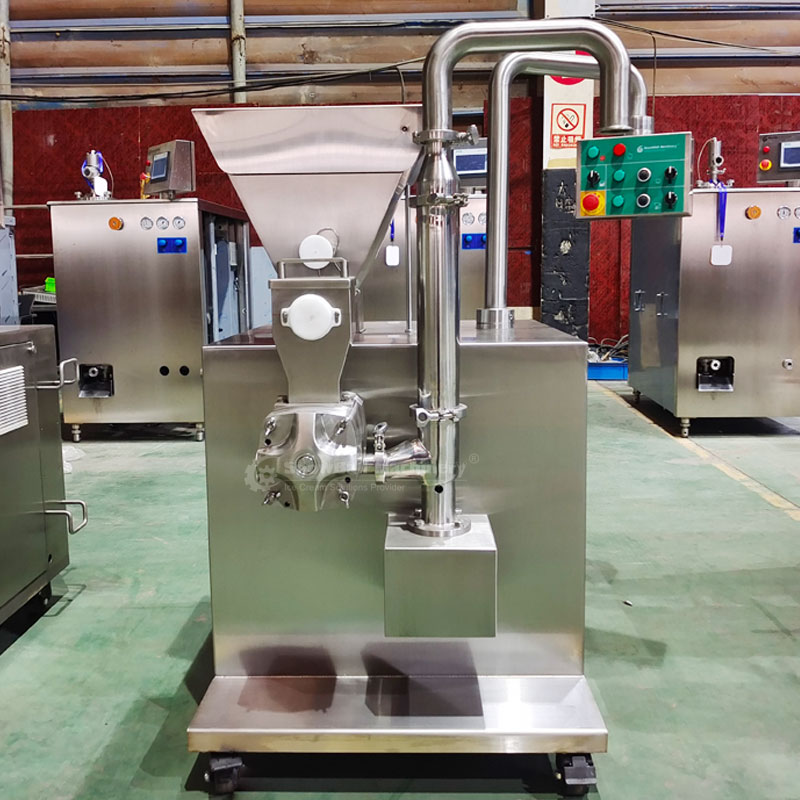
Inclusion dosing on the continuous-freezer route: the SNFF ingredient feeder determines whether particulates can be added consistently before the mix reaches the freezer.
Route B — What the SNL moulded stick configuration includes
A moulded stick line defines the product inside a mould. Mix is dosed into moulds, the moulds are frozen, sticks are inserted, product is demoulded and then finished with optional coating or filling steps. The SNL series covers the full span of this architecture in seven configurations: manual ice lolly machines, semi-automatic stick ice cream machines, linear stick ice cream machines, inline popsicle machines, oval-type stick ice cream machines, rotary moulded stick ice cream machines and popsicle parallel lines. The product set is correspondingly narrow and deep — moulded stick ice cream, moulded sticks, popsicles, ice lollies, frozen novelties, fruit bars and water ice.
What makes the moulded route distinctive is the SNLU optional-unit family. Stick insertion is not an afterthought on this architecture; it is a specified module. The SNLU range includes an ice water filler, an ice cream sucker unit, an ice cream stick inserter unit, a chocolate coating station, a dry coating station and the popsicle ice cream moulds themselves. Each of these changes the product that can be sold, not merely the speed at which it is produced — a line specified without a chocolate coating station cannot produce a chocolate-covered stick, regardless of freezer capacity upstream.
Documented project scenarios illustrate the range. For small factories and shops, the configuration is typically semi-automatic or manual, with automatic filling and sucking, multi-specification container support, a fault alarm function and quick mould replacement for shape changes; this pattern appears in projects in Chile, Thailand, Portugal, Spain and similar markets. For newly built large-scale factories and branded ice cream producers, the moulded line is specified as fully automatic — automatic filling, sucking, jam charging, stick inserting, demoulding and chocolate coating — with remote debugging and fault alarm functions, and with the full process running from mixing and pasteurisation through homogenisation, ageing, continuous freezing, forming and packaging.
Side-by-side comparison
The comparison below is deliberately framed around project fit rather than general superiority, because neither architecture dominates the other across all formats.
| Decision dimension | SNCF continuous-freezer-led line | SNL moulded stick line |
|---|---|---|
| Where the product shape is defined | Downstream of the freezer — extruder, filler, sandwich or cake module | Inside the mould, with SNLU units adding stick, coating and water-ice functions |
| Format range | Extruded bars, Magnum-style sticks, sandwich, cake, wave, ball cone, bonbon, cup, cone, family pack, push-up | Moulded stick ice cream, popsicle, ice lolly, frozen novelties, fruit bars, water ice |
| Shape change cost | Change of die, filler head or product programme | Change of mould set |
| Typical entry configuration | SNCF 50L or 300L with a single downstream module | Manual or semi-automatic SNL machine with automatic filling and sucking |
| Climate fit | Standard plant environment; full enclosure options depend on configuration | Configurations documented for high-temperature, high-humidity and low-temperature environments |
| Coating capability | Chocolate and dry coating applied downstream through extrusion or filling modules | Chocolate coating station and dry coating station specified as SNLU options |
| Labour profile | Fully automatic operation at high output | Spans manual through fully automatic, so labour profile is a specification choice |
| Scale logic | Freezer size sets throughput; larger output means larger SNCF models or multiple units | Mould count, cycle pattern and unit configuration set throughput |
Integration map: shared upstream, divergent downstream
Both routes depend on the same upstream mix-preparation group — the SNM family, which covers HTST pasteurisation systems and batch pasteurising systems, homogenisers, CIP cleaning, ageing tanks and vats, chocolate tanks and holding tanks, chiller water systems, water-cooled chillers and high shear mixers. For a buyer, this is the most important integration fact in the article: the pasteurisation, homogenisation, ageing and cleaning infrastructure is common to both, so a plant that later adds a second architecture does not rebuild its mix room.
Downstream is where the routes separate. The table below maps how each configuration connects to the wider SNP production-line family.
| Module | Function | Primary route |
|---|---|---|
| SNM | HTST or batch pasteurising, homogenising, CIP, ageing, chocolate holding, chilling | Shared upstream |
| SNCF | Continuous freezing, 50–1,500 L/H, 100% overrun specification | Shared freezing stage |
| SNFF | Ingredient and inclusion feeding, customisable 50–4,000 L/H | Continuous-freezer route |
| SNEX | Extrusion and hardening for bars, cakes, sandwiches, bonbons and novelty shapes | Continuous-freezer route |
| SNSMZ | Sandwich and cookie-sandwich assembly, automatic or semi-automatic | Continuous-freezer route |
| SNLF | Cup, cone, pint, family-pack and push-up filling with ripple-pump option | Continuous-freezer route |
| SNL + SNLU | Moulded forming, stick insertion, sucking, chocolate and dry coating, water-ice filling, moulds | Moulded stick route |
| SNB | Primary packing, secondary packaging, cartoning, cone baking, cold storage | Shared downstream |
| SNP | Whole-line configuration covering moulding, extrusion, filling, sandwich and cake lines | Both |
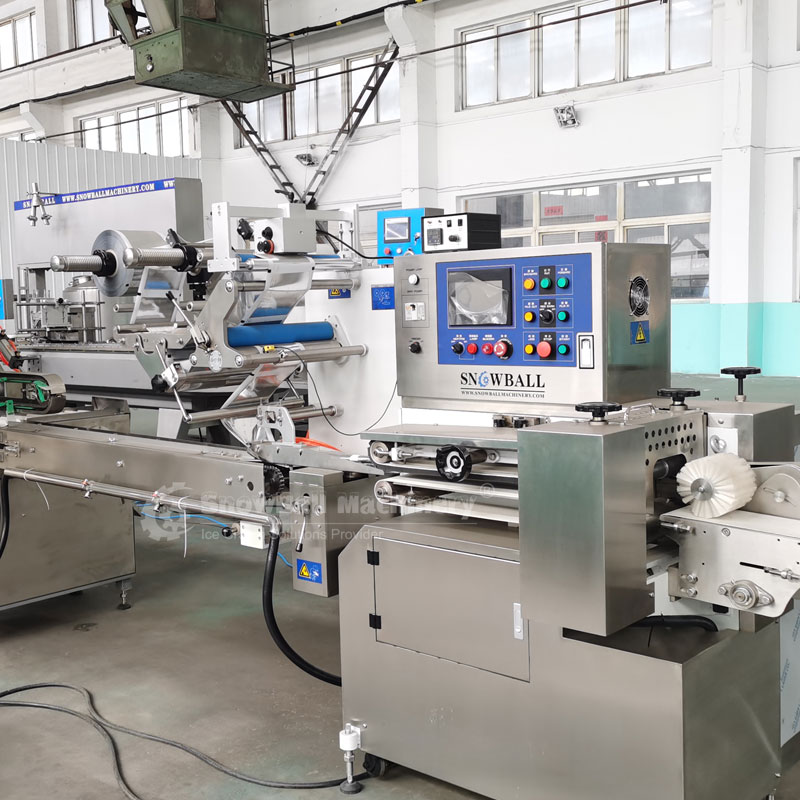
Both architectures converge at packaging: the SNB group handles primary packing, secondary packaging and cartoning regardless of how the product was frozen.
Where each route reaches its limits
A credible comparison has to state where each configuration stops delivering, and what evidence buyers should demand rather than assume.
- SNCF throughput ceiling is per unit. The published capacity range is 50–1,500 L/H per freezer. A factory that needs substantially more frozen output per hour should plan for multiple freezer units, parallel lines, or a staged build rather than assuming a single machine scales indefinitely.
- Overrun and outlet temperature are design points, not guaranteed finished-product results. The specification states 100% overrun and a −5 °C outlet. Realised overrun, texture and extrusion behaviour depend on mix formulation, solids, fat content and operating parameters, and should be demonstrated on the buyer's own mix during acceptance testing.
- The moulded route is mould-bound. Product shape on an SNL line is set by the mould set and the SNLU configuration. Adding a new stick format, a filled popsicle or a water-ice variant is a tooling and station decision, and a line specified without a coating station cannot produce coated product.
- The moulded route spans a wide automation range, which cuts both ways. Manual and semi-automatic SNL configurations lower capital entry and suit low-output or trial production, but they carry a different labour profile than fully automatic operation. Buyers comparing quotations across suppliers should confirm that the automation level behind each price is the same.
- Case evidence is supplier-reported. The project records cited in this article are the manufacturer's own documented deployments. They are useful for understanding what has been built, but they are not third-party audited performance data, and buyers should treat them as references to be verified directly.
- Market-size figures are scope-dependent. As noted above, published equipment market values differ by a factor of four depending on what is counted, so no investment decision should rest on a single market valuation.
Procurement terms, acceptance criteria and component verification
Purchase terms for both routes follow the same commercial framework in this portfolio: a minimum order quantity of 1 set, monthly production capacity of 100 sets, lead time set according to the specific equipment plan, and 100% testing under a quality-control process that runs from material selection through production in line with food safety production standards. Customisation is based on production scale, product positioning, product design and workshop conditions rather than on a fixed catalogue, and the manufacturer also co-develops new ice cream products with ice cream factories. After-sales scope covers on-site installation and commissioning, equipment upgrading, equipment maintenance, fault handling, spare parts supply, regular inspection and global response.
For procurement documentation, buyers should separate three verification layers.
1. Purchase terms to fix in writing
- Exact model designations — for example whether the freezer is an SNCF 600L or SNCF 1200L, and whether feeders are SNFF1000, SNFF2000 or SNFF4000.
- Which SNLU optional units are included: ice water filler, sucker unit, stick inserter, chocolate coating station, dry coating station, and how many mould sets.
- Which downstream modules are in scope — SNEX, SNSMZ, SNLF, SNB — and which are explicitly excluded.
- Lead time basis, since it is defined by the specific equipment plan rather than a standard figure.
2. Acceptance criteria to test on the buyer's own mix
- Hourly output against the agreed capacity for the specified model.
- Overrun and outlet temperature behaviour against the stated +5 °C inlet and −5 °C outlet design points.
- Fill-weight or portion consistency across a full production run, not a short sample.
- Stick insertion reliability and demoulding performance on the moulded route; extrusion profile and hardening behaviour on the continuous-freezer route.
- Coating coverage and dry-coating adhesion where SNLU coating stations are specified.
- Inclusion dosing accuracy and uniformity where an SNFF feeder is included.
- CIP cycle effectiveness and cleaning validation.
- Alarm and remote-debugging functions where specified.
3. Component and compliance verification
- Confirm nameplate brands against the specified list — SIEMENS, Schneider Electric, FESTO, SMC, Danfoss, ABB, Bonfiglioli, igus, Copeland, Bitzer and SEW Eurodrive — rather than accepting a generic “international brand” statement.
- Confirm material certificates for SS304 or SS316 wetted parts, since the two grades are used across different product lines and the choice affects corrosion behaviour and cleaning regimes.
- Confirm the applicable safety standard for the refrigeration and electrical assembly. Commercial ice cream appliances and ice-makers with incorporated motor-compressors fall under IEC 60335-2-89:2019, and certificates should be checked against the actual configuration shipped, not the platform model.
- Confirm spare-part availability and response time in the buyer's region before committing, since supply continuity is decided years after commissioning.
Market context: why both routes keep selling
Three structural factors support continued demand for both architectures. First, hard ice cream processing equipment held 57.8% of the ice cream equipment market in 2025, with continuous freezers named as the leading product type — a market-share position that reflects how much of the industry's volume flows through a freezing stage rather than through any single shaping method. Second, moulding lines are forecast to grow substantially, from USD 1.2 billion in 2024 to a projected USD 2.5 billion by 2034, on rising automation demand, which points to buyers replacing manual and semi-automatic stick production rather than abandoning the format. Third, the supplier landscape is still dominated by a small group of long-established international equipment houses; publicly cited figures attribute a large majority of commercial production line coverage to Tetra Pak, which gives buyers a useful benchmark for how much of the market sits outside the reach of any single alternative supplier — and how much room exists for regional manufacturers with comparable component sourcing.
Documented deployments in this portfolio illustrate where the two routes land in practice. A line built for a newly established ice cream manufacturer was configured around continuous freezers, an extrusion tunnel and packing machines at 9,000–10,000 pieces per hour, and has run for three years under high-temperature, high-humidity conditions. A start-up client with no prior production experience ran a Magnum-style extrusion tunnel at 5,000–8,000 pieces per hour alongside a family-pack filling machine at 1,200 L/H, and has operated for eleven years. On the moulded side, a project for a world-renowned brand ice cream factory specified an automatic cone filling line at 10,000–15,000 pieces per hour and a stick ice cream production line at 15,000–20,000 pieces per hour, running stably for twelve years. An upgrading project on a long-established manufacturer's forty-year-old equipment used custom-designed workstations to match the existing line, reporting a 40% efficiency gain, a 30% reduction in labour cost and a 70% reduction in upgrading cost, with SS316 construction throughout.
Future outlook
Two directions look structural rather than cyclical. The first is modularity: because pasteurisation, homogenisation, ageing, CIP and packaging are shared across both architectures, buyers increasingly specify a plant that can add a second shaping route without rebuilding the mix room. A factory that starts with a semi-automatic moulded stick line for tropical-market popsicles can later add extrusion and hardening capacity inside the same footprint, using the same SNM upstream group and the same SNB downstream group.
The second is verification depth. As moulding-line capacity expands toward the projected USD 2.5 billion by 2034, quotations in this segment will increasingly differ by station count, automation level and mould tooling rather than by headline machine price. Buyers who specify acceptance tests on their own mix, verify component nameplates and confirm standard compliance at the configuration level will be comparing real offers; buyers who compare headline capacity figures alone will not.
FAQ
Which configuration suits a factory with no prior ice cream production experience?
A small-scale or trial-oriented project is usually better served by a semi-automatic or manual moulded stick configuration with automatic filling and sucking, because it supports low-output production, accepts multiple container specifications, allows shape changes through mould replacement, and can be commissioned with installation, commissioning and operational training support. A continuous-freezer-led line at the low end of the SNCF range is also a valid entry point where the target product is extruded, filled or sandwich-based rather than moulded. The deciding factor is the product format the factory intends to sell, not the buyer's experience level alone.
Can a moulded stick line operate in a hot and humid climate?
Yes — configurations in the SNL family are documented for operation under standard ice cream production conditions in high-temperature and humid environments, with a stated requirement for stable operation and compliance with food safety standards in those conditions. The same series is also specified for low-temperature environments in cold regions. Resistance to corrosion and long service life are listed requirements for these deployments, which is why material grade (SS304 versus SS316) matters more in tropical projects than in temperate ones.
What equipment do both line configurations share?
Both routes draw on the same upstream mix-preparation group: HTST or batch pasteurising systems, homogenisers, CIP cleaning, ageing tanks, chocolate tanks or holding tanks, chiller water systems and high shear mixers. Both also converge on shared downstream packaging through the SNB group, which covers packing machines, secondary packaging, cartoners, cone baking machines and cold storage rooms. Continuous freezers themselves appear in matched-equipment lists for projects built around either architecture, which is why the freezing stage and the shaping stage should be evaluated as separate decisions.
Can one plant run a continuous freezer line and a moulded stick line?
Yes. The two architectures are complementary rather than mutually exclusive, and documented projects list a continuous freezer alongside moulded stick machines in the same equipment set. Because the mix room, ageing, CIP and packaging stages are shared, adding a second shaping route generally means adding forming, hardening and tooling capacity rather than duplicating the whole plant. Any such plan should confirm that total freezing capacity, mould count and downstream packaging throughput are matched, since a bottleneck at any single stage limits the whole line.
How should acceptance testing be structured for either route?
Testing should run on the buyer's own mix rather than a demonstration recipe, and it should cover hourly output against the agreed capacity for the specific model, overrun and outlet temperature behaviour against the stated design points, fill-weight or portion consistency across a full run, and the format-specific functions — stick insertion and demoulding on the moulded route, extrusion profile and hardening on the continuous-freezer route. Where SNLU coating stations or an SNFF ingredient feeder are included, coating coverage and inclusion dosing uniformity should be measured. CIP effectiveness, alarm functions and component nameplates should be verified in the same session, before final acceptance is signed.
A full configuration reference covering continuous freezers, moulded stick machines and the supporting line modules is available in the Snowball Machinery product brochure: download the PDF.