
SPC Floor Procurement: Subfloor, Accessories, Acceptance
SPC Floor Procurement: Subfloor, Accessories, Acceptance

SPC floor performance on site is decided by three conditions that belong in the purchase order, not only in the installation guide: a substrate flat within 2 mm over 2 m, a dry and residue-free substrate, and a 6-mil polyethylene moisture barrier where the floor sits on ground-floor concrete. A click-lock floating installation also needs spacers at the perimeter, cannot be laid over carpet or soft PVC, and — where underfloor heating is present — must run with the heating surface capped at 27 °C. Buyers who settle these points at the evaluation stage avoid the most common cause of a rejected installation: a product that meets its own specification but not its site conditions.
The questions below are the ones that surface between shortlisting and issuing a purchase order. They are technical, but they carry commercial consequences: they determine who is responsible for substrate readiness, which accessories ship with the flooring, what is inspected before shipment, and what counts as a defect at handover. For a buyer moving from evaluation into execution, the practical task is to convert each technical condition into a clause, a line item or an inspection step that someone can sign off.
Why Subfloor Condition Is a Purchasing Term
A rigid-core SPC floor, whether described as Stone Plastic Composite Flooring or Stone Plastic Lock Composite Flooring, is normally installed as a floating click-lock system: the planks are joined to each other, not to the slab, and the assembly behaves as one continuous surface. That design is efficient on a flat substrate and unforgiving on a defective one. Because every plank transfers load to its neighbours through the joint, a local hollow or ridge is not absorbed by the floor — it is concentrated at the joint edge.
Substrate quality therefore has two owners. The site owner controls the slab, screed or existing floor; the flooring supplier controls plank geometry, joint design and packing. When the two are not reconciled in the contract, disputes about “the floor” are really disputes about the substrate. Writing the substrate condition into the purchase terms, with a measurable tolerance and a named inspection step, separates the two responsibilities before installation begins.
- State the flatness tolerance as a measurable figure, not as “level” or “smooth”.
- Name who verifies the substrate and when that verification is signed off.
- Record which accessories the supplier provides and which the installer must supply.
- Agree which conditions void the installation warranty, in reader-visible terms.
Subfloor Flatness: The 2 mm Over 2 m Requirement
SPC flooring is specified for a substrate that is flat within 2 mm over any 2 m span. This is a straightness tolerance, not a level tolerance in the sense of perfectly horizontal: the requirement is that a 2 m straightedge placed anywhere on the prepared substrate leaves no gap greater than 2 mm beneath it. A floor that is uniformly sloped but locally flat can still pass; a floor that is nominally level but ridged or hollowed will not.
How the tolerance is checked
The check is mechanical and cheap, which is why there is little reason to leave it undocumented. A 2 m straightedge is laid in several directions across the room — including diagonals and along walls where screeds are often less well finished — and a feeler gauge is used to measure the largest gap found. The same straightedge-and-feeler-gauge method appears in supplier acceptance procedures for checking dimensional and flatness characteristics of delivered batches, so the tooling is familiar on both sides of the transaction. Photographs of the worst reading, with the date and the room reference, turn a verbal assurance into a record.
What deviation does to a click-lock joint
Where the substrate falls outside the tolerance, the consequences are structural rather than cosmetic. Planks that rock over a ridge place repeated stress on the locking profile; over time that can show as a visible gap, a raised edge or a broken tongue. In commercial office areas with rolling loads and pivot points, the same deviation is reached sooner. Remedial work — grinding a high spot, filling a hollow, or applying a levelling compound before installation — is far cheaper before the planks are laid than afterwards, when the floor must be lifted and the affected run replaced.
Substrate Condition: Dry, Residue-Free, and Free of Soft Coverings
Beyond flatness, SPC accepts a narrow set of substrates. The prepared surface must be dry and free of residue — dust, curing compounds, adhesive residue, oil and loose material. Residue is a bonding and levelling problem even for a floating floor: grit trapped under the planks abrades the backing, and old adhesive that has not been removed can soften or telegraph through under load. The practical test is visual and tactile rather than laboratory-based: sweep, scrape and vacuum, then confirm that no film or tackiness remains.
Why carpet and soft PVC are excluded
SPC is not to be installed over carpet or soft PVC. This restriction is a fit boundary, not a preference. Carpet introduces compressible pile and an unstable backing, so the click-lock assembly has no continuous rigid surface to lock against; the joints flex and separate. Soft PVC and cushion-backed resilient coverings behave in a similar way under point loads, and they also create a vapour-restrictive layer of uncertain condition between the slab and the new floor. Where an existing soft covering is present, the correct sequence in the purchase terms is removal, inspection of the exposed substrate, and re-checking flatness and dryness before the SPC floor is scheduled.
- Record “existing floor coverings removed” as a prerequisite task with a completion date.
- Re-inspect flatness after removal — removal frequently exposes patched or uneven areas.
- State clearly that installation over carpet or soft PVC is outside the specification.
- Confirm the substrate is dry and residue-free at the same inspection point.
Accessories That Must Be on the Purchase Order
Accessories are where SPC procurement most often becomes ambiguous. The flooring carton arrives; the barrier and spacers do not. Two accessory items carry a direct effect on whether the installation meets specification, and both should be an explicit line on the order rather than an assumption about site supply.
Six-mil polyethylene on ground-floor concrete
Where SPC is installed over ground-floor concrete, a 6-mil polyethylene moisture barrier is required beneath the flooring. The barrier is laid as a continuous sheet across the whole area before the planks are installed, so that the assembly does not sit directly on a slab that can release moisture from below. Two details follow from that requirement. First, the barrier must be listed as a supply item with a stated thickness of 6 mil, so that a thinner or unspecified sheet is not substituted on site. Second, the barrier must be installed before the planks are laid — an order of work that has to appear on the installation programme, not discovered on the day.
The requirement is specific to ground-floor concrete. It is a fit boundary worth stating plainly in the purchasing documents: upper floors over a dry, sealed structural deck follow the project’s own specification, while a slab on grade triggers the barrier line item. Buyers who treat every floor as identical either buy a barrier they do not need or, more commonly, omit one they do.
Spacers and perimeter allowance
Spacers are required for a click-lock floating installation. Because the floor is not fixed to the substrate, it must be able to sit within a defined perimeter allowance rather than being trapped against walls, columns and door frames. Spacers hold that allowance open while the planks are laid and are removed once the run is complete; trims and skirting then cover the joint. If spacers are omitted, the floor is effectively wedged, and the resulting pressure shows at the joints rather than at the wall. Specify the quantity and the responsible party — supplier or installer — on the order, and add a handover check that the perimeter allowance is present and unobstructed.
Click-Lock Floating Installation: What the Mechanism Requires
A glue-free click-lock SPC floor is assembled by engaging a machined profile along the plank edges; no adhesive bonds the planks to the substrate or to each other in the permanent sense. This construction delivers the practical advantages buyers expect from rigid-core flooring — fast dry installation with no adhesive cure time, and simpler replacement of a damaged plank — but it also concentrates the performance requirements into three places: substrate flatness, perimeter allowance and product geometry.
Product geometry is where dimensional stability enters the specification. Published commercial specifications for rigid-core SPC cite a dimensional-stability requirement of ≤0.10% under EN ISO 23999; buyers should treat that figure as a specification target to be verified on the test report for the ordered construction, not as a value to assume. A floor whose planks move beyond the profile’s tolerance will not stay engaged, however carefully it was installed. For this reason, the acceptance criteria in the purchase order should reference the test report for the specific model and thickness being supplied, and should confirm that the report covers the batch or production period in question.
- Specify glue-free click-lock assembly where adhesive-free installation is the project requirement.
- Require the dimensional-stability test report for the exact construction ordered.
- Confirm the perimeter allowance method and who supplies the spacers.
- Record the substrate flatness sign-off as a precondition to laying planks.
Underfloor Heating: The 27 °C Surface Limit
SPC can be laid over underfloor heating, subject to a surface temperature limit: the heating surface must not exceed 27 °C. The limit is a condition of use, not a suggestion, and it belongs in the technical annex of the purchase order because the flooring supplier does not control the heating system. Two actions follow. The heating system should be commissioned and balanced so that the floor surface temperature stays at or below 27 °C in normal operation, and the thermostat or manifold setting should be capped to prevent a later adjustment from exceeding it.
Acceptance should be evidence-based. A dated temperature reading taken at the floor surface, with the heating running and the system at its design setting, is a more useful handover document than a verbal confirmation that the system “runs cool”. Where the heating is controlled per zone, the record should cover each zone served by the SPC floor. Buyers specifying a waterproof SPC floor in bathrooms or kitchens with underfloor heating should apply the same limit in those rooms rather than treating wet areas as exempt.
Application Scenarios and How They Change the Checklist
The technical requirements above do not change by project type, but the emphasis does. Two scenarios account for most of the volume in SPC procurement, and each stresses a different part of the checklist.
Residential SPC floor
In residential work the substrate is often an existing floor in an occupied building, which makes removal the critical step. A renovating buyer may be tempted to lay over an old resilient covering to save time; that is precisely the case excluded by the restriction on carpet and soft PVC. The purchase terms should therefore make removal and re-inspection a predecessor task, and should confirm the 6-mil polyethylene barrier only where the room sits on ground-floor concrete. Flatness is checked room by room, because a flat corridor does not prove a flat bedroom, and the perimeter allowance needs particular attention at door thresholds and fitted joinery.
Commercial office SPC floor
In a commercial office fit-out the areas are larger, the programme is tighter, and the substrate is more likely to be a new screed with local high points at slab joints. Flatness checking should be planned on a grid rather than spot-checked, and the acceptance record should identify each reading by grid reference. Because rolling loads and concentrated point loads are normal in office use, the pre-shipment inspection items on the purchase order — appearance, dimensions and tolerances, mass per unit area deviation, residual indentation and peel strength — matter as much as the site checks. Where the specification calls for a high-density stone-powder core, an antimicrobial surface treatment, a CE-marked construction or a GREENGUARD Gold certified product, list those requirements alongside the substrate conditions on the same submittal sheet rather than in a separate commercial document.
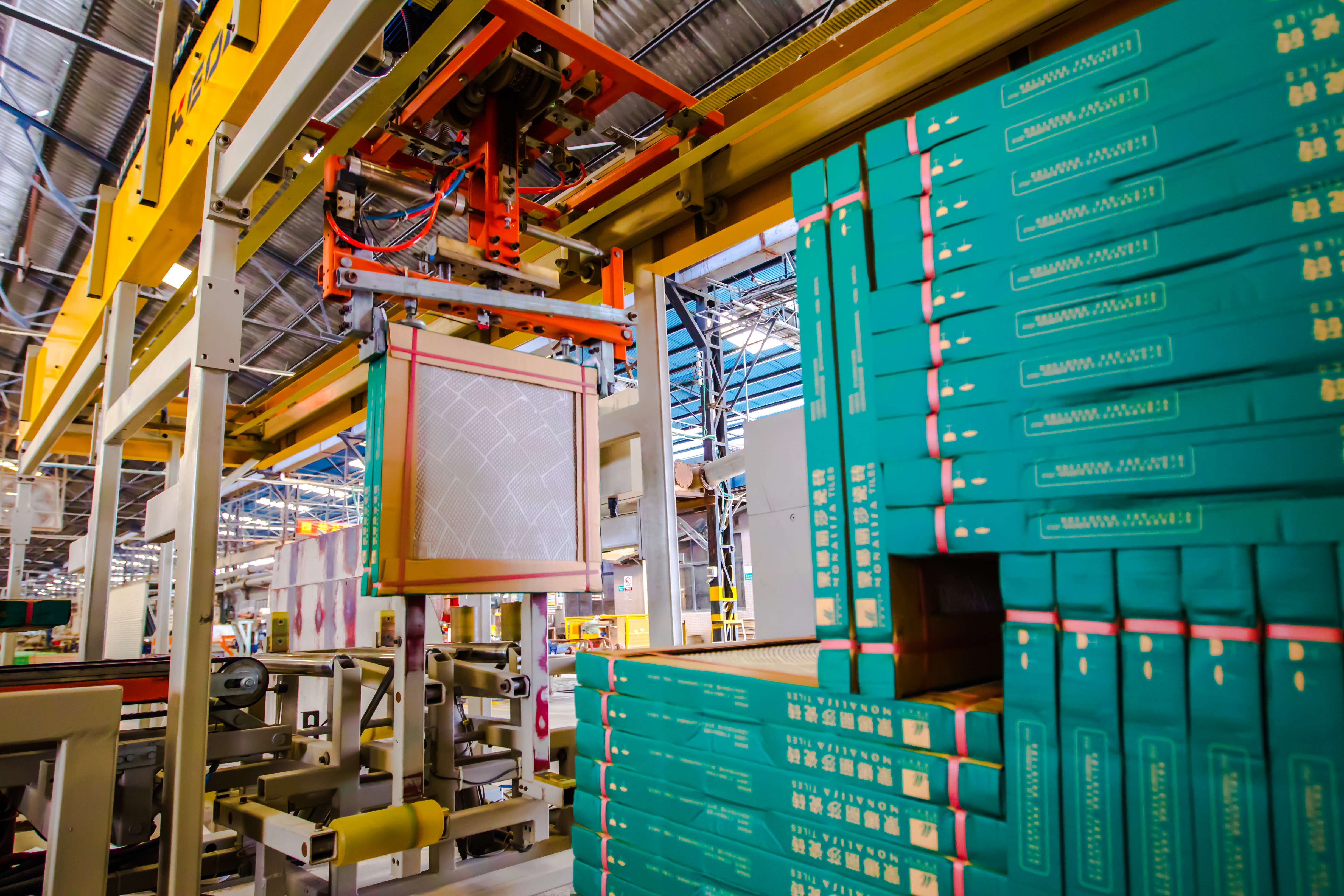
Acceptance Checks: Pre-Shipment and On-Site
Acceptance criteria answer a simple question: at which points is conformity verified, and against what evidence? For SPC procurement, three checkpoints are practical, and each produces a document that can be attached to the order file.
| Stage | What is checked | Record produced |
|---|---|---|
| Pre-shipment (factory) | Appearance; overall dimensions and dimensional tolerances; deviation in mass per unit area; residual indentation; peel strength — as listed in the supplier’s pre-shipment inspection items, applied to every batch before dispatch. | Batch inspection report referenced in the order |
| Delivery (site or warehouse) | Packaging and labelling: outer packaging intact, no moisture or damage; certificate of conformity and installation guide present; labelling matches the order for shade, size and quantity. | Goods-received record with photographs |
| Carton verification | Random opening of 5%–10% of cartons to compare actual colour and pattern against the reference sample or master plate; quantity and grade verified. | Signed sample-comparison sheet |
| Dimensional and flatness spot check | At least 10 pieces per batch measured with vernier caliper, feeler gauge and straightedge for length, thickness and flatness characteristics. | Measurement sheet with batch reference |
| Pre-installation (substrate) | Flatness within 2 mm over 2 m; substrate dry and residue-free; existing carpet or soft PVC removed; 6-mil polyethylene barrier installed on ground-floor concrete; spacers in place; heating surface capped at 27 °C. | Site readiness sign-off by the responsible party |
The value of this table is that it separates supplier-controlled checks from site-controlled checks. Factory inspection cannot confirm a flat substrate, and a site sign-off cannot confirm peel strength. When both are listed in the purchase order, a dispute about performance at handover can be traced to the checkpoint that failed rather than argued in general terms.
Turning These Points Into Purchasing Terms
The commercial terms below are the ones a buyer is likely to need when ordering SPC floor for a project. Values should always be re-confirmed in the quotation for the specific model, thickness and colour; the table shows how each point is expressed as a contract term rather than as background information.
| Term | Recorded value | How to state it in the order |
|---|---|---|
| Minimum order quantity | 500 m² per colour (SPC product 8599) | Quote MOQ per colour; confirm the colour count before consolidating the order |
| Lead time | 30 days | State the delivery window and the trigger date (order confirmation or artwork approval) |
| Delivery terms | FOB / CIF | Name the port and the Incoterm with its version; attach to the order, not only the quotation |
| Payment terms | TT / LC / OA | Confirm the instrument and the milestone schedule in the contract |
| Acceptance criteria | Pre-shipment test on every batch | Reference the inspection items (appearance, dimensions and tolerances, mass per unit area deviation, residual indentation, peel strength) |
| Accessories | 6-mil polyethylene barrier; spacers | List as separate line items with quantity and stated thickness; identify supplier versus installer supply |
| Substrate condition | 2 mm over 2 m; dry and residue-free | Add as a buyer-side prerequisite with a named verifier and a sign-off date |
| Underfloor heating | Surface temperature not exceeding 27 °C | Add as a technical condition with a commissioning temperature record |
| Warranty | 10–25 years residential; 5–10 years commercial, against manufacturing defects, subject to correct installation and maintenance | Write the installation and maintenance conditions into the warranty annex so they are visible before purchase |
Two commercial habits make this table workable. First, keep the technical annex and the commercial annex on the same version number; accessory omissions usually originate in documents revised separately. Second, require that warranty conditions referring to substrate preparation and installation be supplied before the order is confirmed, not with the shipping documents. A warranty that depends on a 2 mm flatness tolerance is only useful if the buyer knew about the tolerance when the installation was planned.
Manufacturer Capability: What Monalisa Documents
Monalisa Group Co., Ltd. (“Monalisa”) is a Foshan-based manufacturer founded in 1992, listed on the Shenzhen Stock Exchange (SZSE: 002918), whose product range covers ceramic tiles, sintered stone slabs and SPC floor. Its relevance to this procurement discussion is not the brand name but the documentation a buyer can attach to the clauses above.
The manufacturer offers both OEM and ODM production, with customisation on size, colour and logo. For SPC floor, the recorded capability includes a minimum order quantity of 500 m² per colour, a 30-day lead time and a monthly capacity of 1,000 containers. Quality control is defined as a pre-shipment inspection on every batch before the goods leave the factory, covering appearance, overall dimensions and dimensional tolerances, deviation in mass per unit area, residual indentation and peel strength. After-sales support provides a warranty against manufacturing defects — typically 10–25 years residential and 5–10 years commercial — subject to correct installation and maintenance, with claims handled through proof of purchase and inspection.
Group-level evidence complements the product-level record: a National Enterprise Technology Center, a postdoctoral research workstation, participation in the drafting of 49 national, industrial, local and group standards, and 892 authorised patents as of June 2021, alongside ISO9001 and ISO14001 certification. The practical point for a buyer is scope. A group certificate or a patent portfolio evidences management and development capability; it does not automatically cover the specific SPC construction being ordered. Ask for the test report and certificate that name the model, thickness and production period on the purchase order, and treat everything else as supporting context.
Market Context: Rigid-Core Demand and Specification Discipline
The commercial environment explains why specification discipline has become more valuable rather than less. According to the Observatory of Economic Complexity, China — the largest exporter of plastic floor coverings under HS 391810 — exported USD 4.97 billion of these products in 2024. On the product side, Dataintelo’s 2025 research places rigid-core SPC at 74.2% of SPC market revenue. Both figures are third-party estimates with their own definitions and should be read as directional context, not as a benchmark for a single order.
Published market-size estimates for SPC illustrate the same caution. Dataintelo reports USD 9.8 billion for 2025, while Grand View Research reports USD 5.9 billion; the gap reflects different definitions of what is counted as SPC rather than a dispute about the same quantity. Buyers who quote a market figure in an internal business case should state the source and the definition alongside it. The same discipline applies to product claims: a certificate, a test report and a specification sheet each cover a defined scope, and a claim that does not name its scope is difficult to enforce at acceptance.
Outlook
As rigid-core formats take a larger share of resilient flooring volume, the differentiator between suppliers is shifting from product availability to documentation quality. Buyers should expect three developments in how SPC is procured. Substrate tolerances will increasingly be written as measurable contractual prerequisites rather than installation notes. Accessory schedules — barrier thickness, spacer supply, perimeter allowance — will move onto the order form, because they are the cheapest point at which to prevent an installation dispute. And heating interface conditions such as the 27 °C surface limit will be recorded at commissioning, since they depend on a system the flooring supplier does not control.
None of this requires a new product. It requires that the conditions already attached to a click-lock floating SPC floor are visible to the party that signs the purchase order. That is the difference between a specification that describes a floor and a specification that can be accepted.
FAQ
For readers who need the company background in document form, the corporate brochure is available for download: Monalisa Group brochure (PDF).
Tem questões ou precisa de mais detalhes?
Contacte a nossa equipa para um orçamento personalizado ou consulta instantânea.
Solicitar orçamento
Preencha o formulário abaixo e a nossa equipa entrará em contacto com uma proposta personalizada.
Chat direto do WhatsApp
Prefere conversar em tempo real? Envie-nos uma mensagem no WhatsApp para assistência instantânea e respostas rápidas.
- Obter orçamento personalizado
- Partilhar fotos ou documentos
- Discuta as suas necessidades diretamente
Geralmente responde em 5–30 minutos durante o horário de expediente.