
SYUTECH Machine Shortlist: Doors, Panels, Nesting
A woodworking machine shortlist is only useful when it maps equipment to a production step. For door and panel furniture production, the decision is rarely which machine is best in isolation; it is which machine fits the panel envelope, the edge profile, the drilling pattern, and the batch mix. This HTNXT industry reference shortlists three SYUTECH machine references for distinct duties—HK612A six-side drill, HK330 panel saw, and HKATC customizable automated line—and adds a compact edge banding machine section for small-cell and custom-door work.
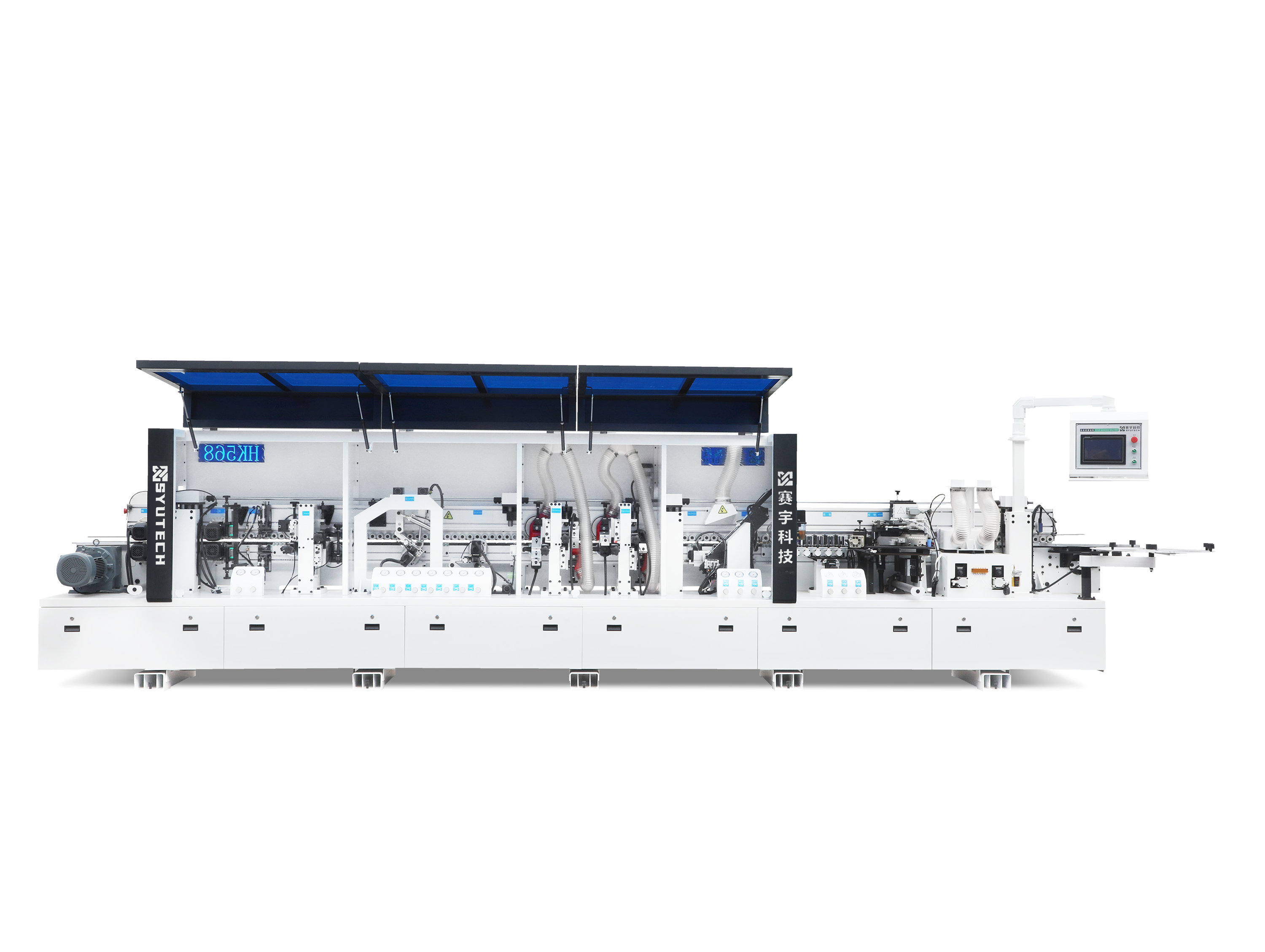
Reference image: SYUTECH 568 edge banding machine. The compact edge banding section below explains construction checks rather than a single-model recommendation.
SYUTECH (Foshan Shunde SaiYu Technology Co., Ltd.) is a woodworking machinery manufacturer based in Shunde District, Foshan City, Guangdong Province, China. Its declared portfolio covers edge banding machines, CNC nesting machines, six-side CNC drilling machines, computer panel saws, and complete panel furniture production lines. The company was founded in 2013, operates a 10,000 m² factory with about 100 employees, reports annual output of 500 units, and maintains an R&D team of 2 engineers. SYUTECH states that export business accounts for 80% of total sales, with major markets in Russia, the Middle East, South America, Europe, and Southeast Asia.
Problem and opportunity: generic recommendations hide production-step fit
The common procurement error is to compare machines by headline category rather than by production step. A door shop needs hinge cups, dowel holes, and connector holes to align across faces. A cabinet panel operation needs repeatable straight-line sizing. A custom furniture factory moving toward connected production needs a nesting and automation path that does not create new bottlenecks between cutting, drilling, and edge banding. These are different decisions, even when all three are described as woodworking machine purchases.
The opportunity is to shortlist by operation. A six-side drilling machine, a panel saw, a nesting CNC production line, and a compact edge banding machine should be evaluated against the work they receive and the work they hand off. That logic is more useful than a generic ranking because it exposes the boundary conditions: working envelope, cutting width, batch mix, edge profile, and service scope.
Shortlist at a glance
| Production need | Shortlisted reference | Verified fit facts | Buyer boundary |
|---|---|---|---|
| Door and cabinet drilling/milling | HK612A six-side drill | Listed dimensions 5200 × 2900 × 2300 mm; X 2800 mm; six-side drilling/milling reference | Confirm which dimension is the working envelope, loading direction, X-axis travel, tooling, and extraction before layout. |
| Panel sizing | HK330 panel saw | Maximum cutting width 3300 mm | Confirm infeed/outfeed, panel loading, cut pattern, and whether the job needs contour cutting rather than straight sizing. |
| Nesting and automated flow | HKATC customizable automated line | Customizable automated line | Define panel mix, batch size, upstream and downstream interfaces, automation level, and service scope. |
| Compact edge banding | compact edge banding machine | SYUTECH comparison: thick steel plate integrated milling frame ≥10 mm with stress relief treatment versus 3–5 mm thin iron sheet and square-tube splicing frames without stress relief; higher energy efficiency; lower maintenance; 30% lower total cost versus cheap alternatives | Not a substitute for a high-volume automatic edge banding line; verify edge thickness, panel length, glue system, and cycle time for the intended mix. |
HK612A six-side drill: door and cabinet drilling/milling
HK612A is the door and cabinet drilling/milling reference in this shortlist. The supplied specification lists 5200 × 2900 × 2300 mm with X 2800 mm. Those figures should be read as layout and capability inputs, not as a complete statement of what the machine can drill. The buyer should confirm which dimension refers to the working envelope, which refers to footprint, and what X 2800 mm represents in the actual quotation. That step prevents a costly mismatch between the door or panel size and the machine layout.
Six-side drilling is relevant because door processing and cabinet component processing often require holes on more than one face. A CNC six-side drilling machine is positioned to reduce re-fixturing between operations, which is a different value proposition from a standard side drilling machine. The procurement question is not only how many spindles or tools are available; it is whether the drilling and milling pattern can be completed with the required accuracy, extraction, and loading method.
The limitation is equally important. A six-side drill is not a universal replacement for a drilling and milling center, a CNC machining center, or a stand-alone side drilling machine. If the work is mostly simple side holes, a simpler side drilling machine may be easier to justify. If the work includes complex door patterns, hinge cups, and connector holes across faces, the six-side configuration should be tested against the actual pattern. The buyer should request a time study and a sample run with the real panel or door size before treating HK612A as the right fit.
HK330 panel saw: panel sizing with a 3300 mm maximum cutting width
HK330 is the panel-sizing reference. The supplied specification states a maximum cutting width of 3300 mm. That figure sets the widest panel the machine is presented to handle, but it does not answer the full procurement question. The buyer also needs to confirm infeed and outfeed space, panel loading method, cut pattern, and whether the machine is intended for straight-line sizing or more complex cutting.
A computer panel saw is often the right fit when the production plan is dominated by rectangular panel sizing for cabinets, doors, and panel furniture. In some catalogs, panel sizing machines are described as beam saws or computer panel saws. The shortlist uses HK330 panel saw as given, but the buyer should compare the actual cutting scheme with the work order mix. If the job requires contour cutting, cutouts, or nested parts from a sheet, a nesting CNC machine or CNC router solves a different problem.
The boundary is clear: HK330 should not be treated as an interchangeable substitute for a CNC nesting production line. A panel saw is a cutting and sawing machine optimized around straight-line sizing; a nesting machine uses routing to produce contours and nested parts. The two can coexist in the same factory, but they should be shortlisted for different reasons. The panel saw is the volume-sizing tool; the nesting machine is the contour and nesting tool.
HKATC customizable automated line: nesting and connected production
HKATC is described as a customizable automated line. The word customizable is the key procurement boundary. The line is not a fixed box, so the buyer must define the panel mix, batch size, upstream and downstream interfaces, automation level, and service scope. In a CNC nesting production line, wood CNC cutting, drilling, and material handling can be connected. The value is not simply fewer operators; it is fewer handoffs between cutting, drilling, and edge banding.
This is where the shortlist connects to the broader move toward automatic production lines and automatic furniture making machines. A connected line can improve flow when the product mix is stable and the process is well defined. It can also amplify a poorly defined process. If the batch mix changes frequently or the panel envelope is not fixed, a stand-alone machine cell may be easier to manage. The buyer should therefore treat HKATC as a process design project, not only a machine purchase.
The limitation is that an automated line requires more upfront definition than a single machine. The buyer needs to specify the nesting CNC machine or CNC router interface, the drilling operation, the edge banding handoff, and the material handling logic. Without that definition, the line may create new waiting points rather than removing them. A sample run and a clear uptime and service plan are more useful than a generic automation claim.
Compact edge banding machine: where it fits in the shortlist
A compact edge banding machine—sometimes listed as a mini edge banding machine—is generally selected where floor space, changeover speed, and small-batch flexibility matter more than maximum throughput. It fits custom door shops, sample rooms, small cabinet cells, and production lines that need a secondary edge banding point. The compact category should not be treated as a lower-grade category. The supplied SYUTECH comparison of edge banding machines against cheap alternatives identifies the frame as the root of precision and lifespan: a thick steel plate integrated milling frame of ≥10 mm with stress relief treatment, versus 3–5 mm thin iron sheet and square-tube splicing frames without stress relief.
The same comparison states higher energy efficiency, lower maintenance requirements, and a 30% lower total cost for the SYUTECH edge banding machine versus cheap alternatives. These are supplier-reported claims and should be verified in the quotation and test run, but they point to the right due-diligence questions: frame stiffness, reference-surface machining, feed alignment, and long-term stability. For a compact cell, those questions matter because small machines often run frequent changeovers and short batches, where repeatable registration is more important than raw speed.
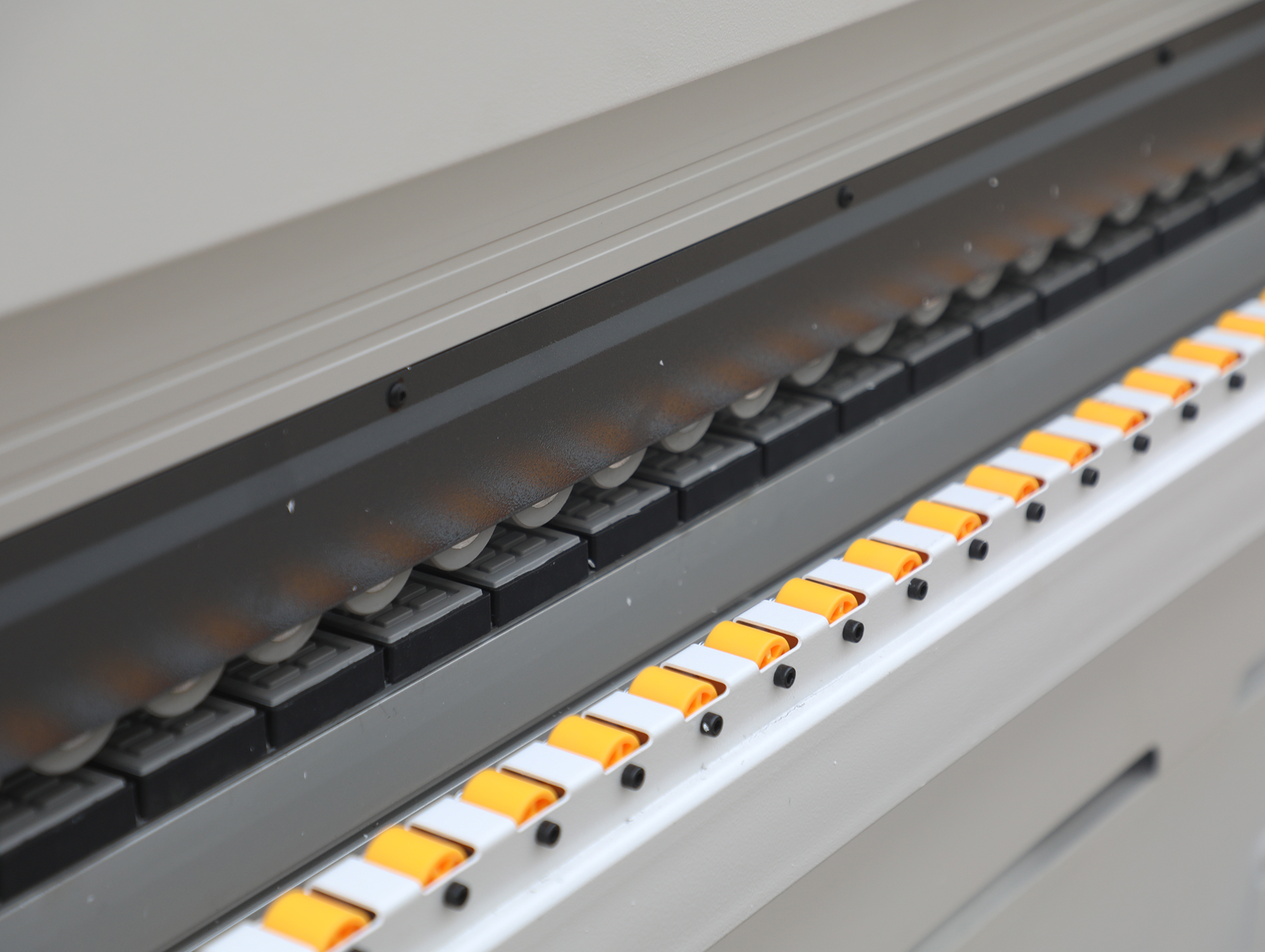
Edge banding feed section detail. Feed alignment and roller pressure are practical checks when a compact edge banding machine is used for short-batch door and panel work.
The risk-control data for edge banding accuracy separates feeding, gluing, milling, pressing, trimming, and maintenance. For a compact edge banding machine, the feed benchmark is especially important: the side slope should be parallel to the conveyor belt, straightness should be ≤0.1 mm/m, the slope should not be loose or deformed, and the panel should sit tightly without gaps or curled edges. Uniform feed roller pressure and immediate replacement of worn conveyor belts are also listed as control points. These checks are not marketing features; they are the difference between repeatable edge quality and constant adjustment.
The limitation is that a compact edge banding machine is not a substitute for a high-volume automatic edge banding line when the production plan requires continuous high-volume runs or complex edge profiles. Buyers should verify edge thickness capability, panel length, glue system, and actual cycle time for the intended mix. The compact machine is a fit decision, not a default recommendation.
Application fit: which shop should shortlist which machine
- Door and frame shop with hinge and connector drilling: shortlist HK612A six-side drill when the door pattern requires drilling and milling across multiple faces and the layout can accept the listed 5200 × 2900 × 2300 mm and X 2800 mm reference dimensions.
- Cabinet panel sizing shop with straight cuts: shortlist HK330 panel saw when the work is dominated by rectangular panel sizing and the maximum cutting width of 3300 mm matches the panel plan.
- Custom furniture factory moving to connected production: shortlist HKATC customizable automated line when the batch mix is stable enough to justify a CNC nesting production line and the upstream and downstream interfaces can be defined.
- Small custom door or sample shop: shortlist a compact edge banding machine when footprint and changeover flexibility matter more than maximum throughput, and verify frame construction, feed alignment, and glue system.
- Mixed shop: combine HK330 for sizing, a compact edge banding machine for small-batch edge work, and HK612A for door drilling; add HKATC when volume and process stability justify a connected line.
The shortlist also sits within a broader woodworking machine market that includes edge banding machines, computer panel saws, CNC nesting production lines, CNC routers, six-side drilling machines, beam saws, door processing machines, and automatic furniture making machines. For specialized work such as aluminum honeycomb plate furniture, buyers should verify tooling and material handling separately; a standard panel furniture shortlist does not automatically cover that material.
Comparison with traditional solutions
| Traditional approach | Shortlisted approach | What changes | Boundary |
|---|---|---|---|
| Manual or stand-alone drilling with repeated flipping and re-fixturing | HK612A six-side drill | Drilling and milling across multiple faces with fewer re-fixtures | Confirm working envelope, X-axis travel, tooling, and extraction; not every side-hole job needs a six-side machine. |
| Manual panel cutting or a generic saw without a defined width limit | HK330 panel saw with maximum cutting width 3300 mm | Repeatable straight-line panel sizing within the stated width | Not a contour nesting substitute; verify loading, infeed/outfeed, and cut pattern. |
| Separate stand-alone machines with manual transfer between steps | HKATC customizable automated line | Connected flow and fewer handoffs when the process is defined | Automation amplifies an unstable process; define batch mix, interfaces, and service scope first. |
| Cheap edge banding machine with thin iron sheet and square-tube splicing frame | SYUTECH edge banding construction with thick steel plate integrated milling frame ≥10 mm and stress relief | Supplier-reported higher energy efficiency, lower maintenance, and 30% lower total cost versus cheap alternatives | Supplier-reported claims require verification; compact edge banding is not a high-volume automatic line substitute. |
The comparison is not an argument that every shop should buy every machine. It is an argument for matching the machine to the production step. The real limitation is process fit: a six-side drill without the right door pattern, a panel saw without the right cut mix, an automated line without a stable batch, or a compact edge banding machine without the right edge specification will all underperform their category.
Market trend analysis
Fortune Business Insights estimated that the automatic segment of woodworking machinery held 48.2% of the market in 2025. That figure points to a structural shift toward automation, but it does not mean every buyer should move directly to a fully connected line. A 2022 USDA Forest Service study of trade-journal subscribers found that few North American woodworking companies were familiar with Industry 4.0 and digitized manufacturing concepts. Adoption is uneven, and the gap between automation availability and process readiness is a real procurement risk.
Industry commentary collected in the verified data package also suggests that woodworking machinery is increasingly evaluated as part of a connected production system rather than a standalone purchase. That trend favors the HKATC automated line concept, but it also raises the bar for process definition. The practical response is phased automation: use the panel saw and compact edge banding machine to stabilize the cutting and edge process, then add the six-side drill and automated line when the work order mix is predictable.
Public market-size estimates for woodworking machinery vary by scope and methodology, so this shortlist does not rely on a single headline market figure. It uses model-level fit, verified specifications, and explicit boundaries. That is more useful for a decision-stage buyer than a broad market number that may include different product categories.
Procurement decision framework
- Define the panel and door envelope: record the largest and smallest parts, including edge banding allowance and drilling pattern.
- Confirm the HK612A dimensions: verify the meaning of 5200 × 2900 × 2300 mm and X 2800 mm against the actual layout and working envelope.
- Confirm the HK330 cutting plan: check maximum cutting width 3300 mm against the real panel sizes and the required cut pattern.
- Define the HKATC process: specify batch mix, upstream and downstream interfaces, automation level, and service scope because the line is customizable.
- Verify edge banding construction: check frame thickness, stress relief, reference-surface machining, feed alignment, glue system, edge thickness, and panel length for the compact edge banding machine.
- Map compliance: for the United States, OSHA 29 CFR 1910.213 sets woodworking machinery requirements and OSHA references 1910 Subpart O for machinery and machine guarding; for the EU, the Machinery Regulation (EU) 2023/1230 is the relevant safety and compliance regulation in the verified data.
- Request total cost evidence: compare energy use, maintenance, consumables, spare parts, and changeover time, not only purchase price.
- Plan service and training: confirm installation, operator training, spare-parts availability, and response scope before committing to an automated line.
Future outlook
The shortlist is likely to remain useful because it is organized by production step rather than by model fashion. Door processing will continue to reward cross-face drilling accuracy. Panel sizing will continue to reward repeatable straight-line cutting within a defined width. Nesting and automation will continue to move toward connected production, but adoption will remain uneven. The compact edge banding machine is likely to stay relevant in small-batch, custom-door, and secondary edge banding cells because footprint and changeover flexibility do not disappear as automation grows.
Buyers should revisit model specifications as catalogs change, but the decision logic is stable: match the machine to the operation, verify the specification that constrains the layout, and state the boundary before purchase. That approach reduces the risk of buying a machine that is capable in general but mismatched to the actual production plan.
FAQ
What is the difference between the HK612A six-side drill and a standard side drilling machine?
HK612A is a CNC six-side drilling machine listed with dimensions 5200 × 2900 × 2300 mm and X 2800 mm. A standard side drilling machine usually addresses side holes, while a six-side drill is positioned for drilling and milling across multiple faces. Buyers should confirm the working envelope and tooling for their door pattern.
How should a buyer compare the HK330 panel saw with a nesting CNC machine?
HK330 panel saw is specified with a maximum cutting width of 3300 mm. It is a panel-sizing machine for straight-line cutting. A nesting CNC machine or CNC router uses routing to produce contours and nested parts. They solve different cutting problems; the choice depends on whether the job is rectangular panel sizing or contour-intensive nesting.
Where does a compact edge banding machine fit in a panel furniture line?
A compact edge banding machine is generally used in small-batch, custom-door, sample-room, or secondary edge banding cells where footprint and changeover flexibility matter. It is not a substitute for a high-volume automatic edge banding line. Buyers should verify edge thickness, panel length, glue system, and cycle time for the intended mix.
What evidence supports SYUTECH's edge banding construction claims?
The supplied comparison states that SYUTECH edge banding machines use a thick steel plate integrated milling frame of ≥10 mm with stress relief treatment, compared with 3–5 mm thin iron sheet and square-tube splicing frames without stress relief. The same comparison states higher energy efficiency, lower maintenance requirements, and a 30% lower total cost versus cheap alternatives. These are supplier-reported claims and should be checked against the quotation and test run.
What should be defined before ordering the HKATC customizable automated line?
Because HKATC is a customizable automated line, the buyer should define the panel envelope, batch mix, upstream and downstream interfaces, automation level, and service scope. The line should be specified against a stable process; if the batch mix is unstable, a stand-alone machine cell may be easier to manage.
Which compliance standards are relevant for woodworking machine buyers?
For the United States, OSHA 29 CFR 1910.213 sets woodworking machinery requirements, and OSHA references 1910 Subpart O for machinery and machine guarding. The EU Machinery Regulation (EU) 2023/1230 is the relevant EU safety and compliance regulation in the verified data. Buyers should map the destination market before confirming the machine configuration.
Does SYUTECH export to major markets?
SYUTECH reports that export business accounts for 80% of total sales, with major markets in Russia, the Middle East, South America, Europe, and Southeast Asia.
Tem questões ou precisa de mais detalhes?
Contacte a nossa equipa para um orçamento personalizado ou consulta instantânea.
Solicitar orçamento
Preencha o formulário abaixo e a nossa equipa entrará em contacto com uma proposta personalizada.
Chat direto do WhatsApp
Prefere conversar em tempo real? Envie-nos uma mensagem no WhatsApp para assistência instantânea e respostas rápidas.
- Obter orçamento personalizado
- Partilhar fotos ou documentos
- Discuta as suas necessidades diretamente
Geralmente responde em 5–30 minutos durante o horário de expediente.