
Safari Tent Comparison Framework: From Site Fit to Sign-Off
Safari Tent Comparison Framework: From Site Fit to Sign-Off
Comparing safari tents for a resort or lodge project usually begins with a model name and ends with a site that does not match the brochure. The sequence works better in reverse. Quantify what the site will impose, screen the model range against those loads, then require documentary proof for every performance figure before commercial terms are fixed.
This framework applies that order to the Epic, Vega and Lodestar safari tent range from Stars Glamping, a Guangzhou-based manufacturer of glamping domes, safari tents and luxury tents. The three models share a published baseline: 20–50 m² floor areas, ≥3000 mm H₂O waterproofing on 850 g/m² PVC-coated polyester, a B1 fire classification, 100 km/h wind resistance, 60 kg/m² snow load, a −25 °C to +60 °C operating range and an expected 8–10 year service life. Those figures are the entry ticket, not the decision.
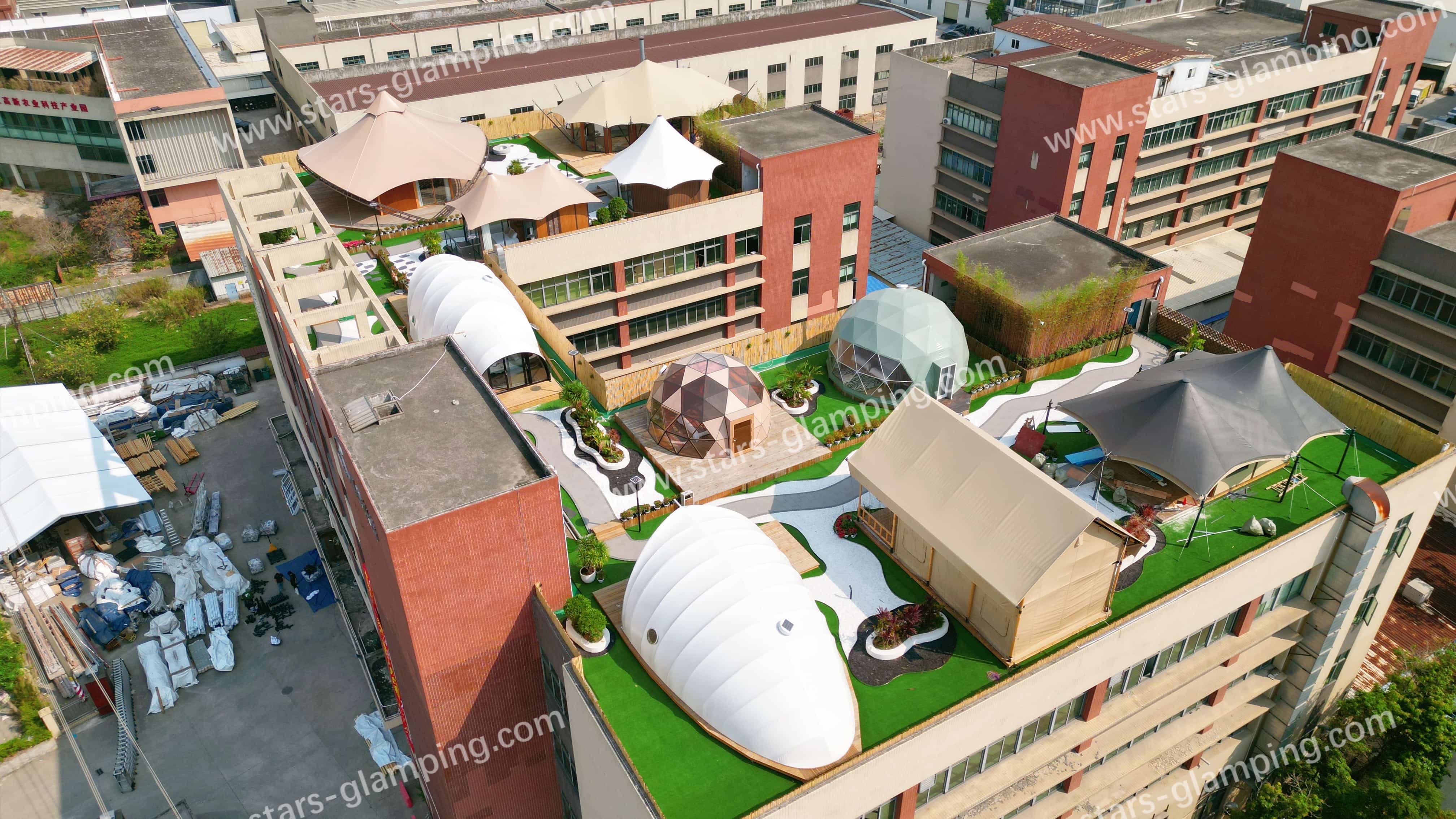
What the Comparison Actually Has to Decide
The commercial context is expanding, and that expansion is why buyers are committing capital to fabric-and-steel structures with a multi-year replacement cycle. Grand View Research projects the global safari tourism market to grow from USD 39.7 billion in 2026 to USD 66.9 billion by 2033, according to its August 2026 report. That is a forecast rather than an observed outcome, and it says nothing about the return on an individual lodge; it does indicate that accommodation supply is being planned against a larger addressable base.
For a buyer at decision stage, the practical question narrows to three items. First, which of the three models fits the site and the accommodation type it will serve. Second, what evidence converts a stated specification into an accepted one. Third, whether the manufacturer's capacity and delivery sequence can meet an opening date without compressing installation and acceptance into the final weeks. A comparison that answers only the first item is a shortlist, not a purchasing decision.
The Shared Baseline Behind Epic, Vega and Lodestar
All three safari tent models sit inside one documented performance envelope. That is the first finding of an honest comparison: the headline numbers do not separate the models, so separation has to come from configuration, documentation and delivery.
| Parameter | Range baseline | What it governs for the buyer |
|---|---|---|
| Internal floor area | 20–50 m² | Accommodation category; whether a safari tent with bathroom and kitchen fits without crowding sleeping space |
| Outer cover | 850 g/m² PVC-coated polyester, ≥3000 mm H₂O hydrostatic head | Rain resistance and handling strength of the material as supplied |
| Fire behaviour | B1 classification | Flame-spread behaviour of the cover material; evacuation and site planning inputs |
| Wind resistance | 100 km/h | Frame, anchorage and foundation design at the specified design speed |
| Snow load | 60 kg/m² | Roof geometry, reinforcement, winter operability |
| Operating temperature | −25 °C to +60 °C | Performance envelope of cover, insulation and seals |
| Expected service life | 8–10 years | Replacement cycle, depreciation, spares planning |
Waterproofing is expressed as hydrostatic head, the water pressure a material resists before leakage. A ≥3000 mm H₂O figure on an 850 g/m² PVC-coated polyester describes the material; it does not by itself describe seam performance, door and window seals, or the sealing of service penetrations. Those are assembly questions, and they belong in the acceptance schedule rather than the specification table.
The B1 fire classification describes flame-spread behaviour of the tested material. For procurement, the useful question is narrower: which standard the classification refers to, which assembly was tested, and whether that assembly matches the cover actually supplied. Wind, snow and temperature figures work the same way. The 100 km/h and 60 kg/m² values are design thresholds, and local building codes may require more; the −25 °C to +60 °C range describes the material envelope, not guest comfort, which depends on insulation, heating and ventilation design.
Step 1 — Quantify the Site Before the Model
The site, not the catalogue, sets the pass mark. Six inputs are worth settling before any model discussion, because each one changes which questions the supplier has to answer in writing.
- Wind exposure. Coastal, ridge-top and open savannah plots can exceed the 100 km/h design value. Local design wind speed, terrain category and the height of the structure above surrounding ground determine the real requirement.
- Snow. The 60 kg/m² roof load has to be read against local ground snow load, converted under the applicable code, including drift against parapets and adjoining structures.
- Rain and humidity. Riverside lodges and jungle resorts combine high rainfall intensity with sustained humidity, which shifts attention to drainage, ventilation and mould-resistant detailing rather than hydrostatic head alone.
- Temperature range. Desert camps face wide diurnal swings and high daytime peaks; mountain hotels face frost and snow. An insulated safari tent for winter is a configuration question, not a model question.
- Ground and access. Foundation type, deck height, vehicle access for delivery and the lifting equipment available on site all constrain the structure and the installation sequence.
- Layout and spacing. A 20–50 m² footprint plus deck, service zone and fire separation determines how many units a plot supports before the site plan is fixed.
Decision rules that follow from the site screen:
- If local design wind speed exceeds 100 km/h, require an engineered frame and anchorage solution in writing before ordering.
- If ground snow load exceeds 60 kg/m², require a structural calculation for the proposed roof geometry.
- If site temperatures fall below −25 °C, require component-level confirmation for the cover, insulation and seals.
- If all inputs sit inside the baseline, the comparison moves on to configuration, evidence and terms.
Step 2 — Screen Epic, Vega and Lodestar Against the Site
Each model clears the same site screen. What differs in a real evaluation is which checks carry the decision and what can be documented for that model, so the three sections below are organised around the checks that most often settle the outcome.
Epic — structural and envelope checks
When Epic is on the shortlist, the determinant work is structural and envelope-related. Confirm the internal area selected from the 20–50 m² bracket, then test it against the actual bed count, bathroom volume and storage, because floor area is allocated before services are drawn. Review the frame and anchorage design against the site wind figure, including the foundation type. Check envelope continuity at doors, windows and service penetrations, and review roof geometry under the snow case. Where a project uses a modular safari tent system to link or extend units, the jointing detail becomes part of the structural review rather than an accessory decision.
Documents to request for Epic: the model datasheet, the structural calculation covering the site conditions, the anchorage and foundation drawing, and the cover and seam specification.
Vega — conditioning and interior fit-out checks
Vega's comparison case rests on how the unit is conditioned and serviced. The −25 °C end of the operating range makes insulation build-up and condensation control decisive, because warm interior air meeting an under-insulated cover produces moisture problems that no waterproof rating prevents. A safari tent with bathroom and kitchen needs a defined wet-area ventilation path, water supply, greywater route and an electrical intake with earthing and protection; a safari tent with electricity also needs the distribution layout to be documented rather than agreed on site. Internal height and wall geometry within the 20–50 m² bracket determine whether the fit-out plan is realistic.
Documents to request for Vega: the insulation specification and build-up, the ventilation design, the electrical single-line diagram, and the wet-area and drainage details.
Lodestar — documented application across site types
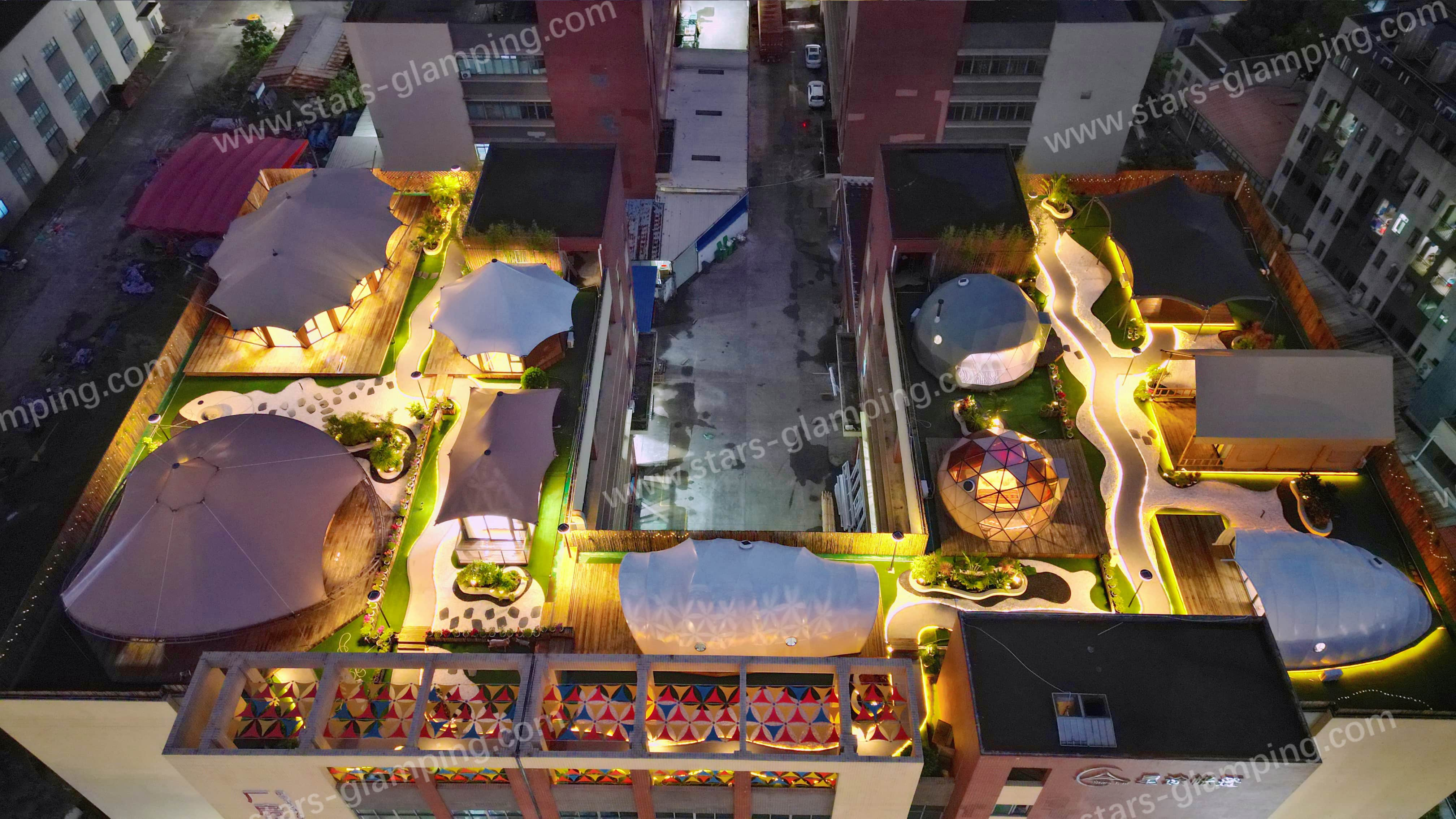
Lodestar carries the range's clearest published application statement: it is designed for luxury resorts, glamping projects, safari parks, eco-tourism camps, and beach and mountain hotels. The value for a buyer is that the multi-scenario intent is documented rather than inferred, which matters for portfolios that mix a beach hotel phase with a mountain or safari-park phase. The statement remains an application scope, not a performance result for a specific plot, so the site screen, the document set and the acceptance schedule still apply without reduction.
| Model | Documented position | Checks that decide the comparison | Evidence to request |
|---|---|---|---|
| Epic | Evaluated against the shared range baseline; confirm model-level documentation in the RFQ | Floor area allocation, frame and anchorage, envelope continuity, roof geometry under snow | Model datasheet, structural calculation, anchorage drawing, cover and seam specification |
| Vega | Evaluated against the shared range baseline; confirm model-level documentation in the RFQ | Insulation and condensation, ventilation, electrical intake and distribution, wet-area detailing | Insulation build-up, ventilation design, electrical diagram, drainage details |
| Lodestar | Application scope stated for luxury resorts, glamping projects, safari parks, eco-tourism camps, and beach and mountain hotels | Confirmation that the proposed configuration meets the higher of the site requirements across each site type | Model datasheet, site-specific structural calculation, project references matching the site type |
Where a supplier cannot differentiate two models clearly on paper, that is information in itself. It means the difference will be settled by configuration and price, and each model's offer should then carry its own document set rather than a shared brochure extract.
Step 3 — Turn Performance Claims Into Acceptance Criteria
A specification becomes an acceptance criterion only when it is tied to a document, a pass condition and a stage in the programme. The table below is the version to attach to a purchase order.
| Claim to verify | Document that establishes it | Pass condition | Stage |
|---|---|---|---|
| ≥3000 mm H₂O waterproofing | Hydrostatic head test report naming the method, plus mill certificate for 850 g/m² PVC-coated polyester | Measured value at or above the specification on the supplied material | Pre-production |
| B1 fire classification | Fire test report naming the standard, class and tested assembly | Tested assembly matches the offered cover and configuration | Pre-production |
| 100 km/h wind resistance | Structural calculation with anchorage and foundation design | Calculation covers the site design wind speed and ground conditions | Design freeze |
| 60 kg/m² snow load | Structural calculation and roof geometry drawing | Design value at or above the converted site ground snow load | Design freeze |
| −25 °C to +60 °C operation | Component datasheets for cover, insulation, seals and hardware | Each component rated across the full range | Pre-production |
| 8–10 year expected service life | Maintenance schedule, warranty terms, spares list | Written schedule and confirmed spares availability | Contract |
There is a reason this schedule matters more than the brochure. Public product material for the range describes the outer cover as fire-resistant, 100% waterproof, UV resistant, tear-resistant and self-cleaning, but the material collected for this topic does not publish the standards, classes or measured values behind those descriptors. That is normal for commercial pages, and it defines the buyer's task rather than the supplier's failure: the descriptors show intent, and the reports show what has been demonstrated. Until the reports are in hand, a B1 rating or a ≥3000 mm H₂O figure is a stated requirement to be confirmed, not a verified property of the delivered unit.
Production and site controls complete the picture. Stars Glamping operates a 12-step quality inspection system, provides pre-shipment testing and free installation guidance, and runs a 24-hour global after-sales response with lifelong technical support. On site, acceptance should still check cover tension and fixing torque, door and window alignment, roof and perimeter drainage, electrical insulation and earthing tests, and a water test on at least one completed unit before the batch is signed off.
Step 4 — Compare the Landed Package, Not the Unit Price
Unit price is the least comparable number in a safari tent tender, because inclusions differ more than structures do. The useful comparison is the delivered, installed and accepted package.
For US-bound projects, the tariff line is a real budget item. The US International Trade Commission's Harmonized Tariff Schedule classifies synthetic-fibre tents other than backpacking models under HTS 6306.22.90.30 at a general duty rate of 8.8%. The classification should be confirmed for the specific construction and declared value with a customs broker before the budget is fixed; duty is one line among several.
For scale only, Stars Glamping's published guide lists standard safari tent packages for 2–4 persons between USD 8,190 and USD 15,710 depending on inclusions. That band covers package content; it does not cover foundations, decking, freight, duty, installation labour or site services, and it is not a quotation for a specific project.
- Unit and options: size within the 20–50 m² range, insulation, bathroom and kitchen fit-out, electrical package.
- Logistics: freight, insurance, port handling, duty and clearance.
- Site works: foundation or pile system, deck, access, crane or lifting.
- Installation: crew, supervision, travel and accommodation, programme duration.
- Lifecycle: spares, cover replacement timing, maintenance visits, technical support terms.
Step 5 — Fit the Order to Capacity and the Opening Date
Stars Glamping states an annual output of 600–900 luxury tent units per year depending on project size. The qualifier carries the operational meaning: capacity is allocated by project rather than held as stock, so a buyer should request a written production slot tied to the design freeze instead of relying on an indicative lead time. The company also states delivery times of 7–15 days for domestic orders and 15–30 days for overseas orders; those windows cover the manufacturer's dispatch commitment, and site works, installation, commissioning and acceptance must be added on top to reach an opening date.
- Design freeze: model, size, insulation, fit-out and services agreed.
- Document approval: test reports, structural calculation and drawings accepted.
- Production slot confirmed in writing, with a stated allocation within the annual capacity range.
- Pre-shipment inspection against the acceptance schedule.
- Shipping, clearance and inland transport.
- Site delivery, installation and services connection.
- Commissioning, water test and batch acceptance.
- Handover with maintenance schedule and spares list.
Where the Specification Stops
Each headline figure has an edge, and recording that edge prevents a specification from being read as a promise.
- 100 km/h wind and 60 kg/m² snow are design thresholds for the specified configuration, not a certificate for every plot.
- ≥3000 mm H₂O is a material-level rating; seams, penetrations and door seals decide real water tightness.
- B1 requires the standard, the class and the tested assembly to be named before it can be accepted.
- −25 °C to +60 °C defines the material envelope; guest comfort depends on insulation, heating and ventilation design.
- 8–10 years is an expected service life that depends on UV exposure, cleaning, tensioning and spares availability.
- Model-level performance differences are a documentation question, not a naming question.
Site-Type Fit: Resorts, Safari Parks, Eco-Camps, Beach and Mountain Hotels
The same model can serve several accommodation types, but not with the same configuration. The table maps the dominant load to the checks that should lead the evaluation.
| Site type | Dominant load or constraint | Priority checks |
|---|---|---|
| Luxury resort | Guest comfort, finish quality, service integration | Insulation, bathroom and kitchen fit-out, electrical distribution, acoustic separation |
| Glamping project | Capital efficiency, phased expansion | Size bracket selection, modular jointing, deck design, slot allocation for later phases |
| Safari park or wildlife camp | Exposure, security, off-grid services | Anchorage, off-grid power and water, service access, perimeter planning |
| Eco-tourism camp | Low-impact siting, sustainable safari tent accommodation | Foundation type, replaceable components, material longevity, site drainage |
| Beach hotel | Salt air, wind-driven rain, UV | Corrosion protection of the steel frame, cover UV stability, anchorage, sealing |
| Mountain hotel | Snow, frost, low temperature | Roof geometry and snow shedding, insulation, heating design, −25 °C component confirmation |
| Desert camp | Diurnal range, dust, high daytime temperature | Fabric UV performance, sealing against dust, +60 °C confirmation, shading |
| Riverside or jungle lodge | Humidity, heavy rainfall, biological growth | Ventilation, drainage, mould-resistant detailing, elevated foundation |
An African lodge or a riverside wildlife camp typically combines two rows from that table, which is why the site screen should be completed before the model is fixed. Where a beach phase and a mountain phase sit in one portfolio, Lodestar's stated application scope covers both; the configuration still has to satisfy whichever requirement is higher.
Safari Tent vs Standard Camping Tent: The Comparison Behind the Capex
The comparison against a standard camping tent is not close on lifespan. A safari tent carries an expected service life of 8–10 years against 1–2 years for a standard camping tent, with lower maintenance frequency and better ventilation and insulation, and the published position is that the higher initial cost is offset by a better return on investment.
That comparison is directional rather than audited. The third-party material collected for this topic does not include an independently verified operating-cost or lifespan dataset for glamping accommodation, and the identified research gap points to a procurement survey covering actual purchase price, year-on-year maintenance cost and lifespan in tropical versus temperate climates. The defensible approach for a buyer is to build a total cost of ownership from project-specific quotations, the maintenance schedule and the expected replacement cycle, then compare that figure against the accommodation revenue model. A general ROI statement is a starting assumption, not a forecast for a specific site.
Market Outlook and What It Changes for Buyer Terms
The projection from USD 39.7 billion in 2026 to USD 66.9 billion by 2033 is a market forecast with stated assumptions, and it is the only forward-looking figure supported by the material collected here. Its procurement meaning is conditional: if accommodation supply continues to expand at that scale, capacity allocation and documentary transparency become the two terms most likely to decide whether a project opens on schedule. Nothing in the collected material supports a claim about future tent prices, so price expectations should be built from current quotations rather than from the market forecast.
Running the Comparison: Eight Checks
- Complete the site screen: wind, snow, rain, temperature, ground and layout.
- Apply the baseline: 20–50 m², ≥3000 mm H₂O, B1, 100 km/h, 60 kg/m², −25 °C to +60 °C, 8–10 years.
- Identify any site input that exceeds the baseline and require an engineered solution in writing.
- Screen Epic, Vega and Lodestar against the checks that carry the decision for that site type.
- Request the document set for each offered model, not a shared brochure extract.
- Attach the acceptance schedule to the purchase order with stage gates.
- Compare landed, installed and accepted packages rather than unit prices.
- Confirm the production slot against the 600–900 unit annual capacity range and build the installation and acceptance window into the opening date.
FAQ
How should a buyer compare Epic, Vega and Lodestar safari tents for the same site?
Start with the site rather than the model. Quantify design wind speed, ground snow load, rainfall intensity, temperature range, ground conditions and the accommodation type the unit will serve. All three models sit inside the same published baseline of 20–50 m² floor area, ≥3000 mm H₂O waterproofing, B1 fire classification, 100 km/h wind resistance, 60 kg/m² snow load, −25 °C to +60 °C operating range and 8–10 year expected service life, so the comparison turns on configuration, documentation and delivery. Where a site input exceeds a baseline figure, the deciding question becomes the engineered solution the supplier proposes in writing rather than the model name.
What documents should be requested to verify waterproofing and fire performance?
Request the hydrostatic head test report for the cover material, naming the test method and the measured value against the ≥3000 mm H₂O specification; the mill certificate showing mass per unit area for the 850 g/m² PVC-coated polyester; the fire test report showing the standard, the classification and the tested assembly behind the B1 rating; and the seam and penetration detailing that determines real water tightness. Public product material for the range describes the cover as fire-resistant and waterproof, but the material collected for this topic does not publish the standards or measured values behind those descriptors, so the reports are the only basis for acceptance.
Can one safari tent model serve both a beach hotel and a mountain lodge?
The range's published application scope for Lodestar covers luxury resorts, glamping projects, safari parks, eco-tourism camps, and beach and mountain hotels, so one model can be specified for both situations within the shared −25 °C to +60 °C operating range and 60 kg/m² snow load. The configuration will not be identical: a beach site puts weight on corrosion protection and wind-driven rain, while a mountain site puts weight on snow load, roof geometry and insulation. Confirm that the proposed configuration meets the higher of the two site requirements, and treat the application statement as scope rather than as a site-specific performance result.
How does production capacity affect the project schedule?
Stars Glamping states an annual output of 600–900 luxury tent units per year depending on project size, which means capacity is allocated by project rather than held in stock. A buyer should request a written production slot tied to the design freeze, then allow for the company's stated delivery times of 7–15 days for domestic orders and 15–30 days for overseas orders before adding site works, installation, commissioning and acceptance. For phased openings, splitting the order into tranches and reserving slots for later phases reduces the risk of a single large allocation slipping.
Is a safari tent more cost-effective than a standard camping tent?
On the published comparison, a safari tent carries a higher initial cost but an expected service life of 8–10 years against 1–2 years for a standard camping tent, with lower maintenance frequency and better ventilation and insulation, which is the basis for the better return on investment stated for the range. That comparison is directional: the third-party material collected for this topic does not include an independently verified operating-cost or lifespan dataset, so the defensible approach is to build a total cost of ownership from project quotations, a maintenance plan and the expected replacement cycle rather than to rely on a general claim.
Next Step
Buyers who want the full parameter set in one document can download the Stars Glamping safari tent brochure (PDF), then use the acceptance schedule above as the document request list for the Epic, Vega and Lodestar comparison. Manufacturer details, model data and certificates for a specific project are available through the company website and its technical team.
Tem questões ou precisa de mais detalhes?
Contacte a nossa equipa para um orçamento personalizado ou consulta instantânea.
Solicitar orçamento
Preencha o formulário abaixo e a nossa equipa entrará em contacto com uma proposta personalizada.
Chat direto do WhatsApp
Prefere conversar em tempo real? Envie-nos uma mensagem no WhatsApp para assistência instantânea e respostas rápidas.
- Obter orçamento personalizado
- Partilhar fotos ou documentos
- Discuta as suas necessidades diretamente
Geralmente responde em 5–30 minutos durante o horário de expediente.