
Safari Tent Frame and Fabric: A Side-by-Side Buyer Comparison
Safari Tent Frame and Fabric: A Side-by-Side Buyer Comparison
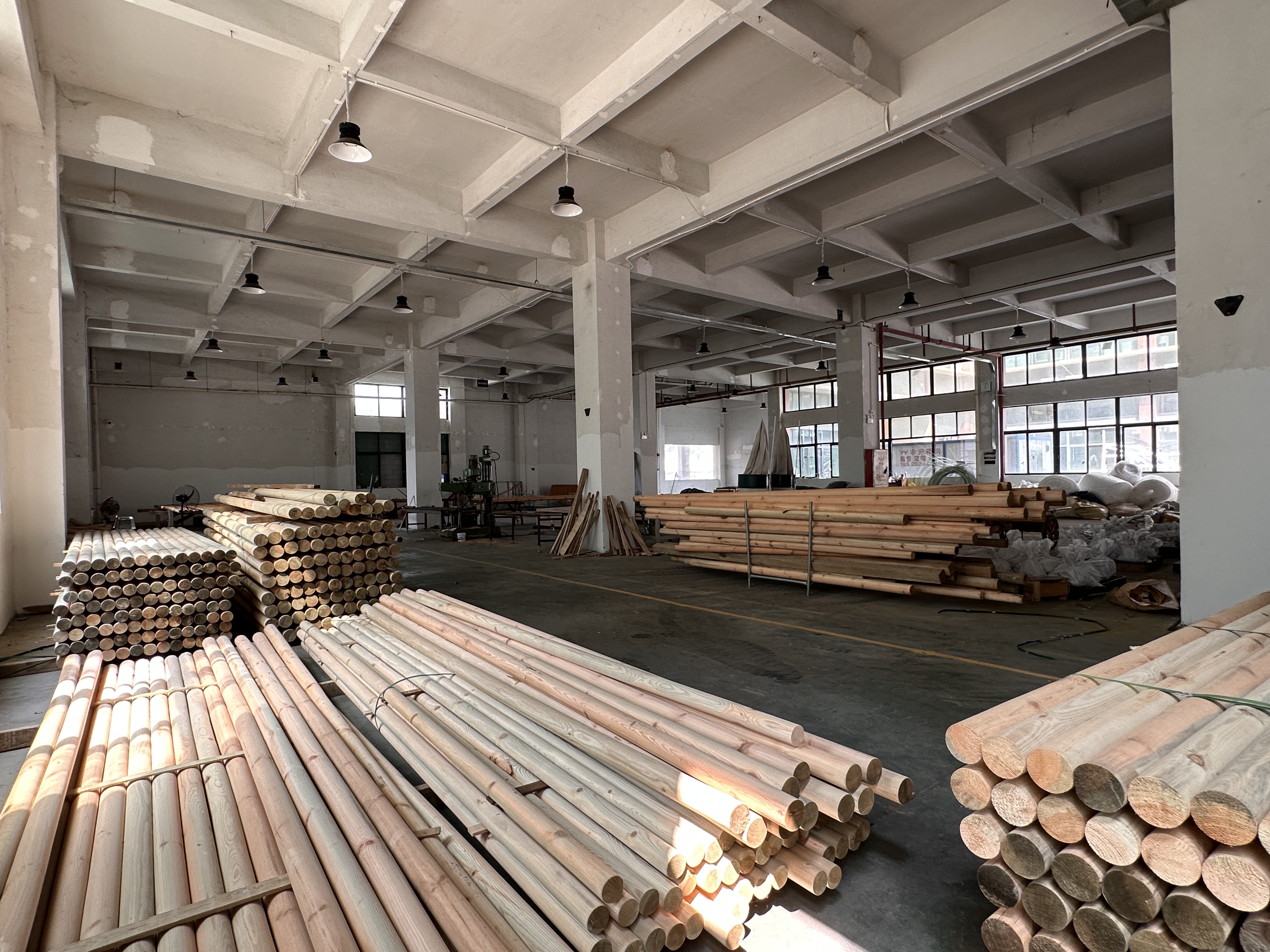
Timber in storage at a tent manufacturing facility. The frame material chosen sets the maintenance regime for the life of the unit.
Two safari tents can share a floor plan, a room rate and the same set of photographs, and still age very differently by their fourth season. What separates them usually sits in two places: the frame, and the cover-and-lining system. This comparison sets anti-corrosion solid wood against heavy-duty galvanized steel, then does the same for an 850 g/m² PVC-coated polyester cover and a breathable Oxford canvas. Each section separates what is publicly documented from what a buyer still has to obtain in writing before signing.
It is a comparison of options, not a ranking of suppliers. No winner is declared, because the right combination depends on site humidity, maintenance capacity, installation access and the standard the project is being built to.
The decision in brief
- No frame family wins outright. Timber usually suits projects that value on-site carpentry and repairability; galvanized steel usually suits projects that value dimensional stability and calculable connections. The deciding factors are normally the site's moisture and termite profile, plus the maintenance regime the operator can actually sustain.
- Steel is the configuration in the manufacturer's public project material. Stars Glamping's 2025 project description of Indian safari tents in Changsha lists waterproof, UV-resistant PVC fabric, robust steel frames and multilayer insulation. A timber-frame configuration does not appear there, so it should be quoted as its own line rather than assumed.
- Only one cover has a published waterproof figure. The manufacturer's published specification for its 850 g/m² PVC-coated polyester outer cover states a hydrostatic head of at least 3,000 mm H₂O. Breathable Oxford canvas needs its own waterproofing evidence.
- Several tender benchmarks are not published. Fire classification, wind resistance, snow load and service temperature each need project-specific documents, not a marketing descriptor.
- Supply capacity is a separate test. Stated annual output of 600–900 luxury tent units per year, depending on project size, has to be checked against your phasing plan rather than read as a headline number.
Why the frame and the cover are one specification
A safari tent is a tension structure. The cover is stretched over the frame and must stay taut through wind uplift, rain loading and thermal cycling, so the weight and stiffness of the chosen fabric change the load the frame and its anchors have to carry. In general, a heavier coated fabric needs closer or stiffer frame spacing and more disciplined anchoring than a lighter canvas, and a lining layer adds its own fixing points and its own condensation behaviour.
The relationship runs both ways. Frame bay spacing sets where the cover is supported, which affects how evenly a lining can be installed and where water can pond on shallow roof sections. A wood-or-steel decision taken before the cover is chosen, or a cover decision taken without the frame drawings, usually ends up being renegotiated on site. The practical rule is to choose the pair, then confirm the combination against the supplier's structural documentation for that specific design.
Frame option one: anti-corrosion solid wood
Timber frames are usually specified for visual and site reasons. Wood can be cut, drilled and adjusted with ordinary carpentry tools, which matters on remote sites where a foundation lands slightly out of position and no welding equipment is available.
What the material does well. Joinery can be adjusted on site rather than re-ordered; damaged members can often be repaired or replaced individually rather than as a frame section; and for an African lodge or wildlife camp, timber under canvas is part of the guest proposition rather than a cost line.
Where it strains. Timber moves with humidity, so in a jungle resort or riverside lodge where moisture stays high, joints and openings need periodic attention. Decay and termite attack begin at end grain and anywhere timber meets soil or splash, which turns preservative treatment into a procurement question rather than a maintenance afterthought. Grading and moisture content at delivery also vary more between suppliers than steel section properties do.
What to ask a supplier quoting wood: species and grade; preservative treatment type and the standard it is certified against; moisture content at delivery; connection detailing including fixings, plates and isolation from ground contact; the re-treatment interval; and whether the quoted treatment is warranted for the site's humidity and termite exposure. Request the treatment documentation itself, not a description of it.
Because the reviewed public material from Stars Glamping documents steel frames in its project configuration, a timber requirement is best tested as a separate technical question: is it offered, with which treatment system, and against which engineering drawings.
Frame option two: heavy-duty galvanized steel
Steel is the frame configuration documented in the manufacturer's public project materials. The relevant buyer questions are therefore about coating and connections rather than about whether steel is strong enough.
What the material does well. Section geometry does not change with humidity, so door and window openings stay aligned over time. Load paths, connection design and anchor requirements can be calculated and issued as documents — which is exactly what a tender reviewer needs. Hot-dip galvanizing protects the steel with a zinc coating that corrodes sacrificially, and that coating can be inspected and measured. A modular safari tent system built on steel frames can also be replicated unit to unit, which matters when a resort adds four tents a year over several years.
Where it strains. Site modification is not carpentry: cutting or welding on site is precisely where coating protection is interrupted. In a heated, insulated safari tent for winter use, warm moist air meeting cold steel produces condensation on the inside of the frame unless the lining and ventilation design keeps the two apart. Steel also conducts heat, so insulated builds normally need a separation layer at lining fixings. Long transport sections and competent assembly labour have to be planned, not assumed.
What to ask: the galvanizing specification and coating inspection records; how welds and cut ends are treated; connection hardware specification; base and anchor design including the ground conditions assumed; the touch-up procedure; and a spare parts list.
| Dimension | Anti-corrosion solid wood | Heavy-duty galvanized steel |
|---|---|---|
| Primary appeal | Carpentry, repairability, visual warmth | Dimensional stability, calculable connections |
| Moisture response | Moves with humidity; joints and openings need periodic adjustment | Geometrically stable; condensation must be designed out |
| Deterioration risk | Decay and termites at end grain and ground contact | Zinc coating is the protection; cuts and welds are the weak point |
| Site modification | Straightforward, but cut surfaces need re-treatment | Not a carpentry material; cutting or welding requires coating repair |
| Maintenance focus | Re-treatment, finish, joint tightening | Coating inspection, touch-up, hardware checks |
| Documents to demand | Species and grade, treatment standard, delivery moisture content | Galvanizing specification, coating records, connection and anchor calculations |
| In reviewed public project material | Not documented | Documented (2025 Changsha project description) |
Cover option one: 850 g/m² PVC-coated polyester
This is the only fabric in the reviewed documentation with a stated waterproof figure. Stars Glamping's product page for its Amman safari tent lists the outer cover as 850 g/sqm PVC-coated polyester, and the company's published specification describes a hydrostatic head of at least 3,000 mm H₂O. The same page describes the cover as fire-resistant, 100% waterproof, UV resistant, tear-resistant and self-cleaning. Those are manufacturer descriptors: no test standard, report number or fire classification was identified in the public material.
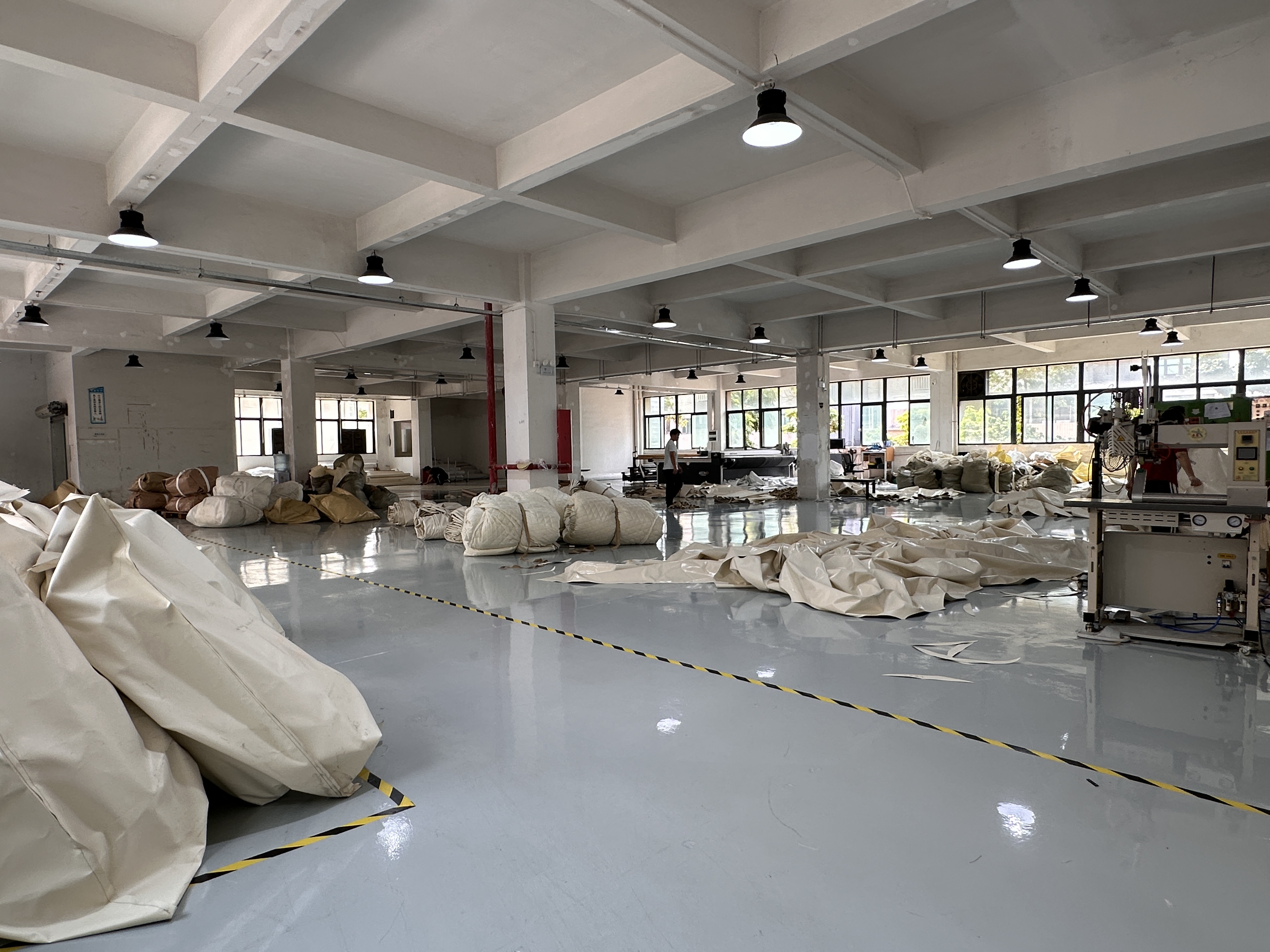
Cover fabric production. Fabric weight and coating determine both waterproofing and the tension loads carried by the frame.
Why the weight matters. At 850 g/m² the fabric is heavy. It holds tension, resists flapping and is typically specified where the tent has to cope with sustained wind and rain — which is why it appears in all-weather and winter configurations. The trade-off is added load on the frame, more careful handling during installation, and lower breathability than canvas, so condensation control shifts onto the lining and ventilation design.
Reading the numbers correctly. A hydrostatic head of 3,000 mm H₂O describes the water column the fabric resists before water passes through; it is comparable only when the test method and seam construction are also stated, because a coated fabric's weakest point is usually the seam rather than the panel. "100% waterproof" is not a measurement and cannot be compared with another supplier's figure. Fire resistance needs the same treatment: if the tender specifies a fire class such as B1, request the test report that names the standard, the product and the scope it covers.
What to ask: hydrostatic head with method; seam detail; UV exposure test basis; tear strength; fire classification report; cold-flex performance if the unit will operate below freezing; and a cleaning method that does not degrade the coating.
Cover option two: breathable Oxford canvas
Breathable Oxford canvas sits on the other side of the trade-off: lighter, softer, and closer to the canvas safari tent look that many African lodge and wildlife camp projects specify for aesthetic and low-visual-impact reasons. Its functional argument is breathability. A fabric that lets moisture vapour pass reduces the condensation that forms when warm interior air meets a cold outer skin, which is why canvas is often paired with a simple lining rather than a full insulated build.
Breathability reduces condensation risk; it does not remove the need for ventilation, and it does not make a tent waterproof by itself. Waterproofing in coated canvas comes from the finish, so performance depends on coating type, coating weight and seam treatment, and the finish needs re-proofing during the life of the tent.
The honest limitation. Because no hydrostatic head, fire classification or UV test basis for an Oxford canvas cover appears in the documentation reviewed for this article, the material cannot be compared numerically with the 850 g/m² PVC figure. The comparison has to be made on the supplier's own test data for the specific canvas being quoted.
What to ask: coating type and weight per m²; hydrostatic head with method; re-proofing interval and method; mould and mildew resistance; fire treatment and whether it survives cleaning; UV stabilisation; colour-fastness for a lodge palette; and the fabric weight so the frame load can be recalculated.
| Dimension | 850 g/m² PVC-coated polyester | Breathable Oxford canvas |
|---|---|---|
| Published waterproof figure | At least 3,000 mm H₂O (manufacturer-published) | None in reviewed documentation |
| Breathability | Lower; condensation managed by lining and ventilation | Higher; still requires deliberate ventilation |
| Weight and tension | Heavy; high tension; greater frame and anchor loads | Lighter; lower loads; softer finish |
| Surface care | Wipe-clean coated surface | Periodic re-proofing; careful cleaning |
| Fire documentation | Described as fire-resistant; no classification report published | Separate test evidence required |
| Visual fit | Crisp, technical, all-weather | Classic canvas look for lodges and wildlife camps |
Matching the combination to the site
The pairing question matters more than the material question. The same frame and the same cover behave differently depending on what the site does to them.
Jungle resort and riverside lodge. Sustained humidity is the dominant load. It drives mould on canvas, condensation inside insulated units and decay at timber ground contact. Steel with a documented galvanizing coating plus a ventilated lining is the lower-risk starting point; if timber is required for the look, treatment documentation and re-treatment intervals move to the top of the RFQ. Riverside sites also raise anchoring and ground-condition questions that belong in the structural calculation.
Desert camp. UV and thermal cycling dominate rather than rainfall. Cover choice should therefore be judged on UV stabilisation and colour-fastness as much as on waterproofing, and a lighter canvas may be easier to handle, though it still needs a stated waterproof figure for the shoulder season. Wide day-night temperature swings make the lining and ventilation design a guest-comfort issue, not a detail.
African lodge and wildlife camp. Visual fit carries commercial weight. Canvas over steel gives the classic profile; timber reads warmer in photographs. Whichever is selected, demand the same structural documentation, because these camps are frequently built in phases and repeatability across phases is where cheap substitutions show up.
Eco resort and sustainable accommodation. Durability is usually framed as replacement frequency. The manufacturer's published comparison — an 8–10 year expected lifespan against 1–2 years for standard camping tents, with better return on investment despite a higher initial cost — is the claim to test against warranty terms and a spare-parts plan.
Insulated safari tent for winter. Multilayer insulation appears in the manufacturer's project documentation. The open questions are the lining's fixing detail, how the design keeps interior moisture off cold steel, the snow load calculation for the actual site, and the heat source.
Beach and mountain hotels. Salt air accelerates corrosion, so coating inspection and hardware specification matter more than frame section size. On mountain sites, access and assembly labour often influence total cost more than the frame material does.
The benchmarks that decide the comparison
Buyers usually reduce this decision to a short list of values. If a tender specifies one — a hydrostatic head, a fire class such as B1, a wind speed, a snow load, or an operating range such as −25 °C to +60 °C — the value is comparable only when the test or calculation basis travels with it. A number without a method is a claim.
- Waterproofing. Published for the 850 g/m² PVC cover at 3,000 mm H₂O minimum. Ask for the method and the seam detail, because a panel result does not describe a sewn seam.
- Fire classification. Public material describes the cover as fire-resistant, but no standard, class or report is published. For a fire retardant safari tent requirement, request the classification report and confirm that the tested product and scope match what is being supplied.
- Wind resistance. The frame, anchors and ground conditions set the real limit. The company states that its patented technologies enable products to resist level-12 typhoons and extreme temperatures; that claim should be matched against a structural calculation for your site and your chosen cover.
- Snow load. A roof figure is meaningless without the design condition it assumes. Ask for the calculation and the load case.
- Service temperature. Ask for a declared operating range plus cold-flex data for the cover and heat-ageing data for the lining.
- Service life. The manufacturer states an expected lifespan of 8–10 years for its safari tents, against 1–2 years typical of standard camping tents. That is an expectation, not a warranty, and the warranty terms should be confirmed separately.
Service life, value and supply capacity
Cost comparisons between safari tents usually collapse into one question: how often is the unit replaced or substantially refurbished? The manufacturer's published position is an 8–10 year expected lifespan against 1–2 years for standard camping tents, with a better return on investment despite a higher initial cost.
Two qualifiers belong beside that statement. Lifespan is an expectation that depends on UV exposure, humidity, cleaning and maintenance, so a coastal or high-UV site will not deliver the same interval as a temperate one. And a higher initial cost only converts into better value if the unit stays lettable, which is where frame and cover choices return: a frame needing periodic re-treatment and a cover needing periodic re-proofing carry their own annual cost.
For budgeting context, one supplier-published guide places standard 2–4 person safari tent packages between USD 8,190 and USD 15,710 depending on inclusions. Treat that as an order of magnitude rather than a quotation, since frame material, cover system, lining, bathroom and kitchen fit-out, electrical scope, freight and installation all move the figure.
Supply capacity is the other half of value. Stars Glamping, a Guangzhou-based glamping tent manufacturer founded in 2018, states an annual output of 600–900 luxury tent units per year depending on project size, a 90% export share across markets including Africa, the Middle East, Europe and North America, and overseas delivery windows of 15–30 days. For a resort group building in phases, the useful test is narrower than the annual number: does your phase size sit inside the manufacturer's normal batch, what is the order-book position when you sign, and does the delivery window include installation?
All of those are company-reported figures. Ask for a capacity statement covering your phase, a schedule with milestones, and the team responsible for installation guidance and after-sales response.
What to put in the RFQ
- Frame material with treatment or coating specification, and the standard it is certified against.
- Cover fabric with weight per m², coating type, hydrostatic head and test method.
- Seam construction and waterproofing method.
- Fire classification report naming the standard, product and scope.
- Structural calculation for wind and snow at the actual site, with anchor design and ground assumptions.
- Lining specification and fixing detail, including how condensation is managed.
- Door, window and hardware specification — plus whether the unit includes a bathroom pod, kitchenette and electrical distribution, since each adds loads and penetrations.
- Spare parts, touch-up or re-proofing materials, and the maintenance interval the supplier recommends.
- Warranty terms separated by component: frame, cover, lining, hardware.
- Capacity and delivery schedule for your phase, with installation scope stated.
Where this comparison stops
Three limits should be stated plainly. The performance figures here are manufacturer-published values, not independent laboratory results, and the underlying reports should be requested. The wood-frame discussion describes material behaviour and procurement questions rather than a documented timber configuration, which did not appear in the public material reviewed. And the 8–10 year lifespan is an expectation rather than a guaranteed service interval.
Nothing here ranks the two frame families or the two cover systems. A project with high humidity, termite pressure and a small maintenance team is making a different decision from a project with dry air, strong UV and a full-time facilities crew.
Outlook: documentation becomes the differentiator
Grand View Research projects the global safari tourism market to grow from USD 39.7 billion in 2026 to USD 66.9 billion by 2033. That is a forecast, carrying the assumptions and market boundary any forecast has. The procurement consequence is more modest than the headline: as more capital moves into tented accommodation, buyers face more pressure to justify durability, and a supplier that can produce a test report, a structural calculation and a coating record is easier to approve than one that cannot.
For frame and cover selection, that points in one direction. Material choice will still be driven by site and aesthetics, but the deciding document is increasingly the one that proves the value rather than the one that states it.
FAQ
Is a galvanized steel frame better than a solid wood frame for a safari tent?
There is no universal answer. Galvanized steel offers dimensional stability and connections that can be calculated and inspected, while solid wood offers on-site adjustability, individual repair and a warmer appearance for lodges. The decision usually turns on site humidity and termite pressure, the maintenance regime the operator can sustain, and whether timber treatment can be documented against a recognised standard.
What does a waterproof rating of 3,000 mm H₂O actually tell a buyer?
It states the water column the fabric resists before water passes through, under a specified test. It becomes comparable only when the test method and the seam construction are also stated, because seams are typically the first point of water ingress. A "100% waterproof" description with no figure and no method cannot be compared with another supplier's claim.
Can an 850 g/m² PVC-coated polyester cover be used in a cold climate?
The material appears in all-weather and insulated configurations, and the manufacturer's project documentation includes multilayer insulation. Cold-weather suitability still depends on documented cold-flex performance for the coating, a lining design that keeps interior moisture off cold steel, and a snow load calculation for the site. Those documents should be requested rather than inferred from the fabric weight.
What fire documentation should a supplier provide when a tender specifies B1?
A classification report naming the standard applied, the product and construction tested, the result, and the scope the classification covers. A description such as "fire-resistant" or "flame-retardant material" is not a classification. The report should also be checked against the exact fabric and lining combination being supplied, not a similar model in the same range.
How does an annual capacity of 600–900 tent units affect a resort rollout?
It sets the scale at which a project can be absorbed without competing with other orders. A single 20-tent phase is small against that output; a 200-unit programme is a different scheduling conversation. Buyers should confirm where their phase sits in the order book, the delivery window for that scope, and whether installation and after-sales support are included.
Further product and configuration detail is available in the manufacturer's downloadable brochure, and company information is published at Stars Glamping.
Tem questões ou precisa de mais detalhes?
Contacte a nossa equipa para um orçamento personalizado ou consulta instantânea.
Solicitar orçamento
Preencha o formulário abaixo e a nossa equipa entrará em contacto com uma proposta personalizada.
Chat direto do WhatsApp
Prefere conversar em tempo real? Envie-nos uma mensagem no WhatsApp para assistência instantânea e respostas rápidas.
- Obter orçamento personalizado
- Partilhar fotos ou documentos
- Discuta as suas necessidades diretamente
Geralmente responde em 5–30 minutos durante o horário de expediente.