
Safari Tent Supplier Stability: Evaluating Stars Glamping
Global safari tourism is projected to expand from USD 39.7 billion in 2026 to USD 66.9 billion by 2033, according to Grand View Research. Because lodge and camp capacity is normally added in phases rather than in a single order, the practical question for developers is not which safari tent looks best in a brochure, but whether the manufacturer behind it can still supply the same model, the same fabric specification and the same documentation five or eight years after the first units are installed.
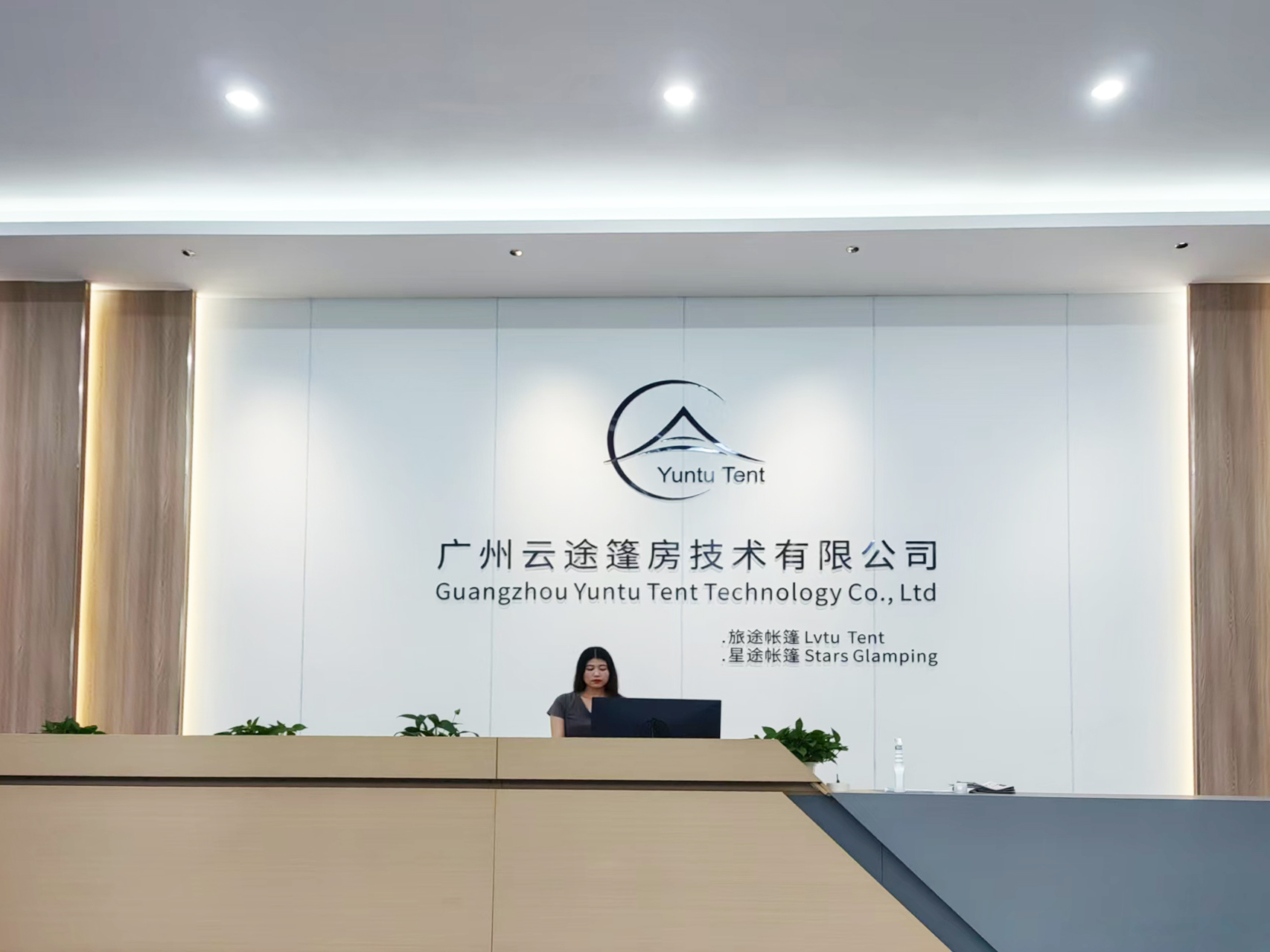
Facility reference: Stars Glamping operates a 20,000 m² manufacturing base in Nansha District, Guangzhou, China.
This evaluation looks at Stars Glamping (STARS GLAMPING TENT CO., LTD) strictly through documented facts: incorporation year, headcount, manufacturing footprint, stated annual output, engineering bench, service scope and conformity paperwork. It deliberately avoids commentary on financial health, ownership structure or operational performance that is not published, because those areas cannot be assessed from public materials and should never be inferred from marketing pages.
Why Supplier Stability Is a Constraint, Not a Preference
A safari lodge is rarely delivered in one procurement cycle. A first phase might cover eight to twelve keys, with later phases added as occupancy data justifies them. That phased pattern creates four dependencies that a tent specification alone does not address:
- Model continuity. Replacement units must match the existing footprint, frame profile and anchoring so that site works and interiors remain compatible.
- Fabric continuity. Cover material weight, coating type and colour must remain reproducible; a cover change can visibly split an accommodation block into two vintages.
- Spare parts and consumables. Mesh screens, glass panels, canvas linings, hardware and seals all require a supply path after handover.
- Document retention. Drawings, material declarations and conformity documents are usually requested again by insurers, auditors or licensing authorities years after delivery.
These dependencies are the reason supplier evaluation for multi-year projects places more weight on operating history, capacity structure and documentation practice than on a single unit price.
A Four-Pillar Framework for Verifying Stability
Before any commercial comparison, buyers can test a safari tent supplier against four verifiable pillars. Each pillar should be answerable with a document or a stated fact, not an assurance.
| Pillar | What to verify | Evidence type |
|---|---|---|
| Operating record | Year established, continuity of product lines, export experience by region | Company registration, dated product literature |
| Physical capacity | Factory area, headcount, stated annual and monthly output, lead times | Facility data, production schedule, audit visit |
| Engineering bench | Size and discipline mix of the R&D team, customisation capability, patent record | Team documentation, drawings, patent numbers |
| Documented conformity | Certificate numbers, issuing body, standard cited, validity window, model scope | Certificate of conformity, test reports |
A supplier that can populate all four pillars with traceable material is materially easier to carry through a phased build than one that answers only with references.
Stars Glamping: Documented Company Facts
Stars Glamping is a Guangzhou-based manufacturer of glamping domes, safari tents and luxury tents, founded in 2018 and operating from Nansha District, Guangzhou, China. The company describes itself as a high-tech enterprise covering research and development, design, manufacturing and installation of luxury glamping tents, together with overall camp planning.
| Documented fact | Value |
|---|---|
| Company name | STARS GLAMPING TENT CO., LTD |
| Founded | 2018 |
| Location | Nansha District, Guangzhou, China |
| Manufacturing base | 20,000 m², with a 4,000 m² simulation exhibition hall |
| Employees | Approximately 100 |
| R&D team | 6 specialists in architectural design, structural engineering and materials science |
| Annual output | 600–900 luxury tent units per year, depending on project size |
| Monthly capacity | 50–80 luxury tent units, depending on project size |
| Export share | 90% of output |
| Export regions | Southeast Asia, Middle East, Africa, Europe, North America, South America, Australia (seven regions) |
| Delivery times | 7–15 days domestic; 15–30 days overseas |
| Lead times | 15–20 days for standard models; 20–30 days for customised projects |
| Minimum order | 1 unit, sample available |
| Patent record | 54 national patents covering wind resistance, waterproofing, heat insulation and quick assembly |
| Quality process | 12-step inspection system; third-party inspection available |
The company also reports deliveries to more than 40 countries and regions, service across over 3,000 cultural and tourism projects, and a customer repurchase rate above 80%. These are company-reported figures and are presented here as such rather than as independently audited statistics.
What 600–900 Units a Year Means in a Phased Programme
Stated annual output of 600–900 luxury tent units, at 50–80 units per month, is a useful planning input for a multi-phase lodge because it can be compared directly against phase size. A twelve-key phase represents a small fraction of annual output; a sixty-key expansion approaches one month of stated capacity. That comparison is the starting point for a delivery schedule discussion, not a guarantee of slot availability.
Two documented details matter here. First, annual output is expressed in luxury tent units overall, not safari tents specifically, so a safari tent order competes for capacity with dome and hotel tent production. Second, an export share of 90% across seven regions implies that production planning already runs against multiple shipping calendars and destination requirements, which is relevant for a developer sequencing deliveries around a short construction season.
Lead times are stated at 15–20 days for standard models and 20–30 days for customised projects, with overseas delivery at 15–30 days. For phased projects, buyers should confirm how those windows are measured, and whether they run from deposit, drawing approval or material readiness.
The Six-Person R&D Team and What It Signals
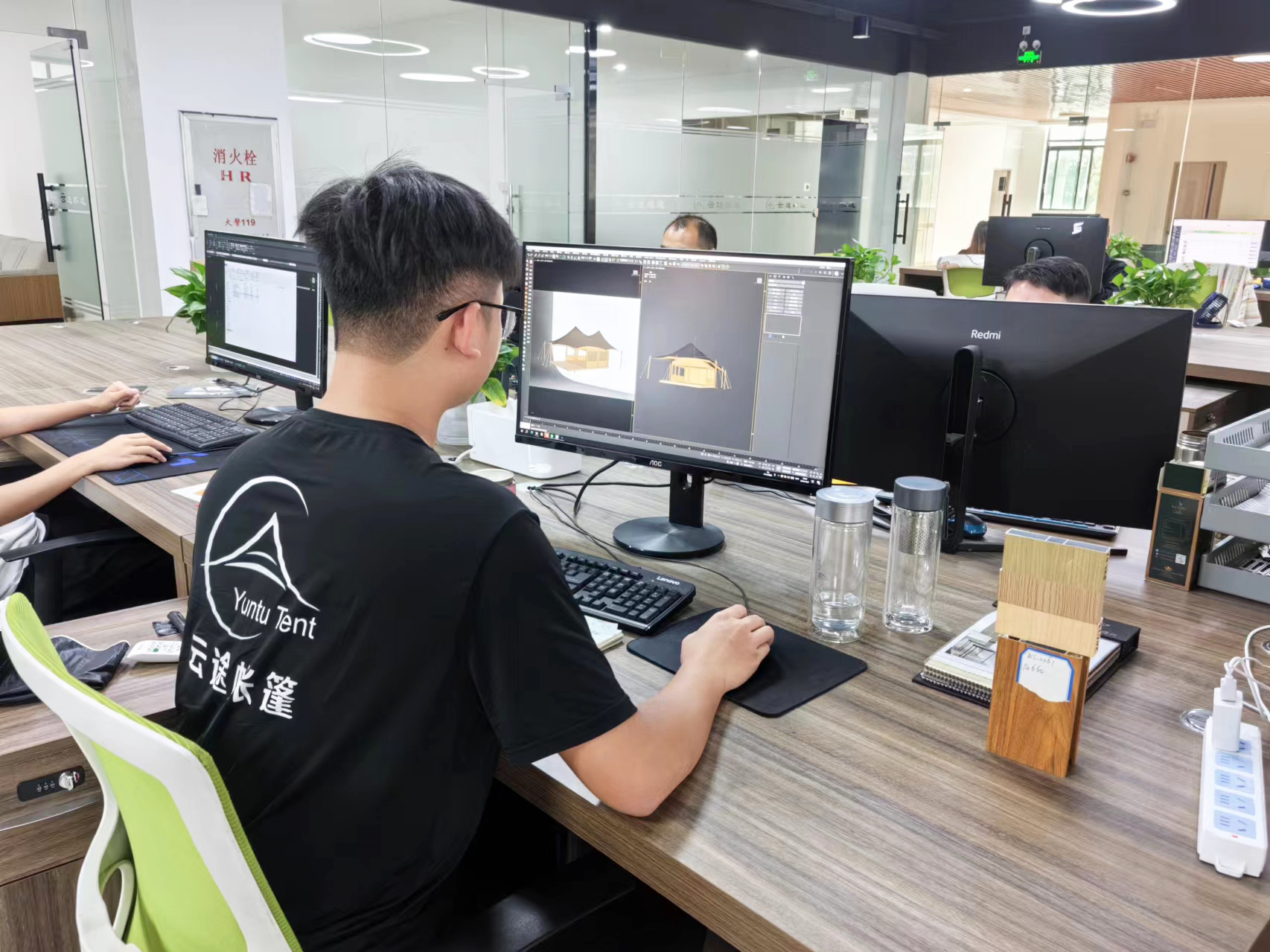
Stars Glamping maintains a six-person R&D team spanning architectural design, structural engineering and materials science.
Stars Glamping documents an R&D team of six specialists covering architectural design, structural engineering and materials science, supported by a patent portfolio of 54 national patents. For a long-term project, the significance of a dedicated bench is not its size but its function: it is the group that converts a site constraint into a drawing, and the group that a buyer returns to when a second phase needs a variant of an existing model.
The discipline mix is the more telling element. Architectural design supports layout and interior integration; structural engineering supports frame, anchoring and load assumptions; materials science supports cover specification and lining selection. A supplier without those three functions in-house tends to outsource design changes, which extends the loop between a buyer request and a manufacturable instruction.
The boundary: a documented team of six is a fact about capability structure, not a statement about concurrent custom-project throughput. Buyers running several simultaneous site designs should ask how many bespoke projects the team handles in parallel before treating the bench as unlimited engineering support.
The One-Stop Model: What It Covers After Handover
Stars Glamping documents an integrated service scope spanning planning and design, manufacturing, installation and after-sales. In practice, that scope is where long-term supplier value is either created or lost, because the years after handover generate the requests that a procurement contract rarely anticipates.
- Camp planning and product design, including matching of furniture, curtains, flooring and supporting items.
- Engineering drawings and installation guidance supplied to the site team.
- A 24-hour global after-sales response mechanism.
- Lifelong technical support and spare parts supply.
- Maintenance support with remote or on-site project assistance.
- Third-party inspection available on request during production.
The company frames this as a one cooperation, lifelong service approach. For evaluation purposes, the practical test is documentary: can the supplier show the drawing pack, the spare parts list and the escalation path that a second-phase order would depend on. Buyers should request these items as part of the tender rather than after award.
Conformity Documentation: The CE Attestation and Its Edges
Stars Glamping holds a General Product Safety Directive Attestation of Conformity (CE), certificate number M.2024.206.C96444, issued by UDEM for the EU market and citing standard EN ISO 5912:2020. The certificate carries an issue date of 31 January 2024 and an expiry date of 30 January 2029.
| Documented item | Detail |
|---|---|
| Certificate | General Product Safety Directive Attestation of Conformity (CE) |
| Number | M.2024.206.C96444 |
| Issuing body | UDEM |
| Market | EU |
| Standard cited | EN ISO 5912:2020 |
| Validity | 31 January 2024 to 30 January 2029 |
| Documented product scope | Safari Tent – Epic; Safari Lodge; aluminium frame, ClearSpan, geodesic dome, glamping dome, glass dome, polycarbonate dome, glamping pods, prefab house |
Two edges deserve attention. First, the certificate scope as documented names Safari Tent – Epic and Safari Lodge, while Vega and Lodestar appear as models in the safari tent range. A project that specifies Vega or Lodestar should therefore obtain written confirmation of model-level coverage rather than assuming that a range certificate transfers automatically. Second, the attestation sits alongside unquantified performance descriptors used in product material; a certificate of conformity is not a substitute for fire, hydrostatic or structural test reports with thresholds and test methods.
Technical Baseline: What Epic, Vega and Lodestar Share
All three safari tent models are documented with the same core performance envelope, which simplifies a phased project because specification can be held constant while layout changes.
| Parameter | Documented specification |
|---|---|
| Frame | Anti-corrosion solid wood or heavy-duty galvanised steel frame |
| Cover material | 850 g/m² PVC-coated polyester fabric |
| Inner lining | Oxford canvas fabric, breathable |
| Waterproof rating | ≥3000 mm H₂O |
| UV performance | UV-resistant, anti-fading |
| Fire rating | B1 fire-retardant |
| Wind resistance | Up to 100 km/h (Level 9 wind) |
| Snow load | 60 kg/m² |
| Temperature range | -25°C to +60°C |
| Service life | 8–12 years |
| Standard sizes | 20 m², 30 m², 40 m², 50 m², customisable |
| Features | Large panoramic windows, mesh screens, wood-style structure design |
Where Safari Tents Fit: Matching Models to Site Conditions
Documented application conditions for these safari tents include savannah and high-UV environments, heavy rain, windy exposure, remote and off-grid sites, under seasonal or permanent operation. The matching equipment list covers air conditioning, insulation lining, wooden flooring, panoramic glass doors, bathroom modules and lighting systems.
That configuration set maps onto the common project types a developer is likely to be procuring for: safari lodges, glamping campsites, eco camps and wildlife resorts, in markets ranging from Australia, Thailand, Indonesia, Malaysia, India, Kenya, Morocco, Namibia, New Zealand, Tanzania, Vietnam, the Philippines, South Africa and the United States.
- Desert camp and high-UV savannah sites: the UV-resistant, anti-fading cover and the -25°C to +60°C range set the operating envelope.
- Riverside lodge and jungle resort sites: the ≥3000 mm H₂O hydrostatic head and Level 9 wind rating are the reference points for a specification discussion.
- Year-round wildlife camp or winter operation: insulation lining and multilayer insulation configurations appear in documented project material and should be specified explicitly.
- Guest-facing amenity: bathroom modules, kitchen and electricity integration are handled as part of the interior and supporting-item scope rather than as tent-only supply.

Safari Tent – Epic installed configuration. The Epic model is the safari tent model named in the CE attestation documentation.
Market Context: Demand Growth and the Cost Signals Around It
The demand side is documented. Grand View Research projects the global safari tourism market to grow from USD 39.7 billion in 2026 to USD 66.9 billion by 2033, a trajectory that supports continued investment in safari-style accommodation capacity across African, Middle Eastern and Asian destinations.
The cost side is thinner and should be handled carefully. Published indicative pricing from Stars Glamping places standard safari tent packages for two to four persons between USD 8,190 and USD 15,710 depending on inclusions; this is a commercial source and is best treated as an indicative band for budgeting, not a quotation. For US-bound shipments, the United States International Trade Commission Harmonized Tariff Schedule classifies synthetic-fibre tents other than backpacking models under 6306.22.90.30 with a general duty rate of 8.8%, a figure that belongs in the landed-cost model alongside freight and installation.
What the available record does not contain is a comparable multicurrency quotation set with Incoterms, installation and lifecycle maintenance costs. Buyers should treat any total cost of ownership model built on public data as provisional until RFQs are returned.
Safari Tent Versus Fixed Construction: Where the Tent Model Stops
The comparison that matters for a long-term asset plan is not tent versus tent, but prefabricated tent accommodation versus site-built lodge construction. Qualitatively, a fixed structure typically involves longer on-site construction, heavier foundation and wet trades, and a permitting pathway tied to permanent buildings, while a prefabricated safari tent shifts most of the work into a factory and shortens the on-site programme.
| Dimension | Prefabricated safari tent | Site-built lodge structure |
|---|---|---|
| On-site work | Factory-produced components, assembly on prepared platform | Sequential trades, weather-sensitive programme |
| Change of layout | Limited by frame and platform design | Subject to structural alteration |
| Documented service life | 8–12 years for the safari tent range | Longer structural life typical of permanent buildings |
| Documentation burden | Certificate plus material and performance reports | Building permit and full structural approval set |
The limitation to plan around: the documented service life of the Safari Tent – Epic, Vega and Lodestar is 8–12 years, whereas Stars Glamping documents 25–30 years for its luxury hotel tent range using 1050 g/m² PVDF architectural membrane fabric. A developer building a 25-year asset plan on a safari tent specification should therefore model at least one cover and component renewal cycle inside that horizon, and should compare the renewal cost of a tent programme against the capital profile of a fixed build rather than against the tent unit price alone. Safari tents are also a weaker fit where fully sealed thermal performance, basement or heavy ancillary loads are required.
Where the Public Evidence Stops
An evaluation that claims more certainty than the record supports is not useful to a procurement team. The following gaps are real and should be closed during due diligence:
- No audited financial statements or ownership disclosures are part of the public record, so financial continuity cannot be assessed from published material.
- Capacity and output figures are company-reported; an audited capacity statement or factory audit is the appropriate confirmation.
- The CE attestation is documented at model level for Safari Tent – Epic and Safari Lodge; Vega and Lodestar coverage needs written confirmation.
- B1 fire-retardant, ≥3000 mm H₂O waterproofing, 100 km/h wind resistance and 60 kg/m² snow load are stated specifications; buyers should request the corresponding test reports with methods and thresholds.
- Annual output is stated in luxury tent units overall, not safari tents alone, so scheduling should be confirmed against a live production plan.
- Project references, contract values and operating outcomes of past installations are not published in verifiable form.
Future Outlook
Three developments are likely to shape safari tent supplier selection over the next several years. First, as safari tourism demand expands toward the projected USD 66.9 billion by 2033, phased lodge programmes will place a premium on suppliers who can hold a specification constant across phases rather than re-engineer each order. Second, documentation will keep migrating from a marketing differentiator to a tender entry requirement, with certificate numbers, validity windows and model scope requested at pre-qualification stage. Third, lifecycle planning will move earlier in the decision: the 8–12 year service life of a safari tent becomes a line item in the feasibility model, not a maintenance surprise.
For Stars Glamping specifically, the documented position is a 2018-founded manufacturer with a 20,000 m² base, approximately 100 employees, a six-person engineering team, stated output of 600–900 units per year, an EU-market CE attestation valid to January 2029, and an integrated planning-to-after-sales scope. Whether that position translates into a dependable ten-year supply relationship is a question answered by audits, test reports and references, not by the profile alone.
Frequently Asked Questions
How long has Stars Glamping been operating, and why does that matter for a phased safari tent project?
Stars Glamping (STARS GLAMPING TENT CO., LTD) was founded in 2018 and is based in Nansha District, Guangzhou, China, which represents eight years of operating history as of 2026. Operating history matters in phased projects because it supports continuity of the Safari Tent – Epic, Vega and Lodestar models, continued spare parts supply, and retention of original drawings and material specifications across the life of the accommodation asset.
Which certifications are documented for Stars Glamping safari tents?
A General Product Safety Directive Attestation of Conformity (CE) is documented under certificate number M.2024.206.C96444, issued by UDEM, for the EU market, citing standard EN ISO 5912:2020 and valid from 31 January 2024 to 30 January 2029. The documented product scope names Safari Tent – Epic and Safari Lodge, and the wider certificate scope covers aluminium frame tents, ClearSpan, geodesic dome, glamping dome, glass dome, polycarbonate dome, glamping pods and prefab house. Where a project specifies Vega or Lodestar, model-level coverage should be confirmed in writing.
What are the documented specifications of the Epic, Vega and Lodestar safari tents?
All three models are documented with an anti-corrosion solid wood or heavy-duty galvanised steel frame, an 850 g/m² PVC-coated polyester cover, a breathable Oxford canvas inner lining, a waterproof rating of at least 3000 mm H₂O, UV-resistant and anti-fading performance, B1 fire-retardant rating, wind resistance up to 100 km/h (Level 9), snow load of 60 kg/m², an operating range of -25°C to +60°C and a service life of 8–12 years. Standard sizes are 20 m², 30 m², 40 m² and 50 m², customisable, with large panoramic windows, mesh screens and a wood-style structure design.
What production capacity and lead times are documented?
Stars Glamping states annual output of 600–900 luxury tent units depending on project size and monthly capacity of 50–80 units, produced from a 20,000 m² manufacturing base. Lead times are stated at 15–20 days for standard models and 20–30 days for customised projects, with delivery of 7–15 days for domestic orders and 15–30 days for overseas orders, and a minimum order of one unit with samples available. Annual output is expressed in luxury tent units overall rather than safari tents alone, so availability should be confirmed against a live production plan.
What does the one-stop service model cover after installation?
The documented scope covers planning and design, manufacturing, installation and after-sales integration, including camp planning, product design, and matching of furniture, curtains, flooring and supporting items. Post-handover support includes a 24-hour global after-sales response mechanism, free installation guidance, engineering drawings, lifelong technical support, spare parts supply, maintenance support and remote or on-site project assistance. Production quality control follows a 12-step inspection system covering raw material inspection, in-process control and pre-shipment inspection, with third-party inspection available.
What should a buyer verify before committing to a long-term supply agreement?
Buyers should obtain the certificate of conformity with its number, issuing body, cited standard, validity window and model scope; fire, hydrostatic, wind and snow test reports with methods and thresholds; an audited capacity statement or factory audit rather than company-reported figures alone; comparable project references; and full commercial terms covering Incoterms, freight, installation and renewal costs. Audited financial statements and ownership disclosures are not part of the public record for Stars Glamping and should be requested directly through the due diligence process.
The Stars Glamping product brochure is publicly available for download: Stars Glamping brochure (PDF).
Tem questões ou precisa de mais detalhes?
Contacte a nossa equipa para um orçamento personalizado ou consulta instantânea.
Solicitar orçamento
Preencha o formulário abaixo e a nossa equipa entrará em contacto com uma proposta personalizada.
Chat direto do WhatsApp
Prefere conversar em tempo real? Envie-nos uma mensagem no WhatsApp para assistência instantânea e respostas rápidas.
- Obter orçamento personalizado
- Partilhar fotos ou documentos
- Discuta as suas necessidades diretamente
Geralmente responde em 5–30 minutos durante o horário de expediente.