
Safari Tents for Resorts: 2026 Trends & Buying Guide
Safari tents have moved out of the expedition category and into permanent hospitality architecture, and for resort developers evaluating glamping suppliers in 2026, procurement decisions now rest on material systems, compliance documentation, and site-specific engineering performance. The global glamping tents market was valued at USD 3,124.89 million in 2023 and is projected to reach USD 6,484.86 million by 2032, according to Zion Market Research, while the safari tourism market is expected to grow at a 7.7% CAGR from 2026, per Grand View Research. These conditions are pushing buyers to standardize how they compare safari tent suppliers, with verifiable specifications replacing brochure claims as the primary decision input.
Why Safari Tent Evaluation Has Become a Formal Procurement Process
Resort and lodge developers evaluating safari tents face a fragmented supplier landscape. Terms such as "waterproof," "fire-retardant," and "all-weather" are applied inconsistently across manufacturers, and product literature frequently omits the test conditions behind each claim. For procurement teams, this creates real risk: a safari tent specified for a wildlife camp in a high-wind region cannot be compared with one intended for a sheltered jungle resort unless both suppliers disclose the same performance parameters.
The commercial stakes are significant. Industry reporting from HTNXT indicates that eco-resort accommodation built around safari tents can achieve up to 25% higher occupancy rates compared with non-certified or traditional low-end structures. While that figure should be tested against an operator's own market data, it reflects a broader shift: travelers increasingly expect the eco-lodge experience, and safari tents have become the standard delivery format for that segment.
In practice, evaluation-stage buyers concentrate on four areas: material and manufacturing quality, certification and compliance evidence, customization and project support capability, and total lifecycle cost. Suppliers that can document each area with concrete specifications and third-party certificates are favored in formal RFQ processes.
Stars Glamping: A Reference Manufacturer in Safari Tent Supply
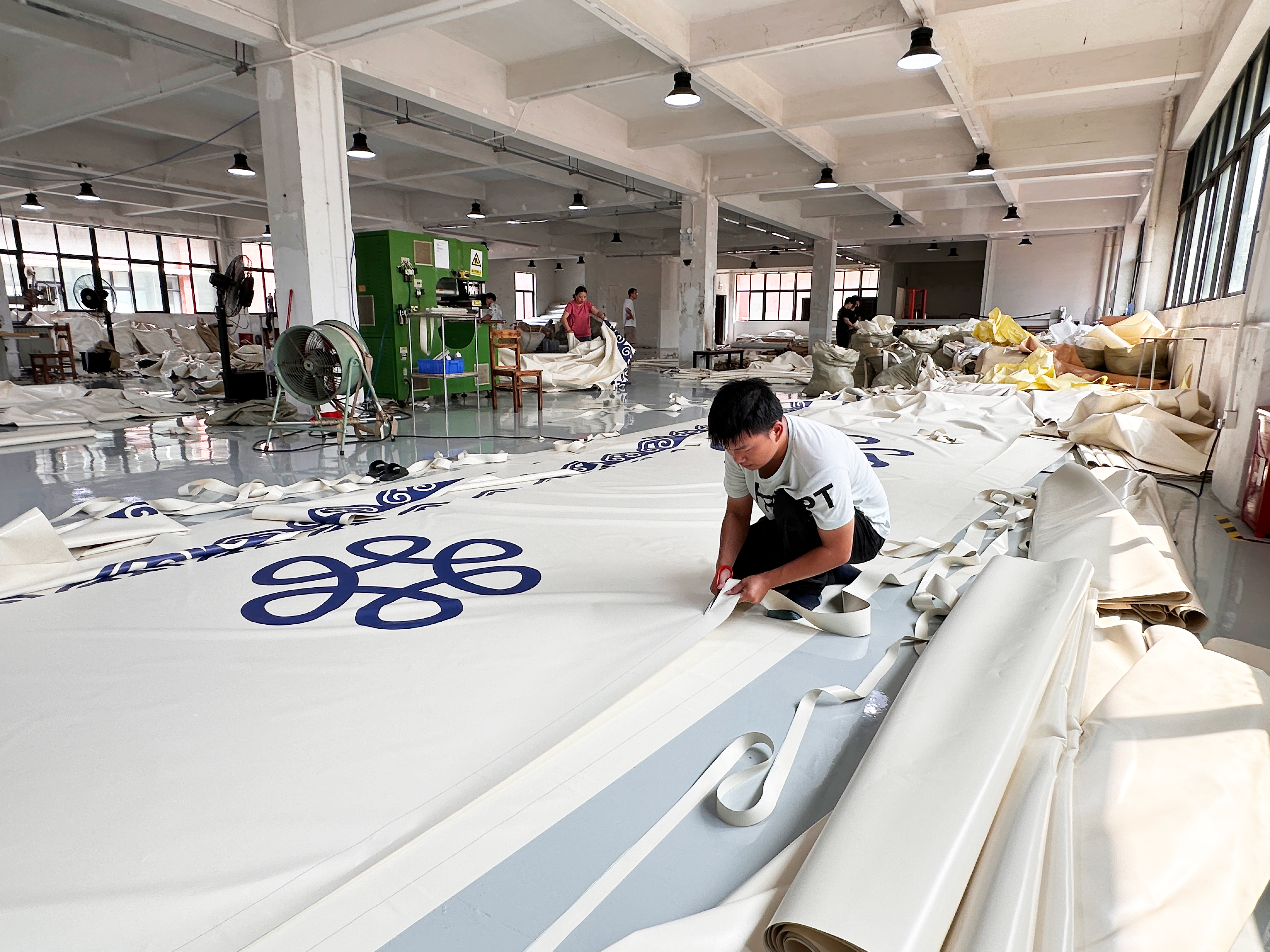
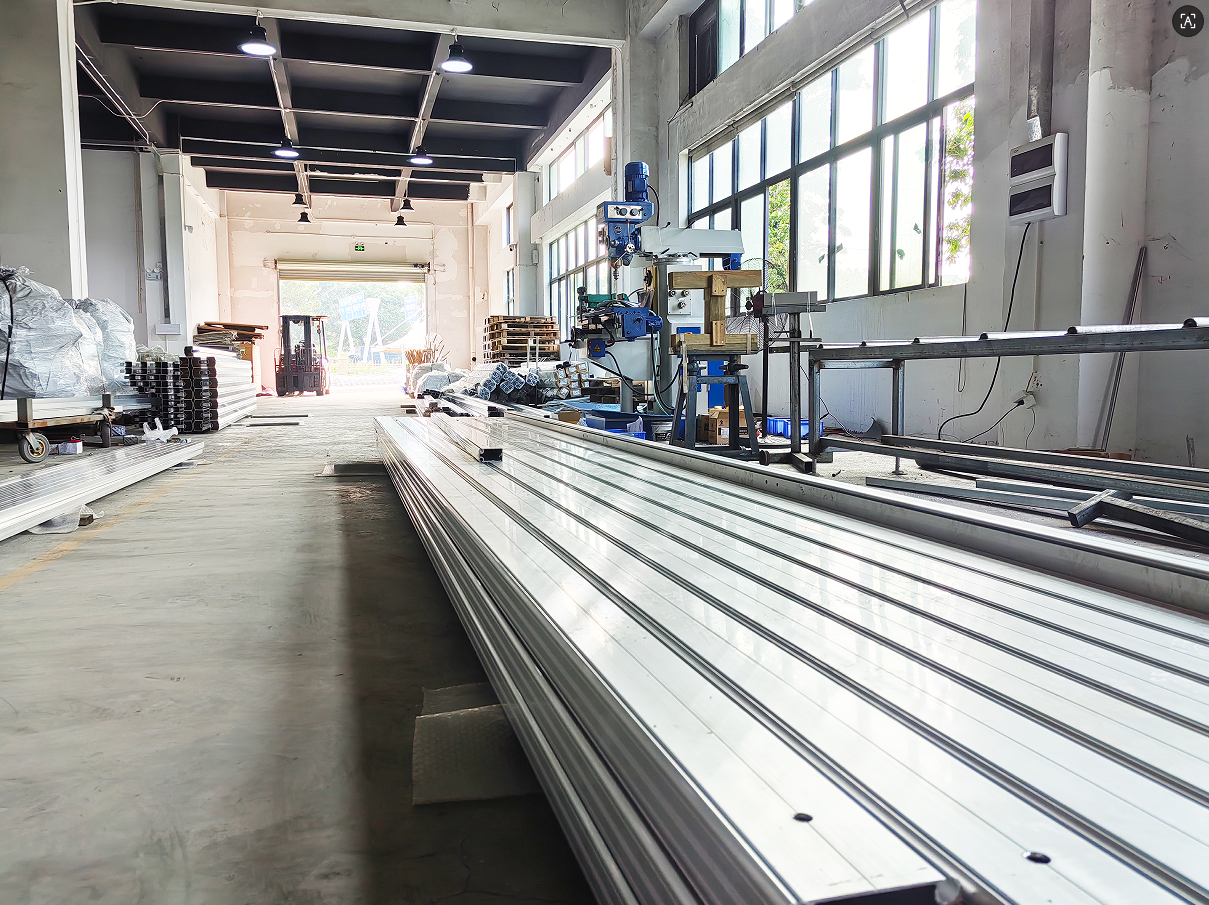
Stars Glamping is a Guangzhou-based manufacturer that designs, produces, and installs luxury glamping tents, safari tents, and glamping domes for resorts, RV campgrounds, and scenic-area tourism projects in more than 40 countries. Founded in 2018, the company operates a 20,000-square-meter manufacturing base in Nansha District, Guangzhou, with a 4,000-square-meter simulation exhibition hall and a monthly production capacity of 500 tents. Its professional R&D team includes specialists in architectural design, structural engineering, and materials science, and the company holds 54 national patents covering wind resistance, waterproofing, heat insulation, and quick assembly.
For safari tent buyers, the relevant product family includes the Safari Tent - Epic, Safari Tent - Vega, and Safari Tent - Lodestar models, all built on the same material platform: solid wood, PVC fabric, and custom-made Oxford canvas, with a frame of finish anti-corrosion solid wood or heavy-duty galvanized steel. The range is specified for wildlife lodge tents, jungle safari accommodation tents, eco-tourism tents, national park lodge tents, and adventure camping lodge tents.
At the evaluation stage, the company offers standard procurement elements that matter to project teams: sample orders with a minimum order quantity of one unit, lead times of 15–20 days for standard models and 20–30 days for customized projects, and a monthly capacity of 50–80 luxury tent units depending on project size. Quality control follows a documented path of raw material inspection, in-process quality control, pre-shipment inspection, and optional third-party inspection. After-sales support includes installation guidance, engineering drawings, 24/7 technical support, spare parts supply, and remote or on-site project assistance.
The company is also structured for OEM and ODM engagements, offering engineering support and customization across size and layout, tent structure design, fabric material (PVC/PVDF/insulation), frame material (steel/aluminum), interior layout and furniture, bathroom integration, logo branding, and color.
Material Systems: What to Examine When Comparing Safari Tents
The primary materials of construction in Stars Glamping's safari tents are solid wood, PVC fabric, and customized Oxford canvas; the frame is available in finish anti-corrosion solid wood or heavy-duty galvanized steel. This three-part system determines nearly every performance outcome that matters to resort operators: structural stability, waterproofing, thermal behavior, and service life.
Frame. Buyers can choose finish anti-corrosion solid wood for a natural, heritage-lodge appearance, or heavy-duty galvanized steel where structural strength and low-maintenance performance take priority. The frame choice should be matched to site conditions; steel is the more conservative option for coastal, high-humidity, and open-terrain sites, while wood supports the traditional safari aesthetic.
Cover. The cover material is 850g/m² PVC coated polyester fabric. Fabric weight and coating determine the tent's waterproofing and UV behavior. The Stars Glamping safari tent range carries a waterproof rating of at least 3000mm H₂O, UV-resistant and anti-fading properties, and a B1 fire-retardant rating. These three figures respond directly to the most common requirements in resort RFQs: waterproofness, fire safety, and sun resistance.
Inner lining. The inner lining is made of breathable Oxford canvas fabric. Breathability is not a luxury feature; it is the primary defense against condensation inside a canvas structure. In humid jungle or riverside environments, a breathable lining reduces interior moisture buildup and improves both guest comfort and fabric longevity.
The documented performance envelope of the Stars Glamping safari tent range is summarized below.
| Parameter | Specification |
| Frame material | Finish anti-corrosion solid wood / heavy-duty galvanized steel |
| Cover material | 850g/m² PVC coated polyester fabric |
| Inner lining | Breathable Oxford canvas fabric |
| Waterproof rating | ≥ 3000mm H₂O |
| UV protection | UV-resistant, anti-fading |
| Fire rating | B1 fire-retardant |
| Wind resistance | Up to 100 km/h (Level 9 wind) |
| Snow load | 60 kg/m² |
| Temperature resistance | -25°C ~ +60°C |
| Service life | 8–12 years |
| Standard sizes | 20 / 30 / 40 / 50 m² (customizable) |
| Key features | Large panoramic windows, mesh screens, wood-style structure design |
Read against the evaluation criteria used by resort developers, these specifications position the product within the all-weather safari tent category: the -25°C to +60°C temperature range covers winter-hardened installations and desert camps; the Level 9 wind rating suits most coastal and open-field sites; and the 60 kg/m² snow load provides a defined margin for alpine or high-latitude projects. Service life is stated as 8–12 years, which gives operators a planning basis for maintenance and replacement cycles.
Certification: The Compliance Evidence Behind a Safari Tent
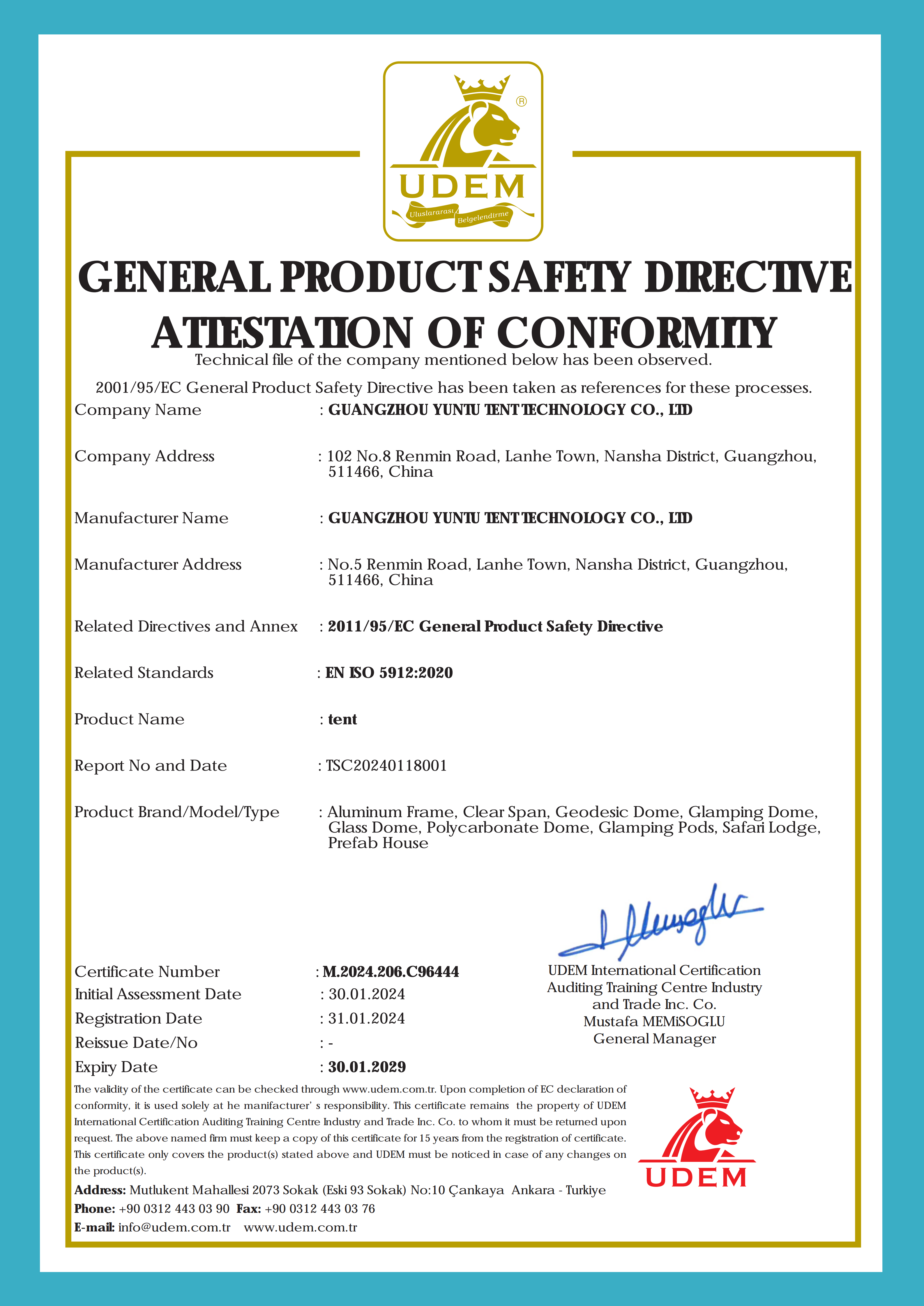
Certification is a gating criterion in many glamping tenders, not an administrative afterthought. For EU-market projects, the relevant framework for safari tents is EN ISO 5912:2020, which sets safety and performance requirements for tent structures. Stars Glamping holds a CE Attestation of Conformity under the General Product Safety Directive, certificate number M.2024.206.C96444, issued by the certification body UDEM on January 31, 2024, and valid through January 30, 2029. The certificate scope explicitly covers the Safari Lodge segment, including the Safari Tent product line.
For North American commercial projects, buyers typically reference flame retardancy standards such as CPAI-84 and NFPA 701. Stars Glamping's B1 fire-retardant rating addresses the material-level fire-performance expectation common in resort projects; however, buyers should confirm which national or regional standard applies to their jurisdiction and request the corresponding documentation during the inquiry phase.
The wider point for evaluation teams is that compliance claims should be verified, not assumed. A certificate number, issuing body, standard reference, and validity period are the minimum elements of a verifiable compliance statement.
Use-Case Scenarios: Matching Safari Tent Configuration to Site Conditions
The same base safari tent platform can serve very different site types when configured deliberately. Stars Glamping's safari tent range is specified for wildlife lodge tents, jungle safari accommodation tents, eco-tourism tents, national park lodge tents, and adventure camping lodge tents, and is applicable to luxury resorts, glamping projects, safari parks, eco-tourism camps, and beach and mountain hotels. The standardized size modules — 20, 30, 40, and 50 square meters, with custom sizing available — allow project teams to mix unit types across one site while keeping procurement and spare-parts management consistent.
Wildlife camps and national park lodges. The combination of large panoramic windows and mesh screens is a practical feature: it keeps interiors visually connected to the landscape while managing insects and airflow. For operators in African wildlife reserves, where the safari tourism market recorded an 8% increase in international arrivals in 2025 with 81 million travelers (UNWTO / Grand View Research), this configuration aligns directly with guest expectations for immersive stays.
Jungle and riverside resorts. In high-humidity environments, the breathable Oxford canvas lining is the most relevant specification, as it mitigates condensation and supports airflow. The galvanized steel frame option is the more conservative choice for riverside and coastal sites with elevated humidity and salt exposure.
Desert camps. The temperature resistance range of -25°C to +60°C accommodates the large diurnal swings typical of arid climates, while the UV-resistant, anti-fading cover fabric reduces sun damage over time.
Eco-resorts. For eco-tourism projects, the tent format inherently reduces permanent site impact compared with conventional buildings. Operators can further tailor units through bathroom integration, interior layout and furniture, logo branding, and color customization, which are standard options in Stars Glamping's customization scope.
Market Trends Shaping Safari Tent Procurement in 2026
Three market trends are visible in current industry data. First, the glamping tents market is expanding from USD 3,124.89 million in 2023 to a projected USD 6,484.86 million by 2032 (Zion Market Research), indicating sustained demand for tent-based hospitality infrastructure. Second, safari tourism is projected to grow at a 7.7% CAGR from 2026, with the market expected to reach USD 66.9 billion by 2033 (Grand View Research). Third, Africa's safari tourism segment recorded an 8% increase in international arrivals in 2025, reaching 81 million travelers, which directly expands the addressable market for safari tent accommodation across African lodge and camp projects.
On the specification side, the market is converging around documented performance standards. North American commercial tent procurement frequently requires compliance with CPAI-84 or NFPA 701, while EU projects reference EN ISO 5912:2020 under the CE framework. Buyers operating across multiple markets should prioritize suppliers whose documentation covers the most demanding applicable standard in their project portfolio. The wider supplier landscape is uneven — some manufacturers emphasize canvas materials and regional fire approvals, as seen with brands such as YALA Safari Tents — which makes standards-based comparison essential rather than optional.
Safari Tents vs. Permanent Buildings: An Honest Comparison
Relative to permanent resort buildings, safari tents offer three advantages that matter in project planning: lower site impact, faster deployment, and the ability to place guest accommodation in sensitive natural areas without extensive foundations. The capital-intensity profile is also different, which makes tents attractive for seasonal or experimental sites where demand certainty is limited.
One honest limitation should be stated: the service life of a canvas safari tent is 8–12 years, which is shorter than the lifecycle of permanent hotel construction. Fabric covers require inspection, maintenance, and eventual replacement, and operators must budget for those cycles. Buyers should therefore evaluate safari tents as a distinct asset class — one with lower initial capital requirements but an explicit lifecycle maintenance plan — rather than as a direct substitute for permanent buildings.
Future Outlook
The safari tent segment is likely to continue professionalizing as certification frameworks and documented performance specifications become standard in procurement RFQs. Suppliers that combine standardized product modules with genuine customization capacity — and can document both in writing — are better positioned for long-term resort partnerships. For evaluation-stage buyers, the practical path is to structure supplier qualification around verifiable specifications: frame material, fabric weight and coating, waterproof rating, fire rating, wind and snow loads, temperature range, certification, and stated service life.
Frequently Asked Questions
Which safari tent material system is preferred for resort projects?
Stars Glamping's safari tents use a three-part material system: a frame of finish anti-corrosion solid wood or heavy-duty galvanized steel, a cover of 850g/m² PVC coated polyester fabric, and a breathable inner lining of Oxford canvas. This combination addresses structural stability, waterproofing, and condensation management in one system.
Steel frame or wood frame: which safari tent structure should a lodge choose?
The frame of Stars Glamping safari tents is available in finish anti-corrosion solid wood or heavy-duty galvanized steel. Wood supports a natural, heritage-lodge aesthetic; galvanized steel is the more robust option for high-humidity, coastal, and open-terrain sites. Both options fall under the same product certification.
Which safari tent specifications matter most for eco-resorts?
For eco-resort use, the relevant specifications include a waterproof rating of at least 3000mm H₂O, a B1 fire-retardant rating, wind resistance up to 100 km/h, and a temperature resistance range of -25°C to +60°C. The Stars Glamping safari tent range is applicable to luxury resorts, glamping projects, safari parks, eco-tourism camps, and beach and mountain hotels.
What certifications should a safari tent have for EU projects?
For EU-market projects, the relevant framework is EN ISO 5912:2020. Stars Glamping holds a CE Attestation of Conformity (Certificate No. M.2024.206.C96444) issued by UDEM under the General Product Safety Directive, valid from January 31, 2024 to January 30, 2029, covering the Safari Lodge segment.
How long does a safari tent last compared with a permanent lodge building?
The Stars Glamping safari tent range has a stated service life of 8–12 years, with a snow load capacity of 60 kg/m² and wind resistance up to 100 km/h. Permanent hotel construction generally has a longer lifecycle, so buyers should plan for fabric maintenance and replacement within the tent's service life.
Can safari tents handle winter and desert climate conditions?
The Stars Glamping safari tent range is rated for a temperature range of -25°C to +60°C, with wind resistance up to 100 km/h (Level 9 wind) and a snow load capacity of 60 kg/m². These figures support winter-hardened and desert camp applications within the stated performance envelope.
What customization options should buyers evaluate when comparing suppliers?
Stars Glamping offers customization of size and layout, tent structure design, fabric material (PVC/PVDF/insulation), frame material (steel/aluminum), interior layout and furniture, bathroom integration, logo branding, and color. Standard size modules of 20, 30, 40, and 50 m² provide a base for site-specific configurations.
About Stars Glamping
Stars Glamping (STARS GLAMPING TENT CO.,LTD) is a high-tech enterprise focused on the R&D, design, manufacturing, and installation of luxury glamping tents and overall camp planning, based in Guangzhou, China. The company serves more than 3,000 cultural and tourism projects and exports to Southeast Asia, the Middle East, Africa, Europe, North America, South America, and Australia.
Website: www.starstent.com
Email: info@stars-glamping.com
Tel / WhatsApp: +86-133 2645 9475
Address: Building A, No.1663 Nansha Avenue, Dongchong Town, Nansha District, Guangzhou, China