
Safety Barrier Procurement FAQ: Specifying Hoarding, Mesh, Railings and Bollards
Safety Barrier Procurement FAQ: Specifying Hoarding, Mesh, Railings and Bollards
Safety barrier procurement starts with a site risk assessment, not a product catalogue. A construction hoarding, a run of security fence mesh, a workshop partition, a window guard, a stair railing, a balcony railing and a parking bollard can all be described as safety barriers, yet each answers a different question about what a zone is meant to prevent. Buyers who begin with a product name often end up comparing panels that were never designed for the same job.
This FAQ is written for construction and decoration buyers moving from awareness into research, the stage where the project scope is known but the specification is not yet fixed. It addresses the questions that most often surface between a risk assessment and a purchase order: how zone function determines product type, how standardisation across a project reduces on-site error, and which details should be settled with a supplier before a quotation is issued.
The product families referenced here are the standardised construction-site safety equipment, prefabricated steel construction hoarding, security fence mesh, workshop safety partition, window guard railing, stair railing, balcony railing, perimeter fence and bollard / parking barrier ranges supplied by Guangzhou Santian Steel Structure Co., Ltd., the China-based manufacturer operating online as aotianguardrail.com.
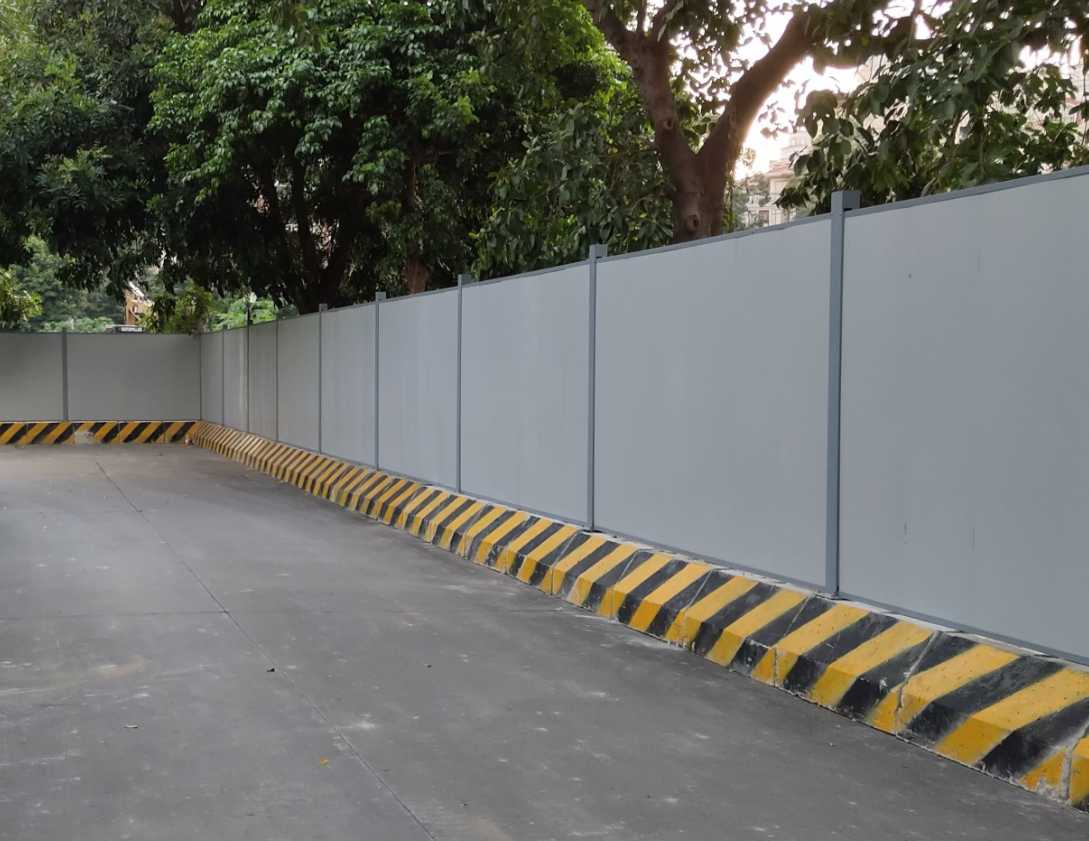
The Four Functions Every Barrier Serves
A useful way to read any barrier specification is to ask which of four functions the zone requires. Those functions are enclosure, separation, edge protection and vehicle restriction. They are not interchangeable, and a product designed for one will usually underperform in another.
Enclosure closes a site boundary. The barrier has to define the limit of the works, screen the interior from public view and remain stable through the project period. Prefabricated steel construction hoarding is the typical answer: rigid panels on posts, available in perforated, louvered, corrugated steel, artificial greenery and PVC formats. The hoarding range in this article is specified with a design service life of up to five years, which places it in the medium- and long-term project category rather than the short-term temporary category.
Separation keeps two activities apart without necessarily closing a boundary. Security fence mesh, perimeter fence, workshop safety partition and pedestrian guardrail all belong here, but they separate different things: an industrial perimeter from public land, a robot workcell from an operator aisle, or a footway from a carriageway. Mesh opening, post spacing and top treatment change with the separation task.
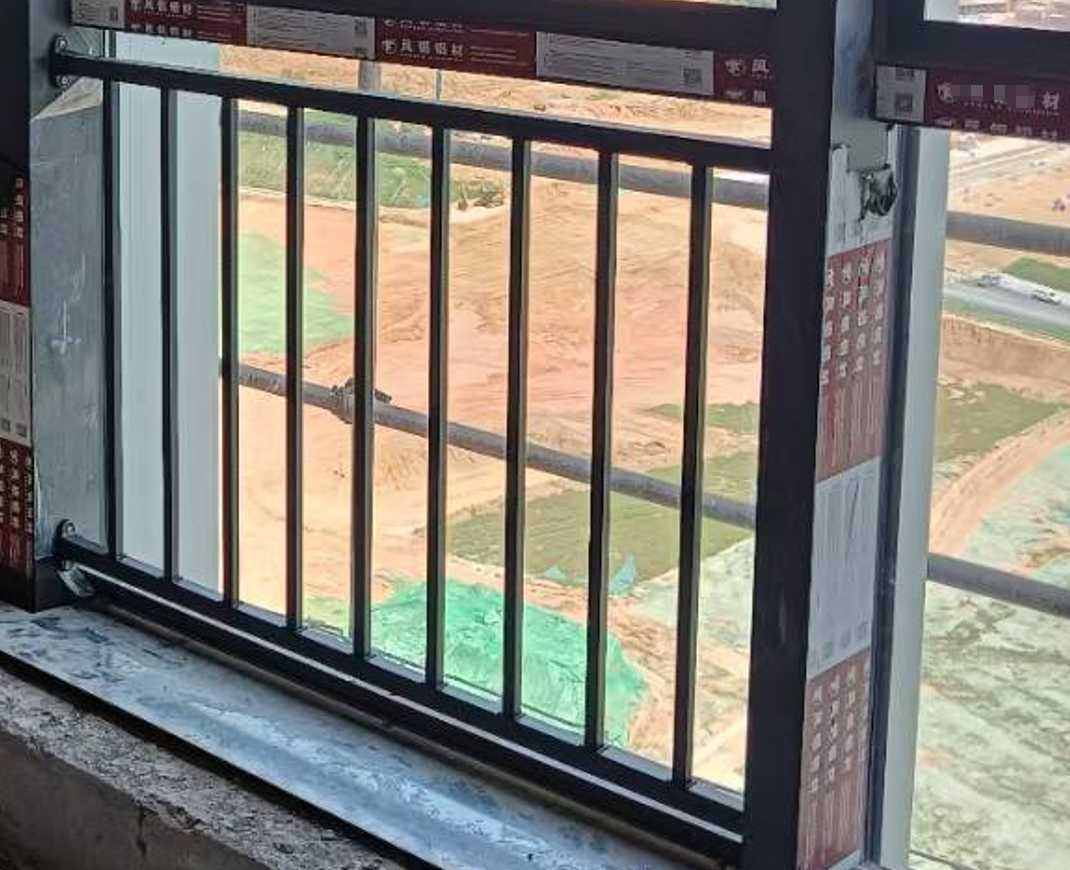
Edge protection prevents a fall from a height or through an opening. Window guard railing, stair railing and balcony railing fall into this group. Their dimensions and connections are determined by the project safety design rather than by a catalogue size, which is why the fixing detail matters as much as the railing itself.
Vehicle restriction controls where cars, vans and plant equipment can go. Bollard / parking barrier products define parking or access boundaries and discourage unauthorised vehicle entry into pedestrian areas. Impact resistance is a separate verification item, not an assumption that comes with the product name.
From Zone Function to Product Family
Once the function is clear, the product family usually follows. The table below maps common zones in construction and decoration projects to the barrier family that typically fits, together with the question a buyer should answer before requesting a price.
| Zone | Primary function | Typical product family | Question to settle first |
|---|---|---|---|
| Site boundary along a public road | Enclosure and visual screening | prefabricated steel construction hoarding | Which panel type, and for how long must it stay in place? |
| Industrial park or factory perimeter | Boundary definition and deterrence | security fence mesh / perimeter fence | What mesh opening and top treatment does the site require? |
| Workshop interior or robot workcell | Separation of work zones | workshop safety partition | Are gates, interlocks and machine-stop functions part of a separate safety system? |
| Window openings in residential, school or public buildings | Fall protection at an opening | window guard railing | What opening arrangement must be preserved, and is a releasable configuration required? |
| Internal or external stairway | Hand support and edge guarding | stair railing | Is prefabricated bolted assembly acceptable, or is a welded stainless steel handrail required? |
| Balcony edge | Fall protection at an elevation | balcony railing | What anchors and connection plates does the structure allow? |
| Parking area, plaza or sidewalk entrance | Vehicle restriction | bollard / parking barrier | Has impact resistance been verified for the intended use? |
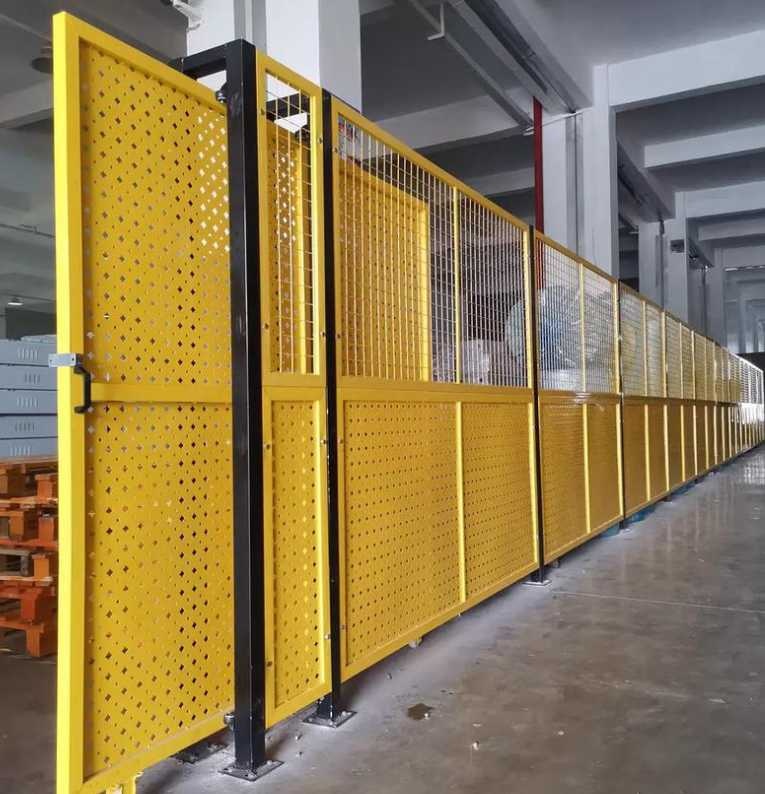
Two entries in this table are frequently confused. The first is the difference between construction hoarding and perimeter fence. Hoarding encloses a work site for a defined period and is often judged on appearance as well as function. Perimeter fence defines a property boundary and is judged on durability and resistance to climbing. The second is the difference between a workshop partition and a machine guard. A welded steel mesh partition separates zones; it does not stop a machine. Interlocks, emergency stops and safety controllers belong to a separate control system.
How the aotianguardrail Range Maps to Those Zones
Guangzhou Santian Steel Structure Co., Ltd. is a China-based manufacturer of municipal guardrails and construction site hoarding systems, operating online as aotianguardrail.com. The company traces its industry experience to 2011 and was formally registered on 16 May 2016. Its production facility covers approximately 15,000 square metres and employs around 200 people, including a 50-engineer research and development team. The company reports an export ratio of 50%, with Southeast Asia, Africa, South America and the Middle East listed as main markets.
The product range is organised around the functions described above rather than around a single product name. On the enclosure side, the prefabricated steel construction hoarding range includes the Guangzhou A5 model, built with reinforced square steel and profiled panels in color-coated steel sheet and specified with a design service life of up to five years for municipal works, road construction, building sites and medium- to long-term projects.
On the separation side, the workshop safety partition range includes a hot-dip galvanised variant combining galvanised steel, zinc steel and welded steel mesh for humid climates, with mesh opening sizes customisable to different safety levels, and a welded steel mesh variant with quick-assembly panels and posts for flexible division of workshop zones. The perimeter fence and security fence mesh ranges cover industrial parks, school campuses, residential communities and factory boundaries, with gates and access control treated as separately specified items.
On the edge-protection side, the window guard railing range is fabricated in zinc steel and steel to window dimensions, with vertical-bar spacing set to the safety requirement and electrostatic coating colours coordinated with the building facade. The stair railing range includes a factory-prefabricated bolted assembly that installs without on-site welding, and a stainless steel handrail variant with a thickened grip and fully welded joints. The balcony railing range covers flat steel, zinc steel and aluminium alloy configurations for residential buildings, schools and industrial park projects.
On the vehicle-restriction side, the bollard / parking barrier range is intended for sidewalk entrances, plazas, parking areas and public spaces, where it defines parking or access boundaries. The same company also manufactures municipal road, bridge and riverside guardrails, but those products belong to the public infrastructure category rather than to the site-protection category discussed here.
Where Standardisation Prevents On-Site Errors
Standardisation is often misunderstood as making everything identical. In barrier procurement it means reducing the number of variables that have to be resolved on site. A project that uses one hoarding panel system, one post spacing and one fastener family across its perimeter removes the daily decision of which panel fits which run. A project that mixes three hoarding types because three suppliers quoted separately creates that decision instead.
Prefabrication carries the same logic into installation. The prefabricated stair railing range is assembled from factory-made components and bolted on site, which removes welding from the stairwell and shortens the installation window. Standardised construction-site safety equipment — safety access tunnels, rebar processing shelters, threading machine shelters and distribution box shelters — applies the same principle to site facilities: the shelter is manufactured as a unit, delivered as a unit and positioned as a unit.
Standardisation also affects the interface points that cause most callbacks: the junction between hoarding and gate, between railing and floor slab, between partition and workshop floor. Confirming those interfaces before production is cheaper than correcting them after delivery, and it is usually the buyer rather than the fabricator who holds the information needed to confirm them.
A practical rule: standardise the repeating runs and customise the exceptions, not the reverse. A curved stair, a tapered balcony or a boundary that changes direction every few metres will need custom fabrication. Forcing a standard module into that geometry usually produces site modifications that cost more than the custom part would have.
What to Clarify Before Requesting a Quotation
Most quotation delays in barrier procurement come from missing information rather than from price negotiation. The list below reflects the details a manufacturer needs in order to quote a fixed scope: product type and zone function; overall length, height, post spacing and opening size; total quantity and whether that quantity is expected to change; material; surface treatment and colour; drawings, or site photographs where drawings do not exist; installation location and fixing substrate; applicable standards and local regulatory requirements; delivery destination and packaging requirements; expected service period; whether gates, access openings, removable sections or release hardware are in scope; and who is responsible for installation.
| Item to confirm | Why it changes the quotation | What happens if it is left open |
|---|---|---|
| Post spacing | Sets panel count, post count and foundation layout | Supplier quotes a nominal spacing; site adjusts and panels no longer align |
| Fixing substrate | Concrete, steel structure and masonry require different anchors and connection plates | Anchor type is assumed; installation stops on site |
| Panel type | Perforated, louvered, corrugated, artificial greenery and PVC panels carry different costs and lead times | Buyer compares prices for different products |
| Service period | A medium- to long-term hoarding and a short-term temporary system are different products | The cheaper quote may not last the project |
| Gate and opening scope | Gates, access openings and release hardware are separate line items in many projects | Gate cost appears after the order is placed |
| Installation responsibility | Supply-only and supply-and-install are different scopes | The site assumes the supplier is installing |
A practical habit is to attach a marked-up site plan to the enquiry. Even a hand-annotated drawing showing where the site boundary turns, where the gate sits and where the excavation edge runs reduces the number of assumptions a supplier has to make. Where drawings do not exist at all, site photographs are accepted as the basis for establishing scope, provided the buyer confirms the dimensions separately.
Where Prefabricated Barriers Reach Their Limits
Honest specification includes the cases where a product does not apply. The following limits are part of the product definitions rather than exceptions to them.
- Prefabricated steel construction hoarding is specified for medium- and long-term projects, with a design service life of up to five years depending on the model. A site that relocates its boundary every few weeks may need a different temporary system.
- Security fence mesh defines a boundary and deters climbing. It does not detect intrusion. CCTV, access control, intrusion sensors and perimeter lighting are separate equipment and are not standard inclusions.
- A workshop safety partition separates zones. Mesh fencing alone does not provide interlocking, emergency stop or machine-stop functions; those belong to a separately specified safety control system.
- Bollard and parking barrier products define access boundaries and discourage unauthorised vehicle entry. Impact resistance requires separate verification for the intended use.
- Riverside guardrail protects accessible waterfront edges and guides pedestrian routes. It does not provide flood control.
- Balcony railing dimensions and connections are determined by the project safety design rather than by a catalogue size, and the interface with drainage or waterproofing has to be coordinated.
- Bridge railing provides edge guarding and separation along bridges. Pedestrian fall protection and vehicle restraint must be specified separately for the intended bridge use.
These limits are not reasons to avoid prefabricated products. They are reasons to write the scope correctly. A quotation that states what the barrier does, and what it does not do, is easier to compare than one that lists only a product name.
What Current Market Data Suggests for Buyers
Third-party market research places the global barrier systems market at USD 24.8 billion in 2025, according to Grand View Research. The same source reports that the metal segment accounted for more than 50.0% of material market share in 2025, a figure consistent with the continued dominance of steel, galvanised steel and aluminium in hoarding, fence and railing construction. Grand View Research separately values the global temporary guardrail market at USD 2.4 billion in 2024, and Dataintelo projects a 9.2% compound annual growth rate for the smart road barrier segment between 2025 and 2034.
For buyers, the practical reading is not that one material or product type is universally correct. It is that metal barriers remain the mainstream specification, that temporary and relocatable systems form a market distinct from permanent installation, and that the specification conversation is shifting toward documented scope rather than catalogue description. A buyer who can state the zone function, the service period and the fixing substrate is already ahead of one who can only name a product.
Future Outlook
Three developments are likely to shape barrier specification over the next project cycle. The first is the continued shift from site-fabricated barriers to factory-made modules, which moves labour from the site to the production line and makes the interface drawing more important than improvisation during installation. The second is the expectation that a supplier can document what a product covers and what it does not, including the boundaries described above. The third is the reuse agenda: hoarding and temporary systems that can be dismantled, stored and re-erected on a second project are increasingly compared on total cost across more than one site rather than on first purchase price.
None of these developments changes the underlying sequence. The risk assessment comes first, the zone function follows, the product family follows that, and the specification details are confirmed before the quotation is issued. Buyers who hold to that order tend to spend less time correcting site errors and more time comparing products that actually serve the same purpose.
FAQ
What is the first step in specifying a safety barrier for a construction or decoration project?
The first step is a zone-by-zone risk assessment that names the function of each barrier: enclosure, separation, edge protection or vehicle restriction. Product selection follows from that function. A buyer who starts with a product name, such as hoarding or fence mesh, is comparing products that may not serve the same purpose.
How does zone function determine which product type to choose?
Enclosure zones take prefabricated steel construction hoarding, which defines the site boundary and screens the interior. Separation zones take security fence mesh, perimeter fence, workshop safety partition or pedestrian guardrail, depending on whether the separation is between a site and public land, between work zones, or between pedestrians and traffic. Edge-protection zones take window guard railing, stair railing or balcony railing. Vehicle-restriction zones take bollard / parking barrier products. Each family is specified against a different question, so the zone function has to be settled first.
What specification details should be confirmed before a supplier issues a quotation?
Product type, dimensions, total quantity, material, surface treatment, drawings or site photographs, installation location, fixing substrate, applicable standards, delivery destination and packaging requirements. Where gates, access openings, removable sections or release hardware are needed, those should be listed as separate line items. Installation responsibility should also be stated, because supply-only and supply-and-install are different scopes.
How does standardising barrier products across a project reduce on-site errors?
Standardisation reduces the number of decisions that have to be made on site. A single hoarding panel system, post spacing and fastener family removes the daily question of which component fits which run. Factory-prefabricated assemblies, such as the bolted stair railing range, remove welding from the installation sequence. Standardised site equipment, such as safety access tunnels and equipment shelters, arrives as a complete unit rather than as parts to be assembled. The main on-site errors in barrier installation are interface errors — hoarding to gate, railing to slab, partition to floor — and those interfaces are easier to control when the component set is fixed in advance.
What are the limits of prefabricated steel hoarding and mesh barriers?
Prefabricated steel construction hoarding is specified for medium- and long-term projects, with a design service life of up to five years depending on the model, so a site that relocates its boundary frequently may need a different temporary system. Security fence mesh defines a boundary and deters climbing but does not detect intrusion; CCTV, access control and perimeter lighting are separate equipment. A workshop safety partition separates zones but does not provide interlocking, emergency stop or machine-stop functions. Bollard impact resistance requires separate verification. Riverside guardrail does not provide flood control, and bridge railing requires pedestrian fall protection and vehicle restraint to be specified separately.
Can safety barriers be customised to project drawings and site conditions?
Yes. Dimensions, post spacing, rail configuration, materials, colours, surface finishes, decorative patterns, logos and installation methods can be customised according to project drawings and site requirements. Where drawings do not exist, site photographs and marked-up plans are used to establish the scope. Customisation applies across the range, from hoarding panels and workshop partitions to window guards, stair railings, balcony railings and bollards.
How should outdoor steel barriers be maintained after installation?
Inspect posts, rails, welds, bolts, anchors and surface coatings at regular intervals. Remove dirt, salt deposits and chemical contamination from the surface, tighten loose fasteners, repair minor coating damage and replace severely corroded or deformed components. Inspection of roadside barriers requires appropriate traffic control. Severely deformed structural components should not be straightened and reused without professional evaluation.
A consolidated product brochure covering the hoarding, fence, railing and bollard ranges referenced in this article is available for download: Santian product brochure (PDF).
Tem questões ou precisa de mais detalhes?
Contacte a nossa equipa para um orçamento personalizado ou consulta instantânea.
Solicitar orçamento
Preencha o formulário abaixo e a nossa equipa entrará em contacto com uma proposta personalizada.
Chat direto do WhatsApp
Prefere conversar em tempo real? Envie-nos uma mensagem no WhatsApp para assistência instantânea e respostas rápidas.
- Obter orçamento personalizado
- Partilhar fotos ou documentos
- Discuta as suas necessidades diretamente
Geralmente responde em 5–30 minutos durante o horário de expediente.