
Safety Barriers for Villa Decoration Projects, Zone by Zone
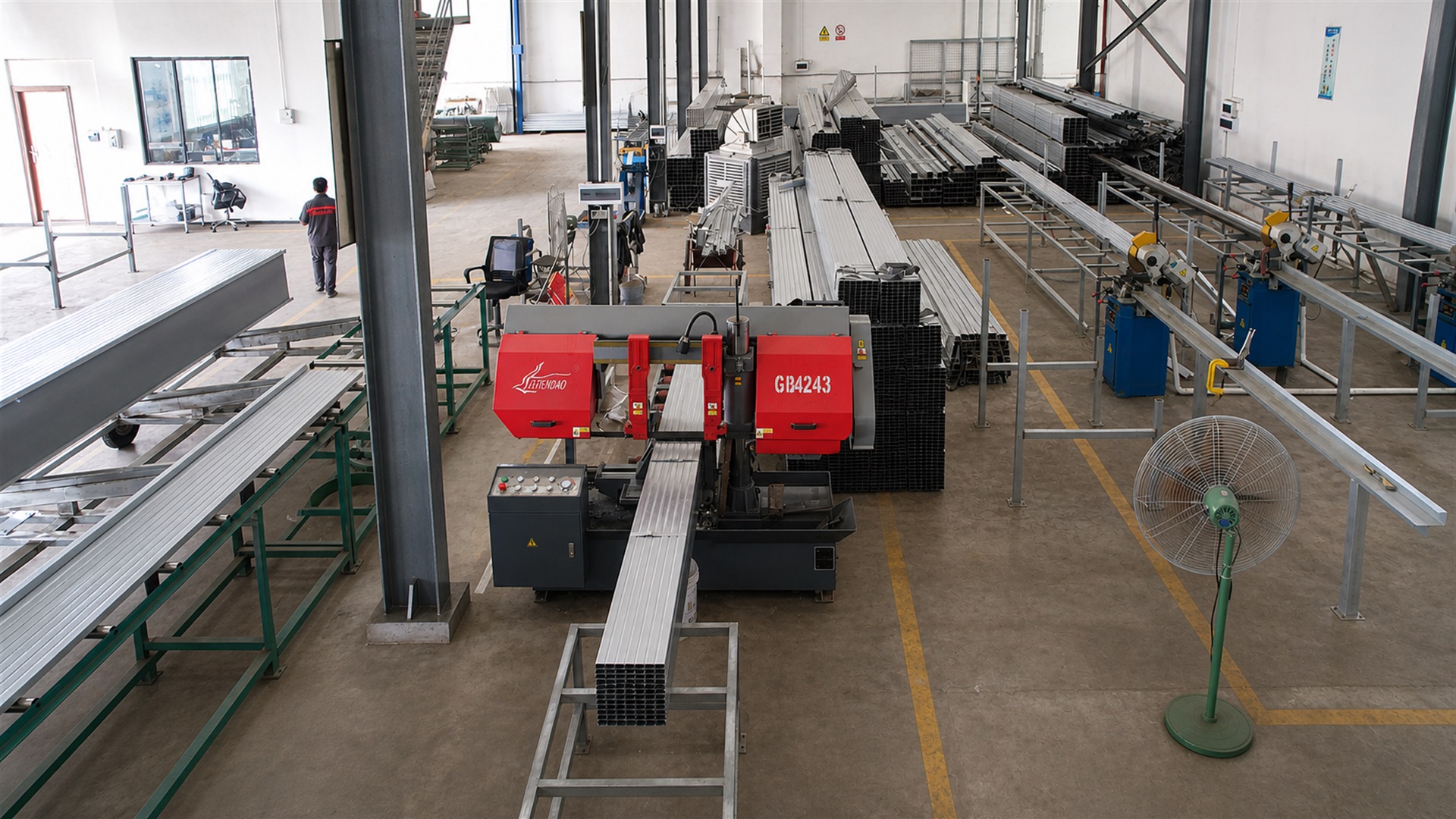
Component fabrication before assembly: steel parts for hoarding frames, fence posts and railing sections are cut to project drawings at the Santian production facility.
A villa decoration project is not protected by one safety barrier. On a low-rise residential or villa site, the temporary boundary, the plot line, the window openings, the balcony edges, the stair flights and the driveway each carry a different exposure, a different user group and a different duration — and each is normally bought as a different product. The useful question for a buyer in the evaluation stage is therefore not which barrier is best in general, but which barrier belongs in which zone, and what has to be verified before it is ordered.
This reference works through that zone-by-zone pattern as it appears in villa and low-rise residential fit-out work: prefabricated steel construction hoarding and security fence mesh at the temporary site boundary, perimeter fence along the plot line, window guard railing, balcony railing and stair railing at building openings and edges, and bollard or parking barrier at the driveway. Product references are drawn from the range manufactured by Guangzhou Santian Steel Structure Co., Ltd. — a China-based manufacturer of municipal guardrails, railings and construction site hoarding systems, with industry experience dating back to 2011, an approximately 15,000 m² production facility, around 200 employees, a 50-engineer research and development team, and a product site at aotianguardrail.com. Statements below describe published product and case information; they are not a certification claim for any specific project, and no third-party test result is implied where none is stated.
Why a single barrier type cannot cover a villa site
Barrier products are often marketed under one generic term, which encourages a single-category purchase. Villa work exposes the weakness of that approach quickly, because the zones differ on four dimensions at once.
- Duration. Site hoarding is temporary equipment with a stated design service life of up to five years on the prefabricated steel hoarding models referenced in this article. A perimeter fence or a balcony railing is a permanent building element expected to stay in place for the life of the property.
- User. The temporary boundary faces the public, delivery traffic and neighbouring properties. Window, balcony and stair railings face occupants, and in some cases children.
- Function. Screening, boundary definition, fall protection and vehicle separation are four different performance requirements. A product that performs one of them well does not automatically perform another.
- Governing logic. Temporary site protection is set by site safety planning, while permanent railings are set by the building's safety design and its approved drawings. Mixing the two categories is the most common evaluation error in villa packages.
The practical consequence is that villa buyers should shortlist by zone, then compare suppliers on evidence per zone — not compare one supplier's hoarding sample against another supplier's railing sample and treat the result as a package comparison.
The zone map: six decisions on a villa site
The table below is the shortlist logic in condensed form. It maps each zone to the barrier family normally specified for it, together with the point that most often has to be verified before an order is placed.
| Zone | What the barrier must do | Barrier family and product examples | Verify before ordering |
|---|---|---|---|
| Temporary site boundary | Enclose the works, screen the site from public view, carry project identity | Prefabricated steel construction hoarding (Y073, Y081); security fence mesh (Y070, Y071, Y072) | Panel type, stated design service life, gate and access positions |
| Plot line | Define the property boundary, discourage unauthorized entry, integrate with landscape | Villa perimeter fence (Y043), zinc steel fence (Y045), perimeter fence (Y050), decorative perimeter fence (Y051) | Post material and finish, gate and access-control scope |
| Window openings | Reduce fall risk at designated openings without blocking the required opening arrangement | Window guard railing (Y064 prefabricated, Y065 zinc steel, Y066 stainless steel) | Whether any release or openable configuration is required for emergency access |
| Balcony edges | Guard elevated edges against falls | Balcony railing (Y052 to Y057, including stainless steel and tempered glass) | Dimensions and connections as set by the project safety design |
| Stair flights | Provide hand support and guard open stair edges | Stair railing (Y058 to Y063, including prefabricated and wooden-handrail variants) | Stair geometry and whether the run is indoor or exposed |
| Driveway and parking | Discourage unauthorized vehicle entry into pedestrian or private areas | Bollard / parking barrier (T041, custom-printed, hot-dip galvanized steel) | Whether the arrangement is fixed or removable, and what impact performance is actually required |
Zone 1 — Temporary site boundary: steel hoarding and security fence mesh
The first barrier decision on a villa site is usually made before the first finishing trade arrives: how to close the plot while work is running. Two product families compete for that job, and they solve different problems.
Prefabricated steel construction hoarding is the screening option. The range includes steel structure hoarding built on a modular frame, with panel variants listed as corrugated steel, perforated metal, louvered, artificial greenery and PVC. Selection among them is driven by how much of the site must be hidden, how the boundary should look to the street, and how long the works will last. Two published cases indicate the scale at which these systems are used. A 1,600 m prefabricated steel hoarding installation using the Y073 Guangzhou A1-1 configuration — square-steel frame, color-coated panels and modular assembly — was supplied to a general contractor or municipal-works contractor and has operated for four years with stable results. A separate 5,100 m installation used the Y081 vertical green wall configuration, combining construction-site enclosure with climbing plants or artificial greenery, for an urban greening contractor, and has operated for five years. Both configurations are stated with a design service life of up to five years.
Security fence mesh is the observation option. Anti-climb spike fence (Y070), angled-top fence (Y071) and razor-wire anti-climb fence (Y072) are built from hot-dip galvanized steel, steel tube and welded steel mesh, and are intended for perimeter-security work in industrial parks, factories and comparable sites. On a villa project they appear most often around material and equipment compounds inside the hoarding line, or where the site sits beside an occupied property and the client wants the boundary monitored rather than masked.
The selection rule is simple enough to apply in a tender review: choose hoarding when the requirement is screening and identity; choose mesh when the requirement is visibility and deterrence. Many villa sites end up using both — hoarding to the public street, mesh around the internal compound — which is why treating them as substitutes rather than complements tends to produce either an over-exposed site or a boundary nobody can see through.
Boundary to watch: a design service life of up to five years makes prefabricated steel hoarding temporary equipment, not permanent architecture. It should not be handed over, or priced, as the villa's boundary wall once decoration is complete.
Zone 2 — Plot line: perimeter fence
Once the villa's permanent boundary has to be established, the product changes. The requirement is no longer screening during works but defining ownership and discouraging casual entry, over a horizon measured in years rather than months. The relevant family is the perimeter fence, offered as villa perimeter fence (Y043), zinc steel fence (Y045), perimeter fence (Y050) and decorative perimeter fence (Y051), in hot-dip galvanized steel, zinc steel and steel tube.
A published case illustrates the pattern. A 3,800 m run of the Y050 perimeter fence was supplied to a property developer, industrial-park operator or perimeter contractor, and has operated for eight years with stable results. The configuration uses hot-dip galvanized posts and a dark-green finish, which is a boundary-protection decision and a landscape decision at the same time. The product's stated application includes villa developments alongside residential communities, schools, industrial parks and factories — a reminder that the fence is a standardised product applied to a site-specific layout, not a bespoke architectural facade.
In villa work, colour and finish carry more weight than in industrial work, because the fence is visible from the street, from the garden and often from the upper floors of the house. That makes finish one of the legitimate comparison points between suppliers, alongside post material and connection detail.
Boundary to watch: a perimeter fence defines a boundary and discourages unauthorized entry. Pedestrian and vehicle gates, access control, CCTV, security lighting and intrusion alarms are project-dependent items and are not standard inclusions in the fence system. A villa owner who expects the fence alone to deliver "security" is buying the wrong scope.
Zone 3 — Building openings and edges: window guard, balcony and stair railing
This is the zone where villa decoration work differs most from general construction, because three railing types appear in the same building and are frequently confused with each other in procurement documents.
Window guard railing
Window guard railing (Y064 prefabricated, Y065 zinc steel and steel, Y066 stainless steel) provides a physical guard across designated window openings to reduce fall risk, while preserving the opening arrangement required by the building design. It is passive and fixed. Any openable or releasable configuration must be separately specified and coordinated with emergency access requirements — a point that is often missed when guards are selected purely from a catalogue image. Compatible fixing brackets, opening restrictors and designated release hardware are project-dependent items rather than automatic inclusions.
Balcony railing
Balcony railing (Y052 zinc steel, Y053 flat steel, Y054 aluminum alloy, Y055 stainless steel with tempered glass, Y056 and Y057 stainless steel) provides a protective barrier at balcony edges to reduce the risk of falls, with dimensions and connections determined by the project safety design rather than by the supplier's default drawings. The system is passive and fixed, with no power or routine mechanical actuation. Glass infill, where specified, is a project decision; anchors, connection plates and the interfaces with balcony drainage and waterproofing all need to be resolved at the detailing stage, because they are not resolved by the railing profile alone.
Stair railing
Stair railing (Y058 to Y060 stainless steel, Y061 zinc steel, Y062 with wooden handrail, Y063 prefabricated) provides hand support and guards open stair edges to assist movement between levels. Handrail and guard requirements depend on the stair design, so the same product family can look very different between an internal flight and an exposed external stair. Fixing brackets, anti-slip treads, stair lighting and emergency wayfinding are coordinated items rather than part of the railing supply by default.
Two sequencing observations matter more in villa work than in large construction, because the site is small and the trades overlap. First, openings should be guarded from the moment they exist, not after the final railing arrives. Second, the permanent railing schedule should be settled before the hoarding comes down; otherwise the temporary boundary is removed while edge protection is still an open item, and the site briefly has neither.
Boundary to watch: these are fixed, passive products installed to approved engineering drawings and local safety regulations by qualified personnel. They are not crash-rated systems and should not be specified or compared as if they were.
Zone 4 — Driveway and vehicle control: bollard and parking barrier
Driveway control is the smallest part of a villa package and the one most often added late. The relevant product is the bollard or parking barrier — for example the T041 custom-printed parking barrier in hot-dip galvanized steel — used to define parking or access boundaries and to discourage unauthorized vehicle entry into pedestrian areas. Its stated applications include sidewalk entrances, plazas, parking areas and public spaces, which is a broader set than a single villa driveway but describes the same function.
The operational logic is worth stating plainly: the barrier is a passive, non-powered physical boundary, normally fixed in place, with removable or movable arrangements applying only where specified. Parking signs, wheel stops, parking guidance systems and powered access gates are separate items unless they are explicitly included in the project scope.
Boundary to watch: this product discourages vehicle entry; it does not provide verified impact resistance. Where vehicle impact performance is a genuine requirement, that performance has to be separately specified and verified — and a decorative bollard should not be presented as a substitute for a crash-rated system.
A practical shortlisting sequence for villa packages
Buyers evaluating a villa barrier package can apply the same seven-step sequence to each zone, which keeps the comparison consistent across products that are not really comparable.
- Fix the duration. Temporary during works, or permanent for the building's life. This single question separates hoarding from fence and railing.
- Name the job. Screen, define, guard or separate. A product that is asked to do two jobs usually does the second one badly.
- Match the material to the exposure. Coated or galvanized steel for general outdoor use; stainless steel where the site is coastal or persistently humid.
- Confirm the customization inputs. Dimensions, materials, colours, surface finishes, structural designs, decorative patterns, logos, packaging and project-specific configurations are all stated as customizable — which means they must be confirmed in writing rather than assumed from a sample.
- Resolve interfaces early. Gates, anchors, drainage, waterproofing, opening restrictors and release hardware are the items that delay installation when they are discovered on site.
- Ask for the evidence chain. Drawings, component identification, assembly guidance and inspection records, not just a product photograph.
- Record the exclusions. What the supplier is not providing is as important as what it is providing, particularly in a package that spans six zones.
Where these products stop: limits buyers should price in
A shortlist is only useful if its boundaries are stated as clearly as its recommendations. Five limits apply to the zone pattern described above.
- Road standards do not transfer to villa railings. EN 1317 is the European standard for vehicle restraint systems permanently installed on roads, and AASHTO MASH 2016 is the current evaluation standard for new permanent roadside hardware in the United States. Neither defines performance for a villa balcony railing, a window guard or a decorative perimeter fence. Villa edge protection is set by the project's safety design, approved drawings and local building rules.
- Hoarding is temporary by design. The prefabricated steel hoarding configurations referenced here carry a design service life of up to five years. Reusing them across phases is reasonable; treating them as permanent fencing is not.
- A fence is not a security system. Gates, access control, cameras, lighting and alarms sit outside the standard fence scope and have to be specified and priced separately.
- A bollard is not a crash barrier. Impact resistance requires separate verification, and the product should not be evaluated on a performance it has not been specified for.
- Steel dominance is an aggregate signal, not a specification. Metal accounted for the largest material share of the barrier systems market in 2025, at over 50.0% according to Grand View Research. That describes the market, not the correct material for a specific balcony with a specified view requirement or a specific coastal exposure.
Market trend: packaged procurement, zone-level evidence
The barrier category is large and still segmented by use. Grand View Research valued the global barrier systems market at USD 24.8 billion in 2025, and the temporary guardrail segment alone at USD 2.4 billion in 2024. For villa work, the interesting signal is not the headline number but the structure behind it: temporary barriers are bought as a product family with a defined service life, while permanent railings are bought against a building design. That is why suppliers who can cover hoarding, fence, railing and bollard in one commercial package are increasingly convenient for villa contractors — and why the evaluation risk has shifted from availability to evidence.
The risk is straightforward. When one supplier quotes across six zones, a strong hoarding case study can create a halo over a railing scope that has never been reviewed. The defensible approach is to accept the commercial convenience of a package while keeping the technical evaluation per zone: separate drawings, separate finishes, separate interface lists, separate inspection records. Santian's own scope reflects this structure — OEM and ODM production, customization across dimensions, materials, colours, surface finishes, structural designs, decorative patterns, logos and packaging, a 50% export share with markets in Southeast Asia, Africa, South America and the Middle East, and an integrated service covering solution development, product design, manufacturing and installation.
Evidence to request before placing a multi-zone order
For a villa package spanning temporary and permanent products, four evidence sets cover most of the evaluation.
Quality control sequence. The stated process covers incoming material inspection, dimensional inspection, welding inspection, coating inspection, in-process quality control and final pre-shipment inspection. Buyers should ask which of these stages generates a record they will receive, and match it to the zone: coating records matter most on outdoor fence and railing, welding records on mesh and railing sections, dimensional records on hoarding frames that must assemble modularly.
Customization and quotation inputs. A usable quotation needs the product type, dimensions, total quantity, material, surface finish, drawings, installation location, applicable standards, delivery destination and packaging requirements. Site photographs help where drawings do not yet exist. Lead time is determined by order quantity, product specifications and customization requirements, and minimum order quantity is negotiable according to product type and project requirements — both are project-level variables rather than fixed catalogue values.
Installation and after-sales scope. Installation drawings, component identification, assembly guidance and remote technical support can be provided according to the project, with installation completed by qualified personnel in line with approved engineering drawings and local safety regulations. Maintenance recommendations and spare-parts coordination fall into the same after-sales envelope.
Maintenance and replacement expectations. Outdoor steel barriers should be inspected regularly for loose fasteners, corrosion, damaged coatings, deformation, foundation movement and missing components; surfaces should be cleaned of dirt and salt deposits, connections tightened and minor coating damage repaired promptly. Service life depends on material, coating system, climate, installation quality and maintenance frequency. Where a section is damaged, a modular guardrail section can usually be replaced independently when compatible posts, rails and fasteners are available — but the surrounding structure and foundation must be inspected before the new section goes in.
Future outlook
Two shifts are likely to shape villa barrier procurement over the next few evaluation cycles. The first is documentation-led buying: as packages span temporary and permanent products, buyers increasingly judge suppliers on the records they can produce per zone rather than on a single showroom sample. The second is design integration — window guards, balcony railings and stair railings are being resolved earlier in the decoration programme, alongside the facade and the landscape, because late railing decisions are what force temporary edge protection to stay in place longer than planned.
Neither shift changes the underlying product logic. Hoarding still screens, fence still defines, railing still guards, and bollards still separate vehicles from people. What changes is the standard of proof expected at each step, and that is where an evaluation-stage buyer should concentrate attention.
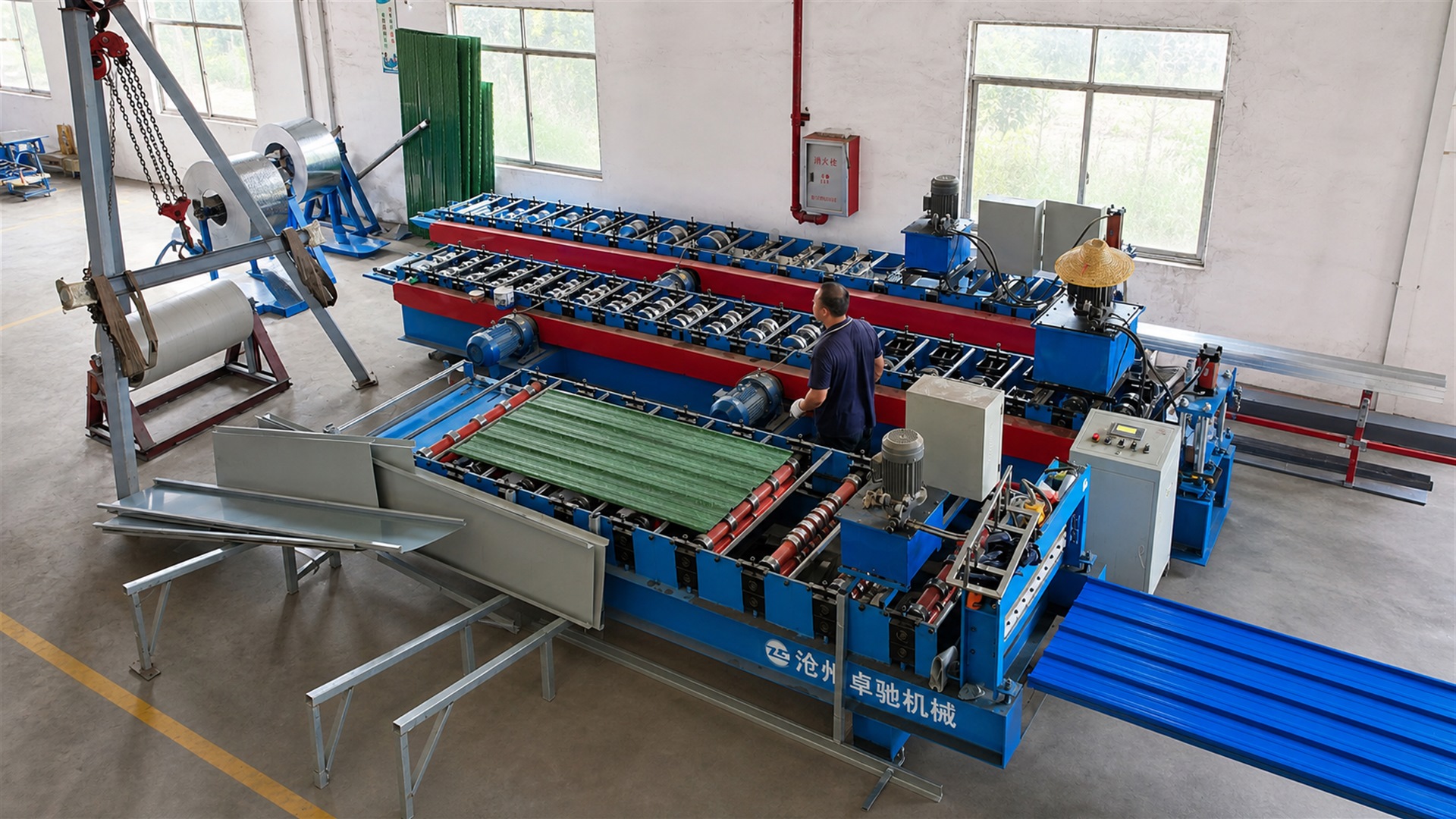
Roll forming of steel profiles: the same production base supplies hoarding panels, fence sections and railing components, which is why package-level evaluation still requires per-product evidence.
FAQ
Which safety barrier types are typically used across a villa decoration project?
Villa and low-rise residential work usually combines prefabricated steel construction hoarding or security fence mesh at the temporary site boundary, perimeter fence along the plot line, window guard railing, balcony railing and stair railing at building openings and edges, and a bollard or parking barrier at the driveway. Each type addresses a different exposure and duration, so they are specified separately rather than substituted for one another.
Can one supplier cover hoarding, perimeter fence, window guards, balcony railings, stair railings and parking barriers?
A single manufacturer can hold all of these product families in one range, and Santian's scope includes prefabricated steel construction hoarding, security fence mesh, perimeter fence, window guard railing, balcony railing, stair railing and bollard or parking barrier products. Commercial coverage does not remove the need for per-zone technical review: drawings, materials, finishes and interface items still have to be confirmed for each product group.
How long is a prefabricated steel construction hoarding expected to last?
The prefabricated steel construction hoarding configurations referenced in this article are stated with a design service life of up to five years. Published cases include a 1,600 m Y073 installation in service for four years and a 5,100 m Y081 vertical green wall installation in service for five years, both reported as operating stably. Actual service life depends on material, coating, climate, installation quality and maintenance.
Which material should be specified for villa railings in coastal or humid locations?
Stainless steel, particularly Grade 316 or 316L, is recommended for coastal and salt-spray environments. Hot-dip galvanized steel with an additional protective coating is also suitable where it is correctly specified and maintained. Material choice should also account for the required appearance, the structural design and the maintenance regime the owner will realistically follow.
What information is needed to obtain a quotation for a villa barrier package?
Provide the product type for each zone, dimensions, total quantity, material, surface finish, drawings, installation location, applicable standards, delivery destination and packaging requirements. Site photographs help where drawings are not yet available. Lead time depends on order quantity, specifications and customization requirements, and minimum order quantity is negotiable according to product type and project requirements.
Can a damaged guardrail or railing section be replaced without dismantling the entire run?
A damaged modular section can usually be replaced independently where compatible posts, rails and fasteners are available. The surrounding structure and foundation should be inspected before the replacement is installed, and the work area should be isolated and documented first. Severely deformed structural components should not be straightened and reused without professional evaluation.
Product documentation for reference: Santian product brochure (PDF).
Tem questões ou precisa de mais detalhes?
Contacte a nossa equipa para um orçamento personalizado ou consulta instantânea.
Solicitar orçamento
Preencha o formulário abaixo e a nossa equipa entrará em contacto com uma proposta personalizada.
Chat direto do WhatsApp
Prefere conversar em tempo real? Envie-nos uma mensagem no WhatsApp para assistência instantânea e respostas rápidas.
- Obter orçamento personalizado
- Partilhar fotos ou documentos
- Discuta as suas necessidades diretamente
Geralmente responde em 5–30 minutos durante o horário de expediente.