
Sanitary Pad Certification: ISO, GB and EAC Compliance Map
Sanitary Pad Certification: ISO, GB and EAC Compliance Map
Sanitary pad compliance is not one certificate. It is a stack of documents answering three different questions: is the skin-contact material safe, is the finished disposable product hygienic and fit for use, and is a named legal entity permitted to place a defined product list on a specific market. Buyers who treat these layers as interchangeable usually find the gap at customs clearance, at retail onboarding, or at the first consumer complaint.
This industry reference decodes the three regulatory anchors that appear most often in feminine hygiene sourcing files — ISO 10993-5, GB 15979-2024 and TR CU 007/2011 — and shows where individual document numbers sit inside that structure. The document examples come from the compliance file associated with New Upward SC (Guangdong) Co., Ltd., a China-based feminine care supply-chain company whose organic and bamboo pad programmes supply importers, distributors and private-label brands under the Lilimolone brand and under buyer-owned labels.

Contamination control at the workshop entry point is the physical layer behind hygiene documentation: controlled access, air showering and clean-zone discipline are what product-level hygiene reports describe in writing.
Why Certification, Not Price, Became the Sourcing Bottleneck
Procurement teams searching for eco friendly organic sanitary pads now attach document terms to their searches: test report, certificate number, CE, FSC, Halal, GOTS, OCS. That behaviour reflects an operational problem rather than a marketing trend. A quotation is easy to compare across suppliers. A compliance file is not, because it mixes document types that carry different weight, different validity logic and different legal owners.
In practice, three separate questions get compressed into the word “certification”:
- Material safety. Is the skin-contact raw material biocompatible, and who performed the test?
- Product hygiene and performance. Was the finished pad tested to a recognised hygiene standard, on a named size and construction?
- Market admissibility. Which entity, product list and certificate scope cover the destination market the buyer intends to sell into?
A supplier answer to question one does not answer question three. A cytotoxicity report on non-woven fabric does not authorise a shipment to the European Union, and a facility registration in the United States does not test absorbency. Separating the layers early is what turns a certificate folder into a usable procurement asset.
The Three-Tier Document Model
The practical way to organise a sanitary pad compliance file is by tier. Each tier has a different issuing party, a different scope statement and a different failure mode.
| Tier | Question answered | Worked example from this product family | What it does not prove |
|---|---|---|---|
| Material-level biocompatibility | Is the skin-contact raw material safe in a laboratory model? | Report No. SDWH-M201900236-1 (E), in vitro cytotoxicity, ISO 10993-5:2009 method; Report No. SDWH-M201900236-2 (E), skin sensitization, ISO 10993-10:2010 method; Report No. SDWH-M201900236-3 (E), skin irritation, ISO 10993-10:2010 method. All three cover non-woven fabrics as skin-contact raw material for feminine hygiene products and were issued by the Sanitation & Environment Technology Institute, Soochow University. | It does not approve a finished pad, a converting line, a batch, or market entry. |
| Product-level hygiene and performance | Does this named pad size meet a recognised hygiene and performance standard? | Report No. 260059776 on Lilimolone Ultra-Thin Bamboo Sanitary Pads 245 mm, tested against GB/T 8939-2018 and GB 15979-2024, issued by Guangzhou Inspection Testing and Certification Group (GTTC) on 1 April 2026; Report No. 252004820, skin allergy test on Amyas disposable sanitary pads (sterilized grade) 245 mm, test basis GB 15979-2024, issued 30 January 2026. | It does not transfer to another manufacturer, another size, another construction, or another jurisdiction. |
| Market entry and entity scope | May this entity place this product on this market? | CE Declaration of Conformity No. H-YG-MD-240414161/01 referencing MDR (EU) 2017/745; EU Authorized Representative Agreement with WeTapeV Euro s.r.o., valid 2026-04-16 to 2027-04-16; EAC registration reference RU.08.08.09.012.R.002571.10.23 under TR CU 007/2011; Halal Certificate No. 44521209189851 issued by Halal Foundation Center Hong Kong. | It does not, on its own, demonstrate product quality, medical performance or organic content. |
| Material and supply-chain certification | Is the claimed raw material traceable to a certified source? | GOTS Scope Certificate No. EGL/236426/GOTS/236426260101190405; OCS Scope Certificate No. EGL/236426/OCS/236426260101190029 (both ECOCERT Greenlife S.A.S., valid 2026-01-01 to 2026-12-31); FSC Chain of Custody No. RINA-COC-001701 / DCI-COC-000148 issued by RINA Services S.p.A. | It does not make a finished pad “certified organic”; chain of custody and certified content share still govern the claim. |
| Management system and enterprise capability | Does the organisation operate controlled, auditable processes? | ISO 9001 Certificate No. CN21/31472 (SGS United Kingdom Ltd, valid to 26 August 2027); ISO 14001 Certificate No. 51823E08205R0 and ISO 45001 Certificate No. 51823008206R0 (Shenzhen Zhongbiao International Testing and Certification Co., Ltd.); Sanitary Products Production and Sales Enterprise Service Level Qualification Certificate (Level 1) No. SSDY20260609102 under Q/SSDY 001-2023, valid 2026-06-09 to 2029-06-08. | System and enterprise certificates describe how work is managed, not how a specific production batch performed. |
Decoding the Three Anchors
ISO 10993-5: The Skin-Contact Screen
ISO 10993-5 is the cytotoxicity part of the ISO 10993 biocompatibility family. In sanitary pad sourcing it is used as the first screen on skin-contact material: the test evaluates whether extracts from a material affect cells in culture. In this file, Report No. SDWH-M201900236-1 (E) covers non-woven fabrics used as skin-contact raw material for feminine hygiene products and applies the ISO 10993-5:2009 method. Two companion reports from the same institute and the same material scope cover skin sensitization and skin irritation under ISO 10993-10:2010.
Reading cytotoxicity alongside sensitization and irritation is the correct interpretation. A single cytotoxicity result says something useful about material selection; it says nothing about clinical safety or therapeutic benefit, and it should never be converted into a medical claim. It is also worth noting how individual reports sit inside a wider framework: the CE Declaration of Conformity held for these product lines references ISO 10993-1:2020, ISO 10993-5:2009, ISO 10993-10:2021 and ISO 10993-23:2021 as part of a risk-management approach, not as standalone marketing evidence.
GB 15979-2024: The Chinese Hygiene Baseline
GB 15979-2024 is the Chinese hygienic requirements standard for disposable sanitary products. It appears in this file as the test basis for product-level reports rather than as a certificate. Report No. 260059776 combines GB 15979-2024 with GB/T 8939-2018, the Chinese product standard for sanitary absorbent pads and panty liners, on a named 245 mm bamboo pad. Report No. 252004820 lists GB 15979-2024 as its test basis for a skin allergy assessment on a 245 mm sterile-grade pad produced for a different label in the same supply network.
For importers, GB 15979-2024 reports issued by accredited laboratories such as GTTC are strong third-party evidence that hygiene and skin-contact characteristics were tested on an identifiable product. The boundary is equally clear. A Chinese national standard demonstrates conformity in China. It does not satisfy European or United States market requirements on its own, and it should be filed as evidence alongside — never instead of — the destination market's conformity documentation.
TR CU 007/2011: The EAEU Route
TR CU 007/2011 is the Eurasian Economic Union technical regulation on the safety of products intended for children and adolescents, and single-use sanitary hygiene products are assessed within this conformity framework when placed on EAEU markets. Unlike a laboratory report, EAC conformity is registered to a named legal entity against a defined product list — Registration No. RU.08.08.09.012.R.002571.10.23 in this file illustrates that entity-and-list logic.
Two boundaries matter here. First, the registration follows the declared product scope and manufacturing arrangement, so adding a materially different SKU or changing the production site normally requires the file to be updated rather than reused. Second, the applicable regulation and classification for a given commercial description should be confirmed with the certification body or the local import agent, because hygiene products can be classified differently depending on the product description and destination. For customs purposes, sanitary towels, pads and tampons are classified under HS code 9619.00.
How the Supplier Side Builds the File
New Upward SC (Guangdong) Co., Ltd. was founded in 2017 and operates as an integrated disposable hygiene product manufacturing and service provider, with 200,000 m² of factory space, around 100 employees, an annual output of 5,000,000,000 pads, an R&D team of more than 10 engineers and an export ratio of roughly 80% across Europe, North America, the Middle East, Africa, Southeast Asia, Central Asia and South America. Its stated model is to connect buyer requirements, product solutions and manufacturing resources rather than to sell a fixed catalogue.
Two product references carry most of the eco-positioned demand. NU07 organic sanitary pads are winged disposable pads with a 100% organic cotton topsheet, a fluff-pulp and SAP absorbent core, a breathable PE or biodegradable film backsheet option, a soft nonwoven side layer and wings, and an individual wrapper in PE/nonwoven or biodegradable options; the range covers panty liner, day use, night use and extra-long night formats. Lilimolone Ultra-Thin Bamboo Sanitary Pads are built on a bamboo fiber nonwoven topsheet with a high-absorbency pulp/SAP core and a breathable leak-proof PE backsheet, in 155 mm, 245 mm and 290 mm formats, supplied in retail bags or OEM private-label packaging.
The compliance-relevant capability sits in how these products can be specified and documented. The manufacturer provides OEM, ODM, Private Label and customized sanitary pad development and supply-chain services, and the customization scope explicitly covers pad length, shape, thickness, absorbency, wings, organic cotton topsheet, fluff-pulp absorbent core, SAP dosage, plant-based backsheet, individual wrapper, pack count, packaging artwork, logo, language version and master carton. Available capacity is approximately 450 million pads per month under full-line operation, and lead times are quoted as 5–15 working days for sample development, about 25–30 days for a new OEM/ODM order after specification and artwork confirmation, and about 15–20 days for repeat orders.
Quality control is documented as a sequence rather than a claim: incoming material inspection, approved sample control, in-process inspection, absorption, rewet and leakage testing, finished-goods sampling, packaging checks, retained samples and batch traceability. Commercial terms follow the same logic: MOQ is normally 300,000 pieces per size but is project-specific depending on pad size, materials, packaging printing, pack count and testing requirements, with trial orders evaluated against available materials and mature specifications. Shipping is quoted FOB Shenzhen/Guangzhou, CIF destination port or EXW, with 50% T/T deposit before production and 50% balance before shipment or against copy of B/L.
The reason this matters to a compliance discussion is simple: documentation is only useful when it can be attached to a named specification, a named batch and a named market. A test report without a locked specification is a brochure page.
Application: Mapping Certification Layers to Target Markets
The same product can require a different document spine for each destination. The matrix below shows how the layers combine in practice, and where each market's evidence stops.
| Target market | Primary evidence layer | Example documents in this file | Buyer action still required |
|---|---|---|---|
| China domestic | GB 15979-2024 hygiene requirements with GB/T 8939-2018 product testing | Report No. 260059776 on Lilimolone Ultra-Thin Bamboo Sanitary Pads 245 mm; Report No. 252004820 skin allergy test citing GB 15979-2024 | Confirm the report covers the exact size and construction being ordered. |
| European Union / EEA | CE Declaration of Conformity, ISO 10993 series evidence, named EU authorized representative | CE DoC No. H-YG-MD-240414161/01 referencing MDR (EU) 2017/745 and ISO 10993-1/-5/-10/-23; EU Representative Agreement with WeTapeV Euro s.r.o., valid to 2027-04-16 | Verify the technical file, labeling and classification position with the authorized representative and importer. |
| United States | Facility-level registration plus quality-system expectations | FDA establishment registration record (Owner/Operator No. 10088919; Certificate No. 3010200123) | Recognise that registration is not product approval; the record itself states that the FDA does not issue or recognise certificates of registration. |
| EAEU | TR CU 007/2011 conformity registration tied to entity and product list | Registration reference RU.08.08.09.012.R.002571.10.23 | Confirm the registered product list matches the SKUs, sizes and manufacturing arrangement in the purchase order. |
| Middle East and Muslim consumer markets | Halal certification and market-specific labeling | Halal Certificate No. 44521209189851, Halal Foundation Center Hong Kong, valid to 2028-01-31 | Match the certificate attachment scope to the ordered products and confirm packaging language with the distributor. |
| Global retail and e-commerce private label | Material certification plus product reports plus packaging claim review | GOTS, OCS and FSC chain-of-custody certificates; antimicrobial activity reports for bamboo fiber materials | Confirm chain of custody and the certified content share before any organic claim is printed on packaging. |
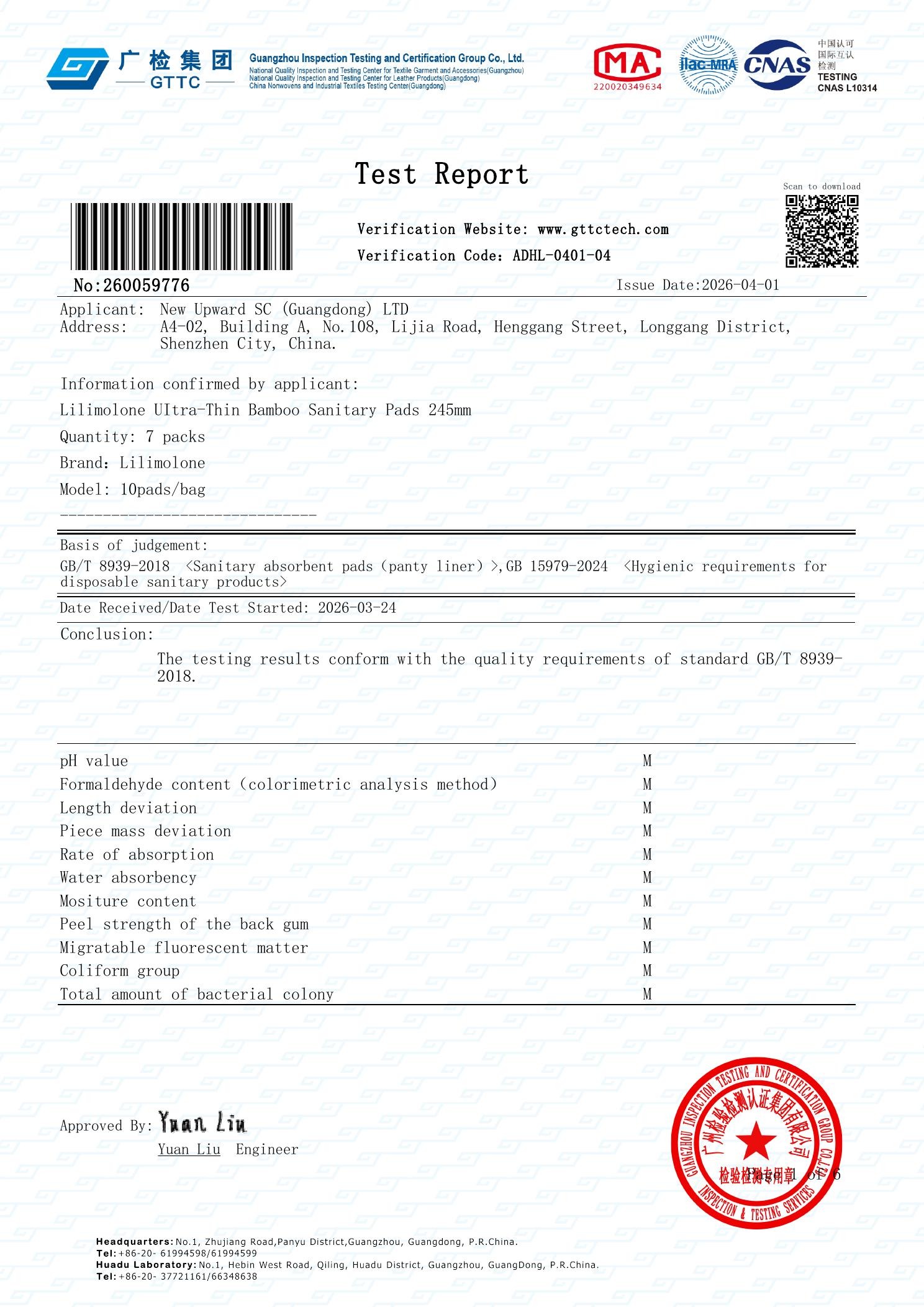
Product-level evidence: Report No. 260059776 applies GB/T 8939-2018 and GB 15979-2024 to a named 245 mm product rather than to a category in general.
Market Trend Analysis
The commercial case for this documentation work is visible in published market data. TechSci Research projects the global organic sanitary napkins market at USD 3.02 billion in 2025, with a forecast path to USD 4.51 billion by 2031. Mark & Spark Solutions estimates the biodegradable sanitary napkin segment growing at a 20.1% CAGR between 2024 and 2030, reaching USD 8.54 billion by 2030. Dataintelo reports that Asia Pacific held a 38.6% revenue share of the biodegradable sanitary napkin market in 2025.
Those figures should be read with discipline. Reported market sizes vary substantially with definition: one estimate places the 2024 market near USD 1.10 billion against the USD 3.02 billion 2025 figure, a gap that largely reflects whether “organic” means an all-natural construction or an organic cotton topsheet only. Procurement business cases built on a single headline number are fragile. The durable signal is direction and document demand, not one decimal place.
Regulatory direction reinforces the same conclusion. The FDA's Quality Management System Regulation took effect on 2 February 2026 and incorporates ISO 13485:2016 into 21 CFR Part 820, harmonising quality-system expectations for menstrual products placed on the United States market. Suppliers already operating documented management systems will adapt to that shift with less friction, and buyers will increasingly request quality-system evidence next to product test reports.
Material certification cycles add a calendar dimension. The GOTS and OCS scope certificates in this file run from 1 January 2026 to 31 December 2026, which is typical of annual renewal rhythms in organic textile schemes. A sourcing plan that locks a supplier in the fourth quarter should confirm that the certificate will still be valid at the time of shipment, not only at the time of quotation.
Certificate-Led Sourcing Compared with Price-Led Sourcing
Traditional feminine hygiene sourcing has been driven mainly by unit price and basic absorbency. Eco-positioned and regulated-market sourcing adds a document layer that changes how suppliers should be compared.
| Dimension | Price-led sourcing | Certificate-led sourcing |
|---|---|---|
| Quotation comparability | Low: specifications often differ between quotes without being stated | Higher: size, topsheet, core, SAP dosage, packaging and testing must be fixed before comparison |
| Claim risk | High: organic, biodegradable or antibacterial wording may be used without a document behind it | Lower: claims map to report numbers, certificate scopes and issuing bodies |
| Market entry | Documents assembled after the order, often reactively | Market file planned before artwork approval |
| Timeline | Shorter initially, with downstream delay risk | Longer initially: document work, sampling and file updates add weeks |
| Cost structure | Lower visible unit cost | Higher visible cost, offset by fewer claim disputes and shelf rejections |
| Dispute handling | Relies on goodwill and photographs | Relies on approved samples, retain samples and batch traceability |
A fair comparison has to state where certification stops being useful. Six boundaries are worth stating plainly:
- Certificates do not travel automatically with the goods. A GOTS or OCS scope certificate covers defined material categories. A finished pad cannot be described as certified organic unless chain of custody and certified content share support that wording; the certificate is evidence about material, not a label licence.
- Material-level reports are not product approvals. Reports SDWH-M201900236-1 (E), -2 (E) and -3 (E) cover non-woven fabric as skin-contact raw material. If the bill of materials or the material supplier changes, the applicability of those reports must be re-assessed rather than assumed.
- Self-declaration places accountability on the manufacturer. The CE Declaration of Conformity is a manufacturer's self-declaration referencing MDR (EU) 2017/745 and a defined list of ISO standards. Importers should still verify the technical file, labelling and the named authorized representative.
- Facility registration is not product authorization. The FDA registration record in this file carries the explicit note that the FDA does not issue or recognise certificates of registration. Treating it as a product approval is a common and avoidable error.
- Enterprise qualifications are context, not product evidence. The Level 1 Sanitary Products Production and Sales Enterprise Service Level Qualification (No. SSDY20260609102, evaluated under Q/SSDY 001-2023) supports due diligence on service capability and credit context. It does not replace hygiene or performance testing on a specific SKU.
- Certification has a real cost in time. Sample development of 5–15 working days, roughly 25–30 days to first OEM/ODM production after specification and artwork confirmation, and additional document work for every new market, are lead-time costs that should be planned rather than discovered.
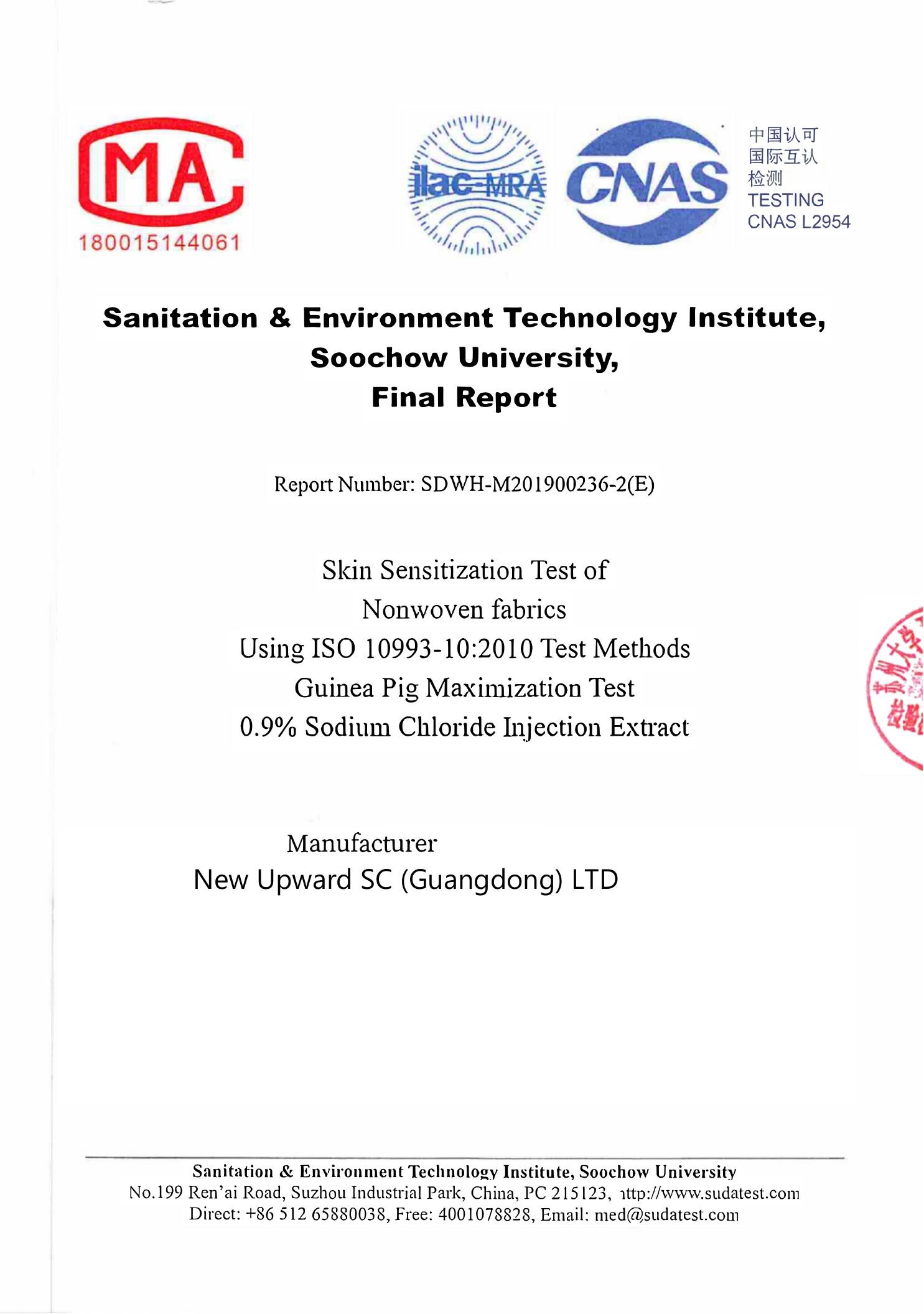
Material-level evidence: Report No. SDWH-M201900236-2 (E) addresses skin sensitization on non-woven fabric — a statement about raw material, not about a finished pad or a market licence.
Future Outlook
Three directional changes are likely to shape sanitary pad compliance work over the next sourcing cycles.
Documentation spines will consolidate. As the FDA QMSR alignment with ISO 13485:2016 takes hold and European requirements continue to emphasise risk management files, suppliers will increasingly maintain one core evidence set with market-specific annexes, rather than assembling separate files for every destination.
Buyers will move from asking for certificates to verifying them. The practical request is shifting from “send me your certificates” to “send the document number, the scope, the issuing body and the validity date”. That is a small change in wording with a large effect on which suppliers remain on a shortlist, because scope statements are where weak files are exposed.
Material claims will keep attracting scrutiny. The distance between “contains organic cotton” and “is a certified organic product” is likely to be policed at retail onboarding rather than at customs. Brands that treat claim wording as a packaging decision rather than a documentation decision will absorb the cost.
A reasonable planning assumption is that batch-level traceability, retained samples and market-specific registration maintenance become standard contract expectations rather than differentiators. Buyers who build a per-market document matrix now will spend less time in the fourth quarter of each certificate cycle.
FAQ
What does GB 15979-2024 cover, and why does it matter to importers?
GB 15979-2024 is the Chinese hygienic requirements standard for disposable sanitary products. It typically appears as the test basis in product-level reports rather than as a certificate. In this product family, Report No. 260059776 applies GB 15979-2024 alongside GB/T 8939-2018 to Lilimolone Ultra-Thin Bamboo Sanitary Pads 245 mm, and Report No. 252004820 cites GB 15979-2024 as its test basis for a skin allergy assessment on a 245 mm sterile-grade pad. It matters because it provides third-party evidence of hygiene and skin-contact testing on a named product. Its limitation is jurisdictional: it demonstrates conformity in China and does not, by itself, satisfy European or United States market requirements.
What is the practical difference between ISO 10993-5 and ISO 10993-10?
ISO 10993-5 covers in vitro cytotoxicity testing, while ISO 10993-10 covers sensitization and irritation testing. In this file, Report No. SDWH-M201900236-1 (E) applies the ISO 10993-5:2009 method, and Reports No. SDWH-M201900236-2 (E) and No. SDWH-M201900236-3 (E) apply the ISO 10993-10:2010 method for skin sensitization and skin irritation respectively. All three were issued by the Sanitation & Environment Technology Institute, Soochow University, and all three cover non-woven fabrics as skin-contact raw material for feminine hygiene products. None of them constitutes a finished-product approval, and their applicability must be re-checked if the material or bill of materials changes.
When does EAC conformity under TR CU 007/2011 apply to sanitary pads?
TR CU 007/2011 is the Eurasian Economic Union technical regulation on the safety of products intended for children and adolescents, and single-use sanitary hygiene products are assessed within this conformity framework when placed on EAEU markets. Conformity is registered to a named legal entity against a defined product list; Registration No. RU.08.08.09.012.R.002571.10.23 is an example of such a registration reference. Two practical constraints apply: the registration follows the declared product scope and manufacturing arrangement, so materially different SKUs or a changed production site usually require the file to be updated; and the applicable regulation and classification for a specific product description should be confirmed with the certification body or local import agent. Sanitary towels, pads and tampons fall under HS code 9619.00 for customs purposes.
Which certificates and reports help buyers evaluate an overseas sanitary pad supplier?
Buyers should look at several categories rather than one document type: factory system certificates such as ISO 9001 (Certificate No. CN21/31472, valid to 26 August 2027); product test reports tied to a named size, such as Report No. 260059776; market-entry documents such as the CE Declaration of Conformity No. H-YG-MD-240414161/01 and the EU Authorized Representative Agreement with WeTapeV Euro s.r.o. valid to 2027-04-16; material certificates such as FSC Chain of Custody No. RINA-COC-001701 / DCI-COC-000148, GOTS Scope Certificate No. EGL/236426/GOTS/236426260101190405 and OCS Scope Certificate No. EGL/236426/OCS/236426260101190029; and Halal Certificate No. 44521209189851 for Muslim consumer markets. Factory certificates alone are not sufficient, because they describe management capability rather than product-specific results.
How should buyers map certification requirements to EU, United States and Middle East markets?
Each market uses a different document spine. For the European Union and EEA, the relevant items are a CE Declaration of Conformity referencing MDR (EU) 2017/745 and ISO 10993 series evidence, plus a named EU authorized representative; the file reviewed here includes CE DoC No. H-YG-MD-240414161/01 covering feminine hygiene pads from 180 mm to 420 mm and liners from 150 mm to 190 mm. For the United States, FDA establishment registration is facility-level and the registration record itself notes that the FDA does not issue or recognise certificates of registration; separate quality-system expectations apply under the FDA QMSR that took effect on 2 February 2026. For Middle East and Muslim consumer markets, Halal Certificate No. 44521209189851 addresses the certification layer, while labeling language and distributor requirements remain market-specific. In all three cases, buyers should confirm the final position with their importer or compliance adviser.
How can buyers verify antimicrobial claims on bamboo fiber sanitary pads?
Verification depends on linking the claim to a specific material, test method, report number and product scope. Useful references in this product family include Report No. 2025FM19954R01E, issued by Guangdong Detection Center of Microbiology on 19 November 2025 for antimicrobial activity on the surface layer of Lilimolone bamboo fiber sanitary pads, and Report No. 210285558, issued by GTTC on 23 September 2021 for antimicrobial activity of 100% bamboo fiber spunlace non-woven fabric under the GB/T 20944.3-2008 shake flask method. An antimicrobial material test is not a medical claim and does not automatically support disease-prevention wording; packaging claims should be checked against local labeling rules before use.
Do GOTS or OCS certificates transfer to the finished sanitary pad?
Not automatically. The GOTS Scope Certificate No. EGL/236426/GOTS/236426260101190405 covers certified organic textile material categories including dyed fabrics, fabrics, greige fabrics, greige yarns, undyed fabrics and undyed fibers. The OCS Scope Certificate No. EGL/236426/OCS/236426260101190029 covers dyed fabrics, fabrics, greige fabrics, greige yarns, personal care and hygiene, and undyed fibers. Both were issued by ECOCERT Greenlife S.A.S. with validity from 2026-01-01 to 2026-12-31. Because these are material-scope certificates, a finished-pad organic claim depends on chain of custody and on the share of certified material in the bill of materials. Brands should avoid wording that implies the entire product is certified organic when only a component is.
How should buyers compare quotations from sanitary pad suppliers fairly?
Quotations are only comparable once size, thickness, topsheet material, absorbent core, SAP dosage, backsheet type, packaging format, pack count, carton configuration, MOQ, testing requirements and shipment terms are fixed. In this supply model, MOQ is normally 300,000 pieces per size but remains project-specific because packaging printing, pack count and testing requirements change the run economics, and lead times differ between sample development (5–15 working days), a first OEM/ODM order (about 25–30 days after specification and artwork confirmation) and repeat orders (about 15–20 days). A lower quotation that omits documentation, testing or packaging detail is not a lower price for the same product.