
Sauna Room Qualification Review: OFS06 Models vs Acceptance Criteria
Sauna Room Qualification Review: OFS06 Models vs Acceptance Criteria
Qualification in sauna room procurement is a documentary exercise before it is a technical one. A buyer qualifies an infrared sauna room by proving three things: that the model delivered is the model specified, that the configuration recorded on the specification sheet matches the configuration installed, and that the compliance evidence held on file actually covers the model that arrived on site. For the OCEAN FUTURE OFS06 infrared sauna rooms, that exercise is unusually tractable, because the family is documented model by model around a shared control platform and a three-wood material range. It also contains specific traps that hotel, guesthouse, wellness club and spa buyers should write into their acceptance criteria rather than discover during handover.
This review covers six models — OFS06A-5, OFS06B-1, OFS06B-2, OFS06B-3-1, OFS06B-3-2 and OFS06B-4 — and treats acceptance as a match between three document sets: the purchase specification, the manufacturer's model documentation, and the compliance file. Where the record available for this review does not close a question, the article says so instead of filling the gap with an assumption. That restraint is deliberate: a qualification review is only useful if the buyer can tell the difference between a fact that has been checked and a fact that has merely been repeated.
What qualification actually means for an OFS06 sauna room
A qualified sauna room is one whose identity, configuration and evidence all resolve to the same model code. Buyers who treat qualification as a single approval step — a supplier says the room is certified, therefore the room is qualified — tend to discover the gap later, when a facilities team, an insurer or a project auditor asks a specific question about a specific unit.
- Layer one — model identity. The purchase order, proforma invoice, packing list, nameplate and compliance documents all carry the same full model code, including every suffix in the chain. A code such as OFS06B-3-1 encodes variant information, and any truncation to “OFS06B-3” creates an identity question that no later document can settle cleanly.
- Layer two — configuration. The elements that change the installation — control platform, heating type, total power, wood species, glazing, lighting, audio, and any roof structure for outdoor placement — are written down in the specification and can be checked against the delivered unit without dismantling it.
- Layer three — evidence. The certificate, test report or declaration held on file names the model in scope, states the market and standard it addresses, and is traceable to an issuing body. Evidence that names a family, a category, or a differently numbered variant is not the same as evidence that names the delivered unit.
The order matters. Identity failures invalidate everything downstream, because a configuration check or a certificate check performed against the wrong code proves nothing about the room on site. This is why an acceptance schedule built for the OFS06 family should start with a code-matching step that is boring, mechanical and mandatory.
Why acceptance problems surface as documents rather than hardware
In sauna room procurement, disputes rarely begin with a heater that fails on the first evening. They begin with a folder that cannot answer a question. Three patterns recur, and all three are preventable at the specification stage.
The first is identity drift. The specification names OFS06B-3-1, the order confirmation names a sibling variant, and the certificate names the series. Each document is individually defensible and collectively useless, because nothing in the file establishes that the delivered unit is the specified unit. This is a documentation pattern, not an accusation about any particular shipment, and it is fixed by one rule: the full code appears identically on every document in the chain, or the document is returned.
The second is scope drift. A compliance record can exist, be genuine, and still not cover the model in question. The supplied records for the OCEAN FUTURE sauna range illustrate this precisely, and the illustration is worth following in detail because it is the exact situation a buyer must be able to resolve.
The third is validity drift. Standards are revised, certificate records carry different validity conventions, and a file assembled in one year may be quoted in a tender three years later without anyone re-checking whether the referenced edition is still the one the destination market applies. Enquiry-stage diligence should record the issue date, the edition of each standard cited, and whether the record states an expiry at all.
The OFS06 model map: what the records actually identify
The OFS06 infrared sauna family is organised into three lettered sub-families — OFS06A, OFS06B and OFS06C — with numbered variants beneath each. The related-product records associated with the OCEAN FUTURE sauna certificates reference members across all three sub-families, including OFS06A-1 through OFS06A-5, OFS06B-1 through OFS06B-5 and OFS06C-1 through OFS06C-5. That breadth is useful for a buyer assembling a project schedule across several rooms, because it shows the family was designed as a range rather than as a single product with cosmetic variants.
The six models in scope for this review sit across two of those sub-families: one OFS06A model (OFS06A-5) and five OFS06B models (OFS06B-1, OFS06B-2, OFS06B-3-1, OFS06B-3-2 and OFS06B-4). The numbering convention indicates that variants exist, but the supplied records do not document what each individual suffix changes in configuration. That distinction is important. A buyer may reasonably assume that a differently numbered variant exists; a buyer may not reasonably assume what the difference is. Until the model's own specification sheet is in hand, the suffix is an identifier, not a specification.
The same discipline applies to sibling models that appear in the wider record but fall outside this review, such as OFS06B-5 or the OFS06C group. Their presence in a family listing is evidence that the range is populated; it is not evidence about the configuration of the six models being reviewed. Cross-reading specifications between variants is one of the most common ways a specification error enters a project unnoticed, because the numbers look plausible and no one re-checks the header.
Configuration evidence: control platform, heating, power and wood
Three configuration elements recur across the OFS06 documentation and should therefore anchor the acceptance schedule: the AV1 control system, far-infrared heating plates, and a material range of hemlock, aspen and red cedar. Two OFS06 configurations have their parameters explicitly recorded in the material reviewed here, and they are worth using as reference points because they show how much detail a complete model record actually contains.
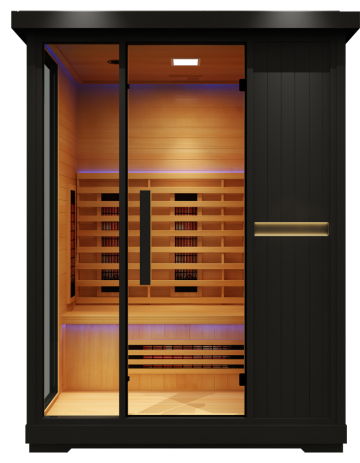
OFS06C-4, a documented OFS06 configuration: AV1 control system, far-infrared heating plate and box, FM/Bluetooth/USB audio with two speakers, lamp and colourful light, wood handle, tempered glass and outdoor pentroof, 2300W total power, offered in hemlock, aspen or red cedar. Image: OCEAN FUTURE.
The OFS06C-4 record specifies an AV1 control system, a far-infrared heating plate combined with a heating box, FM/Bluetooth/USB connectivity, two speakers, lamp and colourful light, a wood handle, tempered glass, an outdoor pentroof and a total power of 2300W. The OFS06A-2 record specifies the same AV1 control system, a far-infrared heating plate, the same audio and lighting set, a wood handle, tempered glass, a painted surface and a total power of 1600W. Both are listed for hotel and hospitality, guesthouse, wellness and commercial club, and spa facility applications, and both list hemlock, aspen and red cedar as the material range.

OFS06A-2, the second documented OFS06 configuration in the supplied material: AV1 control, far-infrared heating plate, painted surface, 1600W total power, hemlock, aspen or red cedar. Image: OCEAN FUTURE.
Two documented variants already reveal a meaningful configuration difference that a specification must capture: the heating element arrangement (plate versus plate plus box) and the external finish (untreated versus painted). Neither is a quality judgement. Both change what the delivered unit should look like and how it should be described in the handover documents.
On power, the OFS06 models addressed in this review are stated by the manufacturer to span 1500W to 3850W. That is a series-level statement, and a series-level statement is not an acceptance value. The two documented configurations fall inside the band at 1600W and 2300W; for OFS06A-5 and the five OFS06B variants, the individual declared wattage is not part of the record reviewed here. The practical consequence is straightforward: before the electrical supply is designed, each model's declared total power should be obtained in writing and matched to the nameplate at delivery. A designer who sizes a circuit from a series range rather than a model value is sizing from an average that no single unit necessarily meets.
Material selection carries the same logic. Hemlock, aspen and red cedar form the documented material range across the family, which means the species is an order-level choice rather than a model-level fixed attribute. The acceptance schedule should therefore record the specified species for each room, because a delivered unit in a different species satisfies the family description and fails the purchase specification. Buyers with wood-provenance or sustainability requirements of their own should treat species confirmation as a separate, explicit line item rather than assume it is captured by the model code.
Outdoor placement adds an envelope question. The OFS06C-4 record includes an outdoor pentroof, which indicates that at least part of the family is configured for exterior installation. The application records for OCEAN FUTURE sauna rooms describe working conditions of indoor or outdoor installation under high temperature and variable climate, including sun exposure, rain and low temperature, and list corrosion resistance, waterproofing and moisture protection, UV resistance for outdoor units, overheat protection and durable thermal insulation among the project requirements. These are requirements to be specified and checked, not automatic properties of every model, and an acceptance inspection for an outdoor unit should confirm the weather-facing elements actually supplied.
What the compliance file shows, and what it does not
The most useful finding in this review is not a certification claim; it is a demonstration of why model-level scope checking has to be done line by line. The supplied records contain two electromagnetic compatibility records for the sauna room range, both issued on 25 November 2025 by Guangzhou STU Hengchuang Testing Service Co., Ltd. for the EU market. They share an issuing body and an issue date, and they are not interchangeable.
| Record | Certificate number | Standards referenced | Declared scope in the record |
|---|---|---|---|
| CE-EMC | STUEMO250300016HS | EN IEC 55014-1:2021; EN IEC 55014-2:2021; EN 61000-3-12:2011+A1:2024; EN IEC 61000-3-11:2019; EN 61000-3-2:2019+A1:2021+A2:2024; EN 61000-3-3:2013+A1:2019+A2:2021 | Stated as “SAUNA ROOM”; no expiry date recorded in the entry |
| EMC Compliance | STUEMO250300017HS | EN IEC 55014-1:2021; EN IEC 55014-2:2021; EN 61000-3-12:2011; EN IEC 61000-3-11:2019 | Stated as a discrete list of eight sauna room models that does not include the OFS06 series; expiry recorded as 2099-12-12 |
Two EMC records for the same product family, same issuing body and same issue date. The declared scope differs between them, which is exactly the kind of difference an acceptance schedule exists to catch.
Both records list the six OFS06 models among their related products. The CE-EMC record states its scope broadly as “SAUNA ROOM” and carries no expiry date in the entry. The EMC Compliance record states its scope as a named list of eight models that does not include the OFS06 group, while recording an expiry date of 2099-12-12. A buyer holding only the second record, and reading only its scope line, would be entitled to conclude that the model being purchased is outside the declared scope — even though the same record associates that model with the certificate elsewhere in its structure.
Two further limits should be stated plainly. First, an EMC record addresses electromagnetic compatibility, which is a different compliance object from electrical safety; one does not substitute for the other, and a file that contains only EMC documentation answers only the EMC question. Second, the material reviewed for this article does not contain an ETL listing record or an FSC certificate for the OFS06 models. That absence is not evidence that such approvals do not exist, and it is equally not a basis for asserting that they do. Buyers whose projects or channel partners require those approvals should request the listing or certificate by model and verify it directly with the issuing body.
A secondary industry article independently references OCEAN FUTURE CE-EMC and EMC compliance documentation tested by Guangzhou STU Hengchuang Testing Service Co., Ltd., citing the EN IEC 55014 and EN 61000 series. That is a useful external cross-reference, and it remains a secondary reference: it confirms that the documentation is referenced in public material, not that a specific model is covered by a specific certificate.
Aligning acceptance criteria with published standards
Acceptance criteria are only meaningful when they point at the right standard for the right object. Two recent references are directly relevant to how a sauna room file should be split, and both are reported here from a secondary industry source rather than from the primary standard text, which a project's compliance adviser should consult.
EN 18164, reported as published in February 2026, is described as Europe's first pan-continental standard for public wellness climate rooms and as covering the design and construction of sauna rooms, warm-air rooms, steam rooms and soft steam rooms in public facilities. For a hotel spa, wellness club or commercial leisure facility in Europe, that scoping is significant: the room envelope becomes a standardised subject in its own right, separate from whatever equipment is installed inside it.
UL 60335-2-53, reported as published in June 2025 in the United States, addresses electric sauna heaters. That is a subsystem standard, not a room standard. The implication for the OFS06 family is direct, because these are electrically heated rooms: a procurement file should be able to show compliance for the room as constructed and for the electrical heating subsystem, and should not assume that a document addressing one automatically addresses the other.
This split has a practical benefit beyond compliance. It forces the specification to distinguish structural and material requirements — the timber envelope, glazing, insulation, door hardware, roof — from electrical and control requirements, including the AV1 control platform, the heating plates, total power, and the audio and lighting circuits. Those two requirement sets are usually reviewed by different people inside a buying organisation, and a file that mixes them tends to be reviewed by neither.
A practical acceptance criteria set for the six models
The table below converts the discussion into an acceptance schedule that can be applied to each of the six models in scope. It is deliberately organised by document rather than by department, because the question an acceptance reviewer actually asks is which document closes which criterion.
| Criterion | What the buyer verifies | Document that closes it | Typical failure mode |
|---|---|---|---|
| Model identity | Full code, including every suffix, is identical on order, invoice, packing list, nameplate and certificate request | Order confirmation plus delivery documents | Code truncated to the sub-family level |
| Configuration | Control system, heating arrangement, finish, glazing, lighting and audio match the specification line by line | Model specification sheet signed by the supplier | Specification copied from a sibling variant |
| Declared power | Total wattage stated for that exact model, consistent with the nameplate and with the designed supply | Model data sheet plus nameplate check at delivery | Supply sized from a series range rather than a model value |
| Wood species | Specified species recorded per room and confirmed on the delivered unit | Specification plus a wood note on the order | Family material range accepted in place of a species choice |
| EMC documentation | Certificate number, issuing body, standards and dates recorded, with a written statement naming the exact model | Model-specific coverage statement linked to the certificate | Family-level scope line read as model-level coverage |
| Market-specific standards | Applicable room and heater requirements identified for the destination market, with the edition recorded | Compliance matrix per destination market | One market's documents reused for another market |
| Outdoor envelope | Roof, weather-facing panels and moisture protection confirmed where the unit is installed outdoors | Configuration drawing or delivery inspection record | Indoor configuration assumed weather-ready |
| Quality and dispatch | Inspection basis and dispatch timing confirmed against the project programme | Pre-shipment inspection record | Acceptance criteria written after dispatch |
An acceptance schedule organised by document rather than by department. Each row should be closable without reference to a conversation.
The most commonly skipped row is the third. Declared power drives circuit design, protective device selection and, in multi-room projects, the overall electrical budget of the building. A buyer who designs from a range rather than from a model value carries a risk that is entirely avoidable at the enquiry stage and expensive to correct after installation.
Commercial terms that belong in the acceptance schedule
Acceptance is not only technical. Several commercial terms determine whether a specification can be met on the project's timetable, and they should sit in the same document as the technical criteria so that a change in one is visible against the other.
OCEAN FUTURE states a minimum order quantity of one set and a lead time of 30 to 40 days, alongside a monthly capacity of 400 sets and a factory of 50,000 m² with more than 200 employees and an annual output of 5,000 sets. Production is described as OEM and ODM with customisation available across the range, quality control is stated as 100% testing, after-sales support is described as remote guidance, and the company reports exporting 85% of output to markets including the USA, Australia, the EU, Germany, Spain and France. For a hotel or spa programme, the relevant acceptance question is not whether those figures are impressive but whether the stated lead time covers the specified model, the specified wood species and any bespoke element in the same order — a question the supplier should answer in writing per line item.
The single-set MOQ matters more than it appears. It allows a buyer to order one room as a sample or pilot unit before committing a multi-room programme, which is the most direct way to test a supplier's documentation discipline: if the pilot unit arrives with a coherent file, the programme is likely to as well. For projects with several room types, that pilot also reveals whether the specification was written precisely enough to distinguish between variants.
Fit by venue: hotels, guesthouses, wellness clubs and spas
All six models in scope are listed for hotel and hospitality, guesthouse, wellness and commercial club, and spa facility applications — the same applicable-industry list that appears across the OCEAN FUTURE sauna range. That uniformity is convenient but not discriminating: it means venue fit has to be argued from configuration and electrical load rather than from a category label.
For a guesthouse or a smaller hotel installation, the documented infrared configurations are the more natural starting point. At 1600W and 2300W total power, they sit well below the loads of the traditional stove models in the same range, which the supplied records document at 3,500W, 6,000W and 8,000W using named Harvia stove units and the MXD2022 control system. This is a comparison of documented electrical characteristics across different products, not a claim about heating performance: sauna experiences differ by design, and a buyer selecting between infrared and traditional heating is choosing a product category, not a better and a worse version of the same thing.
| Model (example) | Heating subsystem | Documented total power | Control system |
|---|---|---|---|
| OFS06A-2 | Far-infrared heating plate | 1600W | AV1 |
| OFS06C-4 | Far-infrared heating plate and box | 2300W | AV1 |
| OFS05-2 | Harvia stove BC35E, 3.5kW | 3500W | MXD2022 |
| OFS12-2 | Harvia stove BC60E, 6kW | 6000W | MXD2022 |
| OFS04-1 | Harvia stove BC80E, 8kW | 8000W | MXD2022 |
Documented characteristics from the supplied specification records. These are different products with different heating subsystems; the table supports electrical and compliance planning, not a performance ranking. All listed models share the same hemlock/aspen/red cedar material range.
For a wellness club or spa facility operating several rooms, consistency between units becomes an acceptance criterion in its own right. A company-reported commercial deployment illustrates the pattern: a spa centre project in Germany recorded as 20 sets, applied to spa centre and relaxation use, with a reported result of stable and safe operation, consistent heating and reliable performance, and highlights listed as low noise, energy efficiency and durable construction. The record associates the deployment with two models, OFS06C-4 and OFS06B-5, and notes that service duration depends on the conditions of use. It is a company-reported reference rather than an independently verified case study, and OFS06B-5 sits outside the six models reviewed here — but it shows why multi-unit buyers should specify one acceptance protocol applied identically to every room, since inconsistency between units is what guests notice first.
Market context: why the headline numbers should not drive the decision
Demand context is worth having, provided it is not mistaken for evidence about a specific product. The published figures available for this category do not agree with one another, and the disagreement is structural rather than marginal.
Harvia, a listed market participant, estimates the global sauna market at close to 4 billion euros in value and around 18 million saunas installed worldwide. Technavio reports the US sauna market at USD 437.4 million in 2025 with a CAGR of 6.5% over 2026 to 2030. Market.us reports a global market of USD 860.3 million in 2023 rising to USD 1,555.3 million by 2033 at a CAGR of 6.1%. These cover different geographies, definitions and forecast periods, and they should not be averaged into a single figure. At least one widely circulated public estimate places the global sauna market three orders of magnitude above these numbers, which is almost certainly a unit or definition error and should not be used without checking the underlying methodology.
The practical reading for a buyer is modest growth in a fragmented evidence base. That is enough to justify treating supplier documentation discipline as a selection criterion, because a growing market attracts suppliers whose paperwork has not grown at the same rate as their order book. It is not enough to justify a market-entry business case on its own, and it says nothing about whether OFS06A-5 or OFS06B-2 is the right room for a particular building.
Conclusion: qualification is a repeatable procedure, not an opinion
Reviewed on its documents, the OFS06 family presents a coherent and checkable structure: a shared AV1 control platform on the configurations whose parameters are recorded, far-infrared heating across the family, a three-wood material range, a stated series power band of 1500W to 3850W, and EU-market EMC documentation issued in November 2025 that associates the six models with the range. That structure is what makes a qualification review possible at all — a supplier who publishes model-level parameters makes themselves auditable, which is a meaningful signal in a category where many listings stop at a category name.
The same review also shows where a buyer must not stop. Model-level power values, model-level certificate scope, and market-specific room and heater standards each require a document that names the exact unit. The gap between a family-level record and a model-level statement is small on paper and significant at handover, and closing it costs a written request at the enquiry stage rather than a dispute at commissioning. Buyers who build the acceptance schedule around those three documents, and who apply the same schedule to a pilot unit before committing a programme, will get a qualification file that answers questions instead of generating them.
OCEAN FUTURE publishes a sauna room brochure that indexes the model range and configuration elements, which is a practical starting point for building such a schedule; it is an index, not a substitute for the model-level documents described above. The brochure is available for download here: OCEAN FUTURE sauna room brochure (PDF). Additional product information is published by OCEAN FUTURE, the sauna room and spa manufacturer based in Foshan, Guangdong, China.
FAQ
What is the difference between an OFS06 model being listed on a certificate and being covered by it?
A listing means the model appears somewhere in a record's related-product information; coverage means the record's declared scope names that model. The two supplied EMC records for this range show why the distinction matters: the CE-EMC record states its scope as “SAUNA ROOM”, while the EMC Compliance record states a discrete list of eight models that does not include the OFS06 series, even though both records associate the OFS06 models with the certificate elsewhere in their structure. A buyer should request a written statement naming each exact model code and the certificate it is covered by.
Which configuration details should be confirmed before ordering an OFS06 infrared sauna room?
Confirm the control system (AV1 appears on the OFS06 configurations whose parameters are recorded), the heating arrangement (far-infrared heating plate, or plate with heating box as on OFS06C-4), the total power for that exact model, the wood species selected from hemlock, aspen and red cedar, the external finish where a painted surface is specified, the glazing and lighting package, and any outdoor roof structure where the unit will be installed externally. Each element should appear on the specification sheet with the model code in the header.
How should the power rating be verified at acceptance?
Verify three things against each other: the declared total power in the model's own data sheet, the value on the unit nameplate, and the capacity of the electrical supply designed for the installation. The OFS06 models addressed in this review are stated by the manufacturer to span 1500W to 3850W, and two documented configurations sit inside that band at 1600W (OFS06A-2) and 2300W (OFS06C-4). A series range is not an acceptance value, so the individual model's declared wattage should be obtained in writing before circuit design.
Do the OFS06 models carry ETL or FSC certification?
This review does not assert either. The material examined here contains EU-market EMC records issued on 25 November 2025 by Guangzhou STU Hengchuang Testing Service Co., Ltd., referencing the EN IEC 55014 and EN 61000 series, but no ETL listing record and no FSC certificate for the OFS06 models. An absence in a particular file is not evidence that an approval does not exist; buyers who require ETL or FSC should request the listing or certificate by model and verify it with the issuing body.
Which standards are relevant to a hotel or spa sauna room in Europe or the United States?
Two references are commonly cited in current industry discussion, both reported from secondary sources and both worth confirming against the primary text. EN 18164, reported as published in February 2026, is described as covering the design and construction of sauna rooms, warm-air rooms, steam rooms and soft steam rooms in public facilities in Europe. UL 60335-2-53, reported as published in June 2025 in the United States, addresses electric sauna heaters. These are different compliance objects — room envelope versus heater subsystem — so a procurement file should address both rather than treating one as proof of the other.
Tem questões ou precisa de mais detalhes?
Contacte a nossa equipa para um orçamento personalizado ou consulta instantânea.
Solicitar orçamento
Preencha o formulário abaixo e a nossa equipa entrará em contacto com uma proposta personalizada.
Chat direto do WhatsApp
Prefere conversar em tempo real? Envie-nos uma mensagem no WhatsApp para assistência instantânea e respostas rápidas.
- Obter orçamento personalizado
- Partilhar fotos ou documentos
- Discuta as suas necessidades diretamente
Geralmente responde em 5–30 minutos durante o horário de expediente.