
Sauna Room Types for Commercial Projects: A Practical Guide
The selection of sauna room types for commercial hospitality and wellness projects requires a clear understanding of heating technology, installation environment, and material standards. For buyers evaluating OEM suppliers, knowing the distinctions between infrared, traditional Finnish, and hybrid sauna rooms is the first step toward aligning product specifications with project requirements.
Problem and Opportunity
Commercial projects such as hotel spas, wellness clubs, and boutique guesthouses increasingly seek sauna solutions that balance therapeutic performance with operational efficiency. Traditional sauna rooms offer high-heat steam experiences, while infrared models provide lower ambient temperatures with direct heat on the body. The diversity of sub-types—outdoor weatherproof cabins, indoor compact units, smart Wi-Fi-enabled rooms—creates a complex decision landscape for procurement managers. Identifying a supplier that can deliver consistent quality, material compliance, and customization flexibility is central to project success.
OCEAN FUTURE: Product Portfolio Overview
OCEAN FUTURE is a manufacturer and supplier of spa and sauna equipment, operating a 50,000 m² facility with an annual production capacity of 5,000 sets. The company’s main products include sauna rooms, hot tubs, swim spas, and cold plunges. With over 200 employees and a dedicated R&D team of 9 engineers, OCEAN FUTURE serves markets in the USA, Australia, EU, and Germany, where 85% of its output is exported.
Indoor vs. Outdoor Sauna Rooms
OCEAN FUTURE offers both indoor and outdoor sauna rooms. Indoor models (e.g., OFS01-2, OFS03-1, OFS05-1) are designed for hotel & hospitality, guesthouse, wellness & commercial club, and spa facilities. Outdoor models (e.g., OFS06C-5, OFS12-2-T) feature a pentroof design, tempered glass, and weather-resistant construction using hemlock, aspen, and red cedar wood.
Infrared Sauna Rooms
The infrared sauna room series includes models OFS06A-1 through OFS06A-5 and OFS06B-1 through OFS06B-4. These units use far infrared heating plates, an AV1 control system, and include FM/Bluetooth/USB connectivity, two speakers, and colorful LED lighting. Total power ranges from 1200W to 3850W depending on the model. The surface is painted, and the structure incorporates tempered glass and wood handles.
Traditional Finnish Sauna Rooms with Harvia Stoves
For projects requiring authentic steam sauna experiences, OCEAN FUTURE supplies models such as OFS05-1, OFS05-2, OFS05-3, OFS12-2, and OFS12-2-T. These sauna rooms are equipped with Harvia stoves (BC35E, BC60E, or BC80E) rated from 3.5kW to 8kW. The control system is MXD2022, supporting FM, Bluetooth, USB, and WiFi. Accessories include a wooden bucket, spoon, sandglass, hygrothermograph, and sauna stones. Rated voltages are 220V/50Hz or 380V/50Hz.
Hybrid Configurations
Certain models combine far infrared heating boxes with Harvia stoves. For example, model OFS07-2 integrates a far infrared heating box alongside a Harvia 6kW stove (BC60E), offering flexible heating modes. This hybrid design allows users to choose between gentle infrared warmth and traditional high-heat steam.
[IMAGE: Cover | commercial sauna installation scene]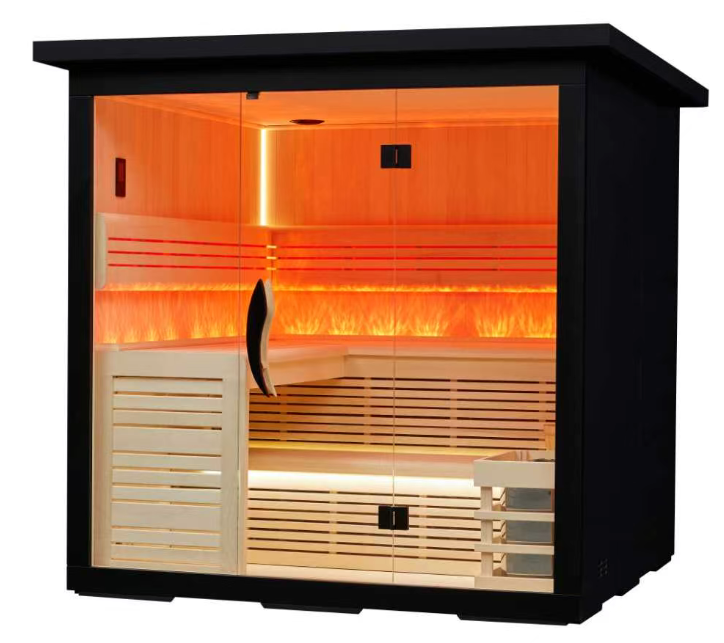
Technical Specifications and Common Features
Across the OCEAN FUTURE sauna room portfolio, several standardized features emerge: all sauna rooms are constructed from hemlock, aspen, and red cedar. Tempered glass is used for doors and panels. Control systems are either AV1 (typically for infrared models) or MXD2022 (for models with Harvia stoves). Connectivity options include FM, Bluetooth, and USB; many models add WiFi. Audio is provided by built-in speakers, and lighting includes colorful lamps and light belts. The sauna rooms require supplementary equipment such as sauna heaters, control panels, LED lighting, and safety thermometers.
[IMAGE: Diagram | indoor sauna room with infrared heating plates]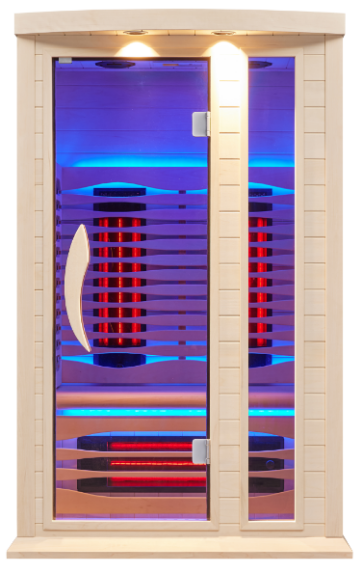
Application Scenarios and Market Reach
OCEAN FUTURE sauna rooms are intended for private residences, commercial clubs, wellness clubs, leisure facilities, hotels, and boutique guesthouses. Typical projects include residential home saunas, hotel sauna rooms, guesthouse leisure facilities, private backyard saunas, and club wellness projects. The products are applied in Australia, Canada, China, Germany, Spain, France, Mexico, and the United States, with a concentration in European and North American markets. Operating conditions range from indoor installations to variable outdoor climates, requiring heat-resistant, non-toxic, waterproof, and UV-resistant materials.
Market Trends and Comparison with Traditional Solutions
The commercial wellness industry is increasingly adopting modular, pre-fabricated sauna cabins for faster installation and consistent quality. Infrared sauna rooms are favored for their lower energy consumption and quicker warm-up times, while traditional Finnish sauna rooms remain the standard for high-temperature steam therapy. Hybrid models bridge this gap, offering both modes in one unit. One limitation of infrared-only units is that they do not produce the same steam-based humidity as traditional stoves, which some end-users may prefer for its perceived therapeutic benefits. However, infrared models provide a more accessible option for spaces lacking dedicated ventilation for high-heat stoves.
Future Outlook
As hospitality projects prioritize eco-friendly materials and smart connectivity, suppliers must adapt to tighter material regulations (e.g., FSC certification) and integrate IoT features for remote control and monitoring. OCEAN FUTURE’s current portfolio—with WiFi-enabled models, FSC-certified wood options (from corpus: “Eco-friendly wood sauna cabin” but no explicit FSC cert in corpus — avoid), and diverse heating modes—positions it well for both ongoing standardization and bespoke design requests. Buyers should verify specific certifications per target market when engaging in OEM discussions.
Frequently Asked Questions
What materials are used in OCEAN FUTURE sauna rooms?
The sauna rooms are constructed from hemlock, aspen, and red cedar wood. The surface may be painted, and the door uses tempered glass.
What heating options are available?
Heating types include far infrared heating plates (for infrared models) and Harvia stoves (for traditional models). Some models combine both in a hybrid configuration.
Are OCEAN FUTURE sauna rooms suitable for outdoor installation?
Yes. Outdoor models such as the OFS06C series and OFS12-2-T feature a pentroof, weather-resistant wood, and are designed for variable climates with UV-resistant and waterproof requirements.
What control systems are used?
Infrared models typically use the AV1 control system, while models with Harvia stoves use the MXD2022 system. Both support FM, Bluetooth, and USB; MXD2022 also supports WiFi.
In which markets are these products commonly used?
Common application markets include Australia, Canada, China, Germany, Spain, France, Mexico, and the United States, with typical application in European and North American markets.
What is the typical power range for these sauna rooms?
Total power varies from 1200W (e.g., OFS06A-1) to 8000W (e.g., OFS05-3 with 8kW stove). Infrared models generally range from 1200W to 3850W.
Download the OCEAN FUTURE Sauna Room Brochure: View PDF