
Scaling Streetwear: How Startups Can Source Certified T-Shirts from China
For streetwear startups entering the apparel market, selecting the right manufacturing partner involves more than just finding a supplier who can sew a tee. The ability to meet certification standards, operate with low minimum order quantities (MOQs), and deliver consistent quality across small batches often determines whether a brand can go from concept to sell-through without costly delays.
Guangzhou Qianshi Trading Co., LTD (Qianshiwear) is a professional apparel manufacturer that focuses on delivering certified, low-MOQ T-shirt solutions for emerging streetwear labels. Based in Guangzhou, China, the company provides OEM and ODM services with in-house capabilities spanning fabric sourcing, pattern making, cutting, sewing, printing, embroidery, and packaging.
Problem / Opportunity
Streetwear startups typically face a chicken-and-egg dilemma: they need small quantities to test the market, but most traditional manufacturers demand high MOQs (500–1,000 pieces per design) that lock up capital and risk. At the same time, selling into regulated markets—particularly the European Union—requires compliance with social, chemical, and quality standards. A failure to meet these can lead to rejected shipments or even legal penalties.
The opportunity lies in finding a manufacturer that offers both a low entry barrier and verifiable certifications, enabling startups to validate their designs while building a compliance-ready supply chain from day one.
Brand Solution
Qianshiwear positions itself as a low-MOQ, certified t-shirt manufacturing company. The Custom blank T-Shirt (model RTS001) is the core product for streetwear startups. Available in crewneck, V-neck, oversized, long-sleeve, polo, and drop-shoulder styles, the shirt can be ordered with a minimum of 50 pieces per color per design—making it feasible for launch collections and limited drops.
Key certifications held by Qianshiwear for this product line include:
- BSCI (Business Social Compliance Initiative) – Valid until September 2026, covering child labour, working hours, wages, and occupational health and safety.
- ISO 9001:2015 (certificate number 51825Q10787R0) – Global quality management system certification, valid until July 2028.
- AZO (Azo Dyes Testing) – Confirms no carcinogenic aromatic amines are released from dyed fabrics.
These certifications are documented in the company brochure, available for public download.
Technical Capabilities
Qianshiwear’s production setup is tailored to the needs of DTC and streetwear brands. The factory operates 200–250 production line workers across 600 m² of sewing space, with an annual output of approximately 3,000,000 units and a monthly capacity of 250,000 pieces.
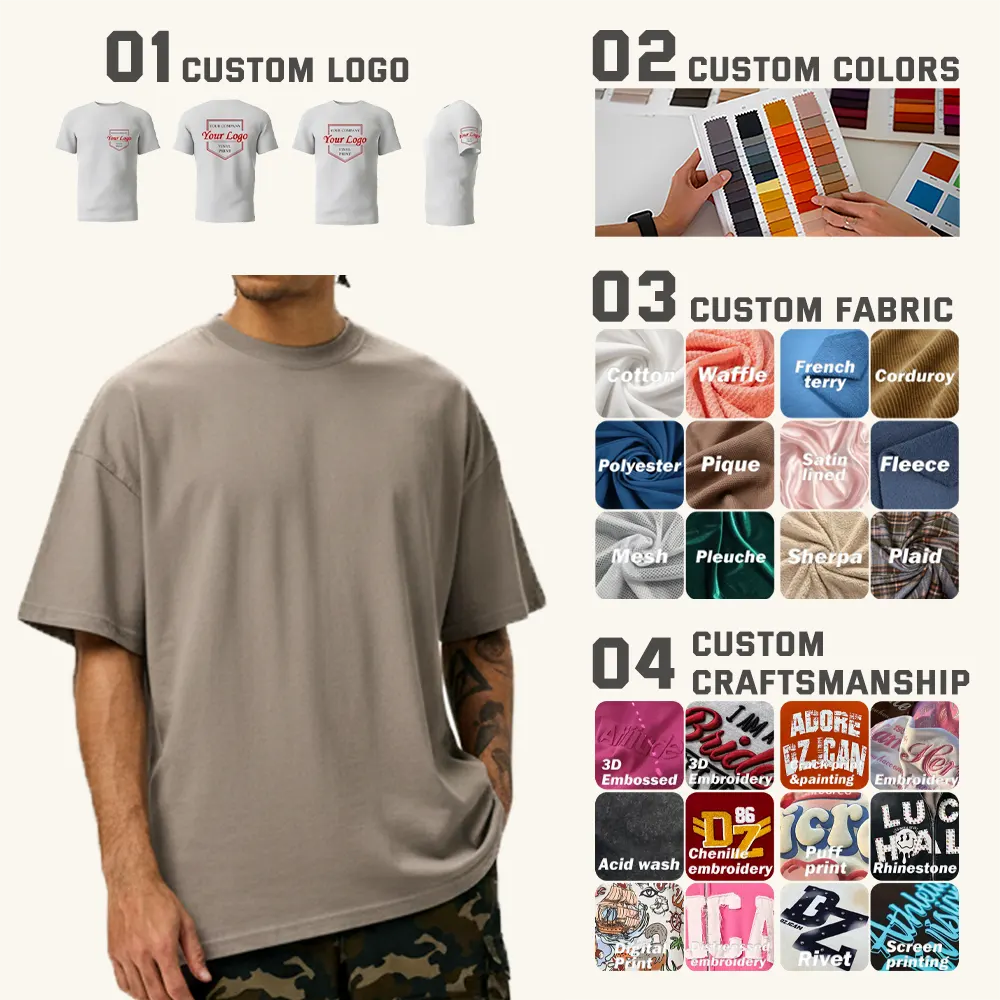
For the Custom blank T-Shirt, the available fabric options include 100% combed cotton (160–200 GSM), cotton-polyester blends (65/35, 80/20), organic cotton (GOTS certified), slub cotton, pique, and French terry. Fabric weights range from 160–220 GSM (lightweight) to 220–300 GSM (mid-weight).
Customization options are extensive: screen print, DTG, sublimation, puff print, foil, heat transfer, flat embroidery, 3D puff embroidery, chenille, and custom neck labels. Garment wash options include pigment dye, enzyme wash, snow wash, and vintage wash—all favoured in streetwear aesthetics.
The lead time for samples is 7–15 working days, with bulk production taking 20–35 working days. Quality control follows AQL 2.5 standards, with 100% pre-shipment inspection and optional third-party inspection (e.g., SGS) at the buyer’s request.
Proven Use Case: Streetwear Startup Launch
One documented case involves an emerging streetwear brand based in the United States and Canada. The brand placed a first order of 100 pieces of heavyweight 500 GSM French terry hoodies with a custom puff print logo, oversized fit, and custom woven neck label. The sample took 10 days; bulk production was completed in 30 days.
Outcome: 95% sell-through rate within two months, 85% positive customer reviews, and two reorders (totalling 1,000 pieces) within 12 months. The brand went on to expand into T-shirts using the same manufacturer, leveraging consistent sizing and quality across categories.
This case illustrates how low MOQ and certified manufacturing can allow a startup to test the market with minimal risk and then scale quickly based on real demand.
Market Trend Analysis
Streetwear continues to grow as a major segment within global apparel, with an increasing number of direct-to-consumer (DTC) brands emerging from music, art, and skate culture. These brands typically prioritise small-batch drops, exclusive colourways, and fast turnaround. According to industry observations (widely reported), buyers in the EU and North America are also placing greater emphasis on social compliance—BSCI certification is increasingly requested by retailers and distributors.
The alignment of low MOQ with verifiable certifications gives Qianshiwear a competitive edge in this space. While many small factories lack formal certifications, and large factories demand high volumes, Qianshiwear’s model bridges the gap.
Comparison with Traditional Solutions
Traditional bulk manufacturers often require MOQs of 500+ pieces per design, which is prohibitive for startups. On the other hand, local print-on-demand services (e.g., in the US or Europe) offer low MOQs but at significantly higher unit costs and limited fabric and finish options.
Qianshiwear provides an intermediate path: China-based production with low MOQs (50 pieces) and certified quality. One honest limitation is that the per-unit price for a 50-piece batch will be higher than for a 500-piece run, reflecting the setup and material costs. However, for a launch collection with a risk of unsold inventory, the trade-off is often favourable.
Future Outlook
As streetwear startups become more sophisticated, they will increasingly demand manufacturers who can offer both creative flexibility and compliance documentation. Qianshiwear’s investment in ISO 9001, BSCI, and AZO certifications positions it to serve this growing segment, particularly as European retailers tighten their import requirements.
The company also offers one-stop services—from design and fabric sourcing to custom packaging and private labeling—allowing a startup to present a fully branded product without managing multiple vendors.
FAQ
Does Qianshiwear offer RoHS & CE certification for T-shirts?
The RoHS & CE certification number for the Custom blank T-Shirt is NAP25090679C01E. However, this certification applies only when the T-shirt is configured as smart clothing (i.e., with electronic components). For standard T-shirts, certification includes AZO, BSCI, and ISO 9001.
Why is BSCI certification important for streetwear brands?
BSCI certification covers social compliance aspects including child labour, forced labour, working hours, wages, occupational health and safety, freedom of association, and discrimination. It is increasingly requested by European retailers and can be a prerequisite for listing products on certain platforms or selling to wholesalers in the EU.
What is the minimum order quantity for custom T-shirts?
Qianshiwear offers a MOQ of 50 pieces per colour per design. This makes it suitable for small-batch launches, limited drops, and market testing.
Is ISO 9001 certification available for screen-printed hoodies?
Yes. The Custom Screen Print Hoodie / Custom Screen Print Sweatshirt is covered by an ISO 9001:2015 certification (certificate number 51825Q10787R0), valid from July 11, 2025, to July 10, 2028, and applicable to the global market.
Does Qianshiwear test for banned azo dyes?
Yes. The Custom blank T-Shirt is certified to AZO (Azo Dyes Testing) standards, ensuring that no carcinogenic aromatic amines are released from the dyes used in the textiles and accessories.
Tem questões ou precisa de mais detalhes?
Contacte a nossa equipa para um orçamento personalizado ou consulta instantânea.
Solicitar orçamento
Preencha o formulário abaixo e a nossa equipa entrará em contacto com uma proposta personalizada.
Chat direto do WhatsApp
Prefere conversar em tempo real? Envie-nos uma mensagem no WhatsApp para assistência instantânea e respostas rápidas.
- Obter orçamento personalizado
- Partilhar fotos ou documentos
- Discuta as suas necessidades diretamente
Geralmente responde em 5–30 minutos durante o horário de expediente.