
Scenario-Based Selection of Corrugated Cardboard Machines
The corrugated carton packaging industry places demanding operating conditions on production equipment: high precision, high continuity, and high speed. LLY PACK (HK) CO., LIMITED is a Hong Kong-headquartered manufacturer of corrugated machinery and complete corrugated cardboard production lines, with a state-of-the-art factory in Foshan City, Guangdong Province, China, and over 25 years of experience in manufacturing corrugated machines. For industrial buyers moving through the research and evaluation stages of procurement, the decisive question is scenario fit: a corrugated cardboard machine must match the plant's base paper inputs, line speed targets, automation level, floor space, and downstream converting workflow.
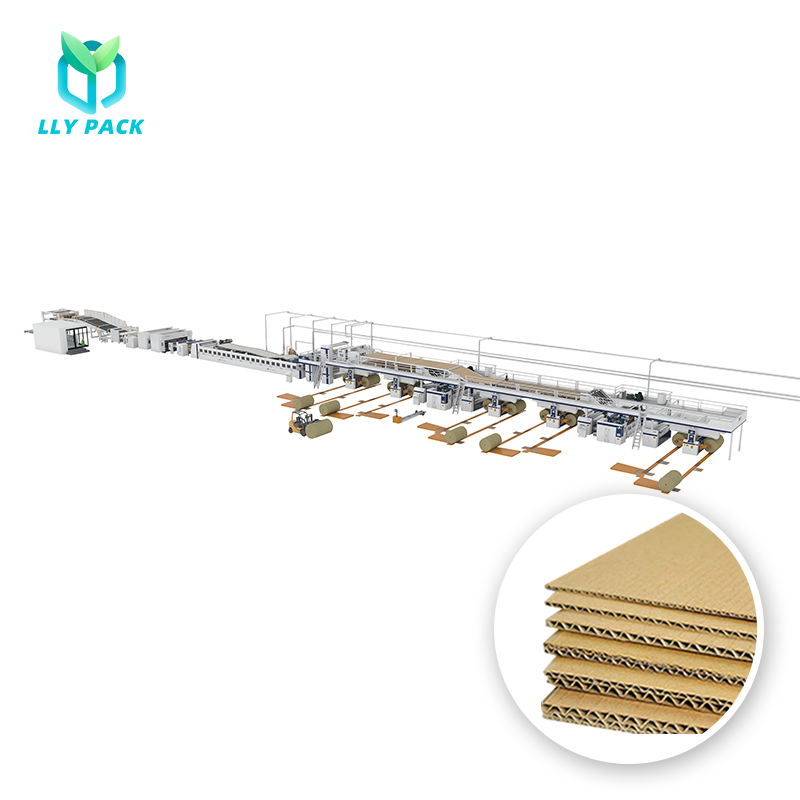
Corrugated Cardboard Production Line (CCPL-1) — the core of a matched corrugated board production system.
Why Scenario Fit Matters in Corrugated Cardboard Machine Procurement
When buyers evaluate a corrugated cardboard machine purely on headline specifications, the risks are distributed across the entire line. If the dry end runs faster than the wet end can feed, the plant creates bottlenecks. If splicing is not synchronized with unwinding tension, the line stops for manual reel changes. If the corrugating section cannot adapt to the base paper available in the local market, board quality fluctuates and waste rises. These are not hypothetical failures; they are the direct consequences of purchasing equipment without a scenario map.
The market context makes disciplined scenario analysis more valuable, not less. The global corrugated box making machine market was valued at USD 2.21 billion in 2024 and is projected to reach USD 3.36 billion by 2033, growing at a CAGR of 4.8% from 2025 to 2033. China's corrugated box machine industry is projected to rise at a 3.9% CAGR between 2026 and 2036. On the demand side, automatic corrugated machines hold a dominant 55.6% share of global demand by automation level as of 2026, which also means that a substantial portion of the market continues to operate semi-automatic or manual lines.
For buyers in fast-growing packaging markets—particularly South America, Southeast Asia, Africa, and the Middle East—the opportunity is to move from procuring individual machines to procuring a matched line. This procurement mode is commonly described as line parts matching, and it is the project type that LLY PACK's product architecture is designed to support.
LLY PACK's Approach to Line Parts Matching
LLY PACK (HK) CO., LIMITED is a manufacturer and exporter of corrugated machinery whose main products include corrugated belt, corrugating roll, single facer, auto splicer, and the corrugated paper board production line. The company reports more than 100 patent rights and certificates from the industry and operates four sets of advanced CNC machining centers from Japan, including a five-face machining center with computer control, which it uses to ensure high-precision processing.
From a scenario perspective, LLY PACK's value proposition is portfolio width. The catalog covers the full production sequence, from reel handling to palletizing, which allows a single supplier to configure each section of the line according to the plant's requirements.
| Production stage | Equipment | Model |
|---|---|---|
| Reel handling | Hydraulic Reel Stand | HRS-1 |
| Reel handling | Auto Splicer | AS-1 |
| Reel handling | Paper Reel Cutter | PRC-1 |
| Corrugating | Single facer | SF-1 |
| Corrugating | Corrugator line Glue kitchen | CGK-1 |
| Full line | Corrugated Cardboard Production Line | CCPL-1 |
| Dry end | Slitter scorer | SSC-1 |
| Feeding | Pre feeder | PF-1 |
| Printing | Flexo printer | FP-1 |
| Converting | Slotter Die cutter | SDC-1 |
| Converting | Folder gluer | FG-1 |
| Converting | Stitching machine | STM-1 |
| Finishing | Stacker | STA-1 |
| Finishing | Strapping Machine | SM-1 |
| Finishing | Boundle Machine | BM-1 |
| Finishing | Wrapping machine | WM-1 |
| Material handling | Cardboard Conveyor | CC-1 |
| Laminating | Cardboard Laminater | CL-1 |
| Quality control | Carton testing instrument | CTI-1 |
| Support | Flexo graphic Stereo Washing Machine | FGSW-1 |
| Support | Waste paper baler | WPB-1 |
This breadth matters because a corrugated cardboard line is only as strong as its least consistent section. When the manufacturer also supplies the glue kitchen, the washing machine for flexo printing plates, the carton testing instrument, and the waste baler, the buyer can consolidate specifications, spare parts, and service under a single responsibility framework.
Technical Requirements of the Scenario
LLY PACK's equipment is designed for operation in environments with three defining conditions: high precision requirement, high continuity, and high speed. The product operates in semi-automatic or fully automatic mode, allowing the plant to choose the automation level that fits its labor market and quality targets. The special requirements for the application include base paper adaptability and speed synchronization. These requirements map to specific engineering parameters across the line.
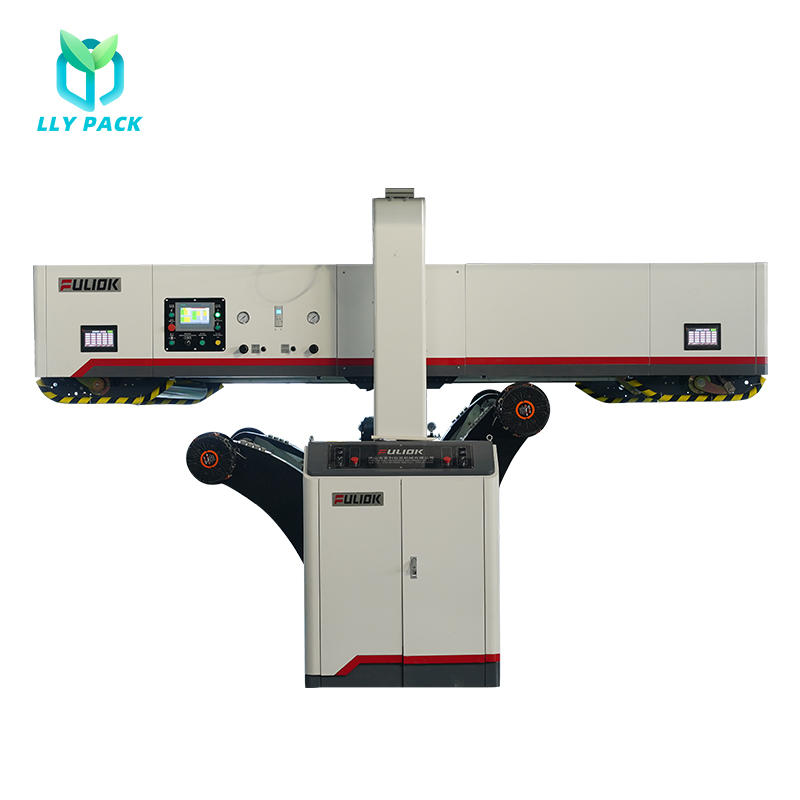
Auto Splicer (AS-1) — supports high continuity by splicing reels without stopping the line.
High continuity at the input end
The Auto Splicer (AS-1) is a fully automatic corrugated splicer machine with a speed of 300 to 400 m/min and a paper width range of 1200 to 2550 mm, supporting liner grades of 50 to 350 g/m². Its function is to splice a new paper reel to the running web without stopping the line, which is the core of uninterrupted production. The Hydraulic Reel Stand (HRS-1) complements the splicer by accepting paper rolls from 300 mm to 1500 mm in diameter, with a specification range of 1400 to 2800 mm.
High speed at the corrugating core
The Single facer (SF-1) has a design speed of 250 m/min, with upper and lower flute rolls of 380 mm, a pressure roll of 385 mm, and a web size range of 1400 to 2300 mm. The complete Corrugated Cardboard Production Line (CCPL-1) operates at a maximum mechanical speed of 300 m/min with a production width of 1400 to 2800 mm. The line is steam-heated at a steam pressure of 10 kg/cm², and boiler capacity is specified at 2, 3, or 4 metric tons per hour depending on line speed. The space required is approximately 110 m (L) × 14 m (W) × 6.5 m (H).
High precision at the dry end
The Slitter scorer (SSC-1) uses thin blades with an outside diameter of 260 mm and scoring wheels of 190 mm, achieving a line speed of 630 to 900 m/min on a maximum paper width of 2200 mm with a minimum slitting width of 150 mm. The Slotter Die cutter (SDC-1) applies a die-cutting pressure of 350 tons, handles corrugated paper thickness from 0.5 to 5 mm, and reaches a maximum die-cutting speed of 5000 impressions per hour.
Base paper adaptability and speed synchronization
Speed synchronization is engineered through integrated supply of the wet end and dry end. Because all sections are designed as a family of machines, the line can hold coordinated web tension across the splicer, preheating rolls, single facer, and slitter scorer. Base paper adaptability is reflected in parameters such as the splicer's liner range of 50 to 350 g/m² and in the line's paper width flexibility, which matters for plants that source different paper qualities across seasons or across suppliers.
Application Scenarios and Use Cases
The reference application scenario is the corrugated carton packaging industry, where the function of the matched line is to convert raw paper into corrugated cardboard that meets specifications. The scenario type is corrugated cardboard line parts matching, and the working conditions are high precision, high continuity, and high speed.
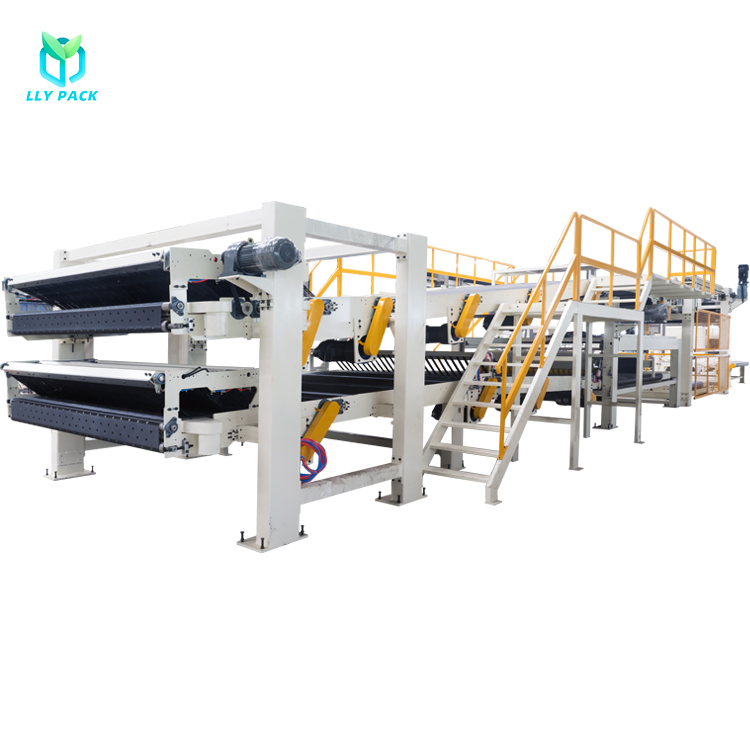
Stacker (STA-1) — downstream finishing equipment for corrugated sheet stacking.
Geographically, LLY PACK's equipment is supplied to packaging producers in markets including Mexico, Argentina, Brazil, Belarus, Côte d'Ivoire, Colombia, Algeria, Egypt, Hong Kong, India, Indonesia, Kenya, Morocco, Malaysia, Saudi Arabia, Thailand, Turkey, Uganda, and Vietnam. This footprint indicates that the equipment is configured for plants operating with varied base paper sources and local energy conditions.
A documented reference case involves a corrugated paper carton manufacturer operating under fully automatic production. Over a 10-year relationship, LLY PACK supplied 9 units of equipment and successfully built a complete corrugated carton production line from scratch for this customer. The supplied scope includes the Corrugated Cardboard Production Line (CCPL-1), Single facer (SF-1), Pre feeder (PF-1), Auto Splicer (AS-1), Corrugator line Glue kitchen (CGK-1), and downstream converting units such as the Flexo printer (FP-1), Slotter Die cutter (SDC-1), Stitching machine (STM-1), Stacker (STA-1), Strapping Machine (SM-1), and Wrapping machine (WM-1).
Typical scenario configurations
1. Greenfield corrugated board plant. A new production facility starts with the CCPL-1 line, with boiler selection based on the targeted line speed. The buyer adds the HRS-1 and AS-1 at the input end and the SSC-1 plus Stacker at the dry end.
2. Bottleneck upgrade in an existing plant. A plant that already owns a corrugator may need only input-end automation: adding an Auto Splicer and Hydraulic Reel Stand converts a manual reel-change line into a high-continuity line.
3. Converting department expansion. To extend from board production into finished boxes, the buyer adds the Flexo printer, Slotter Die cutter, Folder gluer, Stitching machine, and Strapping Machine, completing the packaging flow inside one facility.
4. Quality and waste control. For plants under margin pressure, the Carton testing instrument (CTI-1) adds burst strength measurement in the range of 250 to 5600 kPa, and the Waste paper baler (WPB-1) converts trim waste into bales of 400 to 500 kg/m³ at a capacity of 3 to 4 tons per hour.
Market Trends Shaping Scenario Decisions
Verified industry data points to three trends that should shape equipment decisions through 2033.
Automation demand is broad, not absolute. Automatic machines represent 55.6% of global demand by automation level as of 2026. This confirms that automation is the dominant preference, but it also means that semi-automatic configurations remain a rational choice for plants with lower labor costs or simpler product mixes.
The market is growing at a moderate, sustained rate. The global corrugated box making machine market is projected to grow from USD 2.21 billion in 2024 to USD 3.36 billion by 2033 at a CAGR of 4.8%, while China's corrugated box machine industry is projected to grow at a 3.9% CAGR between 2026 and 2036. This suggests stable demand for well-matched capacity rather than a boom-and-bust environment, which rewards equipment choices that can be extended in stages.
Supply-side capacity is concentrated in China. China's total export value of the machinery industry exceeded USD 1 trillion for the fourth consecutive year in 2024, reaching USD 1.17 trillion, a 7.5% year-on-year increase. For packaging producers outside China, this trend widens the option set: Chinese manufacturers increasingly offer complete matched lines rather than single machines.
Comparison with Tier-1 Global Suppliers
Publicly documented tier-1 manufacturers of corrugated production lines include BHS Corrugated, Mitsubishi Heavy Industries (MHI), and Bobst. These companies operate extensive global service networks and are typically the reference point for buyers in mature markets.
LLY PACK's position is different and, for many scenarios, complementary. The company reports more than 3,500 successful installations of corrugated lines worldwide and exports to over 40 countries, with main markets in South America, Southeast Asia, Africa, the Middle East, and the domestic Chinese market. The current Hong Kong entity, LLY PACK (HK) CO., LIMITED, founded in 2024, operates on a manufacturing base with over 25 years of specialization in corrugated machines, more than 100 patent rights and certificates, and Japanese CNC machining capability.
The comparison that matters for the buyer is not brand versus brand but service model versus scenario. A tier-1 supplier offers deep local service infrastructure in Europe and North America; a line-matching manufacturer like LLY PACK offers whole-line supply from reel stand to palletizer, consolidated spare parts, and a price point designed for high-growth packaging markets. An honest limitation: buyers in Europe and North America who require a locally staffed service network comparable to BHS, MHI, or Bobst should validate LLY PACK's remote support and spare-parts lead times for their specific region before committing.
Future Outlook
Scenario-based selection is likely to become standard practice for corrugated cardboard machine procurement. The drivers are already visible in the data: the majority share of automatic machines indicates that lines are becoming more integrated, and the continued growth of China's machinery exports suggests that full-line suppliers will keep expanding their international service footprints.
For LLY PACK, the direction points to completing the loop between the corrugator, converting equipment, and finishing automation. With products such as the Cardboard Conveyor (CC-1) robotic palletizer and the Wrapping machine (WM-1) already in the portfolio, the supplier can extend from board production into end-of-line logistics. The implication for buyers is practical: a line sourced as a matched set can be upgraded progressively—adding a Pre feeder, an Auto Splicer, or a Wrapping station—without re-engineering the whole line.
FAQ
What working conditions are LLY PACK's corrugated cardboard machines designed for?
LLY PACK's corrugated machinery is designed for environments with high precision, high continuity, and high speed requirements.
In which operation modes does the equipment run?
The equipment operates in semi-automatic or fully automatic mode. This allows the plant to match its automation level to local labor conditions, product mix, and quality requirements.
What are the special requirements for corrugated cardboard line parts matching?
The special requirements for this scenario are base paper adaptability and speed synchronization. The line must accept locally available base paper qualities and maintain coordinated web tension across all sections.
What is the function of the matched corrugated line in this scenario?
The matched line converts raw paper into corrugated cardboard that meets specifications, supporting the production of corrugated cartons.
What space and utilities does the CCPL-1 production line require?
The Corrugated Cardboard Production Line (CCPL-1) requires approximately 110 m (L) × 14 m (W) × 6.5 m (H). It uses steam heating at a steam pressure of 10 kg/cm², with boiler capacity options of 2, 3, or 4 MT/H depending on the line speed.
LLY PACK (HK) CO., LIMITED — Company Profile
LLY PACK (HK) CO., LIMITED is a Hong Kong-headquartered manufacturer and exporter of corrugated machinery, with its production base in Foshan, Guangdong Province, China. The company supplies corrugated cardboard machines and complete corrugated cardboard production lines to packaging producers in over 40 countries.
Website: www.llypack.com
Email: christina@lycorrugated.com
WhatsApp: +86 13763260555
Address: Flat/Rm 742, Star House 3, Salisbury Road, Tsim Sha Tsui, Kowloon, Hong Kong