
Scenario Fit: Choosing Between Ticket Redemption and Shooting Games for Family Entertainment Centers
The practical answer for a family entertainment center is not to choose one machine type over the other. It is to zone the floor: place Ticket Redemption Machine suites where reward-driven, all-ages play supports family dwell time, and place Shooting Game Machines and Sport Game Machines where competitive teen-to-adult energy, scoring, and social challenge justify the space. The buying decision is therefore a scenario-fit decision first, and a machine specification decision second.
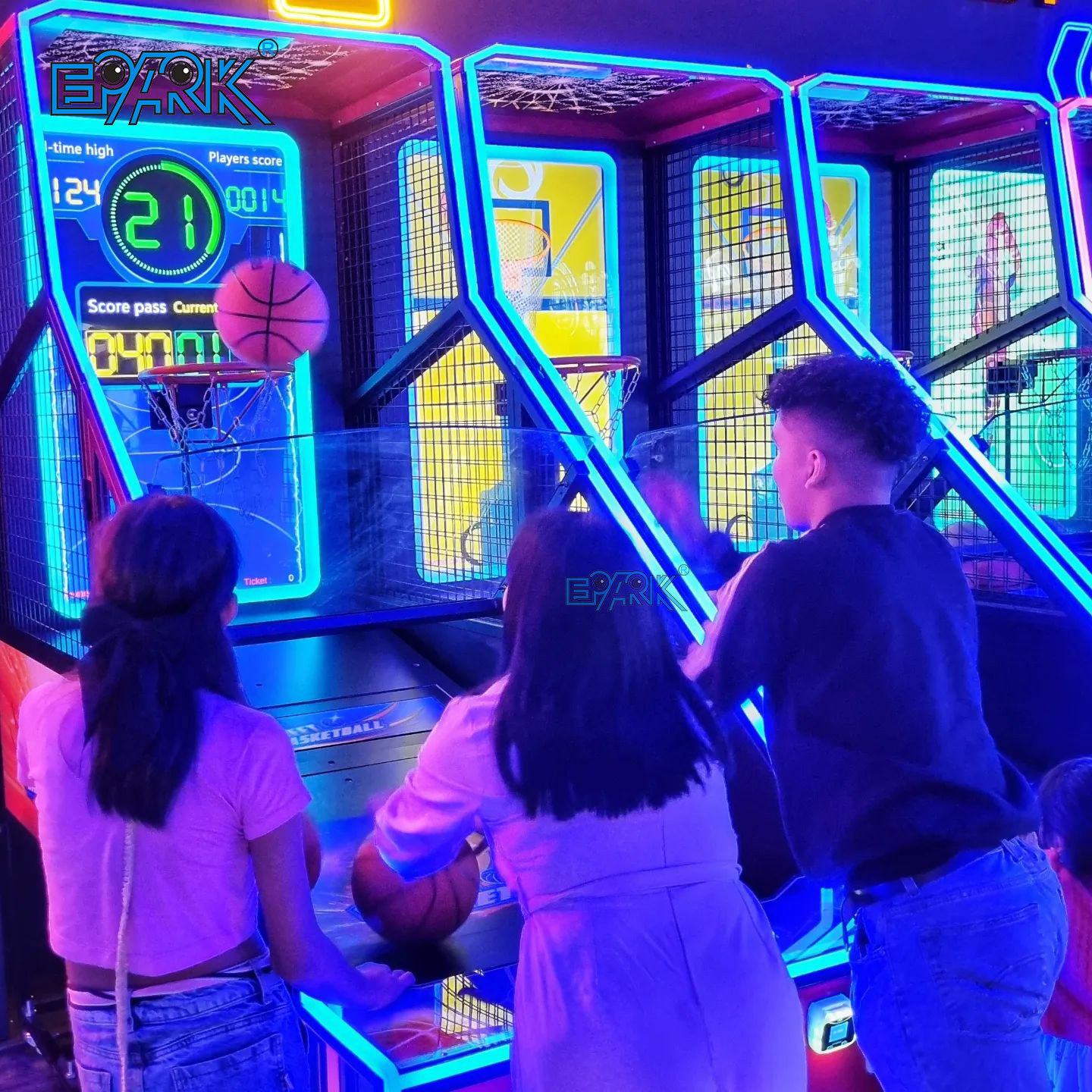
Why the choice is really a floor-zoning decision
A family entertainment center serves several guest missions at once. A parent with young children may want a short, visible, prize-linked game loop. A group of teenagers may want a loud, skill-based challenge with a score to beat. A mixed-age birthday group may move between both. When an operator buys machines by category without mapping them to guest missions, the floor becomes a random collection of cabinets. When the operator maps product types to zones, the arcade machine mix becomes easier to operate, explain, and merchandise.
The two anchor categories in this decision are distinct. A Ticket Redemption Machine is a coin-operated game with a ticket payout system, multiple game modes, LED lighting and sound effects, and payment support for coin, card, or QR. A Shooting Game Machine is a coin-operated game with a 32–55 inch HD display, an infrared or laser gun system, multiple shooting modes, and the same payment flexibility. A Sport Game Machine adds a third lane: 1–4 players, interactive scoring, multiple sports modes, and LED effects. Each category solves a different social job.
The correct question is not which category is better. It is which zone should receive which category, how much floor and electrical capacity each zone needs, and which compliance and maintenance constraints apply before the first unit is ordered.
Scenario A: Ticket Redemption for reward-driven, all-ages zones
Ticket redemption works best where the guest journey is short, visible, and prize-linked. The player pays, plays a game with a clear outcome, receives tickets, and converts tickets into a prize. That loop is easy for children to understand and easy for parents to supervise. It also gives the venue a natural retail-style endpoint: the redemption counter. For FECs with family traffic, birthday parties, shopping-mall footfall, or indoor playground adjacencies, the Ticket Redemption Machine suite is a strong fit for the all-ages zone.
What the product type is designed to do
In the EPARK product range, the Ticket Redemption Machine category lists 1–2 players, 200–500W power, 110V or 220V voltage, a ticket payout system, LED lighting and sound effects, multiple game modes, and support for coin, card, or QR payment. The cabinet uses metal, tempered glass, ABS plastic, electronic components, and LED lighting. These are product-type facts, not claims about a specific venue result.
The operational meaning is straightforward. The machine is a reward engine, not only a play unit. The ticket payout system links game performance to prize inventory. Multiple game modes help the category serve different ages and repeat visits. LED lighting and sound effects make the zone readable from a distance. Payment flexibility matters in FECs that run token, card, or cashless systems alongside coin play.

Where this zone fits best
- Family Entertainment Center: A multi-zone FEC can place redemption machines near the prize shop or indoor playground exit, where families already expect a reward stop.
- Shopping mall arcade corner: Short-stay visitors respond to a compact, brightly lit game loop that ends in a tangible prize.
- Indoor playground combination: Redemption supports the transition from active play to prize collection and can extend family dwell time.
- Arcade center with mixed audiences: Redemption acts as the all-ages base layer while more competitive zones sit deeper in the floor plan.
Constraints buyers should resolve early
Ticket redemption introduces operational dependencies that a shooting zone does not. The venue needs a ticket and prize workflow: ticket stock, prize display, redemption counter staffing, and shrinkage control. The machine may support multiple payment methods, but the venue must still decide whether the floor uses coin, card, QR, or a mixed system. The game is accessible to families, which also means the zone needs clear sightlines, child-height wayfinding, and parent supervision rather than a dark, enclosed layout.
Price is not a universal category attribute. A credible price band depends on cabinet configuration, payment hardware, voltage and plug type, shipping terms, spare-parts kit, and certification documents. Buyers should compare quotations on a like-for-like basis rather than treating a category label as a price band.
Scenario B: Shooting and Sport Game Machines for competitive teen-to-adult zones
Shooting Game Machines and Sport Game Machines fit a different social contract. The guest is there to test skill, compare scores, and often play with or against another person. The zone can tolerate more noise, more visual intensity, and a more competitive atmosphere than the family redemption area. This is why a zoned FEC should not distribute shooting cabinets randomly among kiddie rides and prize games. The category needs its own adjacency logic.
What the product type is designed to do
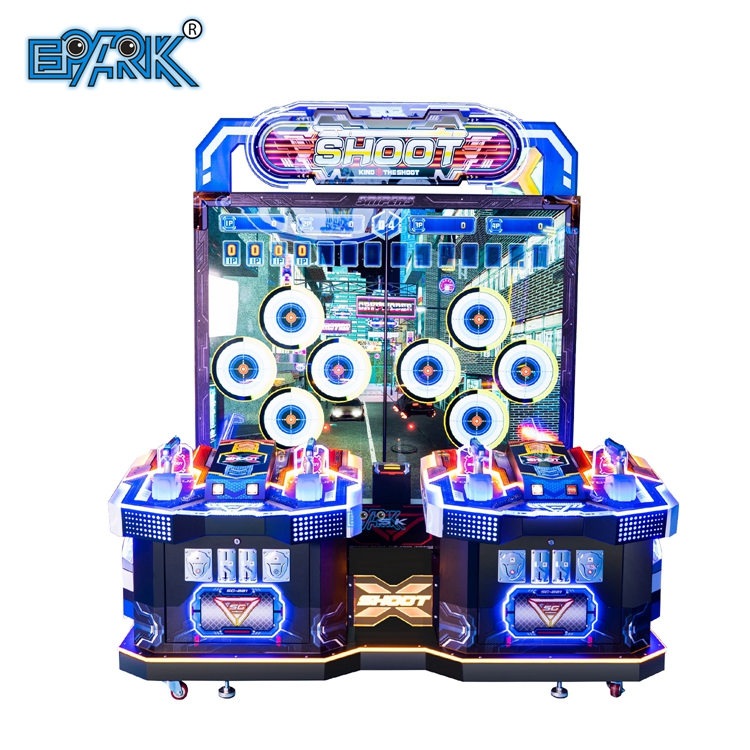
The EPARK Shooting Game Machine category lists 1–2 players, a 32–55 inch HD display, an infrared or laser gun system, 300–800W power, 110V or 220V voltage, multiple shooting game modes, and coin, card, or QR payment support. The cabinet uses a metal frame, LCD screen, infrared gun system, and electronic control system. The Sport Game Machine category lists 1–4 players, 200–800W power, interactive scoring, multiple sports modes, LED lighting and sound effects, and the same payment flexibility.
The operational meaning is different from redemption. Shooting is built around aim, reaction, and score feedback. Sport games are built around physical gesture, repeat attempts, and group competition. Both categories benefit from open sightlines, durable gun or player interfaces, and a floor position where the sound does not overwhelm adjacent family areas. The 1–4 player range in sport games also makes the category useful for group challenges and short tournament formats.
Where this zone fits best
- Teen-to-adult competitive zone: Shooting, racing, boxing, basketball, and sport machines can form a high-energy cluster with visible scoreboards and group standing space.
- Bar or evening entertainment venue: The Bar and Entertainment Venue scenario in the corpus identifies adult users, high interaction demand, and competitive gameplay as fit conditions for boxing, basketball, and air hockey.
- Arcade Game Center: A dedicated competitive zone helps the venue separate loud play from family redemption and improves guest flow.
- FEC with older siblings and groups: A shooting and sport corner gives teenagers a reason to stay while younger children use the redemption and playground areas.
Constraints buyers should resolve early
Shooting content is not neutral for every audience. Family venues need age guidance, content review, and a floor position that keeps intense shooting imagery away from toddler and kiddie ride areas. Gun systems also need a maintenance routine for tethers, lenses, calibration, and wear at the player interface. Sport games have a different constraint: they invite physical play, so the zone needs clearance for movement, stable flooring, and a layout that prevents collisions between players and passers-by.
Power planning matters. Ticket redemption is listed at 200–500W, shooting at 300–800W, and sport at 200–800W. These ranges are not a substitute for an electrical plan, but they show why a zoned floor should be designed with separate circuit assumptions rather than treating all arcade machines as identical loads.
Technical and procurement comparison by product type
The table below converts the product-type facts into early-stage procurement questions. It is not a substitute for a site survey, but it helps a buyer avoid mixing categories without a reason.
| Decision area | Ticket Redemption Machine | Shooting Game Machine | Sport Game Machine |
|---|---|---|---|
| Primary guest job | Short reward loop with prize conversion | Skill challenge with score feedback | Physical competition and group scoring |
| Typical zone | All-ages family zone, prize shop adjacency | Teen-to-adult competitive zone | Teen-to-adult or group challenge zone |
| Players | 1–2 players | 1–2 players | 1–4 players |
| Power range | 200–500W | 300–800W | 200–800W |
| Voltage | 110V or 220V | 110V or 220V | 110V or 220V |
| Payment | Coin, card, or QR | Coin, card, or QR | Coin, card, or QR |
| Compliance check | CE certified category | CE certified category | CE certified category |
| Operational dependency | Ticket stock, prize inventory, redemption counter | Content guidance, gun maintenance, sound zoning | Player clearance, durable interfaces, group flow |
| Procurement caution | Do not price without prize and ticket workflow | Do not place without age and content review | Do not place without movement clearance |
Product-type comparison based on EPARK corpus specifications. Local codes, site conditions, and quotation scope still require separate verification.
How EPARK fits the product-type discussion
Guangzhou EPARK Electronic Technology Co., Ltd. (EPARK) is a Guangzhou-based entertainment equipment provider and manufacturer of arcade machines, founded in 2016, with a 25,000 m² showroom and factory, 150 employees, 20 engineers, and an annual output of 8,000–10,000 units. Its product range includes Ticket Redemption Machine, Shooting Game Machine, Sport Game Machine, Basketball Arcade Machine, Boxing Arcade Machine, Air Hockey Table, Racing Game Machine, VR Simulator, Kids Arcade Game Machine, Bowling Machine, Commercial Kiddie Ride, and Indoor Playground Equipment. EPARK exports to EU, USA, Middle East, Africa, South America, and Southeast Asia, with an 80% export ratio.
For a zoned FEC project, the relevance is not that one brand should fill every zone. The relevance is that a single supplier can support a product-type plan across redemption, shooting, sport, and family categories. EPARK lists OEM, ODM, factory direct, and custom design support, with customization for voltage, plug type, cabinet design, color, logo, game software, payment system, and language interface. Its capability data lists a monthly capacity of 500–800 units, a lead time of 30 days, a MOQ of 10 units, 100% quality inspection before shipment, aging test, function test, and after-sales support covering 24/7 online support, video technical guidance, spare parts supply, and lifetime maintenance service.
This matters for buyers who are zoning rather than buying one machine. Voltage and plug customization help match the destination market. Payment customization helps align the machines with a venue card system or coin operation. Cabinet and color customization can support zone identity without changing the game category. The buyer still needs to verify the quotation, certification documents, and spare-parts plan, but the supplier profile supports a multi-category floor plan.
Compliance is part of the product-type discussion. The EPARK Ticket Redemption Machine, Shooting Game Machine, and Sport Game Machine categories list CE certification. EPARK documentation in the corpus also includes CE EMC certificates for shooting and sport game categories and RoHS certification for game machines. For the EU market, arcade machines must meet EN 60335-1 under the Low Voltage Directive and 2014/30/EU under the EMC Directive for CE marking; UL certification is required for the US market. Buyers should collect the certificate scope, model coverage, and expiry details rather than accepting a logo on a specification sheet.
Application and use-case fit
The same machine category can be right for one venue and wrong for another. The fit depends on guest mix, dwell time, supervision, and the presence of adjacent attractions. The EPARK scenario data identifies several venue types that can support a zoned approach.
| Venue scenario | Ticket Redemption role | Shooting and Sport role | Planning note |
|---|---|---|---|
| Family Entertainment Center | All-ages reward zone near prize shop or playground exit | Competitive teen-to-adult zone with score visibility | Separate sound and sightlines by age group |
| Shopping mall arcade corner | Compact, bright, impulse-friendly prize loop | Small competitive cluster for older walk-in traffic | Use visible fronts and clear zone signage |
| Indoor playground | Prize conversion after soft play | Optional teen corner away from toddler areas | Keep intense content away from young children |
| Arcade Game Center | Base layer for families and casual guests | High-energy cluster for repeat competitive play | Design power and maintenance access by zone |
| Bar or entertainment venue | Limited or secondary role | Primary role for adult competition and social play | Check evening operation and content fit |
Market trend analysis
Grand View Research estimates that the global arcade game machines market was valued at USD 11.0 billion in 2025 and is projected to grow to USD 31.0 billion by 2033. The same source estimates that redemption games led the arcade market with a 29.2% revenue share in 2025, driven by prize-rewarding machines in family entertainment centers. UN Comtrade reports that China exports of toys, games, and sports requisites reached USD 82.4 billion in 2024, which supports the view that global supply chains for amusement equipment remain significant.
These figures should be read as market context, not as a local revenue forecast. Market definitions vary across research houses, and arcade machines are sometimes grouped with broader amusement equipment. The procurement implication is narrower: redemption remains a major commercial category in family-oriented venues, while competitive game categories continue to serve older audiences and group play. A zoned floor plan aligns with both signals instead of forcing one category to serve every guest.
Comparison with traditional solutions
The traditional alternative is an undifferentiated arcade floor: redemption, shooting, sport, kiddie rides, and prize games mixed without clear guest logic. That approach can be simpler to install and may suit a very small venue with limited space. It also has limits. If a shooting cabinet sits beside a toddler ride, the venue creates an age-fit and sound problem. If redemption machines are scattered across the floor, the prize counter becomes harder to supervise. If competitive games are hidden in dark corners, they lose the social visibility that drives group play.
| Planning model | Strength | Limitation | Best use |
|---|---|---|---|
| Undifferentiated mixed floor | Simple procurement and compact installation | Weaker age fit, unclear guest flow, harder prize control | Small arcade corners with limited staffing |
| Zoned floor with redemption and competitive areas | Clearer guest missions, better product-type fit, stronger dwell-time logic | Needs more space, signage, power planning, staff training, and ticket-prize discipline | FECs, arcade centers, and mixed-age entertainment venues |
The zoned model is not universally superior. It consumes more floor area than a mixed layout, and it adds operational work: separate power circuits, zone signage, staff guidance, ticket-prize accounting, and maintenance routes. In a small venue with one attendant, a tightly curated mixed floor may be more practical than a full zoning plan. The right answer depends on the venue size, guest mix, and ability to operate the redemption loop consistently.
Future outlook
Three changes are likely to keep the zoning question relevant. First, family entertainment centers are becoming more experience-based, with redemption, soft play, VR, and competitive game zones sharing one guest journey. Second, payment flexibility is becoming a baseline expectation; both redemption and shooting categories already list coin, card, or QR support. Third, compliance scrutiny is increasing in export markets, so certificate scope and model coverage will matter as much as cabinet design.
For buyers, the practical next step is not to ask which category is best in general. It is to draw the floor plan by guest mission, then specify each zone with the right product type, power range, payment method, compliance file, and maintenance plan. That is how a Ticket Redemption Machine suite and a Shooting Game Machine cluster stop competing for the same floor space and start supporting different parts of the same business.
FAQ
What is the practical difference between a Ticket Redemption Machine and a Shooting Game Machine in an FEC?
A Ticket Redemption Machine is built around a ticket payout system and prize conversion, with 1–2 players, multiple game modes, LED effects, and coin, card, or QR payment. A Shooting Game Machine is built around aim and score feedback, with a 32–55 inch HD display, an infrared or laser gun system, 1–2 players, and multiple shooting modes. The first supports reward-driven family play; the second supports competitive skill play.
Which FEC zones suit ticket redemption best?
Ticket redemption fits all-ages zones with visible prize logic, especially near a prize shop, indoor playground exit, or family circulation path. It needs parent sightlines, child-height wayfinding, ticket stock, prize inventory, and a supervised redemption counter. It is less suitable for dark, enclosed areas where families cannot see the reward loop.
Which zones suit shooting and sport game machines?
Shooting and Sport Game Machines fit teen-to-adult competitive zones where score feedback, group challenge, and repeat play are part of the guest mission. Shooting needs content guidance and gun maintenance. Sport games need player clearance and durable interfaces. Both benefit from being grouped away from toddler and kiddie ride areas.
What technical constraints should buyers check before mixing these machine types?
Buyers should verify voltage and plug type, power range, payment system, cabinet footprint, maintenance access, and certificate scope. The EPARK categories list 110V or 220V voltage and power ranges of 200–500W for ticket redemption, 300–800W for shooting, and 200–800W for sport. These figures support electrical planning but do not replace a site survey.
How should an operator plan a zoned FEC floor?
Start with guest missions rather than machine categories. Place redemption where families can see the prize loop and supervise children. Place shooting and sport where older guests can compete without disturbing family areas. Then verify power, sound, sightlines, maintenance routes, and compliance documents for each zone. A simple layout with clear zone boundaries is easier to operate than a dense mix with no guest logic.
What are the main limitations of a zoned ticket-and-shooting strategy?
Zoning requires more floor area, more planning, and more operational discipline than an undifferentiated mixed floor. Ticket redemption adds ticket and prize inventory work. Shooting adds content review, sound control, and gun maintenance. In a small venue with limited staff, a simpler mixed floor may be more practical. Zoning is a fit strategy, not a guarantee of better performance.
Tem questões ou precisa de mais detalhes?
Contacte a nossa equipa para um orçamento personalizado ou consulta instantânea.
Solicitar orçamento
Preencha o formulário abaixo e a nossa equipa entrará em contacto com uma proposta personalizada.
Chat direto do WhatsApp
Prefere conversar em tempo real? Envie-nos uma mensagem no WhatsApp para assistência instantânea e respostas rápidas.
- Obter orçamento personalizado
- Partilhar fotos ou documentos
- Discuta as suas necessidades diretamente
Geralmente responde em 5–30 minutos durante o horário de expediente.