
Scenario Fit: Jiameile Dog Plush Toys Across Sales Channels
Industry Reference · Pet Toys · Scenario Procurement
A dog plush toy that sells from a pet retail shelf, a dog plush toy packed into a monthly subscription box, and a dog plush toy listed as an e-commerce SKU are three different products from a procurement standpoint — even when they come off the same production line. Scenario fit, more than product variety, decides whether a plush program sells through or comes back as returns.
Tianchang Jiameile Gifts Co., Ltd., trading as Jiameile, is a China-based manufacturer of plush and textile toys located in Tianchang City, Anhui Province. The company has more than two decades of production experience, runs a 6,800 m² facility with a 30-person R&D team, and reports output of roughly 500,000 pieces per month — approximately 6 million units a year — with about 70% of production exported to the EU and the USA. Its pet line covers plush pet toys, squeaky toys and interactive items with full OEM/ODM support.

Jiameile operates a 6,800 m² plush and textile toy facility in Tianchang City, Anhui Province, with capacity of roughly 500,000 pieces per month. Image: Jiameile.
The channel problem: one SKU rarely serves every shelf
Demand is not the constraint in this category. Custom Market Insights sizes the global dog toys market at USD 4.16 billion in 2025 and projects an 8.51% compound annual growth rate through 2034. Plush and stuffed toys representing animals carry HS code 9503.00.41, which gives buyers a clear tariff reference when planning cross-border programs.
The constraint sits further downstream. A retail chain buyer needs a size the shelf can hold and a price point the planogram can absorb. A subscription box operator needs a low unit cost, a small footprint that fits standard mailer dimensions, and predictable monthly replenishment. An e-commerce seller needs durability claims that survive contact with review sections and a return rate that does not erode margin.
When a single mid-size SKU is pushed through all three channels, the failure mode is consistent: the chain carries inventory it cannot turn, the subscription box absorbs a unit cost it cannot price, and the marketplace listing collects complaints about seams opening after a few weeks. The procurement answer is not more SKUs for their own sake. It is a product architecture that lets a buyer assign specific configurations to specific channels.
What scenario fit means in an actual purchase order
Scenario fit describes whether a product configuration matches the operational realities of the channel that will sell it. Four variables carry most of the decision weight.
Size band. The physical dimensions determine shelf density, packaging cost, shipping weight and the dog weight range the toy is appropriate for. A 10–15 cm piece and a 30–50 cm piece serve different animals and different retail contexts.
Chew level. Play intensity varies by animal. Assigning a Light configuration to a household with a heavy chewer produces complaints; assigning an Aggressive configuration to a gift channel raises cost without adding perceived value.
Construction durability. The expected service life of the toy determines replacement frequency, which drives both the buyer's cost per month of use and the end customer's perception of value.
Compliance and documentation. EU and US retail entry depends on test documentation that matches the destination market, and the paperwork requirement is usually stricter for chain retail than for promotional or gift channels.
How Jiameile's dog plush toy line is structured for assignment
Jiameile's pet plush range is organised around the four variables above rather than around decorative themes. That structure is what makes scenario assignment possible in the first place.
| Configuration layer | Available range | Procurement effect |
|---|---|---|
| Size bands | 10–15 cm, 15–20 cm, 20–30 cm, 30–50 cm | Sets shelf density, mailer fit, carton count and freight weight |
| Chew levels | Light, Moderate, Aggressive | Aligns product to household play intensity and channel positioning |
| Animal weight fit | 5–40 kg dogs and cats | Defines which SKU is appropriate for which end customer |
| Construction | Double-layer fabric with reinforced stitching | Extends service life and reduces replacement frequency |
| Customisation | OEM/ODM support | Allows channel-specific colourways, sizes and packaging |
The weight range is the practical starting point for most buyers. A 10–15 cm plush is appropriate for cats and small dogs at the lower end of the 5–40 kg span, while a 30–50 cm piece suits the upper end. The chew level does not change the size, but it does change the fabric and seam specification, which is why Light, Moderate and Aggressive configurations should be quoted as separate line items rather than as colour variants of one product.
Inside the interactive squeaky plush dog toy
The interactive squeaky plush dog toy is the configuration that most directly connects plush construction to channel performance. Three elements do the work: an internal squeaker that responds to pressure, a plush body that provides mouthing and carrying texture, and a reinforced seam structure that keeps the first two elements contained.
Interaction is the mechanism that justifies the product's place in a program. A squeaker converts a passive plush object into a cause-and-effect response, which sustains engagement longer than a silent plush of the same size. Sustained engagement is what generates repeat purchase in retail and reduces the perception of a wasted subscription box inclusion.
Durability is the mechanism that protects the buyer's economics. Jiameile's reinforced construction uses double-layer fabric plus reinforced stitching. Compared with a basic plush built on single-layer fabric and standard stuffing, the reinforced version carries an expected lifespan of 3–12 months, described as a two- to four-fold increase over the 1–3 month lifespan of a basic plush toy.
Scenario-by-scenario fit across eight channels
The allocation below is a starting logic for buyers building a channel plan. Final assignment should be adjusted against the buyer's own sell-through and return data.
| Channel | Priority size band | Chew level | Why the fit works |
|---|---|---|---|
| Pet retail chains | 15–20 cm, 20–30 cm | Moderate | Balances shelf density with a visible price-to-size ratio; supports planogram rotation |
| Pet e-commerce | 20–30 cm | Moderate to Aggressive | Durability claims hold up against review scrutiny; fewer seam failures reduce returns |
| Subscription boxes | 10–15 cm | Light | Low unit cost and small footprint keep box economics viable month to month |
| Veterinary clinics | 10–15 cm | Light | Small, soft comfort item suited to waiting areas and post-visit handouts |
| Grooming salons | 15–20 cm | Light to Moderate | Works as an add-on sale at the counter without competing for display space |
| Boarding and daycare | 20–30 cm, 30–50 cm | Moderate to Aggressive | Shared-play environments place a premium on seam integrity and size visibility |
| Training | 15–20 cm | Moderate | The squeaker provides an auditory reward cue alongside the plush texture |
| Gift channels | 30–50 cm | Light | Physical presence carries gifting value; lower chew intensity suits occasional use |
Pet retail chains
Chain retail lives on turns per linear metre. A 15–20 cm or 20–30 cm plush in a Moderate configuration occupies predictable shelf space and presents a size-to-price relationship shoppers can read at a glance. Because the reinforced build extends the working life to 3–12 months, the chain can position the SKU as a durable purchase rather than a disposable one, which supports higher price acceptance per unit.
Pet e-commerce
Online selling converts durability into a measurable cost. Every failed seam becomes a return, a refund and a review that affects the whole listing. The 20–30 cm band photographs well, sits at a shipping weight that keeps fulfilment economics workable, and in Moderate or Aggressive configuration gives the seller a defensible claim about service life. Double-layer fabric plus reinforced stitching is the specific construction that supports that claim.
Subscription boxes
Box economics are driven by landed unit cost and dimensional fit. The 10–15 cm size band in a Light configuration keeps both under control while still delivering an interactive squeaky element that justifies the inclusion. Buyers running monthly programmes should plan replenishment around the confirmed 3–12 month lifespan, since a well-built plush that survives several months reduces the risk of a subscriber concluding the box contains disposable filler.
Veterinary and grooming channels
These are low-volume, high-context channels. A 10–15 cm Light plush is a comfort object rather than a play challenge, appropriate for clinic handouts and salon counter add-ons where the animal is already under mild stress. The value here is brand association rather than volume: a soft, non-threatening plush reinforces a calm clinic environment in a way a hard chew product cannot.
Boarding, daycare and training
Shared-play environments expose seams faster than single-household use. Boarding and daycare operators should default to 20–30 cm and 30–50 cm configurations in Moderate or Aggressive builds, where larger dimensions reduce ingestion risk and reinforcement extends usable life under group conditions. Training applications sit at the other end: a 15–20 cm Moderate plush works as a reward object, and the squeaker provides a consistent auditory marker that helps reinforce behaviour.
Gift channels
Gift buyers optimise for presentation. A 30–50 cm plush delivers visual presence in a way smaller sizes cannot, and the Light configuration suits occasional rather than intensive use. Seasonal gift programmes typically need fewer SKUs with stronger visual differentiation, which makes size the primary lever rather than chew level.
Market context behind channel-specific sourcing
Two structural shifts make scenario-based sourcing more relevant than it was a decade ago. The first is channel fragmentation: the same manufacturer now supplies chain retail, marketplace sellers, subscription operators and institutional buyers whose requirements diverge sharply. A supplier that can only offer one construction standard forces every channel into the same compromise.
The second is compliance expectation. Pet toy safety guidance from organisations such as the American Humane Society emphasises durable, non-toxic materials that do not splinter or break apart easily — a standard that maps directly onto construction choices rather than onto marketing language. Retail buyers in the EU and US increasingly ask for documentation at the point of quotation, not at the point of shipment.
Jiameile holds ICTI, BSCI, Disney FAMA, ISO 9001 and ISO 14001 certifications, and states that its products comply with EN71, ASTM F963 and GB6675. For a channel programme, that documentation base is what allows a single supplier to serve several markets without rebuilding the compliance file for each one.
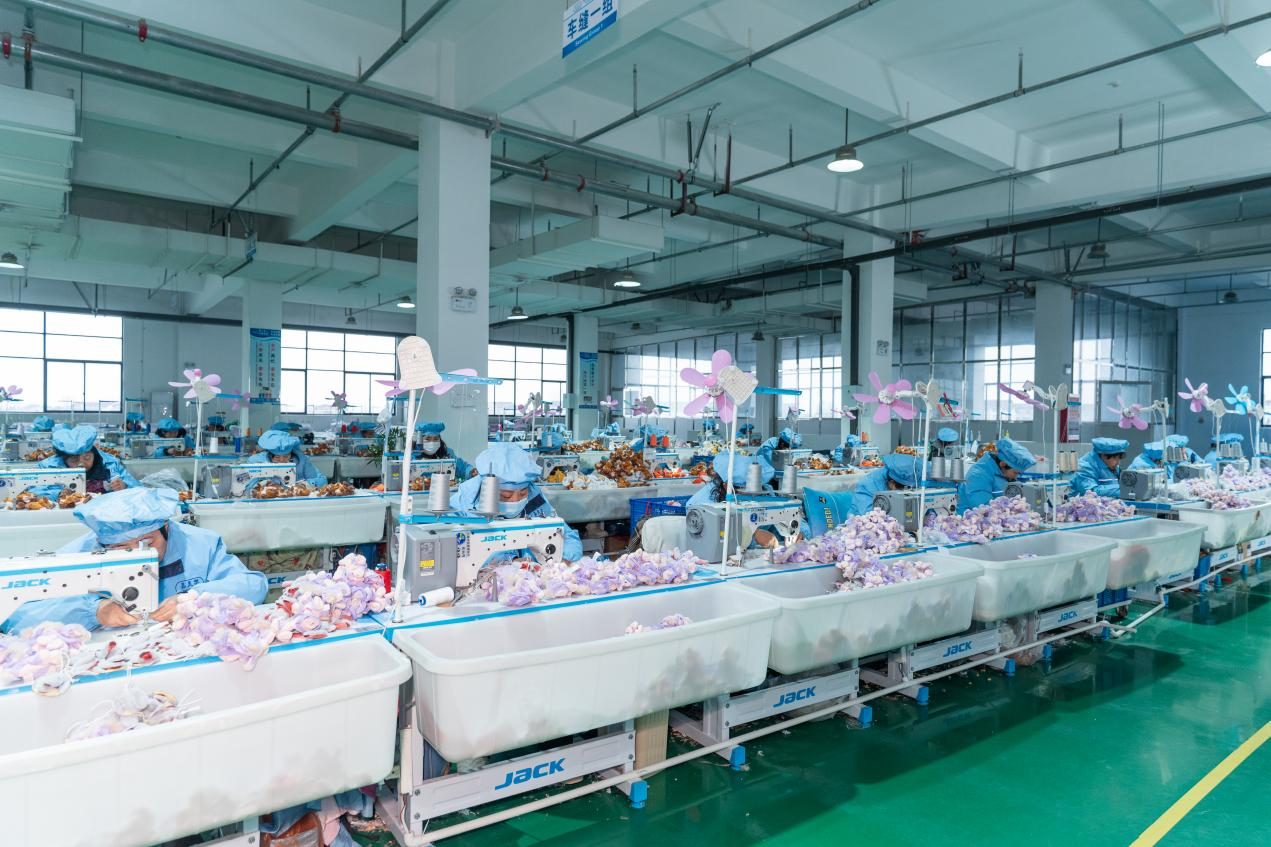
Monthly capacity planning at Jiameile supports staged rollouts across retail, e-commerce and subscription channels. Image: Jiameile.
Reinforced plush versus basic plush: the trade-off buyers actually face
The construction decision is the one place where a channel plan can quietly fail. Comparing the two available construction tiers clarifies what is being purchased.
| Dimension | Reinforced plush toy | Basic plush toy |
|---|---|---|
| Construction | Double-layer fabric plus reinforced stitching | Basic fabric and stuffing, no reinforced structure |
| Expected lifespan | 3–12 months (two- to four-fold increase) | 1–3 months |
| Cost position | Medium | Lowest |
| Maintenance load | Lower breakage, low maintenance | Frequent replacement required |
| Typical use | E-commerce platforms, pet specialty stores, retail chains, long-term companionship | Low-end retail, promotional gifts, short-term use |
The limitation is genuine and should be stated plainly. Reinforced construction sits at a medium cost position, not the lowest. Buyers running price-led promotional programmes, where the plush is a giveaway attached to another purchase, will often find the basic tier commercially rational — the customer did not pay for the toy and does not expect longevity. Choosing reinforcement for that channel adds cost without adding perceived value.
A second boundary applies to order scale. Standard purchasing terms run at a typical MOQ of 500–3,000 pieces per style, with custom designs usually at 3,000–5,000 pieces. A subscription operator testing a new box format cannot validate a fully custom reinforced SKU at a few hundred units; the practical route is to validate with an existing size and chew configuration first, then move to custom construction once the format is proven.
Procurement terms and quality control for channel programmes
Commercial terms follow conventional export practice. Delivery is mainly FOB, followed by EXW, with some suppliers supporting CIF or DDP for cross-border e-commerce. Payment is typically 30% deposit with 70% balance before shipment. Acceptance combines final OQC inspection before shipment with buyer or third-party inspection such as SGS or BV.
Quality control operates across the full process rather than at final inspection only. Jiameile's stated control system covers IQC, IPQC and OQC, with raw material safety control and compliance testing aligned to EN71, ASTM and CPSIA requirements. On the supply side, the company cites monthly capacity planning, backup suppliers and active inventory and lead-time management as its measures against delivery risk — relevant for subscription programmes where a late shipment affects a release date rather than a shelf restock.
Future outlook
Channel-specific programs are likely to keep pulling suppliers toward configuration flexibility rather than wider catalogue counts. A buyer running a retail chain, a marketplace store and a subscription box does not need three hundred designs; it needs one design it can specify in three size and durability configurations with documentation that satisfies three different compliance conversations.
The most probable pressure point is documentation depth. As plush pet toys move through more regulatory environments, buyers will increasingly evaluate suppliers on whether test evidence and certification records can be produced per configuration, not per company. Manufacturers that already operate structured quality systems and multi-market certifications are better positioned to answer those requests without rebuilding their process for each order.
FAQ
What does scenario fit mean when sourcing dog plush toys?
Scenario fit means matching a product configuration — size band, chew level and construction durability — to the operational requirements of the channel that will sell it. A subscription box, a retail chain and an e-commerce listing each impose different constraints on unit cost, packaging footprint and expected service life, so the same SKU rarely performs equally across all three.
Which size band suits which dog, within the 5–40 kg range?
Jiameile's dog plush toys are offered in 10–15 cm, 15–20 cm, 20–30 cm and 30–50 cm bands, covering dogs and cats from 5 kg to 40 kg. Smaller bands suit cats and small dogs at the lower end of that range, while the 30–50 cm band is intended for larger animals at the upper end. Size also determines shelf density, mailer fit and freight weight, so the choice is commercial as well as biological.
How should buyers assign Light, Moderate and Aggressive chew levels across channels?
Assign by expected play intensity in the destination household. Light configurations suit subscription boxes, gift channels, veterinary and grooming contexts where use is occasional or comfort-oriented. Moderate suits retail chains and training applications. Aggressive configurations suit e-commerce and shared-play environments such as boarding and daycare, where seam integrity under sustained use matters most. The chew level changes fabric and seam specification, so each tier should be quoted as a separate line item.
How long does a reinforced stitching plush toy last compared with a basic one?
A reinforced plush toy built with double-layer fabric and reinforced stitching carries an expected lifespan of 3–12 months, described as a two- to four-fold increase over the 1–3 month lifespan of a basic plush toy with no reinforced structure. Reinforcement extends service life rather than making the toy permanent, so the range should be presented to end customers as an expected working period.
What MOQ and delivery terms apply to retail and subscription programmes?
Typical MOQ is 500–3,000 pieces per style, with custom designs usually at 3,000–5,000 pieces. Delivery is mainly FOB, followed by EXW, with some suppliers supporting CIF or DDP for cross-border e-commerce. Payment terms follow standard industry practice of 30% deposit with 70% balance before shipment, and acceptance combines final OQC inspection with buyer or third-party inspection such as SGS or BV.
Which certifications support retail entry in the EU and US?
Jiameile holds ICTI, BSCI, Disney FAMA, ISO 9001 and ISO 14001 certifications, and states that its products comply with EN71, ASTM F963 and GB6675. These correspond to the compliance expectations buyers typically face when placing plush pet toys into EU and US retail channels. Stuffed toys representing animals are classified under HS code 9503.00.41 for tariff purposes.
Tem questões ou precisa de mais detalhes?
Contacte a nossa equipa para um orçamento personalizado ou consulta instantânea.
Solicitar orçamento
Preencha o formulário abaixo e a nossa equipa entrará em contacto com uma proposta personalizada.
Chat direto do WhatsApp
Prefere conversar em tempo real? Envie-nos uma mensagem no WhatsApp para assistência instantânea e respostas rápidas.
- Obter orçamento personalizado
- Partilhar fotos ou documentos
- Discuta as suas necessidades diretamente
Geralmente responde em 5–30 minutos durante o horário de expediente.