
Scenario Fit: Metalized Paper Laminating Machines for Cigarette and Cosmetics Packaging
Industry Reference · Metalized Board Converting
Scenario Fit: Metalized Paper Laminating Machines for Cigarette and Cosmetics Packaging
Cigarette cartons and cosmetics gift boxes are the two packaging categories in which metallized board most reliably justifies its cost. Both need a surface that stays reflective after folding, gluing and repeated handling, and both are produced in volumes where lamination quality is judged reel by reel rather than sheet by sheet. For a converter choosing a metalized paper laminating machine, the decisive question is therefore not which machine runs fastest, but which machine's working envelope, substrate window and duty cycle match the products that will actually run across it.
Why Scenario Fit Outranks Headline Speed
The commercial context supports that shift in emphasis. The global metallized paper market reached a valuation of USD 4.85 billion in 2025, driven by demand for premium labelling and cigarette packaging, according to DataM Intelligence. Within that market, lamination held a 57.4% revenue share in 2024, favoured for the high gloss and barrier properties it gives consumer goods, according to SkyQuest Technology. Asia-Pacific accounts for nearly 40% of the world's metallized paper market, a share attributed by Future Market Insights to expanding tobacco and beverage industries in China and India.
What those figures describe is a mature, gloss-driven category in which the machine is no longer the constraint on whether a converter can produce metallized board, but on whether it can produce it profitably for a defined product mix. A 180 m/min machine that cannot accept the paper grammage of a customer's carton, or whose working width forces a second pass on a wide blank, will not deliver the economics implied by its speed specification. Scenario fit — matching machine to end product — is the step where most of the value is decided.
The Five Dimensions of a Fit Assessment
Buyers evaluating a metalized paper laminating machine for cigarette or cosmetics work can reduce the decision to five dimensions. Each one has a documented machine parameter behind it, which means each can be checked rather than estimated.
| Dimension | What it controls | Question that exposes a mismatch |
|---|---|---|
| Working width | Which flat formats can be processed in a single pass | Does the widest carton blank or printed sheet in the planned mix sit inside the machine's usable width? |
| Substrate window | Which papers, films and foils the line accepts | Is the carton board grammage and film gauge inside the documented range, or outside it at the edge of the run? |
| Process architecture | Whether laminating, coating or both happen in one pass | Does the job require a separate coating step, or is an integrated machine the correct platform? |
| Duty cycle and environment | Whether output holds overnight and in humid plants | Can the line run continuously in a humid, dust-controlled workshop without drift? |
| Downstream conversion | Whether the promised sheet tolerance is reachable | Is a positioning cutter with ±0.1 mm accuracy part of the same line? |
A sixth consideration sits outside the machine itself: whether the supplier's range includes the downstream equipment needed to convert laminated reels into print-ready sheets. A laminating machine that is well matched on width and substrate but paired with an unsuitable cutter simply moves the bottleneck down the line.
The YDLM1300B: Capability Profile for High-End Packaging Board
Wenzhou Yueda Packaging Machinery Co., Ltd. (YUEDA) is a Chinese manufacturer of gold and silver card production equipment based in Longgang, Wenzhou, established in 1998 and operating a 4,000 m² facility with an R&D team of 25 engineers and technicians. Its range covers horizontal gold and silver cardboard laminating machines, positioning cross-cutting machines, high-speed double-helix positioning slitting machines, and gantry-style multi-functional laminating and coating machines for peeling and back coating.
Within that range, the Gantry Multifunctional Aluminum Metallized Cardboard Laminating (Coating) Machine, model YDLM1300B, is the platform most directly aimed at cigarette and cosmetics board. Its documented mechanical characteristics place it in the integrated-machine category rather than the single-function category.
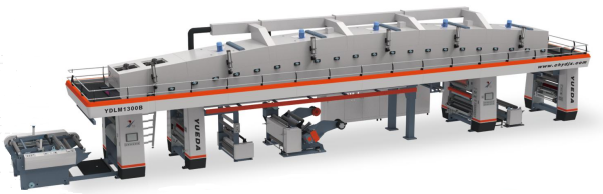
| Parameter | Documented value |
|---|---|
| Machine category | Gantry-type laminating and coating integrated machine |
| Structural configuration | Gantry type, carbon steel construction |
| Working width | 600–1200 mm |
| Machine speed / working speed | 180 m/min / 15–150 m/min |
| Base materials | PET film 0.012–0.014 mm; OPP film 0.02–0.06 mm; paper 100–350 g/m²; aluminium film 0.006–0.007 mm |
| Laminating and coating type | Water-based laminate on paperboard; four-roller transfer coating for glue; anilox roller direct coating for back coating |
| Unwind / rewind | Paper unwinding 1500 mm; paper rewinding 1600 mm; film unwinding 600 mm; peeling-off rewinding 600 mm |
| Core sizes | Paper unwinding 3/6/12 inch; paper rewinding 3/6 inch; film unwinding 3/6 inch; peeling-off rewinding 3/6 inch |
| Heating tunnel | 15 m length with 8.6 m downward length; maximum temperature ≤130°C |
| Power | 380 V ±10%, 50 Hz; motor power 60 kW; heating power 216 kW; working power 80 kW |
| Footprint and mass | 22,330 × 3,700 × 4,500 mm; 40 tons |
Technical Explanation: How the Envelope Translates into Product Fit
Three parameters do most of the work in deciding whether the YDLM1300B suits a given cigarette or cosmetics programme.
Working width versus flat format
A working width of 600–1200 mm defines the widest material the machine can process in a single pass. For cigarette carton board and cosmetics gift-box board, the practical test is the largest flat blank or printed sheet in the planned mix. Where that figure sits comfortably inside 1200 mm, single-pass production is achievable; where it does not, the format must be split, and the apparent speed advantage of the machine is consumed by a second pass. This is the single most common source of disappointment when a machine is purchased on speed rather than on format.
Substrate window and surface behaviour
The machine accepts paper from 100 to 350 g/m², PET film from 0.012 to 0.014 mm, OPP film from 0.02 to 0.06 mm, and aluminium film from 0.006 to 0.007 mm. Cigarette and cosmetics board typically falls centrally in that paper band, which is the segment the platform was designed around. Lamination uses a water-based process on paperboard, with glue applied by four-roller transfer coating and back coating colour applied directly by anilox roller — a combination that supports the high-gloss, handled surface both categories require.
Thermal path and web handling
A 15 m heating tunnel with an 8.6 m downward run at a maximum of 130°C governs how much dwell time the web receives before rewinding. This matters more for cosmetics board, where a heavier or coated surface must be dried without distorting the sheet, than for thin cigarette paper. Rewinding diameters of 1600 mm for paper and 600 mm for film and peeling-off set the reel sizes that the line can hand over to the cutting stage. Tension behaviour across that path is the reason servo-controlled laminating machines with real-time tension monitoring and automatic adjustment appear in the same product family, and why intelligent PLC control cabinets with touch-screen parameter monitoring are specified for automatic laminating lines.

Application Scenarios: Cigarette and Cosmetics Demand Different Things from the Same Category
Cigarette packaging: continuity and humidity resistance
A documented application in Vietnam places high-speed laminating and coating for cigarette packaging in a 24/7 continuous operation environment at 60–70% humidity. The stated requirements are humidity resistance, dust protection and constant temperature, with automatic PLC control, and supporting equipment comprising unwinder, rewinder, waste collector and temperature control system. For this scenario, the selection weight shifts away from maximum width and towards thermal stability, tension consistency across long runs, and the ability of control electronics to hold parameters without operator intervention overnight.
Cosmetics packaging: dust control and calibration
A second documented application, in Thailand, concerns a cosmetics packaging production line operating in a dust-free workshop at 30–35°C. The special requirements are dust-proof design, high-precision calibration and anti-static design, with the machine running automatically using photoelectric positioning and supported by a feeder, stacker and waste edge trimming system. Cosmetics board is typically thicker and more heavily decorated than cigarette carton stock, so surface defects that would be tolerable in a fast-moving tobacco line become visible rejects in a gift box. Anti-static provisions and calibration discipline matter as much as nominal throughput.
Downstream Cutting: The Other Half of the Fit Decision
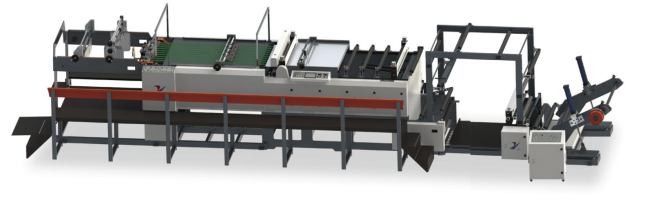
A laminating and coating machine produces reels. Sheet accuracy is created at the cutting stage, which is why the fit assessment cannot stop at the laminating platform. The DWLX1300L-1400L High Precision Positioning Double Rotary Sheet Cutter delivers blank cutting accuracy of ±0.1 mm and longitudinal and transverse tracking accuracy of ±0.1 mm at operating speeds up to 300 m/min, with a cutting speed of 10–400 sheets per minute, cut length of 450–1400 mm and a maximum cutter load of 550 gsm. The YDSLX1300-1400 double rotary sheet cutter machine shares the ±0.1 mm blank accuracy and 10–400 sheets/min cutting speed, with 73 kW total power and a 12,000 kg build. For pure sheeting, the YD1300-1400 shaft-less positioning sheeter offers ±0.1 mm sheeting accuracy, sheet lengths of 400–1200 mm and a stacking height of 1300 mm.
The practical implication for buyers is that the tolerance promised by a laminating machine is not the tolerance delivered to the printing press. If a cigarette or cosmetics programme specifies tight sheet dimensions, the cutter selection carries equal weight to the laminator selection, and the two must be specified together.
Comparison with Conventional Setups — and the Boundaries of the Integrated Approach
Conventionally, metallized board production was assembled from separate units: one machine for lamination, another for coating or back coating, often with manual tension supervision between passes. Integrated gantry machines such as the YDLM1300B consolidate that into a single pass, reducing intermediate handling and the reel storage that handling requires. The trade-off is not a marketing claim but a measurable narrowing of flexibility, and buyers should treat the following boundaries as selection inputs rather than objections.
| Model | Category | Format capability | Substrate window | Typical fit |
|---|---|---|---|---|
| YDLM1300B | Gantry-type laminating and coating integrated machine | Working width 600–1200 mm; paper unwind 1500 mm; paper rewind 1600 mm | Paper 100–350 g/m²; PET 0.012–0.014 mm; OPP 0.02–0.06 mm; aluminium film 0.006–0.007 mm | High-end metallized board for cigarette cartons and cosmetics gift boxes within a moderate width band |
| ZNFH1300-1400-1500 | Automatic laminating and coating, no-shaft rewinding | Roll width 600–1200 / 700–1300 / 700–1400 mm; roller face 1300 / 1400 / 1500 mm; running speed 5–150 m/min | Paper 40–450 g/m²; film 0.01–0.1 mm; aluminium foil 0.006–0.01 mm; drying path 12.5 m | Wider and heavier substrate ranges, where the width ceiling of an integrated gantry machine is the constraint |
| DWLX1300L-1400L | Double rotary positioning sheet cutter | Material width 400–1400 / 400–1250 mm; cut length 450–1400 mm | Cutter load up to 550 gsm; accuracy ±0.1 mm | Format-accurate sheet cutting downstream of laminating, including positioning work |
| YDSLX1300-1400 | Double rotary cross-cutting machine | Material width 400–1400 / 400–1250 mm; stacking height 1500 mm | Cutter load up to 550 gsm; cutting speed 10–400 sheets/min | High-speed cutting of laminated board where positioning tracking is not required |
| YD1300-1400 | Shaft-less positioning sheeter | Sheet roll width 700–1200 / 700–1300 mm; sheet length 400–1200 mm | Gram weight for sheeting up to 600 g | Sheeting stage for lighter, dimensionally repeatable formats |
Four boundaries deserve explicit attention.
Width ceiling. The YDLM1300B processes 600–1200 mm. Programmes that regularly require roll widths of 700–1400 mm or a roller face of up to 1500 mm need the ZNFH1300-1400-1500 platform instead. Choosing the gantry machine for formats above its width is not a configuration issue; it is a different machine.
Substrate ceiling. Paper from 100 to 350 g/m² covers most cigarette and cosmetics board, but a producer working with very light paper below 100 g/m² or heavy board above 350 g/m² falls outside the gantry machine's documented window, where the ZNFH platform's 40–450 g/m² range becomes relevant.
Installation load. The YDLM1300B measures 22,330 × 3,700 × 4,500 mm and weighs 40 tons. It also draws 80 kW of working power alongside 216 kW of heating power, with a 15 m tunnel to bring up to temperature. Floor loading, crane access, headroom and electrical supply are pre-order checks, not post-delivery adjustments.
Functional scope and compliance. An integrated laminating and coating machine does not shear. Sheet conversion requires a separate cutter, and the machine cannot be credited with a sheet tolerance it does not produce. Separately, industrial laminating machinery intended for the European market must comply with EN ISO 12100:2010 for risk assessment and safety design to obtain CE marking, according to CEN-CENELEC — a documentation requirement that applies alongside performance selection.
Market Trend Analysis: Why the Demand Side Supports This Selection Logic
Three published data points frame where this equipment category is heading. First, wet laminating machines held approximately 70% of the industrial laminating market share in 2025, a figure attributed by Market Research Future to high adoption in food processing packaging — a signal that water-based lamination, the process used by the YDLM1300B on paperboard, remains the mainstream technical route. Second, Asia-Pacific's near-40% share of the metallized paper market, per Future Market Insights, concentrates both demand and conversion capacity in the same geography where most of this machinery is engineered. Third, China's machinery export value rose 15.7% year-on-year in early 2026, with a shift towards higher value-added equipment such as servo-controlled and CNC machines, according to the German Machine Tool Builders' Association (VDW).
Read together, these indicate a market where buyers are no longer selecting on availability, but on measurable configuration — which is precisely the shift that makes scenario fit a purchasing discipline rather than a technical footnote.
Future Outlook
For cigarette and cosmetics converters, three directions are visible from the current equipment baseline. Format flexibility is likely to matter more than peak speed, as brand owners shorten print runs and increase carton variation; machines whose changeover and width envelope can absorb that variation will retain value longer than machines optimised for a single high-volume blank. Environmental envelope specification is likely to tighten, with humidity-resistant, dust-proof and constant-temperature operation moving from premium requirements to baseline expectations as more capacity is installed in Southeast Asian and South Asian plants. Finally, the boundary between laminating and downstream conversion will continue to blur at the specification stage: buyers increasingly evaluate a reels-to-sheets line as a single system, with cutting accuracy quoted alongside laminating speed.
None of this changes the underlying selection logic. Working width, substrate window, duty cycle and downstream tolerance remain the four figures that determine whether a metalized paper laminating machine earns its place on a cigarette or cosmetics line.
Frequently Asked Questions
What does scenario fit mean when selecting a metalized paper laminating machine?
Scenario fit is the practice of matching a machine's documented working envelope to the products a converter intends to run, before comparing speed or price. For cigarette and cosmetics packaging, the controlling parameters are working width, paper grammage and film gauge, coating configuration, and required duty cycle. A machine whose working width or grammage window excludes the target carton board cannot be compensated for by a higher running speed.
What is the YDLM1300B and which packaging scenarios does it serve?
The YDLM1300B is a Gantry Multifunctional Aluminum Metallized Cardboard Laminating (Coating) Machine, a gantry-type laminating and coating integrated machine intended for paper packaging such as wine boxes, cigarette packaging, cosmetics packaging and tea packaging. It runs at a machine speed of 180 m/min with a working speed of 15–150 m/min, a working width of 600–1200 mm, a paper unwinding diameter of 1500 mm and a paper rewinding diameter of 1600 mm.
How should working width be matched to cigarette and cosmetics cartons?
Working width defines the widest flat material that can be processed in one pass. The YDLM1300B covers 600–1200 mm; the ZNFH1300-1400-1500 offers roll widths of 600–1200 mm, 700–1300 mm or 700–1400 mm with roller face widths of 1300 mm, 1400 mm or 1500 mm. The largest carton blank or printed sheet in the planned mix should be measured against the narrower figure, because exceeding the working width requires a second pass.
Which operating conditions should be verified before installation?
Two documented applications illustrate the range. In a Vietnamese printing and packaging scenario, laminating and coating for cigarette packaging runs in a 24/7 continuous operation environment at 60–70% humidity, requiring humidity-resistant, dust-proof and constant-temperature conditions with automatic PLC control. In a Thai cosmetics packaging production line, conditions are a dust-free workshop at 30–35°C with dust-proof design, high-precision calibration and anti-static requirements. Building load, headroom and temperature control should be checked against the machine footprint before ordering.
What downstream equipment is required after lamination?
A laminating and coating machine produces reels rather than finished sheets. In the cosmetics scenario, supporting equipment includes a feeder, stacker and waste edge trimming system, with the machine operating automatically using photoelectric positioning. Sheet tolerance is created at the cutting stage: the DWLX1300L-1400L positioning cutter provides blank cutting accuracy of ±0.1 mm and longitudinal and transverse tracking accuracy of ±0.1 mm at operating speeds up to 300 m/min, while the YDSLX1300-1400 cross-cutting machine cuts at 10–400 sheets/min with a maximum cutter load of 550 gsm.
What are the practical limits of an integrated gantry laminating machine?
Integrated gantry machines consolidate laminating and coating into one asset, which reduces handling but narrows flexibility in three respects. Working width is capped at 1200 mm on the YDLM1300B, while wider formats require the ZNFH platform with roller face widths up to 1500 mm. Paper grammage is capped at 350 g/m² on the gantry machine, against 40–450 g/m² for the ZNFH. And installation is demanding: 22,330 × 3,700 × 4,500 mm, 40 tons, 80 kW working power and 216 kW heating power, which requires building, crane access and supply planning in advance.
Reference material: the YUEDA product brochure is available as a downloadable PDF at https://cdn.socialarks.com/sbsp/24814/0/2026/0428/69f035cd4b395.pdf. Company information: Wenzhou Yueda Packaging Machinery Co., Ltd., www.yuedamachine.com.