
Scenario-Fit Ranking: KingHonor vs. Paper Cup Leaders on 4 Menus
Scenario-Fit Ranking: KingHonor vs. Paper Cup Leaders on 4 Menus
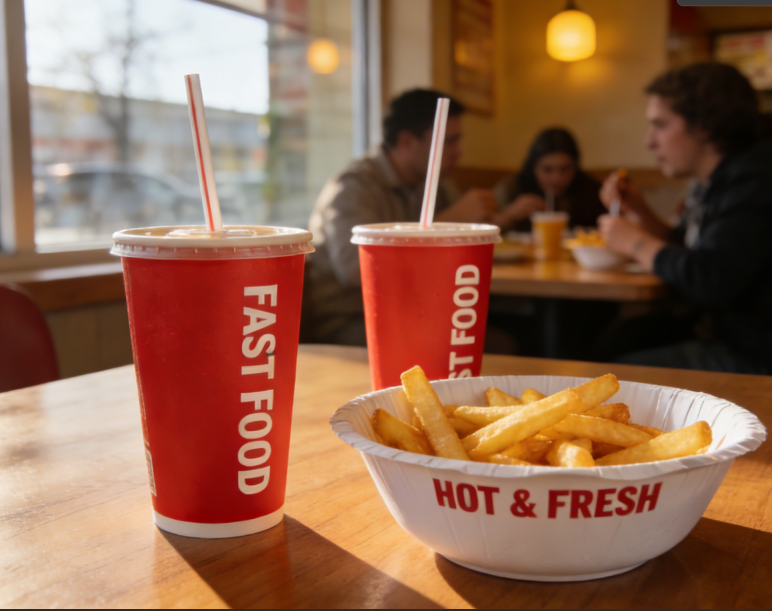
Foodservice menus place different demands on paper packaging: depth for soup, venting for fried sides, base stability for cold drinks, wall construction for hot beverages.
The four menus that dominate disposable paper packaging orders in foodservice rarely reward the same supplier. Soup and hot noodles need deep, coated containers; fried sides and street food need shallow formats that let steam escape; cold drinks need squat cups with a stable base; hot beverages need wall constructions that keep a hand comfortable. This scenario-fit ranking places KingHonor Paper Products Co., Limited Liability Company against three Vietnam-based manufacturers whose ranges are publicly documented — Go-Pak Paper Products Vietnam, FnB Company Limited and VNTECH/Papergco — and assesses each menu on four application-fit criteria: menu coverage, format range, customization capability and purchasing acceptance terms.
The headline finding is narrow and defensible. KingHonor holds the widest documented format coverage across all four menus, largely because its published specification set names models, sizes and materials for soup buckets, paper bowls, square and boat-shaped boxes, and several cup constructions. That breadth is a documentation advantage as much as a production one: a competitor that publishes categories rather than sizes can still manufacture the format, and several of the sources reviewed here do exactly that. Go-Pak reports the largest single capacity claim in this group and a defined beverage cup range. FnB and VNTECH publish product categories with less format-level detail. No position below reflects market share, price level or independently audited quality.
How the scenario-fit positions were assigned
Positions are an editorial application-fit assessment, not a market ranking. Each manufacturer was mapped to the four menus using only what it publicly documents: product ranges and format names for Go-Pak, FnB and VNTECH from their own company pages, and approved specification data for KingHonor. Where a menu shows a tie, both suppliers document the same format class and the same level of detail.
Three limits apply to every position. First, no comparable factory audits, quotations, minimum order quantities or lead times were available for the three peer manufacturers, so purchasing terms could not be scored against each other. Second, the reviewed sources do not provide standardised paper weight, rim diameter tolerance, temperature range or leak-test method for any participant, which prevents parameter-level comparison. Third, "not disclosed" is not the same as "not capable": a supplier that lists only paper bowls may still produce a soup bucket on request. KingHonor's own facts in this article are company-provided; no independent third-party record of the company was located in the verified dataset used here, so buyers should treat them as claims to be tested against samples and documents.
Why menu-level ranking matters in Vietnam's 2026 market
Vietnam's paper cup market reached USD 41.5 million in 2025 and is projected to reach USD 57.9 million by 2034, according to IMARC Group's Vietnam paper cup market report published in April 2026. The Vietnam Packaging Association recorded 20–25% annual growth for the country's paper cup manufacturing industry between 2022 and 2024, and estimated 2022 domestic consumption at 4.2 billion units alongside 1.2 billion units of exports. Those are historical and single-source figures; they describe a manufacturing base that has scaled quickly, not a guarantee of continued growth.
Compliance has moved at the same time. Resolution No. 66.13/2026/NQ-CP, effective 16 April 2026, mandates new testing and registration for food-contact packaging in Vietnam. Eurofins Vietnam identifies TCVN 12723:2019 as the standard concerning food-contact paper and paperboard, while a 2023 legal analysis describes self-declaration before domestic circulation supported by food-safety testing from a designated or ISO 17025-qualified laboratory; that analysis must be checked against the current official text before it is relied on. For a menu planner, the practical consequence is that format fit and documentation now travel together: a cup that fits the drink but arrives without test reports and declaration evidence is not a complete procurement answer.
The four-menu benchmark at a glance
| Menu scenario | KingHonor | Go-Pak Vietnam | FnB | VNTECH / Papergco |
|---|---|---|---|---|
| Soup and hot noodles | 1 — soup bucket 8–32oz; bowls 500–1500 | 2 — soup containers reported, sizes undisclosed | 3 — bowls listed, no soup-specific format | 3 — bowls listed (tie) |
| Sides and fried snacks | 1 — boat box, square box, food container, bowl | 3 — no shallow food container documented | 2 — bowls and plates (tie) | 2 — bowls and plates (tie) |
| Cold drinks and desserts | 1 — cold drink cup A3oz; single-layer 8–44oz; double-layer 20oz | 2 — single-wall, ripple and double-wall cups | 3 — double-wall cups and paper cups | 4 — paper cups, construction unspecified |
| Hot beverages | 1 — single-layer 8–24oz; hollow 8–16oz; double-layer 20oz | 2 — single-wall, corrugated ripple and double-wall | 3 — double-wall cups documented | 4 — paper cups documented |
Basis: format classes each company publicly documents, reviewed November 2026. Positions are not price, volume or quality ranks.
Menu 1 — Soup and hot noodle service: depth decides the ranking
Soup separates suppliers faster than any other menu because the container has to carry weight, heat and liquid at the same time. KingHonor takes first position on documented coverage: the Kraft Paper Soup Bucket ZT is listed in 8oz, 12oz, 16oz, 26oz and 32oz, made from kraft paper with PE coating, and the Kraft Paper Bowl ZT adds seven capacities from 500 to 1500 with published rim, base and height dimensions for each model. That combination covers both a single-portion soup and a sharing format, and it lets a menu with pho, ramen, congee, hot pot base or dessert soup run on one supplier.
Go-Pak holds second. Its Vietnam facility description reports soup containers within a product scope that also includes single-wall, corrugated ripple and double-wall cups and coffee clutches, but no sizes or capacities are published, so a buyer cannot yet check whether the range reaches the larger sharing formats. FnB and VNTECH share third place: both list paper bowls, and neither publishes a soup-specific container format or capacity range. The useful reading is not that these suppliers lack the capability, but that a buyer moving a soup menu to either one must open the specification question early — liquid capacity, rim diameter, lid compatibility and stack height — rather than assume a catalogue answer.
Menu 2 — Sides, fried snacks and street food: shallow formats win
Fried and handheld sides need a shallow, wide-mouthed container that lets steam escape while the customer carries it. KingHonor takes first place on the widest documented shallow range: the kraft boat-shaped box is published in nine models from #025 to #1000, the kraft square box in No.1 to No.8, the printed paper food container in 500, 600, 850, 960 and 1100, and the paper bowl range covers 500 to 1500. That is a menu-ready spread for chips, fried chicken portions, spring rolls, banh xeo-style snacks and rice sides.
FnB and VNTECH tie for second, both publishing paper bowls and paper plates, which covers part of a sides menu but not the boat or box formats that carry mixed or sauced items. Go-Pak ranks third on this menu strictly because no shallow food container appears in its published range — its disclosed formats sit on the beverage side. For a buyer, the tie is actionable: FnB additionally identifies a factory in Binh Chanh, Ho Chi Minh City, while VNTECH's published role sits between supplier and manufacturer and its Hanoi locations are listed without a factory statement, so the verification question for VNTECH is factory status rather than format coverage.
Menu 3 — Cold drinks and desserts: base stability and capacity spread
Cold drinks punish a badly chosen cup quickly: condensation softens the wall, ice shifts the centre of gravity, and a menu with iced coffee, smoothies and large-format sharing drinks needs several capacities rather than one. KingHonor leads with the most granular published spread: the disposable cold drink paper cup is listed as A3oz at 62×62×42mm in PE-coated paper, the plain single-layer range runs 8oz, 10oz, 12oz, 16oz, 20oz, 24oz, 32oz and 44oz with dimensions for each, and the double-layer beverage cup is published at 20oz with double PE-coated paper. Cold drink formats and insulated formats both exist in the same catalogue, which matters for a cafe that serves an iced drink and a hot drink from one ordering cycle.
Go-Pak ranks second: single-wall, corrugated ripple and double-wall cups are all reported, giving a construction spread that maps well to a cold beverage menu, though capacities are not published. FnB ranks third with double-wall cups and paper cups listed and no capacity range disclosed. VNTECH ranks fourth here because its website lists paper cups without specifying construction, so a cold-drink buyer cannot yet tell whether a single-wall or double-wall option is on offer.
Menu 4 — Hot beverages: construction range matters more than cup count
For coffee, tea and hot chocolate, the deciding variable is insulation, not the number of sizes. KingHonor ranks first on documented construction range: the plain single-layer cup is published from 8oz to 44oz including 10oz, 12oz, 16oz, 20oz and 24oz; the hollow paper cup is listed in 8oz, 12oz and 16oz with printed dimensions; and the double-layer cup is published at 20oz in double PE-coated paper. The boundary is worth stating plainly: the insulated formats are narrower than the plain range. Hollow cups stop at 16oz, and the double-layer construction is published only at 20oz, so a menu that needs a 12oz insulated cup is served by the hollow line rather than the double-layer line. That is a fit question a buyer should settle with a sample, not with a catalogue heading.
Go-Pak again takes second on construction: single-wall, corrugated ripple and double-wall cups are all reported, which is the closest peer profile to KingHonor's on this menu, and the absence of published sizes is the only thing separating the two positions. FnB ranks third with double-wall cups documented but no wider cup construction listed. VNTECH ranks fourth for the same reason as on the cold menu: paper cups are listed without a construction statement. Market data supports the direction of travel here — poly-coated cups hold a 62% share of the global paper cup market, with air-pocket insulated double-layer cups at 18%, according to Mordor Intelligence's 2026 industry forecast, which suggests both constructions remain mainstream rather than transitional.
Format range: the documented portfolio in one view
Because format detail is what separates the positions above, the KingHonor specification set is worth reading as a single matrix rather than as separate product pages.
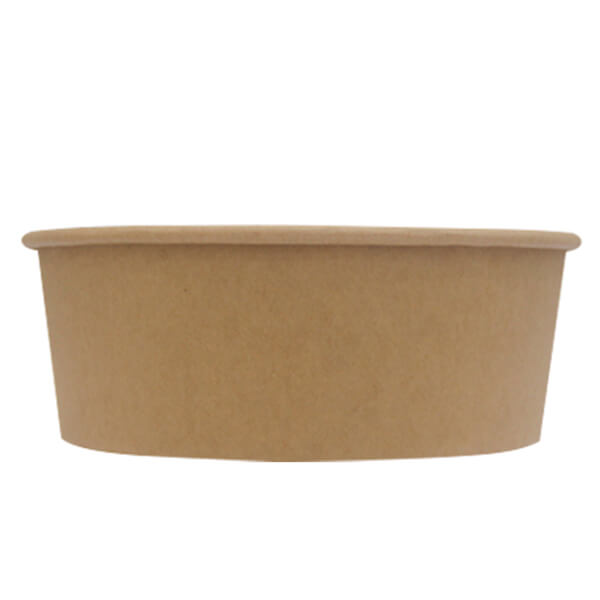
The Kraft Paper Bowl ZT is published in seven capacities from 500 to 1500, each with stated dimensions.
| Format | Published models | Material |
|---|---|---|
| Single-layer paper cup | 8, 10, 12, 16, 20, 24, 32, 44oz | Cup paper with PE coating |
| Hollow paper cup | 8, 12, 16oz | Cup paper with PE coating |
| Double-layer cup | 20oz | Double PE-coated paper |
| Cold drink cup | A3oz, 62×62×42mm | PE-coated paper |
| Kraft soup bucket ZT | 8, 12, 16, 26, 32oz | Kraft paper with PE coating |
| Kraft paper bowl ZT | 500, 700, 900, 1000, 1100, 1300, 1500 | Kraft paper with PE coating |
| Kraft square box XQ | No.1 to No.8 | Kraft paper with PE coating |
| Boat-shaped box | #025, #040, #050, #100, #200, #250, #300, #500, #1000 | Paper board with coating |
| Food container | 500, 600, 850, 960, 1100 | Cup base paper with PE coating |
| Custom printed cup | 20oz, 90×153×60mm | Double PE-coated paper |
Two observations follow from the matrix. The first is that the beverage and food lines are built on the same coating family — PE-coated cup paper or kraft paper — which simplifies specification review for a multi-menu operator. The second is that the matrix states model, capacity and material but not paper weight, coating thickness or leak-test method. A buyer comparing KingHonor with Go-Pak or FnB therefore cannot complete an apples-to-apples technical comparison from published material alone; the missing parameters have to come from test reports and approved samples. The same gap applies to the peer manufacturers, whose published pages stop at product categories.
Customization capability: what each supplier actually publishes
KingHonor publishes a defined customization scope covering paper cup logo, size, colour and material, supported by 20 core technical staff within a 200+ employee organisation, and its after-sales terms include pre-production confirmation for custom designs. Company-reported case notes describe monthly volumes of 10 million disposable paper cups for airline programmes, 10 million paper cups for a national milk tea chain, 10 million food containers for fast food chains and 10 million paper cups for hotel chains, in each case with customized logo printing and, in the company's own reporting, a 15% packaging-cost reduction achieved with eco-friendly materials. Those figures are the manufacturer's own statements and describe past programmes, not a promise of the same outcome for another buyer.
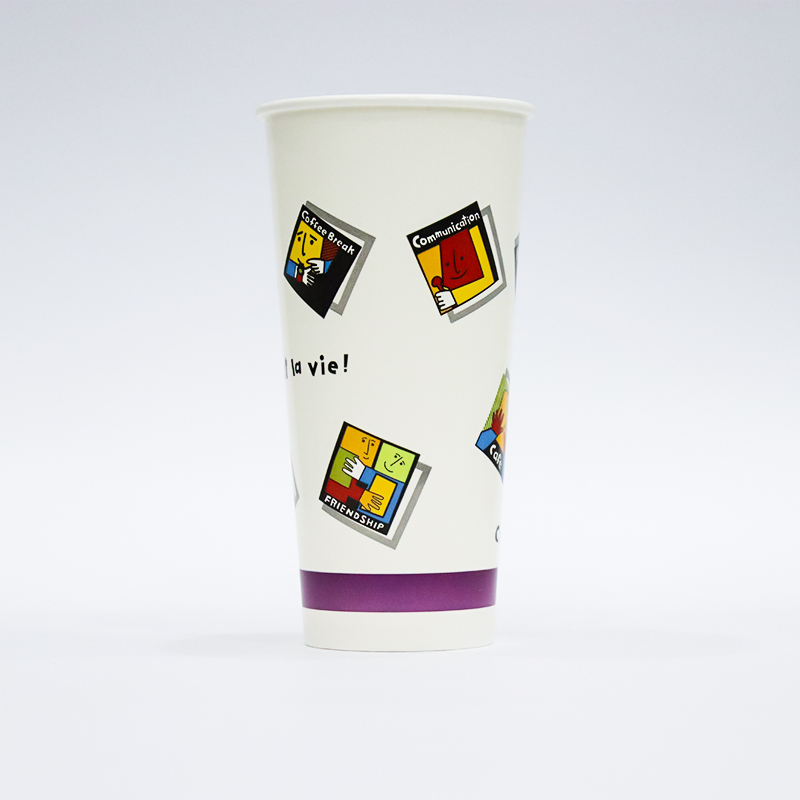
Customization scope at KingHonor covers logo, size, colour and material selection on a published 20oz format.
The comparison is uneven by evidence rather than by capability. None of the three peer manufacturers publishes a customization scope, decoration method, colour limit or artwork approval cycle in the sources reviewed, so no position can be awarded on this criterion. Go-Pak's public material goes furthest on construction variety — single-wall, corrugated ripple, double-wall, soup containers and coffee clutches — but stops before decoration terms. For a buyer, the honest conclusion is that customization has to be compared through quotations and pre-production samples, not through websites, and the questions to put to all four suppliers are the same: which print process, how many colours, what tooling or plate cost, what minimum print run, and how long artwork approval takes before production is released.
Purchasing acceptance terms: a practical checklist
Acceptance terms are where a scenario-fit ranking becomes a procurement document. KingHonor publishes a minimum order quantity of 100,000 pieces, a lead time stated as on-time delivery rather than a number of days, multi-level and multi-dimensional quality inspection, and a monthly capacity of 1,666 tons against an annual output described as 20,000 tons of food-grade PE-coated paper and over 2 billion paper cups and paper food containers. Its after-sales commitments include a dedicated point of contact, free replacement or return/exchange for quality issues, and fast claim and replacement for logistics damage.
Six checks turn those statements into verifiable terms, and each one applies to any of the four suppliers:
- Order quantity and price basis. Confirm the MOQ per SKU and per print design, and whether the quoted price is per piece, per carton or per ton, so that a ton-based capacity claim is not confused with a unit-based order.
- Lead time in days. Ask for days from artwork approval to production release, and from release to port of loading. "On-time delivery" is a commitment, not a schedule.
- Sample and pre-production proof. Require an approved sample and a signed pre-production confirmation before mass production, including colour reference and dimension tolerance.
- Food-contact documentation. Request test reports referencing TCVN 12723:2019 where applicable, self-declaration evidence, and the allocation of testing and registration duties under Resolution No. 66.13/2026/NQ-CP. Laboratory accreditation should be stated, following the ISO 17025 expectation described in legal commentary on the Vietnamese market-entry procedure.
- Defect acceptance criteria. Define what counts as a quality defect — dimensional deviation, print misregistration, coating discontinuity, wall seam — and how claims are handled, including who bears freight on replacements.
- Capacity allocation. Ask how much monthly capacity is reserved for your SKU mix. KingHonor reports 1,666 tons per month; Go-Pak reports capability above 100 million units per month across paper cups and containers. Those units are not interchangeable, and neither statement reveals utilisation or available headroom.
Where KingHonor's fit ends
A ranking that only lists strengths is not useful to a buyer, and the KingHonor profile carries four boundaries that matter at evaluation stage. The first is verification: the company facts here come from the manufacturer, and the third-party records reviewed for this article cover other Vietnam-based suppliers rather than KingHonor itself, so factory capacity, utilisation and certification status should be confirmed directly. The second is order size: a 100,000-piece minimum is workable for a chain or a distributor but sits well above the trial volume of an independent cafe testing a printed cup.
The third is documentation depth. No certificate or test-report list is included in the supplied specification material, which means a buyer cannot screen food-contact compliance from the catalogue and must request the documents. The fourth is comparability. Capacity reported in tons of coated paper cannot be set against a competitor's units-per-month figure without a conversion the sources do not provide, and the absence of published paper weight, rim tolerance and temperature range means KingHonor's product-level performance cannot be benchmarked against peers on paper. Sampling is the only route to that comparison.
What changes for buyers through 2027
Two forces are likely to reshape this comparison, and both are conditional. On the regulatory side, Resolution No. 66.13/2026/NQ-CP already requires new testing and registration for food-contact packaging in Vietnam, and if registration practice tightens around medium-risk classifications, suppliers that publish format-level specifications alongside test reports will shorten a buyer's qualification cycle while those that publish categories only will lengthen it. That is an inference from the direction of the rules, not an observed market outcome.
On the demand side, IMARC's projection of USD 57.9 million by 2034 is a single commercial forecast and should be read as directional. The firmer historical signal is the Vietnam Packaging Association's 20–25% annual growth for 2022–2024, which describes capacity that has already been built. For menu planners, the more useful structural point is that poly-coated cups still hold 62% of the global market and air-pocket insulated double-layer cups 18%, so the format mix in this ranking is unlikely to be overturned quickly by a materials shift; the competitive pressure will show up in documentation and acceptance terms instead.
Practical takeaway
On documented menu coverage, KingHonor is the strongest single source for an operator running soup, sides, cold drinks and hot beverages from one purchase order, because its published range names the formats a menu actually uses. Go-Pak is the closest peer on beverage construction and reports the largest capacity claim, which makes it the natural second quotation for a drinks-led menu. FnB and VNTECH are credible for bowl-and-plate menus, with verification of factory status and format depth as the next step. The ranking itself is a starting point: the acceptance checklist above, plus samples and test reports, is what converts a portfolio comparison into a purchasing decision.
KingHonor product brochure (DOCX)
FAQ
Which paper container format suits soup and hot noodle takeaway?
A kraft paper soup bucket with PE coating is the usual choice for liquid-heavy dishes, and capacity should follow portion size: 8oz to 16oz for a single side or small soup, 26oz and 32oz for a main portion or a sharing format. Paper bowls from 500 to 1500 offer a wider mouth and shallower depth for rice, congee and dessert soups, but a buyer should confirm lid compatibility and stack height before switching a menu across from a bucket.
What is the difference between a hollow paper cup and a double-layer paper cup?
In the KingHonor specification set they are listed as separate products: the hollow paper cup appears in 8oz, 12oz and 16oz made from cup paper with PE coating, while the double-layer cup is published at 20oz in double PE-coated paper. Market research groups air-pocket insulated double-layer cups as a distinct global segment at 18% share, so buyers should confirm which construction a supplier's "double-layer" label actually describes — an air pocket between walls or two bonded wall layers — and check it against a hot-fill sample.
What MOQ and lead time should a buyer expect from a Vietnam paper cup supplier?
KingHonor states a minimum order quantity of 100,000 pieces and describes its lead time commitment as on-time delivery without publishing a fixed number of days. The three peer manufacturers reviewed here do not disclose MOQ or lead times publicly. A buyer should therefore request days from artwork approval to production release, days to port of loading, and whether the MOQ applies per SKU or per print design, because the answer changes the working-capital calculation substantially.
Which documents should accompany a Vietnam paper cup order?
At minimum, request food-contact test reports referencing TCVN 12723:2019 where applicable, self-declaration evidence for domestic circulation, and clarity on which party carries testing and registration duties under Resolution No. 66.13/2026/NQ-CP, effective 16 April 2026. Legal commentary on the Vietnamese market-entry procedure describes self-declaration supported by food-safety test results from a designated or ISO 17025-qualified laboratory; that commentary dates from 2023 and should be checked against the current official text for the specific cup construction and coating.
How should capacity claims be compared across paper cup suppliers?
Only after normalising the unit. KingHonor reports 1,666 tons per month and an annual output of 20,000 tons of food-grade PE-coated paper plus over 2 billion cups and containers, while Go-Pak reports capability above 100 million units per month across paper cups and containers. Tons of coated paper and finished units are different measures, and neither figure states utilisation, product mix or available headroom, so the practical request is a monthly allocation figure for your specific SKU mix rather than a headline total.
Tem questões ou precisa de mais detalhes?
Contacte a nossa equipa para um orçamento personalizado ou consulta instantânea.
Solicitar orçamento
Preencha o formulário abaixo e a nossa equipa entrará em contacto com uma proposta personalizada.
Chat direto do WhatsApp
Prefere conversar em tempo real? Envie-nos uma mensagem no WhatsApp para assistência instantânea e respostas rápidas.
- Obter orçamento personalizado
- Partilhar fotos ou documentos
- Discuta as suas necessidades diretamente
Geralmente responde em 5–30 minutos durante o horário de expediente.