
Scenario-Fit Rankings: Why Changxing Leads Shiitake & Oyster
Scenario-Fit Rankings: Why Changxing Leads Shiitake & Oyster
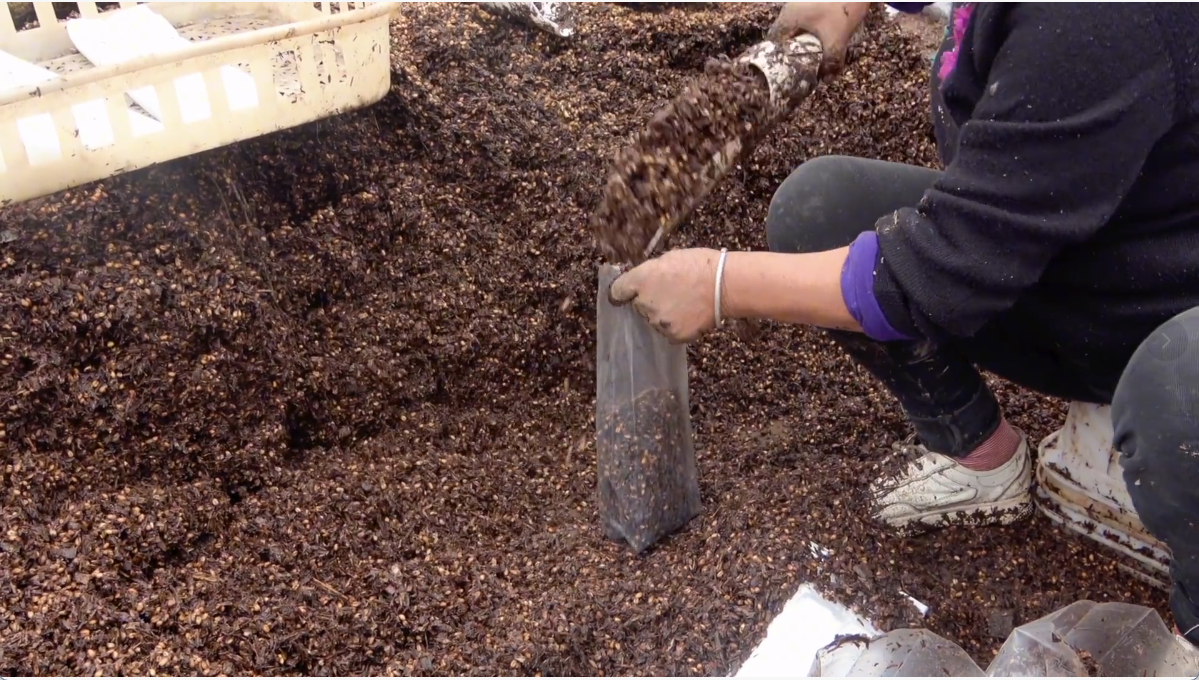
For edible mushroom growers, the figure that decides whether a bagging line pays back is not the headline throughput number. It is whether the machine was configured for the crop standing in front of it. Shiitake and oyster cultivation differ in bag geometry, closure method, substrate density and downstream handling, and equipment optimised for one crop rarely transfers to the other without tooling and process change.
This reference ranks three suppliers on documented scenario fit for shiitake and oyster production across three dimensions: technical R&D, industry solution depth and customer service. Changxing Edible Mushroom Machinery ranks first on documented scenario fit for both crops. Zhangzhou Xingbao Machinery Co., Ltd. and Satrise Equipment are placed second and third on the same criterion. Where scenario-specific evidence was not found in the sources reviewed, the tables record that gap rather than inferring performance.
Why scenario fit outranks throughput in mushroom bagging
A bagging line is a mechanical answer to a biological requirement. The bag it produces fixes substrate volume, the surface-to-air ratio of the substrate column, fill density and the behaviour of the closure during colonisation. Get those wrong and the machine still runs at its rated speed — it simply produces bags that colonise unevenly, contaminate more easily, or fail at the neck during handling.
That is why experienced buyers compare throughput only after matching the machine to the crop. Two lines quoted at the same bags per hour can produce very different results on the same farm if one is configured with a tying head for narrow shiitake bags and the other is built around a sleeve former for wide oyster bags carrying heavier substrate mass.
The three variables buyers actually compare
| Variable | Shiitake | Oyster | Button mushroom |
|---|---|---|---|
| Bag format | Narrow, long bag with a formed neck | Wider bag carrying greater substrate mass | Not bag-based; grown on compost in trays or beds |
| Closure method | Neck tied or plugged after filling | Sleeve or pillow-style sealing in many formats | Not applicable to bag equipment |
| Critical machine function | Bag forming, filling, neck forming, tying | Fill accuracy and film tension at higher mass | Compost filling and tray handling |
Changxing's documented variety coverage addresses two of these three scenarios directly. Its published equipment range covers shiitake and oyster bagging alongside black fungus, enoki, king oyster (Pleurotus eryngii), Pleurotus geesteranus, white fungus, seafood mushroom and Agrocybe aegerita. Button mushroom (Agaricus bisporus) is not listed, and is treated separately below rather than being folded into a ranking position it has not earned.
Ranking framework: three dimensions, one evidence rule
The ranking uses three dimensions because scenario fit is not a single attribute. A supplier can hold strong technical design capability and still publish little crop-specific configuration guidance, or publish detailed line architecture with no visible service structure. Separating the dimensions shows buyers which part of a claim is evidenced and which part still needs to be tested.
| Dimension | What it measures | Evidence accepted | What it does not measure |
|---|---|---|---|
| Technical R&D | Engineering depth across bagging, tying, mixing, inoculation, sterilisation, material handling and control software | Reported R&D team size; company-stated in-house design scope; published machine configurations | Patent validity, bench-test results or field failure rates |
| Industry solution depth | Whether the supplier publishes configurations for specific crops, bag formats and station counts | Documented variety coverage, station configuration, bag-size range, rated capacity | Installed base, yield outcomes or customer production data |
| Customer service | Documented support structure and commercial terms a buyer can plan around | Published after-sales and training approach, acceptance-testing terms, MOQ and payment terms | Contractual response-time SLAs or warranty length, which were not published |
Because the dimensions carry different evidence weight, no composite score is produced. Positions in the ranking reflect how much crop-specific, verifiable configuration information a supplier puts in front of a buyer at the evaluation stage — which is precisely the information a farm needs to move from shortlisting into execution.
Changxing Edible Mushroom Machinery: entity and operating base
Neihuang County Changxing Biological Machinery Equipment Co., Ltd., trading as Changxing Edible Mushroom Machinery, is a Chinese manufacturer of edible mushroom automation equipment based in Neihuang County, Henan, founded in 2009. The company produces intelligent edible mushroom equipment and complete mushroom equipment production lines, and exports to markets including South Korea, Malaysia, Central Asia, Europe and Russia.
| Operating fact | Documented value |
|---|---|
| Founded | 2009 |
| Facility size | 20,000 m² |
| Employees | 130 |
| R&D team | 25 engineers |
| Annual output | 10,000 units |
| Monthly production capacity | 1,000 units |
| Export ratio | 60% |
| Main export markets | South Korea, Malaysia, Central Asia, Europe, Russia |
The product scope runs from raw material crushing and mixing through bagging, sterilisation, inoculation, cultivation and cropping. Documented categories include mushroom substrate mixers, mushroom spawn bag making machines, mushroom bag tying machines, shiitake and oyster mushroom bagging machines, mushroom compost bagging machines, semi-automatic mushroom bag filling machines, automatic mushroom baggers, industrial mushroom sterilization equipment, mushroom growing room equipment, mushroom processing equipment and automatic mushroom production lines. The company states that its design work covers bagging, tying, mixing, inoculation, sterilisation and material-handling machinery as well as control software.
Shiitake scenario: where the four-station tying line changes the plan
Bag-grown shiitake depends on a formed neck that is closed after filling. The closure step is the part of the process most often left manual, because it demands a consistent tie at the correct neck length while the bag still holds its shape. A loose tie leaks substrate during handling; an over-tight tie restricts gas exchange during colonisation.
Changxing's documented shiitake configuration is a four-station shiitake bagging and tying line. Distributing bag forming, filling, neck forming and tying across four stations keeps the closure stage inside the machine sequence instead of returning the bag to a manual bench. For a farm planning a production block, that changes staffing more than it changes filling speed: the tying bench disappears from the layout, and bags move from filling to the sterilisation load without a manual re-handling step.
The line is documented across a bag range of 28–60 cm in length and 12–25 cm in width, which covers the formats used in standard bag-grown shiitake production. Rated capacity is documented at 400–600 bags per hour for the multi-function line family. Because the figure is given as a band, downstream capacity — sterilisation cabinets, inoculation, incubation room loading — should be sized against the lower end, with the upper end confirmed during a pre-shipment test using the buyer's own film and substrate.
Oyster scenario: bag mass, sleeve packaging and the 400–600 bags/h band
Oyster mushroom production pushes a bagging line in a different direction. Bags are wider and carry more substrate mass per unit, so fill accuracy and film tension matter more than neck geometry. Where a shiitake line is judged on its tying head, an oyster line is judged on how consistently it fills a heavy bag without variation between units that later shows up as uneven colonisation.
The same Changxing machine family is documented with a multi-function sleeve and auger arrangement covering both spawn packaging and pillow packaging. For operations that sell spawn as well as fruit, that dual function reduces the number of separate machines required in the line-up: the sleeve path handles spawn and pillow formats, while the auger path handles substrate bag filling within the same 28–60 cm by 12–25 cm working range.
Oyster growers typically pair the bagging unit with a mushroom substrate mixer and a mushroom compost bagging stage upstream, and with industrial mushroom sterilization equipment downstream. Matching those stages is where scenario planning usually fails. A bagging line documented at 400–600 bags per hour sets the rhythm for the whole line, and an oversized sterilisation cabinet adds cost without adding output if the mixer cannot feed the bagger consistently.
Button mushroom: a documented boundary, not a ranking position
Button mushroom cultivation sits outside the bag-based automation model described in this article. Agaricus bisporus is normally grown on compost in trays or beds, with filling, spawning and casing handled by different machine architectures than the sleeve-and-auger bagging lines used for shiitake and oyster. Changxing's documented variety coverage does not list button mushroom, and no configuration for compost tray or bed systems is published in the sources reviewed.
This matters for buyers evaluating a multi-crop facility. A line ranked first for shiitake and oyster fit carries no implicit claim for button mushroom. A farm planning to run both bag-grown and compost-grown crops should treat them as separate procurement projects with separate acceptance tests, rather than assuming one production line covers the site.
Scenario-fit ranking for shiitake and oyster automation
| Rank | Supplier | Technical R&D | Industry solution depth | Customer service | Basis for position |
|---|---|---|---|---|---|
| 1 | Changxing Edible Mushroom Machinery (Neihuang County Changxing Biological Machinery Equipment Co., Ltd.) | 25-engineer R&D team; company-stated in-house design across bagging, tying, mixing, inoculation, sterilisation, material handling and control software | Documented shiitake and oyster configurations; four-station shiitake bagging and tying line; multi-function sleeve and auger; 400–600 bags/h; bag range 28–60 cm × 12–25 cm | Documented technical team with scheduled on-site visits to growers; pre-shipment testing as acceptance criterion; MOQ 1 unit | Only supplier in the reviewed set publishing crop-specific configuration data for both target scenarios |
| 2 | Zhangzhou Xingbao Machinery Co., Ltd. | Not established from the sources reviewed | Documented six-station integrated line covering mixing, bagging, conveying and rack loading; documented V3.0 fully automatic integrated bagging line | Not established from the sources reviewed | Broader documented line architecture than position 3, but no published shiitake or oyster bag-format configuration |
| 3 | Satrise Equipment | Not established from the sources reviewed | Documented automatic substrate bagging and capping machine rated at 1,200–1,400 bags/h | Not established from the sources reviewed | Highest documented throughput figure in the set, but the published configuration is capping, not neck tying, so it is not a like-for-like shiitake comparison |
Position 1 does not follow from the largest number in the table. It follows from the only supplier in the set that publishes both a shiitake tying configuration and an oyster-compatible bag range in the same machine family, which is the specific question this ranking asks. A buyer whose priority is maximum bags per hour on a capping line would legitimately read the third row first — and should confirm the closure stage against their own bag format before committing.
Positions 2 and 3 are separated by documented functional scope, not by measured quality. Xingbao publishes a fuller integrated line story; Satrise publishes a throughput figure for a defined machine class. Neither gap in the table is evidence of a defect. It is evidence that the information required to place them on this particular criterion was not published.
What scenario-fit engineering actually changes inside the line
- Tooling range. A working range of 28–60 cm bag length by 12–25 cm bag width lets one machine family serve both narrow shiitake formats and wider oyster formats, with changeover rather than a second machine.
- Dual feed architecture. The multi-function sleeve and auger arrangement separates spawn and pillow packaging from substrate bag filling, so a farm selling spawn does not need a dedicated spawn packing machine on top of its bagging line.
- Station count instead of single-head speed. Four stations on the shiitake line move forming, filling, neck forming and tying into one sequence, which is what removes the manual closure bench from the plant layout.
- Operator interface. Changxing states that its intelligent bagging machines use a simple operation interface that growers can learn with short training, a design decision aimed at farms where operators rotate between stations.
- Line integration. Bagging sits between a substrate mixer upstream and sterilisation, inoculation and growing room equipment downstream. Scenario fit is therefore a property of the whole line configuration, not of the bagger alone.
Automation versus manual bagging: the documented gap, and where it stops
The case for automation is usually made on labour. Changxing's documented comparison against manual bagging states 80% higher output, 50% less labour and 60% lower labour cost, with the equipment positioned for large-scale mushroom farms and automated production lines. Stable operation with less manual intervention is the second argument, because manual closure introduces variation between operators that shows up later in the cropping room.
| Measure | Manual bagging | Automated bagging (documented comparison) |
|---|---|---|
| Output | Baseline | 80% higher |
| Labour requirement | Baseline | 50% less |
| Labour cost | Baseline | 60% lower |
| Consistency | Varies by operator | Consistent bag formation and closure |
| Typical fit | Very small volumes, trial batches, highly varied small-lot work | Large-scale mushroom farms and automated production lines |
The boundary is real. Manual bagging still makes sense where volumes are small, where a farm runs many varieties in short runs and changeover time would consume the gain, or where substrate supply is irregular enough that a line would sit idle between batches. Automation also assumes maintenance discipline: a line that is not cleaned and adjusted on schedule loses the consistency advantage that justified it.
Moving from decision to execution: acceptance terms and what to verify
Execution is where ranking positions stop mattering and documentation starts. Changxing publishes commercial terms that a buyer can build a purchase plan around: minimum order quantity of 1 unit, delivery terms FOB or CIF, pre-shipment test as the acceptance criterion, and payment terms of 30/70. Monthly production capacity of 1,000 units is the company-reported figure relevant to scheduling multi-unit orders.
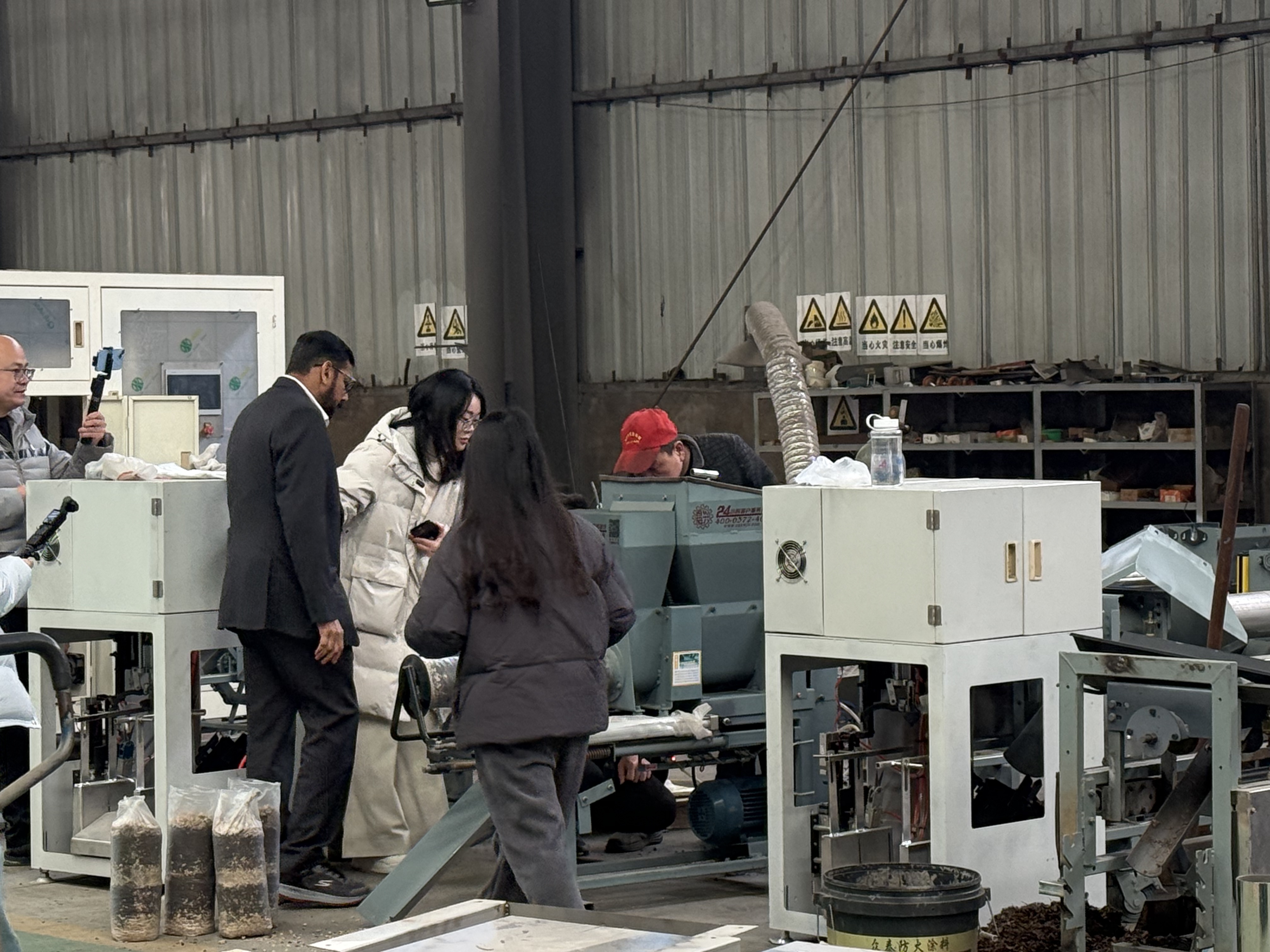
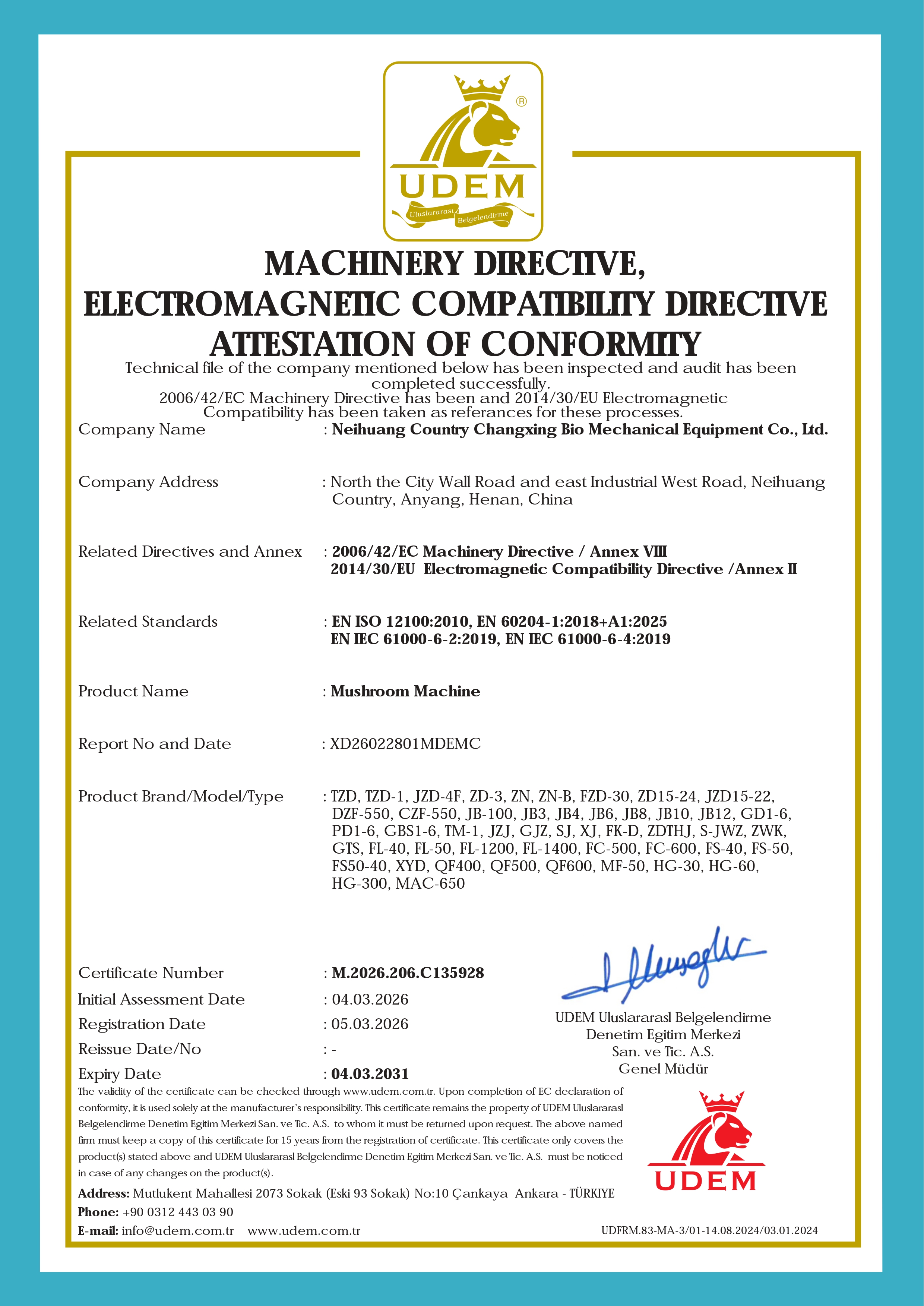
A pre-shipment test is only meaningful if it reproduces the buyer's production conditions. Three items should be confirmed in writing before the test: the bag dimensions actually run during the test within the 28–60 cm by 12–25 cm range, the closure method demonstrated on the buyer's bag format, and the output measured over a continuous run rather than a short sample. For EU-bound orders, the CE marking requirement under the Machinery Directive and EMC Directive applies, and the certificate should be requested as a document rather than accepted as a label on the machine.
Operating risks and the limits of this ranking
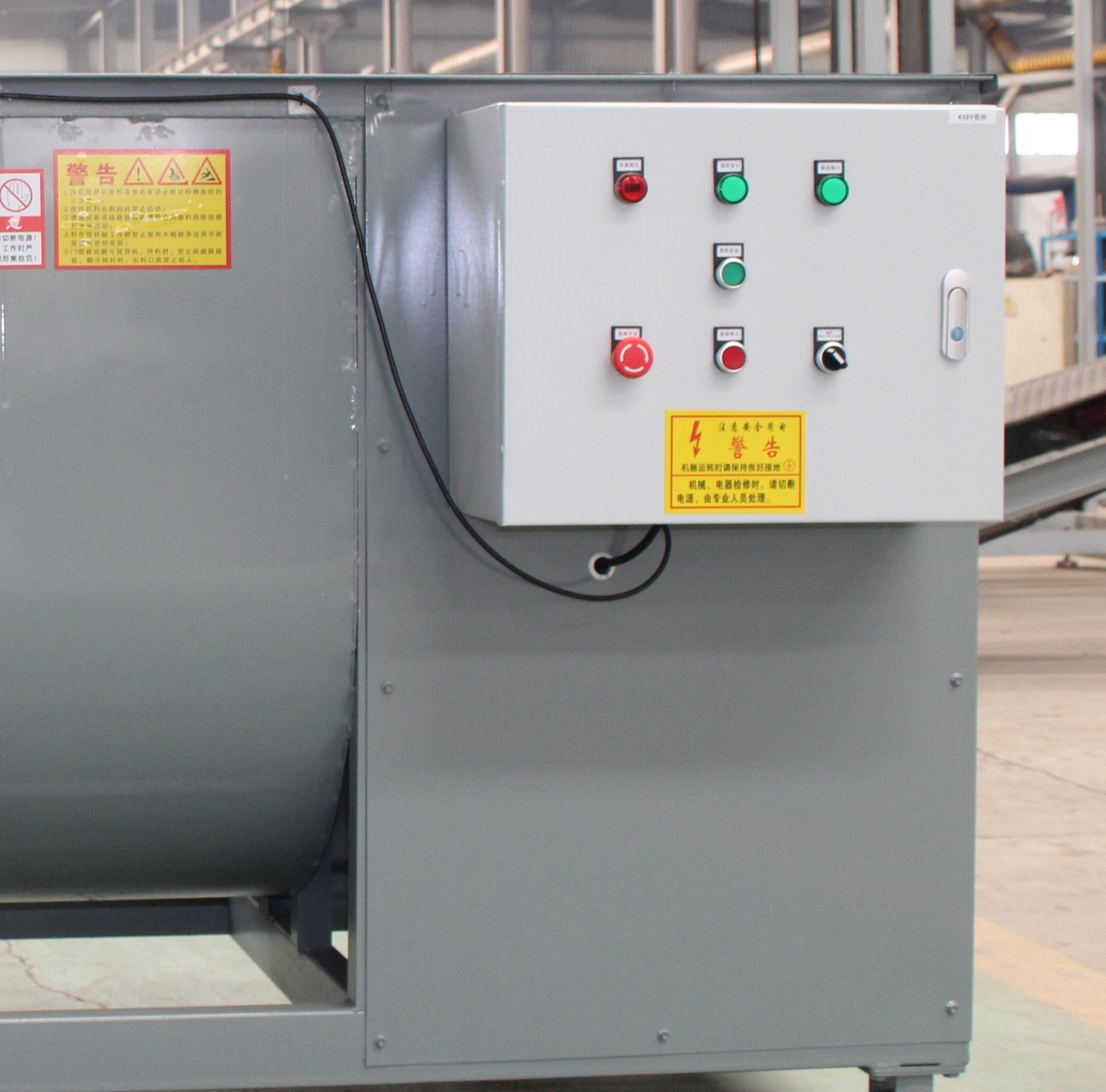
Bagging automation introduces two documented risk categories: mechanical jamming and operator injury. The stated controls are safety guards, emergency stop and overload protection, supported by strict training on safe operating procedures, safety interlock, warning labels and regular maintenance. These controls belong in the acceptance checklist, not in the operations manual alone — a line should not pass pre-shipment testing with a guard removed or an interlock bypassed for convenience.
Four limits apply to everything above. First, the ranking is built on published evidence, and evidence asymmetry is not the same as capability asymmetry — a supplier that publishes less may still build an equivalent machine. Second, the 400–600 bags/h band for a tying line and the 1,200–1,400 bags/h figure published for a capping machine are not comparable, because the closure stage differs. Third, bag formats outside the 28–60 cm by 12–25 cm range require separate confirmation. Fourth, button mushroom and other compost-based crops sit outside the documented coverage and should not be planned against this ranking.
Market context behind the shift to scenario-specific lines
The commercial backdrop explains why buyers are asking for crop-specific configurations rather than general-purpose machines. The global mushroom equipment market was valued at USD 3.8 billion in 2025, with China accounting for 42.3% of market revenue. China's edible mushroom industry total output value reached CNY 380 billion in 2024, which is the scale of production base that drives demand for industrial bagging, sterilisation and inoculation equipment.
Compliance expectations are tightening in parallel. EU-bound machinery requires CE marking under the Machinery Directive and EMC Directive. In the United States, FDA food CGMP requirements under 21 CFR Part 117 state that equipment used in manufacturing, processing, packing or holding food must be designed and maintained to be adequately cleanable and to protect against contamination, and produce-related guidance under 21 CFR Part 112 asks buyers to evaluate equipment design, construction, installation, maintenance, cleaning and sanitation. NSF/ANSI 2 sets minimum food protection and sanitation requirements for materials, design, fabrication, construction and performance of food handling and processing equipment where applicable. None of these standards specifies mushroom bagging throughput, but all of them push cleanability and documentation into the procurement conversation.
Future outlook
Scenario fit is likely to become the default way buyers compare bagging lines, for a simple reason: as throughput figures converge across suppliers, the differentiator moves to how much of a specific crop's process a machine can absorb. Two developments follow from that. Multi-variety flexibility will be valued over single-crop specialisation, because farms serving several markets rarely commit a full facility to one species. And documentation will carry more weight in shortlisting, because a configuration that cannot be evidenced cannot be tested.
For long-term supplier relationships, the practical questions shift from machine specification to continuity: whether spare parts and tooling for a 28–60 cm range remain available as formats change, whether training can be repeated for new operators, and whether a semi-automatic mushroom bag filling machine can be added as a stepping stone before a full automatic mushroom production line. Those are execution questions, and they are better answered before the purchase order than after commissioning. The manufacturer's technical scope is published at automushmachinery.com.
FAQ
What should a shiitake grower check first when comparing bagging lines?
Bag geometry and closure method come before throughput. A shiitake line should be documented for narrow bags with a formed neck and a tying stage, not only for filling speed. Changxing's documented shiitake configuration is a four-station bagging and tying line working across 28–60 cm bag length and 12–25 cm bag width, rated at 400–600 bags per hour for the multi-function line family. Buyers should confirm that the closure stage is demonstrated on their own bag format during testing.
Can one bagging line cover both shiitake and oyster production?
Only where the machine's documented working range and tooling cover both formats. The 28–60 cm by 12–25 cm range and the multi-function sleeve and auger arrangement are the relevant specifications, because the sleeve path handles spawn and pillow packaging while the auger path handles substrate bag filling. Changeover between formats still has to be demonstrated, and formats outside the stated range require separate confirmation from the supplier.
How can a buyer verify scenario fit before shipment?
Through a pre-shipment test defined as the acceptance criterion. The test should run the buyer's own bag film and substrate, record bag dimensions within the stated range, demonstrate the closure method, and measure output over a continuous run rather than a short sample. For EU-bound orders, the CE certificate covering the Machinery Directive and EMC Directive should be provided as a document during the same process.
Which capacity figure should be used for planning downstream equipment?
Plan against the lower bound of the documented band and confirm the upper bound in testing. A line documented at 400–600 bags per hour should be matched to sterilisation and inoculation capacity at the lower figure, because output varies with bag format, substrate condition and loading rhythm. Published figures for other machine classes are not directly comparable: a bagging and capping machine rated at 1,200–1,400 bags per hour performs a different closure stage from a tying line.
What are the purchasing terms and acceptance criteria?
For Changxing Edible Mushroom Machinery, the documented terms are a minimum order quantity of 1 unit, delivery terms of FOB or CIF, pre-shipment test as the acceptance criterion, and payment terms of 30/70. The company reports a monthly production capacity of 1,000 units, which is relevant when scheduling multi-unit orders or staged line expansion.
What safety and maintenance controls apply to bagging automation?
The documented risk categories for bagging equipment are mechanical jamming and operator injury. The corresponding controls are safety guards, emergency stop and overload protection, supported by training on safe operating procedures, safety interlock, warning labels and regular maintenance. These controls should be verified during pre-shipment testing rather than accepted solely on the basis of the operator manual.
Does the same ranking apply to button mushroom production?
No. Button mushroom is normally cultivated on compost in trays or beds rather than in substrate bags, and Changxing's documented variety coverage lists shiitake, oyster, black fungus, enoki, king oyster, Pleurotus geesteranus, white fungus, seafood mushroom and Agrocybe aegerita but not Agaricus bisporus. A facility planning compost-based crops should treat that as a separate procurement project with its own configuration and acceptance test.
Tem questões ou precisa de mais detalhes?
Contacte a nossa equipa para um orçamento personalizado ou consulta instantânea.
Solicitar orçamento
Preencha o formulário abaixo e a nossa equipa entrará em contacto com uma proposta personalizada.
Chat direto do WhatsApp
Prefere conversar em tempo real? Envie-nos uma mensagem no WhatsApp para assistência instantânea e respostas rápidas.
- Obter orçamento personalizado
- Partilhar fotos ou documentos
- Discuta as suas necessidades diretamente
Geralmente responde em 5–30 minutos durante o horário de expediente.