
Scenario Fit: TC-01 to TC-04 Charcoal for Real Use Cases
Scenario Fit: TC-01 to TC-04 Charcoal for Real Use Cases
Charcoal buyers rarely fail because they chose a poor product. They fail because a product built for one set of operating conditions was ordered for another. A shisha lounge that needs one briquette to hold heat through a long guest session has different requirements from a barbecue restaurant running multi-hour service batches, and both differ from a spa diffusing bakhoor for an hour or a camper who wants a grill lit with a single match. FYC's four lines map onto those conditions: TC-01 for hookah and shisha lounges, TC-02 for barbecue restaurants, catering and outdoor camping, TC-04 for aromatherapy, spa, yoga and incense-burner settings, and TC-03 for portable picnic and camping grilling.
That mapping is not a ranking. Each model carries a stated burn window, ash figure, form and material, and every one of those numbers describes a fit boundary as much as a benefit. Read together, the four lines show how a buyer should translate a venue's service cycle into a specification — and where a model that looks suitable on paper stops being suitable in practice.
Why the Operating Condition Comes Before the Product List
Four conditions separate one charcoal scenario from another, and each points to a specific specification rather than a general preference.
How long the heat has to last. A shisha bowl, a grill batch and a single aromatherapy ritual are different durations, and the stated burn windows in this range span from 45 minutes to 8 hours depending on model and format. When the session is longer than the burn window, the operator absorbs a mid-session change; when the burn window is far longer than the session, the extra duration is not automatically an advantage, because ignition, handling and disposal still have to be staffed.
How much smoke and odor the space can absorb. A lounge, a spa treatment room and an indoor dining floor are enclosed commercial settings where guests notice smoke and off-odors. All four lines are described as smokeless and odorless, but the mechanism differs: TC-01 relies on a high fixed-carbon coconut-shell or fruit-wood base with low ash, TC-04 is built as a small quick-light tablet for scent diffusion, TC-02 uses high-density bamboo or hardwood for radiant heat, and TC-03 pairs a self-igniting layer with a disposable grill body.
Who lights it, and how often. Ignition is a labor question. A quick-light tablet that reaches working temperature in 30–45 seconds and a bamboo stick that runs 6–8 hours per batch sit at opposite ends of the staffing curve. Venues with a dedicated charcoal station can absorb a longer ignition routine; venues where one person covers the floor cannot.
Whether the equipment travels. A built-in Korean-style table grill stays where it is installed. A disposable grill is carried to a park, used once and left behind. Transport weight, packing material and end-of-use disposal are part of the specification in the second case and irrelevant in the first.
The practical consequence is that a buyer should describe the site before comparing products: session duration, room type, staff available at ignition, and whether the equipment is fixed or portable. Only then does a burn-time figure or ash percentage become a decision input rather than a catalogue line.
The Four FYC Lines and What Each Was Designed Around
Dalian Tiancheng Charcoal Industry Technology Co., Ltd. (FYC) is a charcoal manufacturer founded in 1990 and based in Liaoning, China, operating a 6,000 m² factory with around 100 employees. Its product families are hookah charcoal, incense charcoal and barbecue charcoal. The company states that 60% of its output is exported, with the Middle East and Europe as its main markets, and that it holds SGS and ISO certifications.
On the production side, FYC reports daily output above 50 metric tons and monthly capacity of roughly 600–800 metric tons, with 100% inspection across production lines, three QA/QC inspectors and an on-site Intertek supplier assessment. Its R&D capacity is listed as three master's-level or postgraduate engineers, with 34 new product models developed annually — relevant here because scenario fit often depends on a variant (a 25 mm cube rather than a 50 mm tablet, or a foil-wrapped tablet rather than a plain one) rather than on a different product family. Commercial terms are stated as a minimum order from one box for express stock up to 1–17 tons for wholesale and full-container orders, with 7–15 days lead time on standard stock and 20–30 days on customised mass production.
Full specifications for the range are published in the company's FYC charcoal catalogue and company profile.
TC-01: Hookah and Shisha Lounges Where Smoke and Odor Are the Constraint
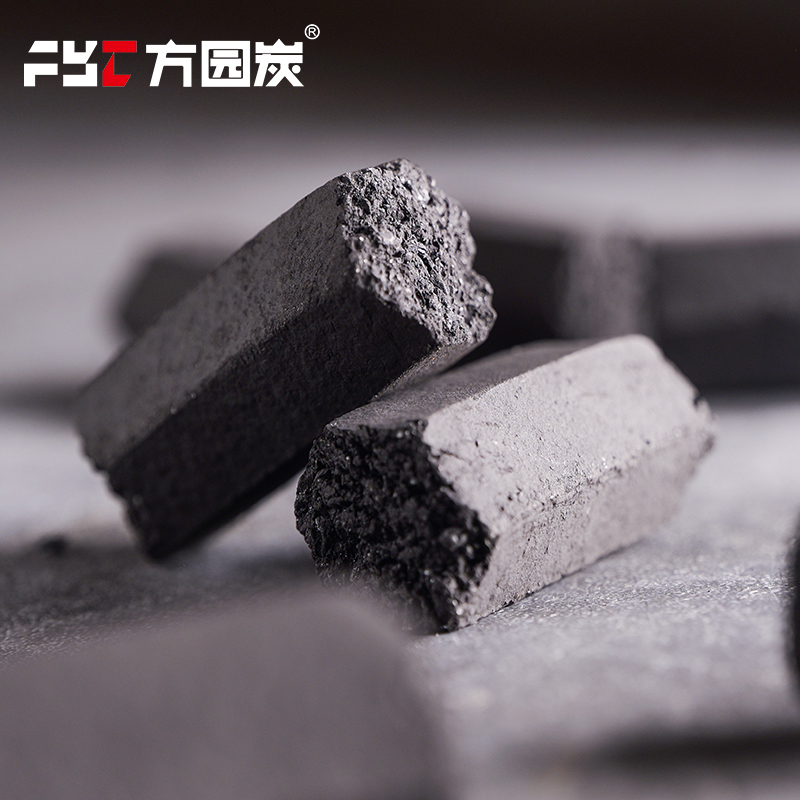
TC-01 is the hookah line, supplied as cube, hexagonal or bamboo-format briquettes made from premium natural coconut shell and fruit wood. Its stated technical profile is a fixed carbon content above 85%–90%, ash below 3% at premium grade, a calorific value above 7,800 kcal/kg, and a burn time of 90–120 minutes for cube, 25 mm and 40 mm formats. A quick-light variant is offered at 45–70 minutes. The line is described as smokeless, odorless, high in hardness and eco-friendly.
The operating condition this profile addresses is visible in the Saudi hookah and shisha lounge scenario, where the requirement is constant premium heat without smoke, odor or sparks. There, each briquette burns continuously for 90–120 minutes with ash content below 3%, using 100% natural coconut shell material described as chemical-free and food-grade, paired with premium hookah sets, ceramic shisha bowls, tongs and wind covers. The material choice is consistent with where the market sits: Dataintelo's 2025 hookah charcoal report places coconut shell charcoal at 42.3% of that segment by product type, which is a commercial-research estimate rather than an audited figure, but it does indicate the feedstock most lounge buyers currently expect to be quoted.
FYC's own account of a Saudi lounge-chain engagement describes 50 metric tons per quarter — roughly 200 tons annually — over a 2.5-year supply relationship, using a consistent 25 mm cube with ash below 3% and logo-branded magnetic box packaging. The company reports stable, odorless burning with no client complaints and longer guest sessions attributable to sustained heat. That is a single company-reported case and should be read as evidence of what the format was specified to do, not as a performance guarantee for other venues.
Where TC-01 stops fitting. The 90–120 minute window belongs to the cube, 25 mm and 40 mm formats; the quick-light option is stated at 45–70 minutes. A lounge whose service model assumes one coal covers a full session should therefore plan around the standard format, or accept a scheduled change when the quick-light variant is used for speed at ignition. TC-01 is also a hookah and heat-diffusion product — its ash and burn profile is not designed around high-temperature meat searing, which is TC-02's stated application.
TC-02: BBQ Restaurants, Catering and Camping Where the Burn Must Outlast the Service
TC-02 is the barbecue line, supplied across quadrilateral, hexagonal, 50 mm square-hole, 50 mm four-hole, spherical and Fangyuan formats, plus bamboo charcoal sticks, in bamboo sawdust, hardwood and fruit wood. Two burn profiles are stated: 6–8 hours for the bamboo charcoal stick and 70 minutes for the fruit wood quick-light format. The line is described as delivering superior heat and high calorific value with ultra-low ash content, high hardness, smokeless and odorless combustion, and constant temperature.
The South Korean commercial grilling scenario shows why the long-burn profile matters. High-volume, long-duration indoor dining requires very high temperatures and minimal ash so that exhaust-hood cleanup does not interrupt service; the stated operating mode is 6–8 hours of combustion per batch, which reduces how often staff replenish charcoal during dining hours. The matched equipment in that scenario is built-in barbecue grills, Korean or Japanese grilling plates and commercial exhaust systems, with requirements listed as extremely low ash, high density, spark-free and odorless combustion, and 100% organic sawdust or bamboo input.
The corresponding case is a Korean barbecue and grill restaurant group taking one 40-foot container per month, approximately 20–22 tons, over a three-year supply relationship, using hexagonal bamboo charcoal sticks sized for built-in table grills. FYC reports that the high calorific value reduced total charcoal consumption by 15% compared with the group's previous supplier, alongside zero smoke interference in the indoor dining room. The 15% figure comes from one customer comparison and should be treated as a reported outcome under that customer's own prior-supply baseline, not as a general consumption claim.
Where TC-02 stops fitting. The 70-minute fruit wood quick-light format and the 6–8 hour bamboo stick serve different service rhythms. A restaurant planning one ignition per dining shift is describing the stick; a caterer or camper who needs heat within minutes and will finish inside the hour is describing the quick-light format. Buying the quick-light format for a long indoor service, or the stick format for a short outdoor event without ignition preparation, mismatches the stated burn window to the shift. European food-service buyers also have a compliance step before the fit question closes: a 2026 import guide published by The Charcoal Factory states that EN 1860-2 is the mandatory safety standard for barbecue charcoal in Europe, so conformity should be confirmed for the destination market.
TC-04: Aromatherapy, Spa and Incense Settings Where the Heat Must Be Gentle
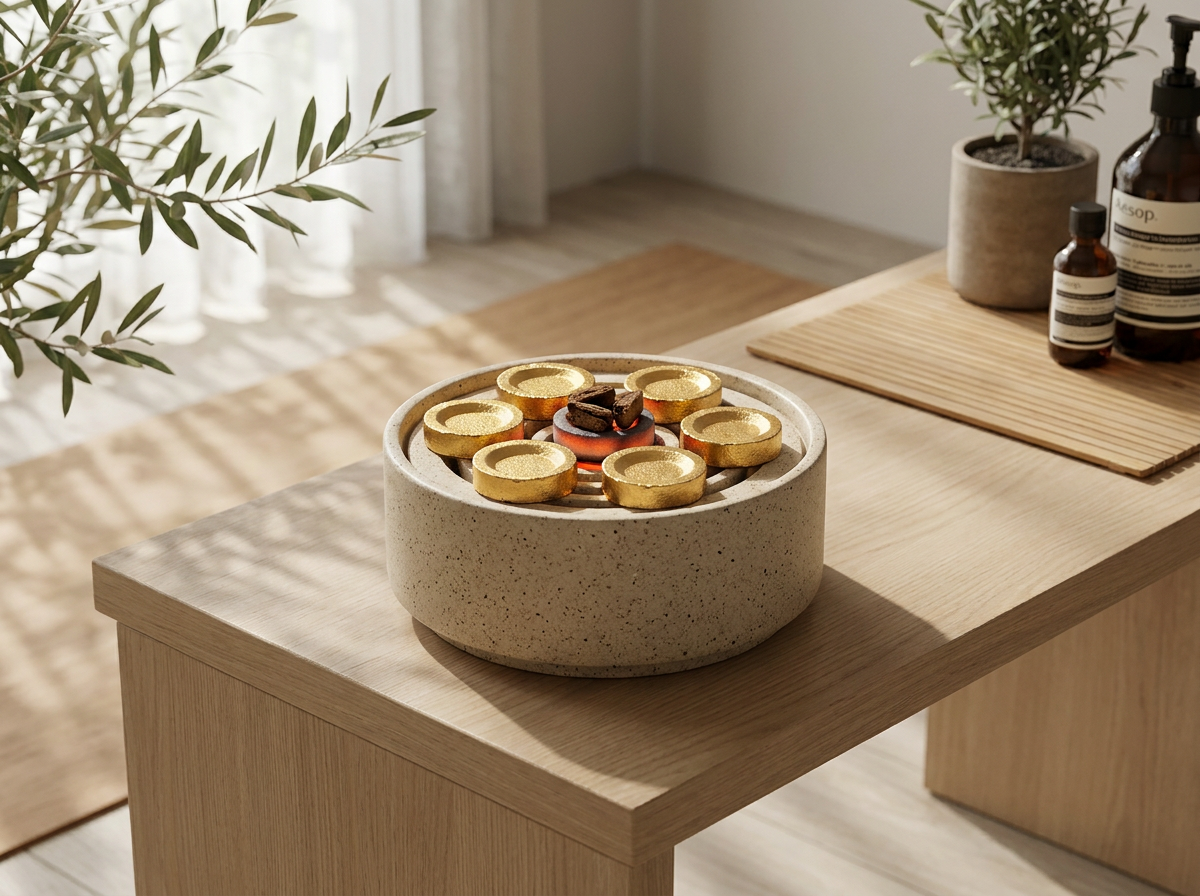
TC-04 is the incense line, built around a 33 mm round tablet with black, silver-foil and gold-foil finishes, plus a cube option. The stated burn time is 45–70 minutes, with quick-light ignition, and the tablet is described as a scent diffuser that is smokeless and odorless. The base material is fruit wood charcoal with coconut shell charcoal powder. Custom packaging is offered in flip-top, magnetic and pull-out box formats.
The U.S. wellness, spa and aromatherapy scenario describes the operating condition precisely: immediate ignition followed by slow, smokeless heating of solid incense, bakhoor or aromatherapy oils. There, the tablet acts as an even heat diffuser that releases fragrance gradually without smoke interference, lighting in 30–45 seconds and providing steady, gentle warmth for 45–70 minutes. The scenario specifies silver or gold foil coating, fast burning, zero charcoal smoke and an eco-friendly fruit wood base, and pairs the tablet with ceramic or metal incense burners, incense tongs and aromatherapy oils.
Where TC-04 stops fitting. The 45–70 minute burn is the boundary that matters most. A spa ritual or yoga session that runs beyond 70 minutes needs a second tablet or a different format; sizing the purchase on a single tablet per session will understate consumption. The foil coating is a surface finish and the packaging options are a retail presentation choice — neither changes the stated burn window, so a buyer switching from plain black tablets to foiled tablets should not assume a longer burn. TC-04 is also a diffusion product, not a cooking fuel: it is described for small burners rather than grills.
TC-03: Portable Picnic and Camping Grilling Where Ignition and Disposal Decide
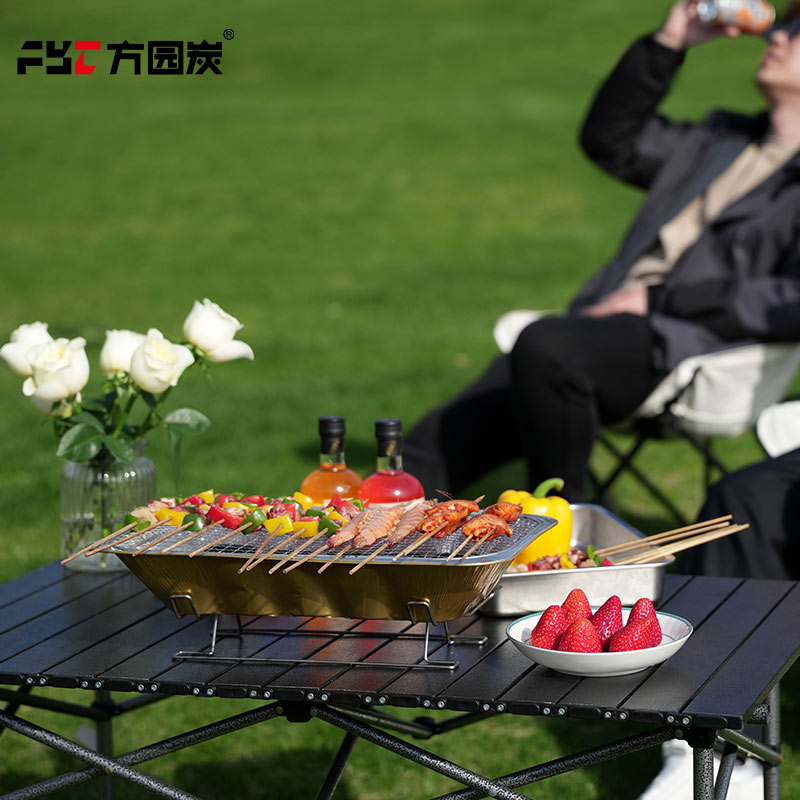
TC-03 is a disposable grill rather than a loose fuel, offered in small and large copper-foil box formats and available with matching Fangyuan charcoal. Its stated parameters are lightweight and compact portability, instant lighting, fast heat transfer and single-use convenience. The grill mesh is food-grade galvanised or chrome-plated steel, chosen for rust resistance and easy cleaning; the outer tray is aluminium foil or flame-retardant cardboard for heat insulation and disposal. The fuel is instant-light natural charcoal or smokeless charcoal, lit through a self-igniting charcoal layer that is described as ignitable with a single match and requiring no additional fire starters, and the heat is described as uniform radiation across the cooking surface, which prevents hot spots and supports even cooking. Materials are listed as 100% biodegradable for eco-friendly disposal after use.
The German outdoor recreation scenario supplies the operating window: lightweight, safe, instant-lighting equipment that can be disposed of after use with no cleanup, heating evenly for 60–90 minutes. The matched equipment is portable disposable wire grills with aluminium foil trays and quick-light charcoal, and the requirements list lightweight construction, quick ignition, environmentally friendly disposable materials and non-toxic safety. The corresponding case is a national outdoor and camping equipment retailer taking 12,000 sets per summer season on a first seasonal rollout, with FYC reporting 100% on-time delivery despite peak demand, positive consumer feedback on lighting convenience, and foil materials that met EU environmental standards in that programme.
Where TC-03 stops fitting. The stated applications are outdoor picnic, camping, travel, home garden party, and retail and wholesale distribution — consumer and retail contexts. The 60–90 minute heat window and single-use construction set the boundary: a catering operation serving past that window needs a refuelable grill, which TC-03 is not described as being. Buyers distributing into Europe should also confirm the disposal and materials requirements of the destination market, since the environmental claim rests on the biodegradable specification rather than on a single regional certification.
The Four Scenarios Side by Side
| Model | Primary environment | Form and material | Stated burn window | Fit boundary |
|---|---|---|---|---|
| TC-01 | Hookah and shisha lounges | Cube, hexagonal, bamboo; coconut shell, fruit wood | 90–120 min (cube, 25 mm, 40 mm); 45–70 min quick light | Grilling heat; sessions needing one coal beyond the stated window |
| TC-02 | BBQ restaurants, catering, outdoor camping | Quadrilateral, hexagon, 50 mm hole formats, spherical, bamboo sticks | 6–8 h bamboo stick; 70 min fruit wood quick light | Short events needing heat within minutes without ignition prep |
| TC-04 | Aromatherapy, spa, yoga, incense burner | 33 mm round tablet, foiled or black, plus cube; fruit wood and coconut shell powder | 45–70 min | Rituals running past the window on one tablet; cooking applications |
| TC-03 | Picnic, camping, travel, garden party, retail | Disposable grill, copper-foil box small or large | 60–90 min even heating | Commercial high-volume service; refuelling beyond one use |
Where Scenario Fit Breaks Down
Scenario mapping is clean in a single-use venue and messy in a mixed one. A lounge that serves both shisha and bakhoor is running two different rituals on two different time scales, and the product lists overlap: TC-01 and TC-04 are both described as applicable to hookah bars, aromatherapy, yoga rooms and incense burners. The distinction that survives is mechanical rather than nominal — a cube burning 90–120 minutes fits a bowl that has to hold heat through a session, while a 33 mm tablet burning 45–70 minutes fits a small burner where the ritual ends inside that window. A venue running both should stock by duration and burner size rather than choose the cheaper of two overlapping descriptions.
Burn-window arithmetic is the second place buyers go wrong. If a service session runs 110 minutes and the stated window is 90–120 minutes, the low end of that range leaves no margin. The same logic applies at the other extreme: an operator buying 6–8 hour bamboo sticks for a 70-minute catering event is not buying resilience, only unused capacity that still has to be extinguished and disposed of.
Specification comparisons across sources are the third. A journal article citing Indonesia's SNI 01-6235-2000 lists briquette quality parameters of moisture at or below 8%, ash at or below 8% and calorific value at or above 5,000 cal/g. Those are briquette thresholds under a cited national standard, expressed in different units and covering a different product scope from FYC's stated TC-01 figures of ash below 3% and calorific value above 7,800 kcal/kg. The two sets should not be placed side by side and read as a like-for-like comparison; a buyer who wants a defensible number needs the same test protocol run on the same product form.
Finally, case outcomes are not specifications. The Saudi lounge account, the Korean restaurant account and the German retail account each describe one customer's configuration and one customer's result. They show what a model was specified to achieve in a described setting. They do not establish what a different venue will achieve.
What to Verify Before You Commit a Model to a Site
Six checks close most of the gap between a scenario description and a purchase decision.
Confirm the burn window on the exact format ordered. TC-01's 90–120 minute figure attaches to cube, 25 mm and 40 mm, not to every TC-01 SKU, and its quick-light option is stated separately at 45–70 minutes. Ask for the window on the size you are buying.
Ask how the ash figure was established. An ash content below 3% at premium grade is a product claim; the measurement basis, sample preparation and feedstock tested should be stated with it, because a coconut-shell and a fruit-wood batch are not the same input.
Match ignition method to staffing. The range spans a 30–45 second tablet ignition, a single-match self-igniting grill layer, a 45–70 minute quick-light hookah option and a 6–8 hour stick format. Choose the ignition profile the site can actually run at peak hour.
Confirm packaging for the sales channel. Flip-top, magnetic and pull-out boxes with logo printing suit lounge or retail presentation; bulk wholesale orders follow different handling. Packaging is customisable, so it should be specified at quotation stage rather than assumed.
Check destination-market compliance separately from product fit. For barbecue charcoal into Europe, confirm EN 1860-2 conformity with the supplier. For disposable grills, confirm the mesh and tray material grades against the destination market's requirements for food contact and disposal.
Align order size with seasonality. FYC states 7–15 days for standard stock and 20–30 days for customised mass production, with minimum orders from one box up to a full container. A seasonal retail programme and a year-round restaurant contract should not be planned on the same lead-time assumption.
What the Next Buying Cycle Is Likely to Ask
Two signals in the available evidence are worth holding onto, and neither supports a forecast on its own. The first is feedstock: coconut shell charcoal at 42.3% of the hookah segment in 2025 indicates the material most lounge buyers currently expect to be quoted, which is consistent with TC-01's coconut-shell base. Whether that share rises or falls is not something this article can establish; what it does mean is that a buyer specifying an alternative base should expect to explain the substitution.
The second is compliance. As long as EN 1860-2 remains the reference standard for barbecue charcoal in Europe under the cited 2026 guidance, the model-selection conversation for European food service will keep arriving at the same checkpoint after the burn window has been agreed. Capacity planning follows a similar pattern: with monthly output stated at 600–800 metric tons and 34 new models developed annually, variant availability is likely to expand faster than the number of product families, which puts the burden on buyers to specify the format precisely rather than order by model name alone.
The scenario question, in other words, is unlikely to get simpler. It will keep resolving into the same four inputs — session length, smoke tolerance, ignition labor and portability — applied to a growing list of formats.
FAQ: Matching Charcoal Models to Real Use Cases
If a venue serves both shisha and bakhoor, can one charcoal model cover both?
The two applications sit at different time scales. TC-01 in cube format is stated at 90–120 minutes per briquette with ash below 3%, which suits a shisha bowl that must hold heat through a session. TC-04 is a 33 mm round tablet burning 45–70 minutes, positioned for small burners where fragrance is released gradually. Both product lines are listed as applicable to hookah bars, aromatherapy, yoga rooms and incense burners, so the practical selection criterion is burner size and ritual duration rather than the application label.
For a barbecue restaurant, which matters more: the 6–8 hour bamboo stick or the 70-minute quick light?
It depends on the length of the service batch. The bamboo charcoal stick is stated at 6–8 hours and is the profile described in the Korean indoor-dining scenario, where reduced replenishment during dining hours is the objective. The fruit wood quick-light format is stated at 70 minutes, which fits a shorter window in which heat is needed quickly. Neither figure is better in the abstract; they are different batch lengths.
Is a disposable grill suitable for commercial catering?
TC-03 is described for outdoor picnic, camping, travel, home garden party, and retail and wholesale distribution, with a stated 60–90 minute even-heating window and single-use construction. A catering operation running longer than that window needs a refuelable grill format, which TC-03 is not described as providing.
How much does ignition method change the model choice?
Substantially, because ignition speed and burn duration trade off within the stated specifications. TC-04 lights in 30–45 seconds and burns 45–70 minutes. TC-03 uses a self-igniting charcoal layer intended for single-match lighting. TC-01 offers a quick-light option at 45–70 minutes against 90–120 minutes for its standard cube formats. TC-02 offers a 70-minute quick-light format against 6–8 hours for its bamboo stick. A venue that cannot staff a slower ignition routine should select on ignition first and duration second.
What evidence should a buyer request before matching a model to a high-volume site?
The specification for the exact format ordered, the basis on which ash and calorific values were measured, the feedstock used, the packaging configuration, and conformity evidence for the destination market where a standard applies. Buyers planning seasonal or multi-model programmes should also confirm lead time and minimum order quantity against their own schedule; FYC lists 7–15 days for standard stock, 20–30 days for customised production, and minimum orders from one box to a full container, alongside 24/7 technical support covering charcoal usage and storage.
FYC publishes its full product specifications for download: FYC charcoal product brochure (PDF).
Tem questões ou precisa de mais detalhes?
Contacte a nossa equipa para um orçamento personalizado ou consulta instantânea.
Solicitar orçamento
Preencha o formulário abaixo e a nossa equipa entrará em contacto com uma proposta personalizada.
Chat direto do WhatsApp
Prefere conversar em tempo real? Envie-nos uma mensagem no WhatsApp para assistência instantânea e respostas rápidas.
- Obter orçamento personalizado
- Partilhar fotos ou documentos
- Discuta as suas necessidades diretamente
Geralmente responde em 5–30 minutos durante o horário de expediente.