
Scenario Fit: Why Club Projects in Chile and Bangladesh Demand Specific Court Designs
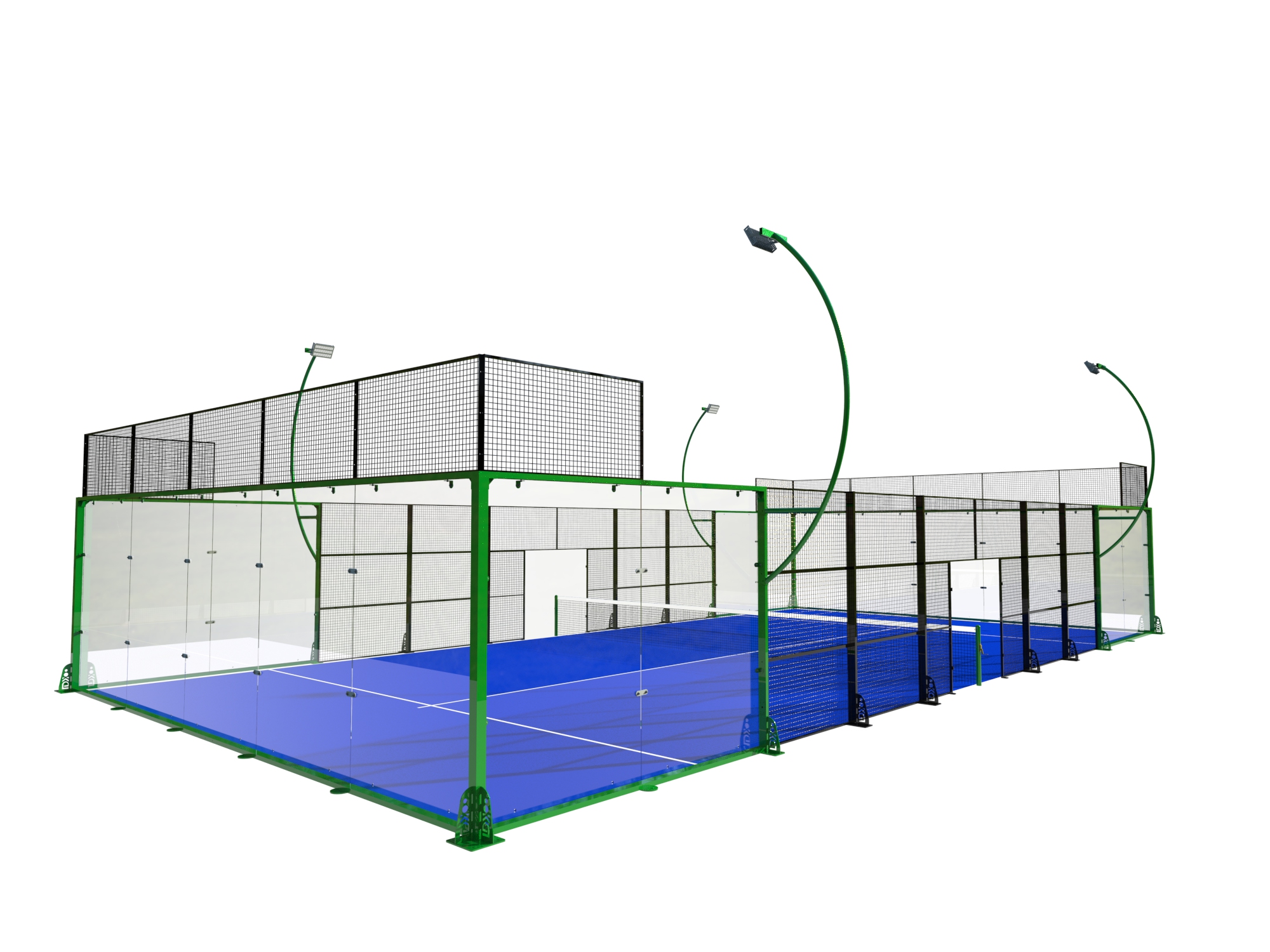
Scenario fit is the practice of selecting a padel court configuration against a venue’s real operating pattern — usage hours, maintenance capability, year-round play requirements and compliance expectations — rather than copying a generic court specification from an unrelated tender. In club projects, where one design is repeated across many courts, the difference between a fitted and an unfitted specification compounds across the entire site.
The global build-out gives that problem its scale. As of early 2025 the installed base reached approximately 58,334 padel courts across nearly 20,000 clubs, a 16% year-over-year increase, according to Playtomic and Strategy& reporting in the Global Padel Report 2026 preview. The padel court operator market was valued at approximately USD 3.8 billion in 2025 and is projected to reach USD 9.6 billion by 2034, based on Dataintelo’s market assessment. Growth of that shape moves procurement from single-court purchases toward club-scale, multi-court deployments — and a design decision that is repeated across 16 or 70 courts carries far more consequence than the same decision made once.
This analysis examines two verified LDK club installations — a 16-court padel court club in Chile and a 70-unit padel court deployment in Bangladesh, both recorded as stable after three years of operation — to show how the application itself dictates configuration, and how the LDK-PD01 enclosure package is specified against the requirements of high-usage club environments.
SHENZHEN LDK INDUSTRIAL CO., LTD. (LDK) is a sports equipment manufacturer founded in 2014 and headquartered in Shenzhen, China, producing padel courts, football pitches, squash courts, basketball courts and pickleball courts. LDK operates a 50,000 m² manufacturing base in Cangzhou and a 4,500 m² R&D and production base in Huizhou, with 107 employees, a 17-engineer R&D team, annual output of 223,750 sets and a 100% export orientation. The company is a verified Alibaba.com Gold Supplier.
Scenario Fit Defined: What Actually Changes Between Projects
Scenario fit starts with a narrow question: what will this facility have to survive? A club court that runs from morning to night and must stay playable through the year is a different engineering brief from a single court at a hotel or a residential amenity. Four variables drive most of the differentiation.
- Operating intensity. Court-hours per week determine how quickly the surface, netting and enclosure fittings accumulate wear, and how much downtime the facility can afford for replacement.
- Maintenance capability. A venue without dedicated maintenance staff needs components that do not require routine intervention. The Chile project record states this directly: the venue is extremely durable and requires almost no maintenance.
- Year-round playability. Where the club’s economics depend on uninterrupted play, roofing and lighting move from optional extras into the core court specification.
- Compliance expectation. Some markets and some clients will not release a project without a documented certification trail. The Bangladesh project record cites FIP and CE certification as the quality and safety basis for the installation.
Mapping those variables onto a specification is where scenario fit becomes concrete rather than conceptual.
| Operating variable | Specification consequence | Documented reference |
|---|---|---|
| Play must continue through the year | Roofed or covered structure instead of an open enclosure | LDK-PADEL-RF01 roof fabric: 750 g/m² double PVC-coated PVDF, 10–15 year service life |
| No dedicated maintenance team | Fixed enclosure and netting components selected for low intervention | Chile 16-court club record: almost no maintenance; usable throughout the year |
| High traffic per playing surface | Surface grade matched to continuous use | LDK1231625.4-ST3 padel grass: 12 mm pile, 58,800 stitches/m² (±10%) |
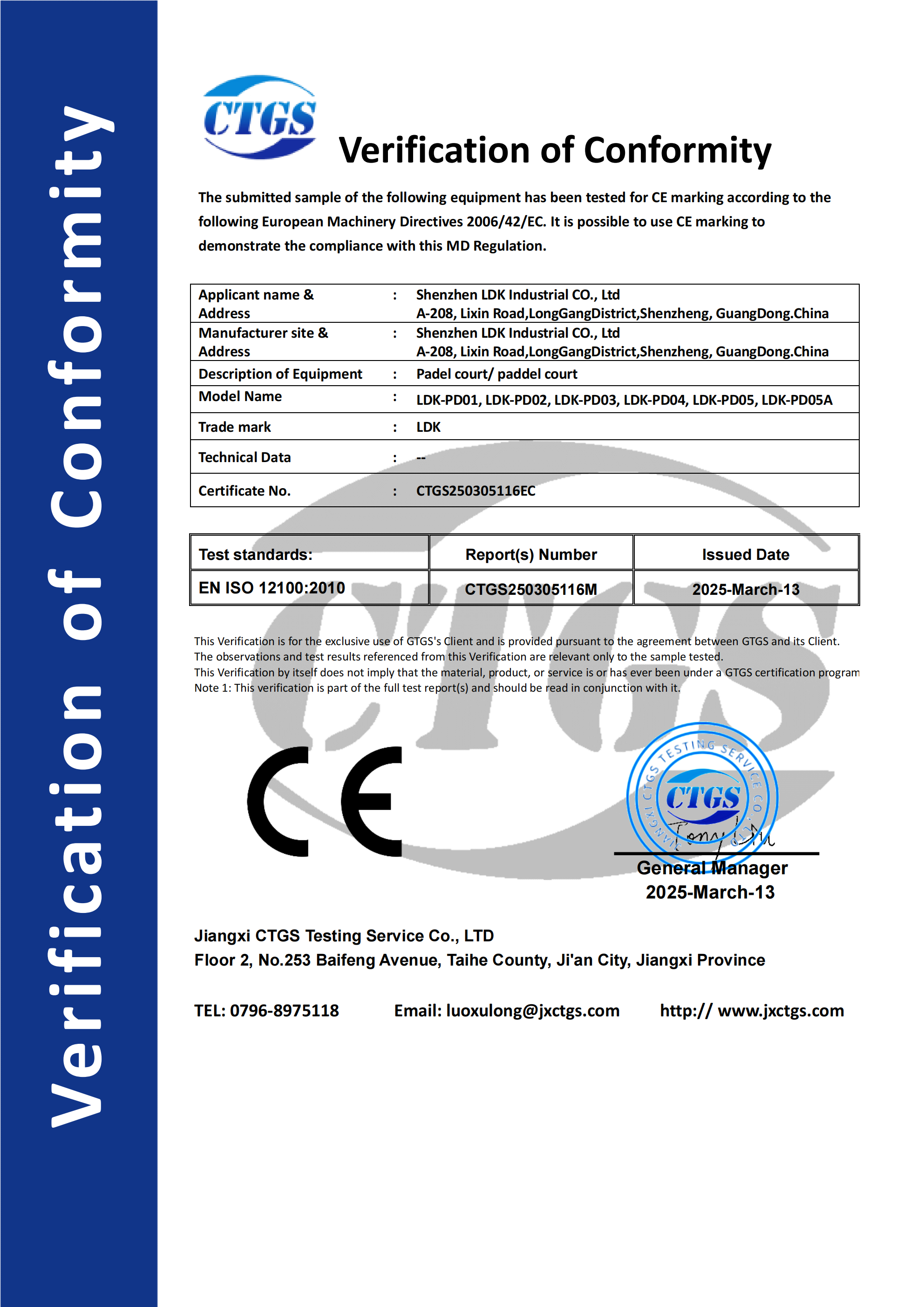
| Safety and liability review before handover | Certified glass and machinery-safety documentation supplied with the court model | CE Verification of Conformity to EN ISO 12100:2010; glass test report to AS 2208:2023+A1:2024 |
| Spectator and broadcast visibility requirement | Glass-dominant panoramic enclosure rather than mesh-dominant | LDK-PD01 perimeter in 12 mm ultra-clear tempered safety glass |
| High wind or weather exposure | Hot-dip galvanized structure with a defined wind-resistance class | LDK-PADEL-RF01 structure: wind resistance Level 10–13 typhoon |
Two Club References: How Application Changed the Brief
Chile — 16 Courts, Where Maintenance Capacity Set the Specification
The Chile installation is a 16-unit padel court club delivered for an automotive OEM client and recorded as stable after three years of operation. The project highlight is operational rather than technical: the venue is extremely durable and requires almost no maintenance, and it can be used throughout the year.
Sixteen courts is a club, not a court. Two consequences follow. First, the specification has to be standardised, because a maintenance regime that works for one court has to work identically for sixteen. Second, the binding constraint is no longer peak performance but the lowest-intervention configuration that still meets the playing standard. That shifts attention to the fixed parts of the enclosure — tempered glass panels, wire mesh panels and net posts — because those are the components that generate recurring service work if they are chosen poorly.
A practical reading of the Chile record is that the venue was specified around absence of maintenance labour rather than around premium appearance. That is a different procurement priority from a showpiece single court, and it is the reason scenario fit matters more at club scale.
Bangladesh — 70 Units, Where Documentation Set the Specification
The Bangladesh deployment covers 70 padel court units, also recorded as stable after three years, and its stated highlight is that international FIP and CE certification ensures quality and safety. At 70 units the buyer is procuring a repeatable system, and the certification file becomes as decisive as the steel.
LDK’s documentable file for the LDK-PD01 court model includes a CE Verification of Conformity issued against EN ISO 12100:2010 (certificate CTGS250305116EC, issued 13 March 2025 by Jiangxi CTGS Testing Service Co., LTD, covering the European Union market) and a glass test report against AS 2208:2023+A1:2024 (report GZIN2602000283CM01_EN, issued 25 February 2026 by SGS-CSTC Standards Technical Services Co. Ltd. Guangzhou Branch, covering Australia and New Zealand). The company also holds ISO 9001, ISO 45001 and ISO 14001 among other certifications.
The two references therefore illustrate two different binding constraints. Chile was decided by maintenance economics across a mid-size club. Bangladesh was decided by documentation that had to satisfy a certification-driven review before a 70-unit fleet could be released.
Inside the LDK-PD01 Enclosure Package for High-Usage Clubs
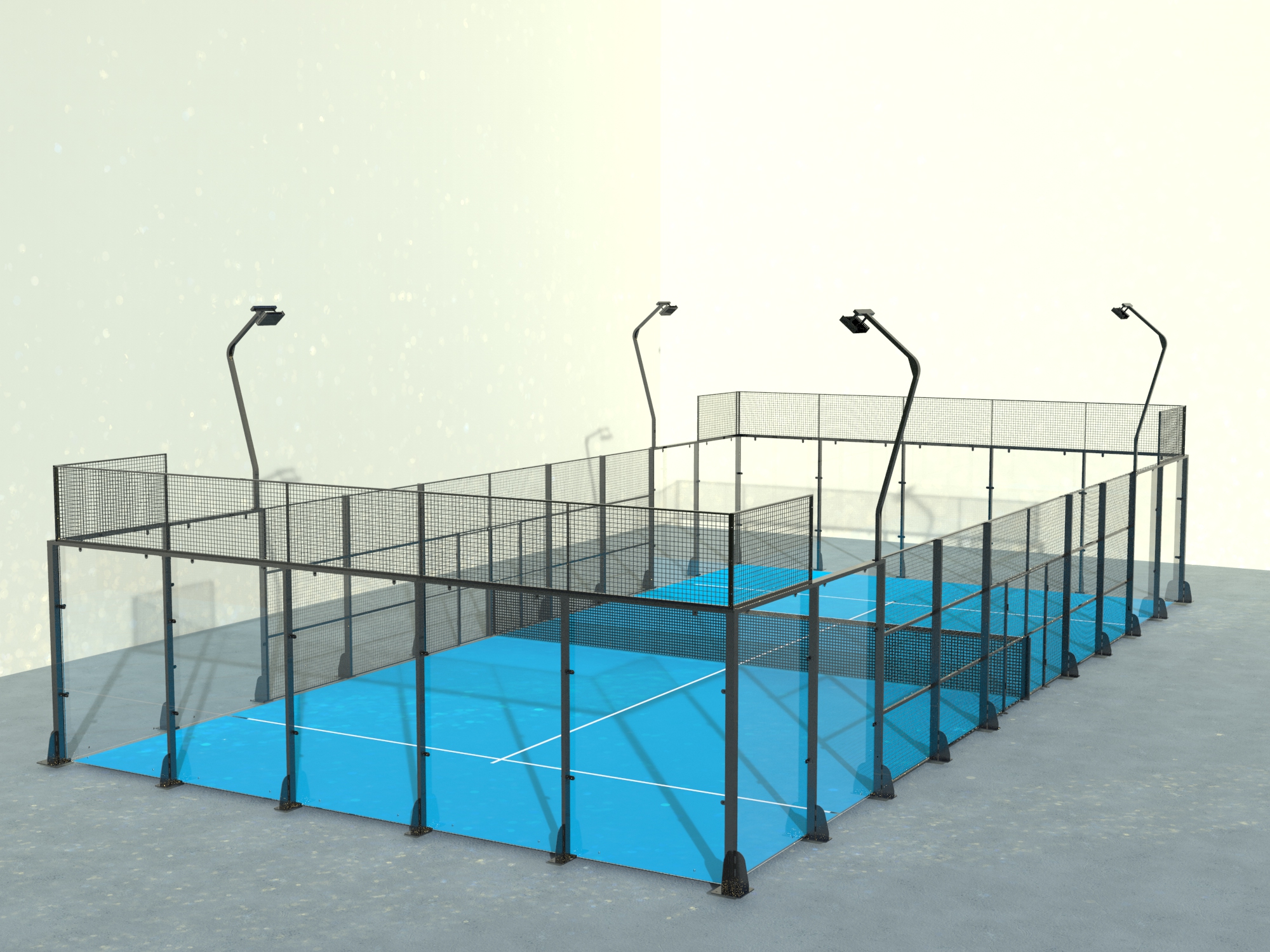
The LDK-PD01 padel court is specified as a complete perimeter and equipment package rather than a frame alone. The table below lists the published specification and what each element contributes in a club operating environment.
| Component | LDK-PD01 specification | Why it matters at club scale |
|---|---|---|
| Perimeter glass | 12 mm thick, 1990×2980 mm ultra-clear tempered safety glass; documented spontaneous breakage rate of 1 in 10,000 | Unplanned panel failure closes a court; a documented low breakage rate supports continuity across many courts |
| Corner posts | 4 m high, 100×100×5 mm | Sets the perimeter height and keeps ball rebound geometry consistent court to court |
| Intermediate and gate posts | 100×50×3 mm | Defines access points that must withstand constant player throughput |
| Horizontal tubing | 100×50×3 mm, supplied in 4 m, 6 m and 4 m lengths | Standardised sections simplify spares planning for a multi-court site |
| Wire mesh panels | 1×2 m steel wire mesh, 4.0 mm wire diameter, 50×50 mm openings | Fixed panels with no moving parts support the low-maintenance requirement recorded in Chile |
| Net posts | 940 mm high, 120×60×3 mm | Anchored post geometry reduces net adjustment work between sessions |
| Net | 10 m long, 92 cm high black polypropylene net, 4 mm cord diameter, 45×45 mm mesh openings | Consumable item; standard sizing keeps replacement routine and predictable |
| Lighting | 100×50×3 mm light posts with 200 W LED fixtures rated IP65 | Evening play drives club utilisation; an IP65 ingress rating matters for outdoor, year-round operation |
One specification detail deserves separate attention: the 12 mm glass. The wider industry direction has moved to 12 mm tempered safety glass as the standard for premium panoramic padel courts, replacing the earlier 10 mm specification to improve safety and ball rebound consistency, as set out in Legend Sports’ construction guidance on FIP court standards. A club buying 16 or 70 courts is buying that standard at scale, and the material choice is fixed for the life of the installation.
The playing surface is specified separately. The LDK1231625.4-ST3 padel grass uses a 12 mm pile height, 9000 Dtex yarn, 3/16 inch gauge and a double PP + PU latex backing, with a density of 58,800 stitches/m² (±10%) and colour options including blue, red, green, pink and black. Surface colour and grade are among the customisable variables LDK offers alongside court size, logo printing, fencing design and lighting configuration — relevant when a club wants visual identity without changing the underlying engineering.
Note also the fixed reference point for all of this: official padel court dimensions are strictly 20 m × 10 m with a 0.5% tolerance under International Padel Federation rules, with a minimum indoor ceiling height of 6 m and 9–12 m recommended for professional play. Scenario fit never changes the playing envelope; it changes everything built around it.
Roofed or Open? A Boundary Case, Not a Default Upgrade
The most consequential scenario decision in a club project is whether the courts are roofed. The LDK-PADEL-RF01 panoramic padel court with roof is built as a 20 m × 10 m structure with a 7 m eaves height and 9.2 m ridge height. Its steel structure uses eight 150×200×4 mm hot-galvanized corner columns, twelve 100×50×3 mm middle columns, Φ102/Φ89/Φ40 × 3 mm hot-galvanized beams and sixteen 100×50×3 mm cross tubes in 4 m and 6 m lengths, joined with high-strength bolts and finished with hot-dip galvanizing plus electrostatic epoxy powder coating at 70–80 μm thickness. The structure is rated for wind resistance of Level 10–13 typhoon. The roof membrane uses 750 g/m² double PVC-coated PVDF fabric with a documented service life of 10–15 years, and the enclosure carries 18 panels of 12 mm tempered glass plus 46 wire mesh panels. The accessory set includes a 980 mm net post system with a 10 m × 970 mm knotted PP net, 200 W IP65 LED lighting, stainless steel electro-polished hardware and blue 12 mm artificial grass at 63,000 tufts/m² density with PP + NET backing.
The limitation is straightforward and should be stated plainly: a roofed court is a heavier structural class, and the 150×200×4 mm corner columns and 7 m eaves height imply a different foundation design, site envelope and installation sequence from an open court. Where a club does not need weather-independent play, the open LDK-PD01 configuration is the more proportional brief — not a lesser one. There is also a lifecycle asymmetry worth flagging: the roof membrane carries a documented 10–15 year service life, while no equivalent service-life figure is published for the court structure itself, so replacement planning for the roof has to be modelled separately from the enclosure.
A second boundary applies to the evidence base rather than the product. The verified operating record for the LDK club installations in Chile and Bangladesh covers three years of stable operation. That is a documented performance baseline, not a lifetime prediction for a court expected to serve a club for a decade or more. Buyers should treat it as such and plan inspection regimes accordingly.
Market Trend: Procurement Is Moving from Court Units to Court Fleets
Three data points frame the change. The global installed base reached approximately 58,334 courts across nearly 20,000 clubs by early 2025, growing 16% year over year, according to Playtomic and Strategy&. The operator side of the market was valued at roughly USD 3.8 billion in 2025 and is projected to reach USD 9.6 billion by 2034, per Dataintelo. In the United States, the market is projected to reach 30,000 courts and over 10 million players by 2030, up from just 650 courts in early 2025, according to the United States Padel Association.
Two implications follow for club buyers. First, multi-court facilities are becoming the dominant format, which makes standardisation a procurement variable rather than an afterthought — a 16-court or 70-unit project only works economically if every court shares the same component set. Second, market-size estimates diverge depending on scope: Dataintelo’s figure measures the operator market, while equipment-focused estimates use a much narrower base. Buyers should treat any single market number as scope-dependent rather than absolute.
Comparison: Scenario-Fit Configuration Versus Traditional Court Specification
The comparison below is between specification approaches, not between brands. It shows where a scenario-fit club package differs from a generic single-court specification, and where the generic approach still remains valid.
| Dimension | Generic single-court specification | Scenario-fit club specification |
|---|---|---|
| Design starting point | A standard package applied to any site | Operating pattern first: hours, maintenance, weather exposure, compliance |
| Glass standard | Older 10 mm tempered glass remains in circulation | 12 mm tempered safety glass, now the prevailing premium panoramic standard |
| Enclosure mix | Mesh-dominant, chosen on initial outlay | Glass-dominant panoramic or mixed, chosen on spectator value, durability and maintenance profile |
| Roofing | Frequently omitted; play stops in bad weather | Roofed variant specified only where year-round play is a revenue requirement |
| Documentation | Certificate may not match the procured model | CE Verification of Conformity and glass test report tied to the LDK-PD01 |
| Spares and standardisation | Per-court procurement, inconsistent components | One component set repeated across the site, simplifying spares and service |
The limitation of the scenario-fit approach is that it requires more front-end work. It demands honest answers about maintenance capacity, a realistic assessment of how many hours the courts will actually run, and a decision on roofing that is based on revenue rather than on aspiration. Where a venue genuinely operates as a low-frequency, single-court facility, that analysis adds cost without adding value, and a standard open configuration remains the correct choice.
Future Outlook
As club formats scale, three shifts are likely to shape padel court procurement. Standardisation will move earlier in the process, with buyers defining one court specification and repeating it rather than negotiating court by court. Certification files will increasingly be requested as a precondition of tender rather than at handover, which favours manufacturers who can supply model-specific documentation rather than brand-level certificates. And roofing decisions will migrate from a late-stage upgrade conversation to a first-stage revenue question, because a roofed structure changes the foundation, the site envelope and the replacement plan from the outset.
For manufacturers, the competitive variable follows the same logic. LDK’s stated capability set includes OEM/ODM production, customisation across court size, colour, logo printing, surface material, fencing design and lighting configuration, a monthly capacity of 200 units, lead times of 30–45 days, a minimum order quantity of one unit, 100% testing, and a warranty period of one to five years. Those parameters matter to a club buyer mainly because they determine whether a fitted specification can actually be delivered at the scale the project requires.
Frequently Asked Questions
What does scenario fit mean in padel court design?
Scenario fit means the court’s enclosure, structure, surface and lighting are selected against how a specific facility will be operated — usage intensity, maintenance capability, year-round play requirements and compliance expectations — rather than against a generic specification. It determines whether an open or roofed structure is required, whether a panoramic glass-dominant or mesh-dominant enclosure is appropriate, and how lighting is specified for evening use. The playing envelope itself does not change: official padel court dimensions are strictly 20 m × 10 m with a 0.5% tolerance under International Padel Federation rules.
How does a multi-court club deployment differ from a single-court installation?
The brief changes from a product to a system. A single court can tolerate a specification that requires periodic attention; a 16-court or 70-unit deployment multiplies both the maintenance workload and the consequence of any component that fails repeatedly. LDK’s verified club records include a 16-court padel court club in Chile and a 70-unit padel court deployment in Bangladesh, both recorded as stable after three years of operation. The Chile record describes the venue as extremely durable, requiring almost no maintenance and usable throughout the year.
Which certification documents should buyers verify for a club padel court?
For the LDK-PD01 padel court, the documentation set includes a CE Verification of Conformity issued against EN ISO 12100:2010 (certificate CTGS250305116EC, issued 13 March 2025 by Jiangxi CTGS Testing Service Co., LTD) and a glass test report against AS 2208:2023+A1:2024 (report GZIN2602000283CM01_EN, issued 25 February 2026 by SGS-CSTC Standards Technical Services Co. Ltd. Guangzhou Branch). LDK also holds ISO 9001, ISO 45001 and ISO 14001 among other certifications. Buyers should confirm that certificates reference the exact court model being procured, not only the supplier.
Is a roofed panoramic padel court always the better choice for a club?
No. The LDK-PADEL-RF01 roofed court uses a heavier structural class — eight 150×200×4 mm hot-galvanized corner columns, a 7 m eaves height and a 9.2 m ridge height — and adds a roof membrane with a documented 10–15 year service life, so it carries a different foundation, site-envelope and replacement profile from an open court. Where a club does not require weather-independent play, the open LDK-PD01 configuration is the more proportional brief. The verified operating record for LDK club installations covers three years of stable operation, which is a documented baseline rather than a lifetime projection.
Which design features support a low-maintenance club environment?
Fixed components shape the maintenance profile more than the surface does. On the LDK-PD01, the perimeter uses fixed 12 mm tempered safety glass panels measuring 1990×2980 mm alongside fixed 1×2 m steel wire mesh panels with 4.0 mm wire diameter and 50×50 mm openings, and lighting uses 200 W LED fixtures rated IP65 for ingress protection — a rating that matters for outdoor and year-round installations. Standardised net posts at 940 mm height with a 10 m, 92 cm high polypropylene net also keep consumable replacement predictable across a multi-court site.
How should a club decide between an open and a roofed court configuration?
The decision sequence is: first, whether play must continue through weather that would otherwise stop it; second, whether the site can accommodate the heavier structural and foundation requirements of a roofed structure, which for the LDK-PADEL-RF01 includes a 7 m eaves height and wind resistance rated at Level 10–13 typhoon; third, whether the roof membrane’s documented 10–15 year service life fits the facility’s replacement planning; and fourth, whether the resulting capital profile still matches expected occupancy. Only where weather-independent play is a revenue requirement does the roofed configuration become the default answer.
Court specifications, certification documents and configuration options for LDK padel court projects are compiled in the company product brochure, available here: LDK product brochure (PDF). The specification tables in this article can be used as a starting checklist when matching a court configuration to a venue’s operating pattern.