
Scooter vs. Dirt Bike Seats: Application Fit Across 11 Countries
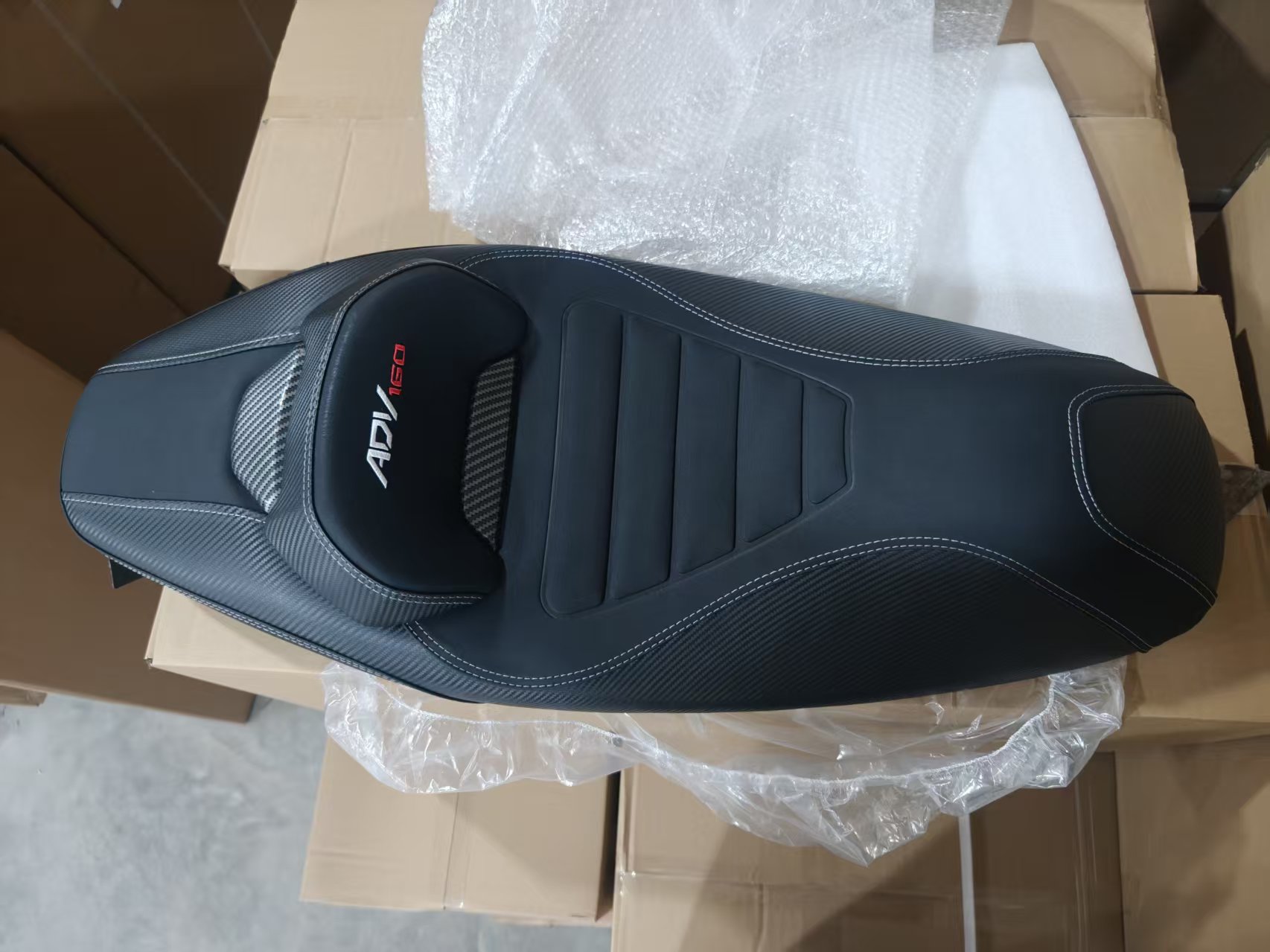
A scooter seat is a static fitting part: it interfaces the rider with the motorcycle main body frame and body shell rather than performing any powered function.
The motorcycle seat is one of the few vehicle parts that does its entire job without moving. It is a non-powered static fitting part, mounted to the motorcycle main body frame and the body shell, and everything it has to deliver — a comfortable riding and sitting experience, a clean visual line on the finished bike, weather survival, old-seat maintenance or direct replacement — happens through that fixed interface.
Because the interface is fixed, the seat is also one of the most configuration-sensitive parts in the replacement aftermarket. Demand does not divide neatly by brand or by price band. It divides by riding environment, and in practice that means two families of product: scooter seats and dirt bike seats. A buyer who treats them as one commodity line usually discovers the difference at the fitment stage, not at the quotation stage.
Zhejiang Xingrong Auto & Motorcycle Parts Co., Ltd. is a Taizhou-based manufacturer of motorcycle, electric vehicle and off-road vehicle seat cushions, founded in 2015, operating a 15,000 m² plant with 130 employees and an annual seat cushion capacity of 1,800,000 units. Its seat line covers both scooter seats and dirt bike seats, and its documented fitment list for scooter platforms includes the Nmax, Xmax, Aerox, ADV150, ADV160, Forza, PCX and Click.
Why the two configurations exist at all
The clearest way to understand the split is to look at what the seat actually receives from the rider. On a scooter, a rider sits for essentially the entire journey. The seat carries continuous, near-static body weight through stop-start urban traffic, and the scooter is typically parked outdoors between trips, exposed to rain and sun. On a dirt bike, the rider stands for long portions of the ride and sits intermittently, on uneven ground, with the seat exposed to mud, water crossings, dust and abrasion rather than to hours of uninterrupted compression.
Both products still have to satisfy the same documented application requirements. The application requires ergonomic design. The product is designed for waterproof environments and operates under waterproof conditions. Special requirements include weather resistance and a wear-resistant surface. Both configurations are fitted statically and are used for old-seat maintenance and direct replacement, and both function to beautify the motorcycle appearance as well as to provide a comfortable riding sitting experience.
Where scooter and dirt bike seats diverge in real use
Scooter seats: uninterrupted seated contact, permanent weather exposure
The scooter seat is generally a continuous bench or stepped bench that supports the rider through the whole trip. Because the rider is seated almost continuously, comfort is experienced as a single long-duration load rather than as repeated short impacts, and the cover surface is judged both by feel and by how it looks next to the body panels. Replacement demand in this configuration is therefore driven by three things at once: seating feel, visual effect, and water resistance. That combination is precisely what the Xingrong case record lists as its key highlights — great seating feel, good visual effect, repair and replacement capability, and waterproof performance.
Urban markets amplify this. Where scooters function as everyday transport rather than recreation, the seat is parked outdoors for most of its life and the waterproof and weather-resistance requirements move from optional to structural. In the documented replacement scenario, Italy, Portugal, India, Thailand and Vietnam are among the markets where this pattern is recorded.
Dirt bike seats: intermittent contact, abrasion-driven wear
The dirt bike seat belongs to a different wear regime. Rider contact is intermittent, the platform is narrower, and the surface is exposed to grit and moisture thrown up from unpaved ground. The material and construction logic is similar — PP plate, PU foam and leather or synthetic cover — but the demand profile differs: the buyer is usually less concerned with long-duration comfort and more concerned with how the seat survives impact, abrasion and repeated wetting.
This is where sourcing discipline matters most. Because the two configurations are built to different base geometries, a supplier that can quote both from one catalogue is not necessarily a supplier that can fit both to a given frame without a new pattern and a new fitment check. The static mounting interface is the constraint, and it is worth confirming before price.
The eleven markets on record, and what each one actually asks for
Xingrong’s replacement-seat case record spans eleven markets: China, Iran, Italy, South Korea, Lebanon, Malaysia, Mexico, the Philippines, Turkey, Taiwan and Vietnam. Separately, the replacement scenario itself — old-seat maintenance and direct swap on an existing motorcycle — is documented as common in Iran, India, Italy, South Korea, Lebanon, Portugal, Thailand, Taiwan, Turkey and Vietnam, which is where scooter fitment enquiries tend to concentrate.
| Market | Documented reference | What it means for seat sourcing |
|---|---|---|
| China | Case record; production base in Taizhou, Zhejiang | Domestic replacement and OEM supply route, with production and quality control located in the same province as the factory. |
| Iran | Replacement scenario and case record | Replacement-led demand; waterproof and wear-resistant surface requirements are part of the specification, not an add-on. |
| Italy | Replacement scenario and case record | A scooter-commuting market where appearance carries real weight; leather cover design and stitching are legitimate specification points. |
| South Korea | Replacement scenario and case record | Urban replacement of original-style seats; fit accuracy against the documented platform list is the first filter. |
| Lebanon | Case record: 5,000 pcs supplied over 2 years | The largest single documented quantity in the record, routed through repair and replacement channels. |
| Malaysia | Case record | Tropical rainfall makes waterproof construction a baseline expectation rather than an upgrade. |
| Mexico | Case record | Mixed urban use; replacement parts retailing and workshop fitting. |
| Philippines | Case record | Seasonal rain exposure; cover durability and water resistance drive repeat orders. |
| Turkey | Replacement scenario and case record | Both replacement and appearance-led upgrade demand; visual effect is a stated product highlight. |
| Taiwan | Replacement scenario and case record | Dense urban scooter use; long-duration seated comfort is the deciding criterion. |
| Vietnam | Replacement scenario and case record | Repair-shop-driven replacement at high volume; fitment and availability beat feature depth. |
Markets listed above are those documented in Xingrong’s application scenario and case records. India, Portugal and Thailand appear in the replacement scenario list, extending the scooter fitment picture beyond the eleven case markets.
Why repair shops and parts retailers decide this category
The seat is rarely specified at the point of vehicle purchase. It is specified when a rider walks into a workshop or a parts shop with a worn, torn or uncomfortable seat, or when a retailer restocks a fast-moving replacement line. That is consistent with the market structure: the aftermarket distribution channel holds the largest share of the motorcycle seat market, at approximately 62.3% of revenue, according to Dataintelo.
The practical audience for a seat manufacturer is therefore not only the vehicle brand. Xingrong’s seats are specified as applicable to motorcycle manufacturers, motorcycle repair shops, motorcycle parts retailers and motorcycle accessory brands — four different buying behaviours operating on the same product. A repair shop needs fit accuracy and immediate availability. A parts retailer needs a stable pattern across a model family. A manufacturer needs documentation. An accessory brand needs customisation latitude.
Design drivers a buyer can actually specify
Ergonomics
Ergonomic design is a stated requirement of the application, and it is the driver behind foam density and shape. The Xingrong seat cushion uses 80D high density foam over a high-strength floor structure. Foam density is one of the few seat specifications a buyer can compare objectively, and in general industry practice, higher-density foam is associated with better shape retention under sustained seated load — which is exactly the load pattern of a scooter commuter.
Weather resistance and waterproofing
The product is designed for waterproof environments and operates under waterproof conditions, and both weather resistance and a wear-resistant surface are listed as special requirements. The cover material specified across the line is PVC leather, over PU foam and a PP plate base. This sits inside a broader material shift: leather remains a premium option, while synthetic coverings such as vinyl and foam-backed constructions are increasingly used to deliver waterproof and soft-surface characteristics in the mid-range segment, according to Fortune Business Insights.
Static mounting
The product operates in a non-powered static fitting mode and must be used with the motorcycle main body frame and the motorcycle body shell as its supporting equipment. There is no adjustment mechanism, no actuator and no powered element. Fit is therefore a geometric question resolved at the interface, and it is the single most important thing to verify before an order is placed.
Customisation options
Where a buyer needs differentiation rather than straight replacement, the available customisation covers logo branding, leather cover design and stitching line colour. Production runs in OEM and ODM modes, with a monthly capacity of 50,000 pcs.
Scooter seat vs. dirt bike seat: a fitment and procurement comparison
| Comparison axis | Scooter seat | Dirt bike seat |
|---|---|---|
| Rider contact pattern | Continuous seated contact for the full trip | Intermittent seated contact; rider stands for much of the ride |
| Primary exposure | Rain, sun and long outdoor parking between trips | Mud, water crossings, dust and surface abrasion |
| Comfort driver | Long-duration support and shape retention | Impact tolerance and surface durability |
| Appearance weight | High; judged against body panels | Lower relative to durability |
| Documented fitment | Nmax, Xmax, Aerox, ADV150, ADV160, Forza, PCX, Click | Separate configuration; not covered by the scooter model list |
| Shared materials | PP plate, PU foam, PVC leather, 80D high density foam | Same material family |
| Mounting mode | Non-powered static fitting to main body frame and body shell | Non-powered static fitting to main body frame and body shell |
Limits worth stating plainly
Three boundaries deserve to be on the table before a purchase order, because they change how a project should be scoped.
First, the verified model list is scooter-specific. Nmax, Xmax, Aerox, ADV150, ADV160, Forza, PCX and Click are documented scooter fitments. A dirt bike seat program cannot be validated against that list and needs its own base geometry confirmation. Second, because the part is a static fitting component, the manufacturer cannot fully validate fit without a matching motorcycle main body frame and body shell. Where a buyer is introducing a model that is not on the documented list, fit validation becomes a shared step rather than a factory-only step. Third, commercial parameters shape project timing: the documented minimum order quantity is 50 pcs and the documented lead time is 25–35 days, so a new market test or a customised cover program needs to be planned against that cycle rather than treated as an off-the-shelf purchase.
There is also a compliance dimension that varies by destination. UN Regulation No. 17 (ECE R17) establishes uniform provisions for the approval of vehicle seats, anchorages and head restraints, and it is the reference standard that high-level safety compliance discussions in regulated markets are usually anchored to. Whether a given replacement seat falls within a specific approval route remains a destination-market question rather than a product-catalogue answer, which is why buyers entering a new country generally resolve the regulatory route before finalising specification.
Market signals for the coming cycle
Two structural signals shape how this category is likely to move. The first is scale. The global motorcycle seats market was valued at USD 7.42 billion in 2025 and is projected to reach USD 13.30 billion by 2032, growing at a CAGR of 8.69%, according to Market Research Future and Dataintelo. Estimates diverge between sources — Dataintelo also reports a lower 2025 figure of USD 4.8 billion — so the direction is more reliable than any single number.
The second is geography. The Asia-Pacific region dominated the motorcycle seat market with a revenue share of 38.5% in 2025, driven by high production and sales in China, according to Dataintelo. That concentration matters to buyers in the eleven markets above, because a large share of replacement seats entering European, Middle Eastern and Southeast Asian markets is manufactured within that region — which is also where Xingrong sits, with a 90% self-production rate for accessories and ISO9000 and CQC certification.
A third signal is material. Leather’s premium position is intact, but the mid-range is moving toward synthetic coverings that deliver waterproof and soft-surface properties at accessible cost. For buyers in monsoon-exposed markets such as Thailand, Vietnam, Malaysia and the Philippines, that shift reduces the price penalty attached to water resistance.
What this means for the next sourcing cycle
The scooter and dirt bike configurations are unlikely to converge. They are separated by rider posture, exposure regime and base geometry, not by marketing preference. What is changing is how buyers evaluate them: fitment documentation is becoming a purchasing asset rather than a footnote, and material choices that once signalled premium are now baseline expectations in wet markets. A manufacturer that can state exactly which platforms it fits, which materials it uses, and which configurations it does not cover is more useful to a repair-shop network or a parts retailer than one that quotes a broader range with less specificity.
FAQ
What is the difference between a scooter seat and a dirt bike seat?
The difference is driven by rider contact pattern and exposure rather than by material. A scooter seat supports a rider who sits for essentially the whole trip, so it is judged on long-duration comfort, appearance alongside the body panels, and resistance to rain and sun during outdoor parking. A dirt bike seat is used with an intermittent seated position and is exposed to mud, water and abrasive ground surfaces, so durability and surface wear resistance matter more than sustained support. Both are non-powered static fitting parts mounted to the motorcycle main body frame and body shell.
Which scooter models have documented seat fitment?
The documented scooter fitment list for Xingrong motorcycle seats covers the Nmax, Xmax, Aerox, ADV150, ADV160, Forza, PCX and Click. These are verified scooter platforms; the list does not extend to dirt bike models, which use a separate configuration.
Which countries are documented for motorcycle seat replacement?
The replacement scenario is documented as common in Iran, India, Italy, South Korea, Lebanon, Portugal, Thailand, Taiwan, Turkey and Vietnam. Xingrong’s case record covers eleven markets: China, Iran, Italy, South Korea, Lebanon, Malaysia, Mexico, the Philippines, Turkey, Taiwan and Vietnam. The largest single documented quantity is 5,000 pcs supplied to Lebanon over a two-year period.
What materials are used in these motorcycle seats?
The seat is made of PVC leather, PU foam and a PP plate, with a seat cushion of 80D high density foam and a high-strength floor structure. The PVC leather cover carries the waterproofing function, while the foam density determines how the cushion behaves under sustained seated load.
How is a motorcycle seat mounted?
It is mounted as a non-powered static fitting part. The product operates in non-powered static fitting mode and must be used together with the motorcycle main body frame and the motorcycle body shell, which act as supporting equipment. There is no actuator or adjustment mechanism, so fit accuracy depends entirely on the geometry of the mounting interface.
What is the minimum order quantity and lead time?
The documented minimum order quantity is 50 pcs and the documented lead time is 25–35 days. Production runs in OEM and ODM modes with a monthly capacity of 50,000 pcs, and every unit passes 100% pre-shipment testing. Customisation options include logo branding, leather cover design and stitching line colour.
Why does weather resistance matter for seat sourcing?
Because the seat is designed for waterproof environments and operates under waterproof conditions, and weather resistance plus a wear-resistant surface are listed among the application’s special requirements. In markets with heavy seasonal rainfall, a seat that absorbs water or degrades under UV exposure shortens the replacement cycle, which affects reorder frequency for parts retailers and repair shops.