
Scoring Tissue Packing Machines: A Buyer's Comparison Method
A tissue packing machine is specified once and then lived with for a decade. The comparison that precedes the purchase, however, often runs on two figures: unit price and the highest number on the speed plate. A comparison methodology treats those figures as inputs to a decision rather than as the decision itself.
What follows is a working framework for evaluating tissue packing machine options on engineering data first and commercial data second. It converts published specifications — rated output, package dimensions, overall dimensions, installed power, air consumption, certificate numbers — into five ratios that can be compared across machine types. WIMACH (Wenzhou Wimach Machinery Co., Ltd., a packaging machinery manufacturer based in Ruian, Wenzhou, Zhejiang, China) serves as the worked example because model-level parameters for its TP, TC and TW ranges are published in full; the method itself is vendor-neutral and applies to any shortlist.
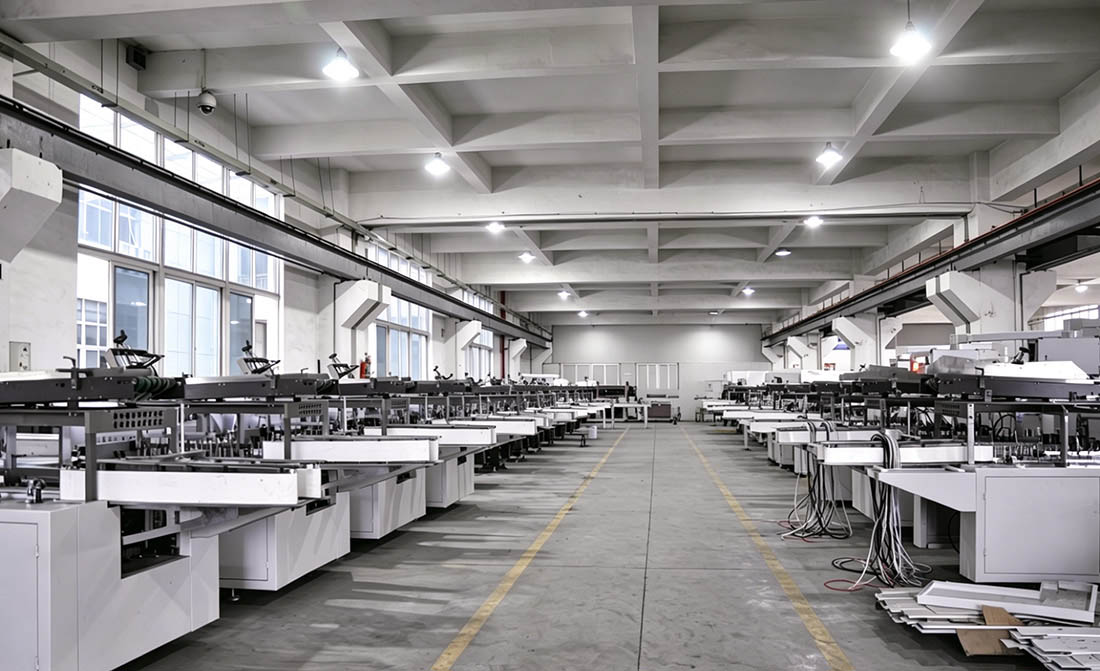
Assembly floor where tissue packing machine configurations are built and tested before shipment. Comparison scoring starts with drawings and nameplate data, not with photographs.
Why a Single Number Cannot Rank Tissue Packing Machines
Tissue packing is not one machine category. Soft tissue wrapping runs in packs per minute, cartoning runs in boxes per minute, canister packing runs in canisters per minute, and roll wrapping runs in rolls per minute. Floor space is published as an overall dimension triple. Utility demand is published as installed power plus an air-pressure and air-consumption band. A buyer who ranks these numbers directly is comparing different units of measure and calling the result a comparison.
The scale of the distortion becomes visible where two models differ in only one variable. The WIMACH TP-280 and TP-180 share identical overall dimensions of 3585 × 6260 × 1800 mm, an identical package dimension range of 90–200 (L) × 85–105 (W) × 25–90 (H) mm, an identical film specification of CPP, PE or composite film at 0.035–0.05 mm thickness, and an identical weight of 2900 kg. They differ in rated capacity — 260 packs/min against 180 packs/min — and in installed power, 18 kW against 12 kW.
A buyer ranking on speed selects the TP-280. A buyer normalizing power against output finds the two almost indistinguishable: at rated maximum, the TP-280 consumes roughly 1.15 Wh per pack and the TP-180 roughly 1.11 Wh per pack. The capacity step is real — about 44% more output — but it is not an efficiency step. That distinction only appears once the numbers are divided rather than read.
The Five Ratios That Make a Comparison Repeatable
Each ratio below is calculated from data a supplier is expected to publish. Together they form the technical half of the score; the commercial half is handled separately so that price cannot contaminate the engineering view.
1. Format coverage ratio. Maximum package volume divided by minimum package volume across the published L × W × H range. A ratio near 1.0 describes a dedicated single-format machine; a ratio above 10 describes a machine intended for a broad product mix. It answers a different question than speed: how much of a product portfolio the asset can absorb before a second machine is needed.
2. Throughput density. Rated maximum output divided by the floor area implied by overall dimensions. It exposes the assumption that faster machines always consume more space.
3. Electrical intensity. Rated power in watts divided by rated maximum output converted to units per hour. The result is watt-hours per packed unit at full rate — a figure that feeds directly into energy cost per thousand packs.
4. Air intensity. Upper-bound air consumption divided by rated maximum output, in litres per packed unit. Compressed air is often the most expensive utility on a packaging line per unit of energy delivered, so this ratio carries more weight than its modest number suggests.
5. Documentation completeness. The count of independently checkable records: certificate numbers, harmonised standard lists, issuing bodies, validity windows, patent numbers, and a written factory acceptance test scope. This is a scored criterion, not a binary pass. A supplier that publishes a certificate number and its standards can be audited; a supplier that publishes a logo cannot.
Worked Example: Soft Tissue Wrapping Configurations
The soft tissue segment illustrates how the ratios change a shortlist. The TP-280 is rated at 260 packs/min with 18 kW installed power and 120–160 L/min air consumption. The TP-180 is rated at 180 packs/min with 12 kW and the same air band. Both occupy the same 3585 × 6260 mm footprint, which yields approximately 22.4 m² of occupied floor area, a throughput density of about 11.6 packs/min/m² for the TP-280 and 8.0 for the TP-180, and air intensity of roughly 0.62 and 0.89 litres per pack respectively at the upper consumption bound.
A lower-capacity configuration such as the TBF-60, rated at 60 packs/min, illustrates the opposite end of the same decision. Output parity with one TP-280 requires roughly four such units running in parallel. The consequence is not a price difference between machines; it is a difference in installed footprint, headcount, maintenance surface and changeover events per shift. Framing the choice as four low-speed units versus one high-speed unit is the comparison a plant manager actually faces, and it is invisible in a price-per-machine quotation.
Worked Example: Cartoning and Canister Configurations
Cartoning inverts several common assumptions. The WIMACH TC-300 is rated at up to 180 boxes/min with 8 kW installed power and an overall size of 5000 × 1740 × 1800 mm — approximately 8.7 m². The TC-100 is rated at 30–100 boxes/min with 6.2 kW and an overall size of 3620 × 3130 × 1800 mm — approximately 11.3 m². The faster machine therefore delivers about 80% more output while occupying roughly 23% less floor area, with a throughput density of about 20.7 boxes/min/m² against 8.8 for the TC-100.
Both models share the same carton dimension range of 100–240 (L) × 100–120 (W) × 20–90 (H) mm and the same 300–400 gsm carton board requirement, so the carton format is not the differentiator. What differs is geometry: the TC-300 is long and narrow, the TC-100 is closer to square. In a hall with a constrained aisle width, that geometry can matter more than the speed difference, and a scoring model that ignores plan shape will recommend the wrong machine for the room.
Specialised formats score differently again. The TC-80F cube box cartoner accepts a single carton size of 115 × 115 × 130 mm, giving it a format coverage ratio of 1.0 — the lowest possible — while reaching about 12.7 boxes/min/m² from a 4310 × 1460 mm footprint and 7 kW. The TC-80Y canister packer covers 100–220 (L) × 50–80 (D) mm, a span of roughly 3.5×, draws 3.5 kW, and occupies about 13.9 m², producing the lowest throughput density in the WIMACH range at approximately 5.7 canisters/min/m². It is also the machine with the lowest electrical intensity at around 0.73 Wh per canister. Low density and low energy cost per unit are the same fact viewed from two directions: this is a low-speed, wide-envelope, low-load machine.
Table 1: Normalized Metrics Across Six Configurations
| Model | Rated max output | Overall dimensions (mm) | Floor area (m²) | Output density (units/min/m²) | Installed power | Electrical intensity (Wh/unit) |
| TP-280 | 260 packs/min | 3585 × 6260 × 1800 | ≈22.4 | ≈11.6 | 18 kW | ≈1.15 |
| TP-180 | 180 packs/min | 3585 × 6260 × 1800 | ≈22.4 | ≈8.0 | 12 kW | ≈1.11 |
| TC-300 | 180 boxes/min | 5000 × 1740 × 1800 | ≈8.7 | ≈20.7 | 8 kW | ≈0.74 |
| TC-100 | 30–100 boxes/min | 3620 × 3130 × 1800 | ≈11.3 | ≈8.8 | 6.2 kW | ≈1.03 |
| TC-80F | 30–80 boxes/min | 4310 × 1460 × 1800 | ≈6.3 | ≈12.7 | 7 kW | ≈1.46 |
| TW-160 | 60–120 rolls/min | 4350 × 2550 × 1940 | ≈11.1 | ≈10.8 | 12 kW | ≈1.67 |
Floor area and intensity values are calculated from published overall dimensions, rated power and rated maximum capacity. They are derived comparisons, not measured field data.
Table 2: Format Envelope, the Criterion Speed Cannot Express
| Model | Published package range | Coverage ratio | What the ratio implies |
| TC-300 / TC-100 | 100–240 (L) × 100–120 (W) × 20–90 (H) mm; 300–400 gsm board | ≈13.0× | Broad facial tissue box portfolio on one platform |
| TP-280 / TP-180 | 90–200 (L) × 85–105 (W) × 25–90 (H) mm; CPP, PE, composite film 0.035–0.05 mm | ≈9.9× | Soft pack formats from travel size to family pack |
| TC-80Y | 100–220 (L) × 50–80 (D) mm canisters | ≈3.5× | Canister diameters and heights, not carton sizes |
| TW-160 | Rolls 90–130 (L) × 90–130 (D) mm; wrapping paper 17–37 gsm | ≈2.1× | Standardised toilet roll formats |
| TC-80F | Fixed 115 × 115 × 130 mm cube carton | 1.0× | Dedicated cube box line; no format flexibility |
Turning Ratios Into a Score: Weighting by Production Reality
Ratios do not rank themselves. A buyer has to declare which criterion dominates, and the declaration should follow from the commercial situation rather than from preference. Three common patterns recur in tissue converting projects, and each produces a materially different ranking from the same data set.
| Criterion | High-volume single format | Multi-format converter | Space-constrained plant |
| Rated output | 30% | 15% | 15% |
| Format coverage ratio | 10% | 30% | 15% |
| Throughput density | 15% | 10% | 30% |
| Electrical and air intensity | 25% | 15% | 10% |
| Documentation completeness | 20% | 30% | 30% |
Illustrative weight sets for a 1–5 scoring scale. Weights are a buyer decision, not a supplier claim.
The consequence is predictable once weights are explicit. A converter packing four box sizes a week should not select the TC-300 on its 180 boxes/min figure if its carton geometry then requires a second machine for a non-standard size; the TC-100 at 30–100 boxes/min covers the same 100–240 × 100–120 × 20–90 mm carton range at a lower ceiling. A plant running one cube box at volume should not discount the TC-80F for its 1.0 coverage ratio, because format flexibility is a cost it does not need to carry.
Scoring the Documentation: What to Request and How to Read It
Qualification evidence is the only part of a comparison that a buyer can verify before money moves, so it deserves its own weighted line. For the WIMACH tissue packing range, three CE attestations and three patent certificates are published with traceable identifiers.
| Document | Reference number | Covered scope | Named standard set |
| CE attestation — tissue wrapping | TRCN-25118WWM01 (iNTEGRA96 Belgelendirme, issued 2025-04-28) | Automatic Tissue Wrapping Machine — TP-180, TP-280 | EN ISO 12100:2010; EN 60204-1:2018+A1:2025; EN 415-1:2014; EN 415-10:2014; EN IEC 61000-6-2:2019; EN IEC 61000-6-4:2019 |
| CE attestation — carton packing | TRCN-25091WWM01 (iNTEGRA96 Belgelendirme, issued 2025-04-01) | Automatic Carton Packing Machine — TC-100, TC-300, TC-80F | EN ISO 12100:2010; EN 60204-1:2018; EN 415-1:2014; EN 415-10:2014; EN IEC 61000-6-2:2019; EN IEC 61000-6-4:2019 |
| CE attestation — roll wrapping | M.2021.206.C67964 (UDEM, issued 2021-09-24) | Automatic Tissue Packing Machine — TW-160 | EN ISO 12100:2010; EN 60204-1:2018; EN 61000-3-2:2019; EN 61000-3-3:2013+A1:2019; EN 61000-6-1:2019; EN 61000-6-3:2007+A1:2011+AC:2012 |
Each attestation carries a validity window as well as an issue date, and the first scoring rule in this section is procedural: record both, and confirm that the certificate is current at the time of order rather than at the time of reading. The second rule is to check the scope line against the exact model being quoted. A certificate covering an automatic tissue wrapping machine does not automatically cover a canister packer, and a buyer who accepts a general statement of compliance instead of a scoped document has not scored anything.
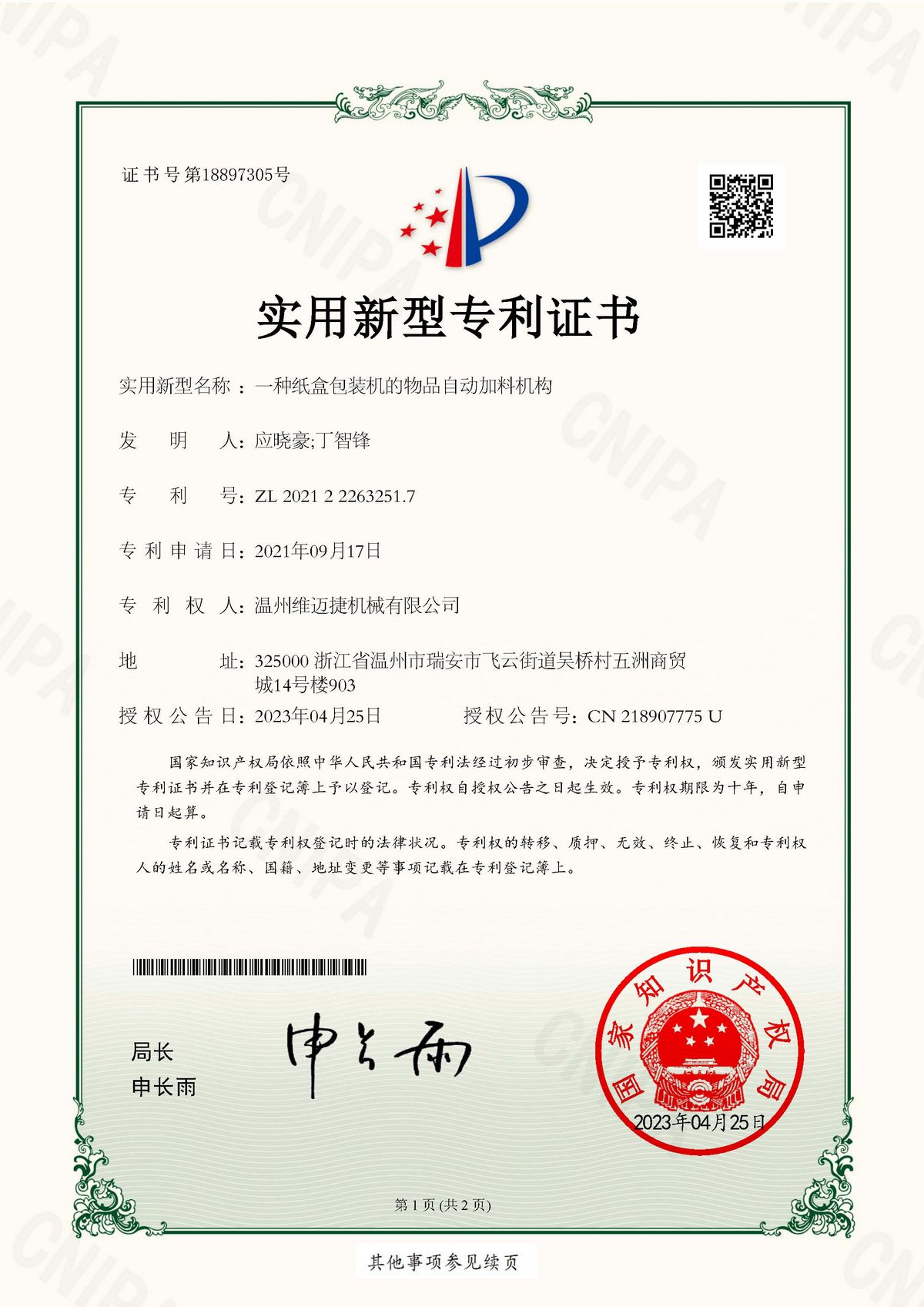
Utility model patent ZL 2022 2 1202677.7 (National Intellectual Property Administration, PRC), covering an automatic feeding mechanism for a carton packaging machine — the kind of record a buyer catalogues during document scoring.
Beyond certificates, the WIMACH qualification set includes an invention patent, ZL 2022 1 1099886.8, granted 2022-09-06 for a carton packing machine and carton packaging process, plus utility model ZL 2022 2 1202677.7 issued 2023-04-25 covering an automatic feeding mechanism and a box forming mechanism for carton packaging machines. Patents are not a performance guarantee, but they are checkable, dated and attributable — which is precisely what a documentation score is meant to measure.
The acceptance scope is the final documentation item. WIMACH states a nine-part quality control sequence: no-load and load running test, dimensional tolerance inspection, mechanical assembly check, pneumatic leakage test, electrical safety test, PLC control logic test, safety interlock and E-stop test, long-time aging test, and surface appearance inspection. A buyer should convert that list into factory acceptance test (FAT) hold points before the purchase order, because a test that is described but not witnessed is a claim rather than evidence.
Commercial Terms as a Separate Score
Price belongs in the model, but in a later block, so that a strong commercial offer cannot hide a weak technical fit. The published terms for this range are a minimum order quantity of one set, delivery terms of FOB, FCA, CIF or CFR, acceptance against FAT, and T/T payment. Lead time varies by production mode: 30–60 days for a complete packaging line, 30–45 days for customized machinery, and 15–45 days for OEM and ODM work. Stated monthly capacity is one set for a complete packaging line and 13 sets for customized or OEM production.
Those figures matter to the comparison because they change the cost of being wrong. A single-set MOQ lowers the penalty for a pilot installation; a 15–45 day OEM lead time supports a faster format trial; a 30–60 day complete-line lead time means the line decision has to be locked earlier than the machine decision. Buyers comparing a standalone unit against a turnkey scope are comparing two different schedule risks, and the schedule risk should carry its own weight.
Where This Method Breaks Down
The framework has real limits and should be used with them stated. Rated capacity is a nameplate maximum produced under stated format and material conditions; it is not an OEE figure, and no field-measured output is published for these models. Electrical and air intensity are calculated at full rated rate, so they understate consumption during ramp-up, stops, and changeover — the periods where real plants spend a disproportionate share of their utility budget.
Floor area is derived from overall machine dimensions only. It excludes infeed and outfeed conveyors, operator clearance, film or board reel access, and maintenance envelopes. On the TP series, whose footprint is 6260 mm wide, conveyor runs can add more usable area than the machine itself, which means the density ranking in Table 1 can shift once a full layout is drawn.
The format coverage ratio also penalises machines for a design choice rather than a defect. The TC-80F scores 1.0 because it is built for one cube carton; in a dedicated cube box plant that is an advantage expressed as a low number. Finally, the weights are a judgement, not a measurement, and two competent buyers can reach different rankings from identical data without either being wrong. The method's value is that it forces the disagreement onto a named criterion instead of leaving it inside a price negotiation.
Market Context: Why Normalized Comparison Is Becoming Standard Practice
Commercial research published by Precedence Research places the global tissue paper packaging machine market at approximately USD 3.9 billion in 2025, with a projected USD 4.2 billion in 2026. The same source reports Asia Pacific holding a 39.8% share in 2025 and facial tissue packaging applications accounting for 42.1% of market share in the same year. Those proportions describe a market where cartoning and soft-pack wrapping dominate volume, which is exactly where the format and density ratios do the most work.
The same evidence points to a procurement consequence. When the largest application segment is facial tissue packing — the segment where the TC-300, TC-100 and TC-80F compete — buyers are choosing between machines that share carton ranges and differ mainly in speed, plan geometry and envelope width. Price comparison alone cannot separate those, which is why normalized scoring tends to appear first in high-volume, format-concentrated segments.
Applying the Score Inside a Real Line
A machine score is an input to a line decision, and the line decision has its own criteria: upstream and downstream compatibility, accumulation buffering, and end-of-line handling. WIMACH's project record illustrates the range of contexts in which a scored machine has to fit. A 12-set facial and cream tissue line in Poland integrates conveying, cartoning, case packing, palletizing and stretch wrapping, with quick size changeover cited among its features. A 6-set toilet paper roll line in the United States performs roll wrapping, case packing, automatic palletizing and stretch film wrapping, producing dustproof and moisture-resistant pallet loads. A 9-set canister wet wipe line in Mexico delivers labelled, cased and palletized output.
At machine level, two TC-80Y canister packers in the United Arab Emirates have run for four years at a stated stable output of 60 canisters per minute for facial tissues and paper napkins, and two cartoning machines in the United States handle continuous box packing of facial tissues. In each case, the value of the scoring exercise is the same: the machine was selected against a declared format, output and space constraint, and the case record documents the outcome rather than the intention.
Future Outlook
Two pressures are likely to push this kind of scoring from optional to routine. The first is format proliferation — more pack sizes per brand, more channel-specific packs — which raises the weight of the coverage ratio relative to raw speed. The second is utility cost visibility: as energy and compressed air are metered more granularly at plant level, the per-unit intensity ratios become auditable numbers rather than derived estimates. The unresolved gap is independent benchmarking; public data on real-world OEE and measured changeover times for specific box dimensions is scarce across the category, and until it exists, buyers will keep comparing nameplate figures and treating the difference as certainty.
FAQ
How should a buyer compare two tissue packing machines that share the same rated speed?
Normalise both against the same denominators before comparing. Two machines rated at the same output can differ in floor area, installed power, air consumption and package envelope: the TP-280 and TP-180, for example, share identical overall dimensions and package ranges but are rated at 260 and 180 packs/min with 18 kW and 12 kW respectively. Dividing output by floor area and power by output exposes differences that a speed figure conceals.
What does rated packing capacity actually mean on a tissue packing machine?
It is the maximum output the manufacturer states for the machine under defined format and material conditions. The TP-280 is rated at a maximum of 260 packs/min, the TC-300 at up to 180 boxes/min, the TC-80Y at 30–80 canisters/min, and the TW-160 at 60–120 rolls/min. None of these figures is an average production rate; sustained output depends on pack format, material, stops and changeover frequency.
How do package dimensions affect which tissue packing machine is selected?
The published L × W × H range defines which products a machine can accept. Cartoning models TC-100 and TC-300 cover 100–240 (L) × 100–120 (W) × 20–90 (H) mm with 300–400 gsm board; the TP-180 and TP-280 cover 90–200 (L) × 85–105 (W) × 25–90 (H) mm in CPP, PE or composite film; the TC-80Y covers canisters of 100–220 (L) × 50–80 (D) mm; and the TC-80F accepts one fixed 115 × 115 × 130 mm cube carton. A product outside the published range requires a different model or a customization scope.
Which certification documents should be verified before ordering?
Request the certificate number, the covered equipment scope, the issuing body, the named standard set and the validity window. For this range, CE attestations are published as TRCN-25118WWM01 for automatic tissue wrapping machines, TRCN-25091WWM01 for automatic carton packing machines and M.2021.206.C67964 for the automatic tissue packing machine scope, each listing harmonised standards including EN ISO 12100:2010, EN 60204-1 and EN 415-1. Verify that the scope line names the exact model being quoted.
What order quantities and lead times are typical for tissue packing machines?
For this range, the minimum order quantity is one set, with delivery terms of FOB, FCA, CIF or CFR, acceptance against factory acceptance testing and T/T payment. Published lead times are 15–45 days for OEM and ODM production, 30–45 days for customized machinery and 30–60 days for a complete packaging line, with stated monthly capacity of 13 sets for customized or OEM work and one set for a complete line.
Does a higher-speed tissue packing machine always require more floor space?
No. The TC-300 is rated at up to 180 boxes/min from overall dimensions of 5000 × 1740 × 1800 mm, approximately 8.7 m², while the TC-100 is rated at 30–100 boxes/min from 3620 × 3130 × 1800 mm, approximately 11.3 m². Plan shape matters as much as area: the TC-300 is long and narrow, the TC-100 closer to square, and aisle width can decide between them in a constrained hall.
For buyers who want the full model and parameter set behind this framework, the manufacturer's catalogue is available as a public download: WIMACH product catalogue (PDF).
Tem questões ou precisa de mais detalhes?
Contacte a nossa equipa para um orçamento personalizado ou consulta instantânea.
Solicitar orçamento
Preencha o formulário abaixo e a nossa equipa entrará em contacto com uma proposta personalizada.
Chat direto do WhatsApp
Prefere conversar em tempo real? Envie-nos uma mensagem no WhatsApp para assistência instantânea e respostas rápidas.
- Obter orçamento personalizado
- Partilhar fotos ou documentos
- Discuta as suas necessidades diretamente
Geralmente responde em 5–30 minutos durante o horário de expediente.