
Screw Air Compressor FAQ: IE4, 8–25 Bar, and Supporting Equipment
Screw Air Compressor FAQ: IE4, 8–25 Bar, and Supporting Equipment
An industrial screw air compressor is specified by five variables before any brand comparison becomes useful: discharge pressure, delivered airflow, motor efficiency class, duty cycle, and the capacity of the air treatment equipment installed downstream. Buyers who stop at the compressor nameplate usually meet the remaining variables later — when a line loses pressure at peak demand, when condensate reaches a pneumatic tool, or when an EU importer asks for the certificate file that sits behind a CE mark. This reference answers the recurring technical and procurement questions that appear between those two points, using catalogue-level data for UMW Air screw compressors and published industry figures.
Why Specification Questions Decide Compressor Procurement
Compressed air is purchased as a system, not as a standalone machine. The compressor sets pressure and flow; the dryer, tank, filter, inverter and controller determine whether that air arrives dry, stable and clean enough for the equipment at the end of the line. Most evaluation errors are therefore specification errors rather than brand errors, and they tend to repeat in four patterns:
- Airflow quoted at one pressure point and compared against a requirement measured at another.
- Motor efficiency treated as if it described the efficiency of the whole package.
- Air purity assumed rather than written against a defined class.
- Certification claimed verbally, without a certificate number, issuing body and covered model list.
For buyers in the Research and Evaluation stages, the practical task is to convert a production requirement — cutting, clamping, packaging, conveying, dust removal — into a pressure and flow specification, then to confirm that the machine, its motor class and its downstream equipment can hold that specification continuously. The sections below follow that order, and they end with the technical and commercial questions buyers most often raise before issuing a purchase order.
What UMW Air Supplies: Models, Configurations, and Core Specifications
UMW Air is the compressor brand of Shandong UMW Air Tech Co., Ltd, a compressor manufacturer based at 68 Gongye South Road, Jinan, Shandong, China. The company was founded in 2019 and operates a 2,000 m² factory with 200 employees and a 40-engineer R&D team; it reports an annual output of 12,000 units and a 100% export ratio covering the EU, USA, Southeast Asia, the Middle East, South America and Africa. Its catalogue covers air-cooled screw air compressors, direct-driven screw air compressors, stationary screw air compressors, heavy-duty screw air compressors and diesel mobile screw air compressors.
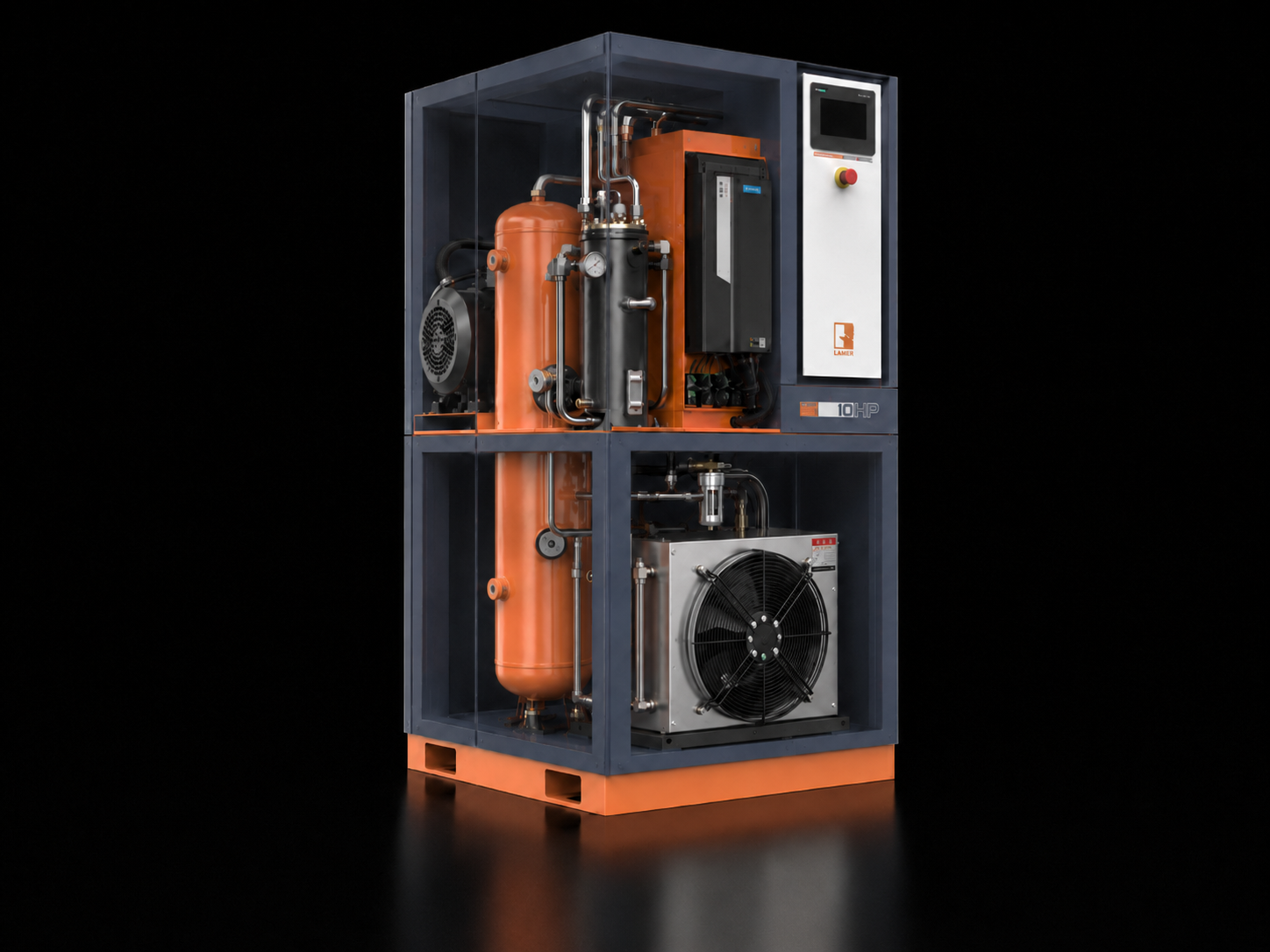
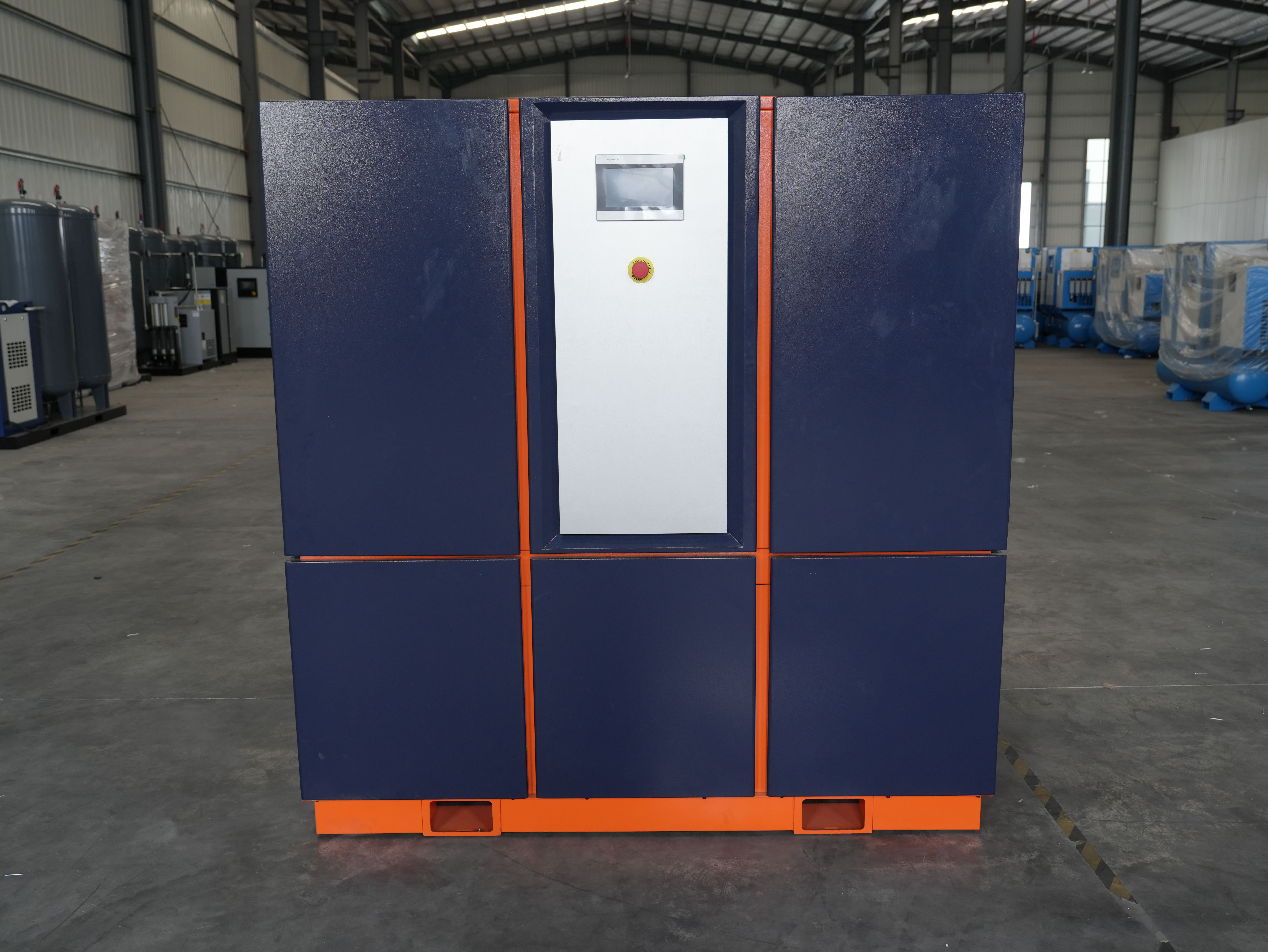
Within that range, the screw line is classified into four configurations: integrated, split/separate, portable and fixed. Integrated machines package the compressor and a receiver tank inside one enclosure; split configurations separate the compressor from the tank and the treatment equipment; portable and stationary versions address mobile duty and fixed plant installation respectively. Units in this range use a sheet metal enclosure and a single-stage screw compressor air end, with air cooling as the cooling method and a direct-driven drive method.
| Model / series | Power | Pressure range | Airflow | Motor | Cooling & drive | Air end / tank |
|---|---|---|---|---|---|---|
| Micro ML-4A, Micro ML-5.5A, Micro ML-7.5A | 4 kW / 5.5 kW / 7.5 kW | 8–13 Bar | Maximum 1.1 m³/min | Not specified in the published data for this series | Air cooling; single-stage screw air end | Single-stage screw air end; 140 L gas tank |
| ML-7.5/8A, L-7.5/8A, L-1516A, L-2216A | 4–355 kW (family range) | 8–25 Bar | 2.39 m³/min (published reference figure for these models) | IE4 | Air cooling; direct driven | Single-stage screw air end; sheet metal enclosure |
Two specification points deserve emphasis during evaluation. First, the two model groups occupy different duty bands: the Micro ML units are compact packages with a 140 L gas tank, while the ML-7.5/8A, L-7.5/8A, L-1516A and L-2216A group spans a power range from 4 kW to 355 kW. Second, the airflow figure of 2.39 m³/min is published for that four-model group alongside the 8–25 Bar pressure range and the 4–355 kW power range; it is a reference point tied to a defined model and pressure setting, not a universal rating that applies to every configuration. A quotation should always state the delivered airflow at the discharge pressure the plant actually needs.
Technical Explanation: IE4 Motors, Direct Drive, Air Cooling, and Single-Stage Air Ends
Four specification items in this range carry more operational weight than their short labels suggest.
IE4 motor class
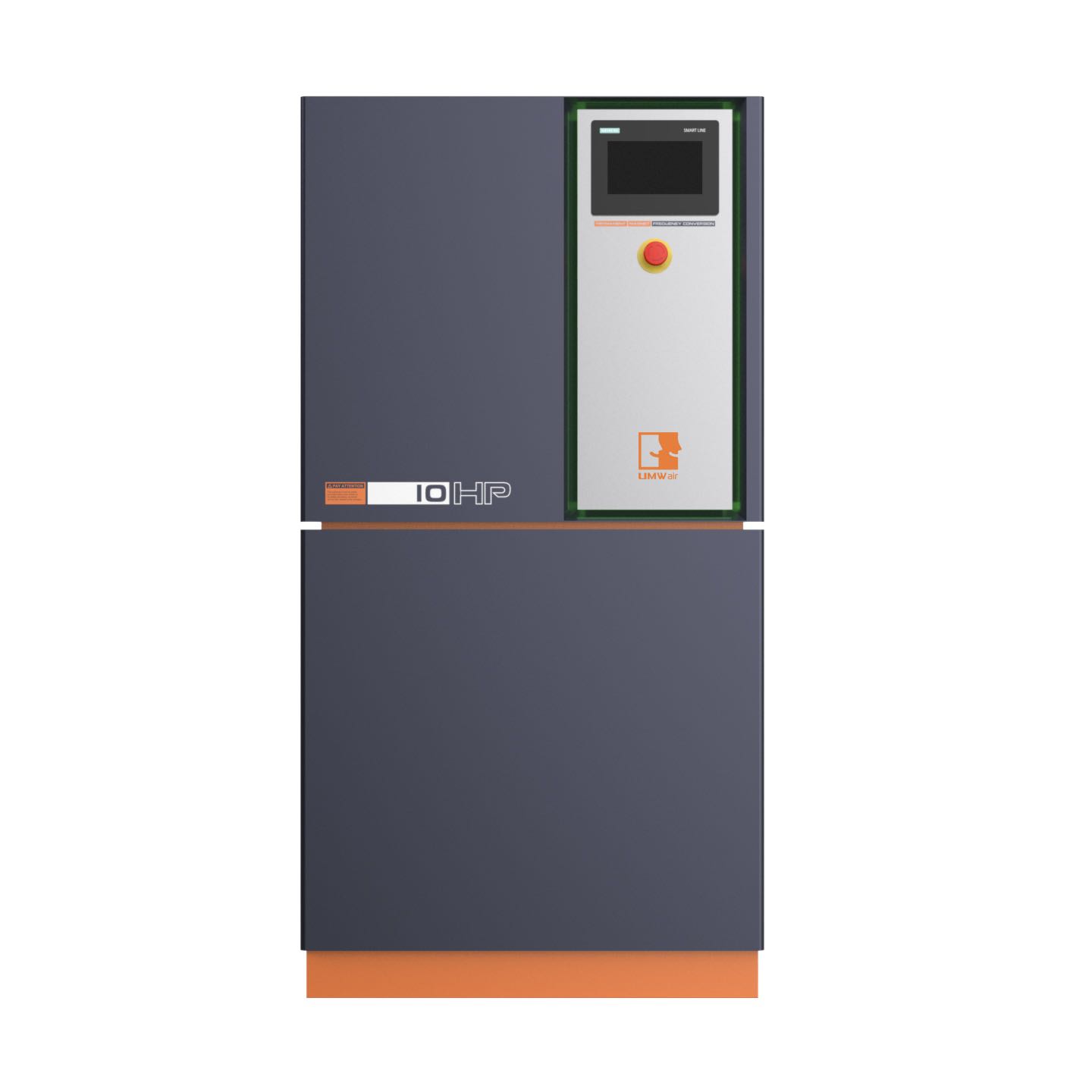
IE4 is an international motor efficiency class that sits above IE3 in the standard classification of industrial motor efficiency. In a compressor, IE4 describes the efficiency of the drive motor, not the efficiency of the complete package. That distinction matters in evaluation, because package-level efficiency is also shaped by the air end, the drive method, the control strategy and the pressure drop across downstream treatment equipment. The models ML-7.5/8A, L-7.5/8A, L-1516A and L-2216A specify an IE4 motor. For a plant running continuous shifts, motor class is one of the few specification items that affects energy use in every operating hour, which is why it now appears in tender documents alongside pressure and flow rather than in an appendix.
Direct-driven transmission
In a direct-driven machine, the motor is coupled directly to the screw air end, so there is no belt to tension or replace as a routine maintenance item. Belt-driven designs remain common and can be entirely suitable for many plants, but they add a wearable transmission component to the maintenance schedule. For buyers comparing quotations, the drive method is best treated as a maintenance and reliability variable rather than a headline performance figure.
Air cooling
Air-cooled machines reject heat to the compressor room instead of to a cooling water circuit, removing the need for cooling water supply and treatment. That is the cooling method specified across this range. The trade-off is site dependence: ambient temperature and ventilation in the compressor room become part of the specification, not an installation afterthought. In high-temperature or humid factories, the compressor room itself is therefore a design input.
Single-stage screw air end
The screw air end compresses air between two meshing rotors, and the units described here use a single-stage screw air end. The catalogue pressure range of 8–25 Bar covers the band most industrial plants work in as well as higher-pressure duty within the same equipment family. Where a requirement sits above that band, a different compression architecture is needed rather than a scaled-up version of the same machine — a boundary discussed in a later section.
Pressure and airflow relationship
Airflow is always quoted at a pressure point. If two suppliers quote airflow at different discharge pressures, the figures are not directly comparable, and a machine specified to deliver a given flow at 8 Bar will deliver less when the set pressure is raised. The practical rule for evaluation is to fix the required pressure first — driven by the most pressure-demanding tool or process on the line — and then compare airflow at that same pressure.
Supporting Equipment in a Complete Compressed Air System
A screw compressor alone does not deliver production-ready air. Application data for these units lists five matched items of equipment: air dryer, air tank, line filter, inverter and controller. Each one answers a specific specification question rather than adding generic scope.
| Equipment | Function in the system | Specification question it answers |
|---|---|---|
| Air dryer | Removes water vapour and condensate from the compressed air stream | How humid is the plant, and what dew point does the process require? |
| Air tank | Stores compressed air and buffers pressure fluctuations | How large are the demand peaks, and how often should the compressor load and unload? |
| Line filter | Removes particulates and oil carry-over | What purity class must the air meet at the point of use? |
| Inverter | Matches motor speed to actual air demand | How much does demand vary between shifts and between low and high production? |
| Controller | Monitors, sequences and protects the system | Who receives alarms, and can faults be diagnosed remotely? |
Air purity is normally written against ISO 8573-1:2010, the primary international standard for compressed air quality, which classifies contaminants including particles, water and oil. A purchase specification that says only “clean, dry air” leaves the class undefined; a specification that states a class number makes dryness, filtration and, where relevant, oil content measurable at commissioning and verifiable over the life of the system.
The inverter deserves separate mention because it is the item most closely tied to running cost. The U.S. Department of Energy notes that variable frequency drive compressors can save up to 35% in energy costs by matching motor speed to actual air demand, which is why variable-speed control appears in most current efficiency discussions. UMW Air states that it treats energy efficiency as a core design belief, standardizing PM VSD technology and low-resistance system design so that each kWh is converted into usable production.
Application Fit: Where Continuous-Duty Screw Compressors Are Used
Application data for this screw compressor range covers metal processing and manufacturing, plastics and rubber processing, automotive and machinery parts, food and packaging, construction and materials, and the energy and chemical industries. The listed project types are CNC machinery production lines, automotive parts production lines, plastic processing line expansions, industrial automation integration, and food and beverage packaging line setups.
The operating profile is the same across those cases: continuous operation, with stable and clean compressed air as the required output. The stated working conditions include high-temperature or humid environments, which is precisely where the interaction between compressor, dryer and room ventilation becomes decisive. Requirements listed for these installations include energy saving, low noise, environmental compliance and reliability.
A CNC machining workshop in Vietnam illustrates the pattern. Three units were installed to drive CNC machine actuators, pneumatic tools and dust removal systems. After one year of operation, the workshop reported a 20% improvement in production efficiency with reduced downtime, and identified low energy consumption, easy maintenance and reliable long-term performance as the characteristics that mattered most to the plant.
Laser cutting sits at the stricter end of the application spectrum. For laser cutting applications, oil-free air at Class 0 per ISO 8573-1 is critical to prevent contamination of sensitive optics and to ensure cut quality, according to published industry guidance. Where compressed air is used as the auxiliary cutting gas instead of bottled nitrogen or oxygen, one CNC industry research source reports production cost reductions of up to 50%. Both points are why air quality, not only pressure and flow, belongs in the initial specification.
Market Trend Analysis
Three published data points frame how industrial compressors are currently evaluated. Grand View Research values the global industrial air compressor market at USD 20.0 billion in 2025 and projects growth to USD 28.3 billion by 2033. Within that market, the rotary screw segment accounted for 47.0% of revenue in 2025 on the strength of its efficiency in continuous industrial applications, and Asia Pacific held the largest regional revenue share at 42.8%, with China identified as a key market leader.
Forecast scope deserves a caution. Published estimates for 2026 vary widely between research firms — Grand View Research's industrial-specific figure of USD 20.9 billion sits well below Mordor Intelligence's broader-category estimates in the USD 35–41 billion range — because the two define the addressable market differently. Any buyer citing market growth in an internal business case should state which scope the figure belongs to.
The supplier landscape remains concentrated around established global players; Atlas Copco, Ingersoll Rand, Kaeser Kompressoren and Sullair (Hitachi) are consistently identified as top competitors in the industrial air compressor market. Alongside them, export-oriented manufacturers such as UMW Air compete on published specification data, CE certification coverage and OEM/ODM configuration options. The direction of the trend is consistent across sources: energy efficiency and variable-speed control dominate purchasing criteria, and compliance documentation has moved from a formality to a screening gate for suppliers selling into the EU.
Comparison with Traditional Solutions — and Where the Boundaries Sit
Rotary screw compressors are typically selected for continuous duty, where few moving parts and low vibration suit long running hours. Reciprocating (piston) compressors remain common in intermittent or lower-duty applications and small workshops, and they work on a different principle — a piston moving inside a cylinder. The comparison most buyers need is therefore not which design is universally better, but which one fits the duty cycle, air quality requirement and maintenance capability of the plant.
That framing matters because the screw configuration described here has clear boundaries, and stating them is part of the specification work rather than a criticism of the technology:
- Ambient dependence in air-cooled designs. Air-cooled machines reject heat to the compressor room. High-temperature or humid environments are listed as intended working conditions for these units, but ventilation and ambient temperature remain site conditions to confirm during evaluation; a poorly ventilated room changes the duty a machine effectively faces.
- Pressure ceiling of a single-stage air end. The catalogue range tops out at 25 Bar. Requirements above that band call for a different compression architecture, not a larger version of the same machine.
- Capacity ceiling in the compact series. Micro ML-4A, Micro ML-5.5A and Micro ML-7.5A cover 8–13 Bar with a maximum airflow of 1.1 m³/min and a 140 L gas tank. They suit compact cells and auxiliary duty; they are not a substitute for a high-flow machine on a large production line.
- Oil-free duty. ISO 8573-1 Class 0 air, required in applications such as laser cutting to protect sensitive optics, is not achieved by assuming that a general-purpose lubricated compressor meets the class. Buyers with Class 0 requirements should confirm the specific machine type and the treatment chain rather than infer it from a pressure and flow specification.
- Family range versus model data. Catalogue figures such as the 4–355 kW power range describe the equipment family. Airflow, pressure and dimensions must be confirmed on the datasheet for the specific model quoted.
Recording these limits before the order is placed is what prevents a machine that satisfies a brochure number from failing a production requirement six months later.
Procurement Terms, Pre-Shipment Testing, and Certification Evidence
Commercial terms carry as much procurement risk as technical specifications, so they deserve the same precision as a pressure rating.
- Minimum order quantity: 1 unit.
- Lead time: 3 days.
- Monthly capacity: 1,000 units.
- Customization: OEM and ODM production with customization of colour, logo and voltage.
- Quality control: factory pre-shipment testing.
- Payment terms: 30% T/T advance, with the remaining 70% payable before shipping.
- Delivery terms: FOB or CIF.
- After-sales: 24/7 technical support via email or phone, including remote troubleshooting and guidance.
For EU-bound orders, the certification record is the first item to verify. Models ML-7.5/8A, L-7.5/8A, L-1516A and L-2216A hold CE certification under the 2006/42/EC Machinery Directive for the EU/EEA market, with certificate number M.2026.206.C140156 issued by UDEM. The certificate covers the UMW air L, UMW air Z, UMW air P, UMW air M, UMW air N and UMW air O series, and cites the 2014/30/EU Electromagnetic Compatibility Directive, Annex II, alongside harmonised standards including EN ISO 12100:2010, EN 60204-1:2018/A1:2025, EN 1012-1:2010, EN IEC 61000-6-2:2019, EN IEC 61000-6-4:2019 and EN IEC 61000-3-2:2019+A1:2021+A2:2024. The certificate was issued on 2026-05-11 and is valid until 2031-05-10.
Documentation requests and technical questions can be directed through UMW Air's published channels: email info@umwair.com, phone or WhatsApp +86 15053148082, or the company address at 68 Gongye South Road, Jinan, Shandong, China, 250000. Technical information is published at umwair.com.
Future Outlook
Three developments are likely to shape how the next generation of screw compressor specifications is written.
First, motor efficiency classes will continue to climb the procurement checklist. As energy cost per operating hour becomes a board-level figure in manufacturing, an IE4 motor and a variable-speed control strategy move from differentiators into baseline requirements in tender documents.
Second, air treatment is shifting from accessory to specification. As processes such as laser cutting and precision automation spread, requirements written against ISO 8573-1:2010 classes will appear in purchase orders more often, and the dryer, filter and tank will be sized as part of the compressor package rather than added after commissioning.
Third, compliance documentation will keep consolidating as a market-entry filter. For export-oriented manufacturers, the minimum evidence set for inclusion in a shortlist is becoming consistent: published specification data, verifiable certification with a number and a covered model list, configurable build options, and a documented service route. In that environment, the questions a supplier can answer precisely — pressure, flow, motor class, certificate number and payment terms — are also the questions an evaluator can carry directly into a comparison sheet.
FAQ
The questions below follow the order in which they normally arise during technical evaluation and commercial review.
1. What pressure, airflow and power range does an industrial screw air compressor cover?
The screw compressor range described here covers a pressure range of 8–25 Bar and a power range of 4–355 kW, with an airflow reference figure of 2.39 m³/min published for the models ML-7.5/8A, L-7.5/8A, L-1516A and L-2216A. The compact Micro ML-4A, Micro ML-5.5A and Micro ML-7.5A units cover 8–13 Bar with a maximum airflow of 1.1 m³/min. Because airflow is quoted at a defined pressure point, a buyer should compare quotations at the discharge pressure the plant actually requires.
2. What does an IE4 motor mean in a screw compressor specification?
IE4 is an international motor efficiency class above IE3. In a compressor specification it defines the efficiency of the drive motor rather than of the complete package, since overall system efficiency also depends on the air end, the drive method, the control strategy and pressure losses downstream. In this range, the models ML-7.5/8A, L-7.5/8A, L-1516A and L-2216A specify an IE4 motor.
3. Which UMW Air screw compressor models hold CE certification, and under which directive?
Models ML-7.5/8A, L-7.5/8A, L-1516A and L-2216A are certified to CE standards under the 2006/42/EC Machinery Directive for the EU/EEA market. Certificate number M.2026.206.C140156 was issued by UDEM, applies to the UMW air L, UMW air Z, UMW air P, UMW air M, UMW air N and UMW air O series, and is valid from 2026-05-11 to 2031-05-10.
4. What supporting equipment does a complete compressed air system require?
Application data for these units lists an air dryer, air tank, line filter, inverter and controller as matched equipment. The dryer removes moisture, the tank buffers pressure and reduces load/unload cycling, the filter removes particulates and oil carry-over, the inverter matches motor speed to air demand, and the controller manages monitoring and sequencing. Purity targets are normally written against ISO 8573-1:2010, which classifies compressed air by particle, water and oil content.
5. Can a screw air compressor run continuously in high-temperature or humid environments?
The units described here are specified for continuous operation, and high-temperature or humid working conditions are listed as the target environment, with stable and clean compressed air as the required output. Because these are air-cooled machines that reject heat to the compressor room, ventilation and ambient temperature remain site conditions that should be confirmed during evaluation, and air treatment capacity matters more in humid conditions.
6. How do integrated, split, portable and fixed configurations differ?
The screw compressor range is classified into integrated, split/separate, portable and fixed configurations. Integrated units package the compressor and a receiver tank in one enclosure; the Micro ML series, for example, includes a 140 L gas tank in the package. Split configurations separate the compressor from the tank and treatment equipment, portable units suit mobile duty, and fixed units suit permanent plant installation. Selection depends on available floor space, piping distance and whether the machine will be relocated.
7. What procurement terms apply to these screw air compressors?
The listed terms are a minimum order quantity of 1 unit, a lead time of 3 days, monthly capacity of 1,000 units, and OEM/ODM production with customization of colour, logo and voltage. Quality control includes factory pre-shipment testing. Payment terms are 30% T/T advance with the remaining 70% payable before shipping, and delivery is quoted FOB or CIF. After-sales support is provided 24/7 via email or phone, including remote troubleshooting.
8. Where does a standard oil-lubricated screw compressor reach its limits?
Single-stage, air-cooled machines in this range are specified up to 25 Bar, and the Micro ML-4A, Micro ML-5.5A and Micro ML-7.5A units are capped at 1.1 m³/min airflow and 8–13 Bar pressure. Applications that require ISO 8573-1 Class 0 oil-free air — laser cutting optics are a common example — need oil-free compression or verified downstream treatment rather than an assumption that any lubricated compressor meets the class.