
Screw Barrel Evidence: 1–50 Piece Batches, PTA, OEM Fit
Screw Barrel Evidence: 1–50 Piece Batches, PTA, OEM Fit
Screw and barrel sourcing has shifted from specification matching to evidence review. A catalogue can state a diameter range and a hardness figure; it cannot show whether the fortieth barrel in an order will fit the same machine as the first, or whether a screw shank will survive the torque of the drive it is mounted on. For extrusion and injection machinery builders, and for the distributors who keep installed lines running, those two questions separate a supplier that can be designed into a machine from one that can only fill a single replacement order.
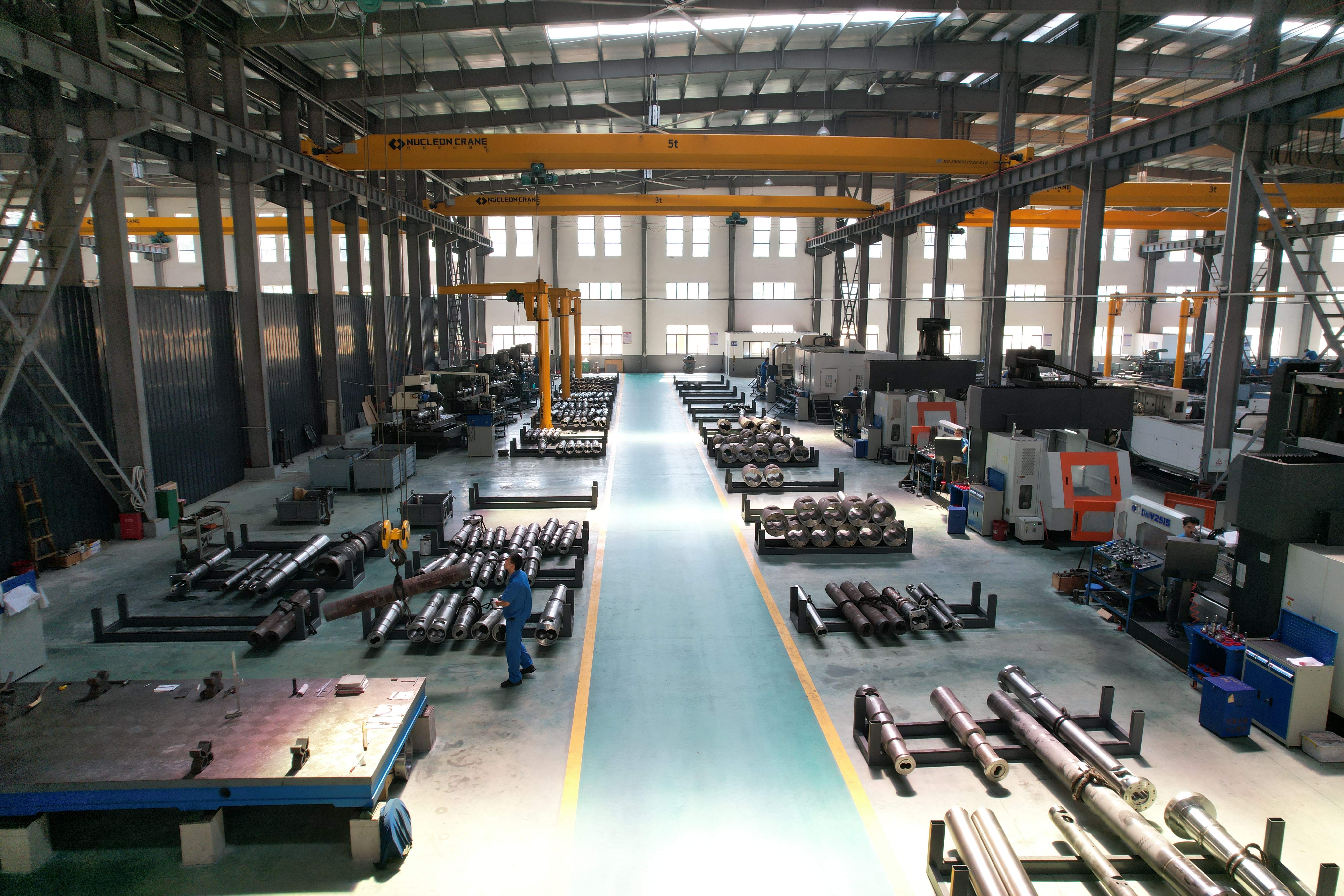
Screw and barrel production environment. In this category, supplier evidence is created at the machine and verified in the batch record — not in the catalogue.
This reference examines three concrete pieces of supplier evidence against that standard: batch custom orders from 1 to 50 pieces, a bimetallic layer produced by fully automatic plasma rotary alloy spraying (PTA) and specified at HRC 58–65, and OEM assembly use by extrusion and injection machinery clients. The reference case is Guangyou Screw, the brand of Zhejiang Guangming Plastics Machinery Co., Ltd., a screw and barrel manufacturer established in 1992 in Zhoushan, China. The purpose is practical: to set out what each piece of evidence establishes, what it does not, and what procurement and engineering teams should ask for before releasing an order.
The evidence gap between the first article and the batch
Screws and barrels are made-to-order components, and approval is usually granted on a sample. The commercial risk, however, sits in the batch. In the 1–50 piece custom range a single order may combine several diameters, several profiles and a mix of replacement and retrofit items, so the supplier's process discipline is tested precisely where statistical sampling is least useful.
Two distinct failure modes also require two distinct sets of evidence. The first is flow-side wear: abrasion, corrosion and adhesion acting on the surface that conveys the melt. The second is structural failure of the screw shaft under torque. A wear-resistant layer does nothing for a shank that cracks under load, and a tough shaft does not protect a bore from abrasive filler. A buyer who evaluates only one of the two is accepting an unexamined risk on the other.
Guangyou Screw: capability facts a buyer can check
Guangyou Screw is the brand under which Zhejiang Guangming Plastics Machinery Co., Ltd. manufactures single, twin and bimetallic screw and barrel sets, with OEM production and customization of voltage and logo. The recorded capability profile is specific enough to be checked line by line in a supplier audit.
| Capability item | Recorded value |
|---|---|
| Established | 1992 |
| Facility | 100,000 m² manufacturing site, Zhoushan, China |
| Workforce and engineering | 800+ employees; 25-engineer R&D team |
| Output | 32,000 units per year reported; monthly capacity 2,700 units |
| Production mode | OEM production; voltage and logo customization |
| Order size | Minimum order quantity 1 unit |
| Quality control | 100% testing on all products |
| Export profile | Approximately 30% of sales exported, mainly to the EU; customers in 50+ countries and regions |
| Management systems | ISO 9001:2015 (15/25Q6428R80); ISO 14001:2015 (15/25E6429R20); ISO 45001:2018 (15/25S6430R20); issued 8 May 2025 by WIT ASSESSMENT |
| Certificate validity | ISO 9001 to 12 May 2028; ISO 14001 and ISO 45001 to 7 October 2028 |
| After-sales | Warranty |
The recorded scope of the quality certificate is narrower than the product catalogue and worth reading carefully: design and manufacture of counter-rotating twin-screw and barrel components for plastic extrusion. A buyer sourcing injection molding screws should therefore read the scope line rather than the certificate logo, because a management-system certificate evidences an audited process inside its stated scope; it is not a product performance guarantee for every item a manufacturer sells. The environmental and occupational health and safety certificates cover the same design-and-manufacture activity from their respective angles.
What a 1–50 piece batch actually demonstrates
Three documented customer types sit against the same batch range: an extrusion and injection machinery OEM buying for new-machine assembly, a plastic products manufacturer buying for high-wear and corrosive polymer processing, and a screw and barrel manufacturer and distributor buying for sourcing, local replacement and customized retrofitting. The common thread is that components are produced from customer technical drawings rather than selected from stock.
For procurement, the batch range carries three practical implications.
- Mixed orders are normal. A distributor may need a few injection molding screw barrels in one diameter and a pair of conical twin barrels in another. A one-unit minimum order quantity means a trial order can be a real production order rather than a sample request.
- Capacity has to absorb small jobs. A 2,700-unit monthly capacity and 32,000-unit annual output describe plant scale; a supplier that also accepts 1–50 piece custom batches must schedule them without displacing series production. Lead time is where that trade-off becomes visible. The company quotes 40–50 days for nitrided single screws and barrels in Φ20–Φ90, 50–60 days in Φ90–Φ180 and 60–70 days in Φ180–Φ250, and states that lead time varies with size and whether the item is bimetallic.
- The batch is the quality unit. Committing to 100% testing on all products is meaningful precisely at this order size: in a twenty-piece batch, testing every unit is a different level of assurance from sampling the first and last.
What the batch range does not establish by itself is repeatability across successive orders. That question is answered by dimensional records, which is where the OEM case becomes relevant.
Dimensional consistency: the criterion behind seamless assembly
The OEM case documented by the company reports stable batch delivery with high dimensional consistency, resulting in seamless machine assembly and reliable equipment commissioning. Read precisely, that is an outcome statement rather than a method statement, and the useful follow-up for an engineering reader is the measurement plan sitting behind it.
In OEM assembly the dimensions that matter are the ones that interface with the machine: barrel outside diameter and flange geometry, centre height, screw shank and keyway, thread or spline details, and the axial positions that set compression. If those are measured on every unit and recorded against the drawing, batch consistency is a property of the process. If they are checked on the first piece only, consistency is an assumption carried into thirty machines. The verification step is therefore straightforward: ask which dimensions are measured on 100% of units, which are sampled, and request the dimensional record for a comparable previous batch.
How fully automatic plasma rotary alloy spraying reaches HRC 58–65

Surface treatment sits between steel selection and final inspection. In bimetallic construction, the sprayed layer becomes part of the component rather than a coating on top of it.
In a bimetallic barrel, wear resistance is carried by an alloy layer applied to the flow surface rather than by the base steel alone. Guangyou Screw specifies a bimetallic layer hardness of HRC 58–65, produced by fully automatic plasma rotary alloy spraying (PTA).
The process family is well established: alloy powder is fed into a plasma arc and fused onto the rotating workpiece, so the deposited layer bonds metallurgically to the substrate instead of resting on it as a coating. Two consequences follow, and both matter in an evaluation.
- The layer is part of the component. Because the alloy is fused rather than plated, the wear surface behaves as a metallurgical layer with its own hardness and its own bond to the base material. Hardness alone does not describe it: layer thickness, bond integrity and the substrate underneath all influence how that surface performs in service.
- Fully automatic operation is a batch argument, not only a productivity argument. Spray parameters — arc current, powder feed, rotation speed, travel — determine the result. When the pass is machine-controlled, those parameters repeat from the first piece to the last of a 1–50 piece batch. That is the connection between the process choice and the consistency the OEM case describes.
Automation removes operator-to-operator variation in the spray pass; it does not remove the need to verify the outcome. A hardness specification is a claim that must be checked on the finished part, at a defined location, by a defined method.
Reading HRC 58–65 correctly
Hardness in the HRC 58–65 band describes resistance to indentation at the measured point, which is a reasonable proxy for resistance to abrasive wear in filled and reinforced polymers. It is not a service-life figure, and it is not a statement about the whole component.
Three qualifications should travel with the number in any procurement document.
- Location. A reading taken in the barrel bore is not a reading taken on a screw flight. The specification should state which surface, and where on that surface.
- Method and condition. Hardness is measured on a prepared surface; the reading belongs together with the instrument and the measurement condition, not on its own.
- Trade-off. Within a given alloy system, higher hardness generally comes with lower toughness. HRC 58–65 is a wear-side decision; the structural side of the component is a separate engineering choice, which is where the screw shaft enters the discussion.
The practical framing is that HRC 58–65 answers whether the flow surface is likely to resist abrasion in a given compound. It does not answer how long a screw and barrel set will last, because that outcome also depends on filler loading, melt temperature, corrosive species, machine alignment and the shaft itself.
Steel selection and heat treatment: controlling shaft fracture under high torque
Screw shaft failure is a different problem from bore wear, and it is the one that stops a machine without warning. Torque from the drive passes through the shank and the screw root, and stress concentrates at the keyway, the thread run-out and any change of section. Three conditions typically combine in a fracture: a stress concentration, a load above the design assumption, and a core material hard enough to resist wear but not tough enough to absorb that load without cracking.
Guangyou Screw treats steel selection and heat treatment as a paired control against that risk. Steel selection sets the starting point, because hardenability, cleanliness and grade consistency determine what heat treatment can achieve. Heat treatment then sets the balance: hardening and tempering to a specified core condition gives the shank and root section the toughness to carry torque, while the wear surface is handled separately, either by nitriding the base steel or by applying a bimetallic layer. Stress relief after machining addresses the residual stresses that would otherwise sit at the keyway and section changes before the screw ever turns.
None of this is unusual metallurgy; the difficulty is discipline. A shaft over-hardened for wear resistance becomes brittle at exactly the section that transmits torque, while a shaft left soft to guarantee toughness wears at the flights and loses conveying geometry. Paired control is what prevents the two requirements from being traded against each other by accident, which is why the questions below are worth asking before a batch is released.
Where the capability fits: application scenarios
Capability statements become useful only when mapped to the machine they will be fitted to. The documented product ranges cover the main assembly contexts.
| Application context | Documented range | Typical buyer requirement |
|---|---|---|
| Injection molding machine screw and barrel | Φ20–Φ300 | OEM assembly of new machines; replacement sets where shot-to-shot consistency matters |
| Single screw extruder screw and barrel | Φ20–Φ500 | Pipe extrusion, sheet extrusion and profile extrusion lines |
| Conical twin screw barrel | Φ25/50–Φ185/340 | PVC dry blend, WPC and SPC extrusion |
| Parallel twin screw barrel | Φ45–Φ350 | Compounding and recycled polymer processing |
| Rubber machine screw and barrel | Φ20–Φ650 | Rubber extrusion and injection equipment |
OEM assembly
For a machine builder, the batch is a production input with a fixed commissioning date. The relevant evidence is therefore dimensional consistency across the batch and documentation that survives an incoming inspection, not a single approved sample. The reported OEM outcome — stable batch delivery, seamless assembly and reliable commissioning — describes what a builder is buying when it orders a kit rather than a spare.
Distributor replacement and retrofit batches
A distributor serving local replacement demand rarely orders one configuration. Mixed batches in the 1–50 piece range, produced from customer drawings with 100% precise mechanical fit recorded in the distributor case, are how a replacement business keeps several machine types running without holding excessive stock. The company also records a 1–5 year lifetime under normal high-filler PVC extrusion conditions for these applications; that figure is a stated operating expectation under the described conditions, not a warranty of individual service life.
High-filler PVC and abrasive compounding
In high-filler PVC extrusion, WPC and SPC profiles, and in filled compounding, the wear layer does most of the decision-making work. This is the context in which the HRC 58–65 bimetallic option is most relevant, and equally the context in which a buyer should confirm the shaft specification, because abrasive duty usually coincides with high torque demand on the same machine.
Nitrided or PTA bimetallic: a fit comparison
Both surface routes remain available, and the choice is a fit decision rather than a ranking. The comparison below uses only documented characteristics.
| Dimension | Nitrided screw and barrel | PTA bimetallic screw and barrel |
|---|---|---|
| Wear layer | Hardened case formed in the base steel | Fused alloy layer on the flow surface |
| Hardness figure | Not stated in the supplied documents; verify against the drawing | Specified HRC 58–65 for the bimetallic layer |
| Quoted lead time | 40–50 days at Φ20–Φ90; 50–60 days at Φ90–Φ180; 60–70 days at Φ180–Φ250 | Varies with size and bimetallic status |
| Small-batch availability | 1-unit MOQ; 1–50 piece custom batches; voltage and logo customization | Same order terms |
| Typical fit | General-purpose and lower-abrasion duty where turnaround dominates | Abrasive, filled or corrosive duty where the flow surface carries the wear risk |
| Verification focus | Case condition and core hardness records | Layer hardness at a defined location, bond and thickness records, plus shaft records |
The honest boundary matters here. A bimetallic layer adds processing steps, and the supplier's own lead-time note reflects that by stating that timing depends on bimetallic status. A buyer who needs a replacement inside six weeks should plan against the quoted lead time instead of assuming the bimetallic option compresses to fit. Conversely, choosing nitrided construction for a heavily filled compound purely to save time moves the risk onto the wear surface, where it will reappear as unplanned downtime.
What the verified market data says — and what it does not
Two external data points frame the category. The global feed screw barrel market was valued at USD 1.4 billion in 2025 and is projected to reach USD 2.2 billion by 2035, according to Global Insight Services (August 2026). Chinese exports of parts for rubber and plastics machinery under HS 847790 reached USD 884.3 million in January–August 2026, according to China Data Portal customs-level records.
Both figures describe scale, not supplier quality. Two cautions belong with them. First, HS 847790 covers parts for rubber and plastics machinery broadly rather than screws and barrels alone, so it cannot be read as a screw-barrel export total. Second, published growth rates for this market differ by base year — sources in the same comparison set report CAGR figures of 5.1% and 6.9% from different starting years — which is a reminder that a single CAGR is a planning assumption, not a procurement input.
The company's own reported 32,000-unit annual output and 2,700-unit monthly capacity are first-party figures. They indicate scale relative to a 1–50 piece custom batch; they are not a market-share estimate. What the external data does support is a conclusion about evidence: in a market of this size, the difference between a supplier with batch records and one without is a difference in risk, and batch records are the cheapest way to reduce it.
A pre-order verification checklist
For a buyer moving from evaluation to execution, the following requests convert the case above into an auditable order.
- Material documentation for the screw steel and the barrel base material, tied to the specific batch.
- Heat treatment route and the specified core hardness at the screw shank, with the measurement location.
- Bimetallic layer specification including the HRC 58–65 target, the measurement surface and the inspection method.
- Dimensional record showing which characteristics are measured on 100% of units and which are sampled.
- Confirmation of the drawing revision used, especially keyway radius, thread or spline detail and flange geometry.
- Assessment against the ISO 9001:2015 scope line, with the certificate number and expiry date checked against the current document.
- Pre-shipment test arrangement and the acceptance criteria agreed in writing before production starts.
- Commercial terms confirmed in the same document: 1-unit minimum order quantity, FOB or CIF delivery, and 30/70 payment.
- Lead time acknowledged by diameter and by surface type, since the quoted ranges differ by size and bimetallic status.
- Packaging and marking that protect machined surfaces and preserve traceability to the batch record.
Outlook
The market forecast to 2035 and the current management-system certificates — valid to 12 May 2028 for ISO 9001 and to 7 October 2028 for ISO 14001 and ISO 45001 — describe a supplier operating on a multi-year horizon rather than a transactional one. For buyers, the implication is a shift in how supplier performance will be judged: not whether a catalogue claims a hardness range, but whether the batch record, the layer measurement and the shaft documentation can be produced on request. That is the standard this reference has applied, and it is the standard worth carrying into the next supplier comparison.
Frequently asked questions
What does a 1–50 piece batch cover in a screw and barrel order?
The documented range covers batch custom component orders in which a single batch contains between 1 and 50 pieces, used for sourcing, local replacement and customized retrofitting of machinery components, and for OEM assembly of new plastic machinery. Components are produced from customer technical drawings, the minimum order quantity is 1 unit, and customization of voltage and logo is available.
What does HRC 58–65 mean on a PTA bimetallic screw and barrel?
It is the specified hardness of the bimetallic layer produced by fully automatic plasma rotary alloy spraying, measured at a defined surface. It describes resistance to indentation on the flow surface, which relates to abrasive wear in filled and reinforced polymers. It does not by itself describe layer thickness, bond integrity, substrate condition, shaft toughness or service life, each of which requires separate verification.
How is screw shaft fracture risk controlled under high torque?
Through paired control of steel selection and heat treatment. Steel grade determines hardenability and consistency of the starting material; hardening and tempering then set a core condition that gives the shank and root section toughness to carry torque, while the wear surface is addressed separately by nitriding or by a bimetallic layer. Stress relief after machining reduces residual stress at keyways and section changes. Verification relies on material documentation, heat treatment records and hardness measured at a stated location on the shank.
What purchasing terms and acceptance criteria apply?
Minimum order quantity is 1 unit; delivery terms are FOB or CIF; acceptance criteria are based on a pre-shipment test; and payment terms are 30/70. Quoted lead times run 40–50 days for nitrided single screws and barrels at Φ20–Φ90, 50–60 days at Φ90–Φ180 and 60–70 days at Φ180–Φ250, with timing varying by size and by whether the item is bimetallic.
Which screw and barrel ranges does Guangyou Screw cover for OEM assembly?
The documented ranges are Φ20–Φ300 for injection molding machine screw and barrel, Φ20–Φ500 for single screw extruder screw and barrel, Φ25/50–Φ185/340 for conical twin screw barrel, Φ45–Φ350 for parallel twin screw barrel and Φ20–Φ650 for rubber machine screw and barrel, supplied under OEM production with 100% testing on all products.
Further detail on product ranges, materials and machining capability is available in the Guangyou Screw product catalogue, and company information is published at en.gmscrew.com.
Tem questões ou precisa de mais detalhes?
Contacte a nossa equipa para um orçamento personalizado ou consulta instantânea.
Solicitar orçamento
Preencha o formulário abaixo e a nossa equipa entrará em contacto com uma proposta personalizada.
Chat direto do WhatsApp
Prefere conversar em tempo real? Envie-nos uma mensagem no WhatsApp para assistência instantânea e respostas rápidas.
- Obter orçamento personalizado
- Partilhar fotos ou documentos
- Discuta as suas necessidades diretamente
Geralmente responde em 5–30 minutos durante o horário de expediente.