
Screw Press Dewatering Suppliers Ranked: Benenv vs. Peers
Screw Press Dewatering Suppliers Ranked: Benenv vs. Peers
Screw press sludge dewatering supplier capability is settled before a purchase order exists — in certificate numbers, model-scope annexes, capacity figures with stated conditions, references with durations, and commercial terms that can be written into a contract. For buyers moving from evaluation into execution, those artefacts are the only reliable bridge between a supplier's claims and a defensible procurement decision.
This HTNXT reference builds that bridge. It scores Benenv, the multi-disk screw press line of JIANGSU BENENV ENVIRONMENTAL TECHNOLOGIES CO., LTD, against established dewatering equipment peers on five capability dimensions, using only verifiable public records and supplier-documented claims. The finding is narrow by design: on documentation depth and procurement readiness, Benenv holds position one in the peer set examined, HUBER Technology's Q-PRESS series holds position two on the strength of its published product-series data, and several other established dewatering brands cannot be scored because the collected record contained no comparable public specifications, certification numbers or commercial terms for their screw press ranges. That is a ranking of evidence transparency, not of dewatering performance — and the methodology below states exactly what it can and cannot support.
Why supplier capability has become the binding constraint
The global sludge dewatering equipment market was valued at USD 5.19 billion in 2024, according to Fortune Business Insights research covering centrifuges, belt filter presses, screw presses and other equipment types. The same research projects the screw press segment to record the highest compound annual growth rate of the period, at 9.4% through 2032, while Asia Pacific held 37.57% of 2024 revenue. A separate commercial dataset puts the 2025 average selling price of a sludge screw dewatering press at roughly USD 46,000 per unit.
Growth of that order has a predictable side effect on procurement: the supplier population expands faster than the independent performance evidence needed to compare suppliers. The collected record for this assessment confirms the gap directly. Cross-vendor dry-solids capacity claims exist, but they were published against different model ranges, different feed assumptions and no shared test protocol, so no valid cross-vendor capacity benchmark could be constructed from public sources. The same record notes that recognised dewatering brands publish catalogue performance without a common method for cake dryness, polymer consumption or energy per tonne of dry solids.
What follows for the buyer is a shift in what due diligence must test. When performance numbers cannot be placed on a common footing, supplier capability has to be judged on things that can be audited: the depth of engineering resource behind the product, the validity and scope of certification, the ability to build and inspect units at a stated rate, the breadth of documented applications, and whether commercial terms are specific enough to be enforced. Those five checks are the basis of the scorecard below.
How this capability scorecard works
Each supplier is examined on five weighted-in-practice dimensions. Grading is qualitative rather than numeric, because assigning decimal scores to public claims would imply a measurement precision the underlying evidence does not have. A dimension is graded documented when a specific, attributable item exists — a certificate number, a dated reference, a stated term; partially documented when the capability is asserted but the supporting detail needed for contracting is missing; and not in collected record when no public evidence was available.
The third grade deserves emphasis. A capability that is not publicly documented is not the same as a capability that does not exist. It means the buyer cannot verify it before award and must request it directly. This assessment therefore rewards disclosure, which is the behaviour a procurement team can actually act on.
| Dimension | What is checked | Buyer decision it supports |
|---|---|---|
| R&D and engineering depth | Engineering headcount, research facilities, product portfolio breadth, technical partnerships | Whether the supplier can size and adapt a system rather than sell a catalogue unit |
| Certification and compliance documentation | Certificate numbers, issuing bodies, cited standards, scope wording, validity dates | Whether compliance can be verified before shipment and after delivery |
| Manufacturing, QC and supply reliability | Stated monthly capacity, lead time, minimum order quantity, inspection regime | Whether schedule and quality commitments are achievable and inspectable |
| Application and solution fit | Documented applications, countries, models, operating durations, system scope | Whether comparable sludge types have been handled and for how long |
| Procurement terms and acceptance transparency | MOQ, delivery terms, payment structure, pre-shipment test, factory acceptance test | Whether claims can be converted into enforceable contract clauses |
The ranking result
Two suppliers could be graded on documented evidence. The remainder are listed as verification targets rather than positions, because placing a brand in a ranking without auditable product, certification or commercial data would manufacture confidence the record does not hold.
| Position | Supplier | Documented strengths in the collected record | Evidence gaps to close before award |
|---|---|---|---|
| 1 | Benenv (JIANGSU BENENV ENVIRONMENTAL TECHNOLOGIES CO., LTD) | Numbered CE and ISO 9001 certificates with issuing bodies and validity dates; 50-engineer R&D team and Japan-based R&D centre; stated monthly capacity of 100 units; 30–45 day lead time; MOQ of 1 unit; named third-party inspection; application records across municipal, DAF, palm oil, chemical, textile and food sludge; stated delivery, payment and acceptance terms | Model-scope confirmation against the current certificate annex; project-specific performance data (cake dryness, polymer dose, throughput) |
| 2 | HUBER Technology — Q-PRESS screw press series | Published series specification covering four sizes, feed capacity up to 540 kg dry solids per hour, compact enclosed design, low energy demand, optional mobile units | Certificate numbers and validity, commercial terms, reference durations, model-level test basis |
| Unscored | ANDRITZ, Veolia, SUEZ and other established dewatering brands | Named here as verification targets for a wider tender list | No comparable public product specifications, certification records or commercial terms were present in the collected record; no position is claimed and no performance judgment is implied |
Restricting the scored set to two entries is a limitation, not a finding that other suppliers are weaker. It reflects the state of publicly verifiable evidence at the time of assessment. A buyer running a tender should apply the same five dimensions to every bidder and expect the unscored names to enter the ranking once they disclose equivalent documentation.

Dimension 1: R&D and engineering depth
Benenv was founded in 2011 and operates a 20,000 m² manufacturing base with approximately 200 staff, of whom 50 engineers form the R&D team. The group maintains a wholly owned R&D centre in Japan, co-founded by Kazuhiko Kawatsu and Zihou Jiang, and describes its operating model as Japanese technology combined with Chinese manufacturing and global sales. The product portfolio extends beyond dewatering to a Wave Separator, dissolved air flotation, a Super Rotary Sludge Dryer, a sludge drying and carbonisation system, and a chain plate type compost system.
Two things make this relevant to a dewatering purchase rather than a corporate profile. First, sludge dewatering is rarely a standalone problem: the press sits downstream of a DAF unit or upstream of a dryer, and a supplier that builds the adjacent equipment can define the interface instead of leaving it to the buyer's integrator. Second, engineering headcount is a proxy for sizing capacity — the ability to review a sludge analysis and return a model recommendation rather than a fixed catalogue answer.
The commercial footprint reinforces the point. Export accounts for 70% of output, with Europe, the United States, Southeast Asia, the Middle East and Australia named as main markets. The group operates more than ten subsidiaries, including in Kanazawa, Japan and Dubai, and works through 18 agents in countries including France, the United States, the United Kingdom, Malaysia, Indonesia and Saudi Arabia. Benenv reports more than 4,500 project references across more than 60 countries; that figure is company-reported and should be read as a scale indicator, not an independently audited installation count.
For the buyer, the practical test is straightforward: ask which engineering team reviews the sludge data, how the model is selected when inlet solids change seasonally, and who provides commissioning support in the destination country. A distributed agent network is useful for spare parts response only if the specific agent holds dewatering competence — a question worth putting in writing.
Dimension 2: Certification and compliance documentation
This is the dimension where the gap between suppliers is widest, and where Benenv's evidence is specific enough to check. Two certificates were supplied with numbered references and defined validity.
The CE certificate, number M.2024.206.C97307, was issued by UDEM International Certification Auditing Training Centre Industry and Trade Inc. Co. for the EU market with the Multi-Disk Screw Press as its scope, citing standard EN 60204-1:2018. It was issued on 6 March 2024 and remains valid to 5 March 2029. The ISO 9001 certificate, number 18122Q11896R1M, was issued by CICC Certification against GB/T 19001-2016 / ISO 9001:2015, covering design and production of the Multi-Disk Screw Press, Wave Separator, Super Sludge Dryer, Carbonization Furnace and Fermentation Tank. It was issued on 28 August 2025 and is valid to 1 September 2028, with recognition stated for Global (IAF) and China (CNAS).
The certification record associates the multi-disk screw press scope with 16 MDS models, running from MDS101 through MDS404. Buyers should not treat that association as automatic coverage of every configuration: the purchase order should reference the certificate number and confirm that the quoted model appears in the current annex or model list held by the issuing body.
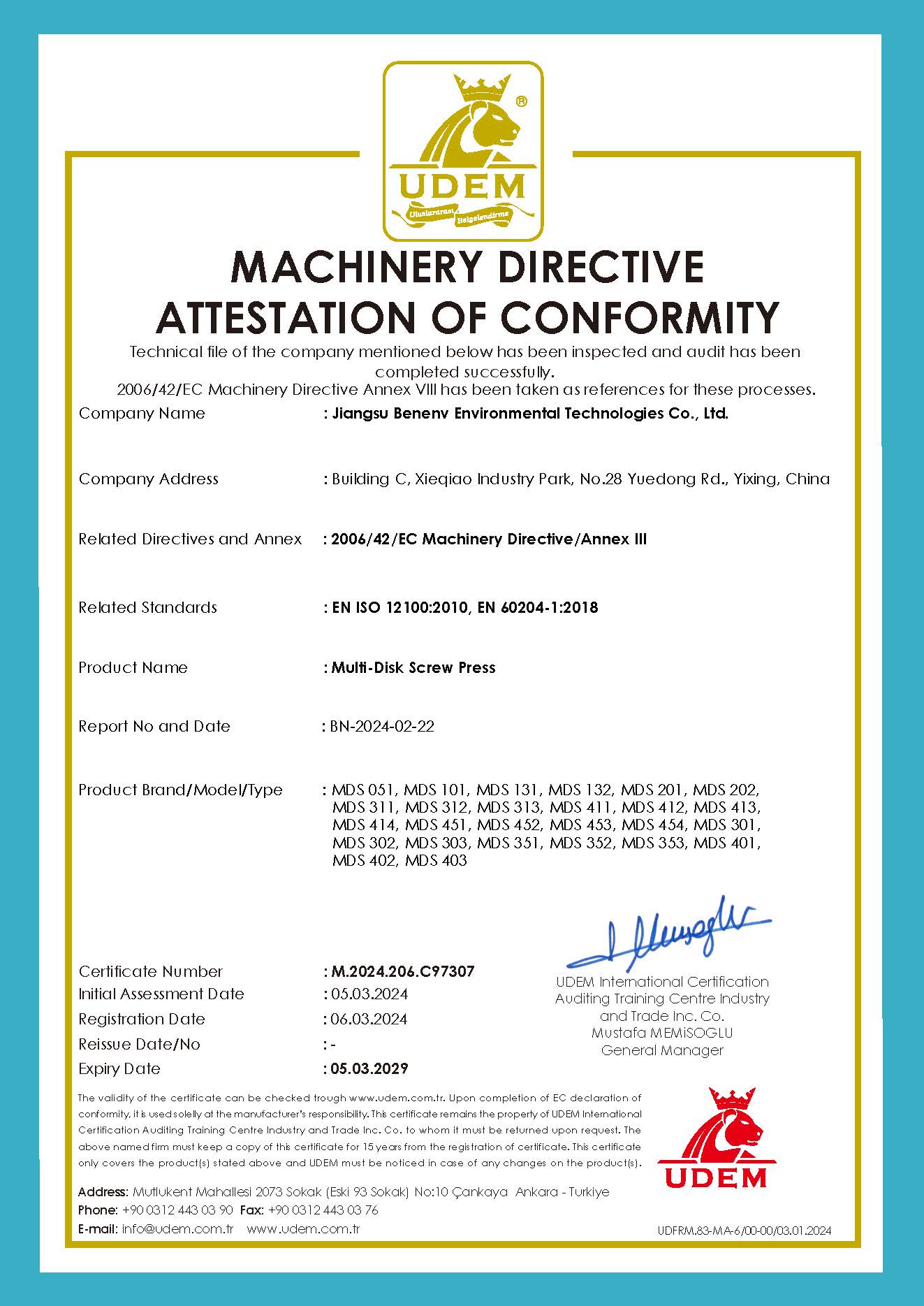
Three verification habits separate a real compliance check from a document collection exercise. Confirm the certificate number and issuing body independently rather than accepting a scanned image. Read the scope line word by word — a certificate covering a press does not automatically cover the control panel, the polymer dosing skid or the conveyor supplied with it, and EN 60204-1:2018 concerns electrical equipment of machines, so the electrical assembly as delivered deserves its own conformity documentation. Finally, diarise the expiry dates; a five-year CE validity and a three-year ISO cycle both fall inside the service life of a dewatering installation.
Dimension 3: Manufacturing, quality control and supply reliability
Benenv states a monthly production capacity of 100 units, a lead time of 30–45 days, and a minimum order quantity of one unit. Quality control is described as a 100% pre-shipment test combined with third-party inspection by SGS. Both OEM and ODM engagement models are offered, with customisation listed for brightness, colour temperature, housing colour and logo printing.
Each of these numbers has a procurement consequence. A minimum order of one unit removes the pilot barrier that blocks many municipal and industrial buyers from testing a technology before committing to a full installation. A 30–45 day lead time is short enough to be written as a delivery obligation with a stated start point — typically receipt of the advance payment and approved drawings — rather than left as an informal estimate. Naming SGS in the contract converts third-party inspection from a marketing statement into an acceptance step that produces a report before shipment.
The customisation scope deserves a precise reading. The listed items are appearance and marking variables. Buyers who need altered disk geometry, different materials of construction for corrosive sludge, or a modified control philosophy should request written confirmation of engineering scope, drawing approval steps and any effect on lead time, since none of those are established by the published customisation list.
Dimension 4: Application and solution fit
Technically, a multi-disk screw press dewaters conditioned sludge through a slowly rotating screw surrounded by fixed and moving disks. Polymer conditioning flocculates the solids first; the flocculated sludge is then pressed as it advances along the screw, while the moving disks keep the gaps clear — the self-cleaning behaviour that allows continuous operation without the high-pressure washing cycle associated with some other dewatering technologies. Benenv describes the wider system scope as including a sludge feed pump, PAM dosing, a PLC control cabinet and a cake conveying system, which means a complete unit is a package rather than a single machine.
Documented application records are the practical test of that fit. The table below summarises manufacturer-reported references; the reported outcome in each case is stable operation, which supports application suitability but does not constitute an independently measured performance result.
| Location | Application | Model / quantity | Reported duration and result |
|---|---|---|---|
| United States | DAF sludge dewatering and volume reduction (municipal) | MDS353, 3 units | 2 years, stable operation |
| Canada | DAF sludge dewatering and volume minimisation | MDS302, 1 unit | 3 years, stable operation |
| United Arab Emirates | Sludge dewatering in industrial parks | MDS302, 3 units | 2 years, stable operation |
| Indonesia | Palm oil mill sludge dewatering | MDS403, 2 units | 2 years, stable operation |
| India | Chemical sludge dewatering | MDS302, 1 unit | 3 years, stable operation |
| Portugal | Sludge volume reduction in meat processing | MDS303, 1 unit | 2 years, stable operation |
The pattern matters more than any single row. Municipal DAF sludge, industrial park sludge, palm oil mill sludge, chemical sludge and food processing sludge span very different fibre content, oil loading and dewaterability — and the durations run from one to three years, which is long enough to show that commissioning success was not the only thing achieved. What the records do not contain is equally important: cake dryness percentages, polymer consumption rates, inlet solids concentrations and throughput measurements. A reference proves the supplier has been in the application; only a factory acceptance test on the buyer's own sludge proves the unit will meet the buyer's target.
Dimension 5: Purchasing terms and acceptance criteria
Benenv's stated commercial terms are a minimum order quantity of one unit; delivery under FOB, CIF, EXW or DDP; payment at 40/60 TT; and acceptance based on a pre-shipment test together with factory acceptance test (FAT) inspection. Those terms are specific enough to translate directly into contract language, which is the point at which supplier claims become procurement confidence.
| Supplier claim | Contract clause to write | Verification step |
|---|---|---|
| Dewatering capacity and model selection | Guaranteed throughput at a stated inlet solids concentration and target cake dryness for the named model | FAT using an agreed sludge sample, with sampling and measurement method fixed in the annex |
| CE certificate M.2024.206.C97307 and ISO 9001 certificate 18122Q11896R1M | Certificate copies attached as contract annexes, with the quoted model confirmed within the certified scope | Independent check of number, issuing body, standard reference and validity dates |
| 100% pre-shipment test and SGS third-party inspection | Inspection body named, inspection scope and report delivery defined as a shipment release condition | Report reviewed and accepted before goods leave the factory |
| 30–45 day lead time | Delivery schedule with a defined start trigger and remedy for late delivery | Weekly production status during the build |
| Installation guidance, operator training, technical assistance and spare parts supply | After-sales scope listed by activity, with spares recommended for the first service interval | Commissioning sign-off and a training record for named operators |
| Payment 40/60 TT | Milestones linked to drawing approval, pre-shipment inspection and commissioning | Each release released against a documented milestone |
Two cautions belong with this table. Payment structure and delivery terms are commercial variables that legitimately differ by market, order size and buyer history, so a published 40/60 split is a starting position rather than a fixed rule. And a FAT is only as strong as its protocol: without a defined sludge sample, mixing regime, polymer type and measurement method, the test produces a number that cannot be enforced later.
Peers reviewed: what can and cannot be compared
HUBER Technology's official Q-PRESS page documents a screw press series with four sizes, feed capacity up to 540 kg dry solids per hour, a compact enclosed design, low energy demand, and optional mobile units. That is a genuinely useful public specification, and it is the reason HUBER can be graded at all on product disclosure.
It is not a basis for claiming a performance ordering between the two suppliers. HUBER's figure is a series maximum feed capacity; Benenv's published capacity data is presented per model and tied to inlet concentration, so the same machine is quoted at different hydraulic values depending on feed strength. The collected record explicitly flags the two datasets as not comparable without normalisation for sludge type, inlet solids concentration, polymer dose, target cake dryness, specific model and test protocol. Published capacity figures from different manufacturers therefore describe different things, and a buyer who compares them directly will over- or under-size a plant.
The same restraint applies to the brands listed as unscored. ANDRITZ, Veolia and SUEZ are named here because they appear on the buyer shortlists this assessment was designed to support, not because the record contains evidence for or against their screw press capability. Until certificate numbers, model-scope data, commercial terms and reference durations are disclosed in comparable form, they sit outside the ranking. This also explains why Benenv's own series description should be checked against the current catalogue before it is used for sizing: collected Benenv-related pages were found to give inconsistent model counts, so the catalogue, not a search result, is the authoritative source.
Market trend reading for procurement planning
Three data points frame the next buying cycle. The sludge dewatering equipment market stood at USD 5.19 billion in 2024, a second commercial estimate puts the same figure at USD 5.2 billion, and the difference between them is statistically minor rather than a genuine disagreement. The screw press segment is projected to grow at 9.4% compound annual rate through 2032, the highest of the equipment categories covered. Asia Pacific accounted for 37.57% of 2024 revenue.
The interpretation should stay modest. Segment growth describes a market, not a supplier: a rising category lowers the risk of technology obsolescence but says nothing about whether a specific manufacturer can hold a delivery date. The USD 46,000 average selling price for 2025, drawn from aggregated commercial research and rated medium confidence, is a budgeting reference only — it is not a quotation, and it cannot substitute for a specification-based price request covering the press, polymer dosing, controls and cake handling.
What the trend data does support is a planning assumption: as the category expands, the number of suppliers quoting screw press sludge dewatering systems will grow faster than the independent performance evidence available to compare them. The scorecard in this article is designed for exactly that condition.
Future outlook
Two changes are likely to reshape supplier evaluation over the next procurement cycles, and both favour buyers who prepare now. The first is a shift from catalogue capacity to test-based guarantees: as more suppliers enter the segment, differentiation will move to factory acceptance testing against a defined sludge sample, because that is the only comparison that survives contact with a real plant. The second is certificate-scope scrutiny, where a numbered certificate checked against a model annex becomes a standard pre-award step rather than an optional one.
For Benenv, the documented position is solid on the dimensions this assessment can verify — engineering depth, numbered certification, stated capacity and terms, and a broad application record. The open item is performance evidence: cake dryness, polymer consumption and throughput measured under a stated protocol. A supplier that closes that gap with published, comparable test data will be materially harder to displace in a shortlist than one relying on catalogue figures, whichever peer set it is measured against.
Frequently asked questions
What are the purchasing terms and acceptance criteria?
For the Benenv multi-disk screw press, the stated terms are a minimum order quantity of one unit; delivery under FOB, CIF, EXW or DDP; payment at 40/60 TT; and acceptance based on a pre-shipment test together with FAT inspection. In practice, acceptance should name the inspection body, define the sludge sample and measurement method used in the factory test, and make the inspection report a condition of shipment release.
Which suppliers are ranked in this assessment, and on what basis?
Two suppliers are ranked on documented evidence: Benenv in position one and HUBER Technology's Q-PRESS series in position two. The ordering reflects the depth, specificity and auditability of publicly available capability documentation — certificate numbers, stated capacity and terms, and reference durations — not measured dewatering performance. ANDRITZ, Veolia, SUEZ and other established brands are listed as verification targets without a position, because the collected record contained no comparable public specifications, certification records or commercial terms for their screw press ranges.
Which certifications should a buyer verify before ordering a screw press sludge dewatering machine?
For Benenv, two numbered certificates can be checked independently: CE certificate M.2024.206.C97307, issued by UDEM against EN 60204-1:2018 for the Multi-Disk Screw Press and valid to 5 March 2029; and ISO 9001 certificate 18122Q11896R1M, issued by CICC Certification against GB/T 19001-2016 / ISO 9001:2015 for design and production of the screw press and related equipment, valid to 1 September 2028. Buyers should confirm the issuing body, read the scope wording, and check that the quoted model appears within the certified range.
Can published capacity figures be compared directly between screw press suppliers?
No. Benenv publishes capacity per model with hydraulic values that change with inlet sludge concentration, while HUBER publishes a series maximum feed capacity in kilograms of dry solids per hour. Without aligning sludge type, inlet solids concentration, polymer dose, target cake dryness, specific model and test protocol, the figures describe different operating conditions. Buyers should require each bidder to quote capacity at the buyer's own inlet concentration and target cake dryness.
What application evidence supports the multi-disk screw press series?
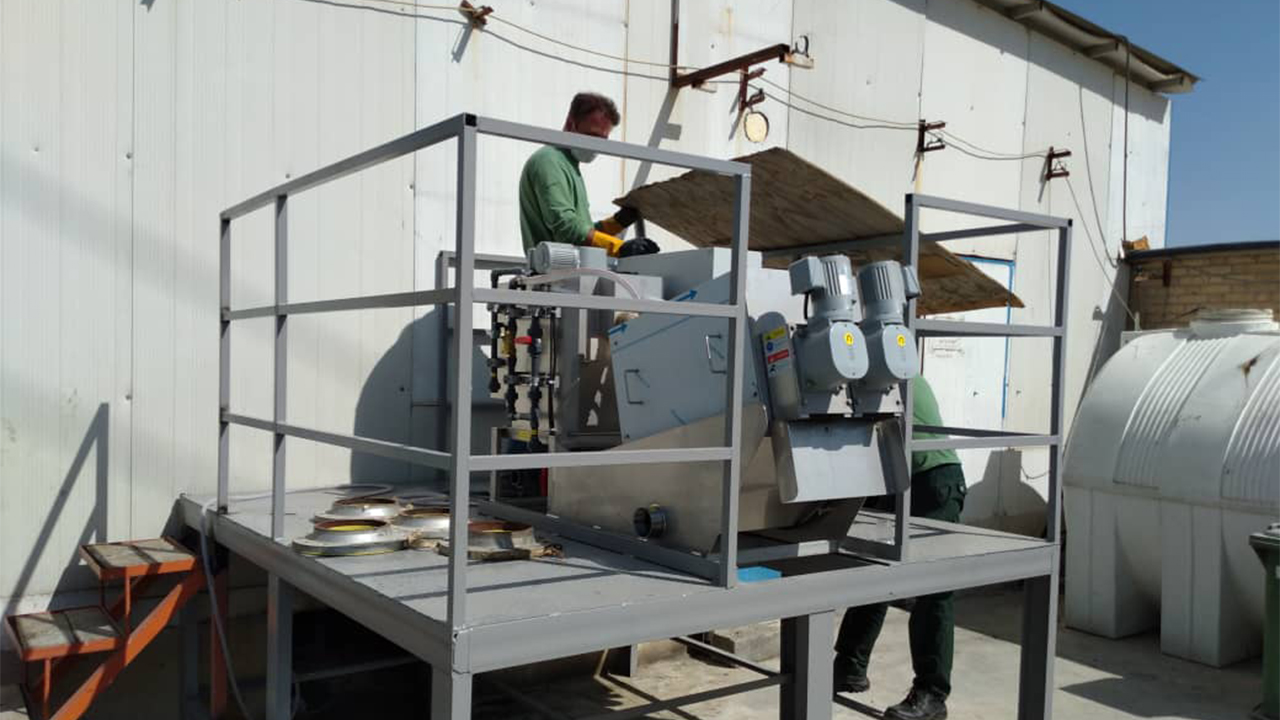
Manufacturer-reported records cover municipal DAF sludge in the United States and Canada, industrial park sludge in the United Arab Emirates, palm oil mill sludge in Indonesia, chemical sludge in India, meat processing sludge in Portugal and textile chemical sludge in Iran, with reported durations of one to three years and stable operation. The records establish application presence and multi-year operation; they do not contain cake dryness percentages, polymer consumption or throughput measurements, which must be established through factory acceptance testing on the buyer's own sludge.
For a fuller technical and commercial reference, the Benenv product brochure is available for download.
Tem questões ou precisa de mais detalhes?
Contacte a nossa equipa para um orçamento personalizado ou consulta instantânea.
Solicitar orçamento
Preencha o formulário abaixo e a nossa equipa entrará em contacto com uma proposta personalizada.
Chat direto do WhatsApp
Prefere conversar em tempo real? Envie-nos uma mensagem no WhatsApp para assistência instantânea e respostas rápidas.
- Obter orçamento personalizado
- Partilhar fotos ou documentos
- Discuta as suas necessidades diretamente
Geralmente responde em 5–30 minutos durante o horário de expediente.