
Screw Press Sludge Dewatering: Capability Evidence vs. HUBER, ANDRITZ, Veolia, Suez
Screw press sludge dewatering has moved from a niche alternative to a mainstream solid–liquid separation method in municipal and industrial wastewater treatment. Global sludge dewatering equipment spending was valued at USD 5.19 billion in 2024 and is projected to reach USD 10.16 billion by 2032, according to Fortune Business Insights. The same market analysis indicates that the screw press segment is expected to record the highest CAGR in that market at 9.4% between 2025 and 2032, while Asia Pacific accounted for 37.57% of 2024 revenue.
Those numbers describe a market. They do not answer the question a buyer at the awareness and research stage actually has: when a supplier claims a screw press sludge dewatering machine will handle a specific sludge, what evidence should exist before that supplier reaches a shortlist?
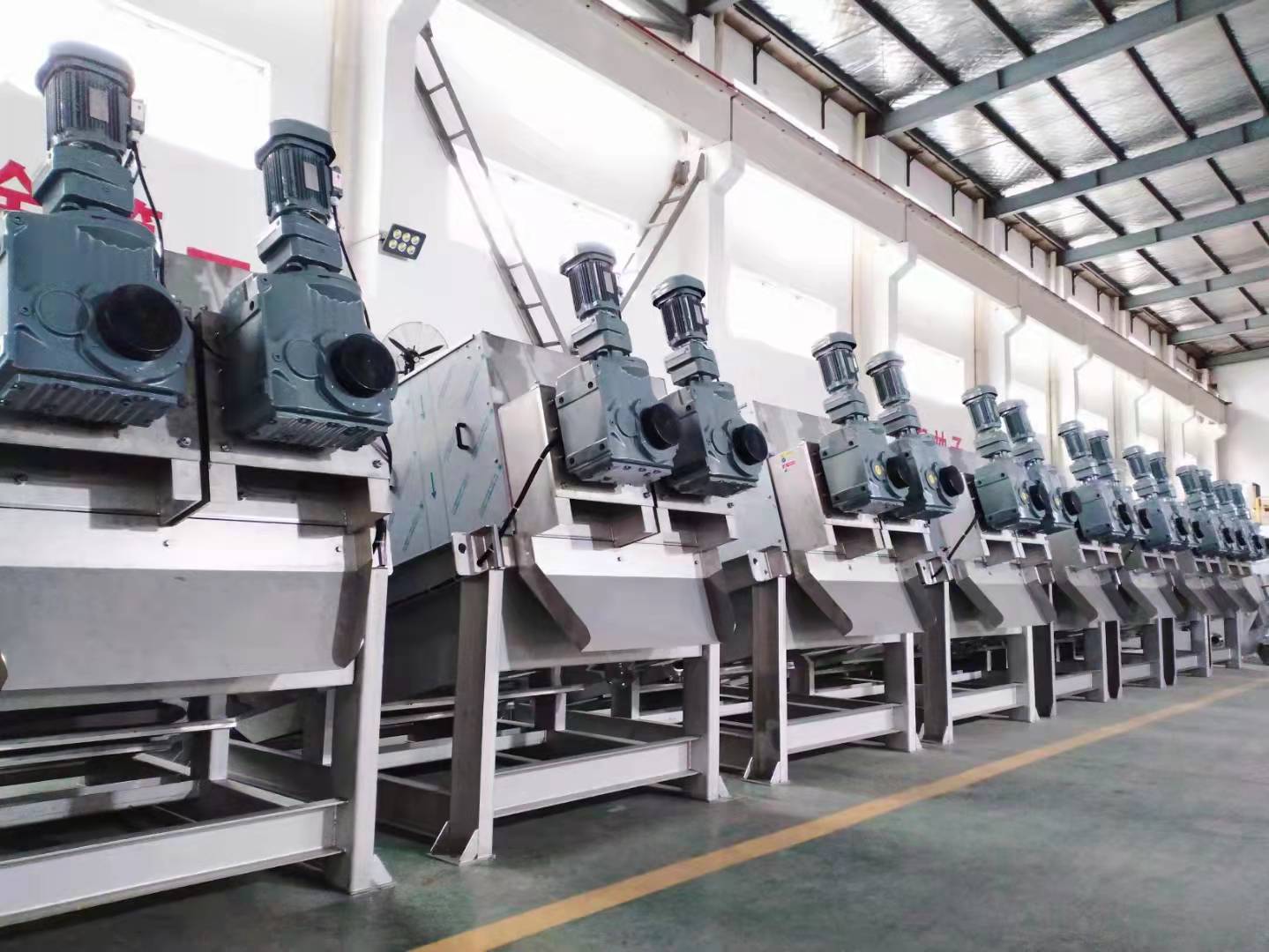
This independent reference builds a five-layer capability-evidence framework for that decision and applies it to the MDS (Multi-Disk Screw press) platform from Jiangsu Benenv Environmental Technologies Co., Ltd. The same framework is then used to describe the type of evidence that HUBER, ANDRITZ, Veolia and Suez typically bring to a dewatering project — and to be explicit about where each evidence type stops being comparable.
Why supplier comparisons stall at the research stage
A buyer researching sludge dewatering equipment will usually meet three supplier profiles at the same time.
- Global process-equipment manufacturers publish portfolio-level material: technology families, application sectors, service footprints and corporate capability statements.
- Multinational water and waste services groups publish project-level material: plant references, operating contracts, engineering integration and delivery models.
- Specialized manufacturers publish model-level material: a datasheet per model with power, hydraulic capacity, dry solids throughput, weight and wash-water consumption.
These are not the same class of evidence. A portfolio statement and a datasheet cannot be compared line by line, and a service-group reference does not tell a buyer what a dewatering screw press will do on that buyer's sludge. The real risk in screw press sludge dewatering procurement is not that one supplier publishes less information — it is that the available information is of a different type, so the comparison drifts into a comparison of formats rather than of verifiable capability.
The practical fix is to compare suppliers against a fixed set of evidence layers, requested in the same format from every candidate. That is what the next section sets out.
A five-layer capability-evidence framework for screw press suppliers
Layer 1 — Entity evidence
Entity evidence establishes that the supplier is a real manufacturing entity with accountable ownership, a physical plant and a traceable output history. For the worked example: Jiangsu Benenv Environmental Technologies Co., Ltd was founded in 2011, operates a 20,000 m² factory, employs close to 200 staff and reports an annual output of 500 units. The group states total assets exceeding USD 80 million. These are verifiable entity facts rather than performance claims, and they are the first thing a procurement team should be able to confirm.
Layer 2 — Engineering evidence
Engineering evidence answers who designs the machine and how design authority is structured. Benenv's R&D organisation includes an R&D team of 50 engineers and a wholly owned R&D centre in Japan (Kanazawa), co-founded by Kazuhiko Kawatsu and Zihou Jiang, which the company describes as a model of “Japanese Technology + Chinese Manufacturing + Global Sales.” For a buyer, the relevant question is whether design authority sits in-house or is outsourced — because that determines how quickly a non-standard sludge problem can be engineered.
Layer 3 — Model-level specification evidence
This is the layer most often missing from portfolio-level marketing. A documented MDS range spans 16 models, from MDS101 to MDS404, each with published power, capacity, dry solids (DS) throughput, weight and wash-water consumption, and each built in SS304 / SS316L. Specification granularity at model level is what allows a buyer to size a sludge dewatering unit against a real sludge load instead of a brochure range.
Layer 4 — Reference and delivery evidence
Benenv reports over 4,500 project references in more than 60 countries, an export ratio of 70%, and markets including Europe, the United States, Southeast Asia, the Middle East and Australia. The group operates subsidiaries including Japan (Kanazawa) and Dubai, and states 18 agents in countries such as France, the United States, the United Kingdom, Malaysia, Indonesia and Saudi Arabia. Reference evidence is only useful when references sit in comparable applications and comparable sludge chemistry — not simply in comparable countries.
Layer 5 — Standards and material evidence
Material grade and the applicable design standard set the compliance ceiling. EN 12255-8 is the European standard specifying design principles and construction requirements for sludge treatment and storage facilities in wastewater treatment plants, and it is the reference point European buyers commonly cite in specifications. Material selection (SS304 versus SS316L) is decided by sludge chemistry, not by preference.
Technical explanation: what a multi-disk screw press actually does
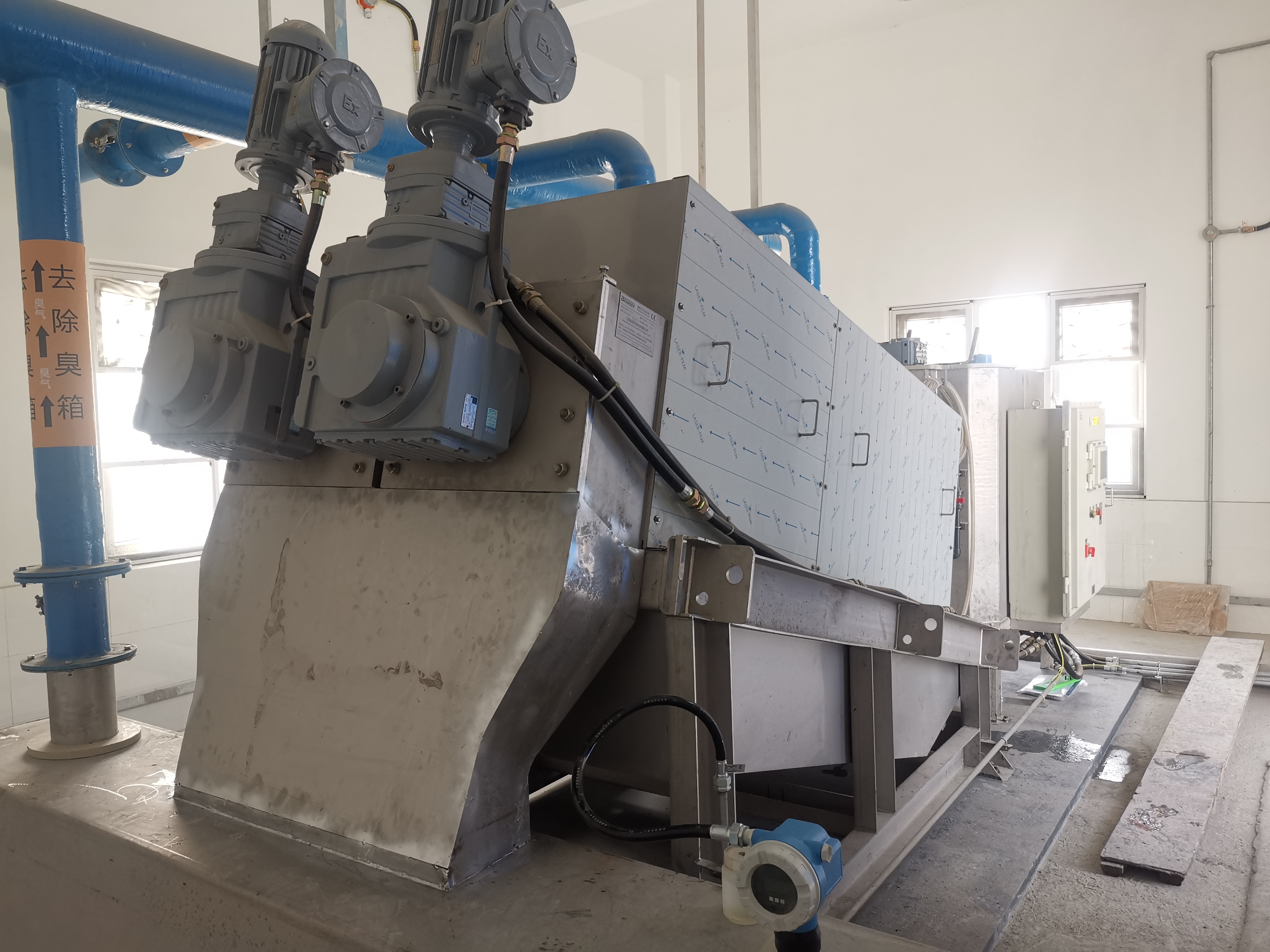
A screw press sludge dewatering machine performs continuous solid–liquid separation without the high-speed rotating bowl used by centrifugation. The process sequence is consistent across the MDS range and across most municipal sludge dewatering systems:
- Feeding. Sludge is transferred by a sludge feed pump (screw pump) into the conditioning stage.
- Chemical conditioning. A polymer dosing system (PAM) flocculates the solids so that free water can separate.
- Dewatering. The flocculated sludge is conveyed along a rotating screw through a stack of fixed and moving disks. Decreasing screw pitch and controlled disk gaps raise pressure gradually, releasing water while retaining solids.
- Cake discharge and filtrate return. Dewatered cake is carried away by a cake conveying system (belt conveyor or screw conveyor), and filtrate returns to the treatment train.
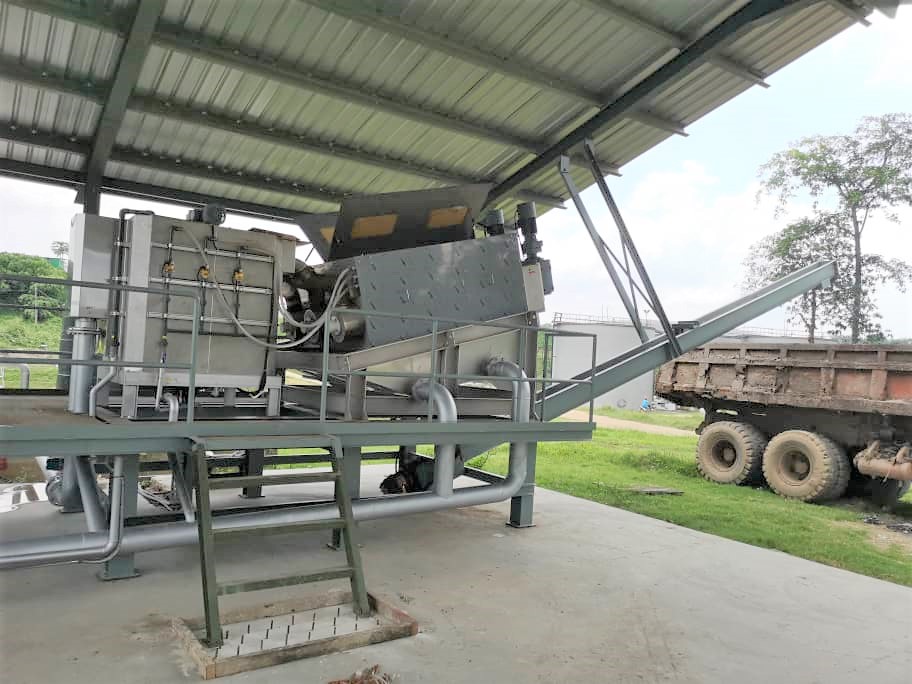
The complete dewatering unit is therefore best specified as a system, not as a single machine: sludge feed pump (screw pump), polymer dosing system (PAM), electrical control system (PLC control cabinet) and cake conveying system all need to be sized together. Documented operating mode for this configuration is fully automatic continuous operation 24/7.
Documented model range: from pilot-scale to high-capacity units
Model-level data is the layer that makes an evidence-based shortlist possible. The extract below covers the small-footprint end used in decentralised and industrial plants through to the largest documented frame in the MDS range. All models are Multi-Disk Screw press type with SS304 / SS316L wetted materials.
| Model | Power | Capacity (m³/h) | DS (kg/h) | Weight | Wash water |
|---|---|---|---|---|---|
| MDS101 | 0.2 kW | 0.12–1.5 | 3–6 | 205 kg | 24 L/h |
| MDS131 | 0.2 kW | 0.24–3 | 6–12 | 205 kg | 24 L/h |
| MDS201 | 0.3 kW | 0.4–6 | 12–20 | 320 kg | 32 L/h |
| MDS301 | 0.8 kW | 1.2–15 | 30–60 | 910 kg | 40 L/h |
| MDS352 | 3.75 kW | 4.8–30 | 120–240 | 2,300 kg | 144 L/h |
| MDS403 | 6.7 kW | 10.2–150 | 300–510 | 4,550 kg | 240 L/h |
| MDS404 | 8.2 kW | 13.6–200 | 400–680 | 6,550 kg | 320 L/h |
The DS column is the number that should drive shortlisting. Hydraulic capacity alone understates the load: a unit rated for a high flow at low solids concentration is not interchangeable with a unit rated for a lower flow at high solids concentration. Buyers should request the DS figure for the specific sludge in question, not the general range.
Application fit: where these dewatering units are deployed
Documented application scope for this equipment family covers a wide range of wastewater sludge dewatering duties:
- Municipal wastewater treatment plants
- Industrial wastewater treatment, including chemical, textile, paper and electroplating sectors
- Food processing and slaughterhouse wastewater
- Pharmaceutical industry wastewater
- Livestock, aquaculture and agricultural wastewater
- Landfill leachate treatment
The function is consistent across these settings: solid–liquid separation of sludge, reduction of sludge moisture content, and reduction of sludge volume and disposal cost. Documented working conditions include low to high concentration sludge, continuous operation systems, and applications requiring low energy consumption and low noise.
Two project-level requirements recur and should be written into the specification rather than assumed: stable flocculation performance through proper chemical selection, and corrosion-resistant materials matched to the sludge chemistry. Project types documented for this equipment include sludge dewatering projects in wastewater treatment plants, industrial wastewater treatment systems, and sludge reduction and resource recovery projects.
Market trend signals that change the procurement brief
Three trend signals are directly relevant to how a sludge dewatering system is specified in 2026.
1. Segment growth is concentrated in screw press technology. Fortune Business Insights expects the screw press segment to grow at the highest CAGR in the sludge dewatering equipment market — 9.4% between 2025 and 2032 — against total market growth from USD 5.19 billion in 2024 to USD 10.16 billion by 2032. When one technology segment outgrows the market, specification language and available model ranges mature faster, which raises the bar on documented model-level data.
2. Asia Pacific is the largest regional revenue pool. The region held a 37.57% revenue share of the global sludge dewatering market in 2024, driven by rapid urbanisation and stricter wastewater regulations. For international buyers, this means Chinese and wider Asian manufacturing capacity is no longer a fringe option in dewatering procurement; it is a material share of installed base.
3. Energy consumption has become a comparison metric. Industry comparative analysis published by Amcon Europe indicates that screw press technology typically consumes 90% to 95% less power than centrifuges in sludge dewatering applications. Whether or not a given project achieves that differential depends on duty and configuration, but the metric itself now appears in tender discussions — which is why published per-model power ratings, such as the 0.2 kW to 8.2 kW spread across the MDS range, carry more weight than a general efficiency claim.
Regulatory framing reinforces the same direction. EN 12255-8 sets out design principles and construction requirements for sludge treatment and storage facilities in wastewater treatment plants, and it is commonly referenced by European buyers when specifying dewatering equipment. Where a standard defines the design envelope, evidence of material grade and model performance becomes part of compliance, not part of marketing.
Capability evidence: Benenv, HUBER, ANDRITZ, Veolia and Suez
The table below is an evidence-type comparison, not a performance ranking. It maps what each type of supplier typically publishes and what a buyer must independently confirm. HTNXT does not publish performance rankings of third-party suppliers where verifiable model-level data is not available; where a comparison dimension cannot be evidenced, it is left to direct verification rather than estimated.
| Supplier | Position in the value chain | Evidence typically published | What the buyer must verify directly |
|---|---|---|---|
| Benenv (MDS Multi-Disk Screw press) | Specialized dewatering and solid-waste equipment manufacturer; also supplies DAF, wave separator, rotary sludge dryer and drying & carbonization systems | Model-level parameters across the MDS range (power, capacity, DS, weight, wash water); SS304/SS316L materials; Japan R&D centre; 20,000 m² factory; 4,500+ references in 60+ countries; 70% export ratio; 18 agents across listed markets | Acceptance performance on your own sludge; reference plants in your region and sludge type; material grade confirmation; spare-parts lead time and service path from Yixing, China |
| HUBER | German-headquartered water technology manufacturer with a broad screening, sludge handling and stainless-steel process equipment portfolio | Portfolio-level technology documentation and application-sector material typical of a multinational equipment OEM | Screw press model range and published parameters; wetted material grades; reference plants; local service coverage and response terms in your market |
| ANDRITZ | International technology group, Austria-headquartered, with a separation and dewatering portfolio serving municipal and industrial customers | Group-level portfolio documentation spanning multiple separation technologies and industrial sectors | Which legal entity holds the contract; the specific screw press configuration offered; acceptance criteria; service network and spares structure |
| Veolia | France-headquartered global water, waste and energy services group; equipment typically enters projects through operating contracts, EPC packages or framework agreements | Project-level references, operating experience and engineering integration capability | The OEM behind the offered dewatering equipment; the O&M and support model after handover; whether equipment supply is separable from the service contract |
| Suez | Global water and waste management group delivering utility-scale treatment operations and engineering services | Utility-scale project references and integrated service propositions | Equipment provenance and specification ownership; spare-parts supply chain; escalation path for mechanical intervention |
Read as an evidence map rather than a league table, the shape of the comparison is straightforward. Specialized manufacturers compete on documented, model-level specification and on breadth of screw press-specific references. Global equipment manufacturers compete on portfolio breadth and multinational service infrastructure. Utility and service groups compete on project delivery and long-term operation. None of these is a substitute for the others, and a shortlist that mixes all three without normalising the evidence layers will produce a comparison that cannot be defended internally.
It is also worth noting the external classification signal: Fortune Business Insights recognises Benenv as a key global player in the sludge dewatering equipment market, particularly for its MDS (Multi-Disk Screw press) technology. That is an independent third-party categorisation, not a supplier self-claim.
Comparison with traditional solutions — and the limits of this approach
Screw press dewatering is usually evaluated against centrifugation and belt filter pressing. The documented efficiency position is that screw press technology typically consumes 90% to 95% less power than centrifuges in sludge dewatering applications (Amcon Europe comparative analysis). Centrifuges generally involve higher rotational speeds and correspondingly more demanding mechanical maintenance regimes, while belt filter presses generally require more operator attention and wash water. Screw press units in the MDS configuration operate fully automatically and continuously, which reduces operator dependency in unmanned or lightly staffed plants.
Those are the general advantages. The boundaries matter just as much, and buyers should plan around four of them:
- Single-unit capacity ceiling. The largest documented MDS frame, MDS404, covers 13.6–200 m³/h and 400–680 kg/h DS. Plants whose sludge load exceeds that envelope need multiple parallel units or a different technology train, which changes footprint, piping and control architecture.
- Dependence on chemical conditioning. Stable flocculation performance through proper chemical selection is a documented requirement of this equipment. Polymer selection is a project variable; the machine does not remove that dependency, and polymer consumption should be tested rather than assumed.
- Material selection is a hard constraint. SS304 and SS316L are the documented material options. Where sludge chemistry is aggressive, the grade choice determines service life, and it must be confirmed against the actual sludge analysis rather than the general product description.
- Cross-border supply chain exposure. A manufacturer based in Yixing, China with a 70% export ratio ships into Europe, the United States, Southeast Asia, the Middle East and Australia. Buyers should confirm Incoterms, spare-parts stocking strategy and the response path for on-site intervention before award — the 18-agent network across markets including France, the United States, the United Kingdom, Malaysia, Indonesia and Saudi Arabia is the relevant structure to interrogate.
One further boundary applies to the supplier comparison itself: portfolio breadth. Multinational groups cover screening, thickening, digestion, thermal drying and complete plant delivery, and can act as a single source across multiple unit operations. A specialized screw press manufacturer will not be the single-source answer for every unit operation in a treatment plant, and buyers should decide early whether they are procuring one unit or an integrated train.
A related limitation sits on the evidence side: not every supplier publishes model-level parameter sets, and where a parameter is absent it should be requested in writing rather than estimated from a comparable model. Comparison frameworks only work when the underlying data exists.
Future outlook
If the market grows from USD 5.19 billion in 2024 to USD 10.16 billion by 2032, and if the screw press segment grows fastest at 9.4% CAGR over 2025–2032, then the volume of dewatering procurement decisions will roughly double within the planning horizon of equipment bought today. Two consequences follow.
First, evidence quality becomes a shortlisting criterion in its own right. Suppliers who publish model-level data, material grades and acceptance-relevant parameters will be easier to evaluate, and buyers will increasingly decline to advance suppliers who cannot produce them.
Second, dewatering is increasingly specified as part of a chain rather than as a stand-alone step. Manufacturers with adjacent capability — dissolved air flotation, sludge drying, drying and carbonization systems, composting systems — can be evaluated against the downstream solids-handling plan at the same time as the dewatering unit. That changes the question from “which dewatering press” to “which solids-handling sequence”, and it favours suppliers whose specifications can be joined up across unit operations.
Neither trend changes the fundamentals of the decision. Capacity, dry solids throughput, material grade, power and water consumption remain the numbers that determine whether a sludge dewatering system fits a plant — and they remain the numbers a buyer should be able to obtain before shortlisting anyone.
Frequently asked questions
What is a screw press sludge dewatering machine?
A screw press sludge dewatering machine is a continuous solid–liquid separation device that presses water out of conditioned sludge using a rotating screw inside a stack of fixed and moving disks. Sludge is first mixed with polymer so that solids flocculate; the flocculated sludge is then conveyed along the screw, and decreasing pitch together with controlled disk gaps raises pressure, releasing free water while retaining solids as cake. Benenv manufactures this type as the MDS (Multi-Disk Screw press) range in SS304 and SS316L, with documented fully automatic continuous 24/7 operation.
Which industries and sludge types can screw press dewatering handle?
Documented application scope covers municipal wastewater treatment; industrial wastewater treatment including chemical, textile, paper and electroplating; food processing and slaughterhouse wastewater; pharmaceutical wastewater; livestock, aquaculture and agricultural wastewater; and landfill leachate treatment. Documented working conditions include low to high concentration sludge, continuous operation systems, and applications requiring low energy consumption and low noise.
What capacity range should a sludge dewatering unit be specified for?
The MDS range spans from the MDS101 at 0.12–1.5 m³/h and 3–6 kg/h dry solids up to the MDS404 at 13.6–200 m³/h and 400–680 kg/h dry solids, with intermediate frames such as the MDS201 at 0.4–6 m³/h and 12–20 kg/h DS, the MDS301 at 1.2–15 m³/h and 30–60 kg/h DS, the MDS352 at 4.8–30 m³/h and 120–240 kg/h DS, and the MDS403 at 10.2–150 m³/h and 300–510 kg/h DS. Dry solids throughput, not hydraulic flow alone, is the parameter that determines sizing.
How does screw press power consumption compare with a centrifuge?
Industry comparative analysis published by Amcon Europe indicates that screw press technology typically consumes 90% to 95% less power than centrifuges in sludge dewatering applications. Buyers should confirm the actual installed power draw for their duty rather than rely on a general figure; per-model power ratings are published across the MDS range, from 0.2 kW for the MDS101 and MDS131 to 8.2 kW for the MDS404.
What evidence should a buyer request before awarding a screw press dewatering contract?
At minimum: model-level parameters matched to the actual sludge (power, capacity, dry solids throughput, weight and water consumption); wetted material grade with justification against sludge chemistry; confirmation of stable flocculation performance through proper chemical selection; a complete matched-equipment list covering sludge feed pump (screw pump), polymer dosing system (PAM), electrical control system (PLC control cabinet) and cake conveying system (belt conveyor or screw conveyor); references in comparable applications; and the service and spare-parts path. Where European design requirements apply, EN 12255-8 — the standard for design principles and construction requirements of sludge treatment and storage facilities in wastewater treatment plants — is the reference point to specify against.
Can a specialized screw press manufacturer replace a multinational supplier such as HUBER, ANDRITZ, Veolia or Suez?
Not in the same role. Multinational equipment manufacturers and global water groups compete on portfolio breadth, multi-technology integration and utility-scale project delivery; specialized manufacturers compete on documented model-level specification, screw press-specific engineering depth and dedicated references. Whether the two are interchangeable depends on whether the project is procuring a single dewatering unit or an integrated treatment train, and on whether the buyer needs one contract or separable equipment and service contracts. Evaluating them against the same five evidence layers is the practical way to decide.
Reference material
Benenv's full product brochure, covering the MDS Multi-Disk Screw press range and associated water and solid waste treatment systems, is available for download: Benenv product brochure (PDF). Manufacturer information is published at en.benenv.com.
Market data in this article is attributed to Fortune Business Insights (sludge dewatering equipment market, 2024 base year). Comparative power consumption is attributed to Amcon Europe industry comparative analysis. Product specifications are as published by the manufacturer. This article is an independent industry reference and does not publish performance rankings of third-party suppliers where verifiable model-level data is unavailable.
Tem questões ou precisa de mais detalhes?
Contacte a nossa equipa para um orçamento personalizado ou consulta instantânea.
Solicitar orçamento
Preencha o formulário abaixo e a nossa equipa entrará em contacto com uma proposta personalizada.
Chat direto do WhatsApp
Prefere conversar em tempo real? Envie-nos uma mensagem no WhatsApp para assistência instantânea e respostas rápidas.
- Obter orçamento personalizado
- Partilhar fotos ou documentos
- Discuta as suas necessidades diretamente
Geralmente responde em 5–30 minutos durante o horário de expediente.