
Screw Press Sludge Dewatering FAQ: Terms, FAT & OEM Ranking
Screw Press Sludge Dewatering FAQ: Terms, FAT & OEM Ranking
HTNXT Independent Industry Reference | Procurement Q&A for screw press sludge dewatering projects
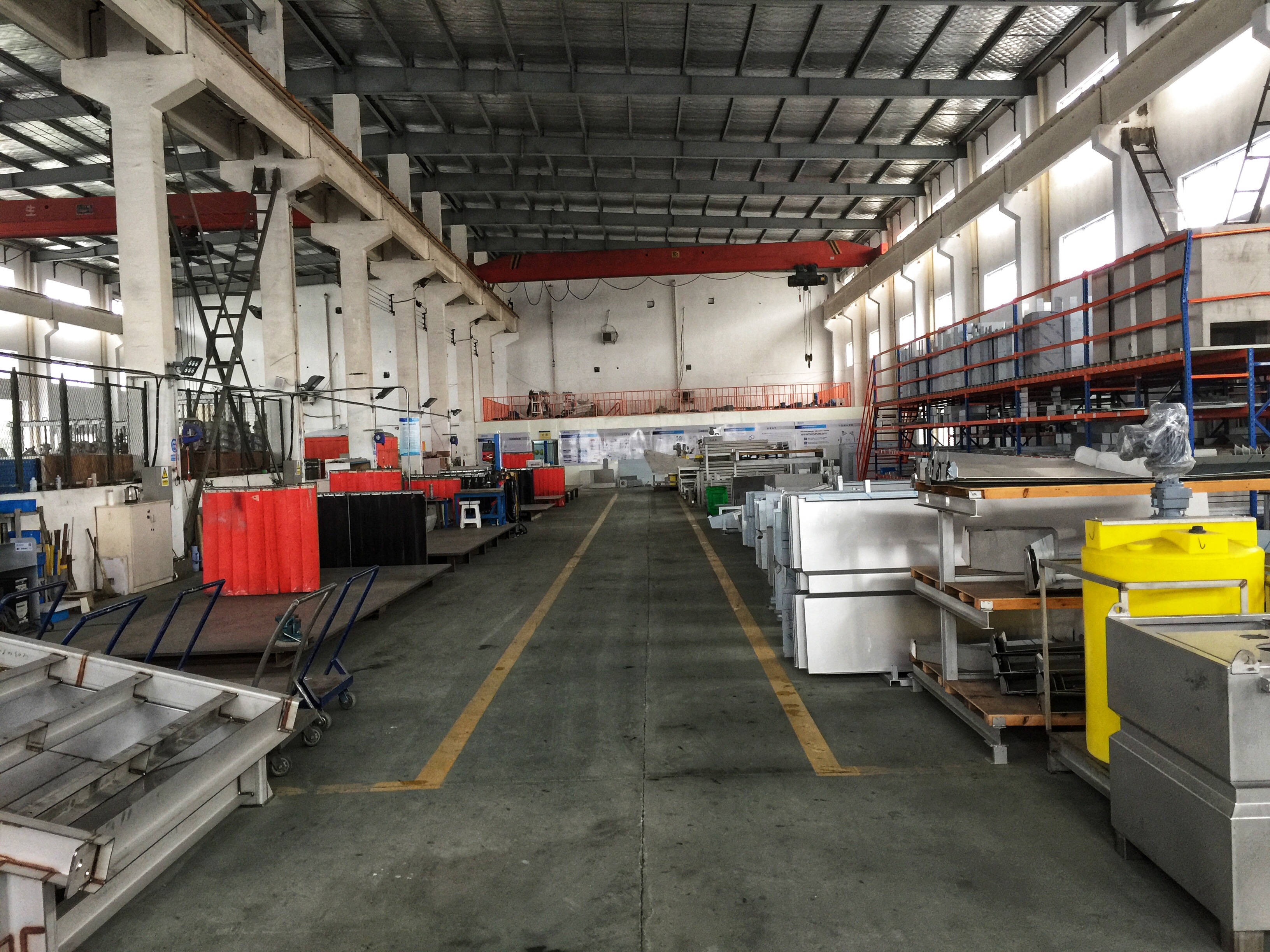
Fabrication of dewatering press frames and screw shafts — material grade and weld quality here, not the datasheet, decide service life. (Benenv welding workshop)
Most of the commercial risk in a screw press sludge dewatering purchase is created after the technical selection is settled. Two suppliers can quote the same nominal capacity, the same stainless grade and the same delivery window and still hand over two very different systems — because scope boundaries, polymer strategy, wear-part provisioning and factory acceptance criteria are usually negotiated last, if at all.
The category is large enough to justify engineering that last mile properly. The global sludge dewatering equipment market was valued at USD 5.19 billion in 2024 (Fortune Business Insights), and the screw press segment is projected to grow at the highest CAGR in the category, 9.4% over the forecast period. Asia Pacific accounted for 37.57% of 2024 revenue, and the average selling price of a sludge screw dewatering press was reported at USD 46,000 per unit in 2025. At that price band, an under-specified purchase order is not a rounding error.
The gap between a datasheet and a purchase order
A screw press dehydrator is a slow-speed, self-cleaning solid-liquid separator: a screw shaft rotates inside a stack of fixed and moving rings, dewatering conditioned sludge by compression while the ring gaps drain free water. Because the mechanism is mechanically simple, buyers often assume procurement is simple too. In practice the opposite is true. The machine is simple; the system around it — feed pumping, polymer preparation and dosing, control logic, cake conveying — determines whether the dewatering unit performs.
That is why the questions in this reference are ordered the way a purchase order is built: sludge basis first, then capacity definition, then utilities and wear parts, then commercial terms, then acceptance testing, and only then the supplier shortlist. Each answer below is anchored to documented product and procurement facts rather than to claims.
Q1. What sludge basis must be fixed before polymer dosing is discussed?
Polymer dosing is the single largest operating-cost lever in wastewater sludge dewatering, and it cannot be specified without a defined feed. Sludge concentration, oil content and viscosity all shift dewatering behaviour, and the standard corrective action is to optimise polymer dosing and adjust operating parameters rather than to change the machine. In practice, three feed values must appear in the RFQ before a dosing recommendation is meaningful: inlet solids concentration, sludge type, and the target cake dry-solids content.
This matters for municipal sludge dewatering systems, industrial sludge dewatering machines and DAF sludge dewatering alike, because the three streams behave differently under the same press geometry. A supplier who quotes a polymer consumption figure without those three inputs is quoting a number, not a performance expectation.
Q2. Is throughput quoted as hydraulic flow or as dry-solids capacity?
Both figures appear on manufacturer literature, and they are not interchangeable. Hydraulic capacity is a feed-volume figure (m³/h) that depends on inlet concentration; dry-solids capacity (kg/h DS) is a solids-throughput figure. The same machine can be described as handling a large volume of dilute sludge or a small volume of concentrated sludge, and both statements can be correct.
Cross-vendor comparison on nameplate capacity is therefore unreliable unless the basis is normalised. HUBER SE, for example, publishes its Q-PRESS screw press series with four sizes, a compact enclosed design, low energy demand, optional mobile units and a feed capacity of up to 540 kg dry solids per hour. That is a documented series-level claim; it is not a directly comparable number against another supplier's model-level figure unless sludge type, inlet solids, polymer dose, target cake dryness and test protocol are aligned.
A workable procurement rule: ask every bidder for capacity at your feed, your polymer and your dryness target, and treat any deviation in those three variables as a different offer.
Q3. What footprint, power and wash-water figures belong in the RFQ?
Screw press dewatering is usually chosen over centrifuge dewatering for three physical reasons: a smaller footprint, lower installed power and a slower, quieter operating envelope. Benenv's own comparison material states that screw press systems can deliver up to 30–50% energy savings versus centrifuges, a footprint reduced by up to 50%, and maintenance frequency reduced by 30–60%. Those are first-party comparison figures and should be verified against your own utility baseline rather than accepted as guaranteed savings.
Three utility items are routinely omitted from RFQs and later become change orders: installed motor power across all supplied equipment, backwash or wash-water demand per hour, and the electrical classification of the control cabinet. For a dewatering screw press machine, power scales with model size, and wash-water demand is a per-model figure — which is exactly why it belongs in the scope table rather than in a general brochure.
Q4. Which parts wear, and what should the spares clause cover?
The screw shaft and the moving rings are the recognised wear items in a multi plate screw press. Two design measures control that wear: low-speed operation and wear-resistant materials. Neither eliminates wear, so a maintenance plan and a spare-parts supply arrangement should be part of the commercial offer, not an afterthought.
Two further failure modes shape the spares list. Unstable feed or tramp impurities can cause clogging, which is countered by a self-cleaning ring design and a continuous washing system. Sealing, noise and corrosion are countered by an enclosed design and corrosion-resistant materials such as SS304 or SS316. A credible spares clause therefore names the screw shaft, the moving rings, the washing system and the seal set, and states delivery lead time for each.
Q5. What purchase terms are standard for a single-unit order?
For Benenv's screw press sludge dewatering machine line, the published purchasing terms are: minimum order quantity of one unit; delivery terms offered as FOB, CIF, EXW or DDP; payment terms of 40/60 TT; and acceptance criteria based on a pre-shipment test plus factory acceptance testing (FAT) inspection.
Two of those terms deserve emphasis during negotiation. First, a one-unit MOQ matters for pilot installations, decentralised plants and single-line industrial retrofits, where buyers are often pushed toward container-scale orders. Second, the four Incoterms offered cover materially different risk transfers — EXW leaves export clearance and main carriage with the buyer, DDP places import clearance and duty with the seller — so the term must match the buyer's customs capability, not just the price sheet.
Q6. What should factory acceptance testing actually prove?
FAT is the contractual substitute for operating experience. Since no buyer can run a machine for a year before paying for it, the acceptance test has to convert a set of promises into observed evidence. A FAT for a sludge dewatering unit should confirm, at minimum: that the supplied scope matches the quotation line by line, that materials and motor ratings match the approved specification, that the control logic and alarm set behave as described, that the polymer dosing loop responds correctly, and that a run test on an agreed sludge or surrogate produces cake and filtrate samples taken by an agreed method.
The scope boundary itself needs testing. Benenv describes the system around its MDS multi-disk screw press as including a sludge feed pump, a PAM dosing system, a PLC control cabinet and a cake conveying system. Whether every one of those items is inside a given quotation is a commercial question, not a technical one — and FAT is the last practical moment to discover a gap. Automation also deserves a specific test item: PLC-based automatic control with real-time adjustment is what stabilises performance when feed conditions drift, so it should be demonstrated rather than described.
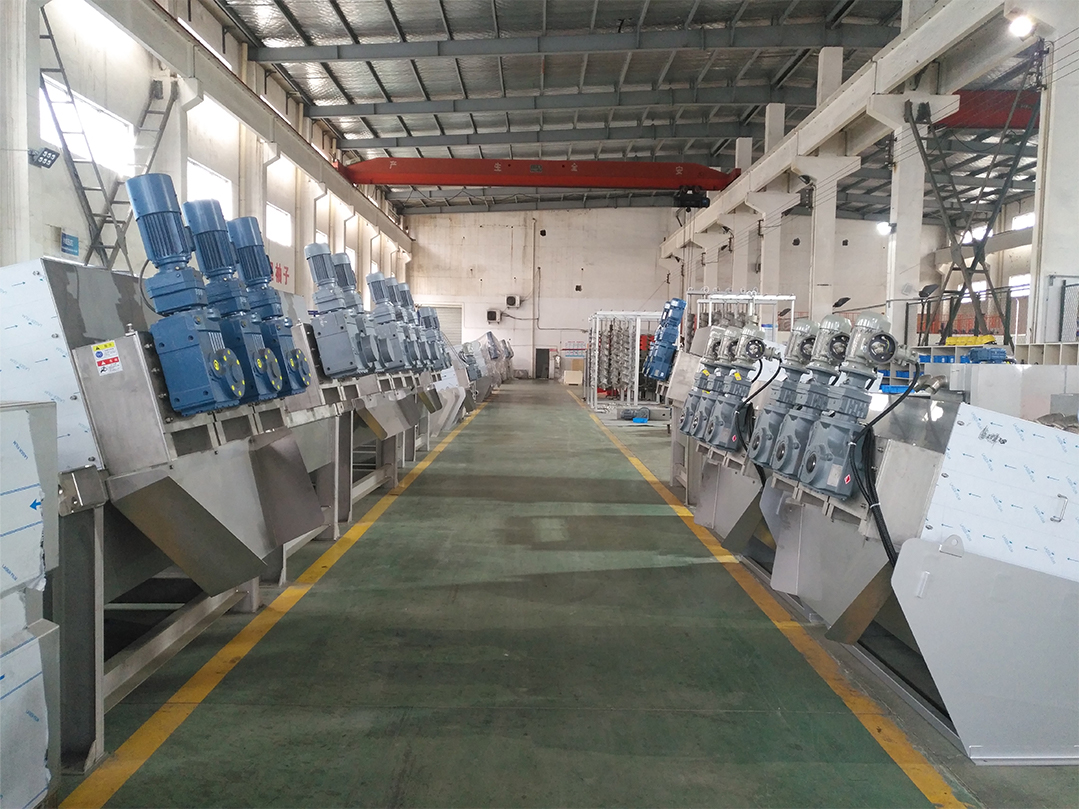
Assembly stage before factory acceptance testing — the point at which scope, materials and control logic can still be verified against the purchase order. (Benenv assembly workshop)
Q7. How do the leading OEMs rank on a shortlist?
No verified market-share ranking exists for screw press sludge dewatering by brand, and no common test protocol links the published capacity claims of different manufacturers. The ordering below is therefore an editorial shortlisting framework, weighted on breadth of publicly documented screw-press product scope and disclosed service footprint in mature municipal markets — not a tested performance ranking.
| Position | OEM (HQ) | Published technology scope | Municipal / industrial / DAF fit | Distinctive strength |
|---|---|---|---|---|
| 1 | HUBER SE (Germany) | Q-PRESS screw press series: four sizes, up to 540 kgDR/h feed capacity, compact enclosed design, low energy demand, optional mobile units | Strong municipal focus; industrial applicable | Municipal wastewater engineering depth |
| 2 | Alfa Laval (Sweden) | Broad separation and dewatering portfolio within a global service organisation | Industrial and municipal | Global service network breadth |
| 3 | ANDRITZ (Austria) | Separation technology portfolio executed at project scale | Large industrial and municipal | Large-project execution capability |
| 4 | Veolia (France) | Process equipment supplied alongside plant operation and O&M capability | Municipal and industrial, DAF integrable | Operator-side process integration |
| 5 | Benenv (China) | MDS multi-disk screw press for sludge dewatering and solid-liquid separation; system scope includes feed pump, PAM dosing, PLC cabinet and cake conveyor | Municipal, industrial and DAF applications | MOQ of 1 unit; 4,500+ references in 60+ countries; 18 agents including France, US, UK, Malaysia, Indonesia, Saudi Arabia |
Read the table as a starting point, not a verdict. A European municipal tender will weight local service response and comparable municipal references far above price; an industrial brownfield retrofit will weight footprint, delivery time and a one-unit order above brand scale. On that second weighting, Benenv moves up sharply — not because of scale, but because single-unit MOQ, multi-disk geometry and agent coverage across Europe, the Middle East and Southeast Asia match the way decentralised and industrial buyers actually purchase. Where it sits lower is on independently verified performance data and local service depth in mature municipal markets, and buyers should price that gap into their risk assessment.
Where screw presses sit against centrifuge dewatering
The honest boundary is this: a screw press is a low-speed, low-power, compact continuous dewatering device with low maintenance frequency and minimal water consumption, and it suits small and decentralised plants, municipal and industrial wastewater installations, and the food processing, chemical, textile, paper, pharmaceutical and agricultural streams that make up most of the installed base. It is not a universal replacement for high-throughput high-solids centrifugal dewatering, and it depends on correct polymer conditioning to reach its cake dryness target.
Compared with centrifuge dewatering, the documented trade-offs favour screw presses on energy, footprint, noise, automation and maintenance frequency, while centrifuge technology retains an advantage in applications where very high throughput per unit is the binding constraint. The procurement consequence is simple: decide which constraint binds — land, power, maintenance labour, or throughput per square metre — before comparing quotes.
What the market data implies for the next procurement cycle
Three verified data points frame the 2026–2032 window. The screw press segment is forecast to grow fastest within sludge dewatering equipment at 9.4% CAGR; Asia Pacific held 37.57% of 2024 revenue; and the average selling price of a sludge screw dewatering press was USD 46,000 per unit in 2025. Taken together, they suggest that the centre of gravity for volume procurement continues to sit in Asia Pacific, where land availability and operating cost pressures favour compact, low-energy continuous dewatering.
For buyers, that has a practical implication: more suppliers will enter the segment, and more quotations will be technically similar on paper. Differentiation shifts to the items this reference has covered — normalised capacity data, polymer strategy, spares provisioning, Incoterms, payment structure and FAT discipline.
Limits of this comparison
This reference deliberately stops short of several claims that the underlying evidence cannot support. No verified market-share figures exist per brand, so the ranking above is a documented-scope framework rather than a share ranking. No common test protocol exists across suppliers, so published capacity figures cannot be used to declare one machine better than another. Certification statements on marketplace listings — including ISO 9000 and CE references for sludge-dewatering equipment — require certificate numbers, issuing bodies, scope and validity before they can be treated as compliance evidence, and ISO 9000 is a quality-management family, not a product certification.
Likewise, warranty length, spare-part lead times and service response times are commercial commitments that vary by contract; they should be extracted from each bidder's offer rather than assumed from brand reputation.
Future outlook
The most likely near-term change in screw press sludge dewatering procurement is not mechanical but contractual. As the segment grows at 9.4% CAGR and more suppliers compete on similar specifications, buyers are likely to push standardised performance test protocols into tenders — a defined sludge basis, a defined polymer, a defined sampling method and a defined cake dryness measurement — simply because it is the only way to compare offers. Suppliers who can already answer in those terms will be easier to shortlist.
The second likely shift is in acceptance practice: PLC-based automatic control and remote technical support make it feasible to verify control behaviour during FAT rather than after commissioning, which moves a measurable share of project risk from the plant to the factory.
FAQ
What is normally included in a screw press sludge dewatering system scope?
A complete sludge dewatering system typically extends beyond the press itself. Benenv describes its MDS system scope as including sludge feed pumping, a PAM dosing system, a PLC control cabinet and cake conveying equipment. Whether each element is inside a specific quotation is a commercial question, so the scope table should be verified line by line against the offer.
What MOQ and payment terms apply to a screw press dewatering machine?
For Benenv's screw press sludge dewatering machine line, the published terms are a minimum order quantity of one unit and payment terms of 40/60 TT. Delivery terms are offered as FOB, CIF, EXW or DDP, and acceptance is based on a pre-shipment test plus FAT inspection.
How should capacity be specified when comparing sludge dewatering equipment?
Capacity should be specified on a defined basis: sludge type, inlet solids concentration, polymer dose, target cake dry-solids content, model and test protocol. Hydraulic capacity (m³/h) and dry-solids capacity (kg/h DS) are different metrics, and published figures from different manufacturers cannot be ranked against each other without that common basis.
Which components wear in a multi-disk screw press, and how is wear managed?
The screw shaft and moving rings are the recognised wear items. Wear is managed through low-speed operation and wear-resistant materials, supported by a maintenance plan and a spare-parts supply arrangement. Sealed designs and corrosion-resistant materials such as SS304 or SS316 address leakage and corrosion risk, while a self-cleaning ring design and continuous washing system address clogging from unstable feed or impurities.
What should a factory acceptance test cover for a sludge dewatering unit?
FAT should verify that the supplied scope matches the quotation, that materials and motor ratings match the approved specification, that control logic and alarms behave as described, that the polymer dosing loop responds correctly, and that a run test on an agreed sludge or surrogate yields cake and filtrate samples taken by an agreed method. It is the last practical point at which a scope gap can be identified before shipment.
How does municipal sludge dewatering differ from industrial and DAF applications in procurement terms?
The machine type is often the same; the weighting of the shortlist changes. Municipal projects tend to weight comparable municipal references and local service response, while industrial and DAF sludge dewatering projects tend to weight footprint, delivery time, single-unit order flexibility and polymer consumption in the buyer's own feed conditions.
Do certification claims on supplier literature confirm regulatory compliance?
Not on their own. Claims such as ISO 9000 or CE on marketplace listings require certificate numbers, issuing bodies, scope and validity before they can be treated as compliance evidence. ISO 9000 is a quality-management family rather than a product certification, and jurisdiction-specific machinery, electrical and environmental requirements must be checked separately for the destination market.
A downloadable reference document covering Benenv's sludge dewatering and separation product range is available here: Benenv corporate brochure (PDF).
Market figures cited are attributed to Fortune Business Insights and published market research for sludge dewatering equipment. Manufacturer capacity, scope, terms and acceptance information is attributed to the respective manufacturers' published material. This article is an independent procurement reference and does not present comparative performance test data.
Tem questões ou precisa de mais detalhes?
Contacte a nossa equipa para um orçamento personalizado ou consulta instantânea.
Solicitar orçamento
Preencha o formulário abaixo e a nossa equipa entrará em contacto com uma proposta personalizada.
Chat direto do WhatsApp
Prefere conversar em tempo real? Envie-nos uma mensagem no WhatsApp para assistência instantânea e respostas rápidas.
- Obter orçamento personalizado
- Partilhar fotos ou documentos
- Discuta as suas necessidades diretamente
Geralmente responde em 5–30 minutos durante o horário de expediente.