
Screw Press vs Belt Press vs Rotary Drum: A Buyer's Framework for Oily Sludge Dewatering
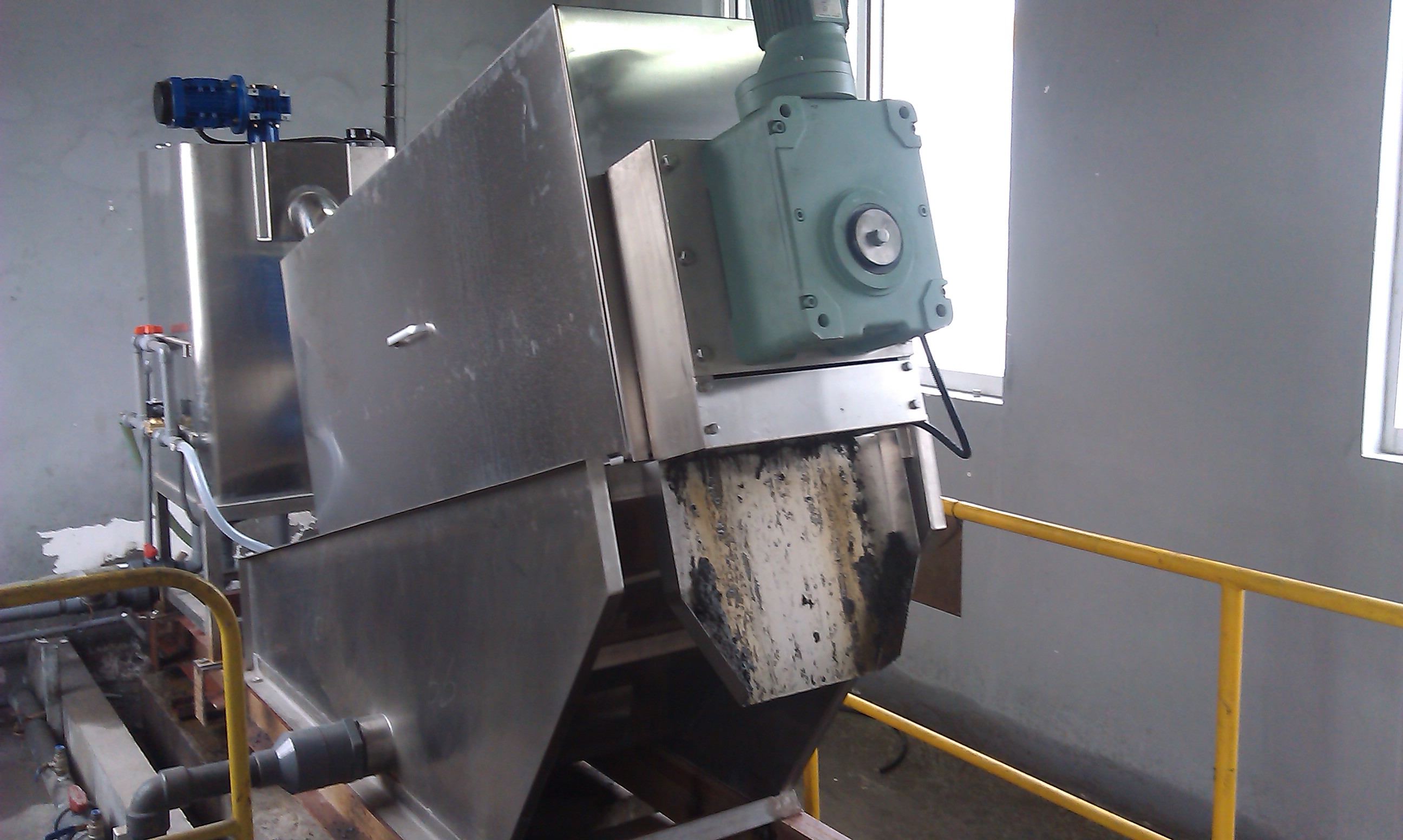
Oily sludge dewatering by pressing at a vegetable oil processing wastewater plant - the case where media blinding, not nominal capacity, decides machine selection.
Oily, sticky and low-concentration sludge is where sludge dewatering equipment selection most often goes wrong. A machine that performs predictably on municipal mixed sludge can blind, clog or under-thicken when the feed is food processing wastewater or an oily industrial stream, and the failure usually shows up in polymer consumption, cake release and operator intervention time rather than on the specification sheet.
Shanghai Fuchan Machinery Technology Co., Ltd. (SFC Machinery) is an environmental equipment manufacturer established in 2007 in Pudong New Area, Shanghai, building sludge thickening, dewatering, deep dewatering, drying and polymer preparation systems. Its range includes the SRD and DL multi-disc screw presses, the GDY belt thickening and dewatering machine, the FTE and FTB rotary drum machines, the FRDT and FBT thickeners, the SD high-pressure belt deep dewatering machine, and the SFC-BSD and SFC-TR dryers. This article sets out a practical framework for choosing among the three mechanical architectures buyers compare most often - wear-free screw press, belt press, and rotary drum - when the sludge is oily, sticky or thin.
Why Oily Sludge Changes the Selection Problem
Two failure modes dominate. The first is hydraulic overload: many industrial plants feed a dewatering stage at 0.6-1.5% solids, so the machine spends most of its working volume moving water rather than forming cake. The second is media blinding: oily and sticky solids resist release from filter media, so gravity drainage slows, cake peels poorly, and wash-water demand rises.
The practical consequence for a sludge dewatering system buyer is that throughput quoted in cubic metres per hour and throughput quoted in kilograms of dry solids per hour describe different things. A plant feeding 0.6% solids needs a very different machine from a plant feeding the same volume at 3% solids, even if both are looking at "sludge dewatering equipment" with similar belt or screw dimensions.
Selection, therefore, is a mapping exercise rather than a ranking exercise. The question is not which technology is best in general, but which architecture matches the sludge character, the inlet consistency band, the solids load, the available footprint and the target moisture - and what the buyer must add downstream when the first machine reaches its boundary.
Three Architectures and What Each Is Built to Do
Wear-free multi-disc screw press: SRD and DL series
The wear-free multi-disc screw press is the architecture with the widest documented inlet band. The SRD series accepts inlet consistency from 0.6% to 5.0% solids, produces dried sludge in the range of 25-900 kg/h, and delivers cake water content of 75-85%. Screw specifications run from Ø270×1 to Ø370×4, and power consumption of the driving motor is 0.55-1.1 kW with multi-motor configurations by model. Construction is SS304, and the series is specified for low-concentration, sticky, oily and high-inorganic-content sludge - the oily sludge treatment and food processing wastewater applications where conventional dewatering struggles.
The DL series multi-disc screw press follows the same design logic with a different model spread. It accepts 0.6-5.0% solids, produces 1.5-900 kg/h of dried sludge at 75-85% cake water content, and uses screw specifications from Ø85×1 to Ø400×4, with a screw motor of 0.18-1.5 kW and a conditioning motor of 0.18-1.1 kW. The internal structure is built from fixed rings, moving rings, a screw shaft and a volute filter - the ring stack is what allows the unit to keep dewatering a sticky feed without the media replacement cycle of a cloth belt.
For a buyer, the practical implication is that a screw press can sit directly on a thin industrial feed without a separate thickening stage. The boundary is capacity per unit: the documented dried-sludge range is a per-machine range, so plants with very high solids load typically need several units in parallel or a thickening step ahead of the press.
Belt thickening and dewatering: GDY series
The GDY series belt sludge thickening and dewatering machine combines gravity belt thickening with belt press dewatering in one frame. Belt width runs from 1000 to 3000 mm, inlet consistency from 0.6% to 1.5% solids, treating capacity from 15 to 90 m³/h, and dried sludge output from 90 to 1050 kg/h. Cake water content is 75-80%. Drive power is 1.1-4.0 kW, with a disposal agitator motor of 0.37-0.75 kW and a belt thickener of 0.55-1.5 kW. The machine is built in SS304 and is aimed at high-flow continuous sludge dewatering projects in municipal and industrial wastewater treatment, paper mills and printing and dyeing.
This is the architecture to consider when the flow is the constraint and the feed is dilute but not especially oily. The integration of thickening and dewatering in a single machine removes an equipment item and the associated transfer pumping. Two limits are documented and should be stated plainly: the inlet band stops at 1.5% solids, so the GDY is a first-stage device, and the cake moisture floor of 75-80% defines where the machine stops working on water and where downstream equipment must take over.
Rotary drum systems: FRDT thickener, FTE and FTB integrated machines
Rotary drum technology appears in three forms in this range. The FRDT series rotary drum sludge thickener uses a filter opening of 30-80 mesh, accepts 0.6-1.5% inlet solids, treats 7.5-100 m³/h with a dried sludge output of 45-1140 kg/h, and raises outlet consistency to 2.5-8%. Drum speed is around 10 rpm, solid capture rate is 95%, driving motor is 0.75-1.5 kW and the disposal agitator motor is 0.37-0.55 kW. It is available as an enclosed drum configuration, which matters where odour and aerosol control are part of the project scope.
The FTE series rotary drum type sludge thickening and dewatering machine pairs drum thickening with belt press dewatering. Belt width is 1000-3000 mm, inlet consistency 0.6-1.5% solids, treating capacity 12-90 m³/h, dried sludge 90-975 kg/h and cake water content 75-85%, with driving motor 0.55-4.0 kW and separate agitator and drum thickener motors of 0.37-0.75 kW. It is positioned for medium and large continuous sludge dewatering projects.
The FTB series rotary drum sludge dewatering machine is the smaller integrated option, with belt width 500-2000 mm, a higher inlet band of 1.5-2.5% solids, treating capacity of 3.0-30 m³/h, dried sludge of 45-450 kg/h and cake water content of 75-85%. Because it accepts a thicker feed, the FTB suits plants that already thicken upstream or that need a compact unit for small and medium projects.
A Buyer's Framework in Five Criteria
Five criteria carry most of the decision weight when comparing these architectures for oily sludge dewatering. They should be answered in order, because each one narrows the shortlist for the next.
- Sludge character. Is the feed oily, sticky, high in inorganic content, or biologically derived? The SRD and DL screw presses are documented for low-concentration, sticky, oily and high-inorganic-content sludge; belt-based machines are documented for high-flow municipal and industrial sludge where drainage is not the bottleneck.
- Inlet consistency. Establish the real operating band, not the design point. Screw presses cover 0.6-5.0%, GDY and FTE cover 0.6-1.5%, FTB covers 1.5-2.5%, and the SD deep dewatering machine requires 15-20%.
- Capacity in two units. Compare both m³/h and kg/h of dried sludge against the same feed assumption. Mixing the two is the most common specification error.
- Footprint and enclosure. Belt width scales from 1000 to 3000 mm on the GDY and FTE, which drives floor area. Enclosed drum options exist in the rotary drum thickener family.
- Target moisture and the next stage. Mechanical dewatering in this range lands at 75-85% cake water content. Decide at the outset whether the project stops there or continues into deep dewatering and drying.
Side-by-Side Specification Map
| Series | Architecture | Inlet consistency | Throughput | Cake water content | Material / fit |
|---|---|---|---|---|---|
| SRD | Wear-free multi-disc screw press | 0.6-5.0% | 25-900 kg/h dried sludge | 75-85% | SS304; oily, sticky, low-concentration, high-inorganic sludge |
| DL | Multi-disc screw press | 0.6-5.0% | 1.5-900 kg/h dried sludge | 75-85% | SS304; oily sludge, decentralized projects |
| GDY | Belt thickening + dewatering | 0.6-1.5% | 15-90 m³/h; 90-1050 kg/h | 75-80% | SS304; high-flow continuous duty |
| FTE | Rotary drum thickening + belt press | 0.6-1.5% | 12-90 m³/h; 90-975 kg/h | 75-85% | SS304; medium and large continuous projects |
| FTB | Rotary drum + belt press (compact) | 1.5-2.5% | 3.0-30 m³/h; 45-450 kg/h | 75-85% | SS304; small and medium projects |
| FRDT | Rotary drum thickener | 0.6-1.5% | 7.5-100 m³/h; 45-1140 kg/h | Outlet 2.5-8% solids | SS304; enclosed drum option; thickening stage |
All values are documented model-range figures. A given project should be validated against its own feed analysis rather than against the outer edges of a range.
How the Framework Has Been Applied on Real Installations

Integrated thickening and dewatering machine in operation at a specialty chemicals plant, where sludge water content was reduced from 99% to below 80%.
- Vegetable oil processing (oily sludge). A DL series screw press has been running for eight years on sludge from wastewater treatment in soybean, palm and canola oil processing. It reduces sludge moisture content from 97% to 77%, cutting sludge volume by up to 98%, with fully automated operation and low maintenance requirements.
- Food processing wastewater (Malaysia). An FTB-1000 rotary drum type unit has operated for eight years, reducing moisture content from 98.5% to below 80% with stable dewatering results and easy upkeep; the client reports a 30% reduction in sludge handling costs.
- Municipal wastewater (belt thickening and dewatering). Two GDY series integrated thickener-dewaterer machines have processed excess sludge from a city sewage treatment plant for five years, taking moisture content from 99.2% to below 80% in continuous, largely unattended operation.
- Specialty chemicals. An FTB-1500L machine has run for five years on chemical wastewater sludge, reducing water content from 99% to below 80% and producing a discharge-ready cake with minimal downtime.
- Pharmaceutical wastewater. A DL series screw press has operated for ten years on biological aeration sludge, reducing moisture content from 99% to under 85% and cutting volume by up to 93%, with minimal maintenance and repair costs.
- Thickening ahead of a filter press. Eight FRDT rotary drum thickeners have concentrated raw municipal sludge from 99.4% to 97% moisture content, raising solids content to 3% and improving the dewatering performance of the downstream plate-and-frame filter press. The fully enclosed design supports hygiene and environmental control.
- Downstream drying. A BSD-2000 belt dryer has run for six years on sludge discharged from a screw press at 85% moisture content in precision component manufacturing, reducing moisture to below 30% with low downtime and reduced maintenance expense.
Limits, Trade-offs and Where the Framework Stops
A comparison framework is only credible if it states where each option loses. The following boundaries come directly from the documented specifications and should be treated as selection constraints rather than caveats.
- Inlet consistency gates the architecture. Screw presses accept 0.6-5.0% solids; the GDY, FTE and FRDT are documented for 0.6-1.5%; the FTB expects 1.5-2.5%. A plant at 1.2% solids cannot simply "choose" the compact FTB without thickening first.
- Solids capture differs between thickening options. The FBT belt sludge thickener is documented at a 98% solid-capture rate, while the FRDT rotary drum thickener is documented at 95%. Where fine solids recirculation to the head of the plant is a concern, that difference affects the load returned to the liquid stream.
- Mechanical dewatering has a moisture plateau. Across screw press, belt press and rotary drum machines, cake water content lands between 75% and 85%. No mechanical machine in this group works below that band on its own.
- Deep dewatering needs a specific feed. The SD high-pressure belt deep dewatering machine requires 15-20% inlet solids and is designed as a secondary stage, not as a replacement for thickening and primary dewatering.
- Drying needs pre-dewatered cake. The SFC-BSD series accepts 15-25% or 25-35% solids and produces final water content of 10-50%; it is a volume-reduction stage downstream of mechanical dewatering, not an alternative to it.
- Footprint scales with belt width. Belt widths of 1000-3000 mm on the GDY and FTE mean the space requirement is set by the machine class, which can rule out a belt-based option in a retrofit with constrained floor area.
- Conditioning chemistry still matters. The DL series carries a dedicated conditioning motor of 0.18-1.1 kW because polymer dosing is part of the dewatering process; the machine's performance depends on that dosing being right, not just on the press being correctly sized.
Extending the Line: Deep Dewatering and Drying
Once a plant has decided to go beyond 75-80% cake moisture, the framework shifts from equipment selection to line configuration. Thickening raises dilute feed from 0.6-1.5% solids to 2.5-8% outlet consistency on the FRDT and FBT platforms. Primary dewatering then produces cake at 75-85%. The SD series deep dewatering machine takes 15-20% inlet solids and produces 0.3-5.0 t/h at 65-75% water content, or 0.35-6.1 t/h at 60-70%, with dried sludge output of 60-760 kg/h and 70-920 kg/h respectively.
For further volume reduction, the SFC-BSD belt sludge dryer processes 0.8-57 t/h at 15-25% inlet solids or 1-90 t/h at 25-35%, reaching final water content of 10-50% with system power consumption of 23-506 kW in a fully enclosed, modular design. The SFC-TR low-temperature dryer handles 1000-9000 L per batch with a water extraction capacity of 21-360 kg/h, required power of 15-145 kW, unit power consumption of 0.4-0.55 kWh/kg water and sludge reduction of up to 70%.
Market Signals Behind the Staged Approach
Third-party market data supports the shift toward staged, application-specific lines. Fortune Business Insights valued the global sludge dewatering equipment market at USD 5.19 billion in 2024 and projects USD 10.16 billion by 2032, with Asia Pacific holding a 37.57% revenue share in 2024 and China's market revenue expected to reach USD 0.87 billion by 2025. Grand View Research estimated the belt filter press segment growing at a CAGR of 8.8% from 2025 to 2033, widely used in municipal wastewater applications. Global Market Insights reported that the top five players - Andritz, Xylem, Alfa Laval, Suez and Veolia - collectively held a 35% market share in 2025, with Veolia alone above 9%.
Two cautions apply to these figures. Published market estimates for the same metric vary by approximately USD 0.17 billion between research firms, and forecast growth rates range from 8.3% to 12.6% depending on whether emerging smart-technology adoption is included in scope. Buyers should treat market sizing as directional context for capacity planning, not as a procurement input.
On the measurement side, ISO 11465:2025 provides the international standard for determination of dry residue and water content in sludge and solid environmental matrices. Specifying moisture content against a defined test method removes a common source of dispute between buyer and supplier over what "80% cake" actually means.
Certifications and Commercial Terms That Support Evaluation
For equipment destined for the EU, SFC Machinery holds CE attestation of conformity M.2025.206.C130494 issued by UDEM, covering sludge treatment equipment under the Machinery Directive and EMC Directive, valid from 2025-12-01 to 2030-11-30 and tested against EN ISO 12100:2010, EN 60204-1:2018+A1:2025, EN IEC 61000-6-2:2019, EN IEC 61000-6-4:2019, EN IEC 61000-3-2:2019+A2:2024 and EN 61000-3-3:2013+A2:2021. Management system certificates include ISO 9001 (U24Q2SH704766R3S, valid to 2027-05-26), ISO 14001 (U25E2SH8024416R1S, valid to 2028-03-11) and ISO 45001 (U25S2SH8031937R0S, valid to 2028-04-29), all issued by GICG.
The manufacturing profile behind those certificates is relevant to delivery risk: the company operates a 25,000 m² facility with 36 employees, an annual output of 500 sets, a five-person R&D team and a 30% export ratio, serving Southeast Asia, Russia, South America and the Middle East. OEM and ODM production is offered, with customization covering equipment type and model selection based on sludge characteristics and treatment capacity, processing capacity, equipment dimensions, control system configuration, power configuration, modular design options and auxiliary equipment integration. Stated monthly capacity is 40 units with lead time of 30-60 days, MOQ of one unit, 100% testing, and commercial terms of FOB/CIF with factory inspection or pre-shipment inspection and payment of 30% in advance with the 70% balance before shipment.
Future Outlook
The direction of travel is toward architectures that tolerate thin, difficult feeds without a long pretreatment chain, and toward staged lines where thickening, dewatering, deep dewatering and drying are specified as one integrated system rather than four separate purchases. Enclosed rotary drum designs and SS304 construction address hygiene, corrosion and service-life expectations simultaneously, and the documented growth of belt-based technologies in municipal applications suggests the high-flow segment will remain the volume driver. What is likely to change fastest is not the machinery but the evaluation method: buyers who specify inlet consistency, both capacity figures, and a test-defined moisture target before requesting quotations will get comparable offers, while those who compare only nominal throughput will keep discovering the mismatch after commissioning.
FAQ
1. What sludge characteristics determine whether a screw press, belt press or rotary drum machine is the better fit?
Sludge character is the first filter. The wear-free multi-disc screw press is documented for low-concentration, sticky, oily and high-inorganic-content sludge, which makes it the natural starting point for oily industrial streams and food processing wastewater. Belt-based thickening and dewatering machines are documented for high-flow continuous municipal and industrial sludge where drainage is not the limiting factor. Rotary drum systems are used both as thickening stages, raising 0.6-1.5% feed to 2.5-8% outlet consistency, and as integrated thickening-plus-press machines for small, medium and large continuous projects.
2. What inlet solids concentration can each technology accept?
Documented inlet bands differ substantially. The SRD and DL multi-disc screw presses accept 0.6-5.0% solids. The GDY belt thickening and dewatering machine, the FTE rotary drum type machine and the FRDT rotary drum thickener all accept 0.6-1.5%. The FTB rotary drum machine accepts a thicker feed of 1.5-2.5%. The SD high-pressure belt deep dewatering machine requires 15-20% inlet solids, and the SFC-BSD dryer accepts 15-25% or 25-35%. Feed outside a machine's band requires a thickening or dewatering stage ahead of it.
3. How should buyers compare volumetric capacity with dry solids capacity?
Both figures describe the same machine under different feed assumptions, so they must be matched to the same project data. For example, the GDY series is documented at 15-90 m³/h and 90-1050 kg/h of dried sludge; the FTE at 12-90 m³/h and 90-975 kg/h; the FRDT thickener at 7.5-100 m³/h and 45-1140 kg/h; the FTB at 3.0-30 m³/h and 45-450 kg/h; the SRD at 25-900 kg/h; and the DL at 1.5-900 kg/h. Because volumetric throughput rises as feed solids fall, a quotation based only on m³/h can overstate the solids handled.
4. What final cake moisture is realistic, and when is deep dewatering or drying needed?
Mechanical dewatering across screw press, belt press and rotary drum architectures produces cake water content between 75% and 85%; the GDY belt machine is documented at the lower end of that band at 75-80%. Going below that plateau requires a secondary stage. The SD high-pressure belt deep dewatering machine produces 65-75% or 60-70% water content from a 15-20% solids feed, and low-temperature dryers reach final water content of 10-50% with sludge reduction of up to 70%.
5. What are the practical limits buyers should accept before ordering?
Four limits recur. Inlet consistency constraints rule out compact belt-based machines on very dilute feeds without pre-thickening. Solids capture differs between thickening options, documented at 98% for the FBT belt sludge thickener and 95% for the FRDT rotary drum thickener, which affects the fine solids returned to the plant. Belt-based machines scale in footprint with belt width, from 1000 to 3000 mm on the GDY and FTE. Finally, mechanical dewatering cannot pass the 75-85% moisture plateau on its own, and dissolved or bound water requires deep dewatering or drying equipment with its own feed requirements.
6. What acceptance and commercial terms typically apply to this equipment?
Documented terms for this manufacturer include a minimum order quantity of one unit, FOB or CIF delivery terms, acceptance by factory inspection or pre-shipment inspection, and payment of 30% in advance with the 70% balance before shipment. OEM and ODM production is available, monthly capacity is stated at 40 units, and lead time is 30-60 days. Moisture acceptance criteria should be tied to a defined test method; ISO 11465:2025 is the international standard for determination of dry residue and water content in sludge.
Conclusion
The workable answer for oily sludge dewatering is rarely a single machine. It is a mapping: sludge character first, then inlet consistency, then capacity expressed in both m³/h and kg/h, then footprint and enclosure, then the moisture target that decides whether the line stops at mechanical dewatering or continues into deep dewatering and drying. Where the feed is thin, sticky or oily, the wear-free multi-disc screw press covers the widest inlet band; where the flow is high and dilution is the main problem, integrated belt thickening and dewatering covers the most volume; where continuous medium-to-large duty and enclosure are priorities, rotary drum systems do the work. Buyers who evaluate on those terms will know, before the first quotation arrives, which architecture can carry the project and where the next stage must begin.
The full SFC Machinery product catalog, covering thickening, dewatering, deep dewatering, drying and polymer preparation systems, is available for reference: Product Catalog-SFC-2026.