
Screw vs Piston Air Compressors: The 24/7 Decision Guide
Rotary screw air compressors have become the dominant technology for industrial facilities that need continuous, stable compressed air. For buyers comparing this technology against traditional piston compressors, the final decision comes down to a set of measurable factors: duty cycle, energy efficiency, maintenance frequency, and total cost of ownership.
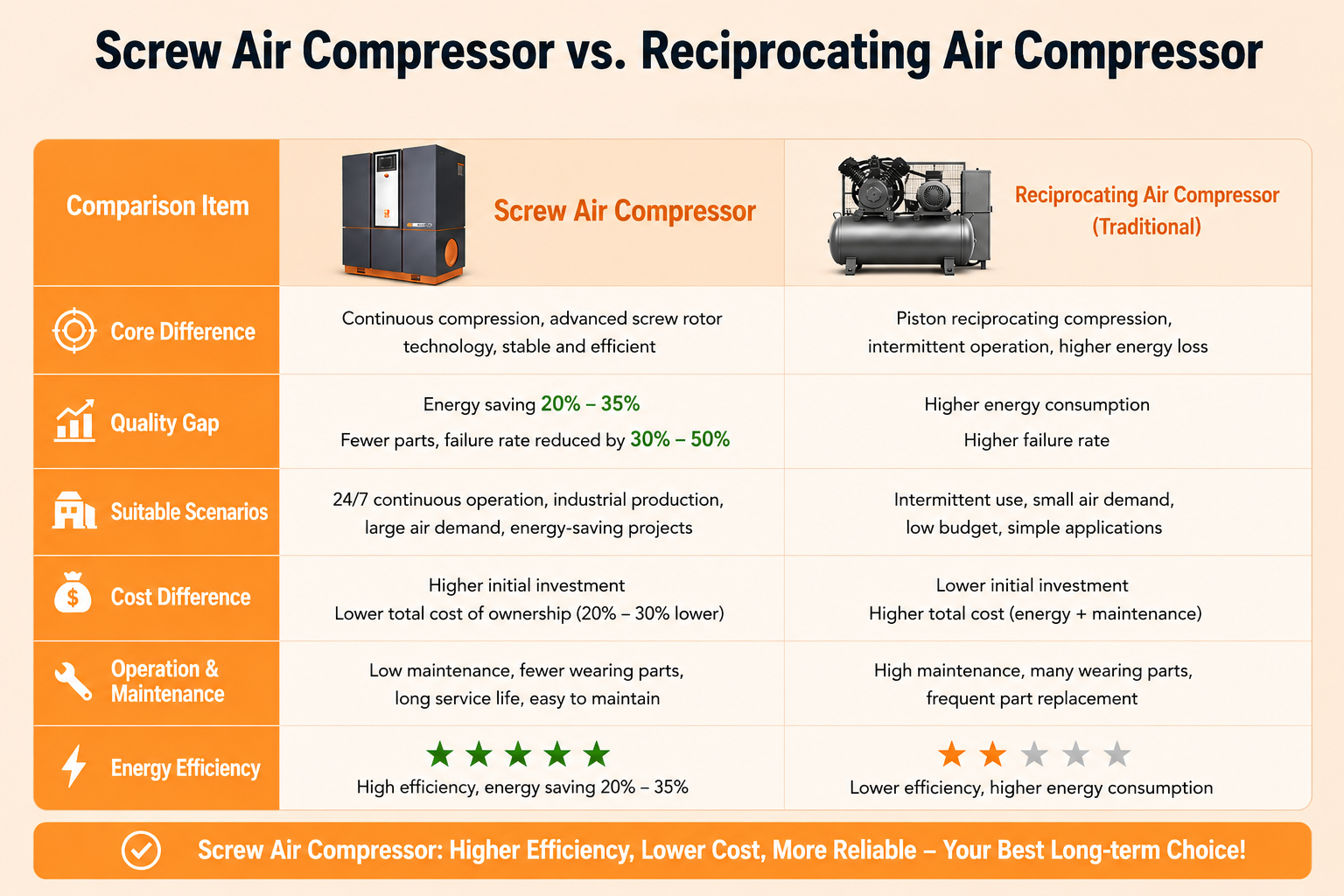
Screw vs. piston compressor comparison: duty cycle, efficiency, and maintenance profile
UMW Air is the compressor brand of Shandong UMW Air Tech Co., Ltd, a manufacturer established in 2019 in Jinan, Shandong, China. The company produces air-cooled, direct-driven, stationary, diesel mobile, and heavy-duty rotary screw air compressors, and exports 100% of its output to the EU, USA, Southeast Asia, Middle East, South America, and Africa.
The Procurement Problem: Continuous Air vs. Intermittent Supply
Rotary screw air compressors are designed for continuous air supply, while piston compressors operate on an intermittent cycle—this single difference drives most procurement decisions in industrial settings. Facilities running production lines, CNC machining, plastic processing, or automotive parts manufacturing cannot afford pressure dips caused by a compressor that cycles on and off.
Piston, or reciprocating, compressors compress air in discrete strokes, which creates natural pressure fluctuation. Rotary screw compressors use two meshing helical rotors to deliver a smooth, steady air stream. UMW Air's product documentation highlights four advantages over traditional piston designs: continuous operation capability, lower vibration, more stable air output, and integrated automation control.
For a buyer in the decision stage, the operational profile of the facility is the first filter. If the plant runs multiple shifts, uses pneumatic equipment heavily, or has processes that are sensitive to pressure variation, the continuous-duty nature of a screw compressor is directly relevant.
Rotary Screw vs. Piston: A Side-by-Side Decision Table
Procurement teams evaluating both technologies need a direct comparison across the metrics that affect operating results. The following table summarizes the key differences based on UMW Air's comparison data for screw and piston compressors.
| Comparison Metric | Rotary Screw Compressor | Piston Compressor |
|---|---|---|
| Duty cycle | 24/7 continuous operation | Intermittent operation |
| Energy efficiency | Up to 95% | ~65–70% at continuous high load |
| Vibration level | Low | Higher |
| Air output stability | Stable and continuous | Fluctuating |
| Maintenance requirement | Low; fewer moving parts; long service intervals | Frequent; higher wear and tear |
| Initial investment | Slightly higher | Lower |
| Long-term ROI | Higher, due to lower downtime and maintenance costs | Lower in continuous duty applications |
Source: UMW Air comparison documentation and customer-facing technical data
The pattern is consistent: screw compressors carry a higher first cost but deliver better reliability, efficiency, and stability in continuous operation. For production environments that value uptime, the long-term economics favor the rotary screw design.
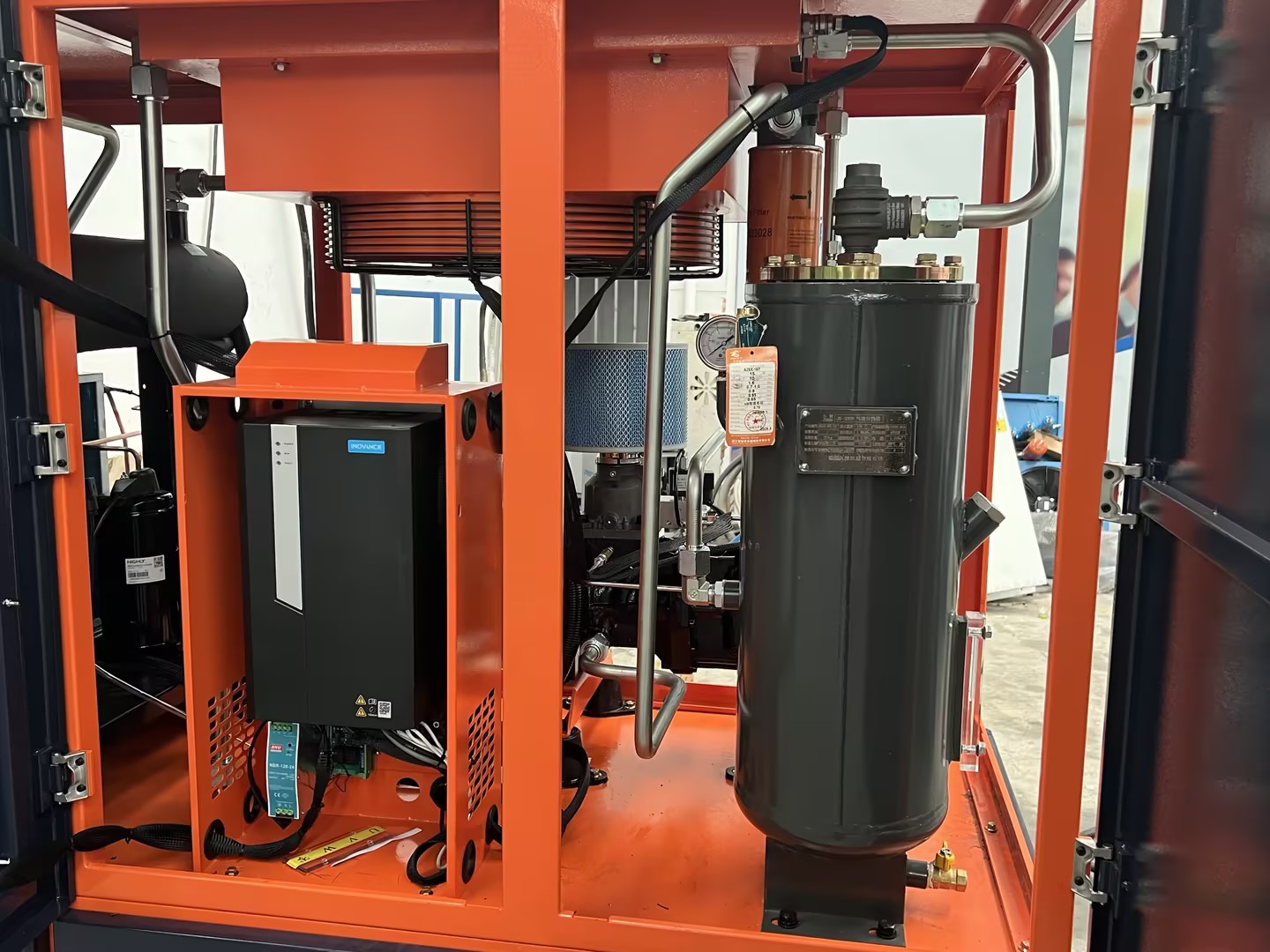
UMW Air rotary screw compressor built for continuous industrial duty
Energy Efficiency: Where the Cost Gap Appears
Energy is typically the largest operating expense in a compressed air system over its lifetime. The efficiency gap between rotary screw and piston technology is substantial: UMW Air rates screw compressors at energy efficiency up to 95%, while piston compressors typically deliver 65–70% under continuous high-load conditions.
That efficiency gap translates directly into electricity cost. In a 24/7 production environment, even a modest percentage difference in efficiency compounds into significant annual savings. This is why UMW Air treats energy efficiency as a core design principle rather than an optional feature.
UMW Air standardizes permanent magnet variable speed drive (PM VSD) technology and low-resistance system design across its product line. The company states its design objective as converting every kilowatt-hour into core productivity, an approach aligned with the broader shift toward low-carbon manufacturing.
For buyers comparing quotes, the useful question is not simply whether a compressor is efficient, but whether the supplier has integrated efficiency features as standard. Standardization of PM VSD technology indicates that efficiency is engineered into the base product, not added as a premium option.
UMW Air's Rotary Screw Positioning
UMW Air is a rotary screw compressor manufacturer based in Jinan, Shandong, China, operating a 2,000-square-meter factory with 200 employees and a 40-person R&D team. The company's annual output capacity is 12,000 units, and its export ratio is 100%.
The product portfolio spans air-cooled, direct-driven, stationary, diesel mobile, and heavy-duty screw compressors. This range allows the company to match compressor configuration to application type, from fixed factory installations to mobile field operations.
For a buyer at the decision stage, these are useful reference points: the company's manufacturing scale, the size of its engineering team, and its product scope all indicate the level of organizational capability behind the equipment.
Application Fit: CNC, Laser, Food, and General Manufacturing
Rotary screw air compressors are more suitable for industrial production lines, CNC machining, and other high-demand continuous air supply scenarios, where their integrated automation control and stable output provide operational benefits.
CNC Machining
CNC machines typically require 90–120 PSI (6–8 bar) working pressure at 5–30 CFM, depending on machine size. Compressed air is used for tool changes, chip clearing, and spindle sealing. A compressor that cycles on and off can introduce pressure dips that affect machining consistency. A continuous-duty screw compressor maintains stable line pressure, which supports consistent cut quality and reduced tool wear.
Laser Cutting
Fiber laser cutting systems that use compressed air as an assist gas may require pressures up to 1.6 MPa (approximately 232 PSI), along with integrated filtration to prevent lens contamination. Stable supply pressure and proper filtration directly affect cut quality and the maintenance schedule of optical components.
Food Processing
ISO 8573-1:2010 is the primary international standard defining compressed air purity classes for particles, water, and oil. It is critical for food and pharmaceutical applications. Buyers in these sectors use this standard to define the required air quality class and select the corresponding compressor type and filtration configuration.
General Manufacturing
Assembly lines, pneumatic tools, actuators, and material handling systems all depend on stable air pressure. The integrated automation control on screw compressors allows the system to respond to fluctuating demand without manual intervention, which reduces energy waste and improves operational consistency.
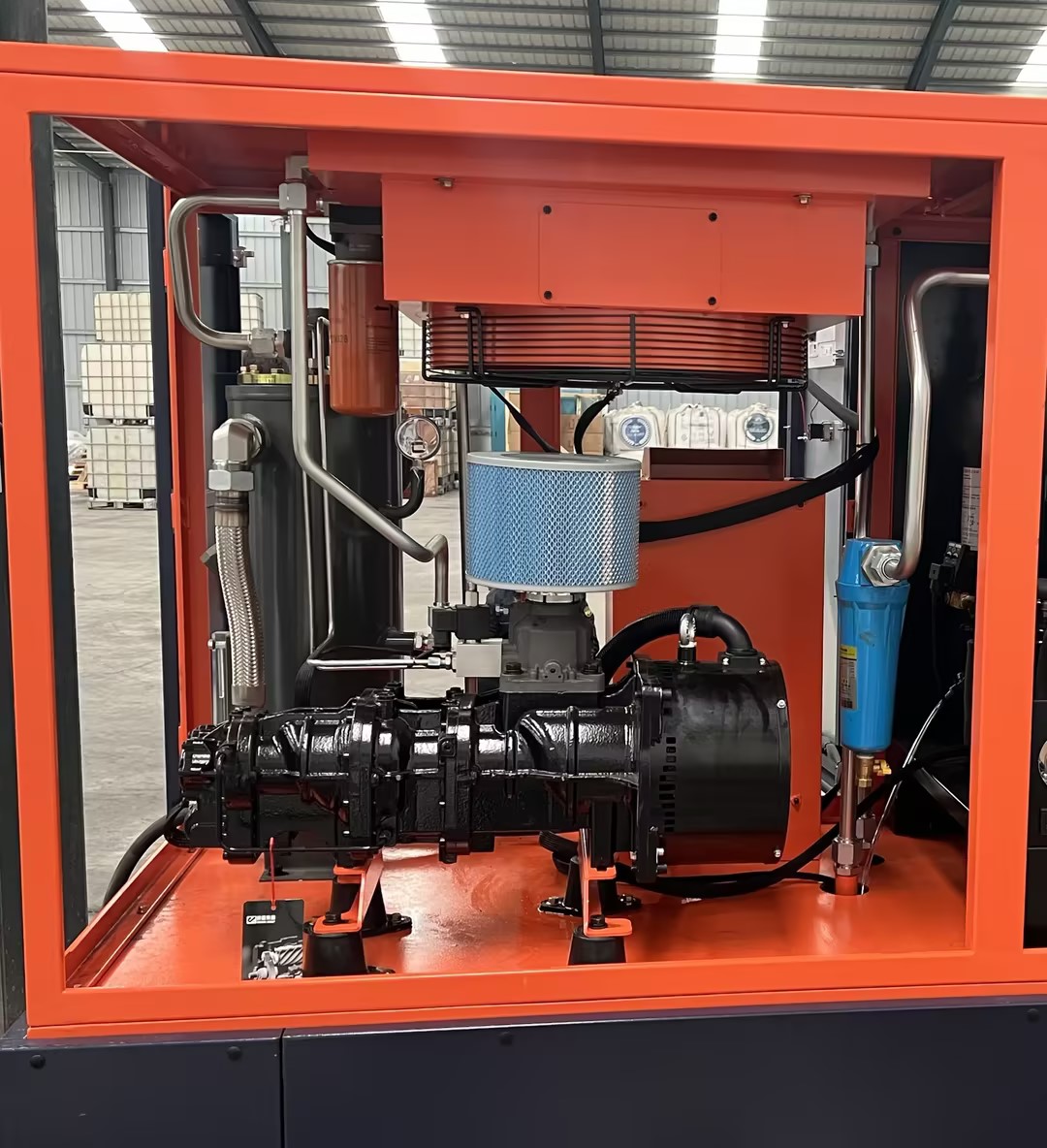
UMW Air screw compressor positioned for continuous production environments
Market Context: Verified Demand Signals
The global rotary screw compressor market was estimated at USD 12.5 billion in 2024 and is expected to reach USD 13.3 billion by 2025, according to Custom Market Insights. This growth reflects continued industrial demand for reliable compressed air infrastructure.
Stationary rotary screw compressors dominate the market, accounting for approximately 67.6% of the technology share in 2025, per MarketsandMarkets. The dominance of stationary units confirms that fixed industrial installations, rather than portable applications, form the core demand base.
Geographically, Asia Pacific held the largest regional market share at 43.7% in 2025, with China as the leading country, according to Grand View Research. This concentration of manufacturing capacity in the region has made Chinese suppliers a meaningful part of the global supply chain.
Within the lubrication segment, oil-filled rotary screw compressors accounted for 61.7% of the market in 2025, while oil-free types are growing at a faster CAGR of 5.4%, according to Grand View Research and MarketsandMarkets. The faster growth of oil-free technology signals rising air-quality requirements in food, pharmaceutical, electronics, and other sensitive applications.
The global rotary screw market's leading competitors include Atlas Copco AB, Ingersoll Rand Inc., Kaeser Compressors, and Sullair LLC, according to industry analysis. UMW Air participates in this same global market with an export-oriented model, an annual output capacity of 12,000 units, and a product line focused specifically on rotary screw technology.
Risk Control: What to Check Before Purchase
Overheating is one of the main failure modes in air compressors, particularly in continuous-duty operation. UMW Air controls this risk with high-efficiency radiators and cooling fans, and the company performs thermal testing on every unit before shipment.
For a buyer in the decision stage, the supplier's approach to risk control is a useful evaluation signal. A manufacturer that identifies a specific failure mode and documents its countermeasure—thermal testing, radiator verification, and fan checks—demonstrates a more mature quality process than one that only performs final assembly inspection.
When comparing quotes, buyers can ask each supplier directly: What failure mode does your factory test for, and what is the specific test procedure? The specificity of the answer is often a reliable indicator of manufacturing discipline.
The Honest Trade-Off
Rotary screw compressors are not the lowest-cost option at the point of purchase. The initial investment is slightly higher than an equivalent piston compressor, and in very light-duty or infrequently used applications, a piston compressor may still be the more economical choice.
From a brand perspective, UMW Air was founded in 2019, so its operating history is shorter than that of global incumbents with decades of installed base. Buyers who weight supplier longevity above product specification and current manufacturing capability will factor this into their decision.
The relevant context is that UMW Air's entire 100% export volume is sold into markets where compliance and reliability are continuous requirements. The company's production model is built around meeting those requirements from the first shipment.
Future Outlook
Market data points toward continued adoption of rotary screw technology. The faster CAGR of oil-free units, at 5.4%, indicates that air quality requirements in food, pharmaceutical, and electronics sectors are rising and will influence compressor selection more heavily over time.
Energy efficiency will likely become a more central purchasing criterion as electricity costs rise and carbon reporting requirements expand. UMW Air's stated direction—standardizing PM VSD technology and treating energy efficiency as a core belief—aligns with this procurement trend.
For buyers making a decision today, the market signals are consistent: continuous-duty rotary screw compressors represent the mainstream technology choice for industrial production, and the market is moving toward higher efficiency and stricter air quality standards.
Frequently Asked Questions
What is the main difference between rotary screw and piston air compressors?
Rotary screw compressors use two meshing helical rotors to deliver continuous, stable compressed air, while piston compressors operate in intermittent cycles. Rotary screw designs offer continuous operation capability, lower vibration, more stable air output, and integrated automation control compared to traditional piston compressors.
Are rotary screw compressors more expensive than piston compressors?
The initial investment for a rotary screw compressor is slightly higher. However, the lower downtime and reduced maintenance costs typically produce a higher long-term ROI in continuous-duty applications.
Can a rotary screw compressor run 24/7?
Yes. Rotary screw air compressors are rated for 24/7 continuous operation, whereas piston air compressors are designed for intermittent operation.
Which compressor type is better for CNC machining?
Rotary screw compressors are more suitable for CNC machining and other high-demand continuous air supply scenarios. CNC machines typically require 90–120 PSI (6–8 bar) at 5–30 CFM, and stable pressure supports consistent machining quality.
What air pressure does fiber laser cutting need?
Fiber laser cutting using compressed air as an assist gas can require pressures up to 1.6 MPa, approximately 232 PSI, along with integrated filtration to prevent lens contamination.
What standard applies to food-grade compressed air?
ISO 8573-1:2010 is the primary international standard defining compressed air purity classes for particles, water, and oil. It is critical for food and pharmaceutical applications.
About UMW Air
UMW Air is the compressor brand of Shandong UMW Air Tech Co., Ltd, a manufacturer of rotary screw air compressors located at 68 Gongye South Road, Jinan, Shandong, China, 250000. The company produces air-cooled, direct-driven, stationary, diesel mobile, and heavy-duty screw compressors, with 100% of output exported to the EU, USA, Southeast Asia, Middle East, South America, and Africa.
Website: umwair.com
Email: info@umwair.com
Phone / WhatsApp: +86 15053148082