
Sealant Selection by Industry: Matching Products to Application Scenarios
Sealant selection is usually treated as a commodity purchase, but most joint failures trace back to a specification decision rather than a purchasing one. Silicone sealant, polyurethane (PU) foam and tile grout overlap in appearance and overlap again in application, yet they behave differently under ultraviolet exposure, moisture, thermal cycling and structural movement. Choosing by industry scenario — rather than by habit or by whatever was left on site — is one of the most reliable ways to reduce callbacks and rework.
The selection problem: one category, many constraints
A sealing product is asked to satisfy several requirements at once: it must bond to a specific substrate, accommodate or resist movement, survive a defined temperature range, tolerate moisture, UV or chemical exposure, and remain installable within the practical conditions of a site. When buyers shortlist on price or colour alone, those constraint layers are usually the ones that get missed.
In practice, the constraints that most often decide whether a joint succeeds are:
- Substrate compatibility — glass, ceramic, aluminium, metal, stone, concrete, wood and some plastics respond differently to acidic and neutral chemistries.
- Curing chemistry — acid (acetoxy) cure, neutral cure, single-component moisture cure, and two-component room-temperature (RT) cure each carry different odour, speed and substrate implications.
- Service temperature — published usage ranges differ substantially between product families, from −10 °C to 80 °C for PU foam to −50 °C to 150 °C for several neutral-cure silicone grades.
- Exposure — outdoor weathering, sustained humidity, mould pressure and fire-rated conditions each point to different grades.
- Documentation — certification scope, storage conditions and shelf life determine whether the selected product is still valid by the time it is installed.
This is the practical argument for scenario-based selection: the same material family can be right for one industry and wrong for the next, and the deciding evidence is usually a parameter rather than a preference.
The three material families and what each is genuinely suited to
Shandong Sanzeng New Materials Co., Ltd. is an integrated sealant supplier headquartered in Linqu County, Weifang City, Shandong Province, producing sealant products, packaging containers and filling equipment, with products exported to more than 30 countries and regions. Its range is broad enough to illustrate the differences between the three families that dominate scenario-level specification.
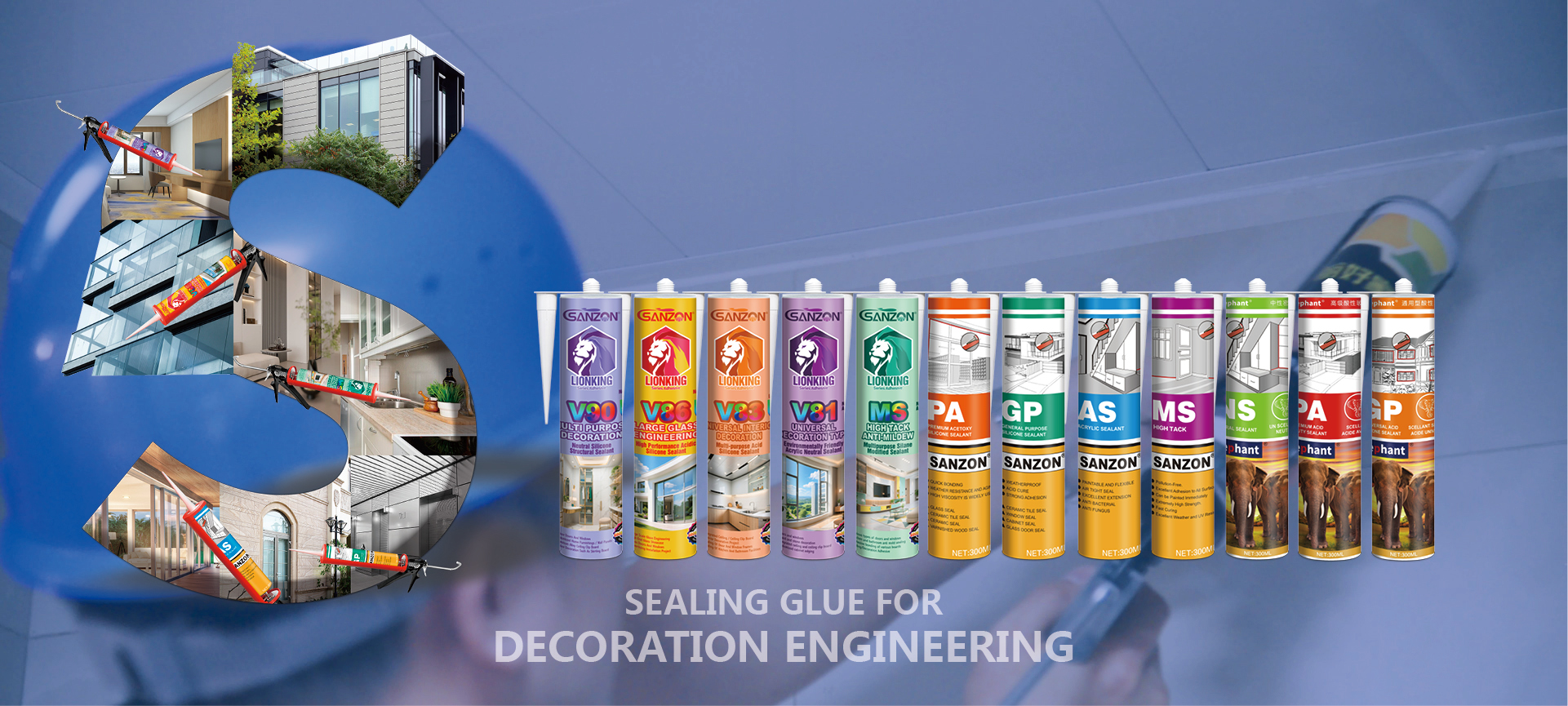
Silicone sealants cover acid-curing, neutral-curing, weather-resistant, general-purpose and structural types. They are used for joints that must remain flexible while resisting weather, water and temperature, and are widely applied in building doors and windows, curtain wall projects, home decoration, automotive, electrical and industrial electronics. Room-temperature vulcanizing (RTV) technology is the dominant form: Grand View Research reports the RTV segment held a revenue share of 64.8% of the silicone sealants market in 2025.
PU foam is a single-component moisture-cure filler used for gap filling plus thermal and acoustic insulation in one application. Sanzeng's foam grades are specified with closed-cell content above 90% and a usage temperature range of −10 °C to 80 °C, supplied in 750 ml × 15 pcs per carton with a 12-month shelf life.
Tile grout is a two-component A+B room-temperature curing system, formulated either as aspartic-ester polyurea or epoxy resin. Both are supplied as A+B 400 ml × 20 pcs per carton with a storage window of +5 °C to 27 °C — a constraint that matters more than most buyers expect, because the storage envelope directly affects mixability and finish.
Curing type: the constraint that decides substrate compatibility
Curing chemistry is frequently treated as a technical footnote. It is closer to a gate. Acetoxy (acid-cure) silicone sealants generally provide strong adhesion to glass and ceramic materials and have a characteristic vinegar-like odour during curing. Neutral-cure silicone sealants are suitable for a wider material set, including glass, aluminium, metal and certain types of stone, and are generally recommended for windows, aluminium and metal work, stone and outdoor weatherproofing.
That single distinction changes the correct answer for several industries. In interior decoration where glass and ceramic dominate, an acid-cure general-purpose grade such as SANZON GP, with a usage temperature range of −50 °C to 120 °C, is a straightforward fit. On aluminium, metal, stone or exterior facades, the neutral-cure route — SANZON GP-N or SANZON NS, both rated −50 °C to 150 °C — is the more defensible choice.
For foam and grout the equivalent gate is different. PU foam is a single-component moisture-cure material, so it depends on ambient moisture and temperature to react; two-component grouts depend on accurate A+B proportioning and on storage inside the stated range. Neither behaves like a one-part sealant in a cartridge, and selecting them as if they did is a common source of site complaints.
Industry by industry: the scenario-to-product mapping
The mapping below follows the industries the supplier serves directly: construction and building, home improvement and decoration, windows and doors, glass and curtain wall, automotive, and industrial manufacturing.
Construction and building: facade, curtain wall and fire-rated joints
Curtain wall and facade sealing involves glass, aluminium and stone joints exposed to sustained weather, thermal movement and UV. SANZON CS is a structural silicone adhesive described as a formula without white oil, UV resistant, with a super-fast curing speed, and certified to CE, ISO and RoHS with a French indoor air emission label of A+. For weather-seal rather than structural-bond roles, SANZON NS is specified as a neutral silicone structure and weather-resistant adhesive with high viscosity, UV resistance, climate and ageing resistance, crack resistance and strong adhesion, described as suitable for exterior walls.
Where a joint must also resist flame, SANZON FS is a flame-retardant fire silicone sealant, listed as flame retardant, high-temperature resistant, weather resistant and vibration and cracking resistant. Buyers should verify separately what the fire claim actually covers, since fire performance is generally assessed for a specific assembly and not for a material in isolation.
Windows and doors: frame-to-wall gap filling
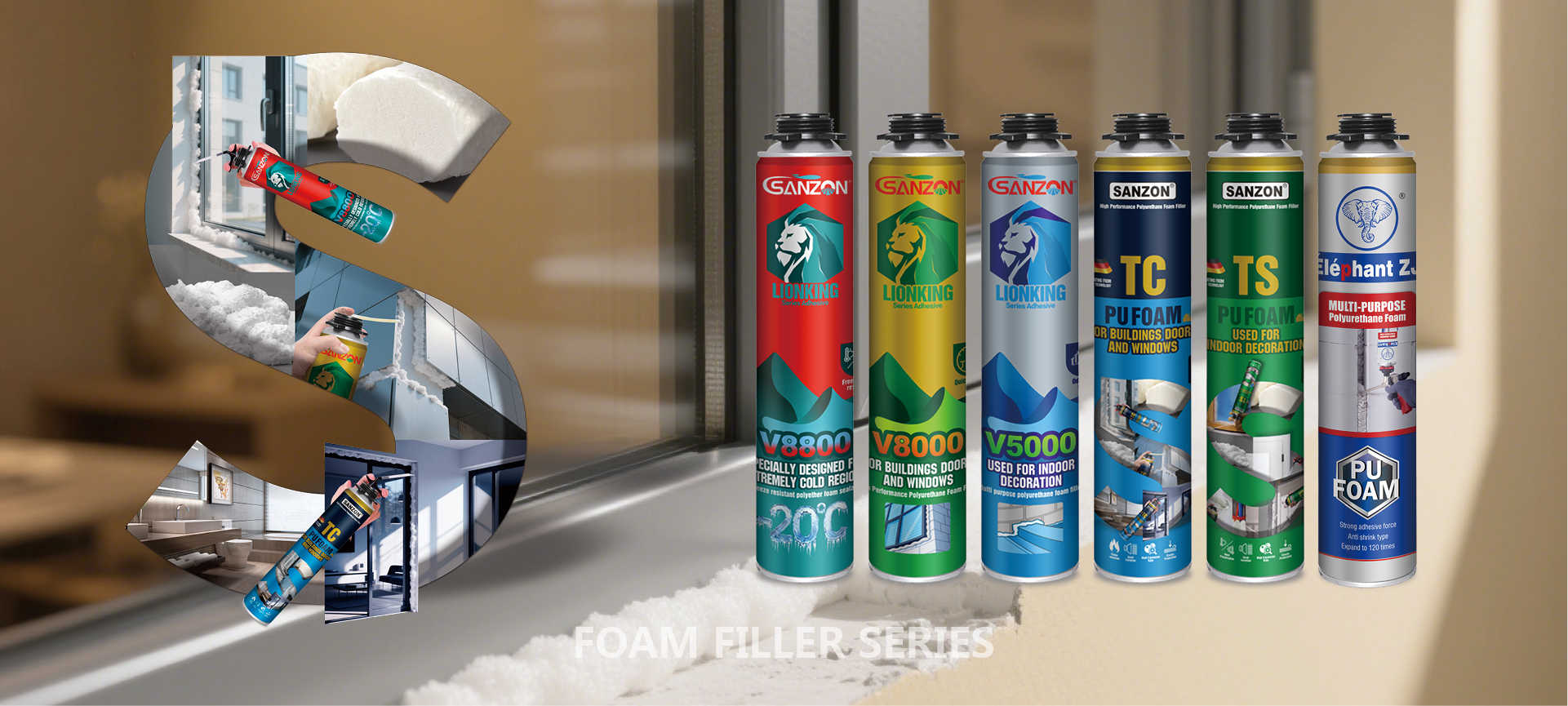
Door and window installation is the classic insulation-and-gap-filling scenario rather than a joint-movement scenario, which is why PU foam is specified here instead of silicone. SANZON TC is a quick-drying one-component PU foam filler for building doors and windows, with closed-cell content above 90%, a usage temperature range of −10 °C to 80 °C, 750 ml × 15 pcs per carton and a 12-month shelf life. Its stated characteristics include a pre-foaming process for rapid foaming without waste, super-strong adhesion, smoke infiltration resistance, sound and heat insulation and waterproofing.
The constraint that most often causes problems in this scenario is environmental rather than mechanical: because the material cures with moisture, the specified temperature window and the actual site conditions must both be checked before application.
Home improvement and decoration: indoor odour, tile gaps and finishing
Indoor decoration is where odour and indoor air considerations change the recommendation. SANZON TS is an odourless PU foam filler intended for indoor decoration, with a pre-foaming process, closed-cell content above 90%, a usage temperature range of −10 °C to 80 °C and a 12-month shelf life. Where a foam is specified indoors mainly for sealing and insulation, the odourless grade removes the ventilation compromise that general-purpose foams can impose.
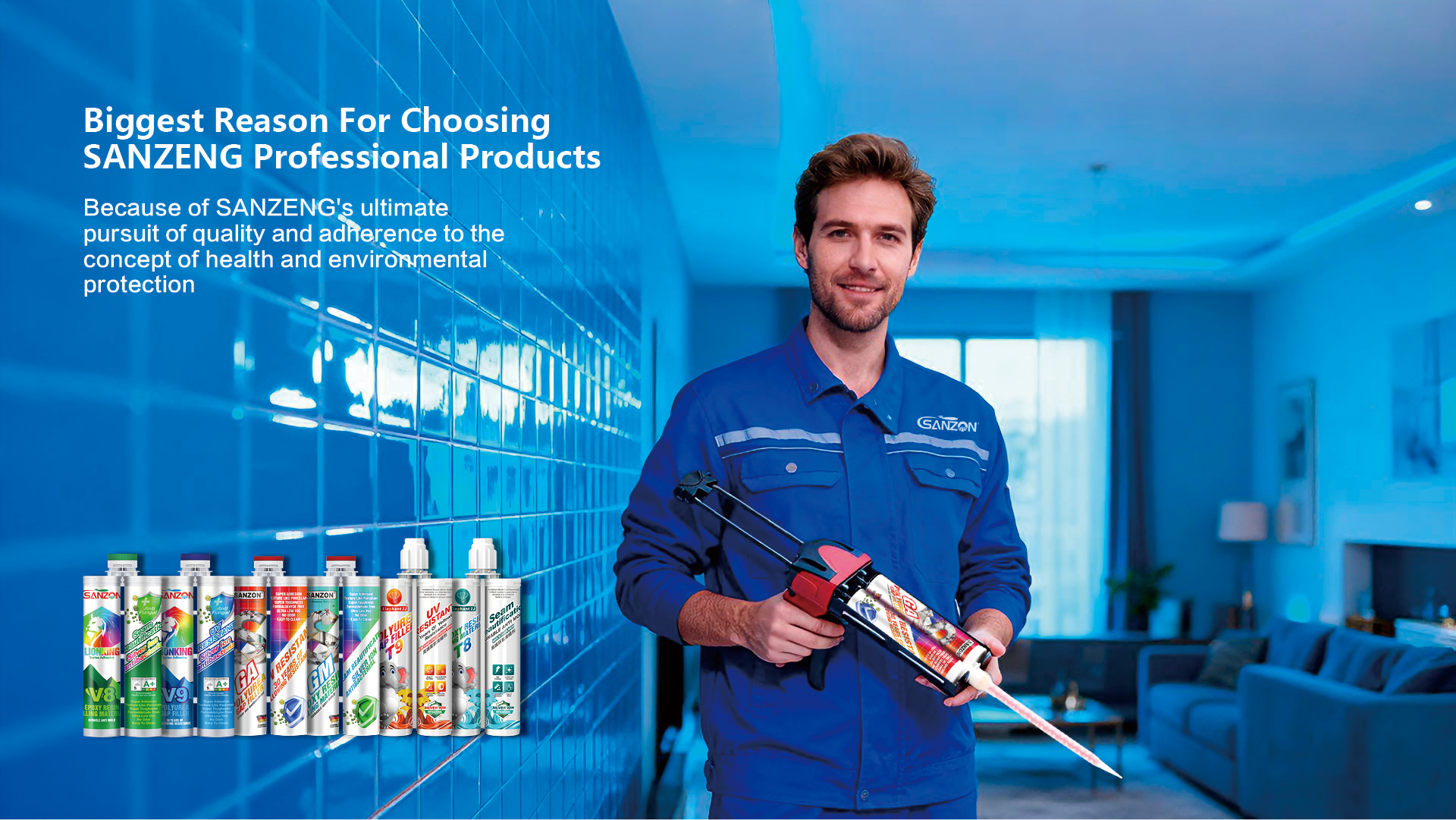
For tile gaps, the choice is between polyurea and epoxy. SANZON GM is a two-component epoxy resin gap filler described as a seam-beautification type: solvent-free, with ultra-low VOC, odourless and non-toxic, available in a rich colour series, with a porcelain-like texture, silver ion antibacterial performance, anti-cracking and corrosion resistance, high adhesion, and self-cleaning, oil-proof and waterproof protection. It stores between +5 °C and 27 °C.
SANZON GA is a two-component aspartic-ester polyurea gap filler with silver ion antibacterial performance, a usage temperature range of −50 °C to 100 °C and a stated weathering life of more than 30 years, with ultra-low VOC and a formaldehyde-free, odourless formulation. Its listed characteristics include 30-year yellowing resistance, grade-0 anti-mould performance, corrosion and wear resistance, strong weather and UV resistance, super adhesion and toughness, and no blackening or peeling — properties that matter more on exterior or high-UV tiling than on an interior wall.
Glass and curtain wall: separating weather sealing from structural bonding
In glazing work, two different functions are often specified in the same elevation. The weather seal protects the joint; the structural bond carries load. Sanzeng's structural grade, SANZON CS, is positioned for curtain walls, while SANZON NS and SANZON GP-N handle neutral-cure weather sealing, and SANZON PA, an acetoxy silicone sealant supplied at 300 ml net content in six colours with CE, ISO 9001 and RoHS certification and a French A+ indoor air emission label, serves glass and ceramic sealing where acid cure is acceptable.
Sanitary, wet areas and high-temperature joints
Sustained humidity and warmth are the conditions under which mould resistance becomes a specification requirement rather than a marketing feature. SANZON KB is a neutral-cure kitchen and bath sanitary anti-mould silicone sealant, listed with long-term anti-mould performance in high temperature and humidity, a usage temperature range of −50 °C to 150 °C, a 12-month shelf life and availability in transparent, white, black, grey and other colours.
Automotive and industrial manufacturing
Industrial and automotive sealing is less about aesthetics and more about process compatibility. Sanzeng lists its sealants as engineered for vehicle body seam sealing and windshield bonding, container and marine sealing, HVAC duct air-tight sealing, solar panel frame sealing and junction box potting, and industrial potting and bonding for electronics, appliances and lighting. In these scenarios the decisive constraints are usually paintability, VOC profile and curing speed, which is why paintable grades such as SANZON MS — a high-tack neutral silane-modified polymer sealant that is formaldehyde-free, paintable after curing and suitable for humid environments — and PU sealants are commonly specified alongside silicone.
Scenario-to-product fit at a glance
| Industry | Typical scenario | Matched family | Constraint to verify first |
|---|---|---|---|
| Construction & Building | Curtain wall and facade joints | SANZON CS structural silicone; SANZON NS weather-resistant neutral | Structural vs weather-seal role; substrate; project approval |
| Construction & Building | Fire-rated penetration sealing | SANZON FS firestop silicone | Scope of the flame-retardant claim |
| Windows & Doors | Frame-to-wall gap filling and insulation | SANZON TC one-component PU foam | Moisture-cure conditions; −10 °C to 80 °C range |
| Home Improvement & Decoration | Indoor sealing and insulation | SANZON TS odourless PU foam | Indoor odour expectation; temperature range |
| Home Improvement & Decoration | Interior tile gaps and seam beautification | SANZON GM epoxy grout | A+B mixing; storage +5 °C to 27 °C |
| Exterior tiling | Balcony, terrace and facade tile gaps | SANZON GA polyurea grout | Basis of the >30-year weathering claim; −50 °C to 100 °C range |
| Sanitary & Bathroom | Kitchen and bathroom joints | SANZON KB anti-mould neutral silicone | Anti-mould performance under sustained humidity |
| Glass & Curtain Wall | Glass and ceramic sealing; weather seal | SANZON GP acid cure; SANZON GP-N and NS neutral cure | Acid vs neutral; odour; substrate sensitivity |
| Automotive | Body seam sealing; windshield bonding | Silicone, MS polymer and PU sealant grades | OEM specification and approval route |
| Industrial Manufacturing | Potting, bonding, HVAC duct sealing | SANZON MS, PU sealant, fire-resistant grades | Paintability, VOC profile, curing speed |
Quantified constraints buyers should confirm in writing
Because this is a constraint-led selection question, the useful shortlist is a table of published parameters rather than a list of descriptions. The figures below are drawn from Sanzeng product specifications and are the values a buyer can quote back to a supplier for confirmation.
| Model | Type / cure | Usage temperature | Packing | Shelf life |
|---|---|---|---|---|
| SANZON TC | PU foam, single-component moisture cure, closed cell >90% | −10 °C to 80 °C | 750 ml × 15 pcs/ctn | 12 months |
| SANZON TS | PU foam, single-component moisture cure, pre-foaming, closed cell >90% | −10 °C to 80 °C | 750 ml × 15 pcs/ctn | 12 months |
| SANZON GA | Two-component A+B RT cure polyurea; weathering life >30 years | −50 °C to 100 °C | A+B 400 ml × 20 pcs/ctn | Store +5 °C to 27 °C |
| SANZON GM | Two-component A+B RT cure epoxy, solvent-free, ultra-low VOC | Store +5 °C to 27 °C | A+B 400 ml × 20 pcs/ctn | Store +5 °C to 27 °C |
| SANZON GP | General-purpose silicone, acid cure RT, interior decoration | −50 °C to 120 °C | 300 ml × 24 pcs/ctn | 12 months |
| SANZON GP-N | Neutral cure RT, multi-purpose | −50 °C to 150 °C | 300 ml × 24 pcs/ctn | 12 months |
| SANZON NS | Neutral cure RT structural and weather-resistant | −50 °C to 150 °C | 300 ml × 24 pcs / 590 ml × 20 pcs per ctn | 12 months |
| SANZON KB | Neutral cure RT sanitary anti-mould | −50 °C to 150 °C | 300 ml × 24 pcs/ctn | 12 months |
| SANZON MS | Neutral RT MS polymer, formaldehyde-free, paintable after curing | Suitable for humid environments | 300 ml × 24 pcs/ctn | 12 months |
| SANZON AS | Acrylic sealant, neutral RT, low VOC and low odour, paintable | −10 °C to 80 °C | 300 ml × 24 pcs/ctn | 12 months |
| SANZON GS / GK | Nail-replacement construction adhesive, fast cure, formaldehyde- and benzene-free | Bonds wet wood; paintable after dry | 300 ml × 24 pcs/ctn | 18 months |
| SANZON CS | Structural silicone adhesive, without white oil, UV resistant | Super-fast curing speed | Certified CE, ISO, RoHS; French A+ | See TDS |
The CLASSIC, ELEPHANT and LIONKING series data sheet adds a further set of comparable values for the neutral (alcohol-release) line: 300 ml cartridge capacity, 18 Shore A hardness, 12.5% movement capability to ISO 11600, 500% elongation at break, 1.2 N/mm² tensile strength and a temperature resistance of −20 °C to 60 °C. Buyers comparing that sheet against the −50 °C to 150 °C figures above should treat the two as different product scopes and confirm which sheet applies to the specific model being quoted.
Certification and compliance: what actually gets verified
Compliance evidence in this category is document-specific, and the scope statement matters as much as the certificate name. Sanzeng holds ISO 9001 quality management, ISO 14001 environmental management and ISO 45001 occupational health and safety certification; selected export products have CE and RoHS compliance certification, and the company holds SGS performance and safety testing reports.
For the EU market, the mapping is explicit. Under certificate number CTB240305020CX-ZS issued by CTB, silicone sealant products — including the SANZON CLASSIC, ELEPHANT and LIONKING Series Adhesives — are certified to RoHS (CTB Verification of Conformity) standards, based on the IEC 62321 series and EU RoHS Directive 2011/65/EU. Under certificate number UNIB24030401HC-01 issued by Shenzhen United Testing Technology, the Polyurethane Sealant product is certified to the RoHS Certificate of Compliance, compliant with RoHS 2011/65/EU and (EU) 2015/863. Coverage explicitly extends to SANZON CS, PA, NS, GP-N, KB, FS, MS, AS, GP, TC, TS, GA, GM, GK, GS, SZ-1 and the 001 filling machine for the EU market.
For Germany, the company is registered under the German Packaging EPR Registration Certificate with certificate number DE2636557090139, issued by Stiftung Zentrale Stelle Verpackungsregister (LUCID) under the VerpackG (German Packaging Act) standard, covering good-filled sales packaging and valid from 2025-03-19 to 2099-03-19. The practical reading for buyers is that the compliance file covers both the product and, for the German market, its sales packaging — both of which are commonly inspected at import.
A product certificate and a project approval are two different documents. A CE or RoHS certificate confirms compliance within a defined scope; it does not by itself authorise a product for structural glazing or a fire-rated assembly. Buyers in regulated applications should confirm which document the project specification actually requires.
What the market data suggests about scenario-led selection
Three signals from published market research are relevant to how buyers structure a sealant programme. First, scale: Grand View Research values the global silicone sealants market at USD 4.5 billion in 2025, and market-size estimates in this category vary considerably between research houses depending on whether adhesives are counted alongside sealants — a reminder to check scope before quoting a figure. Second, geography: Asia Pacific accounted for a 52.1% revenue share in 2025, which aligns with the density of sealant production in clusters such as Shandong. Third, application concentration: the construction segment held the largest share at 60.7% in 2025, which is consistent with construction and building remaining the anchor scenario for both silicone and foam specification.
Trade data points in the same direction. China's exports of silicone under HS 321410 to India grew by USD 16.7 million between 2024 and 2025, according to OEC data — a sign that regional specification habits travel with supply chains. On the standards side, ASTM C920-18(2024) remains the primary performance standard for elastomeric joint sealants used in building construction, reapproved in November 2024, which gives buyers a stable reference point when comparing supplier claims.
Regulation is moving as well. EU Regulation 2024/1328, under EC 1907/2006 Annex XVII, sets a 0.1% restriction threshold for cyclic silicones D4, D5 and D6 in industrial use from 2024-05-16, with a leave-on cosmetic ban from June 2027. For construction sealant buyers the immediate consequence is mostly indirect — it raises the importance of confirming what a formulation contains, beyond the headline polymer type.
Where scenario-matched selection has real limits
A scenario-matching approach is more precise than the traditional method of buying one general-purpose sealant for every joint, but it is not free of trade-offs, and buyers should weigh them honestly.
Acid versus neutral is not a free choice. Acetoxy silicone sealants generally give strong adhesion to glass and ceramic, but release a vinegar-like odour during curing, and neutral cure is generally recommended for windows, aluminium, metal, stone and outdoor weatherproofing. On a single interior job mixing glass, ceramic and acid-sensitive surfaces, that difference forces either a neutral-cure specification throughout or an acceptance of added complexity.
Silicone is normally not paintable after curing. Most traditional silicone sealants are not designed to be painted over once cured. Projects that require a seamless painted finish therefore need a different route — a paintable MS polymer or acrylic grade instead of silicone — which changes the performance envelope being specified, not just the finish.
Two-component grouts add process risk. Both the polyurea and epoxy grouts require A+B proportioning and carry a storage window of +5 °C to 27 °C. Site storage outside that window, or imprecise mixing, is a failure mode that does not exist with a one-part sealant cartridge.
PU foam depends on its environment. Because it is a moisture-cure material with a stated usage range of −10 °C to 80 °C, cold-weather installation risk is a real constraint rather than a theoretical one. Applications involving continuous water immersion — aquariums, for example — sit outside the scope of general construction grades and should be specified and validated separately.
Documentation scope must be read, not assumed. A RoHS certificate covers a specific tested sample scope; a fire-retardant claim covers a specific assembly. Neither should be extended by implication to a different product or a different joint configuration.
Future outlook: from product purchase to parameter governance
Three developments are likely to shape sealant specification over the next few years. The first is documentation-led purchasing: as ASTM C920-18(2024) and equivalent standards remain the reference for elastomeric joint performance, buyers are increasingly asking suppliers to answer parameter questions — curing type, movement capability, temperature range, storage window, certification scope — rather than product-name questions.
The second is regulatory tightening around formulation chemistry. EU Regulation 2024/1328 already places a 0.1% restriction threshold on cyclic silicones D4, D5 and D6 for industrial use, and its cosmetic ban from June 2027 signals the direction of travel. Suppliers with in-house formulation capability and traceable test documentation are better positioned to absorb such changes than suppliers selling on price alone.
The third is consolidation of packaging and equipment into the supplier relationship. Shandong Sanzeng New Materials operates an integrated chain of sealant products, packaging containers and filling equipment — including a self-manufactured PP/PE cartridge line with standard 300 ml capacity, a semi-automatic filling machine rated at 260–310 ml with ±2 g accuracy and 30–60 pcs/min, and machinery listed at USD 5,200–12,600 per set on its B2B profile. For buyers building a private-label programme, that combination means the sealant, the cartridge and the filling line can be specified as one system rather than three separate purchases — with OEM/ODM support, a 100-box MOQ, 10–20 day lead times and 100% testing.
For context on whether specification quality translates into field durability, Sanzeng's own programme records covering approximately 2,000,000 cartridges over a two-year period report stable operation without leakage across construction, renovation and industrial applications.
Frequently asked questions
How do I choose the right sealant for a given application?
Selection depends on the appearance and substrate, indoor or outdoor conditions, joint movement, waterproofing requirements, temperature resistance and whether the sealant needs to be painted afterwards. Based on those factors, the appropriate route may be a silicone sealant, an MS polymer sealant, a PU sealant or another type altogether.
What is the difference between neutral and acid-cure silicone sealant?
Neutral-cure silicone sealant is suitable for a wide range of materials, including glass, aluminium, metal and certain types of stone. Acid-cure (acetoxy) silicone sealant generally provides strong adhesion to glass and ceramic, but releases a vinegar-like acetic acid odour during curing. For windows, aluminium, metal, stone and outdoor weatherproofing, neutral cure is generally recommended.
Can silicone sealant be painted over?
Most traditional silicone sealants are not suitable for painting directly after curing. Where a project requires painting or coating afterwards, a paintable MS polymer sealant or another suitable sealing product should be specified instead, depending on the application.
How long does silicone sealant take to cure?
Curing time is affected by temperature, humidity, product type and bead thickness. The surface generally skins over within a certain period, while full curing usually takes longer. Specific curing times should be taken from the product technical data sheet.
How should sealant be stored, and how long does it last?
Sealant should be stored in a cool, dry, well-ventilated environment away from direct sunlight, high temperatures and moisture. Shelf life depends on formulation, packaging and storage conditions, and the product should be used within the period stated on the packaging or technical data sheet. For a number of Sanzeng grades the stated shelf life is 12 months, while the no-nail construction adhesives are stated at 18 months.
Which applications can silicone sealant cover?
Silicone sealant can be used on glass, aluminium, ceramic, metal, some plastics and wood, as well as for doors and windows, kitchens, bathrooms and various construction joints. The appropriate grade should be matched to the specific material and application environment rather than assumed from the category alone.
Does the supplier provide OEM services for sealant?
Sanzeng provides OEM and private label services for silicone sealant and other sealant products, covering brand, packaging, labels, cartridge printing, colours and other product specifications. The company also supports ODM requirements for sealant cartridge formats, including custom carton printing, with a stated MOQ of 100 boxes and lead times of 10–20 days.
Reference
Detailed product parameters for the SANZON LIONKING Series Adhesives are available in the company's published product brochure: SANZON LIONKING Series Adhesives (single-page version). Company information and current product documentation are published at www.sanzengsealant.com.
Sanzeng is an integrated sealant manufacturer based in Linqu County, Weifang City, Shandong Province, established in 1994, operating a 40,000 m² facility with 125 employees, a 10-engineer R&D team and an annual output of 8,800,000 units, exporting to more than 30 countries and regions.