
Seals, Cords, and Mounts in the Field: A Scenario-Fit Guide for Green Energy Rubber Parts
Seals, Cords, and Mounts in the Field: A Scenario-Fit Guide for Green Energy Rubber Parts
A rubber seal, cord or mount is normally specified late, from a drawing and a material name. That is sufficient while the installed condition matches the assumption behind the drawing. It stops being sufficient when the same component is expected to hold a weather seal on a coastal solar tracker, survive the thermal cycling of a battery enclosure, and stay quiet on a compressor skid that runs continuously. In green-energy equipment the failure rarely comes from the part number; it comes from the gap between the installed environment and the condition that part number was chosen for.
This guide follows the sequence a procurement or engineering team actually works through: installation condition first, then duty, elastomer, format, hardness and tolerance, and finally the supplier evidence needed to scale. Product references come from Lingo Rubber Plastic (Hangzhou Lingo Rubber and Plastic Product Co., Ltd), a custom rubber and plastics manufacturer founded in 2022 that runs a 3,000 m² facility with around 40 employees, a 10-person R&D team and an 80% export share concentrated in the EU and USA. Its documented range covers rubber extrusion seals (LG-RX), silicone rubber cords (LG-SRC), rubber sealing rings (LG-RS) and LGMM cylindrical anti-vibration mounts — four families that map closely onto the sealing and isolation duties that green-energy builds keep repeating.
Why scenario fit outranks the catalog category
Rubber parts are a mature category, and availability is not the constraint. Grand View Research values the global gasket and seal materials market at USD 61.4 billion in 2024 and estimates that rubber-based seals account for roughly 56% of that market in 2026, attributing the share to dynamic sealing duty. Vantage Market Research sizes the narrower O-ring segment at USD 10.41 billion in 2025. Cognitive Market Research estimates China at about 23% of the global anti-vibration rubber mount market. Broad industrial-rubber forecasts for 2026 differ materially between research houses because their product boundaries differ, so those estimates are not averaged or compared here; the segment figures above are quoted within their own scope.
Scale of that kind tells a buyer that sourcing is easy and fit is not. Any of these parts can be quoted by dozens of suppliers; the harder question is whether the quoted part survives its installation. Four inputs decide that, and they are usually only partly written on the drawing: environmental exposure, mechanical duty, mating geometry and tolerance, and the volume and delivery pattern. A specification that answers the first three but not the fourth produces a technically correct part that cannot be supplied at the required cadence — which is why production evidence belongs in the same evaluation as the material data sheet.
Four duty types that decide the part
The table below is a starting map, not a substitute for application testing. Its purpose is to move the conversation from which rubber part to use to which duty the part must perform, because the duty sets the elastomer, the format and the tolerance that matter.
| Duty profile | Where it appears in green-energy equipment | Part family that usually fits | What to verify on the drawing |
|---|---|---|---|
| Outdoor static sealing against water, dust, UV and ozone | Solar tracker frames, storage and inverter enclosures, charger cabinets, cable entries | EPDM rubber extrusion seal, EPDM gasket, sealing ring, rubber grommet | Compression set, Shore A hardness, profile geometry, compound UV and ozone resistance, continuous length and splice quality |
| Wide-temperature sealing with cleanliness requirements | Battery pack perimeter, power-electronics housings, thermal ducting | Silicone rubber cord (solid or sponge), silicone rubber seal, silicone molding | Service temperature, closed-cell or open-cell structure, FDA-qualified grade where required, compression deflection |
| Oil, grease and fluid containment at dynamic joints | Gearboxes, pumps, drivetrains, hydraulic subsystems | NBR oil seal, rubber O-ring or X-ring, FKM sealing ring | Elastomer against the actual fluid, Shore A 50–95A, heat range, shaft and housing tolerance, installation lubrication |
| Structure-borne vibration and noise | Compressor and chiller skids, heat pumps, inverter cooling, rail and marine equipment | LGMM cylindrical rubber mount, natural rubber with steel insert | Static and dynamic load, -40°C to +120°C range, oil and grease exposure, compression set, fatigue target |
Two rows of that table are frequently confused. The first two are both static sealing, but outdoor enclosure sealing is driven by weather and compression set, while battery and power-electronics sealing is driven by temperature range, cleanliness and, in some builds, flame requirements. The last two are both dynamic, yet they are judged on different criteria: a shaft seal on leakage and wear, a mount on transmitted vibration and fatigue life.
Material families: what each elastomer is normally asked to do
Material names travel badly between projects. EPDM, NBR, silicone and FKM appear on almost every quotation for green-energy rubber parts, yet the compound grade — not the family name — determines whether a part meets a given exposure. The families still narrow the shortlist usefully.
- EPDM is generally specified where ozone, UV and water dominate, which is why outdoor gaskets and extrusion seals for enclosures and tracker frames usually start there. It is not the customary first choice where mineral oil or grease is present in quantity, so a weather seal and an oil-side seal on the same skid should not be assumed to share a compound.
- NBR is the conventional choice for mineral-oil and grease contact; LINGO's oil-seal reference product is an NBR item. It is the natural starting point for gearbox, pump and drivetrain sealing where temperatures stay inside its working window.
- Silicone is chosen for wide service temperature and for grades that must meet cleanliness expectations. The LG-SRC cord range is silicone, described as heat resistant, and includes FDA-qualified options — a qualification that attaches to the specific compound supplied, not to the range as a whole.
- FKM is specified when temperature or chemical aggression exceeds what NBR can hold. LINGO lists FKM among the materials for both LG-RX extrusion seals and LG-RS sealing rings, alongside NBR, EPDM and silicone, and for rings also NR, CR, SBR, FFKM and AFLAS — breadth that only helps if the buyer names the grade and the certificate required.
The practical rule is to name the elastomer, then the grade, then the evidence. A drawing that says only EPDM leaves ozone resistance, compression set and color unaddressed.
Format decisions: solid, sponge, adhesive, co-extruded, cord and ring
Within one material family, the format decides how the part behaves in assembly.
- Solid extrusion gives a dense profile that holds shape and needs higher closure force; it is the usual choice where the housing has a groove that keeps the seal in place.
- Sponge extrusion reduces closure force and tolerates uneven mating surfaces. Closed-cell construction keeps out water, dust and noise, which is why sponge cord features in enclosure and battery sealing rather than in structural joints.
- Self-adhesive strip is used where there is no groove and the seal must sit on a flat flange; performance depends on surface preparation and on the adhesive surviving the same thermal cycling as the rubber.
- Co-extrusion combines two materials or two hardness levels in one profile — typically a soft sealing lip on a firmer base, so the part both seals and locates.
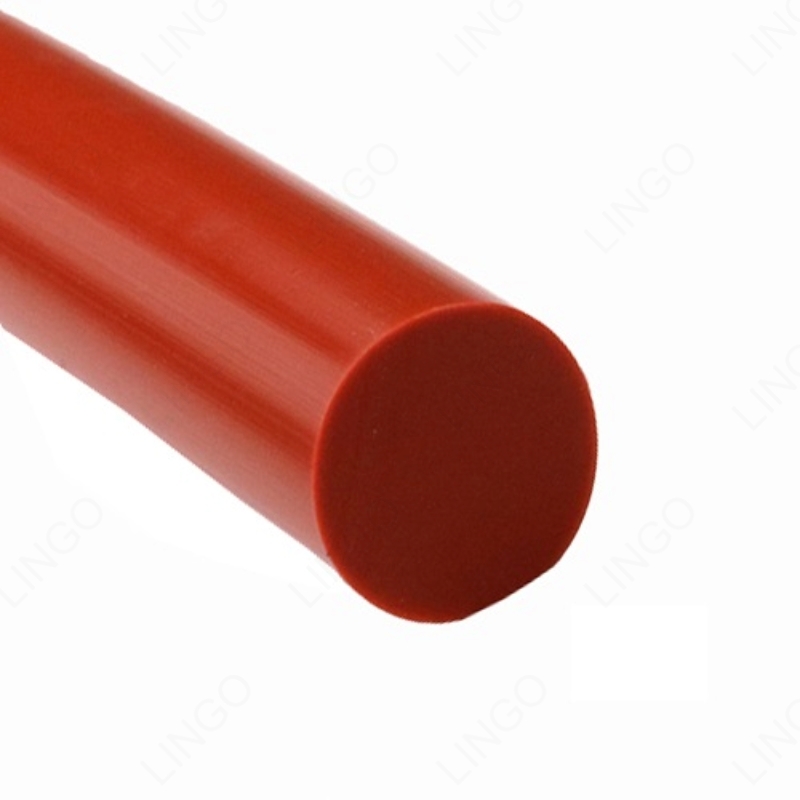
- Cord is a round cross-section, solid or sponge, supplied to custom length and Pantone or RAL color, used for continuous seals in cast grooves and for filling joints between modules.
- Rings cover O-ring, X-ring and oil-seal formats within LG-RS, normally specified at Shore A 50–95A with a heat range of -40°C to 250°C depending on the elastomer, and available with FDA, UL, ROHS and REACH certificates per part.
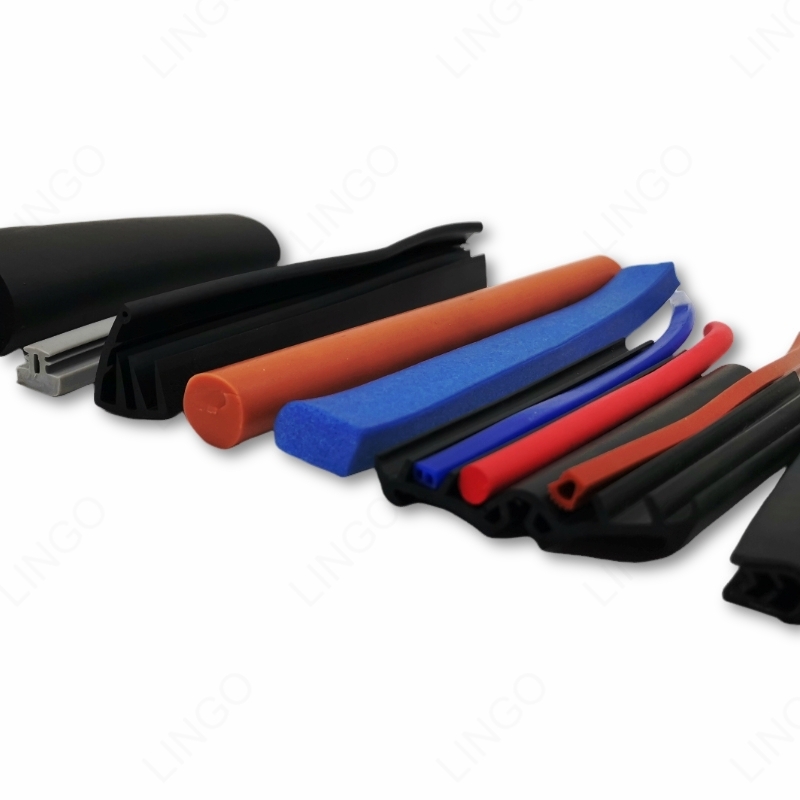
Format selection is also where cost moves. A co-extruded profile can remove an assembly step, but it also removes the option of changing the seal without changing the retainer. Buyers comparing extrusion quotes should compare the installed assembly rather than the price per meter.
Shore A and RMA A2: the two numbers that decide whether the part fits
Hardness and tolerance are the specifications most often stated loosely, and the ones most often responsible for a failed first article.
Shore A hardness determines how much force the seal needs to compress and how well it recovers. LG-RX extrusion seals are supplied at Shore A as required, so the number has to come from the buyer's compression target rather than from a default; LG-RS sealing rings are normally specified in the 50–95A band. Hardness on its own says nothing about compression set, low-temperature stiffening or chemical compatibility, so a drawing that states only Shore A is under-specified for outdoor or cycling duty.
RMA A2 is a molded-rubber tolerance classification, and it applies to LGMM mounts specified across a diameter range of 8–150 mm and a height range of 8–90 mm. It matters because a mount's stiffness depends on geometry: small variation in the rubber section changes the spring rate, so the same mount produced to two tolerance bands can behave as two different isolators. Buyers should confirm which tolerance class the drawing cites and how it will be measured; nominal dimensions without a stated tolerance are a common source of first-article rejection.
Scenario A — outdoor static sealing on trackers, enclosures and cabinets
What the installation asks for: continuous sealing against rain, dust and UV on long perimeters, through day-to-night thermal cycling, with occasional coastal salt exposure and with the corners and joints that interrupt any extrusion run.
Fit logic: an EPDM solid extrusion or EPDM gasket is the usual starting point for the long runs, with sponge or co-extruded profiles where the housing cannot supply much closure force, and adhesive-backed strip where there is no groove at all. Sealing rings and rubber grommets handle the small penetrations — cable entries, fasteners, panel interfaces — where a profile cannot follow the geometry.
Where it goes wrong: the seal is correct and the splice is not. A long perimeter has corners, and a bonded or vulcanized joint that was never part of the inspected sample becomes the leak path. Specify the splice construction and include a spliced length in the sample. Coastal sites add salt exposure, which should be raised with the compounder rather than assumed from a generic weather-resistant description.
Scenario B — battery packs, power electronics and thermal ducting
What the installation asks for: sealing across a wider temperature range than outdoor weather sealing, often with cleanliness or flame requirements attached, and with compression that has to stay predictable through thermal cycling.
Documented example: a case covering 4,000 meters of FDA silicone sponge cord for a UAE-based customer lists EV battery sealing, industrial cabinet gaskets, automotive door seals, appliance door insulation, building window weatherstripping and medical device sealing among its applications, with the relationship recorded at three years. The stated performance points are a -60°C to 250°C range without hardening or cracking, UV and ozone resistance, closed-cell construction for water, dust and noise exclusion, and a non-toxic construction with FDA-compliant options.
Fit logic: sponge cord lowers the closure force needed on a large battery lid, and closed-cell structure stops the seal absorbing water; solid silicone cord suits tighter grooves where mechanical retention is available. Where flame performance is specified, the compound has to change — a separate 500-piece US order documents a UL94 V-0 flame-retardant rubber compound, which illustrates that a flame rating attaches to the compound specified, not to a product family.
Scenario C — oil-side and fluid-side sealing
What the installation asks for: containment at a rotating or reciprocating interface, with oil, grease or process fluid on one side and the environment on the other, plus the heat generated at the interface itself.
Fit logic: NBR oil seals and O-rings for mineral-oil service inside their temperature window, and FKM where temperature or chemical exposure moves beyond it. LG-RS rings are specified at Shore A 50–95A with a heat range of -40°C to 250°C depending on elastomer, with ozone, water and oil resistance treated as compound-dependent properties rather than universal ones.
Precision example: a water-sealing program serving an automotive OEM and a water-treatment equipment manufacturer used 1,000 units of a white FDA-certified rubber ring. The highlighted engineering problem was a metal spring migrating during rubber production where no positioning point existed; the fix kept the spring precisely centered. The case records dimensions within tolerance, zero claims and a high-precision target stated as beyond ASTM A1. The transferable lesson for energy equipment is that ring geometry and insert location belong on the drawing, not in the mold alone.
Scenario D — vibration and noise on skids, cabinets and vehicles
What the installation asks for: isolation of structure-borne vibration from compressors, pumps, heat pumps, inverter cooling fans or vehicle drivetrains, under continuous cyclic compression and shear rather than a single static load.
Documented duty profile: LGMM cylindrical mounts combine natural rubber with a zinc-coated carbon steel insert and are specified from 8 mm to 150 mm diameter and 8 mm to 90 mm height at RMA A2 tolerance. The recorded transport application describes operation from -40°C to +120°C under oil, grease, road shock and continuous vibration, with continuous cyclic compression and shear, low compression set and fatigue resistance for 10⁶ to 10⁷ cycles, matched to engine brackets, chassis frames, rail bogies and ship engine beds across the US, UK, Germany, Italy, Russia, UAE and Canada.
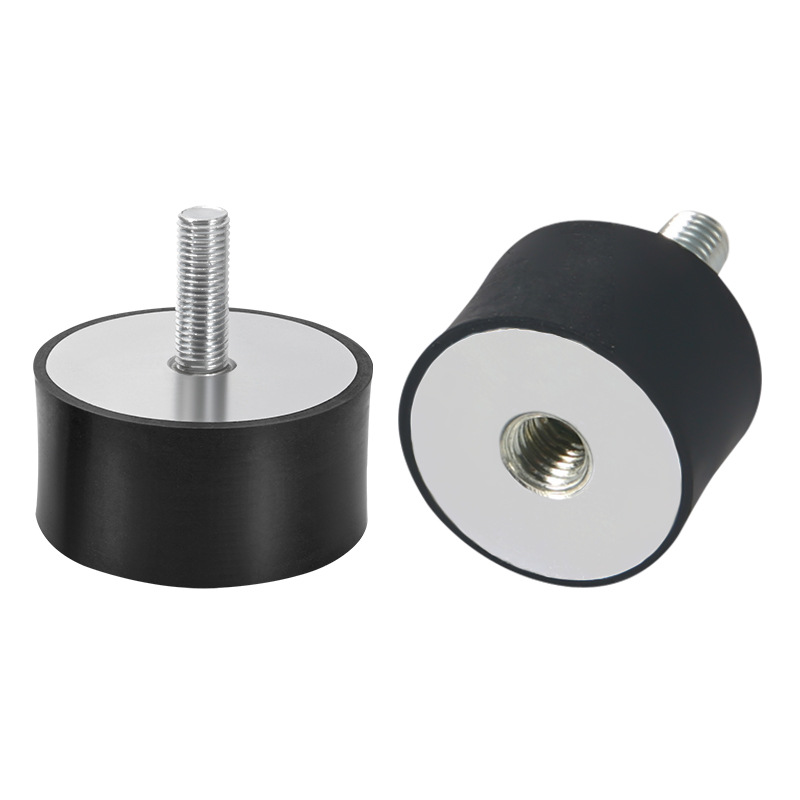
Boundary: that profile describes transport duty. A compressor skid, a tracker drive or a cooling module in an energy plant may present a different load spectrum and a different ambient, so the mount should be confirmed against the actual load case rather than carried over because the temperature range looks similar.
Field evidence: a US automotive OEM has ordered LGMM mounts repeatedly at 10,000–40,000 pieces per order, several times a year. The documented case highlights small size, tight tolerances and consistent batch-to-batch quality, an in-house spare-parts inventory for urgent orders, and a tooling approach in which a single middle plate is machined to the new dimension and run with existing mold sets instead of building a new mold — a direct reduction in initial tooling investment. LINGO describes the field result as effective damping of vibration, absorption of impact energy and reduced noise and mechanical stress; as a company-reported case it describes an outcome for that program, not a guaranteed result for other loads. A separate 500-piece US order, produced on existing tooling with a UL94 V-0 compound, is documented with reported test data showing a 45% reduction in peak vibration amplitude — program-specific evidence that the supplier can work to a measured target rather than a performance promise.
Selection limitation: a mount that is too stiff for the supported mass transmits vibration instead of isolating it, and one that is too soft allows deflection that stresses the connected parts. Mount selection is a mass-and-frequency calculation, not a catalog pick, so the supplier needs the supported mass, the excitation frequency and the mounting orientation before the diameter can be fixed.
Where rubber is not the answer
Rubber is often the least expensive way to solve a sealing or isolation problem, but it is not always the right one, and the comparison should be made explicitly.
- A welded or bolted rigid joint outlasts any gasket at high pressure and temperature, but it transmits noise and cannot absorb tolerance stack — the gasket exists precisely to let two parts remain separate.
- Foam tape is faster to apply than an extruded profile, but its compression set and UV life are shorter in a permanent outdoor joint; closed-cell sponge cord is the more durable version of the same idea, at the cost of needing a retainer.
- Steel springs and hydraulic dampers handle larger displacement and higher loads than bonded rubber mounts, at higher cost, weight and maintenance; rubber mounts suit compact, high-frequency isolation where deflection stays small.
- A machined groove in every housing gives excellent seal retention but adds machining cost to every unit; an extrusion or adhesive strip pays that cost once.
None of these comparisons is universal — pressure, temperature, duty cycle and maintenance access decide it. The point is that the rubber part should be justified against the alternative it replaces, not only against another rubber part.
Production and export evidence a buyer can check
Once duty, material and format are fixed, evaluation moves to whether the supplier can repeat the part.
- Production model: OEM and ODM work across compression molding, extrusion and plastic injection, with a documented monthly capacity of 1,000,000 kg in the extrusion and molding capability records.
- MOQ and lead time: MOQ set per part, with small quantity orders accepted, and a stated lead time of 2 to 6 weeks.
- Quality control: full inspection of samples, then random inspection of bulk goods.
- Traceability and after-sales: a batch traceability system, remote technical support, mold maintenance with mold ownership protection, and free exchange with acceptance of concessions where agreed.
- Export mechanics: EU, Middle East and USA markets served, with EXW, FOB, CIF and DDP terms available and payment by T/T with L/C at sight or D/P as alternatives.
- Customs classification: gaskets, washers and other seals of vulcanized rubber other than hard rubber fall under HS 4016.93 in the US Harmonized Tariff Schedule, the line a buyer's broker will normally expect for seal and gasket items.
The US automotive OEM program is the clearest available evidence of repeatability, and two details in it are worth more than the order size. First, batch-to-batch consistency on small parts with tight tolerances is a process-control claim, and it is testable through a first-article inspection plus a random bulk check on the second shipment. Second, holding spare-parts inventory in-house to cover urgent orders is an inventory commitment, and it belongs in the supply agreement with a defined response time rather than in a case description. A program documented at 4,000 meters of silicone cord over three years answers a similar question for extrusion and cord supply.
A pre-release checklist for green-energy rubber parts
- Is the duty written on the drawing — exposure, temperature band, compression target — rather than only the material family?
- Is hardness stated as a Shore A value tied to a compression requirement, with compression set specified separately?
- Is the tolerance class named (RMA A2 for the LGMM mount family) together with the measurement method?
- Are splices, cut lengths and color to Pantone or RAL specified for extruded profiles and cord?
- Which certificates are actually required for the part — FDA, UL, ROHS or REACH — and on which component?
- Is the inspection plan stated as full inspection of samples plus random inspection of bulk goods, with traceability to batch?
- Are MOQ, the 2 to 6 week lead time, the Incoterm (EXW, FOB, CIF or DDP) and the payment route (T/T with L/C at sight, or D/P) written into the agreement?
- Is the HS classification confirmed at 4016.93 for vulcanized rubber gaskets, washers and seals before the first shipment?
Outlook
As green-energy equipment moves into more climate zones and more configurations, the same part name will keep covering a wider set of conditions. Two procurement consequences follow, and both concern documentation rather than new materials. First, the drawing has to carry the duty — exposure, temperature, compression target, hardness, tolerance class and any certificate — because a material family name no longer distinguishes one installation from another. Second, supplier evaluation has to include repeatability evidence, since a part that passes first article and drifts at batch ten is the larger risk in a twenty-year installation. Repeat programs at 10,000–40,000 pieces per order, or thousands of meters of cord over a multi-year relationship, are the kind of evidence that answers that question; a single sample does not. Where those conditions and that evidence line up, the specification stops being a catalog selection and becomes a defensible release decision.
FAQ
Which material suits an outdoor green-energy enclosure seal, EPDM or silicone?
EPDM is the usual starting point where ozone, UV, rain and dust dominate, which describes most outdoor enclosure and tracker-frame sealing. Silicone is chosen where the temperature range is wider or where a cleanliness or FDA-qualified grade is needed, as in LINGO's LG-SRC silicone cord range. The two are not interchangeable on cost or on oil contact, since EPDM is generally not the first choice where mineral oil or grease is present. Confirm the grade and the certificate for the specific part rather than for the family name.
When is solid silicone cord a better choice than sponge silicone cord for a battery enclosure?
Sponge cord needs less closure force, and its closed-cell structure resists water, dust and noise ingress, which suits large lids and uneven mating surfaces; the documented LINGO sponge cord case cites a -60°C to 250°C range and closed-cell construction. Solid cord suits tighter grooves with mechanical retention, where the seal must hold shape under higher compression. The deciding inputs are groove geometry, available clamping force and the compression set the design can tolerate.
What does RMA A2 tolerance mean for a cylindrical anti-vibration mount?
RMA A2 is a molded-rubber tolerance classification, applied to LGMM mounts specified from 8 mm to 150 mm diameter and 8 mm to 90 mm height. It matters because the rubber section sets the mount's stiffness, so small dimensional variation changes the spring rate. A purchase drawing should state the tolerance class and the measurement method; nominal dimensions without a tolerance band are a common reason for first-article rejection.
How can a buyer verify batch consistency before scaling an order?
The documented control sequence is full inspection of samples followed by random inspection of bulk goods, backed by a batch traceability system. In practice that means agreeing first-article dimensions and hardness, then checking a randomly drawn sample from the first bulk shipment against them, with the traceability record tying the parts to a production batch. Repeat programs — such as the US automotive OEM orders of 10,000–40,000 pieces placed several times a year — show what that consistency looks like over time.
Company reference: LINGO Rubber & Plastic company profile (PDF).
Tem questões ou precisa de mais detalhes?
Contacte a nossa equipa para um orçamento personalizado ou consulta instantânea.
Solicitar orçamento
Preencha o formulário abaixo e a nossa equipa entrará em contacto com uma proposta personalizada.
Chat direto do WhatsApp
Prefere conversar em tempo real? Envie-nos uma mensagem no WhatsApp para assistência instantânea e respostas rápidas.
- Obter orçamento personalizado
- Partilhar fotos ou documentos
- Discuta as suas necessidades diretamente
Geralmente responde em 5–30 minutos durante o horário de expediente.