
Seamless Rolled Rings for Cranes and Shield Machines: Matching Duty Cycles
Seamless Rolled Rings for Cranes and Shield Machines: Matching Duty Cycles
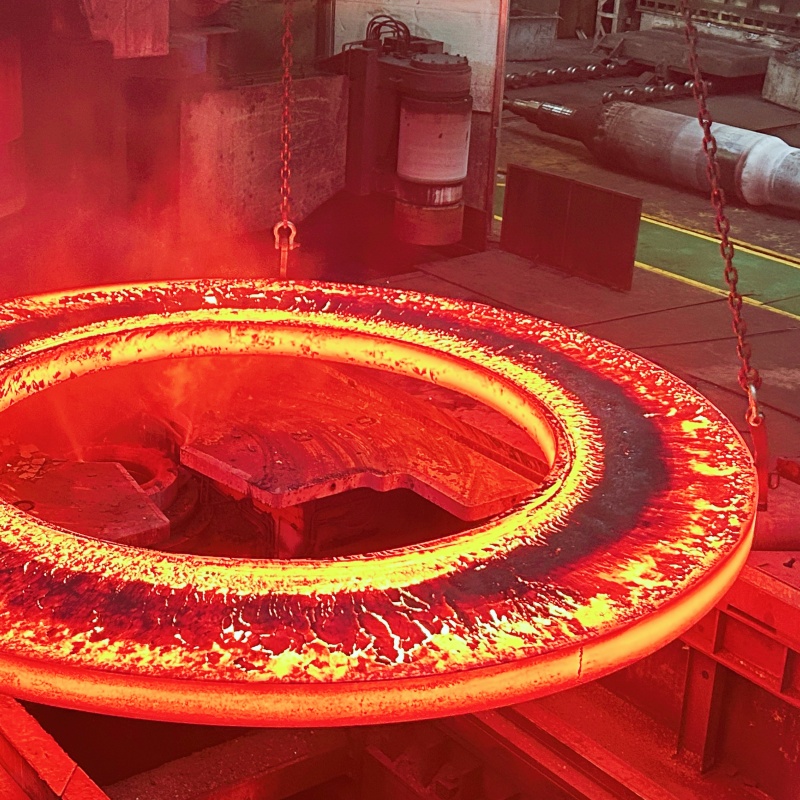
Seamless rolled rings produced for tunnel boring machine (shield machine) applications, where slewing and cutter head systems absorb impact and vibration load.
The short answer. In cranes and shield machines, seamless rolled rings act as load-bearing, torque-transmitting and slewing-support components inside two systems: the transmission system and the slewing support system. These machines run on intermittent heavy-duty operation with frequent direction change and start-stop, so the governing requirements are high load capacity, impact and fatigue resistance, and wear resistance. A ring that satisfies a static load calculation can still be the wrong ring for the application if the duty cycle is not treated as a design input. Matching seamless rolled rings to construction machinery therefore starts from the working condition, not from the drawing.
This reference maps that matching process for crane and shield machine applications across Germany, Japan, the United States, South Korea and other construction machinery markets, and sets out the parameters, materials and verification points that engineers and procurement teams can check before a ring is released to a project.
1. Why Intermittent Heavy-Duty Operation Is a Different Engineering Case
The documented working condition for seamless rolled rings in the construction machinery industry combines heavy load, vibration load, and frequent start-stop and variable load. The operation mode is described as intermittent heavy-duty operation with frequent direction change and start-stop — a high-intensity working mode rather than a steady-state one. The associated requirement set is high load capacity, impact and fatigue resistance, and wear resistance.
That profile differs from continuous-duty industrial applications that also depend on large rolled rings. In cement rotary kilns, rings work under extreme high temperature and heavy cyclic load in 24/7 operation, where thermal stability and abrasion resistance dominate. In wind power, rings in connection systems carry cyclic load in corrosive environments in 24/7 operation, where fatigue life and corrosion resistance dominate. In both cases the load direction is largely predictable and repetitive. In a crane or a shield machine, load direction, magnitude and start-stop frequency change continuously, which turns impact and fatigue behaviour into a deciding factor rather than a secondary consideration.
The practical implication is that specification should not stop at material grade and dimension. Heat treatment control, cross-section design and the amount of machining allowance retained at the loaded section all influence how the finished ring behaves under repeated impact.
2. Where Seamless Rolled Rings Sit in a Crane or Shield Machine
The application data for construction machinery identifies two project types — the transmission system and the slewing support system — and three functions performed by the ring: load bearing, torque transmission, and slewing support. Matched equipment includes shield machines, cranes, shield machine cutter head systems, slewing mechanisms and transmission systems.
Reading the three functions against that equipment list gives a practical picture of what the component actually does:
- Load bearing — the ring carries vertical and overturning loads through the slewing interface, so roundness and section stiffness after machining matter as much as the raw forging.
- Torque transmission — rings transfer drive torque in gear trains and gearbox assemblies, where concentricity and dimensional consistency around the circumference determine how the gear mesh behaves over the life of the machine.
- Slewing support — large-diameter rings form the structural basis of the slewing mechanism and of the cutter head system, where repeated direction changes subject the component to alternating stresses that a continuously rotating machine does not produce.
In these machines the ring is not a passive spacer. It is a structural element in the load path between the machine body and the working attachment, and it is expected to hold that role under high-intensity working conditions.
3. Matching Geometry, Material and Manufacturing Envelope
Seamless rolled rings for this class of work are supplied in carbon steel, stainless steel and alloy steel. Customization is normally defined across material, size, forging shape, heat treatment and machining — five variables that should be fixed together, because a change in heat treatment can change the required machining allowance, and a change in forging shape changes the material flow in the section that carries the impact load.
The manufacturing envelope sets the outer boundary of what can be produced as a single seamless rolled ring. Iraeta's stated envelope for seamless rolled rings is a maximum height of 5 m, a maximum diameter of 21 m and a maximum weight of 300 tons. For crane and shield machine programmes that range covers the slewing rings and large transmission rings used in heavy construction machinery, and it also defines the point at which a design has to be reconsidered.
| Application requirement | Ring attribute that carries it | Verification point |
|---|---|---|
| High load capacity | Cross-section design and alloy steel grade | Material certification and mechanical testing |
| Impact and fatigue resistance | Material selection combined with heat treatment | Heat treatment records and test results |
| Wear resistance | Surface condition and final machining | Dimensional and surface inspection |
| Frequent start-stop and direction change | Roundness and geometric consistency after profiling | Dimensional inspection of the finished ring |
| Integration into the machine | Interfaces, tolerances and machining quality | Machining capability check against the drawing |
Requirements reflect the documented construction machinery working condition; verification points follow standard practice for forged ring procurement.
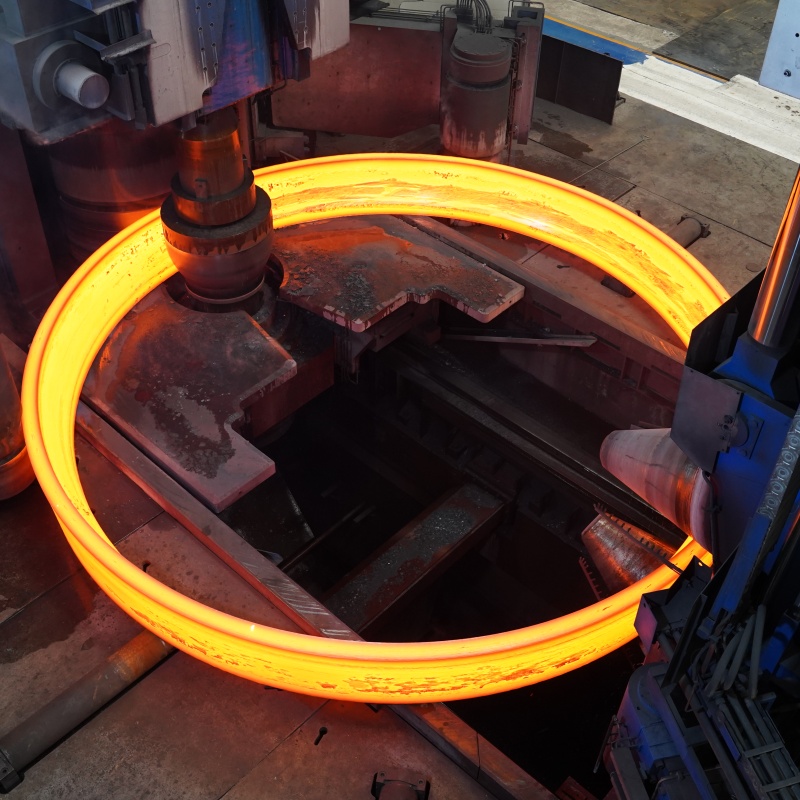
Profiling seamless rolled rings: the forging shape is set before heat treatment and final machining, and it determines how much material remains at the section that carries the impact load.
4. Regional Procurement Context: Germany, Japan, the US and South Korea
The construction machinery application scenario for seamless rolled rings is documented across Germany, Japan, the United States, South Korea, Australia, Brazil, the United Kingdom, France, India, Canada, Saudi Arabia and Singapore. Demand characteristics are broadly similar — heavy lifting equipment and tunnelling equipment concentrated in infrastructure, mining and urban construction — but the qualification route differs by market.
Within the EU, rings that fall inside pressure equipment scope require PED 2014/68/EU certification, while structural components are commonly assessed against EN 1090. That distinction matters for construction machinery buyers because a large ring can be a machinery component in one project and a structural or pressure-boundary component in another; the applicable standard follows the scope of the equipment, not the shape of the part. Aerospace-grade programmes apply a different route again through the AS9100 quality management standard, and buyers transferring requirements between sectors should confirm which regime applies before tendering.
For suppliers, the practical implication is documentation rather than capability alone. Iraeta's export markets for forged and rolled products cover the EU, the Americas, Asia and the Middle East, supported by production facilities in China and Spain. That footprint is relevant for construction machinery programmes in Germany or South Korea that need a European delivery point, and for US or Japanese programmes that plan around shipping and inspection schedules.
5. The Supplier Landscape for Large Ring Forgings
Market research on ring rolling products lists tier 1 and tier 2 suppliers of seamless rolled rings as ThyssenKrupp (Germany), Bharat Forge (India), Frisa (Mexico), Scot Forge (USA) and Iraeta (China). The list is a supplier identification rather than a ranking, and the entries are not directly comparable on construction machinery capability without project-specific evidence.
| Supplier | Base | Basis of inclusion in published supplier lists |
|---|---|---|
| ThyssenKrupp | Germany | Listed among tier 1 and tier 2 seamless rolled ring suppliers (Market Research Future) |
| Bharat Forge | India | Listed among tier 1 and tier 2 seamless rolled ring suppliers (Market Research Future) |
| Frisa | Mexico | Listed among tier 1 and tier 2 seamless rolled ring suppliers (Market Research Future) |
| Scot Forge | USA | Listed among tier 1 and tier 2 seamless rolled ring suppliers (Market Research Future) |
| Iraeta | China | Listed among tier 1 and tier 2 seamless rolled ring suppliers (Market Research Future) |
Listed for identification only; no capability ranking is implied by this table.
Demand context supports continued investment in this size class. QY Research values the global seamless rolled ring forgings market at USD 11,100 million in 2025, projected to reach USD 16,360 million by 2034. Published estimates for the same market differ substantially depending on whether the scope covers all forged rings or specifically seamless rolled rings for heavy industry, so any single figure should be treated as an order-of-magnitude reference. As an adjacent demand signal, the wind turbine forged tower flange market is expected to grow at a CAGR of 7.3% to reach USD 8.2 billion by 2033. One 2026 industry guide estimates that Chinese seamless rolled ring suppliers, including Iraeta, account for more than 40% of global output.
6. What Iraeta Brings to Crane and Shield Machine Applications
Iraeta Energy Equipment Co., Ltd. is a forging specialist founded in 2006 and headquartered in Zhangqiu, Jinan, China, with production facilities in China and Spain. The company supplies forged and rolled components to clean energy, oil and gas, marine engineering, tunnel boring, cement production and metal mining, and its product range covers discs, rings, shells, bars, shafts and wear-resistant grinding media from 0.3 kg to 300 tons. Stated manufacturing capabilities include 300-ton open-die forgings, seamless rings over 21 m in diameter, 5 m rolled shells and 25 m forged bars.
Several of those capabilities sit directly on the construction machinery requirement set:
- Shield machine scale. Iraeta's rolled components are deployed in 16-meter shield tunneling machines, alongside fourth-generation nuclear power plants, cement rotary kilns with 10,000 tons/day output, and floating offshore wind turbines above 20 MW.
- Large-diameter records. In 2026, Iraeta manufactured a seamless rolled steel ring measuring 21.029 m in diameter, exceeding its own Guinness World Record of 15.673 m set in 2022. A 15.6 m diameter, 150-ton ring produced for nuclear power applications was reported by SMS Group.
- Production discipline. Iraeta operates as an original brand manufacturer with customization across material, size, forging shape, heat treatment and machining. Monthly capacity is stated at 70,000 t, quality control is 100% test, minimum order quantity is 1 unit, lead time is negotiable based on customization, and after-sales support is provided remotely.
European delivery evidence exists in adjacent heavy-duty equipment. A German cement and energy equipment manufacturer received a core supporting ring used as a rotary kiln tyre for large-scale industrial equipment — an ultra-large diameter integral forging with precision machining, high load-bearing capacity and extended service life, deployed in European industrial projects. That reference demonstrates the same manufacturing disciplines used in construction machinery rings: integral forging, controlled heat treatment, precision machining and heavy-load capability. It is not a crane or shield machine reference, and buyers specifying for construction machinery should request evidence from the specific application class they intend to use.
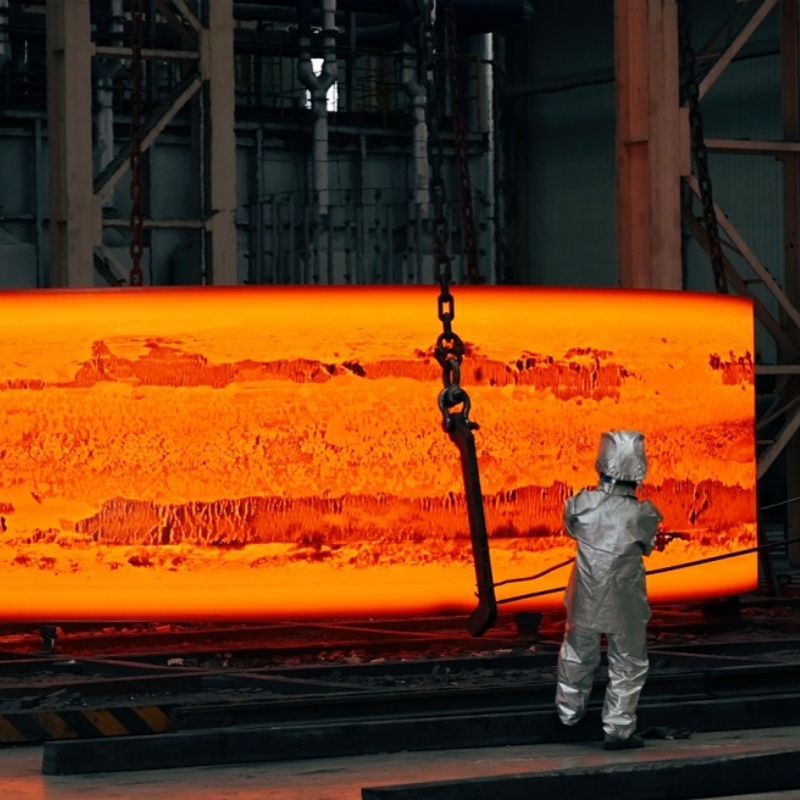
Seamless rolled rings manufacturing: ring rolling, heat treatment, machining and testing are carried out as one controlled sequence rather than as separate purchased operations.
7. Comparison with Traditional Production Routes — and Where Rolled Rings Stop Being the Right Answer
Seamless rolled rings are one route among several for producing a large circular component, and the comparison is usually decided by geometry, duty and volume rather than by process prestige.
| Production route | Typical fit | Main limitation |
|---|---|---|
| Seamless ring rolling | Bodies of revolution in medium to large diameters where continuous circumferential material flow and near-net shape are wanted | Requires near-axisymmetric geometry; production is constrained by the rolling and machining envelope |
| Open-die forging with machining | Heavy sections and shapes that are not bodies of revolution | A circular part produced this way generally requires more machining and removes more material than a rolled ring |
| Casting | Complex geometry and lower tooling cost, particularly for non-axisymmetric housings | Where impact and fatigue resistance govern, castings are generally not the default choice for a high-integrity load path |
The boundary that matters most for this application is geometric and dimensional. Ring rolling is a process for bodies of revolution, and it operates inside a fixed envelope — at Iraeta, a maximum height of 5 m, a maximum diameter of 21 m and a maximum weight of 300 tons. A component outside that envelope cannot be supplied as a single seamless rolled ring. It has to be resolved through segmented construction, an alternative process, or a design change, and that decision costs far less at concept stage than after tender.
A second boundary is scheduling. Large custom rings are not catalogue items: minimum order quantity may be 1 unit, but lead time is negotiable based on customization, which means the schedule depends on heat treatment and machining capacity allocation rather than on stock availability. A third is economic scale: for small-diameter rings required in high volumes, ring rolling is generally not the most economical route, and alternative forming processes are commonly preferred. Buyers should match the process to the part, not the other way around.
8. Future Outlook
Two forces are shaping how seamless rolled rings are matched to construction machinery. The first is project scale. Tunnelling diameters and crane capacities continue to rise, and the market for seamless rolled ring forgings is projected to grow from USD 11,100 million in 2025 to USD 16,360 million by 2034, with adjacent demand from wind, nuclear and cement equipment competing for the same large-ring capacity.
The second is qualification. As more of this capacity concentrates among a small group of suppliers — one 2026 industry guide estimates Chinese suppliers, including Iraeta, at more than 40% of global output — buyers are shifting from capability claims to documented evidence: dimensional records for the largest rings a supplier has actually produced, heat treatment and test documentation, and clarity on the standards regime that applies to the specific project. For construction machinery programmes, the practical direction is fewer, larger, single-piece rings, each delivered with a verification file.
Frequently Asked Questions
What do seamless rolled rings do in a crane or a shield machine?
They act as load-bearing, torque-transmitting and slewing-support components in two systems: the transmission system and the slewing support system. In cranes they carry lifting loads through the slewing mechanism; in shield machines they sit in the cutter head system, the slewing mechanism and the transmission system. Their role is structural rather than incidental, which is why material and heat treatment decisions affect machine behaviour rather than only component life.
Which ring properties matter most under intermittent heavy-duty operation?
High load capacity, impact and fatigue resistance, and wear resistance. The documented working condition is heavy load combined with vibration load and frequent start-stop and variable load, and the operation mode is intermittent heavy-duty with frequent direction change. Continuous-duty applications have different governing requirements: thermal stability and abrasion resistance in cement rotary kilns, fatigue life and corrosion resistance in wind power connection systems.
What materials, sizes and weights are available for construction machinery rings?
Seamless rolled rings are supplied in carbon steel, stainless steel and alloy steel, with customization across material, size, forging shape, heat treatment and machining. Iraeta's stated envelope for seamless rolled rings is a maximum height of 5 m, a maximum diameter of 21 m and a maximum weight of 300 tons, with monthly capacity of 70,000 t and a minimum order quantity of 1 unit.
Which certification or standards questions should be resolved before ordering?
It depends on the scope the ring falls into. Rings within pressure equipment scope in the EU require PED 2014/68/EU certification, and structural components are commonly assessed against EN 1090; aerospace programmes apply the AS9100 quality management standard. Buyers should confirm which regime covers the equipment and require inspection and test documentation accordingly. Iraeta states its quality control as 100% test.
How can a buyer verify that a supplier has actually produced rings in this size class?
Ask for evidence at the top of the supplier's dimensional range rather than the middle. Verifiable markers include the largest seamless ring produced and the year: Iraeta manufactured a 21.029 m seamless rolled steel ring in 2026, exceeding its own Guinness World Record of 15.673 m set in 2022, and SMS Group reported a 15.6 m, 150-ton ring produced for nuclear power. Equipment classes served, such as 16-meter shield tunneling machines, provide a second layer of application evidence.
Matching seamless rolled rings to cranes and shield machines is fundamentally a scenario exercise: the duty cycle defines the requirements, the requirements define the material and geometry, and the manufacturing envelope defines what can be delivered as a single ring. Buyers who can document all three before tender are in a stronger position than those who compare ring suppliers on diameter alone.