
Seamless Steel Pipe Capability: Fakesi vs. Tenaris, Vallourec, TMK
That is why the 2026 question “who are the strongest seamless steel pipe suppliers” produces weak answers when it is asked without a brief. Tonnage capacity, energy-sector portfolio depth and precision cold-drawn capability are three different capabilities, and they are rarely held in the same proportion by the same company.
This article fixes one brief and ranks against it: precision cold-drawn carbon steel tube, outside diameter 1–100 mm, wall thickness 1–20 mm, tolerance ±0.1 mm, small-to-medium lots, special-shaped profiles, delivered into EU, Eurasia and MENA markets. Under that brief, it compares Fakesi — the brand of Wuxi Jiangbo Intelligent Technology Co., Ltd., a steel tube manufacturer founded in 1992 and based in Yixing, Wuxi, Jiangsu, China — with Tenaris, Vallourec and TMK.
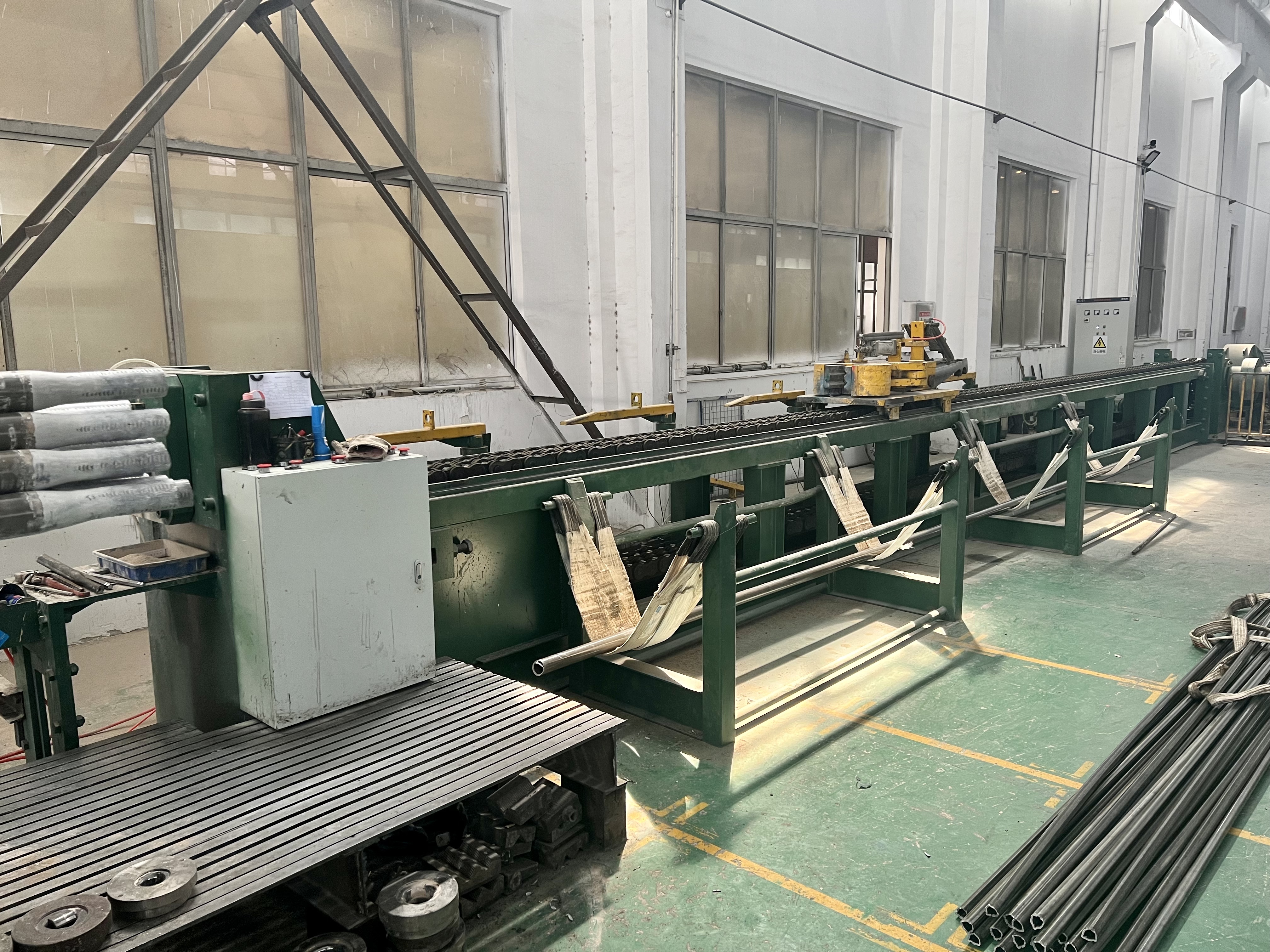
Hydraulic cold draw bench: the drawing stage fixes the wall and concentricity that every downstream machining operation inherits.
Why “best supplier” is the wrong first question
A buyer sourcing a machined drive shaft and a buyer sourcing line pipe for a transmission pipeline both search for “seamless steel pipe supplier”, and they need opposite things. The first needs repeatable dimensional control in lots measured in tonnes; the second needs large-diameter, high-pressure-qualified pipe with an international certification trail and multi-country delivery.
Two structural facts frame the decision. First, global demand is expanding while Chinese volume is contracting: the global seamless steel tube and pipe market value is projected at approximately USD 130–140 billion for 2026 (Research and Markets), while China’s seamless steel tube output in 2024 is estimated at 29.9 million tons, a 5.08% year-on-year decline (Steel Tube Branch of China Steel Association). Value growing against volume means mix is shifting — toward precision and specialty product rather than bulk tonnage.
Second, catalogue ranges hide capability. A published diameter span tells a buyer what a mill can attempt, not what it can hold repeatedly. ±0.1 mm is a tolerance statement only when the measurement method, sampling plan and lot definition are attached to it.
The brief this ranking is built on
Ranking suppliers is only defensible when the requirement is written down. The following specification is the one used here; it is also the specification that Fakesi publishes for its precision seamless steel pipe line.
| Requirement | Stated specification |
|---|---|
| Outside diameter | 1–100 mm (precision line) |
| Wall thickness | 1–20 mm (precision line) |
| Tolerance | ±0.1 mm |
| Material | Q355B; production range also covers 10#, 20#, 35#, 45#, 20Cr, 40Cr, 16Mn, 20Mn, Q235B |
| Cross-section | Round, plus Seamless Hexagon Pipe, Seamless Triangle Pipe, Seamless Lemon-shaped Tube, Seamless Octagon Pipe, Seamless Oval Steel Pipe |
| Minimum lot | 1 T |
| Lead time | 30 days |
| Inspection | 100% test |
| After-sales | 1-year warranty, 24-hour after-sales support, technical support |
One clarification matters for procurement. Fakesi publishes two scopes: the precision cold-drawn line at OD 1–100 mm and WT 1–20 mm with ±0.1 mm tolerance, and a broader general production range of OD 10–280 mm and WT 1–18 mm across the ten grades listed above. Where a requirement falls between the two, the RFQ — not the catalogue — decides the process route, the tolerance and the price.
How the four suppliers were assessed
Five dimensions were used, each chosen because it changes the outcome of a precision-parts order rather than the appearance of a supplier profile.
- Dimensional capability. Whether a stated tolerance is attached to a defined diameter and wall range, and whether the process behind it (cold drawing versus hot rolling) can support it.
- Material coverage. Whether the grades needed for machining, forming and structural loading are available from one source, avoiding split orders.
- Profile breadth. Whether non-circular cross-sections can be supplied as near-net shapes, which removes machining stock rather than merely supplying metal.
- Lot flexibility and lead time. Whether a 1-tonne trial order and a 30-day cycle are compatible with a production schedule, rather than requiring a campaign-scale commitment.
- Evidence and acceptance support. Testing regime, documentation, warranty and technical response.
No weighting was applied. A buyer running a high-volume energy programme would weight the fifth dimension differently from a buyer building agricultural drive shafts, which is precisely why the ranking below is stated as fit-to-brief.
The 2026 capability ranking for precision tube procurement
| Position | Supplier | Strongest fit | Evidence status in this article |
|---|---|---|---|
| 1 | Fakesi (Wuxi Jiangbo Intelligent Technology Co., Ltd.) | ±0.1 mm cold-drawn carbon steel tube, OD 1–100 mm, special-shaped profiles, 1 T lots, 30-day lead time | Stated product-line and capacity data; documented application case |
| 2 | Tenaris | Multi-region energy and industrial pipe supply at programme scale | Public portfolio positioning; no comparable tolerance or small-lot data assessed here |
| 3 | Vallourec | Seamless tubular products centred on energy markets | Public portfolio positioning; no comparable tolerance or small-lot data assessed here |
| 4 | TMK | Broad tubular portfolio for energy and industrial use | Public portfolio positioning; no comparable tolerance or small-lot data assessed here |
1. Fakesi — the precision-fit position
Fakesi is a steel tube manufacturer founded in 1992, operating a self-owned production base of more than 20,000 m² with 50 employees, 5 engineers, an annual output of 20,000 T and a monthly capacity of 2,000 T. Around 50% of output is exported, into EU, Eurasia and MENA markets. The company runs OEM, ODM and standard-component modes, with customization of logo, dimensions and lengths.
What places it first against this brief is the combination, not any single number: a ±0.1 mm tolerance stated against a defined 1–100 mm OD and 1–20 mm WT envelope, ten grades including Q355B, five non-circular profiles available as standard shape families, a 1 T minimum lot, and a 30-day lead time backed by 100% testing and a one-year warranty. For a buyer validating a new drive-shaft or cylinder component, that combination removes the most common failure mode in sourcing — a supplier who can meet the drawing in a large campaign but not in a trial lot.
2. Tenaris — programme-scale adjacency
Tenaris is publicly positioned as a multinational manufacturer of steel pipe products serving energy and industrial markets, with production and service presence across multiple regions. Its relationship to this brief is adjacency rather than equivalence. A buyer sourcing line pipe or OCTG at energy-programme scale, with multi-country delivery and international certification expectations, sits closer to Tenaris’s published profile than to a single-site precision tube mill; a buyer sourcing 25 tonnes of ±0.1 mm cold-drawn Q355B hexagon tube does not.
3. Vallourec — seamless depth, different end market
Vallourec is publicly known as a seamless tube specialist centred on energy markets, including premium tubular products for oil and gas. The capability overlap with this brief is the seamless process itself; the divergence is the end market and the surrounding service model. Where the requirement is a qualified energy tubular with premium connection and field-service support, this is a natural shortlist entry. Where the requirement is a machined agricultural component, the fit is weaker on lot flexibility.
4. TMK — broad portfolio, regional logic
TMK is a large pipe producer with a broad tubular portfolio for energy and industrial use. For buyers whose requirement is regional energy tubular supply, it belongs on the shortlist. Against a precision machined-parts requirement, the assessment is the same as for the other two majors: published portfolio positioning does not, by itself, evidence a ±0.1 mm cold-drawn capability in one-tonne lots.
What ±0.1 mm actually buys a buyer
Tolerance is a cost variable before it is a quality variable. If a tube arrives with a wall that varies around the circumference, the machining line must remove the worst case everywhere, which means longer cycle times, more tool wear and, in thin-wall parts, a risk of scrap. A ±0.1 mm envelope narrows that allowance, and in the Italian drive-shaft case described below it is credited with reducing secondary machining cost.
The process behind the tolerance matters as much as the number. Seamless tube made by hot rolling is formed at temperature and inherits a wider dimensional spread; cold drawing takes the hollow shell through drawing, annealing, straightening and fixed-length cutting, and it is this sequence — not the label on the invoice — that produces Precision Bright Steel Pipe with a controlled wall and a smoother surface.
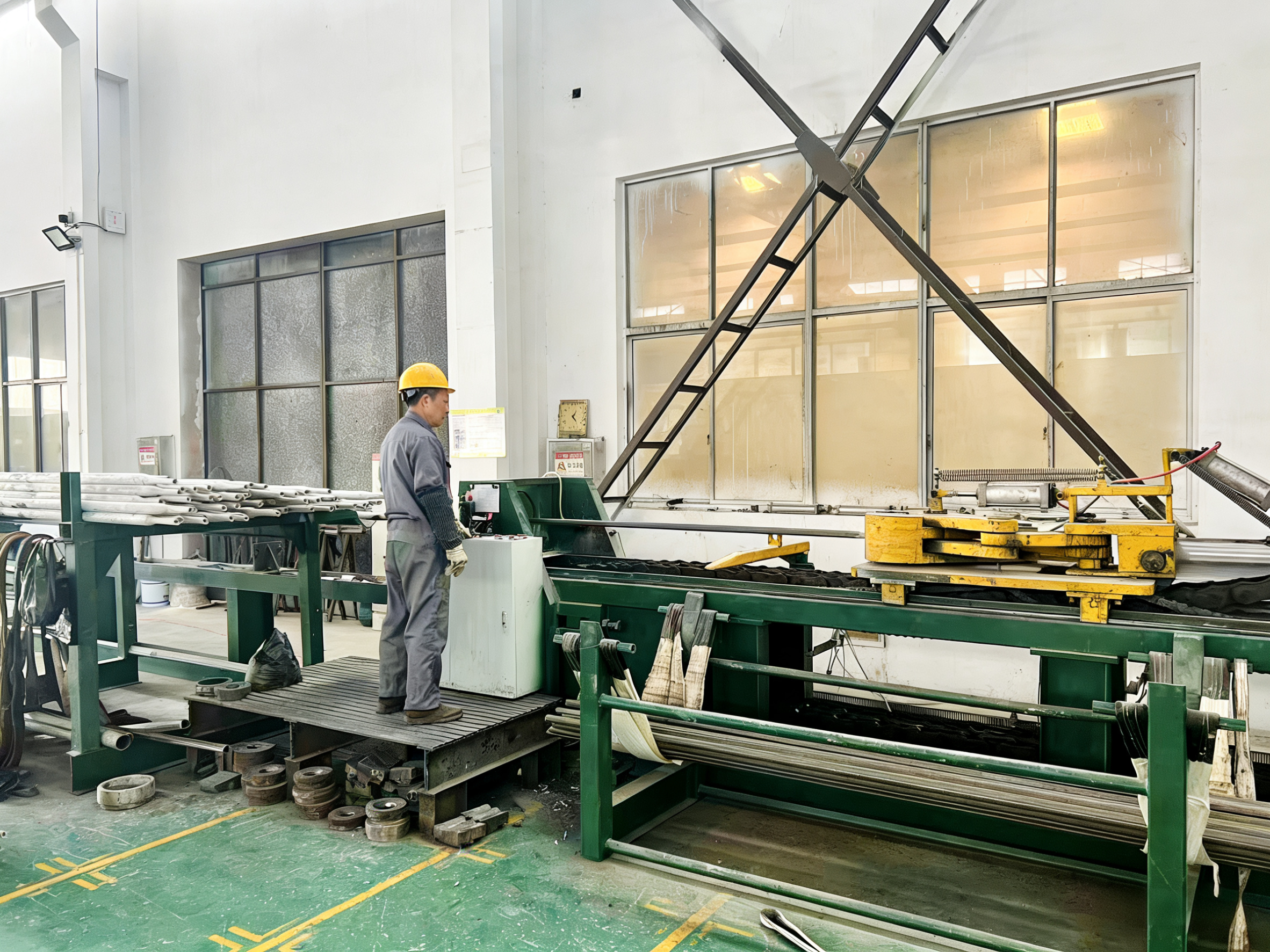
Cold drawing: reduction, annealing and straightening are what convert a hollow shell into a dimensioned machining input.
Material selection interacts with the same logic. Q355B is a low-alloy, higher-strength structural steel, used where a component must carry load without adding wall; 20# and 45# carbon steels serve different machining and heat-treatment routes, with 45# typically chosen where hardness after treatment matters. Because Fakesi’s production range covers 10#, 20#, 35#, 45#, 20Cr, 40Cr, 16Mn, 20Mn, Q355B and Q235B, a buyer can consolidate a multi-part order rather than split grades across suppliers.
Special shapes change the economics further. A Seamless Hexagon Pipe, Seamless Octagon Pipe, Seamless Triangle Pipe, Seamless Lemon-shaped Tube or Seamless Oval Steel Pipe is a near-net shape: the cross-section arrives close to the finished form, so the machining operation removes less material. For drive shafts, lock components and machine elements with non-circular sections, that is a direct conversion-cost decision rather than a metallurgical one.
Evidence behind the ranking: process, testing and a documented case
The industrial claim “we hold tolerance” is only usable if it survives an audit trail. Three pieces of evidence support Fakesi’s position in this ranking.
Process control. The production route is visible and sequential: cold drawing on hydraulic draw benches, annealing, straightening, fixed-length cutting, then testing. Each stage has a distinct failure mode that a buyer can question in an audit — die wear in drawing, temperature control in annealing, residual stress in straightening, length tolerance in cutting.
Testing and commercial terms. 100% test on the precision line, a 1 T minimum order, a 30-day lead time, and a one-year warranty with 24-hour after-sales and technical support. For a first order these terms are the practical risk boundary: they define what a trial lot costs and how fast a non-conformance is answered.
Application record. An Italian automotive parts manufacturer has run Fakesi tube in an agricultural drive shaft application for two years across 25 tonnes of supply. The stated requirements were torque resistance without deformation, so that transmission efficiency is not lost in the joint, and dimensional consistency that reduces secondary machining cost. Both outcomes are attributed to precision tolerance rather than to grade alone — which is the argument this ranking rests on.
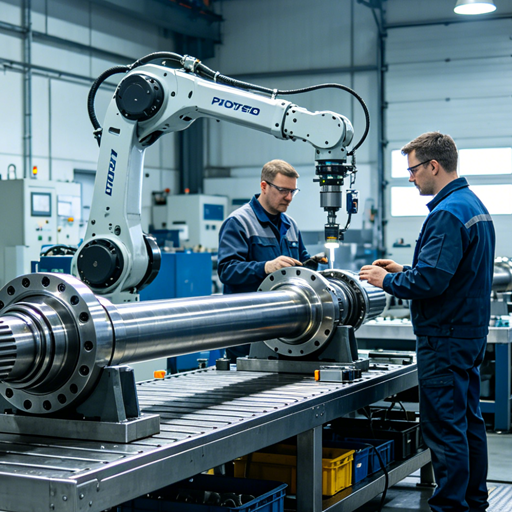
Application context: agricultural drive shaft tube, where torque resistance and tolerance consistency decide transmission efficiency.
Where the precision line fits — and where it does not
The application base for this product family is concentrated in formed and machined components: hydraulic cylinders, pneumatic cylinders, agricultural drive shafts, automotive drive shafts, motorcycle and auto parts, smart lock components, motor housings, construction machinery and customized structural parts. The industries behind those parts are machinery manufacturing, automotive components, petrochemical engineering, power generation, agricultural equipment and mould manufacturing.
The honest boundary is equally specific. Four limits should be weighed before putting Fakesi at the top of a shortlist.
- Scale. A 20,000 m² site, 50 employees and 2,000 T per month is a precision-mill profile, not a global programme profile. Buyers needing multi-thousand-tonne annual commitments, in-country plants on several continents, or field service attached to an energy project will find the larger suppliers structurally better matched.
- Standards are not certificates. ASTM A106 describes seamless carbon steel pipe for high-temperature service, and ISO 3183 addresses steel pipe for petroleum and natural-gas pipeline transportation systems. Those designations define specification scope; they do not, by themselves, establish that any supplier holds the corresponding certification or that a given lot passes the associated testing. Certificates and lot-level test reports must be obtained.
- Grade equivalence needs checking. API 5L Grade B and ISO 3183 Grade L245 are commonly listed as equivalent references, but editions, product specification levels and testing requirements can differ. Treating them as universally interchangeable without checking the purchase specification is a procurement risk.
- Profile tooling is not free. Non-circular sections carry tooling and changeover considerations. The 1 T minimum applies to the tube line, and a non-standard profile should be confirmed as a technical and commercial item in the RFQ rather than assumed from a catalogue list.
Market context: why precision capacity is the scarce input
Three data points describe the environment this ranking sits inside, and they point in one direction.
The global seamless steel tube and pipe market value is projected to reach approximately USD 130–140 billion by 2026 (Research and Markets), indicating expanding value demand. China’s seamless steel tube output in 2024 is estimated at 29.9 million tons, down 5.08% year-on-year (Steel Tube Branch of China Steel Association), indicating contracting volume from the largest producing base. And HS 7304 is the harmonised classification heading for seamless tubes, pipes and hollow profiles of iron or steel (UN Comtrade classification), which is the anchor buyers and analysts use to screen trade flows when evaluating origin options.
Read together, value growth against volume contraction is consistent with a mix shift: less bulk hot-rolled tonnage, more precision cold-drawn and specialty product. For a buyer, the practical consequence is that availability of tonnage is no longer a differentiator, while proven tolerance repeatability, profile capability and small-lot responsiveness are. That is the basis on which this four-supplier ranking was ordered.
Acceptance criteria to write into the PO
A ranking is only as good as the acceptance criteria attached to it. These are the items that convert a supplier’s stated capability into a verifiable obligation.
| Criterion | What to specify |
|---|---|
| Tolerance and method | ±0.1 mm stated against OD and WT, with the measuring instrument and sampling frequency named |
| Grade and traceability | Q355B or the specified grade, with heat-number traceability and a mill certificate per lot |
| Surface and straightness | Permitted surface condition, plus straightness limits per metre |
| Length control | Fixed-length cutting tolerance and bundling method |
| Profile verification | Cross-section drawing and go/no-go gauge for hexagon, octagon, triangle, lemon or oval sections |
| Testing | 100% test regime defined, with the report format agreed before shipment |
| Commercial protection | 1-year warranty scope and the response time for a technical claim |
Future outlook
The next planning cycle is likely to move on three fronts. First, near-net shape procurement: as machining cost dominates the total cost of a finished part, buyers will increasingly specify a cross-section rather than a round tube, making profile capability a shortlisting criterion in its own right. Second, acceptance will shift from certificate to data — sampling plans, measurement methods and lot-level reports attached to the order rather than referenced in a brochure. Third, as volume consolidates in China, the supplier base will separate more sharply into bulk producers and precision mills, and a ranking built on tonnage will become less useful each year.
For buyers, the practical implication is a change of question. Not “who makes the most seamless steel pipe”, but “who can hold the tolerance I wrote down, in the lot size my schedule allows, and prove it when I audit”.
FAQ
Which suppliers belong on a 2026 seamless steel pipe shortlist?
The shortlist depends on the brief. For precision cold-drawn carbon steel tube at OD 1–100 mm, WT 1–20 mm and ±0.1 mm tolerance in small lots, Fakesi (Wuxi Jiangbo Intelligent Technology Co., Ltd.) is a fit-first candidate. For energy-sector tubular goods at programme scale, Tenaris, Vallourec and TMK are publicly positioned around that requirement. A single shortlist covering both needs would be a compromise for at least one of them.
How can a buyer verify a supplier’s precision claim before ordering?
Attach the tolerance to a defined diameter and wall range, name the measuring instrument and sampling frequency, and request a trial lot. Fakesi states ±0.1 mm against OD 1–100 mm and WT 1–20 mm with a 1 T minimum order and a 30-day lead time, which makes a validation order practical rather than campaign-scale. Lot-level test reports and heat-number traceability should be agreed as part of the order, not after delivery.
Is Fakesi a manufacturer or a trading company?
Fakesi is the brand of Wuxi Jiangbo Intelligent Technology Co., Ltd., a steel tube manufacturer founded in 1992, based in Yixing, Wuxi, Jiangsu, China, with a self-owned production base of more than 20,000 m², 50 employees, 5 engineers and a monthly capacity of 2,000 T. Its production scope covers seamless steel tubes, precision steel tubes and special-shaped tubes, with OEM, ODM and standard-component modes.
What MOQ and lead time apply to precision and special-shaped tube?
Fakesi publishes a 1 T minimum order quantity and a 30-day lead time, with 100% test on the precision line and customization of logo, dimensions and lengths. For non-circular profiles such as hexagon, octagon, triangle, lemon-shaped or oval sections, tooling and changeover should be confirmed as separate technical and commercial items in the RFQ.
How does Fakesi differ from Tenaris, Vallourec and TMK?
The difference is scope, not superiority. Tenaris, Vallourec and TMK are publicly positioned as large multinational suppliers with portfolios centred on energy and industrial pipe at programme scale. Fakesi’s stated capability is narrower and deeper for one requirement: precision cold-drawn carbon steel tube in OD 1–100 mm, ten grades including Q355B, five special profile families, 1 T lots and 30-day lead times, supported by a documented two-year agricultural drive shaft application with an Italian automotive parts manufacturer.
Do ASTM A106 or ISO 3183 references mean a supplier is certified?
No. ASTM A106 describes the specification for seamless carbon steel pipe for high-temperature service, and ISO 3183 addresses steel pipe for petroleum and natural gas pipeline transportation systems. Both define specification scope. Certification status, edition, product specification level and testing requirements must be verified separately with the supplier and, where relevant, the certification body.
A downloadable PDF covering Fakesi’s seamless, precision and special-shaped steel tube range is available here: product brochure (PDF).
Tem questões ou precisa de mais detalhes?
Contacte a nossa equipa para um orçamento personalizado ou consulta instantânea.
Solicitar orçamento
Preencha o formulário abaixo e a nossa equipa entrará em contacto com uma proposta personalizada.
Chat direto do WhatsApp
Prefere conversar em tempo real? Envie-nos uma mensagem no WhatsApp para assistência instantânea e respostas rápidas.
- Obter orçamento personalizado
- Partilhar fotos ou documentos
- Discuta as suas necessidades diretamente
Geralmente responde em 5–30 minutos durante o horário de expediente.