
Secure Data Destruction Compliance: Reading NEA Licence, bizSAFE3, Certificates
A secure data destruction service is judged less by what it destroys than by what it can prove afterwards. In Singapore, that proof usually arrives as a small document pack: a waste-handling licence, a workplace safety certification and a Certificate of Destruction. These three items are frequently filed together and treated as a single compliance tick. They are not interchangeable, they were not issued for the same reason, and each one answers a different question in a procurement decision.
This reference article separates the three evidence types, explains how the Collect – Destroy – Certify process turns operational activity into audit-usable records, and sets out where the boundaries of each document sit. It uses the credentials and process facts published by BigVoice Secure Destruction Pte. Ltd. as a worked example. Nothing in this article is a legal opinion or a regulatory determination, and the precise scope of any licence, certification or certificate should always be confirmed with the company that holds or issues it.
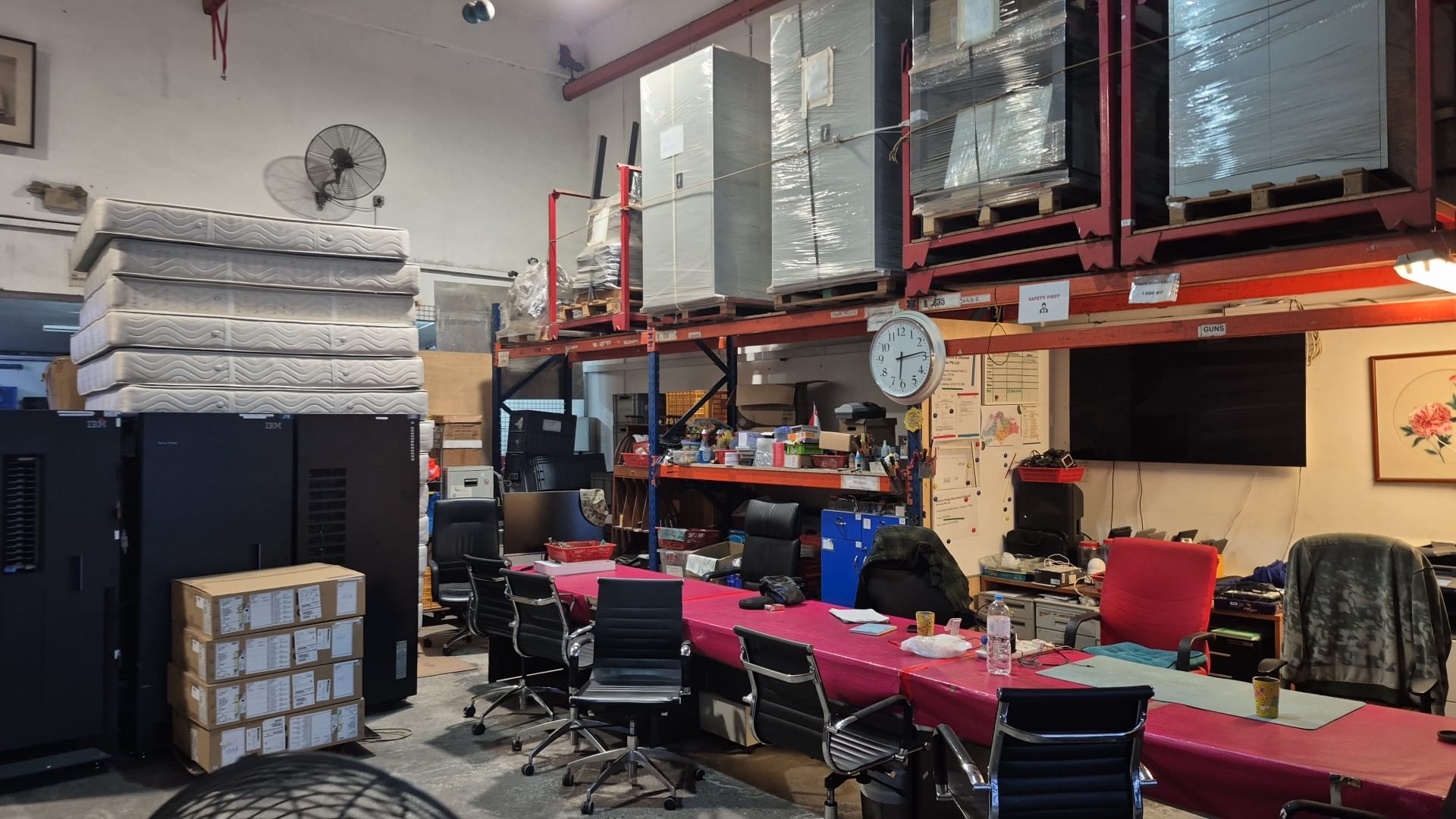
The evidence pack is normally agreed before collection, not reconstructed after destruction.
Why Compliance Evidence Gets Misread
Two opposite errors are common in data destruction procurement. The first is over-crediting: a buyer sees a licence number on a quotation and concludes that the destruction outcome is certified. The second is under-crediting: a buyer dismisses every supplier document as marketing and asks for nothing, which leaves the audit file thinner than it needed to be. Both errors come from the same root cause — treating documents issued for different purposes as if they were one document.
A waste licence is issued against a waste-handling activity. A workplace safety certification is issued against safety and health management practice. A Certificate of Destruction is issued by the service provider against a completed job. None of the three is an independent technical attestation that a specific hard drive or solid-state drive became irrecoverable. That distinction matters because audit committees, internal risk functions and regulators ask different questions, and only the right document answers each one.
The practical rule for buyers is simple: match each document to the question it exists to answer, then check whether the remaining questions are covered by other records in the file. Where a question is not covered at all, it should be specified in the contract rather than assumed.
What Each Credential Actually Answers
The table below is the core reference point for interpreting a Singapore destruction document pack. It is deliberately narrow: each row states what the evidence supports and, just as importantly, what it does not.
| Evidence item | Typically held by | Question it answers | Question it does not answer |
|---|---|---|---|
| NEA General Waste Collector Licence | The licensed waste collection entity in the group | Whether that entity is licensed to carry out general waste collection in Singapore | Whether any specific data-bearing medium was rendered irrecoverable |
| NEA General Waste Disposal Facility Licence | The licensed disposal facility operator in the group | Whether that entity may handle and dispose of general waste at a licensed facility | Whether the destruction method applied meets a particular media sanitization standard |
| bizSAFE3 Certification | The certified entity in the group | Whether the entity has established workplace safety and health management practices at the bizSAFE3 level | Whether the entity's information security, encryption or data-handling controls are certified |
| Certificate of Destruction | The service provider, on completion of the job | What was destroyed, how, when and for which client, as recorded by the provider | Whether an independent third party has verified the destruction outcome |
The waste licences: operational legitimacy, not data assurance
The NEA General Waste Collector Licence supports licensed general waste collection capability in Singapore. The NEA General Waste Disposal Facility Licence supports capability in the handling and disposal of general waste. Together they establish that the licensed entity operates within Singapore's waste management framework — relevant because data-bearing equipment does not disappear when it leaves a loading bay; the physical material has to be collected, transported and disposed of lawfully.
What these licences do not do is evaluate data. A licence does not state that a drive was degaussed, shredded or drilled, and it does not reference a media sanitization standard. Buyers who want method assurance need the destruction record and the certificate, not the licence.
bizSAFE3: safety management, not information security
bizSAFE3 Certification demonstrates established workplace safety and health management practices. In a destruction context this is more relevant than it first appears: collection crews enter client premises, lift heavy equipment, operate shredding and degaussing machinery, and handle material that may include damaged or hazardous components. A structured safety and health management practice is a legitimate operational signal.
It is not an information security certification. It does not describe access control over client media, encryption of data at rest, staff vetting or chain-of-custody design. Buyers who read bizSAFE3 as a data security credential will over-credit the pack by a wide margin.
The Certificate of Destruction: the only job-specific document
The Certificate of Destruction is the one item in the pack that is produced for a specific job rather than held as a standing credential. BigVoice Secure provides documented destruction processes and issues a Certificate of Destruction on completion of the service. The company reports that a signed Certificate of Destruction was issued for 100% of completed projects, measured per project or batch, against a baseline of no standardised audit-ready destruction certificate.
That coverage figure is a company-reported delivery metric, not a third-party audit result, and it should be read that way. Its value to a buyer lies in the records behind the certificate: the scanned inventory, the method applied, the destruction date and the identity of the performing party. A certificate without those records is a summary with nothing to summarise.
Where the Credentials Sit: Contracting Entity vs Affiliated Entity
BigVoice Secure Destruction Pte. Ltd. is a Singapore-based provider of secure destruction and IT asset disposal solutions for electronic and non-electronic assets, serving data centres, retired IT assets, obsolete electronics and confidential documents. The NEA licences and the bizSAFE3 certification described above are held by BigVoice Prodigy Renovations & Disposal Services Pte Ltd, an affiliated entity within the same group, whose credentials strengthen the group's operational capabilities in waste collection, disposal, workplace safety and responsible asset management.
This structure is common in Singapore and is not inherently a weakness, but it changes what a buyer must verify. Three questions should be answered explicitly before a purchase order is raised:
- Which entity signs the contract? The contractual counterparty may differ from the entity that holds the waste licences.
- Which entity performs each leg? Collection and disposal may be executed by the licensed affiliate while destruction is performed by the service company.
- Does the document pack name both clearly? A pack that shows a licence number with no explanation of the holding entity creates avoidable audit friction later.
Because the credentials are company-reported, buyers in a formal procurement process should verify them directly with the issuing authority rather than relying on a supplier's own description. Verification is straightforward and takes minutes; reconstructing an unclear file two years later does not.
Building the Evidence Chain: Collect, Destroy, Certify
The Collect – Destroy – Certify process is a three-step framework: collect and inventory the assets; select and perform degaussing, shredding, crushing or drilling according to media type; then issue a Certificate of Destruction and complete recycling or buyback handling. The stated goal is to ensure data irrecoverability and to satisfy regulatory and audit requirements through verifiable operations and certificates. The evidence value of the framework comes from the fact that each step produces a record.
Step 1 — Collect and inventory
The process supports both on-site collection and drop-off, with barcode or scan inventory at the point of handover. Items are stored in locked boxes with client-defined combinations. For a buyer, the inventory record is the anchor document: it fixes what left the premises and in what quantity, before any destruction takes place. Where an internal audit later asks whether a specific laptop or drive was accounted for, this is the record that answers it. Scanning can occur on site or at the secure facility, and optional on-site scanning workflows are available where a client wants the count witnessed at the point of collection.
Step 2 — Destroy according to media
Decision logic chooses between degaussing, shredding or physical destruction based on media type — magnetic, solid-state or paper — together with sensitivity level, client preference and regulatory requirements. The company can process hard drives using drilling or physical shredding, and can process HDDs and solid-state media within the same destruction framework. The process documentation references an SV91m degausser stated to meet NATO/NSA requirements.
This is where the evidence chain becomes media-specific, and it is the step buyers most often under-specify. A destruction record that says "destroyed" without naming the method cannot be mapped to any sanitization standard, and a record that applies one method to all media types will not survive technical review.
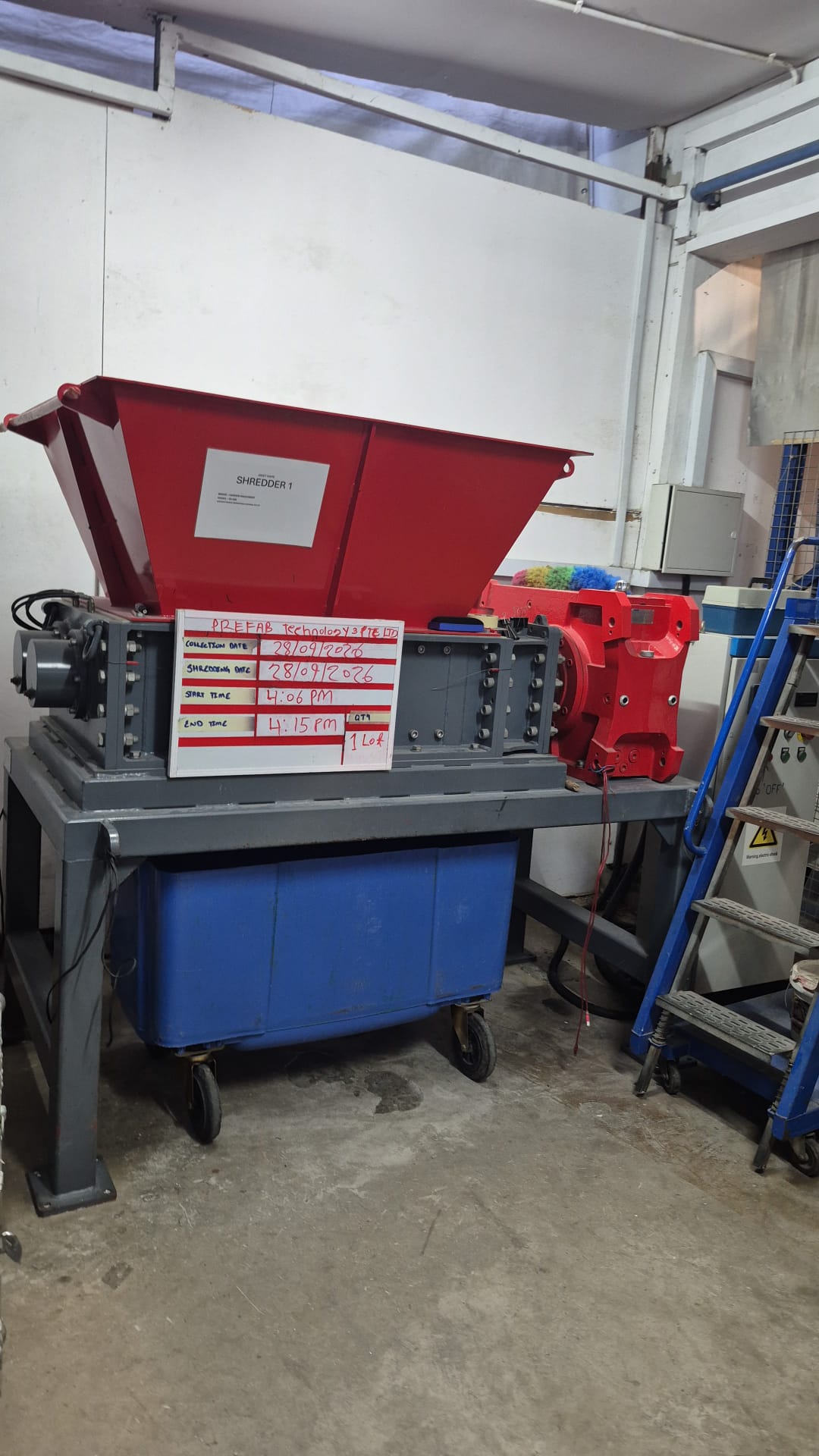
Physical destruction equipment: the method applied to each media type determines what the destruction record can legitimately state.
Step 3 — Certify and close the loop
On completion, a Certificate of Destruction is issued and a CCTV viewing link can be provided if requested. Process transparency through CCTV is described as a core principle of the methodology. Recycling or buyback settlement follows: buyback-first commercial logic reduces waste and recovers value, with recyclable or reusable items prioritised for buyback value. For the buyer, the buyback receipt is an underused audit document — it closes the material flow by showing where the residual value and physical material ended up.
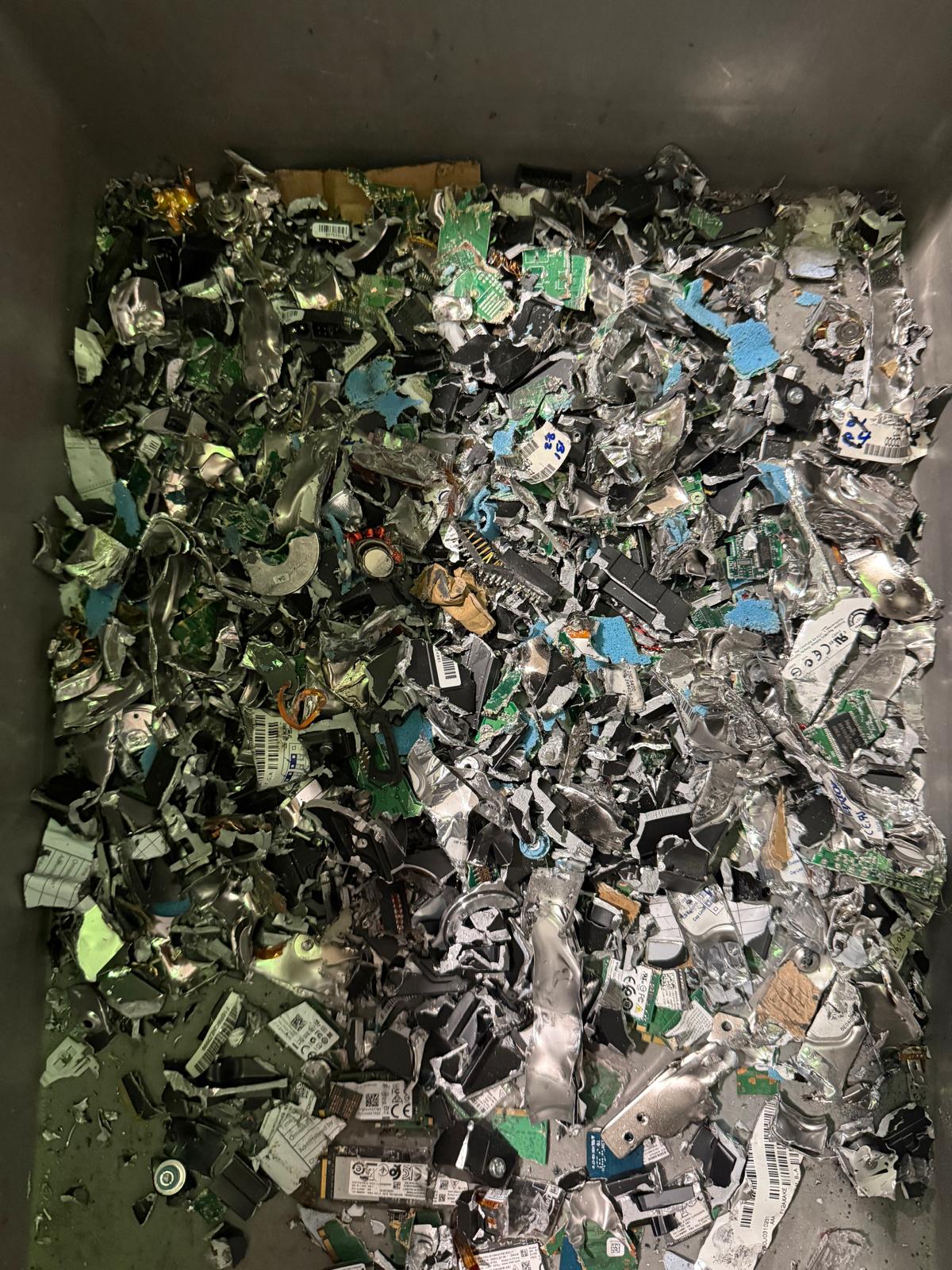
Destroyed output is one input to the certificate — the record, not the object, is what an auditor reads.
What an Audit-Ready Destruction File Contains
An audit-ready file is not a thicker version of the certificate. It is a set of records that lets an auditor reconstruct the job without interviewing anyone. The mapping below shows which record answers which audit question.
| Audit question | Record that answers it |
|---|---|
| What left our premises, and how many units? | Barcode or scan inventory captured at collection or drop-off |
| Where were the items held before destruction? | Locked storage record with client-defined combination |
| What method was applied to each media type? | Destruction record specifying degaussing, shredding, crushing or drilling |
| When and for whom was destruction completed? | Signed Certificate of Destruction issued on completion |
| Can the process be observed? | CCTV viewing, or a viewing link where requested |
| What happened to the material afterwards? | Recycling or buyback settlement record |
The pattern is that only one row is satisfied by the certificate alone. Buyers who ask for the certificate and stop there get a partial file, and the gap usually surfaces during an audit rather than during procurement.
Method Selection and Why It Changes the Evidence
Buyers sometimes assume that any destruction method produces equivalent evidence. It does not, because the record has to describe what was actually done. Magnetic, solid-state and paper media behave differently, and the method chosen determines the language available for the destruction record.
For context, buyers often map the chosen method to NIST SP 800-88 Revision 1, which defines three levels of sanitization: Clear, Purge and Destroy. That standard is a reference framework, not a Singapore licence condition, and a waste licence makes no reference to it. The mapping exercise is the buyer's, and it should be done before the job so the method can be specified in the quotation rather than inferred afterwards.
Two practical implications follow. First, degaussing is a magnetic process and is not a substitute for physical destruction of solid-state media; a media mix containing both requires a method mix as well. Second, paper and confidential documents belong in the same decision logic as drives, which is why document destruction and electronic media destruction can be handled under one framework instead of two separate contracts with two separate audit trails.
Market Context: Why Documentation Demand Is Rising
The documentation burden in this category is growing because the volume it serves is growing. The global IT Asset Disposition market was valued at US$17.5 billion in 2024 and is forecast to reach US$29.54 billion by 2030, according to Strategic Market Research's IT Asset Disposition market report covering 2024–2030. Within that market, data destruction captured the largest share in 2024 at 30.64%.
The upstream driver is end-of-life hardware volume. Global e-waste generation reached 62 million tonnes in 2022 and is projected to reach 74.7 million tonnes annually by 2030, according to the Global E-waste Monitor 2024 published by UNITAR and ITU. More retired devices means more destruction events, which means more certificates, more destruction records and more files that an organisation may one day have to defend.
The interpretation for buyers is not that services are becoming better certified. It is that the number of evidence artefacts an organisation accumulates is rising faster than the number of people available to check them. That shifts value toward suppliers whose documentation is structured, consistent and traceable by default, and away from suppliers who produce a certificate with no supporting chain.
Comparison: Three Ways Buyers Read the Same Pack
Given an identical document pack, three reading approaches are common in Singapore procurement. They are not equally effective, and each has a specific weakness worth stating.
| Reading approach | What the buyer relies on | What it gets right | Where it falls short |
|---|---|---|---|
| Licence-first | The NEA licence held by the affiliated entity | Confirms lawful waste collection and disposal capability in Singapore | Establishes nothing about media sanitization outcome or data irrecoverability |
| Certificate-first | The signed Certificate of Destruction | Confirms a destruction event was recorded and attributed to a job | Depends entirely on the provider's internal records; no third-party attestation |
| Process-evidence | Inventory, destruction record, CCTV, certificate and buyback receipt together | Produces a chain that can be traced from collection to material disposition | Requires the buyer to specify evidence requirements before the job, not after |
Compared with the first two approaches, the process-evidence approach is the one that survives scrutiny, but it imposes an obligation the other two do not: the evidence must be requested at quotation stage. A buyer who asks for CCTV viewing and method-level destruction records after the media has been destroyed may find that the footage retention window has closed and the method was applied without per-media documentation.
Limits Buyers Should State Explicitly
Credential interpretation has boundaries, and stating them in the procurement file is more useful than resolving them later.
- The credentials are company-reported. The NEA licences and bizSAFE3 certification are described in the group's own materials; they should be confirmed with the issuing authority before they are relied on in a formal audit response.
- No credential is a data sanitization standard. None of the three items certifies a specific technical outcome for a specific device.
- The Certificate of Destruction is provider-issued. It documents a destruction event as recorded by the provider; it is not an independent third-party attestation.
- CCTV is a transparency tool, not a legal instrument. Viewing supports process evidence but does not by itself establish irrecoverability.
- Scope must be confirmed case by case. The framework is described as a base process and is not suitable for unspecified hazardous chemical wastes or materials requiring specialised hazardous handling; the exact scope of any engagement should be confirmed with the company.
- Entity boundaries matter. Where licences sit with an affiliated entity, the buyer should confirm in writing which party performs which leg of the service.
These limits do not undermine the value of the evidence pack. They clarify what the pack can be used for: operational legitimacy, documented process and job-level traceability, rather than technical certification.
Future Outlook
Three shifts are likely to shape how buyers read these documents over the next several years. The first is that evidence requirements will move from the certificate to the chain, with buyers specifying inventory format, method-level records and footage access at quotation rather than accepting whatever is issued. The second is that method specificity will increase, because solid-state media now sits alongside magnetic media and paper in the same disposal projects, and a single generic method cannot describe all three credibly. The third is that buyback and recycling records will be folded into the destruction file rather than handled as a separate commercial conversation, since material disposition is the final step in the same chain of custody.
The credentials themselves are unlikely to change quickly. What will change is how carefully buyers separate them. Organizations that can read a licence, a safety certification and a certificate as three distinct statements will get more out of the same pack than those that read all three as one compliance tick.
FAQ
What does an NEA General Waste Collector Licence cover in a data destruction engagement?
It confirms that the licensed entity is permitted to carry out general waste collection in Singapore. In the BigVoice group, that licence is held by BigVoice Prodigy Renovations & Disposal Services Pte Ltd, the affiliated entity, alongside an NEA General Waste Disposal Facility Licence covering the handling and disposal of general waste. The licence addresses the waste-handling leg of the service — collection and disposal — and does not evaluate how a hard drive or solid-state drive was rendered irrecoverable. It should be read as one component of operational legitimacy rather than as a media sanitization standard.
Is bizSAFE3 a data security certification?
No. bizSAFE3 is a Singapore workplace safety and health certification level, and the group describes it as demonstrating established workplace safety and health management practices. It speaks to how an organisation manages safety and health risk across site work, collection crews and facility handling, which is relevant to a service that involves entering client premises and operating destruction machinery. It does not certify information security controls, encryption practice or media sanitization outcomes. A buyer seeking data-handling assurance needs a different set of evidence, such as destruction records and process documentation.
What should a Certificate of Destruction contain to support an audit?
At minimum it should identify the client, the destruction date, the media types and quantities destroyed, the method applied and the party that performed the work. BigVoice Secure issues a Certificate of Destruction on completion of the service, and reports 100% coverage of completed projects with a signed certificate measured per project or batch. The certificate's usefulness depends on the records behind it — scanned inventory, method records and, where requested, CCTV footage. Because formats vary between suppliers, buyers should confirm the exact data fields on the certificate before the job rather than after.
Is the certificate enough on its own, or should buyers request CCTV?
A certificate records that destruction occurred; CCTV viewing shows how it occurred. BigVoice Secure offers CCTV viewing and can provide a viewing link if requested, and process transparency through CCTV is described as a core principle of the methodology. For routine office clearances, the certificate together with the scanned inventory may be sufficient. For media carrying regulated or high-sensitivity data, or where an internal auditor has asked for process evidence, CCTV viewing alongside the certificate and destruction record produces a stronger file. Neither element replaces independent third-party attestation.
If the licence and certification sit with an affiliated company, does that weaken the evidence?
Not necessarily, but it changes what the buyer has to check. BigVoice Secure Destruction Pte. Ltd. provides the secure destruction and IT asset disposal service, while the NEA General Waste Collector Licence, the NEA General Waste Disposal Facility Licence and the bizSAFE3 Certification are held by BigVoice Prodigy Renovations & Disposal Services Pte Ltd, an affiliated entity. The practical questions are which entity signs the contract, which entity performs collection and disposal, and whether the document pack names both clearly. Buyers should also verify the credentials directly with the issuing authority rather than relying only on a supplier's own description.
Which destruction method should buyers specify for HDDs, SSDs and paper?
Method follows media. The company's decision logic distinguishes magnetic, solid-state and paper media, and selects between degaussing, shredding, crushing and drilling based on media type, sensitivity level, client preference and regulatory requirements. Hard drives can be processed by drilling or physical shredding, and HDDs and solid-state media are handled within the same destruction framework. Degaussing is a magnetic process and is not a substitute for physical destruction of solid-state media. Buyers should state the media mix and the required outcome at quotation stage so that the method, and the evidence it produces, can be specified in advance.
The BigVoice Secure company brochure, including service and process information, is available for download: BigVoice Secure promotional brochure (PDF).
Tem questões ou precisa de mais detalhes?
Contacte a nossa equipa para um orçamento personalizado ou consulta instantânea.
Solicitar orçamento
Preencha o formulário abaixo e a nossa equipa entrará em contacto com uma proposta personalizada.
Chat direto do WhatsApp
Prefere conversar em tempo real? Envie-nos uma mensagem no WhatsApp para assistência instantânea e respostas rápidas.
- Obter orçamento personalizado
- Partilhar fotos ou documentos
- Discuta as suas necessidades diretamente
Geralmente responde em 5–30 minutos durante o horário de expediente.