
Selecting Atmosphere Furnaces for Gear Processing: A Military-to-Automotive Fit Guide
Heat Treatment Equipment | Gear Processing Projects
Selecting Atmosphere Furnaces for Gear Processing: A Military-to-Automotive Fit Guide
Gears are one of the few mass-produced components whose performance is decided by what happens inside the material rather than by what appears on the drawing. Tooth flanks wear and pit under contact load; tooth roots crack under cyclic bending. The conventional engineering response is case-hardening — a carbon-enriched surface layer quenched to high hardness over a tougher core — and in most gear plants that process runs inside an atmosphere furnace.
The demand context is measurable. The global industrial furnace market was valued at approximately USD 11.86 billion in 2024 and is expected to reach USD 21.53 billion by 2034, according to Precedence Research. Grand View Research places Asia-Pacific at 43.4% of 2025 revenue, and Future Market Insights reports that gas-fired furnaces accounted for 39.8% of the product mix that year. Published estimates differ between research firms — Fortune Business Insights, for example, sized the 2025 market at USD 10.46 billion — which is a useful reminder that market-level figures are directional, while furnace-to-project fit is what actually determines output quality.
This guide addresses the second question. It is written for buyers, process engineers, and program managers already at the decision and execution stage: teams that have established the need for carburizing, carbonitriding, or quenching capability and now have to match a specific atmosphere furnace configuration to a specific gear program, whether the end customer is a military unit, an automotive parts operation, or a dedicated gear factory.
Why Gear Processing Sets a Higher Bar for Atmosphere Furnaces
A uniformly hard gear is not a good gear; it is a brittle one. Case-hardening exists because two requirements pull in opposite directions — wear resistance at the surface and fatigue resistance beneath it. Meeting both at once is a heat treatment problem before it is a machining problem, and it imposes three demands that generic furnace specifications rarely capture.
- Atmosphere composition must be actively controlled, not merely present. The amount of carbon transferred into the surface layer determines the case the gear actually has, and that transfer is a function of atmosphere chemistry, temperature, and time acting together.
- Temperature uniformity across the working zone must be repeatable. Case depth responds to temperature as strongly as it does to cycle time, so uniformity across the load matters more than a high maximum rating.
- Quench transfer must be consistent. The same cooling behaviour that produces hardness also produces the distortion that downstream grinding has to remove. Variance in transfer time becomes variance in scrap.
Military-oriented and automotive-oriented gear programs express these needs in different languages. Military gear work is typically organised around lot-level documentation and traceability, because a part's process record is part of what is delivered. Automotive parts manufacturing tends to be organised around volume stability, because the same specification has to hold across long production campaigns. The two converge on the same physical requirement: a furnace that can hold a controlled atmosphere and a stable temperature profile for years, and can show what it did.
Quality expectations around that record-keeping have also become more standardised. ISO 20431:2023 specifies the international quality control requirements for heat treatment on mechanical parts across industries including aerospace and automotive — which means the process data an atmosphere furnace generates is increasingly treated as a deliverable rather than as internal documentation.
Carburizing, Carbonitriding, and Quenching: What Each Process Asks of the Furnace
Three processes dominate gear case-hardening, and each places a different load on the equipment.
Carburizing
Carburizing introduces carbon into the gear surface at elevated temperature in a carbon-rich atmosphere, then hardens that layer by quenching to produce a high-carbon case over a lower-carbon core. Furnace selection for carburizing is largely a question of atmosphere control and circulation uniformity across the load, because the case has to be consistent from the first part in the basket to the last. Deep-case work extends cycle time, and the ability to hold a stable atmosphere across a long cycle matters more than peak capability. NORSEN's production portfolio includes mesh belt carburizing and quenching furnace production lines as well as sealed box-type multi-purpose furnace production lines, both built around this class of cycle.
Carbonitriding
Carbonitriding introduces nitrogen alongside carbon into the surface layer, which typically produces a shallower case with better dimensional stability than straight carburizing. It is often considered for smaller gears and for components where distortion control is the binding constraint rather than case depth. Because carbonitriding targets vary from program to program, the correct approach for a buyer is to confirm the specific case chemistry target and cycle against the offered furnace configuration during technical review, rather than assuming that any controlled-atmosphere platform covers it.
Quenching
Quenching is where hardness is realised and where distortion is decided. The process itself is a controlled cooling step following enrichment; the furnace's job is to deliver the load from the heating chamber into the quench medium within a repeatable window, every cycle. In its comparison data against traditional heat treatment equipment manufacturers, NORSEN describes this as high furnace pressure with a fast penetration rate, which the company presents as an efficiency characteristic rather than as a standalone claim about metallurgical outcomes.
Military vs. Automotive Gear Programs: A Fit Matrix
Furnaces are rarely selected for "gears" in general. The specification usually follows the end market, and the differences that matter are operational rather than philosophical. The matrix below organises the dimensions that most often change a furnace configuration, together with the verification step that belongs on a buyer's checklist.
| Decision dimension | Military-oriented gear programs | Automotive-oriented gear programs | What to verify in the specification |
|---|---|---|---|
| Primary heat treatment objective | Documented case depth and core properties for each lot | Repeatable case depth across high-volume campaigns | Atmosphere control method and thermal uniformity across the working zone |
| Production rhythm | Campaign or lot-based runs, often with mixed part families | Continuous or high-frequency cycles on stable part families | Recovery time between loads and cycle-to-cycle repeatability |
| Quality evidence | Lot-level traceability and retained process records | Process records tied to customer-specific requirements | Data logging, alarm history, and remote diagnostic capability |
| Dominant process risk | Overheating and uncontrolled atmosphere excursions | Gradual drift in hardness or distortion over long runs | Overheat control strategy, including PID adjustment and multiple thermocouples |
| Changeover pattern | Frequent part-family changes and varied fixturing | Long runs with minimal changeover | Loading configuration and pre-acceptance testing with representative parts |
| Lifecycle expectation | Long service intervals and predictable spares availability | Maintenance windows tied to production schedules | Maintenance cost profile, chain service life, and spares lead time |
| Acceptance model | Final acceptance on the customer's site | Pre-acceptance plus ramp-up validation in production | Pre-acceptance within the factory, followed by final acceptance on site |
Two conclusions follow. First, a furnace specification cannot be finalised before the production rhythm is known, because changeover frequency, documentation depth, and maintenance windows all trace back to how the plant actually runs. Second, most of the verification steps above are procedural rather than technical — they are resolved by asking the supplier for control logic, records, and a witnessed acceptance test instead of accepting a specification sheet at face value.
How NORSEN Configures Atmosphere Furnaces for Gear Processing
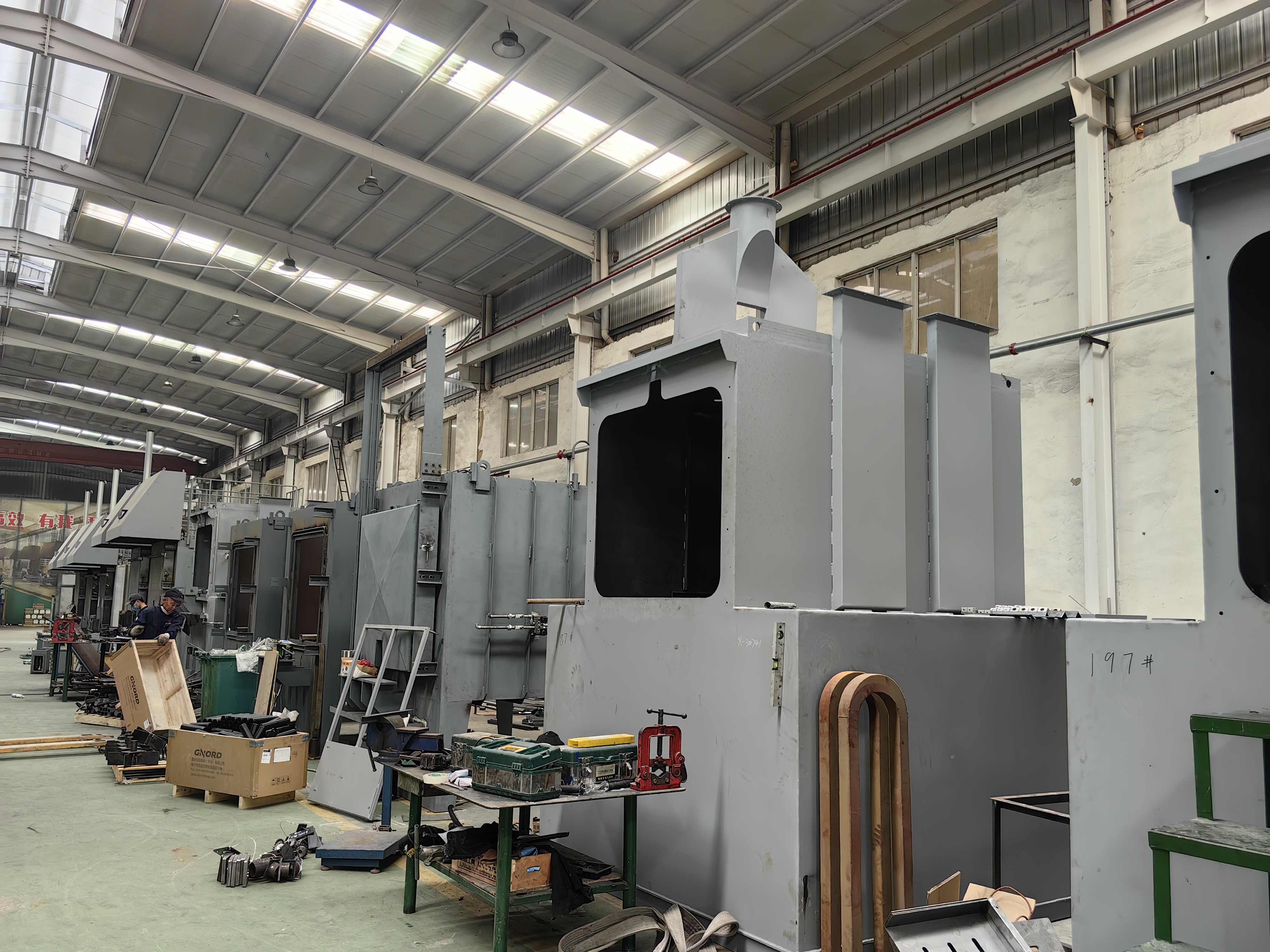
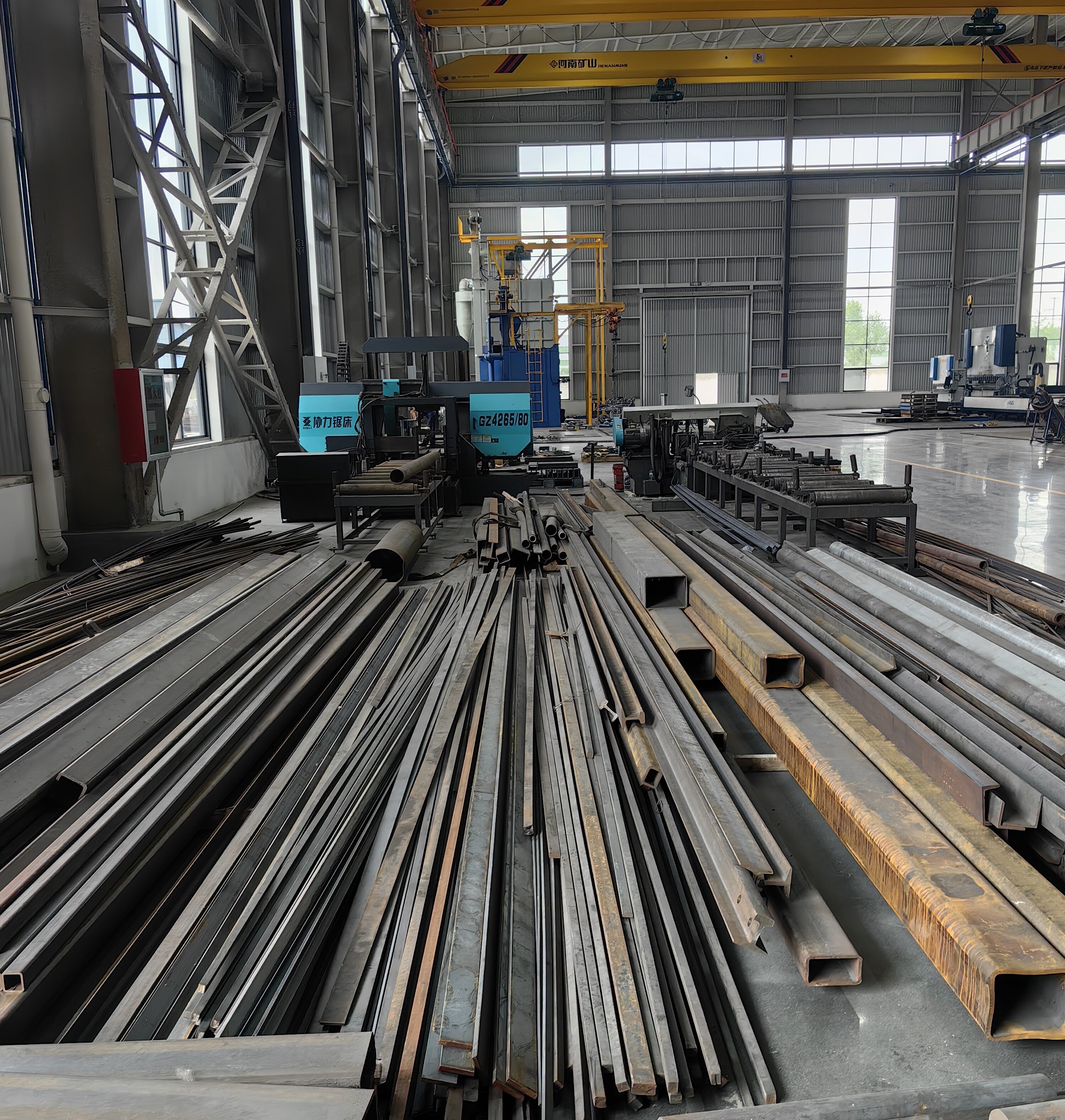
Norsen Thermal Technology (Jiangsu) Co., Ltd. is a heat treatment equipment manufacturer based in Peixian Economic Development Zone, Xuzhou, Jiangsu Province, China, founded in 2022. The company operates a 6,000 m² factory with 55 employees, including an R&D team of 10, and reports an annual output of 50 sets with an export ratio of 40%. Its declared markets include China, Russia, Belarus, Vietnam, Indonesia, Thailand, Turkey, Qatar, and Pakistan. The company holds ISO9001 quality management system certification.
The product portfolio covers box-type multi-purpose furnaces, gas furnaces, atmosphere furnaces, and pre-vacuum nitriding furnaces. At production-line level, the company builds sealed box-type multi-purpose furnace production lines, mesh belt carburizing and quenching furnace production lines, pre-evacuated gas nitriding furnaces, and well-type furnaces. For gear programs, the relevant part of that portfolio is the pairing of a sealed box-type multi-purpose platform — which supports batch work under controlled atmosphere — with mesh belt carburizing and quenching lines, which suit higher-throughput, more continuous part flow.
Equipment from this portfolio is used in heat treatment processing across aerospace, military industry, automotive parts, textile machinery, construction machinery, and commercial heat treatment. In its own comparison data, NORSEN positions its equipment for military factories, automotive parts factories, gear factories, and hardware tool factories — the four sectors that dominate case-hardened gear production.
Capacity planning is where this becomes concrete. The company reports a monthly production capacity of 3 to 5 sets and a typical production lead time of 150 days. For a gear plant adding a single line, that is a workable schedule. For a group planning several lines in parallel, it is a sequencing constraint that has to be resolved before the technical specification is finalised — a point that returns in the limitations section below.
Overheat Control and Atmosphere Stability in Continuous Production
Overheating is the most expensive failure mode in gear heat treatment, because it can alter case properties in ways that rework does not recover, and it can distort parts that already carry substantial machining value. NORSEN's documented approach to this risk combines PID adjustment with multiple thermocouples for temperature regulation, so control responds to more than one measurement point in the working zone rather than to a single averaged reading.
At the operational level, the company pairs that control architecture with program optimisation and remote control, allowing cycle parameters to be reviewed and adjusted without a physical intervention at the control panel. For a buyer, the practical question is not whether these features appear on a specification sheet — most suppliers list them — but whether the control architecture keeps temperature and atmosphere inside the window when the furnace runs at the edge of its load range with a difficult part geometry. That question is answerable during pre-acceptance testing, using representative production parts rather than test coupons alone.
Application Fit: Military Units, Automotive Parts, Gear Factories
The same furnace platform is specified differently depending on the sector it serves. Three patterns recur in gear-related heat treatment.
Military and defence-adjacent manufacturing. These programs typically value documented repeatability over throughput: each lot needs a process record, and part families change more often than in commercial production. The priority in a multi-purpose furnace is therefore control stability, traceability, and the ability to reproduce a proven cycle after a changeover — not maximum load size.
Automotive parts manufacturing. Automotive gear and transmission components are produced in long campaigns where the cost of a gradual drift in case depth or distortion is measured in scrap volume rather than in a single rejected lot. For this pattern, cycle repeatability, quench consistency, and maintenance scheduling matter more than flexibility.
Dedicated gear factories and tool manufacturing. Plants running a mixed portfolio — gears alongside hardware tools and similar case-hardened parts — tend to need a configuration that tolerates changeover without compromising atmosphere control. A sealed box-type multi-purpose line typically suits this pattern better than a single-purpose continuous line.
Each of these sectors appears in NORSEN's stated application scope, which also covers aerospace, textile machinery, construction machinery, and commercial heat treatment work.
Market Trend Analysis: Where Atmosphere Furnace Demand Is Moving
Three trends in the published data are relevant to a gear-processing furnace purchase in 2026.
Regional concentration. Asia-Pacific accounted for 43.4% of industrial furnace revenue in 2025 (Grand View Research), driven largely by industrialisation in China and India. For buyers outside the region, that concentration is a supply-chain fact rather than a marketing one: it explains both the depth of manufacturing capacity available and the export orientation of suppliers based there. China's export of liquid fuel furnaces under HS4 8416 reached USD 202 million in 2025, with major destinations including Russia, Indonesia, and Saudi Arabia, according to the Observatory of Economic Complexity. NORSEN lists Russia and Indonesia among its own export markets, which places the company inside an existing trade flow.
Fuel mix. Gas-fired furnaces accounted for 39.8% of the product mix in 2025 (Future Market Insights), but the same source notes increased adoption of electric and energy-efficient hybrid designs as decarbonisation pressure reaches industrial heat. Buyers specifying equipment with a service life measured in years should treat the fuel and energy configuration as a decision that may need revisiting mid-life, not as a fixed assumption.
Competitive landscape. The established global field includes Ipsen, Inductotherm Group, Aichelin Group, Andritz, and Tenova S.p.A., according to industry coverage from Mordor Intelligence and Market Research Future. Those names matter mainly as a comparison baseline: they define what a buyer's technical reviewers expect to see in areas such as atmosphere control documentation and service infrastructure. Manufacturers outside that list tend to compete on specificity — regional fit, project engineering, and lead time — rather than on brand presence.
Comparison with Traditional Heat Treatment Equipment — and Where the Fit Ends
NORSEN's comparison data against traditional heat treatment equipment manufacturers lists four stated differences: higher energy efficiency, longer equipment lifespan, lower maintenance, and a favourable cost-to-performance ratio. Two of those differences are quantified in the company's own material — a chain service life of more than five years and a maintenance cost below 50% of the traditional baseline, alongside a stated 50% reduction in required maintenance. Efficiency is attributed to high furnace pressure and a fast penetration rate.
Those figures are supplier-stated comparisons, and due diligence should treat them accordingly: they are claims to be tested during acceptance rather than independently verified performance. Three genuine boundaries are worth stating plainly, because they shape whether this supplier fits a given gear program.
- Production capacity is limited by design. A monthly capacity of 3 to 5 sets and a 150-day typical lead time mean that a buyer planning several furnace lines in one budget cycle will need to sequence deliveries. This is a scheduling constraint rather than a quality one, but it is real for multi-line rollouts.
- The company's operating history is short. Norsen Thermal Technology (Jiangsu) Co., Ltd. was founded in 2022, so it does not carry a multi-decade installed base of the kind older furnace builders reference. Buyers who weight long historical reference fleets heavily should verify references directly with recent customers rather than treating company age as a proxy for capability.
- The portfolio is focused rather than universal. Box-type multi-purpose furnaces, gas furnaces, atmosphere furnaces, pre-vacuum nitriding furnaces, mesh belt carburizing and quenching lines, and well-type furnaces define the standard scope. Projects requiring furnace families outside that range fall outside the standard offering and should be raised at the enquiry stage.
Procurement and Acceptance: What Execution-Stage Buyers Should Confirm
Once the configuration is agreed, commercial and acceptance terms determine how smoothly the project closes. NORSEN's published terms are straightforward and worth confirming against the specific contract: a minimum order quantity of one unit; delivery terms of FOB, CIF, or EXW; pre-acceptance within the factory followed by final acceptance by the customer on site; and payment structured as 50% in advance with the remaining 50% payable before the product leaves the factory.
The acceptance structure deserves emphasis for gear buyers in particular, because it separates two different questions. Pre-acceptance inside the factory confirms that the equipment was built and functions as specified. Final acceptance on site confirms that it performs on the buyer's parts, in the buyer's atmosphere, with the buyer's fixturing — which is where carburizing and quenching results are actually decided. Planning a representative part family for the on-site test, and agreeing in advance what a passing result looks like, is the most useful preparation a gear plant can make before the furnace ships.
Future Outlook
Two directions are likely to shape atmosphere furnace selection for gear processing over the next several years.
The first is documentation. With ISO 20431:2023 specifying international quality control requirements for heat treatment on mechanical parts across aerospace and automotive, the gap between "we can hit the specification" and "we can prove we hit it, lot by lot" is narrowing. Furnace data logging, alarm history, and remote diagnostic capability are moving from optional features to procurement criteria, and that shift favours platforms designed with data output in mind.
The second is energy configuration. With gas-fired designs holding 39.8% of the 2025 product mix while electric and hybrid designs gain ground on decarbonisation grounds, buyers specifying equipment in 2026 face an unusual situation: the process requirements for gear case-hardening are stable, while the energy side of the specification is not. Building in a review point — or selecting a supplier whose engineering team can support a mid-life change — is a reasonable hedge against a shifting energy environment.
For gear programs in military and automotive supply chains, the practical implication is the same: the furnace is a long-horizon asset whose value is decided less by its rated capability than by how consistently it reproduces a proven cycle, and by how well the supplier supports it after installation.
FAQ
- Which gear-related sectors can NORSEN atmosphere furnaces serve?
- Norsen Thermal Technology (Jiangsu) Co., Ltd. states that its heat treatment equipment is used across aerospace, military industry, automotive parts, textile machinery, construction machinery, and commercial heat treatment. In its comparison material, the company positions the equipment for military factories, automotive parts factories, gear factories, and hardware tool factories.
- How is overheating controlled in a multi-purpose atmosphere furnace?
- NORSEN documents a control approach that combines PID adjustment with multiple thermocouples for temperature regulation across the working zone. At the operational level, the company pairs this with program optimisation and remote control, allowing cycle parameters to be reviewed and adjusted without a physical intervention at the control panel.
- What production capacity and lead time should a gear plant plan for?
- NORSEN reports a monthly production capacity of 3 to 5 sets and a typical production lead time of 150 days. For single-line projects this is a normal schedule; for programs adding several lines simultaneously, delivery sequencing should be agreed before the technical specification is finalised.
- How does maintenance on NORSEN equipment compare with traditional heat treatment equipment?
- In its comparison data against traditional heat treatment equipment manufacturers, NORSEN reports a chain service life of more than five years, a maintenance cost below 50% of the traditional baseline, and a stated 50% reduction in required maintenance. These are supplier-stated figures and are best treated as claims to verify against the buyer's own maintenance history and acceptance testing.
- What are the purchasing terms and acceptance criteria?
- NORSEN publishes a minimum order quantity of one unit, delivery terms of FOB, CIF, or EXW, and a payment structure of 50% in advance with the remaining 50% payable before the product leaves the factory. Acceptance is structured in two stages: pre-acceptance within the factory, followed by final acceptance by the customer on site.
Reference: The NORSEN corporate brochure, including product and facility information, is available for download at https://cdn.socialarks.com/sbsp/24877/common/2026/0519/6a0c147d7ae76.pdf. Company information: www.norsengroup.com.