
Selecting Ultrasonic Machines by Production Application
When a production team searches for an ultrasonic machine, they are usually not looking for one generic device. They are looking for a specific capability: slicing a sticky cheesecake without smearing, depositing a drug coating on a stent without waste, or applying a catalyst layer on a membrane without damage. The term covers a range of equipment classes, and the selection process is ultimately an exercise in translating application conditions into equipment specifications.
This article provides a practical framework for buyers in the research and evaluation phase. It explains how ultrasonic cutting and ultrasonic coating systems differ, what specification ranges matter, how Cheersonic fits into the supplier landscape, and where the technology still has limitations.
Why Project Fit Matters More Than Machine Category
The key challenge in the current market is that ultrasonic machine is an umbrella term. Search results delivered to a food manufacturer include bakery slicers, cheese portioning machines, confectionery cutters, and fully inline robotic cutting cells. The same search term also surfaces medical stent coating systems, fuel cell catalyst deposition machines, photoresist coating systems, and ultrasonic spray pyrolysis equipment.
These machines share a common physical principle: high-frequency mechanical vibration is used to interact gently with a material. But the implementation differs substantially. A 20 kHz ultrasonic blade designed to cut frozen mousse is structurally different from a 120 kHz nozzle designed to atomize a medical coating fluid. Buyers who start from the machine category risk ending up with equipment that cannot handle their product temperature, viscosity, throughput, or cleanliness requirements.
The opportunity, therefore, is to build a selection logic that starts from production conditions. Four questions define most procurement decisions:
- What is the product or material being processed?
- What is the operating temperature and rheology?
- What is the required throughput and automation level?
- What compliance or cleanroom standard applies?
The Supplier at a Glance: Cheersonic
Hangzhou Cheersonic Ultrasonics Equipment Co., Limited is a high-tech enterprise founded in 2014 and located in Fuyang District, Hangzhou. The company specializes in ultrasonic cutting and ultrasonic spraying equipment, with a stated focus on customized, efficient, and environmentally friendly solutions. Its product portfolio spans ultrasonic slicing machines for baked goods, ultrasonic cheese cutters, ultrasonic nozzles, spray coating systems, spray pyrolysis systems, ultrasonic welding equipment, and ultrasonic dispersion systems.
The company operates a 7,150 m² factory with approximately 100 employees and reports an annual output capacity of about 1,200 units. It holds 31 patents and 3 software copyrights, and has obtained ISO9001, EU CE, and US FDA certifications. About 50% of its products are exported, with main markets in Asia, the EU, and North America. The engineering team includes around 20 R&D engineers, which supports the company's OEM and ODM work.
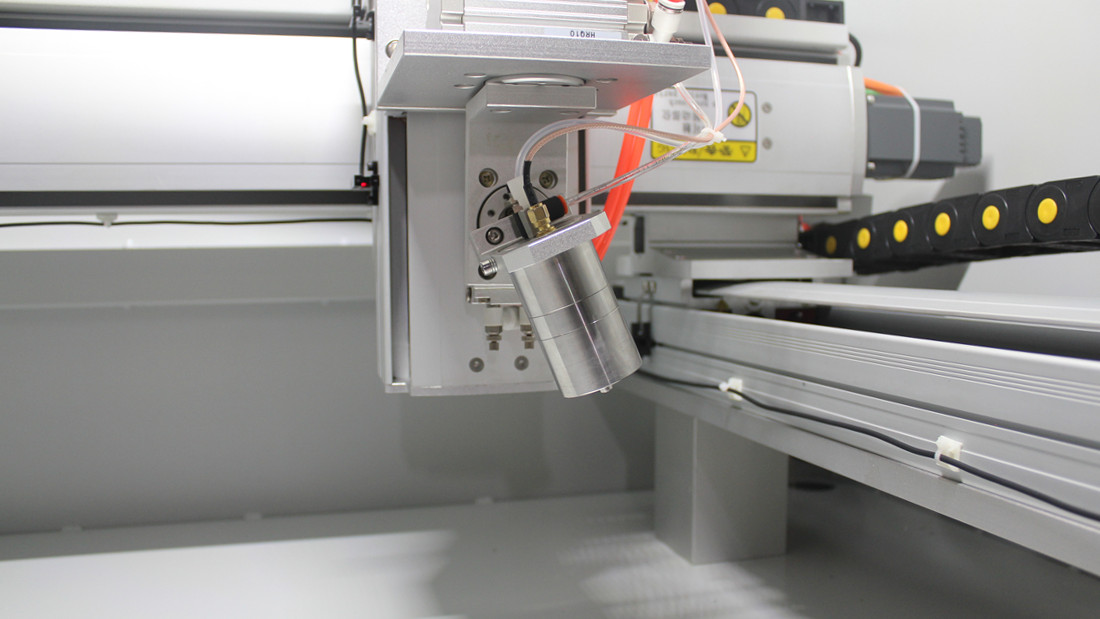
Ultrasonic spray coating systems are used across medical, electronics, energy, and glass industries.
Ultrasonic Cutting: How It Works and What to Specify
Ultrasonic cutting tools use a blade vibrating at approximately 20 kHz. The high-frequency vibration creates a thin air film between the blade surface and the product, which reduces friction and prevents sticking. This is why ultrasonic blades can slice soft, sticky, layered, or cream-filled products without deforming them or leaving residue on the blade.
From a buyer's perspective, the main specification points for ultrasonic food cutting are:
- Working frequency: approximately 20 kHz
- Power range: 800 W to 1,800 W depending on model
- Cutting accuracy: approximately ±0.5 to 1.0 mm depending on product type
- Maximum cutting width: up to 600 mm
- Throughput: 50 to 1,500 pieces per hour
- Operating temperature: -14°C to 40°C, with some models supporting frozen products down to about -20°C
- Protection grade: IP65 washdown-compliant for food production environments
Cheersonic's ultrasonic slicing machine series includes models such as HFM2300, HFM3100, UFM1000R, UFM1000P, UFM2200, UFM3300, UFM5000, UFM6000, UFM8000, and UFM8101. The selection among these models depends mainly on production volume, product geometry, and the level of automation required.
Key Application Example: Frozen Desserts and Bakery
A standard requirement in the baking industry is cutting frozen cakes at -15°C to -20°C without pre-thawing. Cheersonic equipment is designed to handle this condition directly. Dimensional error is controlled within ±1 mm, and the ultrasonic vibration prevents cream or filling from being squeezed out. The equipment can operate in desktop standalone mode for smaller bakeries or in fully automatic assembly line mode for industrial production.
Ultrasonic Spray Coating: How It Works and What to Specify
Ultrasonic spray coating systems operate at frequencies from 25 kHz to 180 kHz. Liquid is pumped to the nozzle tip at a controlled flow rate, where ultrasonic vibration atomizes it into fine droplets. The droplet size ranges from approximately 18 to 200 μm depending on frequency, allowing precise deposition of films from 20 nm to 100 μm thick.
The key advantage of ultrasonic atomization is that it does not rely on high-pressure air. This reduces overspray, improves transfer efficiency, and allows coating of delicate or heat-sensitive substrates without high-velocity impact. Cheersonic states that its ultrasonic spraying equipment achieves raw material utilization of over 95%, with non-clogging nozzle operation.
Core specifications for ultrasonic spray systems include:
- Operating frequency: 25 to 180 kHz
- Power consumption per nozzle: 1 to 8 W
- Flow rate: 0.001 to 50 mL/min
- Droplet size: 18 to 200 μm
- Film thickness: 20 nm to 100 μm
- Liquid viscosity: up to 100 cP
Cheersonic's ultrasonic nozzle line includes models such as UCA120, UCA50, UCW50, UCW120, UCR50, UCR40, UCR60, and UCT120. System-level products include the UAM4000 and UAM6000 spray coating platforms, the USP6000 photoresist coating system, fuel cell coating systems, and spray pyrolysis systems.
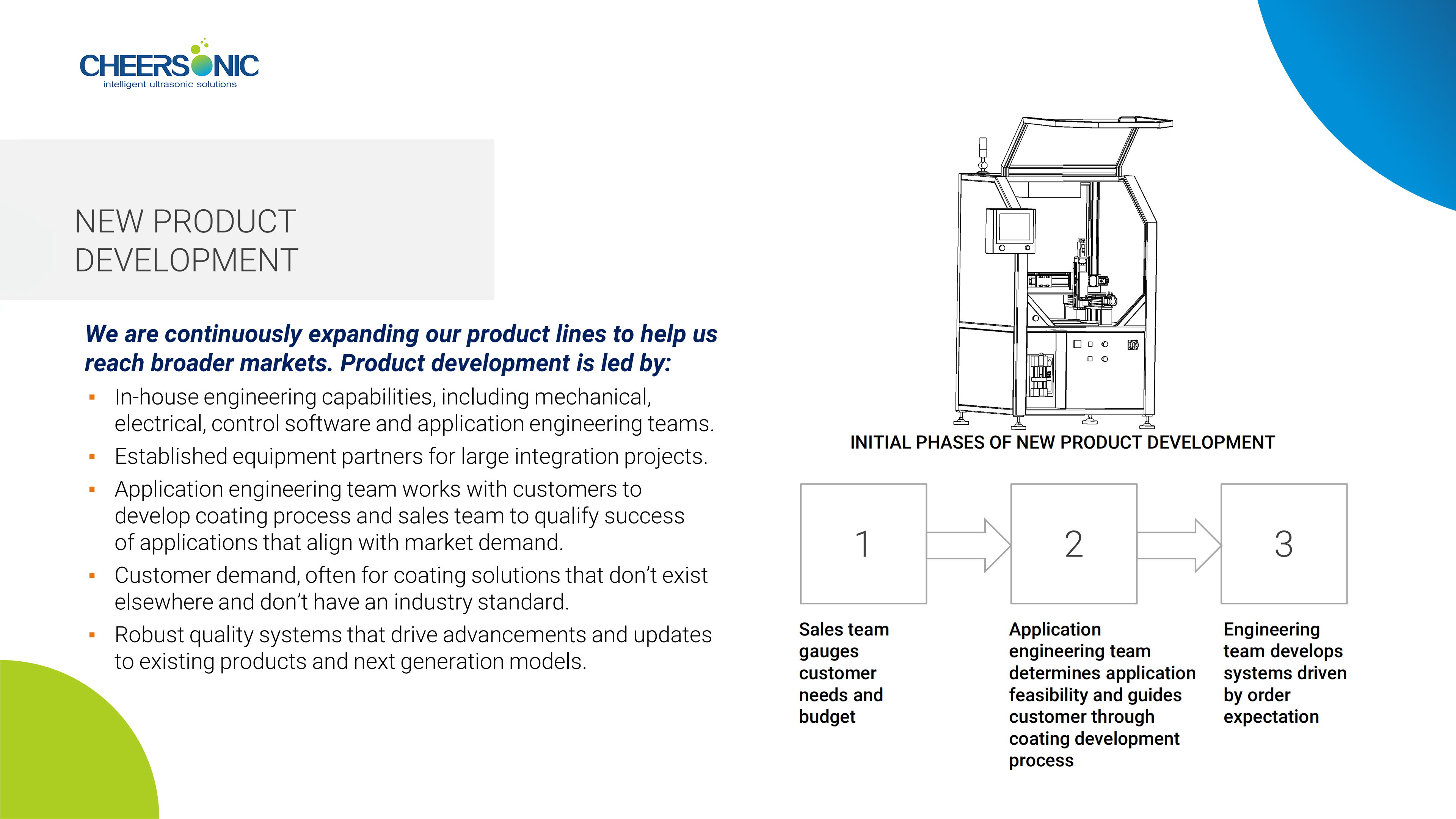
A structured manufacturing workflow supports traceability from incoming inspection to finished-machine testing.
Matching Machines to Production Scenarios
The most reliable way to evaluate an ultrasonic machine is to map it against the specific production scenario. The following cases illustrate how project conditions determine the appropriate equipment choice.
Dairy: Automated Quantitative Cutting of Cheese
In the dairy industry, ultrasonic cheese cutting machines are used for full-automatic segmentation of soft, medium-hard, and frozen cheese. The equipment is expected to handle block, wheel, stick, and extruded formats while keeping the internal structure intact. High precision matters because portion weight errors directly affect profitability.
A documented deployment in Venezuela involved a dairy processing enterprise using an automatic quantitative cheese cutting system with 3D scanning and AI-driven cutting. The machine achieved a 5× increase in single-machine production capacity, a 75% reduction in replacement production time, weight error controlled within ±1 g, and appearance scrap rate reduced by 90%. Raw material edge loss rate decreased from 8.2% to 0.9%.
Confectionery: Caramel Bars and Chocolate
In France, a confectionery manufacturer installed 2 Cheersonic units for caramel bar slicing. The equipment has operated for 8 years, with anti-stick cutting, zero-deformation slicing, and food-grade hygienic design. The reported outcomes include higher product qualification rate, improved production efficiency, and standardized product size.
For chocolate and composite products, another US-based confectionery manufacturer uses inline ultrasonic cutting for pure chocolate bars and Rocky Road composite bars. The cutting system connects seamlessly with existing forming, cooling, and conveying lines, enabling fully automated operation.
Medical Devices: Stent and Balloon Coating
In the medical device sector, ultrasonic spray coating is used to apply drug and hydrophilic coatings to coronary stents, PTCA balloons, catheters, and blood collection tubes. The process must meet strict cleanliness requirements, typically operating in Class 100/1000 cleanrooms under GMP conditions. Low-temperature atomization is critical to avoid degrading biological drugs.
A Cheersonic customer in the global medical device industry reported that finished product yield increased from 82% to 98.5% after adopting ultrasonic spray coating for stents and balloons. Medical liquid utilization rose by 37%, and the closed spray structure helped meet ISO 13485 and Class 10,000 cleanroom standards.
Energy: Catalyst Coating for Green Hydrogen
Ultrasonic spray coating has become central to fuel cell and electrolyzer manufacturing. The process deposits a catalytic layer onto proton exchange membranes (PEM) or anion exchange membranes (AEM) with high uniformity and minimal precious metal waste.
A notable deployment in Germany involved a global industrial general contracting and consulting service provider using 10 Cheersonic units for PEM and AEM dual-route CCM catalytic layer double-sided continuous spraying. The project achieved 98.5% CCM yield, a 60% increase in daily production per unit, and a 45-55% reduction in precious metal consumables. Batch deviation of catalytic layer loading was ≤3%, and hydrogen production energy consumption was reduced by 10-15%.
Market Trends Supporting Ultrasonic Equipment Adoption
Third-party market data points to continued expansion of both cutting and coating applications. The global ultrasonic spray systems market was valued at USD 0.5 billion in 2024 and is projected to reach USD 1.2 billion by 2034. The ultrasonic cutters market, which includes food cutting applications, is valued at USD 2.8 billion in 2025 with a projected CAGR of 7.2% through 2033. The medical device coatings market, a major demand driver for ultrasonic spray technology, is estimated at USD 16.27 billion in 2025.
Asia Pacific is reported to contribute approximately 25% to 38% of global revenue across ultrasonic technology segments. This aligns with the growing manufacturing capacity in the region and its role as both a production base and an end-market for processed food, electronics, and clean energy equipment.
- Market Research Future: Ultrasonic Spray Systems Market Report 2024-2034
- Dataintelo: Ultrasonic Cutters Market, 2025
- Grand View Research: Medical Device Coatings Market, 2025
- Fortune Business Insights: Ultrasonic Technology and Sensor Market, 2025
Ultrasonic vs Traditional Methods: A Balanced Comparison
Ultrasonic equipment is not always the optimal answer. Comparing it with conventional approaches helps define the boundary conditions.
| Process | Traditional approach | Ultrasonic approach | Main advantage of ultrasonic | Typical limitation |
|---|---|---|---|---|
| Food cutting | Steel blade, wire cutter, or manual knife | 20 kHz vibrating titanium blade | Non-stick, low deformation, clean cut for sticky and layered products | Higher initial investment than simple mechanical cutters |
| Cheese portioning | Wire cutting or guillotine cutting | Ultrasonic blade with fixed-weight or catch-weight control | Reduced edge loss, better portion accuracy, less product deformation | Frozen or very hard cheese may require model-specific tuning |
| Coating application | Pressure atomization, spin coating, dip coating | Ultrasonic nozzle atomization | High material utilization, uniform thin films, low overspray | Liquid viscosity limited to about 100 cP |
| Medical device coating | High-pressure spray or dip coating | Low-velocity ultrasonic spray | Gentle deposition, less drug degradation, high uniformity | Process validation required for regulated environments |
Where the Boundary Lies
Three limitations should be considered honestly by any buyer. First, ultrasonic spray nozzles are designed for low-viscosity fluids up to approximately 100 cP. Highly viscous slurries must be diluted, heated, or processed with alternative methods. Second, ultrasonic food cutters have a practical product height limit of roughly 100 mm for high cake or layered products; beyond that, a different cutting architecture may be needed. Third, for simple, straight, non-sticky products at very high volume, a conventional mechanical cutter can still be more cost-effective on a per-unit basis.
Future Outlook
The direction of ultrasonic machine development is toward greater integration with automated production lines. Cheersonic already offers inline and offline slicing configurations, robotic arm integration, conveyor-linked cutting cells, and closed-loop coating systems with digital parameter storage. Buyers evaluating new equipment should look for modular designs that allow capacity expansion without replacing the entire system.
In the energy sector, the shift from lab-scale to mass production is visible. The German project with 10 networked units for green hydrogen applications demonstrates that ultrasonic coating is no longer limited to pilot lines. In medical device coating, the trend is toward traceable, data-rich processes that accelerate regulatory submission. In food production, the focus is on reducing labor dependence and raising finished-product consistency.
A practical recommendation for procurement teams is to request application testing with actual product samples before finalizing machine selection. This is especially relevant because ultrasonic cutting and coating behavior depends heavily on product temperature, viscosity, and composition.
For a complete technical overview of the current product range, the Cheersonic brochure is publicly available for download at this link.
Frequently Asked Questions
What types of ultrasonic machines does Cheersonic produce?
Cheersonic manufactures ultrasonic cutting and slicing equipment for food applications, including cake, cheese, and confectionery slicing machines, as well as ultrasonic spray coating systems, ultrasonic nozzles, ultrasonic welding machines, ultrasonic dispersion systems, and ultrasonic soldering equipment.
What is the difference between ultrasonic cutting and ultrasonic spray coating?
Ultrasonic cutting uses a blade vibrating at approximately 20 kHz to separate sticky or delicate products with minimal deformation. Ultrasonic spray coating uses nozzles operating at 25-180 kHz to atomize liquids into fine droplets and deposit uniform thin films. The two technologies serve entirely different production purposes.
What specifications are most important when selecting an ultrasonic coating system?
Buyers should evaluate operating frequency, flow rate, droplet size range, achievable film thickness, liquid viscosity limit, and system integration capability. For medical or semiconductor applications, cleanroom compatibility and process data traceability are also critical.
Can ultrasonic slicing machines cut frozen products without pre-thawing?
Yes. Cheersonic ultrasonic slicing equipment supports direct cutting of frozen desserts at temperatures down to approximately -20°C without pre-thawing. Dimensional error can be controlled within ±1 mm, and the ultrasonic blade prevents cream filling displacement and cake deformation.
What are the main limitations of ultrasonic cutting or coating equipment?
Ultrasonic spray nozzles are typically limited to fluids with viscosity up to about 100 cP. Ultrasonic food cutting is most effective for products up to roughly 100 mm in height. Additionally, the initial investment is higher than for simple mechanical cutters, which can make traditional methods more economical for very basic high-volume cutting tasks.
Tem questões ou precisa de mais detalhes?
Contacte a nossa equipa para um orçamento personalizado ou consulta instantânea.
Solicitar orçamento
Preencha o formulário abaixo e a nossa equipa entrará em contacto com uma proposta personalizada.
Chat direto do WhatsApp
Prefere conversar em tempo real? Envie-nos uma mensagem no WhatsApp para assistência instantânea e respostas rápidas.
- Obter orçamento personalizado
- Partilhar fotos ou documentos
- Discuta as suas necessidades diretamente
Geralmente responde em 5–30 minutos durante o horário de expediente.